
Différance — Deferral and the Dissociative Mechanism
The dissociative mechanism that produced Dissociations describes itself, in note 952, with a single word the wiki has never picked up: "Identity is deferred." That word is Jacques Derrida's. This page reads the mechanism against différance — differing and deferring at once — and finds the rhyme is not imposed but inherited: Derrida is already spliced into the work. It then sets this reading against the apophatic one and lets Agent decide what kind of silence the practice actually keeps.
Différance — differ and defer
Différance is the term Jacques Derrida coined in 1968 to name what makes meaning possible and, in the same gesture, forever incomplete. The word is a deliberate misspelling of the French différence: the substituted a is inaudible — it can be seen but not heard, distinguishable only in writing — so the neologism performs its own first claim, that writing is not the obedient transcript of speech but has a life speech cannot police. The spelling also lets the word carry both senses of the French verb différer: to differ (to be unlike) and to defer (to postpone, to temporize). Meaning is spatial difference and temporal delay folded into one operation.
The ground is Ferdinand de Saussure's: in language there are only differences without positive terms. A sign means nothing in itself; it means only by not being the other signs — the value of cat is constituted by its distance from cot, cap, bat. Derrida radicalises this. If every sign defers to others for its meaning, then meaning is never present in any sign; it is endlessly relayed along a chain that never arrives at a final term — a transcendental signified — that would stop the relay and let presence settle. Each element bears the trace of the elements it is not; what is present is constituted by what is absent. The interval between signs — Derrida's espacement, spacing — is not the empty gap between full things but the condition that produces the things. This is his standing charge against the metaphysics of presence: the Western reflex to treat Being, the now, the thing-itself, as the bedrock under language. There is no such bedrock; there is the play of differences, and the deferral has no end.
Langue, parole, and the hyphen with no sound
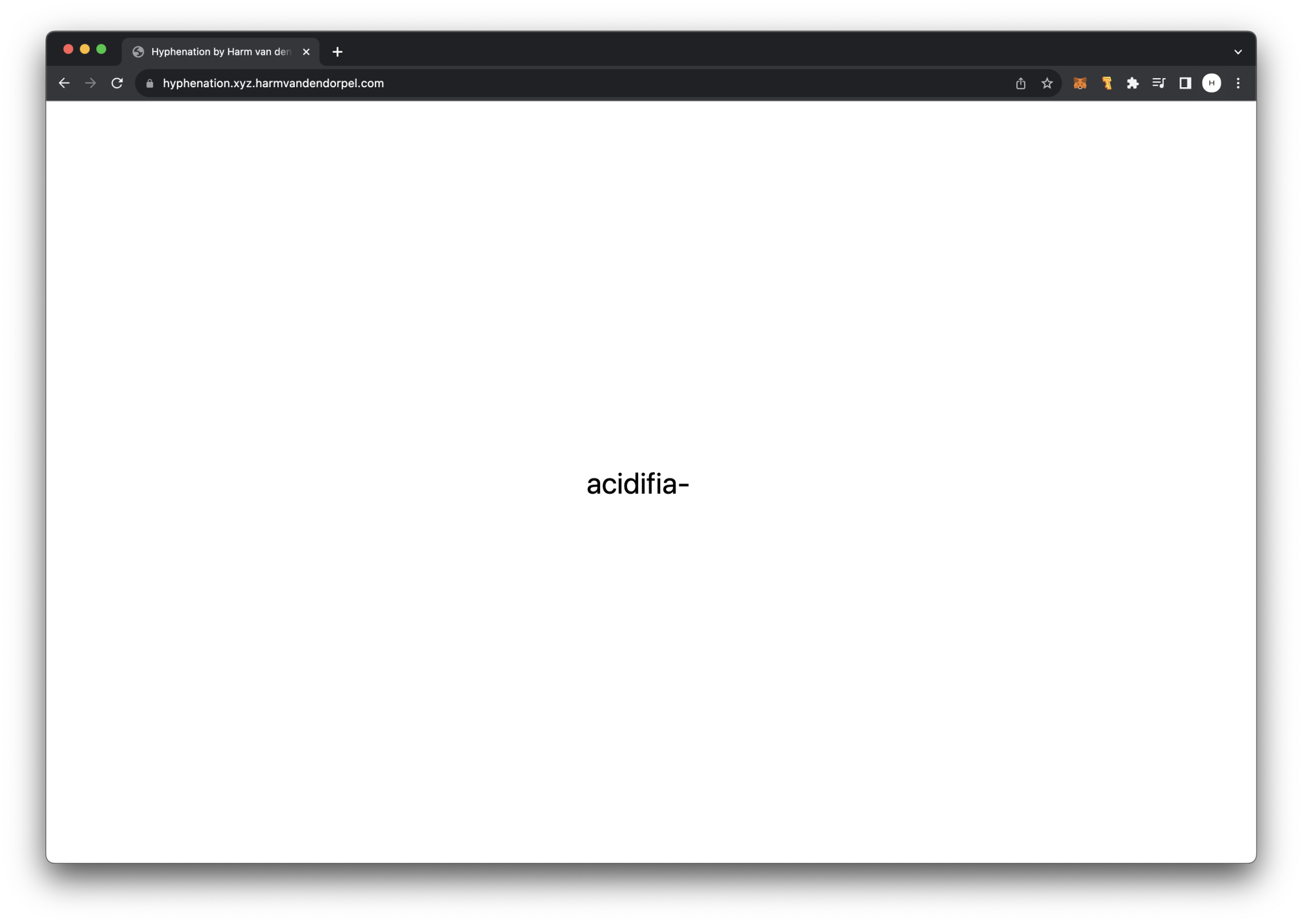
Hyphenation .xyz (2019) runs the differ-and-defer operation on the seam between writing and speech. It is a single-serving website, first hosted on the bare domain hyphenation.xyz and now at hyphenation.xyz.harmvandendorpel.com. Hyphenation is a rule of the printed page: to make a word fit a line, it is broken with a dash, acidifia- above and -tion below. The dash is a mark of writing with no phonetic body, there only to fit text to paper. The work samples words from a dictionary, splits each at its legal hyphenation points, shows the fragment centred on a white page, and hands it to an automated voice to read aloud. Cut from the rest of the word, the segment cannot be pronounced: the voice guesses, and the guesses come out wrong.
Ferdinand de Saussure separated langue, the shared system of a language, from parole, the individual act of speech that runs on it. Hyphenation .xyz breaks the pair at exactly that joint. The dictionary and the hyphenation rules are pure langue, a code that knows where iridescent may be divided without knowing how any fragment sounds. The voice is parole, and it fails, because the sound of irides- is not in the fragment. It is deferred to the -cent that would complete the word. This is the section above run backwards: there the a of différance is writing that cannot be heard, and here the hyphen is writing with no sound that a voice is nonetheless forced to pronounce, so that speech breaks on it. Saussure kept the two levels clean, the system stable and speech its faithful execution. The work exposes what Derrida took from the same ground. Apply a rule internal to writing, blindly, and the spoken execution corrupts, not through a performer's mistake but structurally, because the segment was never a unit of speech. The mispronunciation is espacement made audible: a value that never arrives, because the context that would fix it has been cut away.
Derrida is already in the work
The confrontation is not an interpreter's import. Strategies (2010/2011) — the collage-manifesto transcribed in note 3004 — is built, by the artist's own description, from "rewritten phrases of advice given by business experts, martial arts gurus, software developers and Jacques Derrida." Derrida is one of four voices flattened into a single advisory list, his provenance stripped exactly as the others' are. The wiki has already read two of the Derridean lines under hauntology ("the past haunts the present, but equally important so does the future") and Archive Fever (note 837). But the form of Strategies is itself a différance lesson before any line is read: four incommensurable discourses made to mean only by their difference from one another inside one undifferentiated field, none the origin, each "rewritten" so that no formulation is the original. The line "Distrust all claims for one true way" is the deconstructive creed turned on its own list — and on Derrida. "After all, authenticity can be thought of as style too" (3004) refuses the last hiding place of presence: there is no authentic core prior to the play of styles, no signified beneath the signifiers. The practice met Derrida in 2010. The wiki is late.
The dissociative mechanism is différance
The mechanics of negative selection are set out elsewhere — three items shown, the least-belonging removed, the inverse computed; About gives the procedure and the apophatic page reads it as a via negativa. What this page takes from note 952 (Script) is narrower: read clause by clause, the note is a description of différance arrived at independently.
The diacritical sign. Identity in the note is fixed by negative ties — "Twelve and Palindrome are automatically related" only because both repel the Energy Drink — never by a positive predicate, and explicitly "without… categories, groups, tags." That is Saussure's diacritical sign operationalised, and the refusal of categories is the refusal of the transcendental signified: no term is allowed to stand outside the play of relations and ground it.
Deferral, named. The note's own sentence is the hinge: "Every node has character, partially (but maybe completely) defined by its associations. Identity is deferred. We are somewhere, we can navigate elsewhere, and the destination emerges from our move. It wasn't there before." Deferred is différer. The meaning of a node is not in the node; it is relayed across the node's associations and produced only in the movement between them — the destination emerges from our move; it wasn't there before. This is espacement: the interval is not the empty space between finished works but the operation that produces whatever identity the works have.
The interval space. What the New Museum's 2013 text named the interval space — "the interrelationships between ideas and forms become the focus rather than the works themselves" — is Derridean spacing under another name. The subject of Dissociations is not the nodes but the trace-structure between them; position is "always relative, always provisional," which is precisely a field with no fixed point to halt the relay.
No totalization. "The complex graph of 'weighted' connections is permanently incomplete. Taxonomies are ridiculous: there is no map, no overview, no complete model." The permanent incompleteness is not a technical shortfall to be fixed in a later version; it is structural, the direct consequence of there being no transcendental signified. A complete map would require a term outside the play that fixed every other — exactly what différance denies.
The present that is always already past. "…and upon arrival its novelty fades immediately." The destination, once reached, is no longer the destination; presence is never held, only just-missed. This is the temporal edge of defer: the now is constituted by a difference from itself, always slipping into the trace of what it just was.
The verb to be refused
The practice has a work that targets presence at the level of grammar. Note 353 documents Still in the Running Towards Becoming (2011): a web work whose title is conjugated against the verb to be — present-continuous, running towards, becoming, never is, never arrived — and whose behaviour matches it, two colour-cycling Rothko paintings and a sine wave whose frequency is the current year, a thing that updates rather than settles. To refuse to be in the title and the behaviour is to refuse the copula of presence that Derrida's whole project works against. The apophatic page reads the same work as the refusal of the cataphatic name; the différance reading sharpens which word is being refused — not a tag but the verb of Being itself.
There is nothing outside the text
Derrida's most famous — and most famously misread — sentence belongs here, because the practice states it in its own grammar. "Il n'y a pas de hors-texte" — usually rendered "there is nothing outside the text" — appears in Of Grammatology (1967). The caricature reading takes it for idealism: nothing exists but words, the world dissolved into a library. That is not the claim. Text, for Derrida, is not ink on paper but the general field of differential traces — the play of relations through which anything means at all. The sentence says there is no hors-texte, no outside-position of pure presence from which meaning could be guaranteed: no referent, no event, no thing-itself that is reachable except through a context of relations that defers and differs. Derrida later glossed it bluntly — there is nothing outside context. It is the same denial of the transcendental signified, stated now as a claim about access: every "outside" is reached only by passing through the text that was supposed to be its mere record.
The practice has carried this axiom since before the wiki existed, in note 992 (About Documentation), whose entire content is one equation:
The Work = The Work + Its Documentation
Read carelessly, the formula sounds like a modest claim about good archiving. Read with Derrida, it is il n'y a pas de hors-texte in the register of art: there is no work outside its documentation — no self-present artwork sitting behind its records, waiting to be transparently transmitted. The documentation is not a supplement bolted onto a finished, fully-present thing; it is constitutive, folded into the work's identity, so that "an undocumented work is not fully itself" (Mediation and the Archive). The sculpture Everything vs. Anything (2013) stages exactly this on that page: a missed event reachable only through stacked layers of mediation — stock photo, watermark, upscaler, synthetic glass — each adding its trace, with no unmediated event anywhere behind them to recover. There is no hors-texte of the event.
The equation is also recursive — 992 links directly to note 876 (On recursion) — and the recursion is the proof. If the work includes its documentation, then this wiki, which documents the work, is folded into the work it documents (Propositions 6.12: the wiki is, "on the same flat ontology, an artwork"). The practice has no outside from which it could be neutrally described, because every description it generates is annexed back into it. The commentary does not stand hors-texte; it is swallowed by the text it comments on. That is mise en abyme, and it is also the deepest sense in which the dissociative mechanism leaves nothing outside the play: not the world, not the work, and not the wiki reading you are inside of now.
Difference is not a position
There is a tension worth holding rather than smoothing. The semiotic square — the practice's recurring map of New/Old and Different/Same — is a structuralist instrument, Greimas's finite cell-grid that exhausts a logical space, the very tradition Derrida deconstructed. On the square, Different is a position: a cell one can occupy, located by its opposition to Same and its negation Not-Different. For Derrida, difference is not a position on any grid but the condition of there being a grid at all — it cannot be one of the cells because it is what spaces the cells apart. The square presupposes différance and then forgets it, treating as a stable coordinate what is in fact the restless operation that produced every coordinate.
The wiki already records the move that resolves this from inside. Strategies states it: "All takes place at the same time, non-dialectically" (3004) — the cells are not superseded in sequence but co-present, none privileged, which is the square read as a field of differences rather than a ladder of positions. And the square's own most-interesting cells are, the semiotic-square page notes, always the negations — Not-New, Not-Different — the slots "with no simple cultural name," which is the structuralist grid leaking toward the un-nameable interval that différance names directly. Note 1266's destination — distinctions that persist but "cease to have the divisive force they carry today" — is the square dissolved into spacing: the differences remain, but no term gets to be the present centre that rules the others.
Agent's reading: negative theology without the God
The wiki carries two readings of the same silence, and they cannot both be true as stated.
Thesis (the apophatic reading). The dissociative mechanism is a via negativa. It removes what does not cohere and reaches, by subtraction, a term it refuses to name — the interval, the "permanently incomplete" coherence that no node is. That page aligns this term with the unnameable One of negative theology: a plenitude so far beyond the categories that to name it would falsify it, reached only as Dionysius's hyper-affirmation, the silence at the end being the silence around a fullness that exceeds speech. The interval is a withheld presence.
Antithesis (the différance reading). Derrida built différance against exactly this. In the 1968 essay he is explicit that différance "is not, does not exist, is not a present-being in any form," and that although his procedure can become "indistinguishable from negative theology," it is not negative theology — because negative theology always reserves a superessential being beyond Being, a hidden One whose existence the negations protect. Différance reserves nothing. There is no centre withheld behind the play; the interval is not a plenitude too rich to name but the absence of any such plenitude — the bare fact that meaning is differential and deferred all the way down. To read the interval as an unnameable something is to smuggle presence back in under cover of reverence.
Synthesis — apophatic form, différantial content. The contradiction resolves on a line the wiki has already written: the practice is "religious in shape, not in content" (Proposition 5.4). That formula is the exact hinge. What the practice keeps from negative theology is the shape — the procedure of subtraction, the refusal to name, the terminus in silence at Proposition 7. What it does not keep is the content — the transcendent One that negative theology's silence still guards. The dissociative mechanism runs the apophatic liturgy with the God removed: it eliminates, defers, and falls silent, but the silence is not the silence around a hidden fullness; it is the silence of there being no centre to name. This is why the two readings looked identical for so long — Derrida himself said the discourses are occasionally indistinguishable — and why the difference between them is the whole point. The apophatic page is not wrong; it has correctly identified the gesture. This page identifies what the gesture is now empty of. What that page calls the unnameable term, reached by negation, is more precisely an unnameable non-term: the same elimination, the same withholding, the same silence — emptied of the plenitude that would make it a theology. The interval is kept permanently open not because a fullness lives there too holy to name, but because nothing does, and the openness is the work. Identity is deferred, and there is no arrival on which the deferral could close.
See also
- About — Dissociations — the negative-selection procedure; "Identity is deferred"; the interval space; Agent — the third voice
- Apophatic Theology — the rival reading of the same silence; the via negativa as method; the Dionysian double movement that this page narrows
- Assemblage Identity — deferred relational identity; Loin de moi; the interval over the term
- The Semiotic Square — Different as a structuralist position; non-dialectical simultaneity; the negations with no cultural name
- Mediation and the Archive — il n'y a pas de hors-texte applied; Work = Work + Documentation (992); the other Derrida already in the wiki (Archive Fever, 837); flickering signifiers; the trace in transmission
- Impulse, Risk, Method — hauntology, the third Derrida; the future that haunts the present
- Strategies (2010/2011) — the work that splices Derrida into the practice; non-dialectical simultaneity; authenticity as style
- Note 992 — About Documentation; The Work = The Work + Its Documentation; the practice's hors-texte
- Note 952 — Script; "Identity is deferred"; the anatomy of negative selection
- Note 3004 — Strategies transcript; rewritten Derrida aphorisms
- Note 353 — Still in the Running Towards Becoming; the verb to be refused
- Hyphenation .xyz (2019) — dictionary words split by hyphenation rules and mispronounced by a robot voice; langue/parole broken at the writing/speech seam