
Software
Software is the harm.work collection of van den Dorpel's software editions. Its text reads: "Selected editions of generative animations. Artworks were offered in collaborations with left gallery, Upstream Gallery, and Lohaus Sominsky. Some of these were acquired by institutional art collections such as the ZKM Karlsruhe and the Kadist Foundation." It lists 126 tokens for ten works, made between 2008 and 2024 and tokenised between 2021 and 2026. A hundred of the tokens are one screensaver, Temporality is.
The token metadata keeps saying the same few things about these works: "duration infinite", "never repeats itself", "dimensions variable", "silent", "not interactive". A token here points to a program that keeps running, often at its own web address, and seldom to a file that can be looked at once. The still images have their own collection, JPGs (→ Small Collections).
| Work | Made | Editions on harm.work | Offered through |
|---|---|---|---|
| White Rectangle | 2008, remade 2024 | 1 (minted 2026) | independent |
| Transplant | 2015 | 2 + AP | independent |
| Death Imitates Language Autobreeder (master edition) | 2016 | 1 + AP | Upstream Gallery |
| Algues Artificielles | 2017 | 5 | Upstream Gallery |
| Nested Exchange | 2018 | 1 + AP | Upstream Gallery |
| Temporality is | 2020 | 100 | left gallery |
| Mutant Garden Autobreeder | 2021 | 3 | Upstream Gallery |
| Fernand | 2022 | 5 | Upstream Gallery |
| Breezy Doozy | 2012, reworked 2022 | 1 | Grails |
| Pression des pairs | 2024 | 3 + AP | DAM Gallery, Lohaus Sominsky |
White Rectangle (2008)
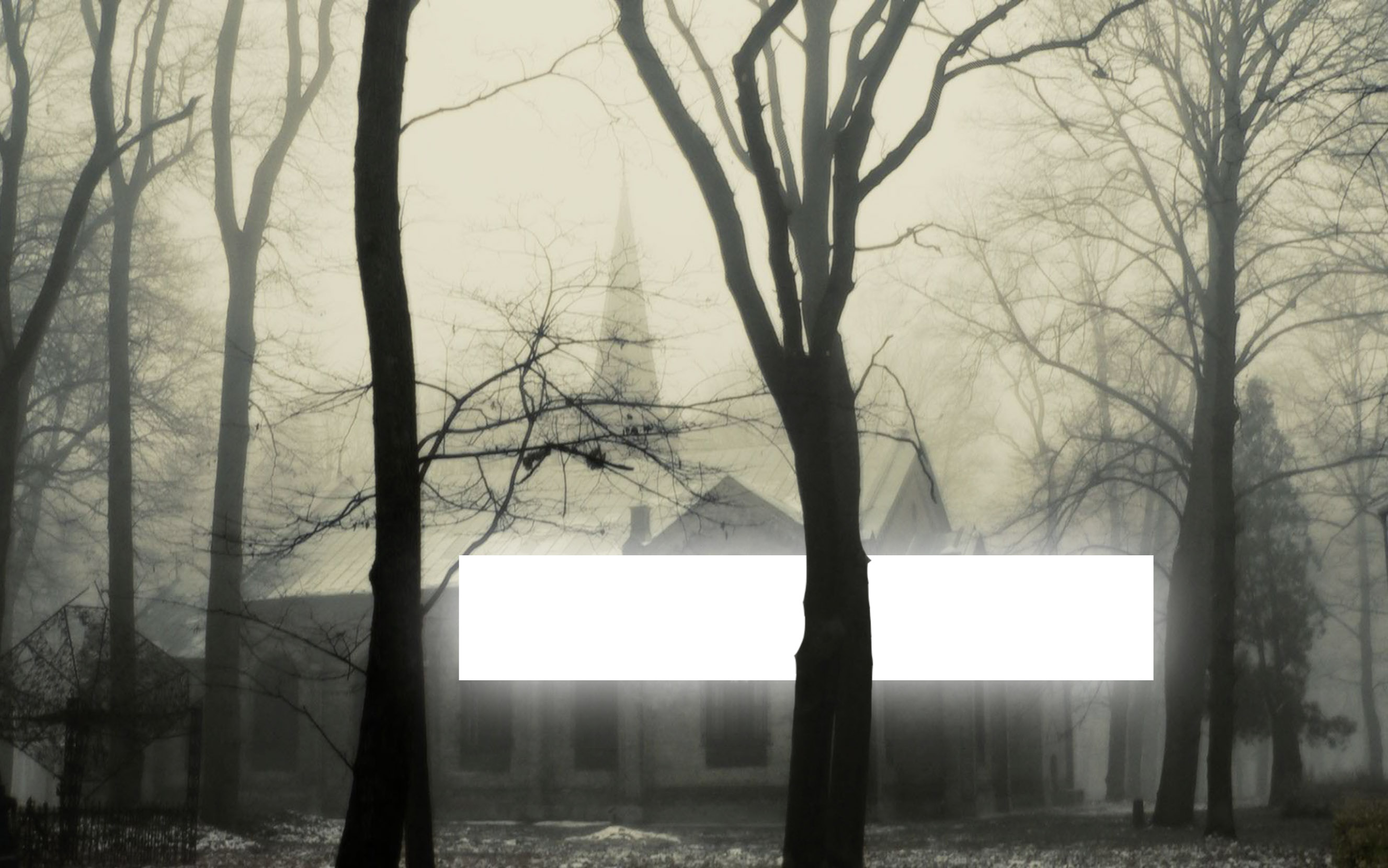
White Rectangle was a Flash animation of 2008. harm.work lists a "2024 remake of the 2008 Flash animation using HTML + CSS", and the token calls itself "a remake of a 2008 Flash animation, minted in 2026". The whole page is stored in the token as one HTML file with its images embedded. The scene is a misty photograph of bare trees with a church spire behind them. A white bar, half as wide as the picture and blurred at its edges by a glow, slides from left to right and back in ten seconds. One tree trunk has been cut out of the photograph and laid over the bar, so the flat white shape passes behind it, inside the depth of the photo.
The Flash works and their afterlife are discussed on Mediation and the Archive; another Flash work of 2008, Field, was rebuilt for the chain in 2023 (→ Field).
Transplant (2015)
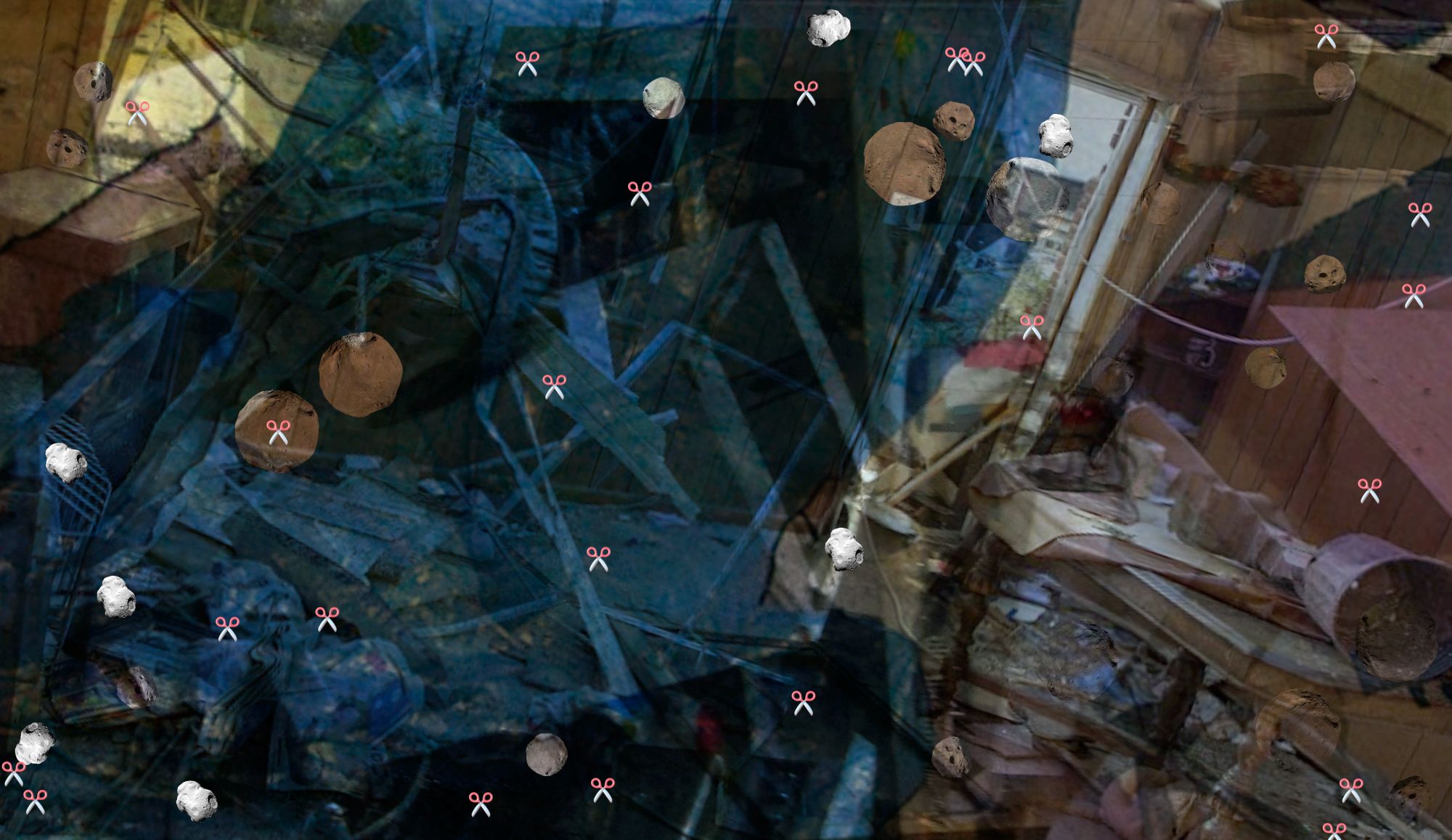
Transplant is a website, still online at transplant.harmvandendorpel.com, with "Music by Bill Kouligas (12 min)" (token text). A click starts the soundtrack and a scripted sequence that advances one step per second. The script, readable in the page's code, draws on 56 found image files. Background photographs turn slowly and give way to one another; cut-out shapes, asteroids, knots, a feather, a lens, a drone, a loading spinner, drift across them as bodies in a physics simulation, colliding with each other and bouncing off the edges of the window, and the viewer can drag them. Emoji (✂️ 🔓 🔒 🔗 🚩 💡 💀) appear in swarms of up to thirty. Comments in the code name the sections: "living room trash asteroids"; "ingewanden, kabels, rhunes, knopen" (Dutch: entrails, cables, runes, knots); "networks, corporate design, schema"; "ghosts, nerves, retina"; "drones, desert"; "watermarks, spinner". The token image is one moment of the first section: photographs of cluttered interiors, wooden debris, a window, a table, partly tinted blue, with cut-out stones and scissors emoji across them. It was issued in two editions and an artist's proof, under a Creative Commons licence (CC BY-NC-ND 4.0). Kouligas, who runs the label PAN, worked with van den Dorpel again on Lexachast (→ Lexachast).
Death Imitates Language Autobreeder (2016)
The master edition of Autobreeder: "This fullscreen software autosurfs the massive genealogy of the 'death imitates language' project, containing the entire population, bred by a genetic algorithm, and selected by micro-feedback of the artist", followed by "offline, duration infinite, not interactive, silent". Edition 1/1 and the proof were offered with Upstream Gallery. The collection Autobreeder (lite) draws on the same genealogy; the series is on Death Imitates Language.
Algues Artificielles (2017) and Nested Exchange (2018)
Five editions of the Algues Artificielles software (1/5 to 5/5) carry the artist's account of the summer of 2016 in Brittany, the seaweed curves and the breeding by feedback (→ Algues Artificielles). They run at algues-artificielles.harmvandendorpel.com.
Nested Exchange (2018), one edition and a proof, runs at exchange.harmvandendorpel.com. Its token text: "The specimens rendered by this software are configured in nested recursive 'tree' structures similar to those used in the first iterations of Chomskyan linguistics. (…) in the work no new information - per se - is produced, but existing information is recombined toward an optimally diverse distribution. The nest is a kind of open and closed system at once, recursive, and, therefore, functionally infinite, but also radically constrained. The system records its changes between states as 'snapshots', leaving a complete history of itself in a manner similar to a blockchain ledger." The series Nested Exchange is discussed on The Grid and Protocol, Taste, and Systems.
Temporality is (2020)
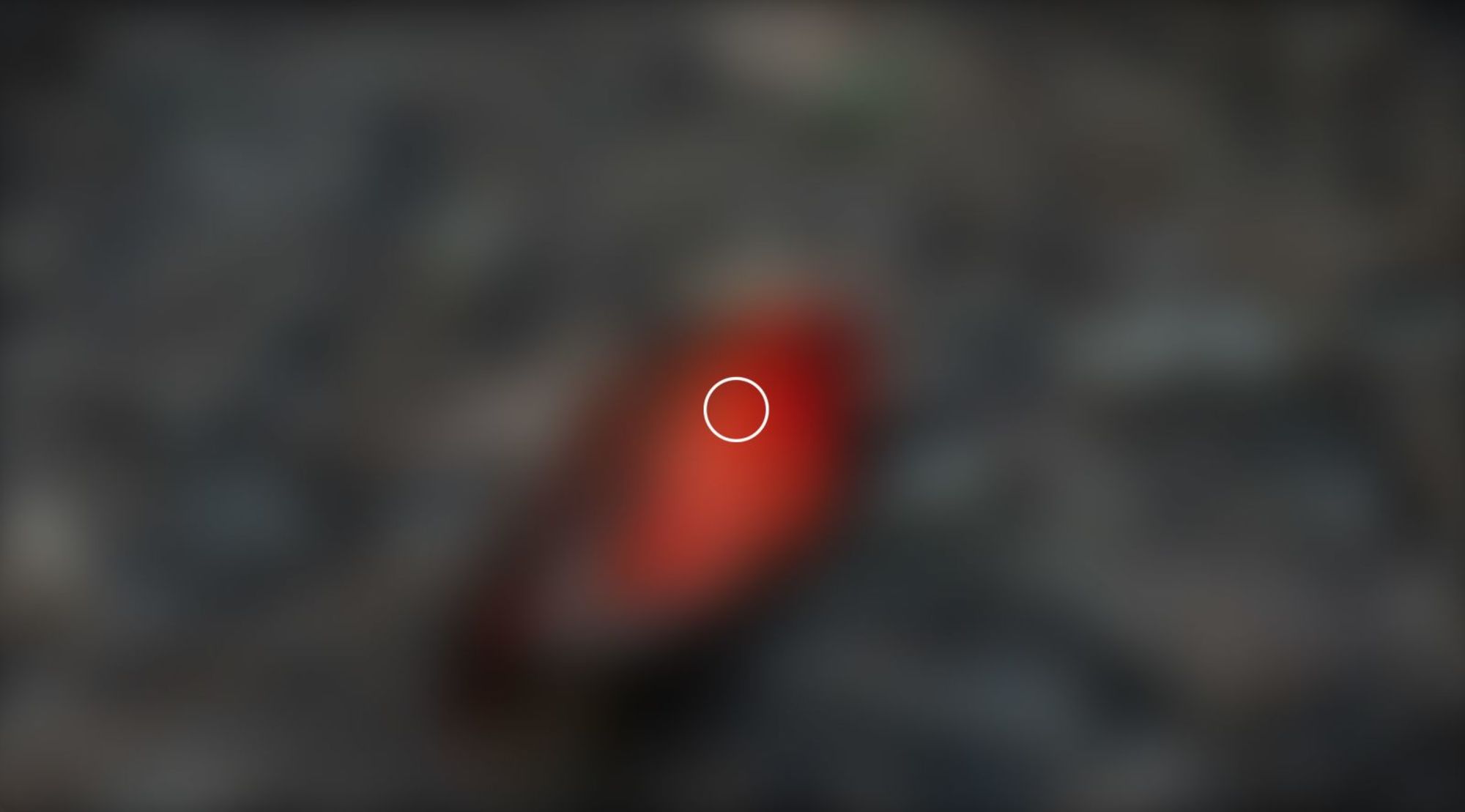
Temporality is is a screensaver for macOS, sold through left gallery in an edition of 100. It needs an internet connection: it fetches newly uploaded photographs from photo-sharing sites, blurs each one and shows it for a random number of seconds, with a thin white circle in the middle. The token quotes a text by Terence Sharpe: the work "uses Gaussian smoothing, a function used in noise reduction for digital images, and a frozen loading spinner, to adorn live uploaded images scraped from photo sharing sites. (…) The blurring effect and static circle emulate a frozen moment in time, eliciting a sense of disruption in the viewer waiting for the theatricality that has become standard in UX culture. The work renders the mundane as a digital artefact without opulence but with an almost unnerving sense of pause in time that requires a still appreciation of a moment where nothing happens."
The circle is the sign of an interface waiting for data, and here it never turns. The loading spinner had been his material before: Field (2008) is a grid of them (→ Field). The screensaver form goes back to Event Listeners (2015), the screensaver the MAK Vienna bought for Bitcoin (→ Event Listeners, left gallery).
Mutant Garden Autobreeder (2021)
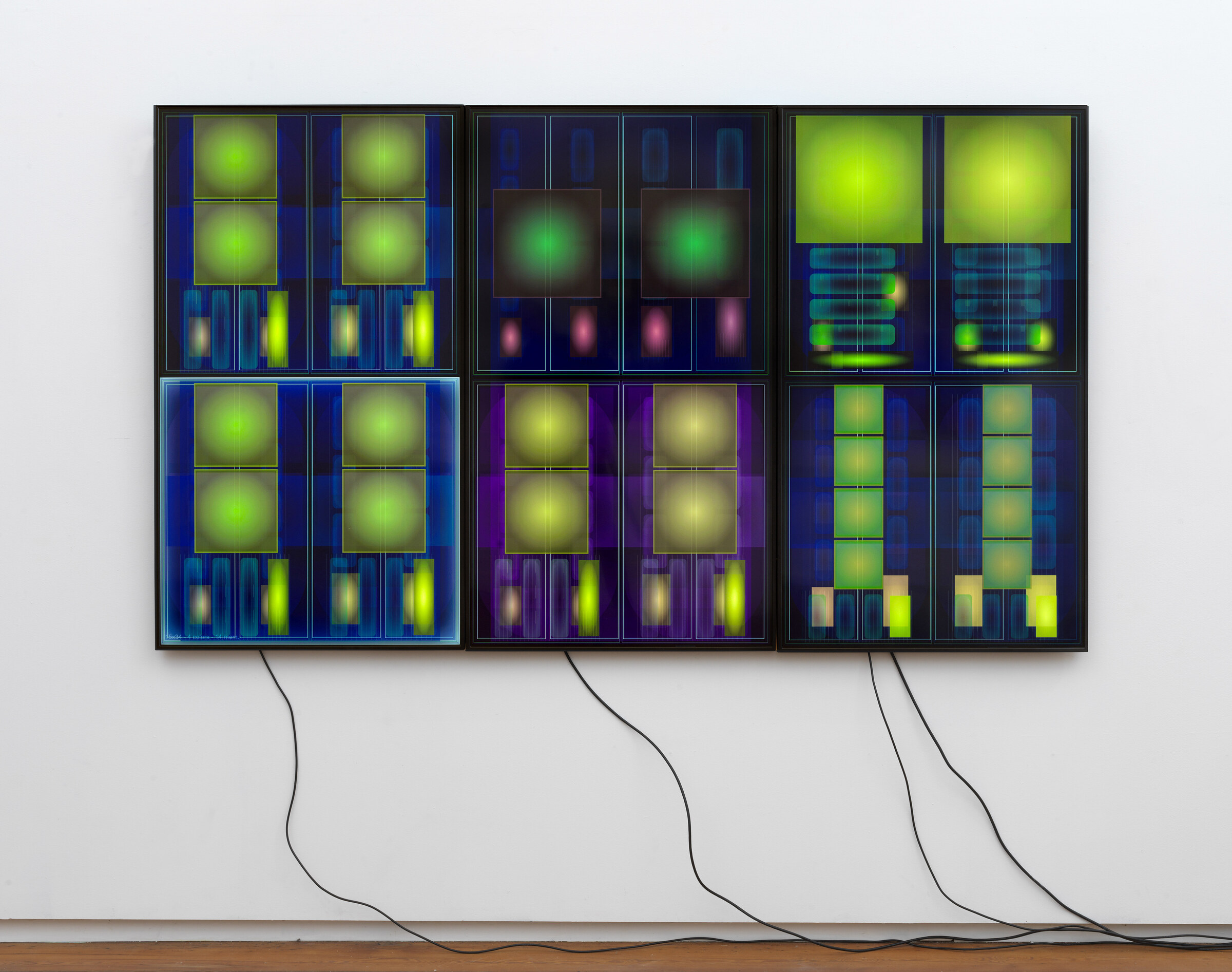
Mutant Garden Autobreeder is "a computer app" and, by its token text, "the centerpiece of Harm van den Dorpel's solo exhibition Mutant Garden at Upstream Gallery in Amsterdam, 2021. A generative animation artwork, based on evolutionary programming, which never repeats itself. The amount of rows and columns is configurable. Dimensions variable, duration infinite, silent." It was issued in three editions. In the photograph it runs on three screens hung side by side, their cables falling to the floor, each split into a grid of cells in which green and yellow squares glow against dark blue. The breeding is described on Evolutionary Logic and the forms on The Squircle.
Fernand (2022)
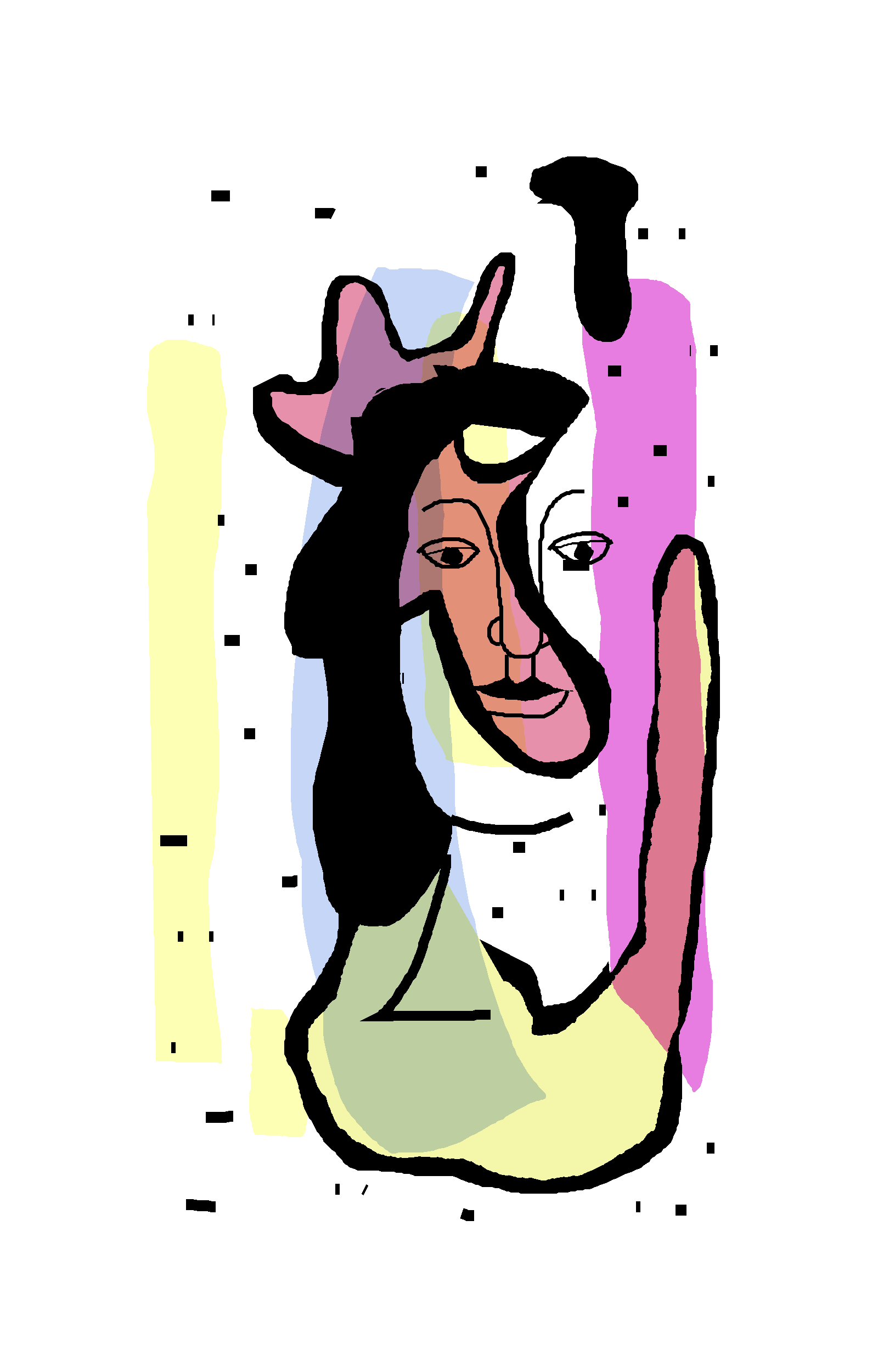
Fernand: "Twenty-five drawings, each based on a work by Fernand Léger, drawn with a laptop touchpad, overlapping in time, in ever changing order." harm.work adds that it "was commissioned by the Triton Foundation Collection, in collaboration with Upstream Gallery. Premiered at the Kröller Müller museum alongside original paintings by Léger." Five editions (65 to 69) run at fernand.harm.work. The still of the fifth shows a face with a long nose in a thick black line, Léger's contour, over flat fields of pink, yellow, pale green and blue, with a hand raised at the right. The software descends from Monaco Mix (2016); both are discussed on Meditative Labour under the recorded gesture.
Breezy Doozy (2022)
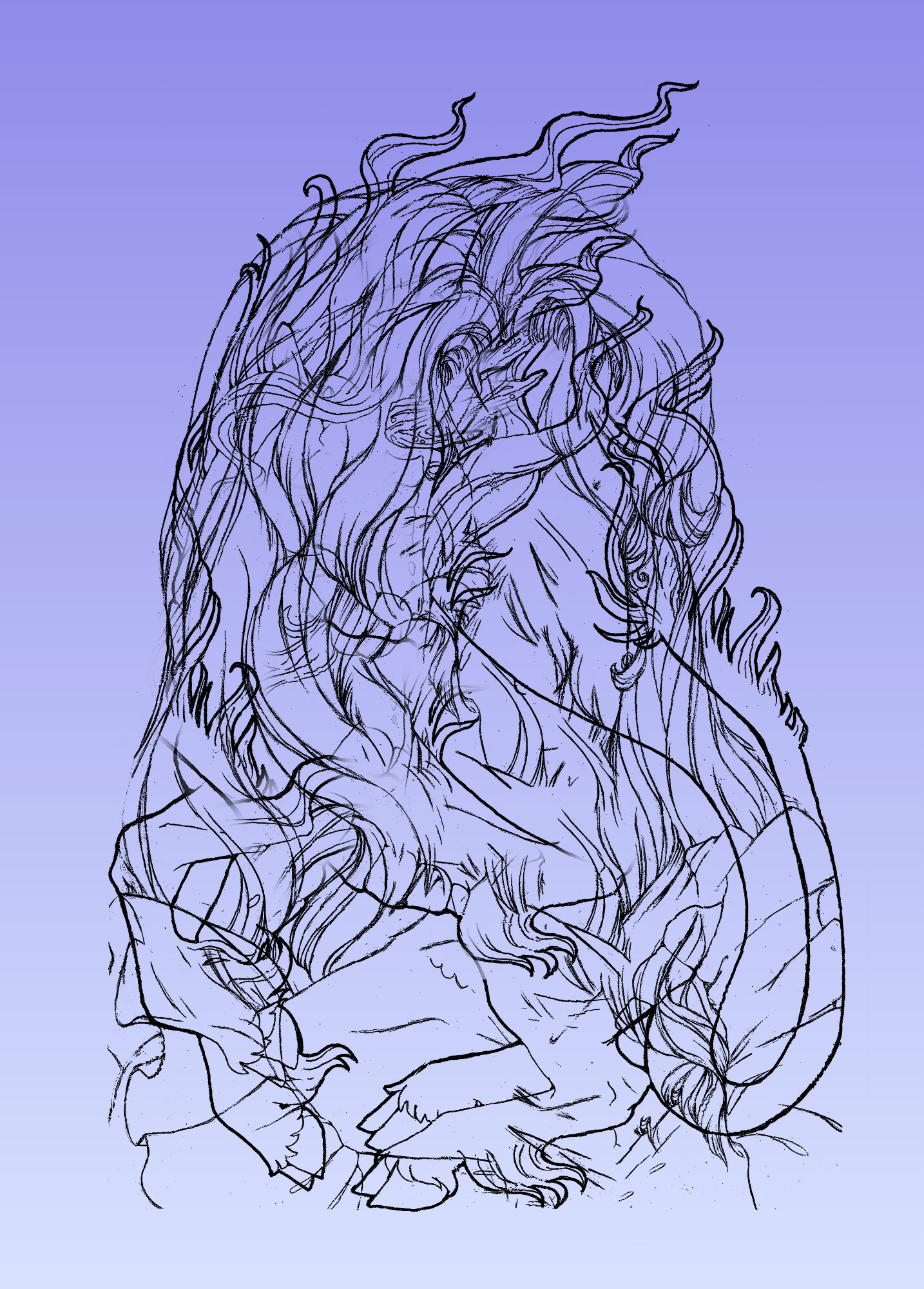
Breezy Doozy is a single token issued through Grails, numbered "Grail #15" in its "Season 2". The artist's text: "This work is a 2022 reimagining of a previously unreleased composite drawing I made in 2012. At the time I was investigating the Deviant Art community as an outsider, somewhat as visual anthropologist. The aesthetics that emerged from that community strike me as influential for many Degen PFP NFT projects - but then without the financial component. The image is animated with a wavy SVG filter, and it responds to your operating system's settings for 'light' or 'dark' mode appearance." The drawing is a dense tangle of black lines, swirling hair, faces and limbs; in light mode it sits on a gradient from lavender to pale blue, and a turbulence filter makes the lines waver. DeviantArt images also went into the 2011 video The Four Master Tropes (→ The Four Master Tropes).
Pression des pairs (2024)
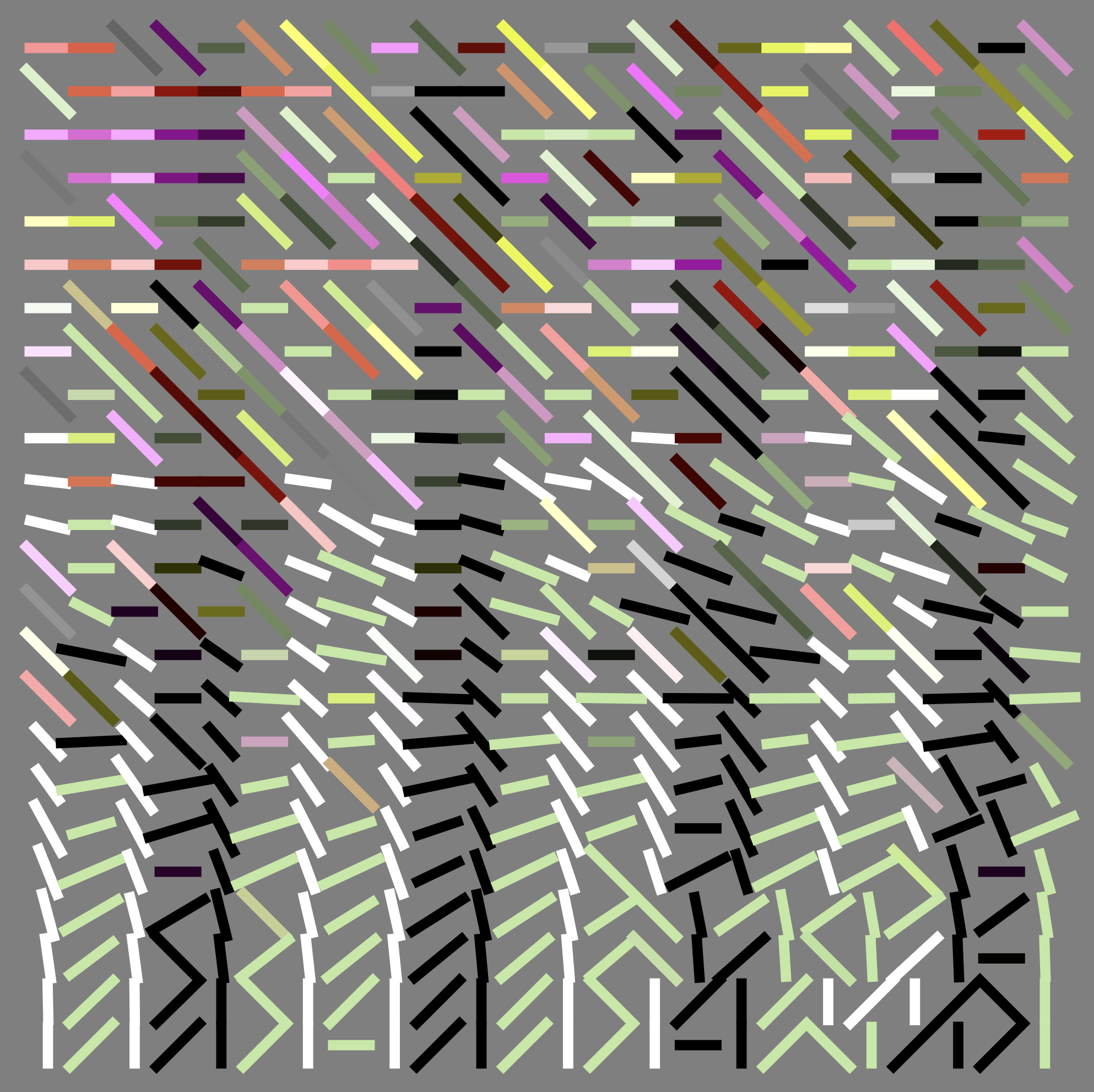
Pression des pairs is a "generative animation inspired by the work 'Quatre éléments distribués au hasard' by Vera Molnár from 1959. 'Pression des pairs' is french for 'peer pressure'. Each cell its rotation is based on the configurations of its neighbouring cells (its peers). This algorithm could be described as a combination of a cellular automata and a Markov chain. The grid is reconfigured in intervals, and scans from top left to bottom right, referring to the process of weaving, or writing text. Each time rotation completes, connecting cells take on one similar colour, creating groups." The edition is three and a proof: 1/3 through DAM Gallery, 2/3, 3/3 and the proof through Lohaus Sominsky. In the proof's still the upper rows are a scatter of short bars in pink, violet, yellow and olive at many angles; the lower rows stand upright in groups of green, black and white. Its successor on the Stained Unravel engine is Interruptions; the grid is discussed on The Grid.
What the collection leaves open
harm.work names the ZKM and the Kadist Foundation as collectors of "some of these" works without saying which. The Triton Foundation commissioned Fernand. The tokens came through different channels: left gallery for Temporality is (2021), Upstream Gallery for the breeding software (2021–22), Grails for Breezy Doozy (2022), DAM Gallery and Lohaus Sominsky for Pression des pairs (2024), and the artist directly for Transplant (2022) and White Rectangle (2026). Why he began tokenising older software in 2021 is told in Tokenising Sustainability.
See also
- Small Collections — JPGs, Single Specimens, Monaco Mix and Sources
- left gallery — downloadable objects in editions of a hundred
- Meditative Labour — Fernand and the recorded gesture
- Death Imitates Language — the Autobreeder