
The Four Master Tropes (2011)
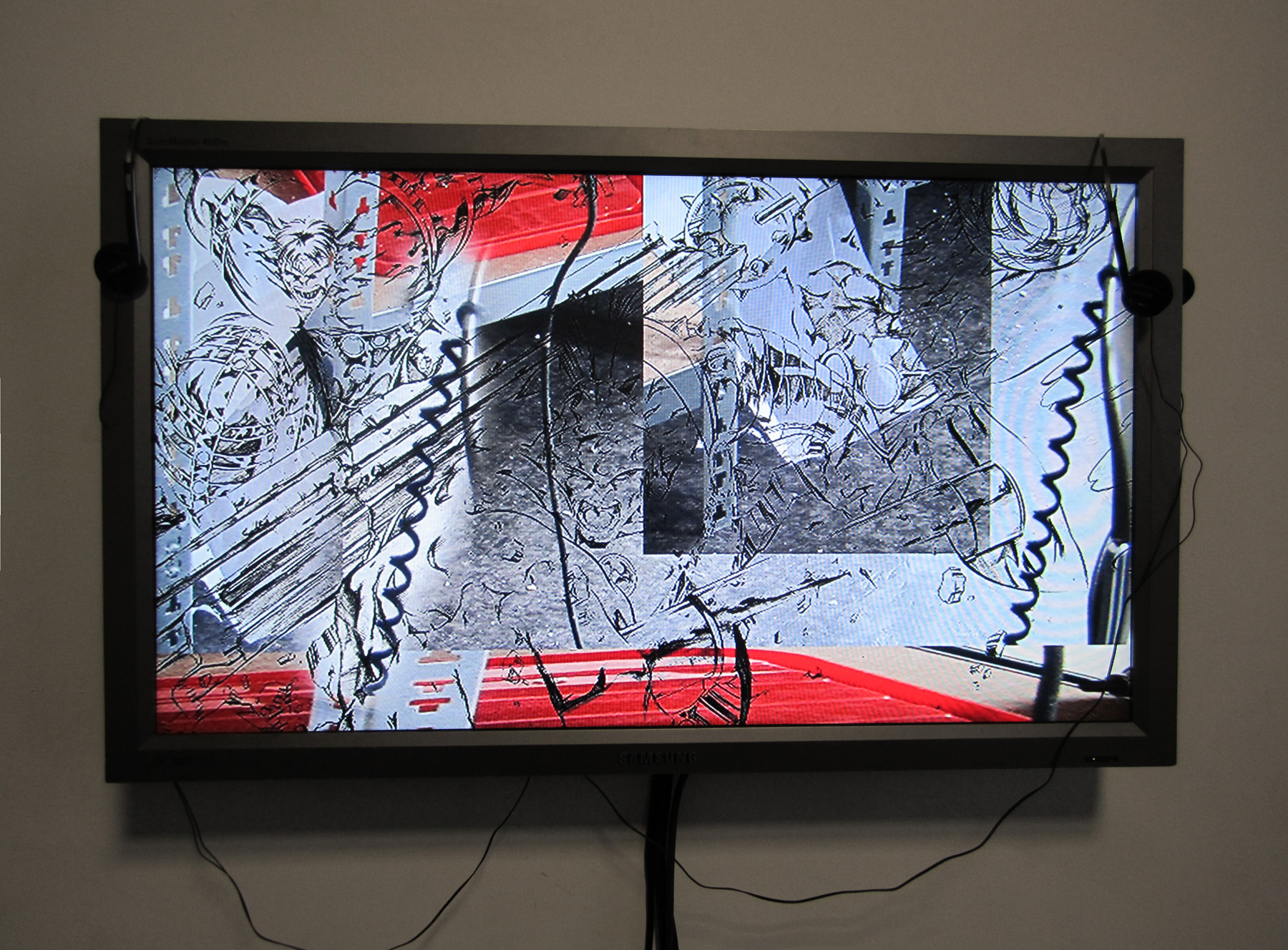
Video work, 2011. Sources: note 662 (The four master tropes (still), 2011), note 690 (The Four Master Tropes, installation context), note 1005 (The Four Master Tropes, source material).
What the source notes say
Note 1005 gives the only first-person description of the work in the vault:
"The Four Master Tropes, 2011 — (Slightly reordered) Kindle highlights from a few ebooks on contemporary philosophy and ethics, with images from Deviant Arts and random photos taken in my studio."
The work is a video; the source notes embed a YouTube link. It was shown at NIMK (the Nederlands Instituut voor Mediakunst, Amsterdam) — the related-section thumbnails across notes 685, 686, 690 all carry the nimk_ filename prefix, placing this work in an NIMK installation context alongside van den Dorpel's Assemblage doorstopper sculptures of the same period. No standalone harm.work page for the work exists at the time of writing.
Note 662 is the still — the static frame extracted from the video — confirming that the video has at least one composed image worth presenting as a separate, photographic object. The pair (still + video) is a frame-from-frame doubling that appears across the practice (mise en abyme, Recursive Intervention); see Recursion and Self-Reference.
The rhetorical framework the title invokes
The Four Master Tropes — metaphor, metonymy, synecdoche, irony — are a rhetorical schema that originates with Giambattista Vico's Scienza Nuova (1725, 1744), where they appear as the four "tropes par excellence" structuring the development of human thought. The framework was extended in the twentieth century by Kenneth Burke (A Grammar of Motives, 1945) and most influentially by Hayden White (Metahistory, 1973), who used the four tropes as the deep-structural grammar of historical writing — every historical narrative, White argued, is organised by a dominant trope.
The version that the work's title cites is not specified in the source notes. What is clear is that the work treats the tropes as a four-position structural device — a system that arranges human thought into a small finite set of operations. This is precisely the formal interest that runs through the practice: the small finite set of operations from which large surfaces are generated.
Sibling to Strategies (2010/2011) — the collage-aphorism method
The Four Master Tropes (2011) and Strategies (2010/2011) — see Strategies summary and note 3004 — are the two video-collage works of the early-2010s period that share a specific compositional method:
| Strategies (2010/2011) | The Four Master Tropes (2011) | |
|---|---|---|
| Source material | "Rewritten aphorisms from business experts, martial arts gurus, software developers, and Jacques Derrida" (3004) | "Slightly reordered Kindle highlights from a few ebooks on contemporary philosophy and ethics" (1005) |
| Image material | Screenshots and found footage | DeviantArt images and studio photos |
| Operation | Recombination across registers (business / martial arts / software / Derrida) | Slight reordering of the highlights |
| Curation context | Maps & Legends, MACRO Rome (2010), curated by Valentina Tanni | NIMK installation |
| Released as | Video / animation | Video |
Both works use other people's sentences as raw material, processed by minimal authorial intervention (rewriting, reordering) into a new artefact. Both treat textual material as already-formed and the artist's role as combinatorial-curatorial rather than compositional. The shared method belongs to the same lineage that randomness and pattern traces through Arp/Dada chance procedures — chance as a method of composition that admits external material on its own terms — and to the openness principle that the practice would name later (Eric Raymond's "release early, release often").
The four-position structure across the practice
The Four Master Tropes' four-fold structure (metaphor / metonymy / synecdoche / irony) is not the only four-position framework that organises the practice. Two later structural devices share the cardinality:
- The semiotic square — New / Old / Different / Same (plus their negations); the logical map of artistic positioning (→ 901, 1010, 909). The Greimasian semiotic square is itself part of the structuralist lineage that the Vico/Burke/White tropes belong to — a finite cell structure that exhausts a logical space.
- The fitness-function progression (Evolutionary Logic) — manual / crowdsourced / structural / formal; four theories of what "better" means across Death Imitates Language, Hybrid Vigor, Nested Exchange, Mutant Garden.
The shared cardinality is not itself an argument — many systems take four positions — but the recurring move is worth noting: the practice tends to articulate its own structural choices in four-position frames. The 2011 video work is the earliest instance the vault preserves of the artist explicitly engaging with a four-position rhetorical framework as material.
See also
- Strategies (2010/2011) — the sibling collage-aphorism video; rewritten aphorisms from business experts, martial arts gurus, software developers, and Derrida; same period, same compositional method
- Semiotic Square — the later four-position logical structure that the practice repeatedly returns to
- Evolutionary Logic — the fitness-function progression as another four-position structural device
- Randomness and Pattern — chance / Dada / Arp as the longer methodological lineage of the collage-aphorism method
- Openness — Release Early, Release Often — the work that admits external material on its own terms
- Recursion and Self-Reference — The Four Master Tropes (still) (662) as the still-from-video doubling that recurs across the practice