
The Painter's New Tools — Nahmad Contemporary, New York, 2022
Group exhibition, 22 June – 24 September 2022, 980 Madison Avenue. Organised by Eleanor Cayre and Dean Kissick. Exhibition page: harm.work/exhibition/the-painters-new-tools; press release: sources/ingested/the-painters-new-tools-press-release-2022.md. Installation photographs: Tom Powel Imaging.
The exhibition
The Painter's New Tools gathered 57 works by 31 artists at Nahmad Contemporary, a Madison Avenue gallery that describes its specialism as "leading Contemporary artists who rose to prominence during the 1980s, and a selection of Modern masters from the 20th century". Its organisers were Eleanor Cayre, "an independent art adviser specializing in the 1950s to today", and Dean Kissick, a critic with a regular column in Spike (Travis Diehl in The New York Times, reproduced by the gallery). The artists included Laura Owens, Wade Guyton, Seth Price, Albert Oehlen, Richard Prince, Jacqueline Humphries, Anicka Yi, Tishan Hsu, Jordan Wolfson and Urs Fischer, and younger artists working with screens, renders and code such as Ezra Miller, Jessica Wilson, Julien Nguyen and the NFT project Tojiba CPU Corp.
The press release, signed by both organisers, begins with someone waking after twenty years asleep to find that "everyone's making and remaking and communicating through images; and have, in a sense, turned into images on screens themselves." It asks: "How can you make a distinct image in the face of this glut of images, this constant distraction, and is that even important? What are the painter's new tools, and what can be done with them?" The artists, it says, "have found new ways of manipulating paint, and of painting without paint, by using software, CGI, code, AI, printers, tablets, phones and other image-making technologies. Many of these works are made in conjunction with machines, or even by machines. For centuries artists strove to imitate the effects of light with paint, and now they are able to draw with pure light, on canvases lit from within." It quotes Clement Greenberg in 1939 on the avant-garde's function "to keep culture moving in the midst of ideological confusion and violence", and closes: "We want to show that new images are still possible. / That new modes of beauty are still possible."
Coralena, three times
harm.work describes his contribution: "3 Mutant Garden Seeder mutation prints of mutant 'Coralena' presented as triptych and the Mutant Garden Autobreeder software (AP)."
Coralena is specimen #25 of Mutant Garden Seeder (2021), the 512+1 tokens he released with Folia. Each token stores a genetic program, bred with Cartesian genetic programming, that keeps mutating after it is minted. Its token text: "Coralena was born on block 12652071 and mutated 1095 times." Its traits give the colouring as "Balanced", the complexity as "Chaotic" and the mutation frequency as "Daily". Every mutation is a new image of the same specimen. From those states he chose three and had them exposed on photographic paper, each 110 × 125 cm, and hung them side by side. harm.work links Coralena (Mutation 62) to the mutation on the Seeder site: mutation 62 of the specimen born on block 12652071, made on block 13275559.
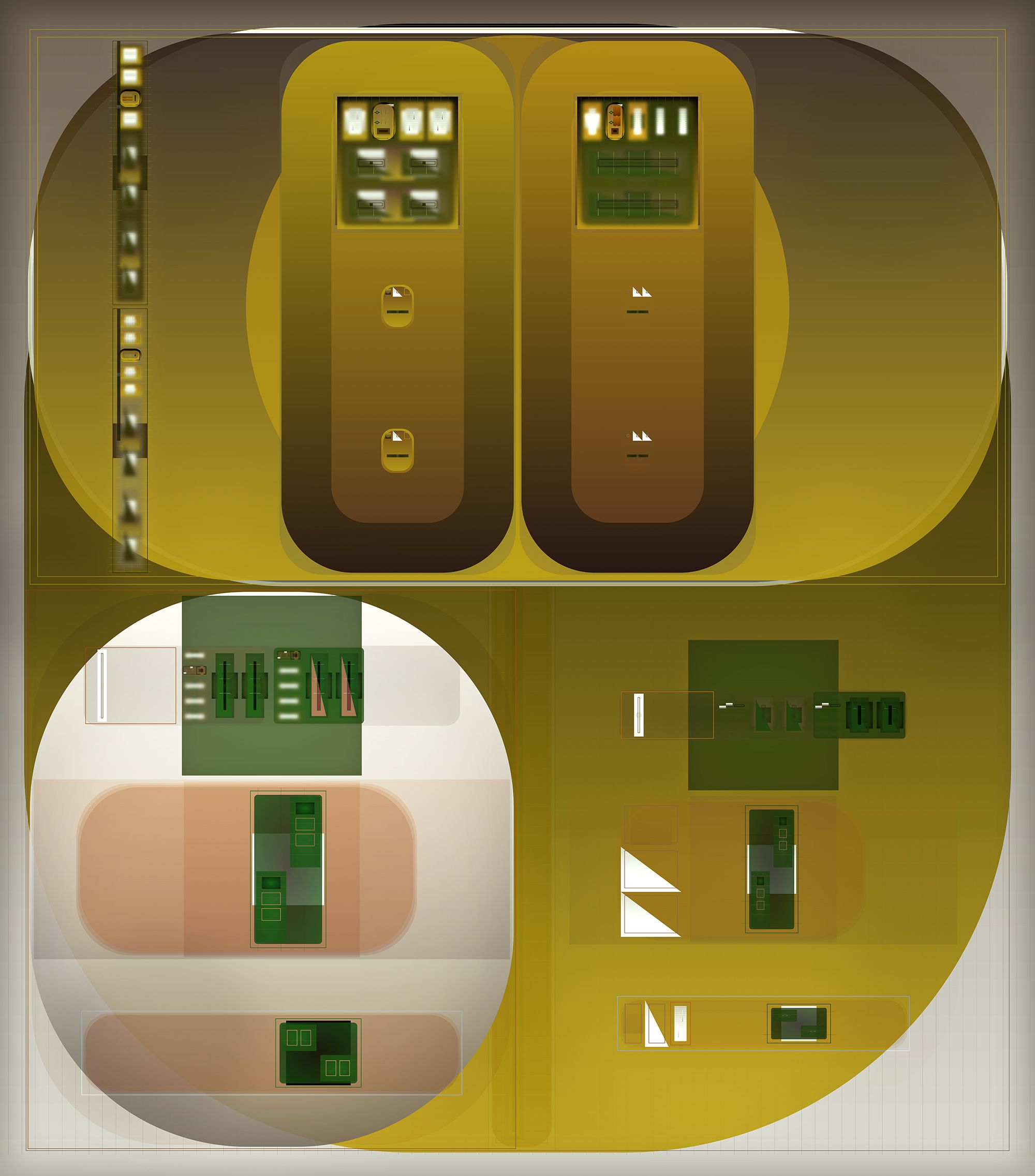
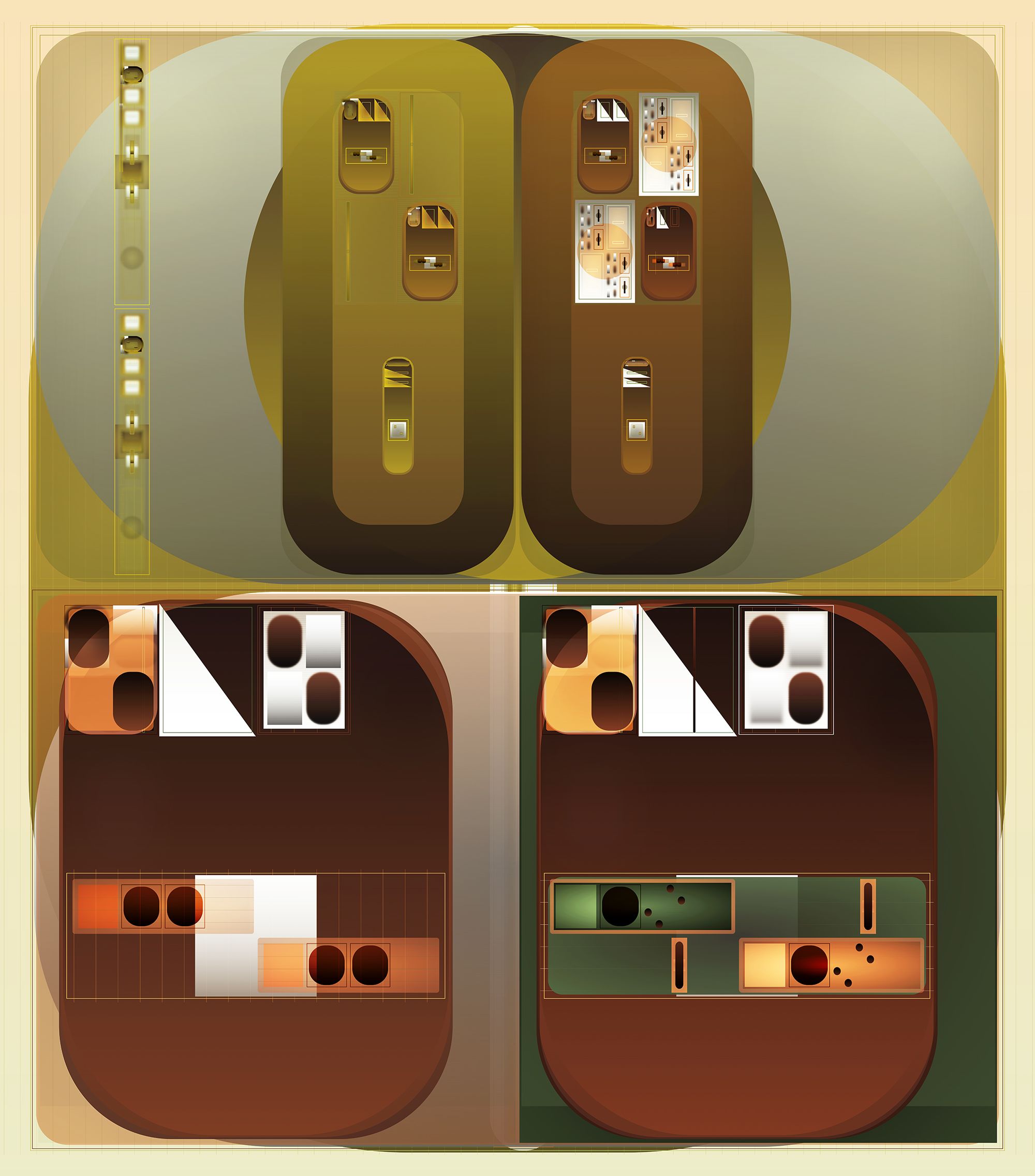
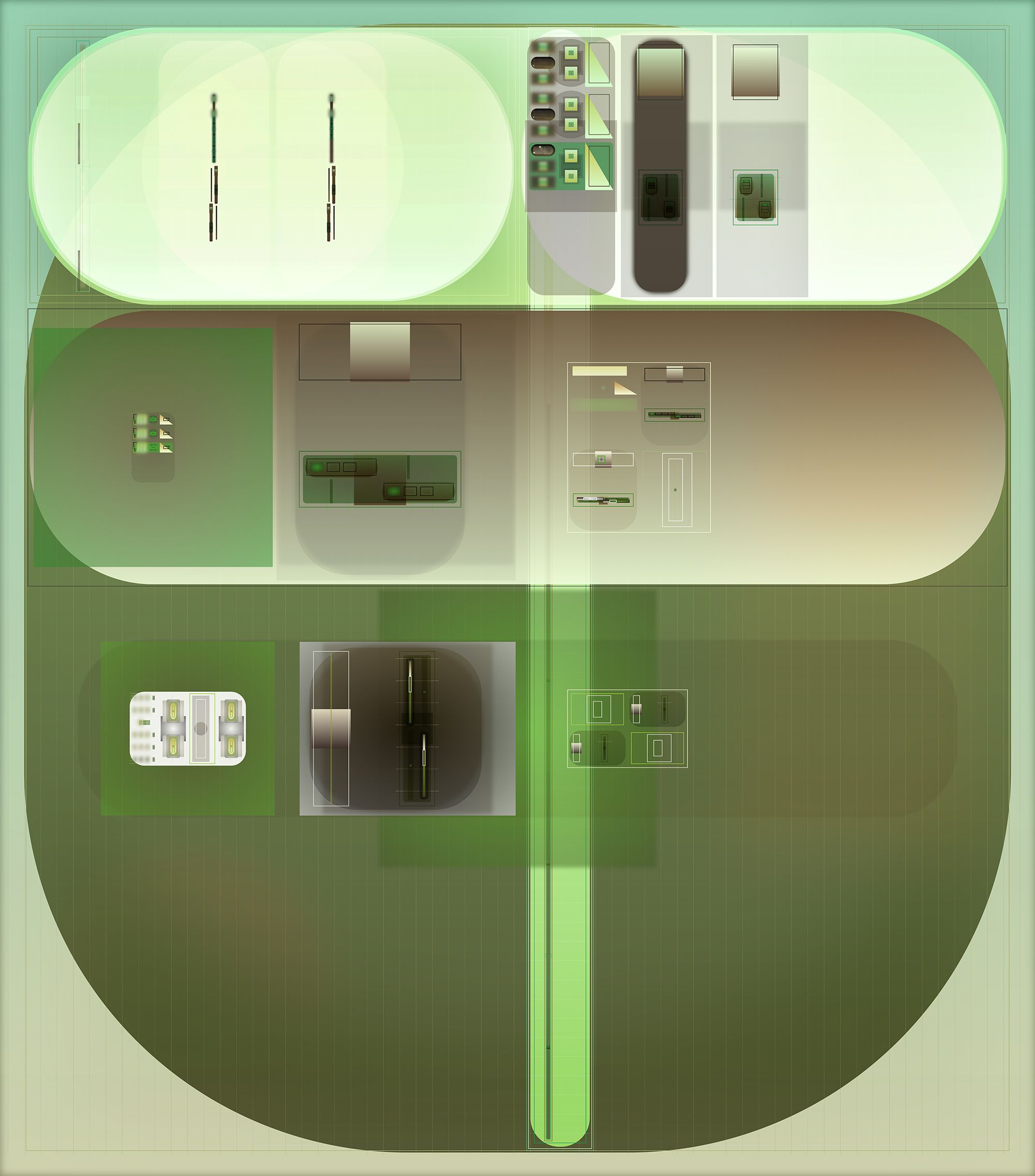
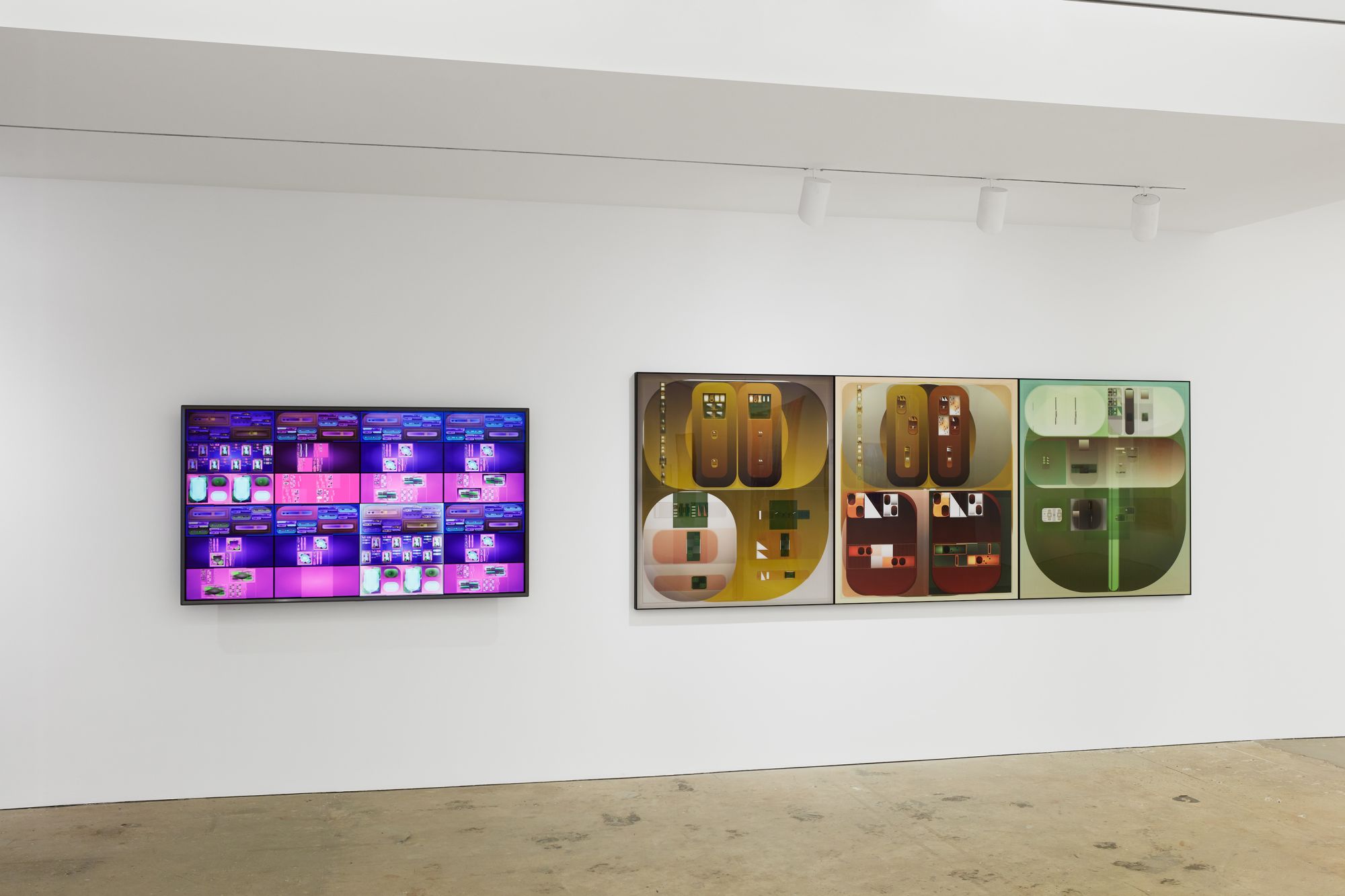
The three prints share a plan: a large rounded form split into an upper and a lower half, with capsules and small framed panels inside. What changes is colour and filling. Coralena (Mutation 62) is ochre and olive: two tall dark-brown capsules in the upper half contain small framed panels, and a white rounded form with a pale pink capsule sits at the lower left. Coralena (Mutation 105) lightens the ground to cream, keeps the ochre and brown capsules above, and fills the lower half with two brown rounded panels holding white triangles and orange circles. Coralena (Mutation 160) turns pale green: a light pill shape crosses the top, a grey-brown band runs through the middle, and a vertical green bar cuts down through a large olive body. On the wall the three read left to right as a sequence in time.
The same mutations were later minted as tokens in Mutant Garden Seeder Mutations, "Curated Mutations from Mutant Garden Seeder": Coralena ⟋ 62, Coralena ⟋ 105 and Coralena ⟋ 160. Mutation 160, on block 14131065, is also the state the artist filed on are.na in May 2022 under the caption "Frog" (→ Colour, where the colour states of Coralena are followed).
The triptych answers the press release's question in a particular way. The tool is a breeding program, and the specimen's colours come from the colour space its "Balanced" trait selects, not from a palette he picked. His choice comes after the program has run: which three of a thousand states to fix, at what size, on what paper. In the artist's statement for Mutant Garden (Upstream Gallery, 2021) the outputs are "input for my own aesthetic wetware: I curated, and optimised the highly complex compositions, emphasised desired traits in a painterly, subjective, and labour intensive process" (text; → Mutant Garden, 2021). "Painterly" is his word, a year before this show. How judgment moves from making an image to choosing among images is the subject of Protocol, Taste, and Systems.
Mutant Garden Autobreeder
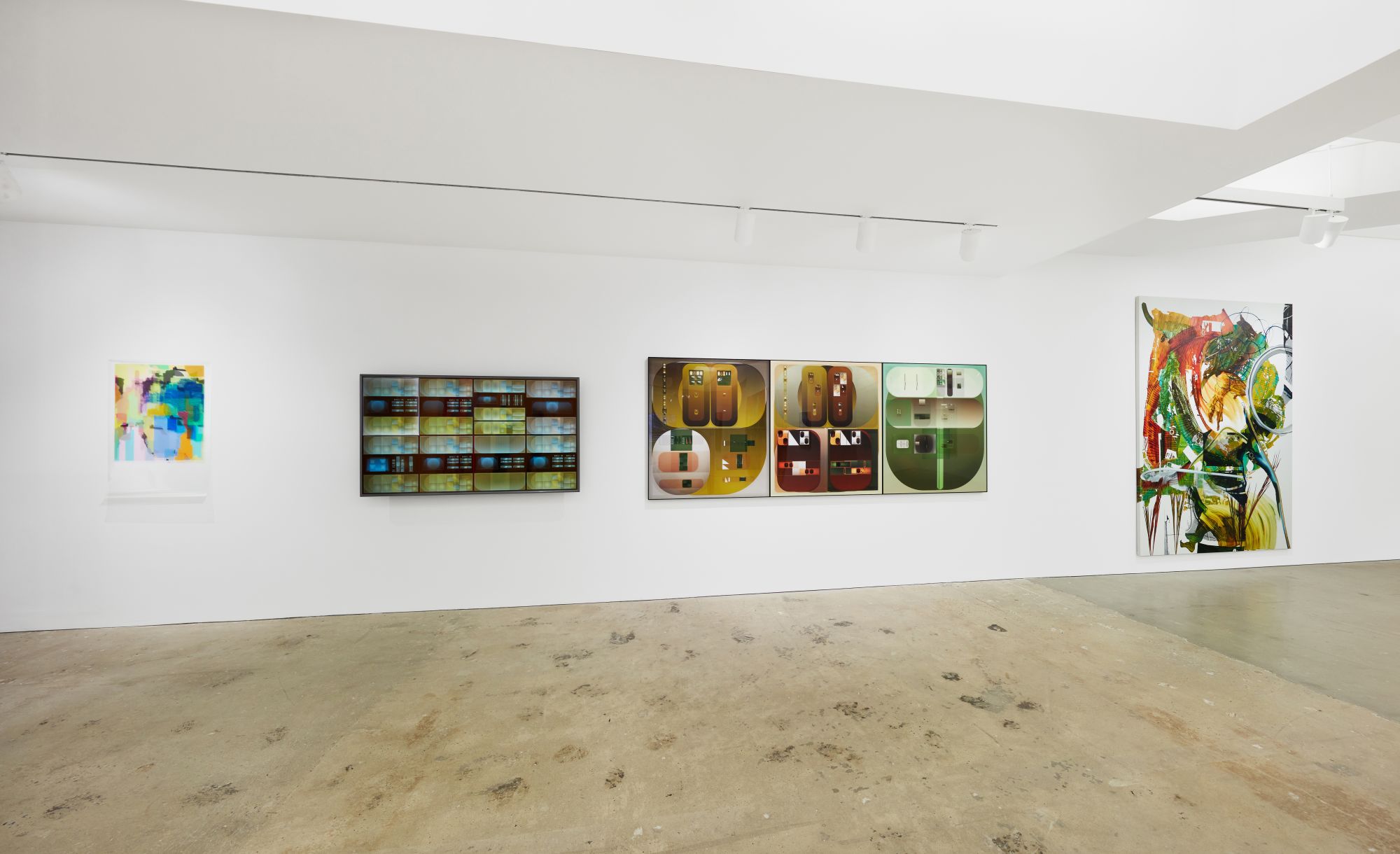
Mutant Garden Autobreeder (2021), "Generative animated artwork, based on evolutionary programming. Dimensions variable, duration infinite, silent" (harm.work), was shown as the artist's proof on one landscape screen to the left of the triptych. In the photographs the screen shows a grid of eight specimens in two rows, each in three bands; in one view the grid is violet and pink, in another dark green and brown. Here the breeding runs without a hand: siblings are scored on "visual complexity versus cost of computation", and "complex compositions that are relatively quick to generate are favored over simple images that take disproportionate effort" (KADIST collection text). The prints next to it show the other route out of the same software, the one that passes through his selection. That summer another edition of the work was on view in BioMedia at the ZKM, Karlsruhe, on three screens (→ BioMedia).
Reception
Travis Diehl reviewed the show for The New York Times ("Computers and Painting's Identity Crisis", 13 July 2022; reproduced by the gallery). He reads the curators as holding two ideas at once, that "new technologies have irrevocably redefined what it means to paint" and that "painting remains defined by the pursuit of beautiful things", and he sees the show bounded "on one side by artists departing from conventional painting into digital territory, and on the other by artists making animations and unpainted objects, shoehorned into painting's company because they go on the wall". He discusses Owens, Ei Arakawa, Kate Cooper, Julien Nguyen, Wolfson, Ezra Miller, Tojiba CPU Corp, Price, Guyton, Humphries, Yi and Jessica Wilson, and does not mention van den Dorpel. The CLOT Magazine feature by Irem Erkin names him among the artists "probably familiar to our audiences", with Guyton, Jesse Kanda and Yi, and reports that the show had 57 works by 31 artists.
In the practice
The show fell in a year of many showings of the Mutant Garden software: the Autobreeder at the ZKM, metallic exposures of bred specimens in Context Switch at Galerie Noah Klink, Berlin, in November (→ Context Switch), and the earlier CGP prints SPARCStation and Field in Tokyo that July (→ the Tokyo group show). The Graz venue's biography that September named "Nahmad Contemporary (NY); — curated by Eleanor Cayre & Dean Kissick" among his recent shows (→ Systems of Belief).
See also
- Mutant Garden — the body of work, from the first CGP outputs to the Seeder and its mutations
- Evolutionary Logic — Cartesian genetic programming and selection
- Colour — the Coralena states and colour left to the algorithm
- BioMedia (2021–22) — the Autobreeder at the ZKM
- Spike #70 — The Squircle of Life — the conversation with Tina Rivers Ryan on the Mutant Garden algorithm
- The Painter's New Tools press release — the organisers' text in full