
BioMedia — ZKM Karlsruhe, 2021–22
Group exhibition, ZKM | Center for Art and Media Karlsruhe, 18 December 2021 – 28 August 2022. Curators: Peter Weibel, Sarah Donderer, Daria Mille. Exhibition page: harm.work/exhibition/biomedia-the-age-of-media-with-life-like-behavior; the ZKM's text: sources/ingested/biomedia-zkm-exhibition-text-2021.md.
The exhibition
BioMedia: The Age of Media with Life-like Behavior opened at the ZKM on 18 December 2021 with a free day and a digital opening, and ran until 28 August 2022. It was curated by Peter Weibel, the ZKM's director, with Sarah Donderer and Daria Mille. More than sixty artists and research institutions took part, among them Gordon Pask, Karl Sims, Jeffrey Shaw, Refik Anadol, Random International, Anna Ridler, Alexandra Daisy Ginsberg and Universal Everything, with research projects from the KIT, the EPFL and IBM.
The ZKM's text tells a history of media that imitate life: animatronics, wheel-based machines, cinema, then the computer. It names three steps, "virtuality, variability, and viability": digital storage made image content variable, and variable images could then behave. "It is this phenomenon – media which exhibit life-like actions – that we call biomimetic media or BioMedia." The catalogue description adds that the term "does not refer to Bio Art – art made with organic or biological material – but to art made with inorganic material that exhibits organic features". Some of the agents in the show, the text says, "are purely digital, computer-generated and computer-simulated systems that evolve on a screen". Van den Dorpel's four works were of that kind.
Mutant Garden Autobreeder
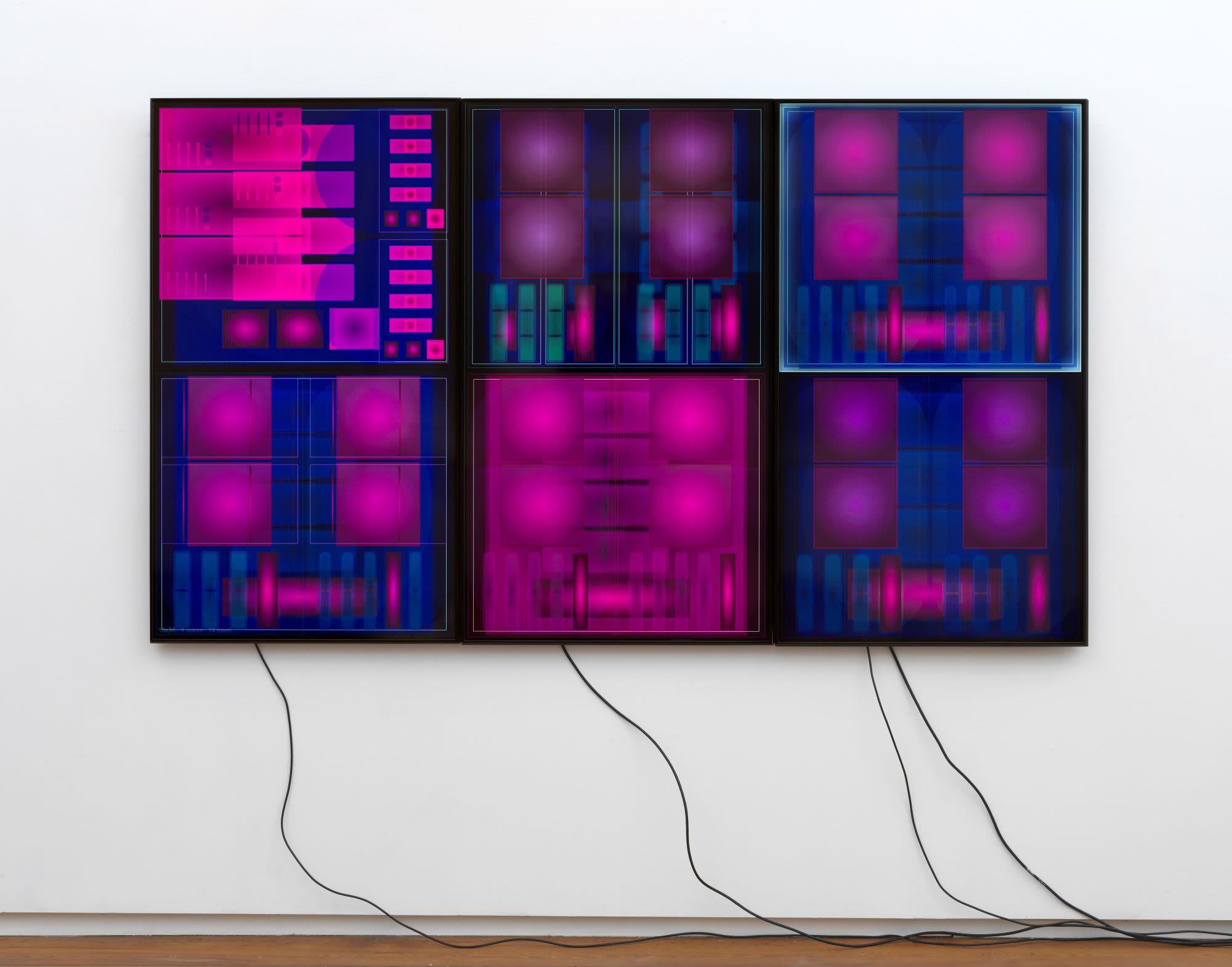
Mutant Garden Autobreeder is, in harm.work's words, "Generative animated artwork, based on evolutionary programming. Dimensions variable, duration infinite, silent." It runs the Mutant Garden software without a viewer's choices (→ Mutant Garden). In the photograph three portrait screens hang side by side, each split into two panels; every panel shows a specimen of nested squares, rounded rectangles and rows of bars, here all in magenta and blue.
The artist described the selection rule for the Mutant Garden exhibition at Upstream Gallery in April 2021, where the Autobreeder stood in the main room: "specimens undergo mutation, and siblings are evaluated based on measuring their visual complexity versus cost of computation. Complex compositions that were relatively quick to generate are favoured over simple images that took disproportionate effort" (exhibition text; → Mutant Garden, 2021). The algorithm underneath is Cartesian genetic programming, which Julian F. Miller and Peter Thomson invented in 1997 and which he took up in 2019 (→ the interview with Miller, Evolutionary Logic). KADIST, which also has the work in its collection, gives the same rule and adds that "This breeding strategy requires that each mutant in the lineage improves or declares its predecessor obsolete" (collection text).
The ZKM bought the work for its collection "with the kind support of the Werner Stober Foundation". Its record dates the installation 2022, the year of the purchase; the artist dates the work 2021, as harm.work does (November 2026). The record describes it as three 55-inch LCD monitors run by one computer, 205 × 121 cm (ZKM collection). Upstream Gallery reported in February 2023 that the work is included in the exhibition catalogue (Peter Weibel, ed., BioMedia, Spector Books, 2023) and is "also part of the collection from the institute for media art". The ZKM's collection also holds two works titled Event Listeners: the 2015 screensaver, as copy 42 of its edition of 100, and one dated 2018 (→ Event Listeners).
Mutant Garden Tracer
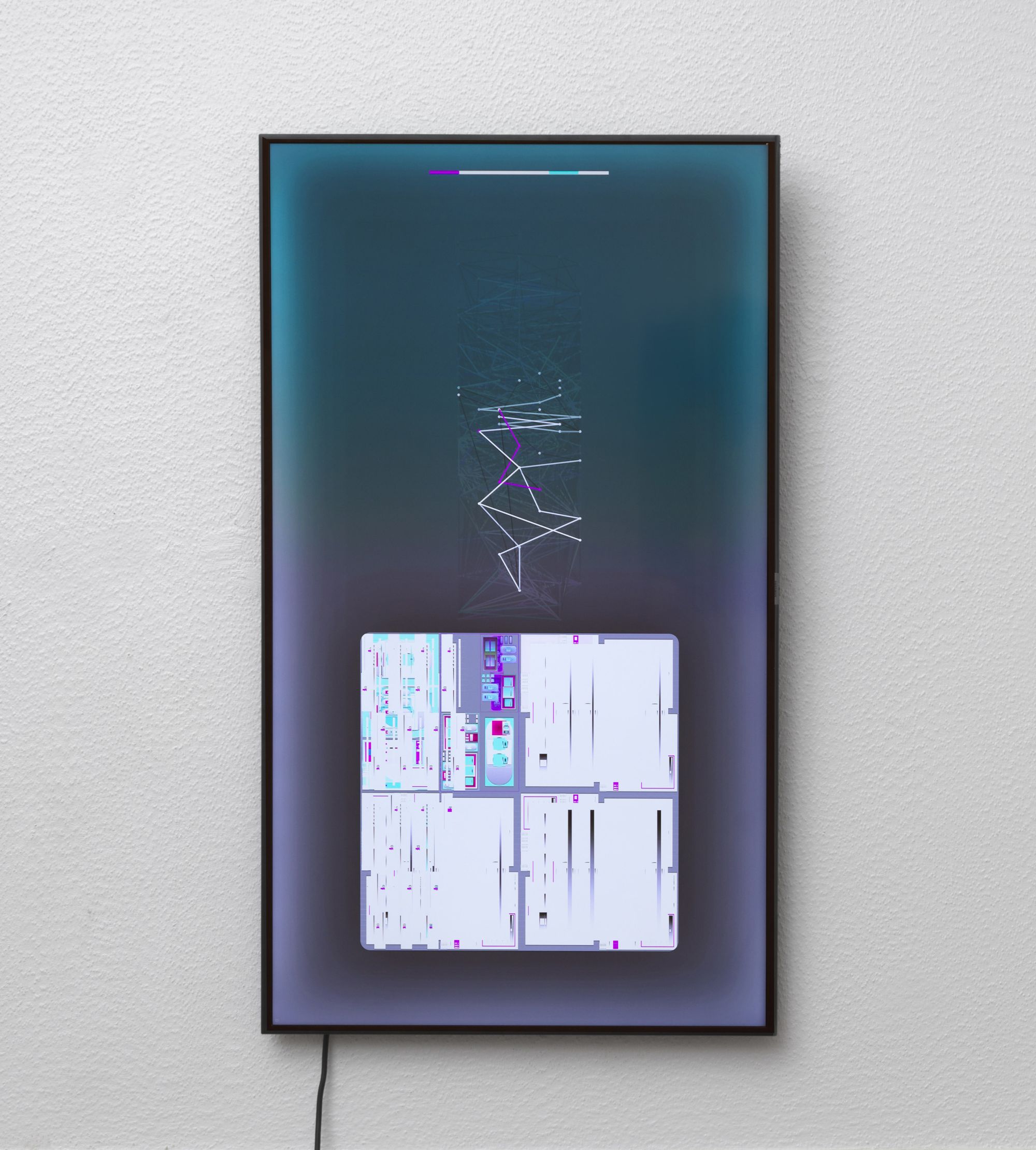
Mutant Garden Tracer has no text on harm.work. On a portrait screen, the upper half shows a faint grid of nodes joined by many grey lines; one path through it is drawn in white and magenta, zigzagging up the column. Below it sits the specimen, a pale lilac image of four panels. In Cartesian genetic programming a genome is a grid of nodes, and only the nodes connected to the output take part in the image; the rest are inactive (→ Miller interview). The Mutant Garden statement of 2021 describes, in the gallery's smaller room, "an additional software work ... which visualises how the genetic code is formatted as a two-dimensional network, and how this is parsed to generate the layered visual compositions". The wiki takes Tracer to be that work: the highlighted path is the part of the program that draws the specimen beneath it.
The Associative Displays
The same statement ends: "a series of light emitting tablets connect the various algorithms, series, works by myself, by other contemporary artists, and historical art movements. These help me define my activities in a broader artistic and historical frame, and appreciate associations in their own right." The two lightboxes shown in Karlsruhe fit that description: LED lightboxes in custom casings with UV prints, each a white board of images with centimetre rulers printed along two edges. The archive itself began as an engine of associations (→ Subconscious Computation).
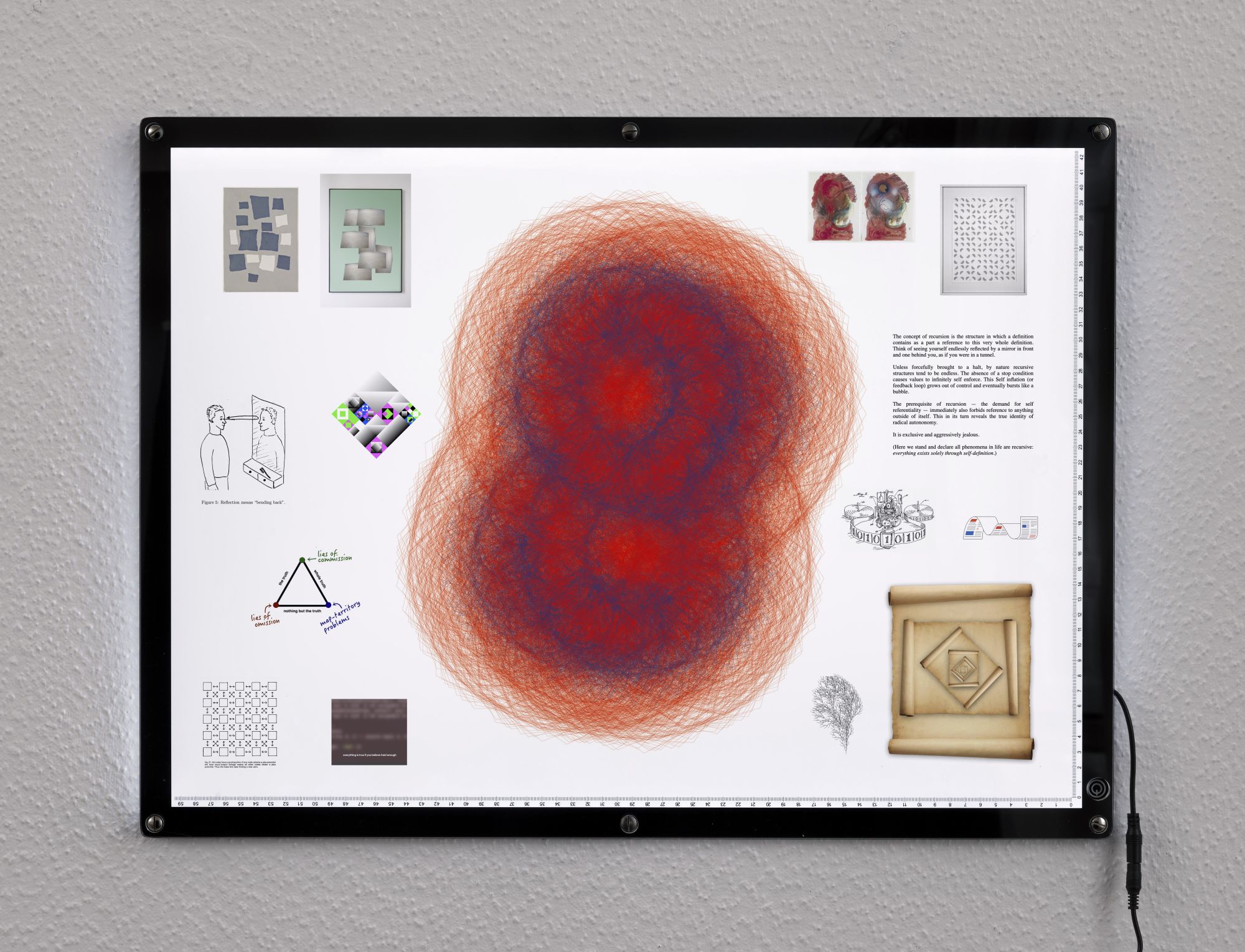
Associative Display (recursion) carries, as a block of text on the right, the whole of note 876, "On recursion": "The concept of recursion is the structure in which a definition contains as a part a reference to this very whole definition. Think of seeing yourself endlessly reflected by a mirror in front and one behind you, as if you were in a tunnel", down to "(Here we stand and declare all phenomena in life are recursive: everything exists solely through self-definition.)" Around it are the images that note's argument calls up. A line drawing of a man looking into a mirror is captioned "Figure 3: Reflection means 'bending back'". A small turned square in green, magenta, blue and grey gradients is Markov's Window (2004), whose squares split into squares. A triangle diagram is labelled "nothing but the truth", "lies of commission", "lies of omission" and "map-territory problems". There is a grid of arrows, an engraving of a machine above a strip of binary digits, a branching tree, and a parchment scroll that contains a smaller scroll turned 45°, which contains a smaller one again: the Droste effect, after which the file of the Flash piece Scroll (336) is named, drostescrolls. Two overlapping masses of red and blue looping lines fill the centre. A small dark image near the bottom edge reads "everything is true if you believe hard enough". The note and its place in the practice are on Recursion and Self-Reference.
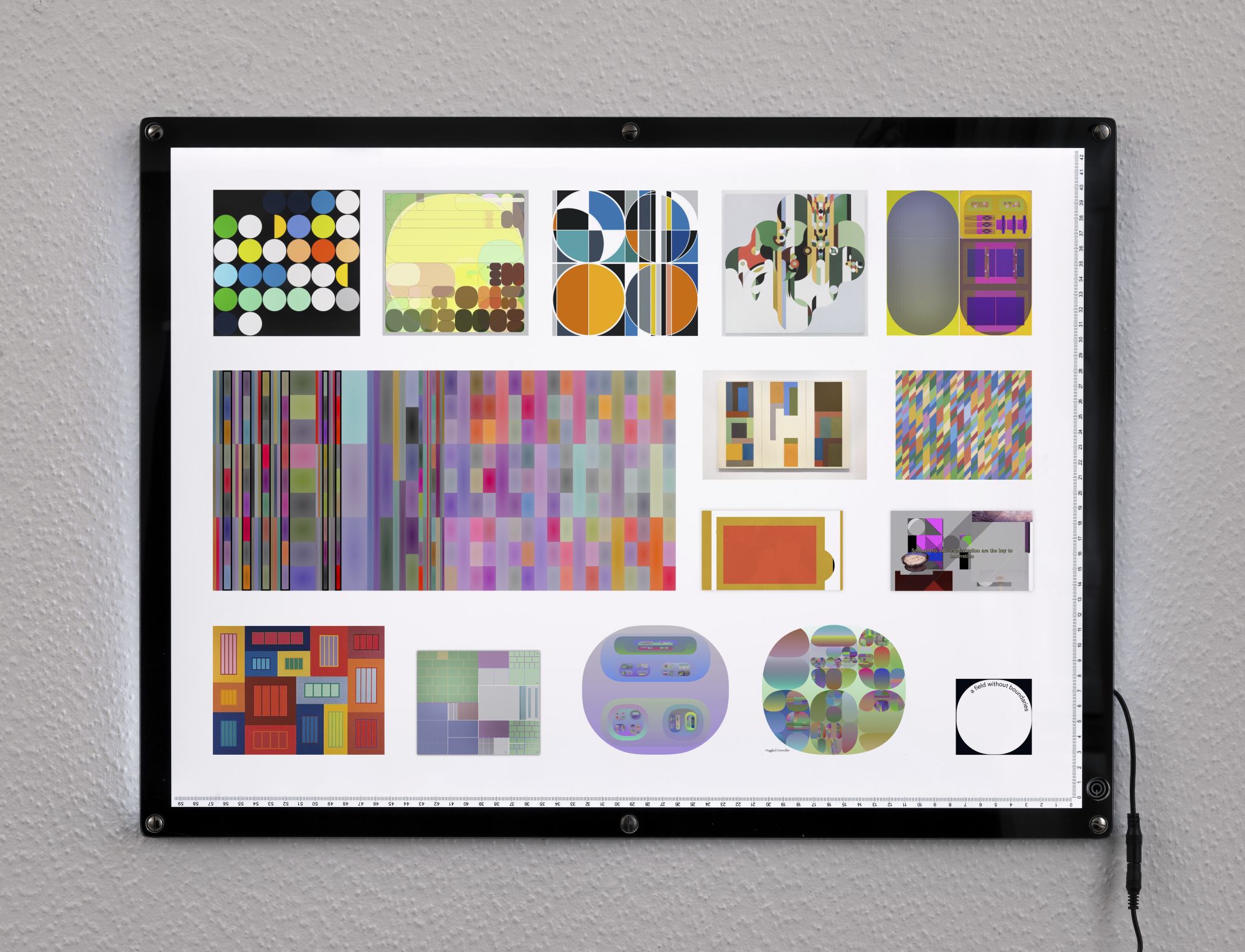
Associative Display (painting) sets fifteen images in three rows: a grid of coloured discs on black, quartered circles in orange, blue and black, a biomorphic composition, a long field of vertical colour stripes, a pattern of coloured parallelograms, block compositions in red and blue, pale grid fields, and two rounded specimens of the Mutant Garden kind. In the lower right corner a white circle on black carries the words "a field without boundaries". The other images are not captioned on the board, and the wiki does not identify them; together they place generated specimens in a lineage of grid and colour painting, the lineage the Mutant Garden text calls "algorithmic archaeology" (→ Algorithmic Archaeology, The Grid).
Life-like, or programs all the way down
The ZKM's frame moves from media toward life: artificial agents that "imitate, demonstrate, and simulate life-like behavior". The artist's 2021 statement moves the other way, from life toward programs: "Genetic information could be considered as a compressed collection of computer programmes, from which life emerges", and "this tension between relative simplicity of computational rules, but enormous complexity in outcome, holds the key to understanding life, and by extension, our aesthetic appreciation of it." Miller, in the interview the artist published the same spring, called life "a 3.5 billion year old technology". In Karlsruhe the two directions met: the museum showed the Autobreeder as a medium behaving like an organism, and the artist built it on the premise that organisms are already running code. The lightboxes beside it show the other half of his account, the human selection and association that the statement calls "my own aesthetic wetware".
The artist and the ZKM
The ZKM's page for van den Dorpel lists three exhibitions: Open Codes. Leben in digitalen Welten (20 October 2017 – 2 June 2019), BioMedia, and the collection presentation The Story That Never Ends. The ZKM Collection (from 5 April 2025). Two later threads run back to the museum: Clara Runge of the ZKM gave an artist talk with him at Angles Morts in Munich the day after its opening in 2024 (→ Angles Morts), and Margit Rosen, the ZKM's head of collections, archives and research, wrote the text pairing him with Herbert W. Franke in 2026 (→ Franke × van den Dorpel).
See also
- The Painter's New Tools (2022) — the Autobreeder in New York half a year later, beside three Coralena prints
- Evolutionary Logic — Cartesian genetic programming and selection in the practice
- A 3.5 Billion Year Old Technology — the interview with Julian F. Miller
- Recursion and Self-Reference — note 876, printed on Associative Display (recursion)
- Mutant Garden exhibition text — the artist's 2021 statement on the Autobreeder and the lightboxes
- BioMedia exhibition text — the ZKM's text in full