
Mutant Garden — Upstream Gallery, Amsterdam, 2021
Solo exhibition, Upstream Gallery, Kloveniersburgwal 95, Amsterdam, 23 April – 27 June 2021. On harm.work: Mutant Garden. Exhibition texts: Mutant Garden — exhibition text. The body of work is described on Mutant Garden (2019–).
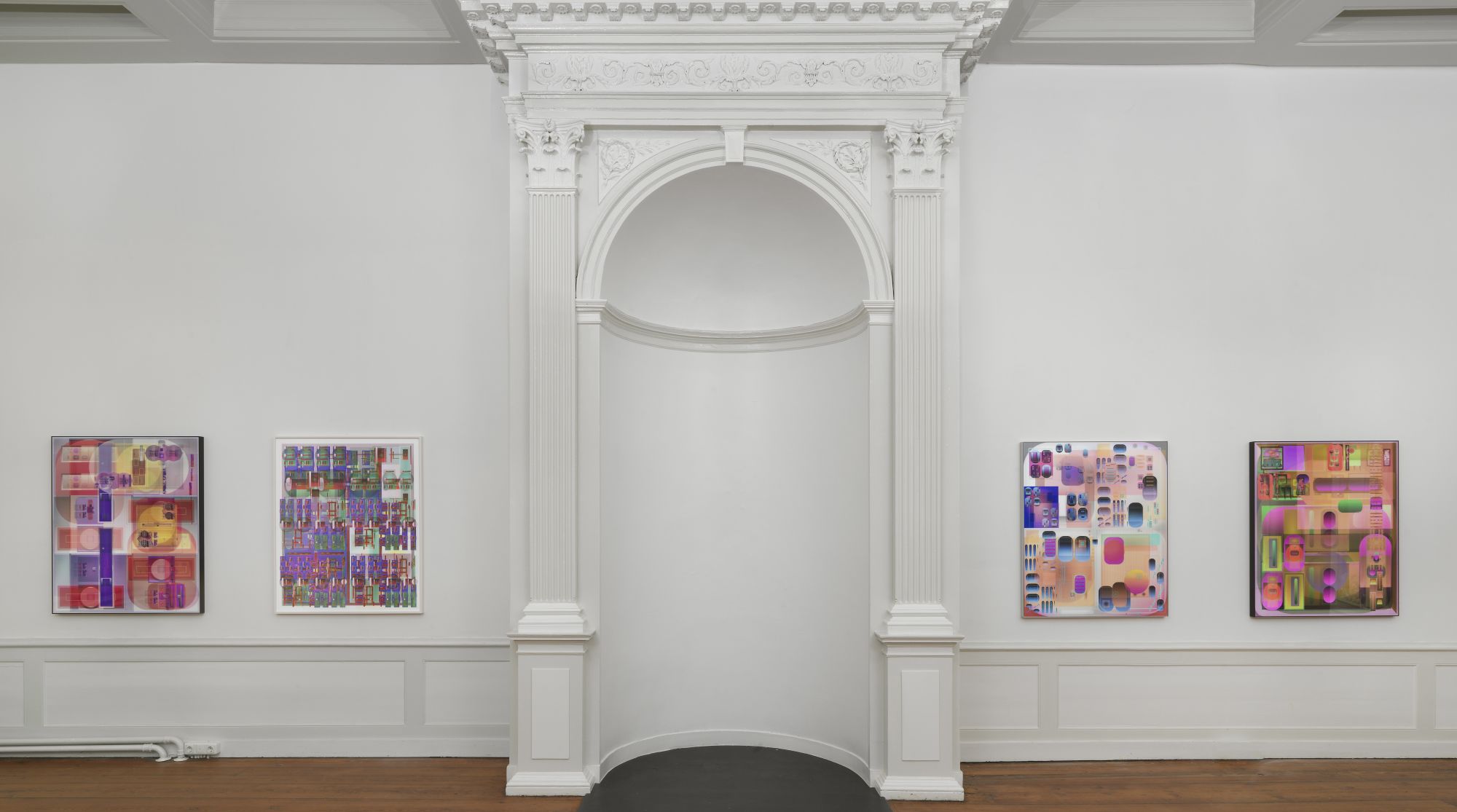
The main room has a stucco arch between fluted pilasters. Left of it hang Grand Formation and Decent Fabric, right of it Odd Motives and Plural Shim.
The exhibition
Mutant Garden was van den Dorpel's second exhibition with Upstream Gallery, after Pattern and Presence in 2018 (→ Pattern and Presence). The gallery presented it as "dedicated to his Mutant Garden software, its various material outputs and research". His invitation of 16 April 2021, published as the harm.work news item Mutant Garden, says the Mutant Garden body of work "has developed (sometimes on its own) over the past 2.5 years and will now be exhibited in its entirety for the first time", and asked visitors to book in advance. It thanks Paloma Rodríguez Carrington, with whom he ran left gallery, Lisa Blanning, Wassim Alsindi, the writer William Kherbek, who had titled Neural Dust (2020), and the gallery's team.
The show was laid out like the software it presented. The website Mutant .garden (2020) already had two views, "lab" and "garden" (→ Mutant Garden). The gallery's text: "Mutant Garden is divided into two parts: a 'garden', where the Mutant Garden software breeds new artworks and where the different material outcomes are shown. The next room forms a 'lab', where Van den Dorpel gives an insight in his artistic process leading up to the final results, as well as showing a timeline of earlier series of works in his larger project of algorithmic archaeology."
What the text argues
The artist's statement, published by the gallery and on harm.work, begins with DNA. A genome cannot be a map of the body with "a one-to-one relationship between genes and cells": "Such a map would exceed the territory. The genome is limited to contain a relatively small amount of information." It is "better to think of our genetic information as a repository of many highly efficient intertwined strategies, recipes, methods – algorithms, if you will – from which the huge amount of cells that compose our bodies are generated, recursively", so that "genetic information could be considered as a compressed collection of computer programmes, from which life emerges". He made the same comparison to Jenna Sutela later that year, with the leaves of a tree as the example (→ Outland, 2021).
From there to aesthetics: "It is my conviction that this tension between relative simplicity of computational rules, but enormous complexity in outcome, holds the key to understanding life, and by extension, our aesthetic appreciation of it. We are attracted to visual systems which are to some extent complex, novel, tantalising, yet at the same time contain familiar, repeating elements. Difference and variation, surprise and expectation, have provided essential building blocks in the history of human expression." The pairs are the ones the wiki maps on The Semiotic Square (new and different, old and same) and on Randomness and Pattern. The statement claims them as a "trade off" to be researched and optimised with evolutionary algorithms.
The engineering problem comes next. "Just as mutations in biology often result in death of specimens, mutations in software often result in programmes that get stuck in an infinite loop: the notorious blue screen of death or endless rainbow spinner on MacOS." Cartesian Genetic Programming, "invented by Julian F. Miller and Peter Thomson in 1997", let him "freely let programmes mutate without crippling them". Why it does is set out on Evolutionary Logic; his interview with Miller appeared on harm.work two weeks after the opening (→ interview with Julian F. Miller).
The last paragraphs describe the rooms, and the sections below follow them.
The garden: Autobreeder and the material outputs
The Mutant Garden Autobreeder ran on six square screens hung as a block of three by two beside a tall window, cables hanging to the floor. Each screen shows a pair of siblings, rounded compartments with glowing green or yellow squares over blue and violet. harm.work: "Generative animated artwork, based on evolutionary programming. Dimensions variable, duration infinite, silent." The statement gives its rule: "specimens undergo mutation, and siblings are evaluated based on measuring their visual complexity versus cost of computation. Complex compositions that were relatively quick to generate are favoured over simple images that took disproportionate effort." In Spike #70 he gives the two measures as the time it takes to render and the size of the file after compression (→ Spike #70). Tina Rivers Ryan, in the same interview, noted that he showed Mutant Garden at Upstream "using both screens running a live version and prints you call 'wall objects'", among them square ones, and read the square against Malevich and the Instagram post; he answered with the squircle (→ The Squircle).
Around the screens hung the outputs he had chosen and worked on: "I used the outputs of this algorithm as input for my own aesthetic wetware: I curated, and optimised the highly complex compositions, emphasised desired traits in a painterly, subjective, and labour intensive process. Some of these works are materialised as digital exposures on photographic paper (lightjet), others are printed on archival paper using UltraChrome inks."
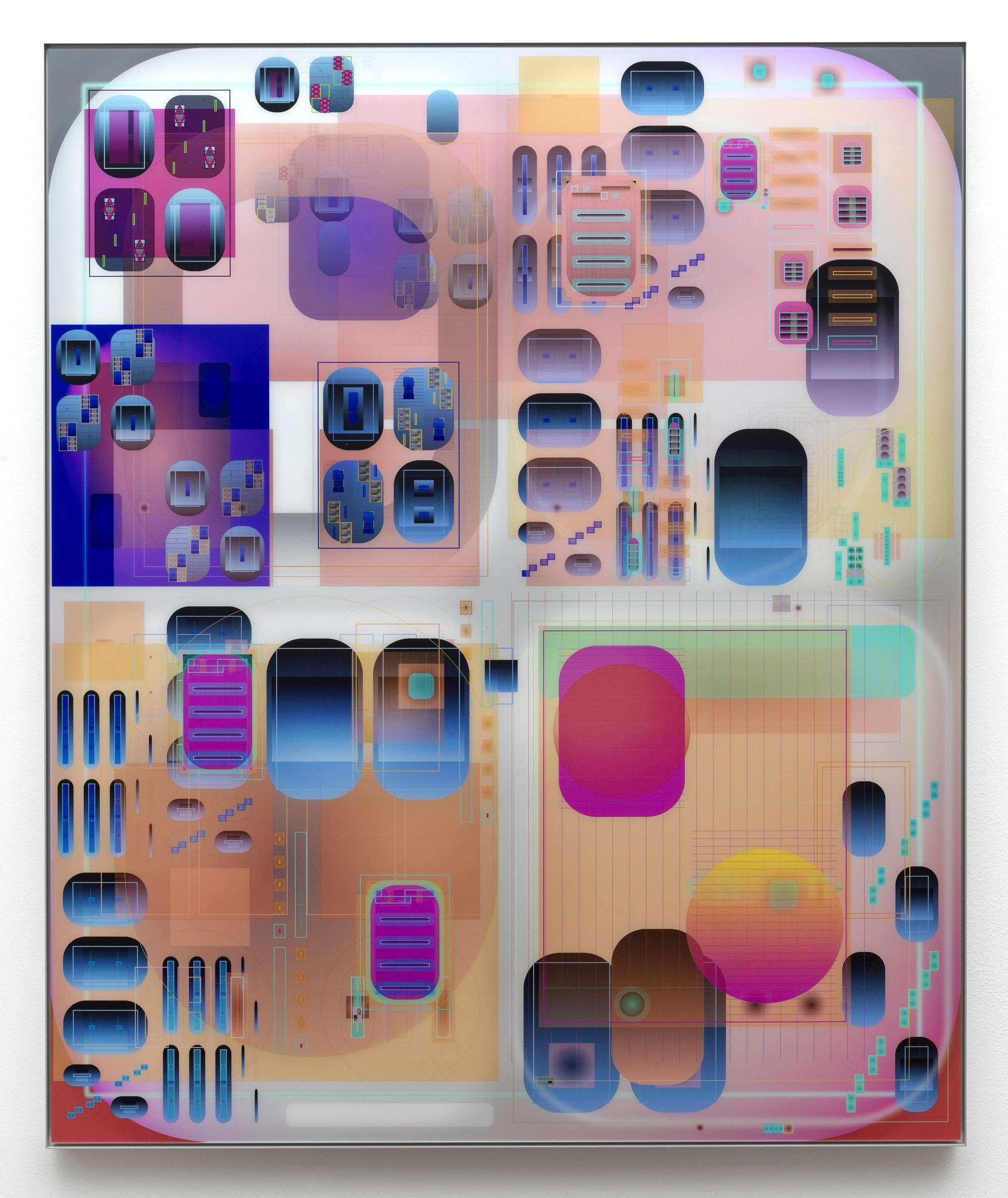
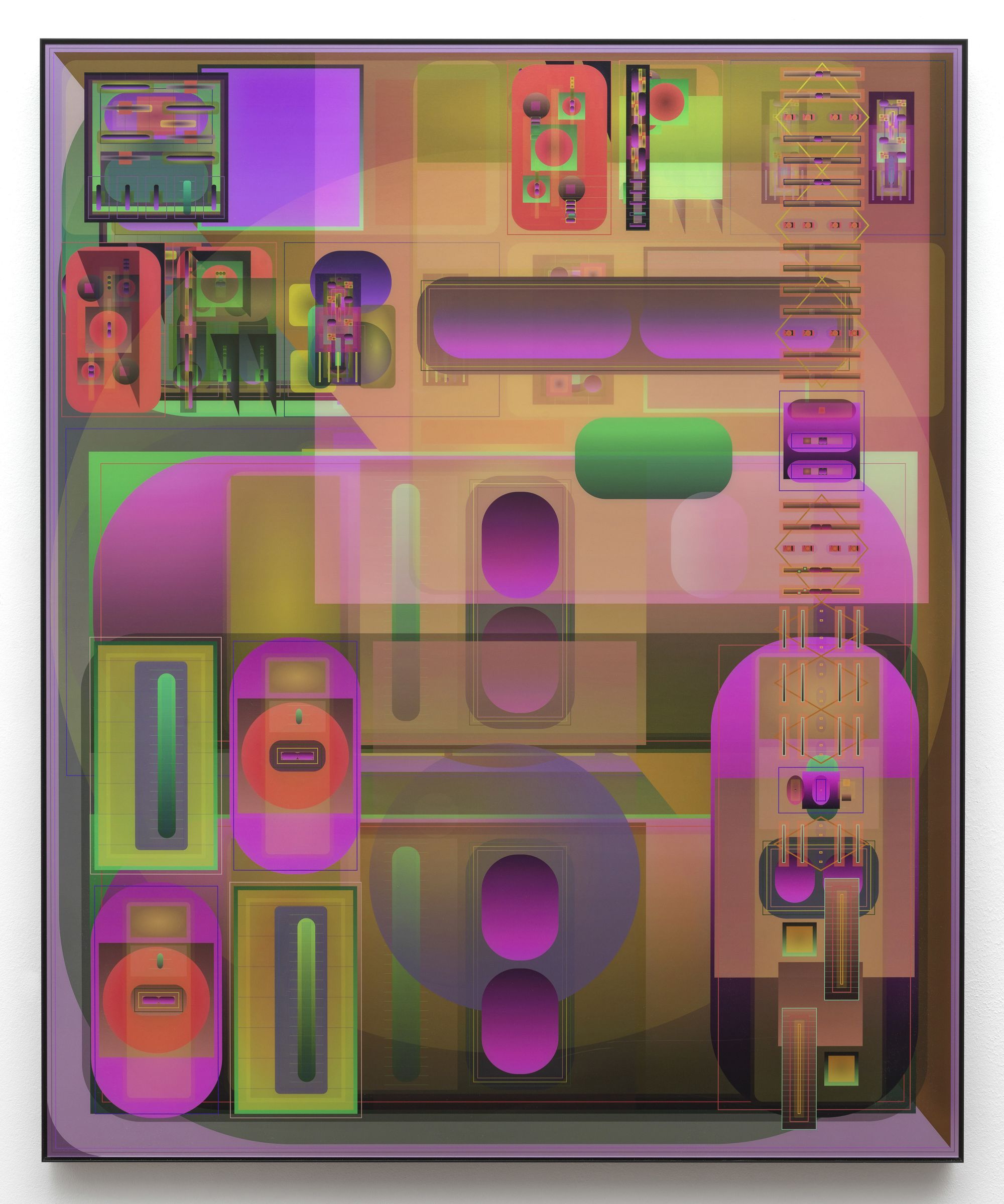
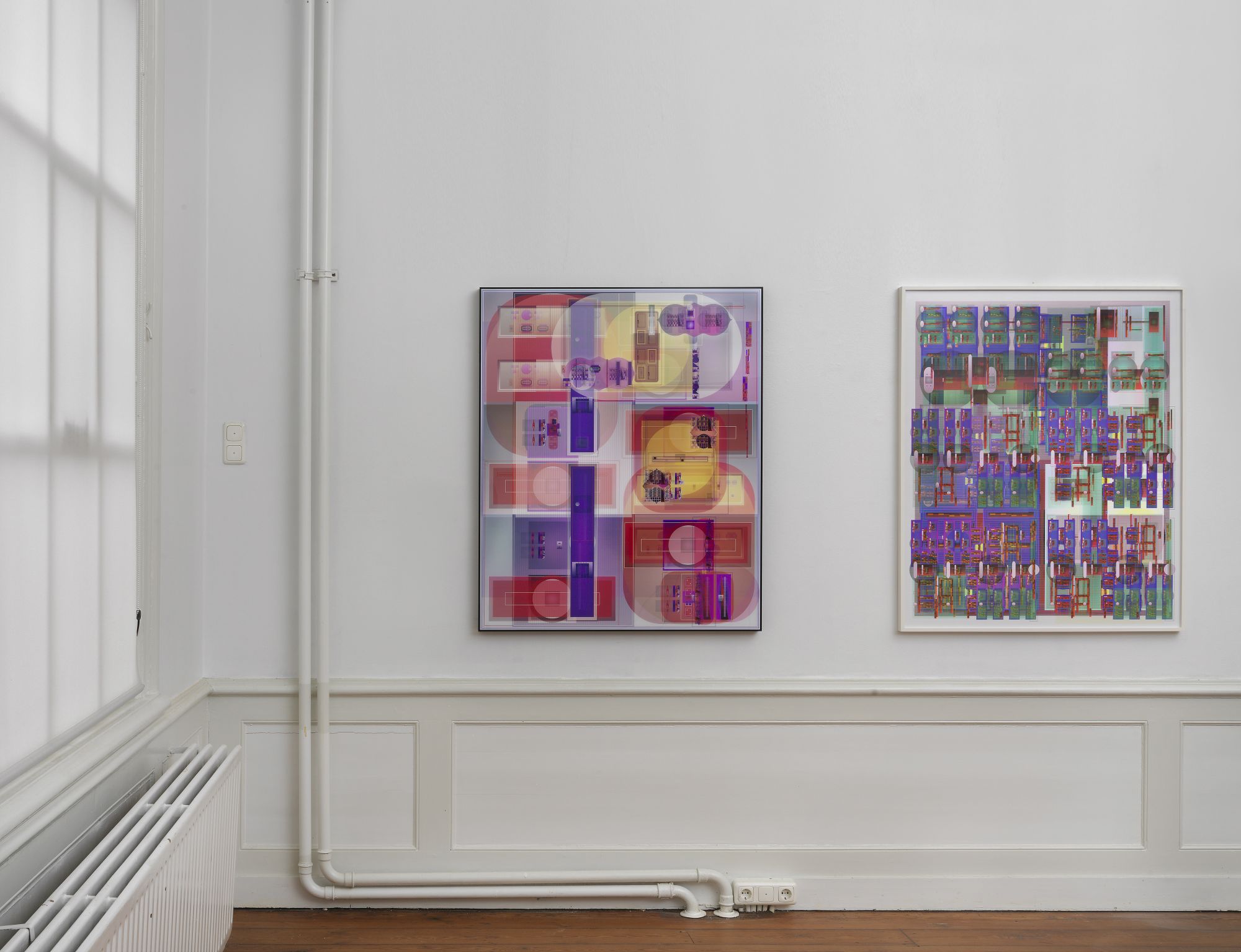
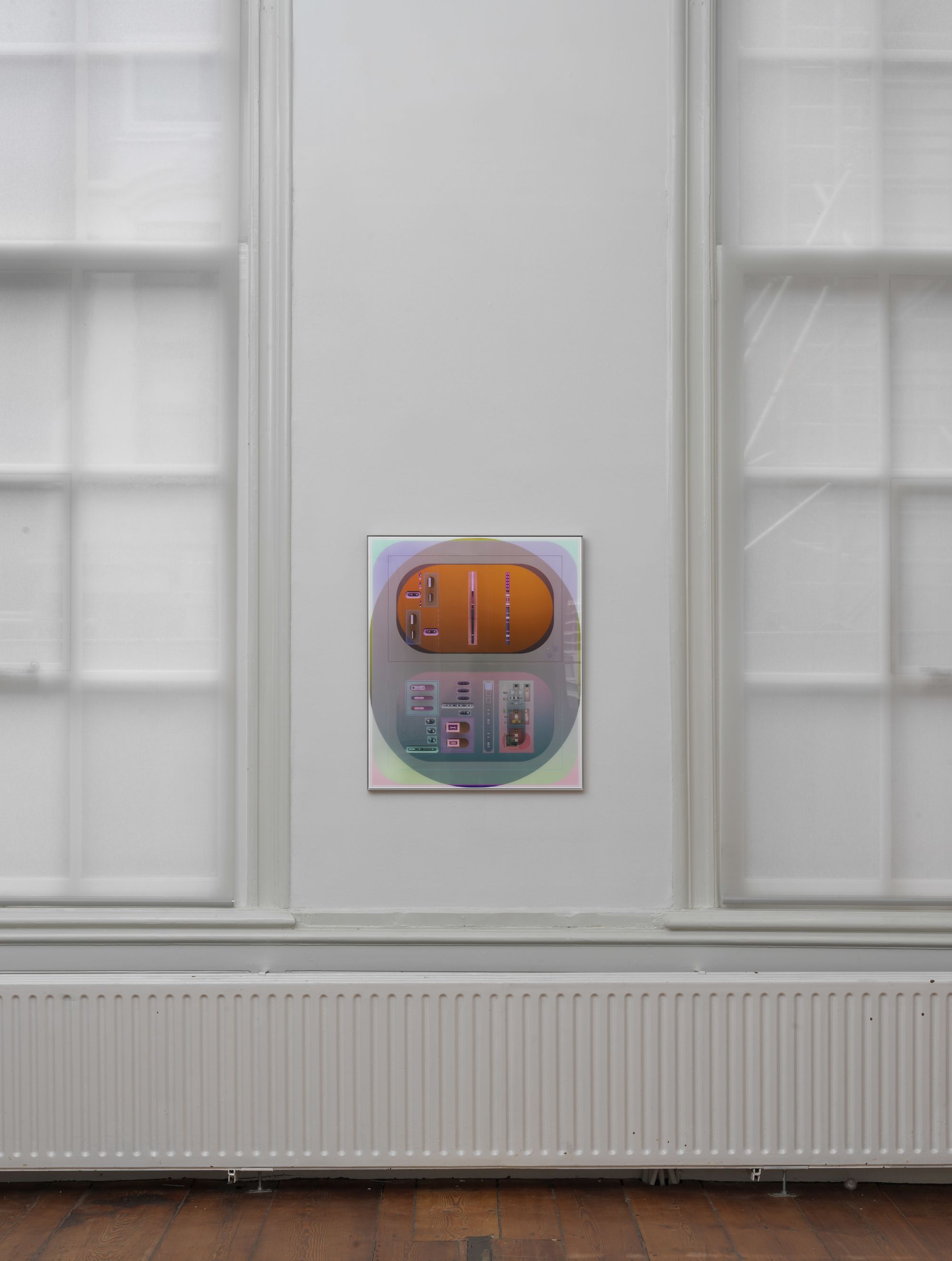
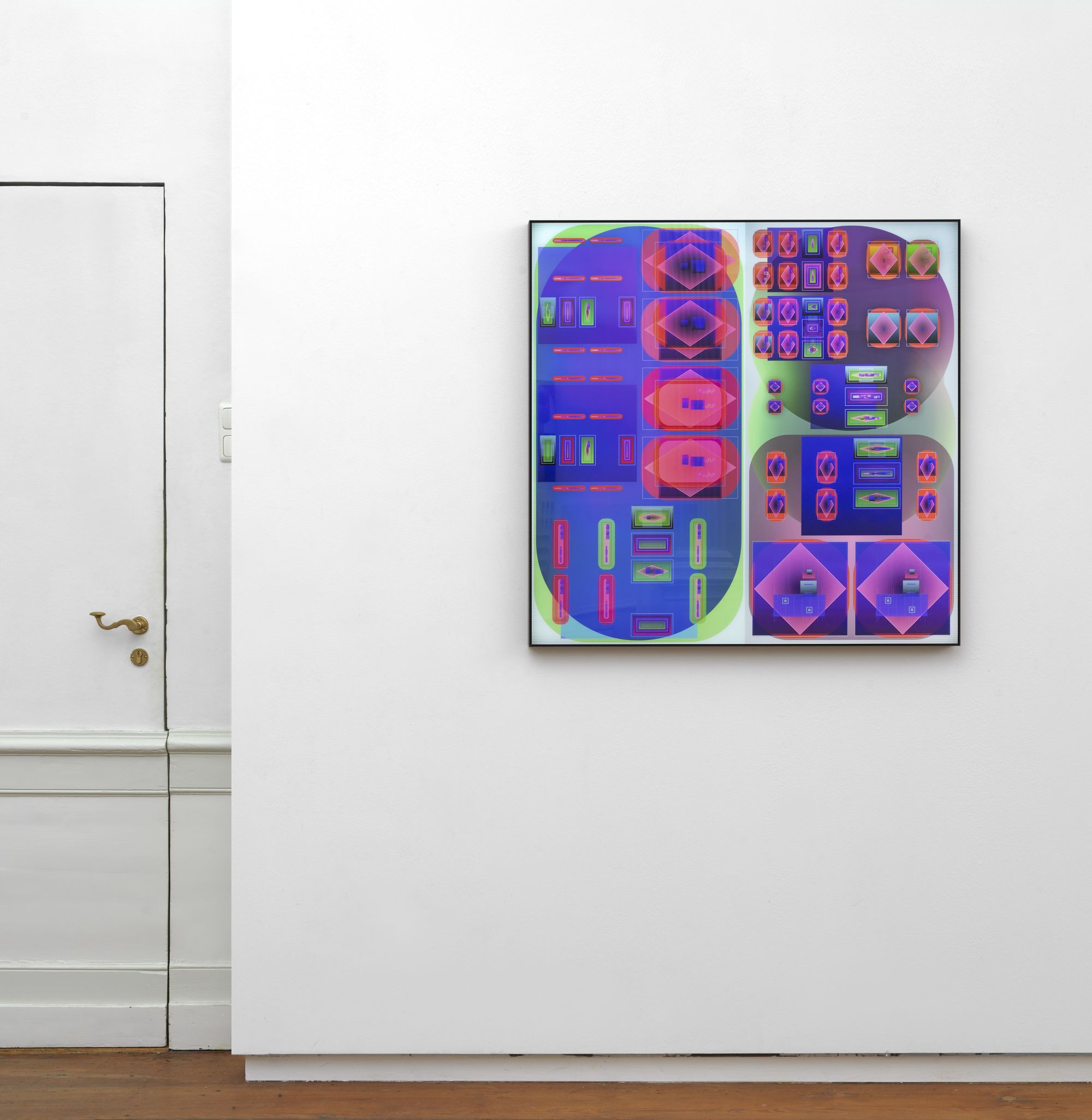
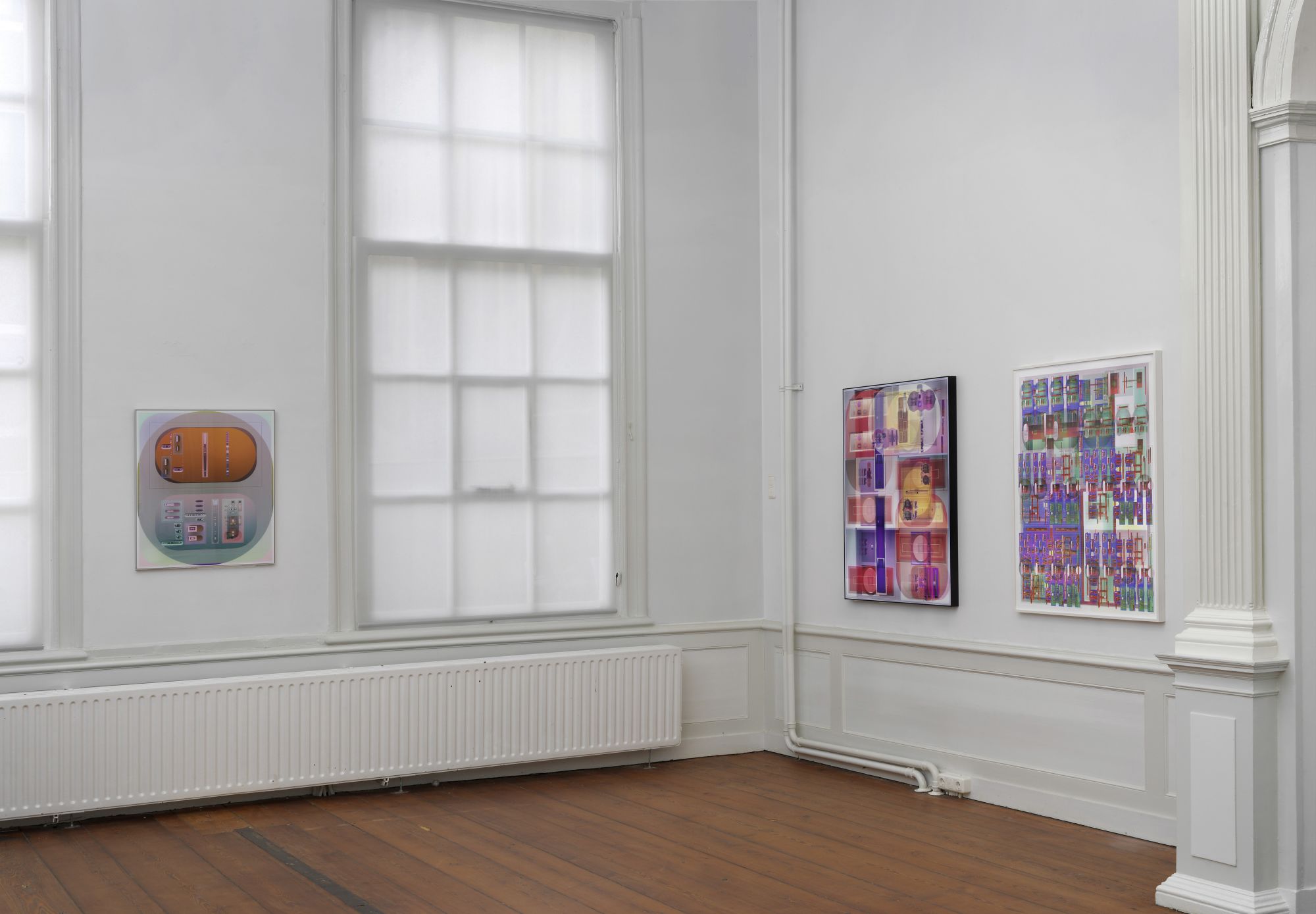
Five of the 2021 works are exposures on light-sensitive metallic paper, mounted and framed: Odd Motives, Grand Formation and Plural Shim at 100 × 122 cm, Zwour at 100 × 100 cm and Moksi at 70 × 83 cm. Decent Fabric (102 × 124 cm) is an UltraChrome HD print on paper. Odd Motives fills a pale rounded field with panels of small blue, pink and orange modules. Plural Shim nests olive, pink and purple capsules inside one another. Moksi, hung alone between two windows, is an orange capsule above a grey one inside a pale disc. Zwour sets two tall blue capsules side by side, each with pink diamonds and stacked small modules. Grand Formation overlaps red, yellow and violet circles and bars; Decent Fabric is a dense grid of violet and green modules threaded with red lines. The pre-2021 works came from the same program: Triddle and Crystallophobia (2020), and Run Too (2020) on the timeline wall.
The lab: the Tracer, the timeline, the lightboxes
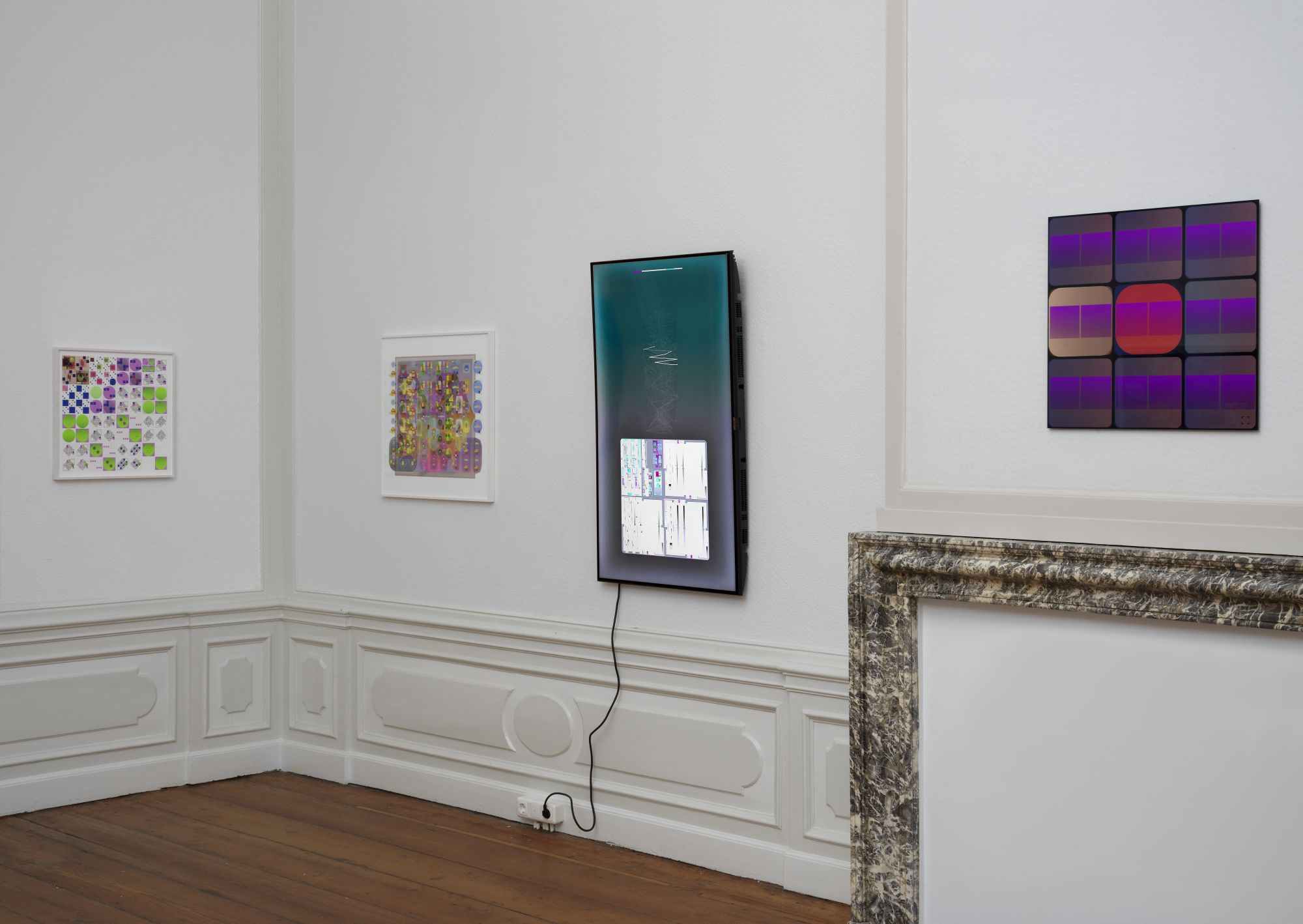
"In the smaller room (the 'lab'), an additional software work is installed which visualises how the genetic code is formatted as a two-dimensional network, and how this is parsed to generate the layered visual compositions." That is the Mutant Garden Tracer (2021), here on a portrait screen hung on the wall: a teal gradient with a thin white network of lines in its upper half and a white panel of small compositions below. On the walls around it hang Multi Dimensional Zoom (2019, 55 × 55 cm), a grid of green discs, blue squares and turned squares on white, and Crystallophobia (2020), a dense block of yellow, green and violet modules. Over the marble fireplace hangs Triddle (2020, exposure on metallic paper, 60 × 60 cm): nine rounded tiles in purple and violet, the centre one red.
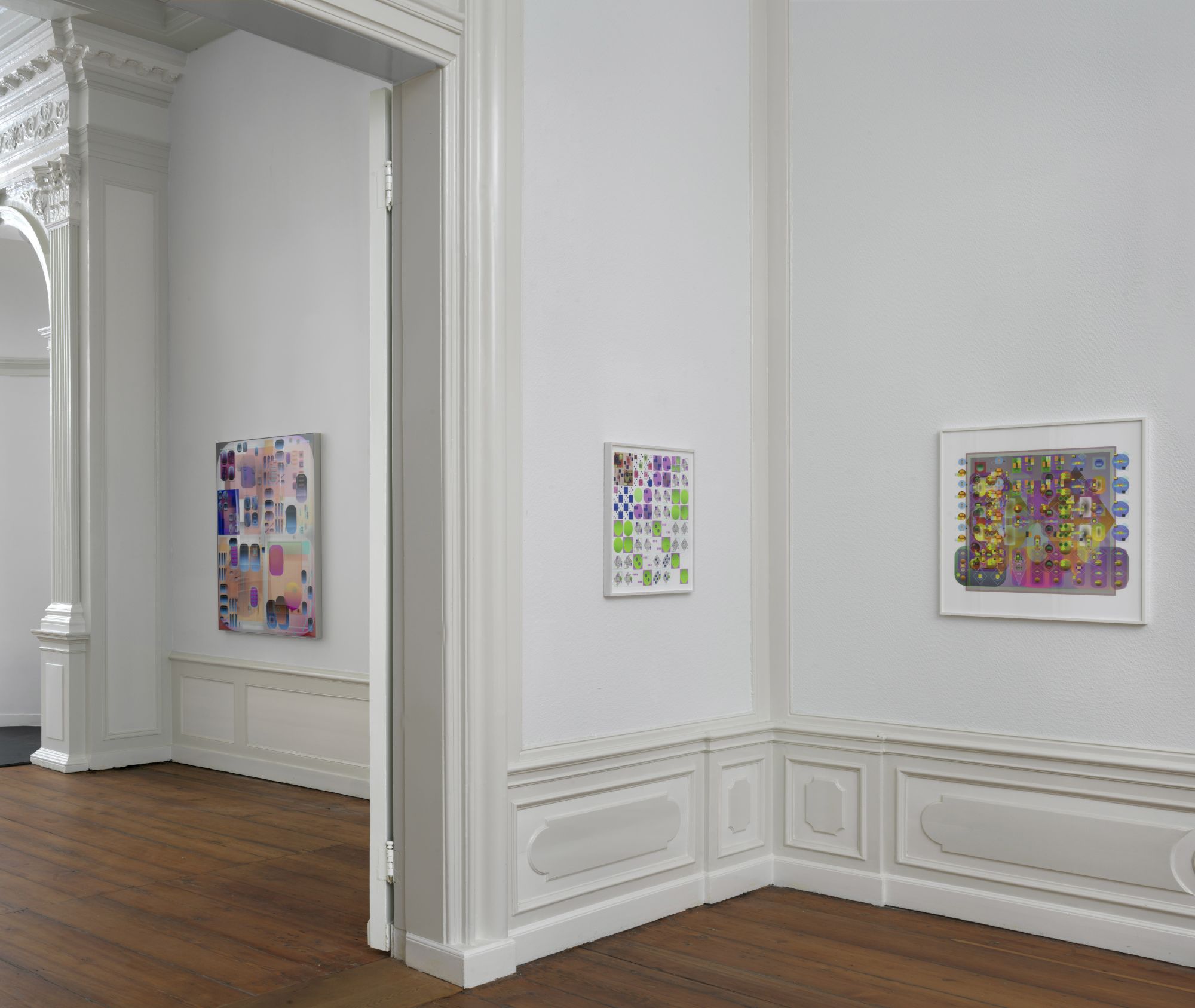
Seen from the lab, through the open door, Odd Motives hangs in the garden; in the near room Multi Dimensional Zoom and Crystallophobia hang on the corner walls.
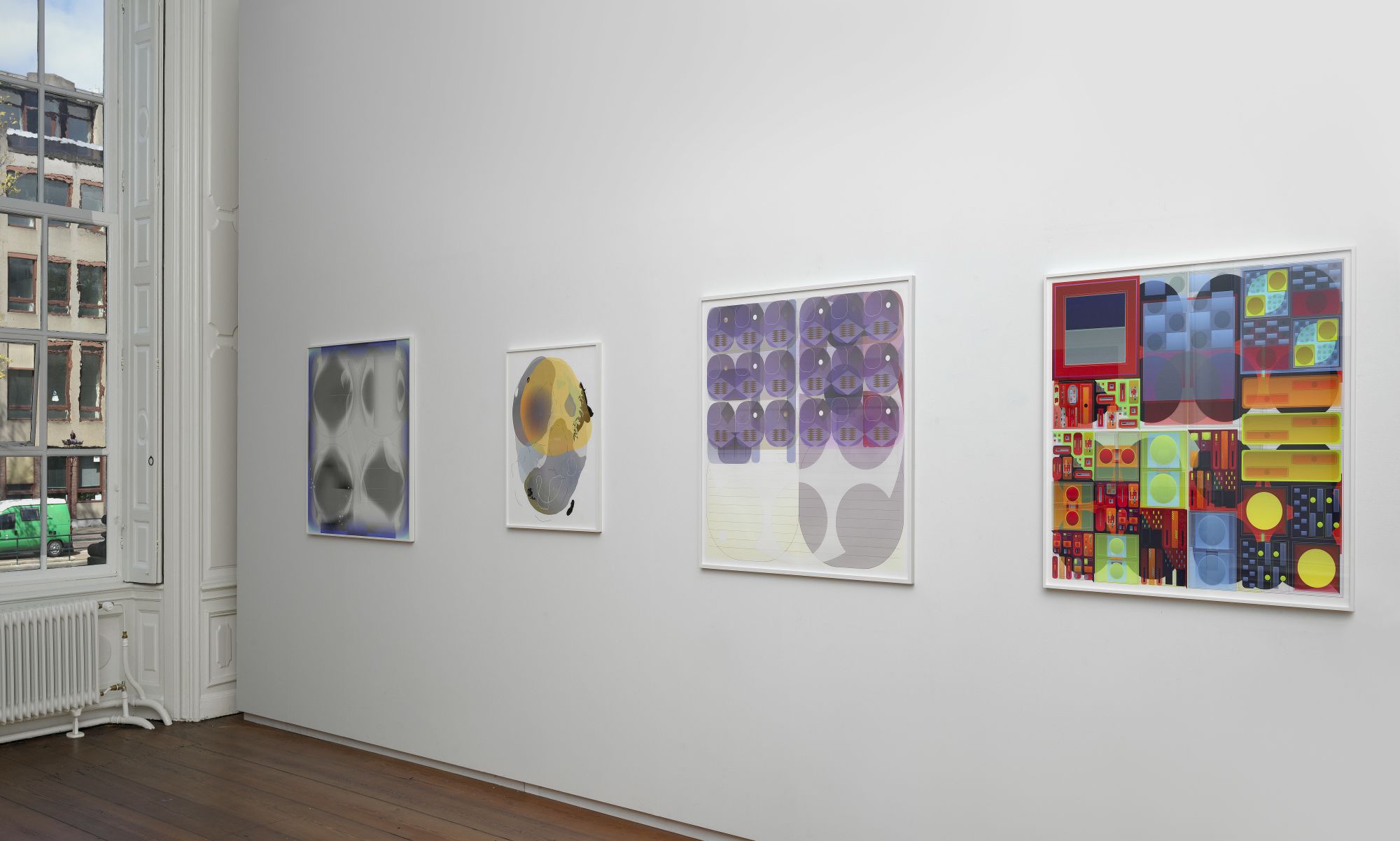
"On one wall, as a timeline of my larger project of algorithmic archaeology, from each iteration, one work is installed, highlighting my own artistic practice as a genealogy as well." The photograph shows four works, which match harm.work's records of one work from each of his four breeding series, in the order he began them. From left: Big Pablo Ferenc Zatlas (2021), a Death Imitates Language specimen printed on perforated paper, four blurred grey discs in a violet border; Unheard Estimator (2019, 80 × 65 cm), from Algues Artificielles, a yellow and grey blob crossed by dark curves; Cussos Unfence Thermographers (2018), from Nested Exchange (→ Nested Exchange), a grid of purple rounded tiles above pale shapes; and Run Too (2020, 100 × 100 cm), from Mutant Garden, a square of red, grey, yellow and blue modules. The selection criteria of the four lines are compared on Evolutionary Logic. The wall shows the method the Spike interview calls algorithmic archaeology turned on his own work (→ Algorithmic Archaeology).
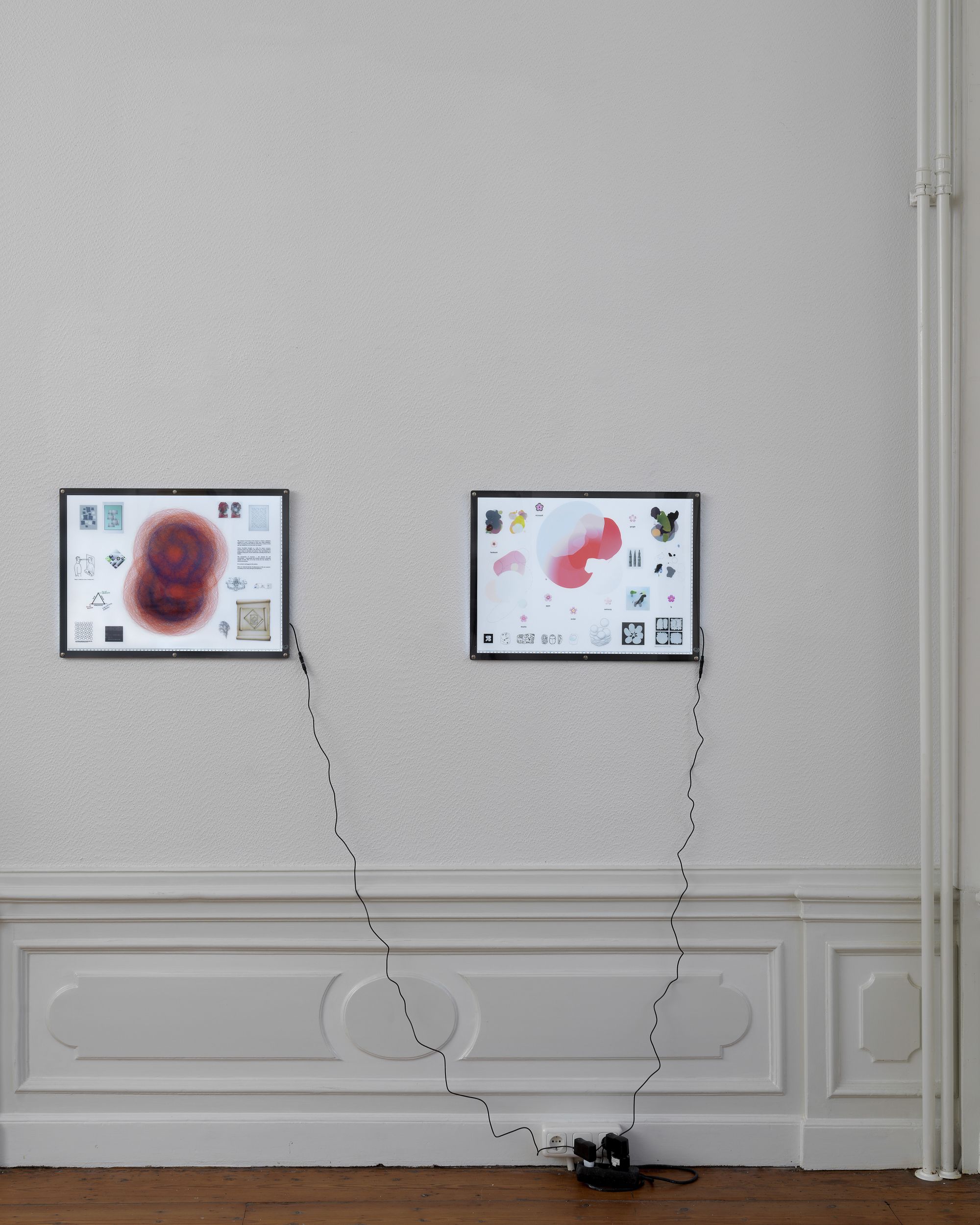
"To conclude, a series of light emitting tablets connect the various algorithms, series, works by myself, by other contemporary artists, and historical art movements. These help me define my activities in a broader artistic and historical frame, and appreciate associations in their own right." These are the three Associative Displays, LED lightboxes in custom casings with UV prints. On each a central image is surrounded by small reproductions. On Associative Display (recursion) the centre is an orange and violet double spiral, with triangles, diagrams and a framed scroll around it. On Associative Display (organisms) (2020, 47.5 × 64.5 cm) it is a red and pink blob among flowers and small organic shapes. Associative Display (painting) lays out grids of paintings and colour fields. The wiki connects the closing phrase, "appreciate associations in their own right", to Dissociations (2010), the website built on associations between images (→ Subconscious Computation); the text itself does not name it.
Tokens at the gallery
During Amsterdam Art Week in June 2021, while the show was on, the gallery offered 64 Mutant Garden Seeder tokens minted in advance with Folia, a month before the public launch (Prelaunch Mutant Garden Seeder NFT). Visitors paid "with fiat currency", and for most it was the first NFT they owned (FAQ, 2021). Van den Dorpel told ZORA ZINE: "We gave workshops, we're like 'Bring your computer! Write down your seed phrase (don't forget it)!' They were hooked. Then my NFT is next to a painting by some artist or a sculpture, which is very good for me artistically" (→ ZORA ZINE). The tokens and how they mutate are described on Mutant Garden. The Seeder's site still shows an installation view of the show on its about page.
Reception
HOLO's news stream noted the opening: the show was "surveying the artist's research into evolutionary algorithms" and divided "into a 'garden' for breeding artwork … and a 'lab' for sharing process" (HOLO, archived). The longest response is Tina Rivers Ryan's interview in Spike #70 (Winter 2021/22), which takes the screens and square wall objects of the Upstream show as its starting point for the squircle, fossils and algorithmic archaeology (→ Spike #70). No review in the Dutch press has been found.
Works from the show went on to BioMedia at ZKM Karlsruhe (December 2021 – August 2022): the Mutant Garden Autobreeder, the Mutant Garden Tracer and two of the Associative Displays (→ BioMedia). Big Pablo Ferenc Zatlas and the Autobreeder were shown again in Context Switch (Galerie Noah Klink, Berlin, 2022–23; → Context Switch).
Works in this exhibition
Per harm.work.
| Work | Year | Medium | Size |
|---|---|---|---|
| Mutant Garden Autobreeder | 2021 | generative software | variable |
| Mutant Garden Tracer | 2021 | software | variable |
| Moksi | 2021 | exposure on light-sensitive metallic paper, mounted and framed | 70 × 83 cm |
| Odd Motives | 2021 | exposure on light-sensitive metallic paper, mounted and framed | 100 × 122 cm |
| Grand Formation | 2021 | exposure on light-sensitive metallic paper, mounted and framed | 100 × 122 cm |
| Plural Shim | 2021 | exposure on light-sensitive metallic paper, mounted and framed | 100 × 122 cm |
| Zwour | 2021 | exposure on light-sensitive metallic paper, mounted and framed | 100 × 100 cm |
| Decent Fabric | 2021 | UltraChrome HD print on archival fine art paper | 102 × 124 cm |
| Triddle | 2020 | exposure on light-sensitive metallic paper, mounted | 60 × 60 cm |
| Run Too | 2020 | 100 × 100 cm | |
| Crystallophobia | 2020 | UltraChrome print on Hahnemühle semi-glossy paper | 70 × 70 cm |
| Mutant .garden | 2020 | website | — |
| Multi Dimensional Zoom | 2019 | 55 × 55 cm | |
| Unheard Estimator | 2019 | print (Algues Artificielles) | 80 × 65 cm |
| Cussos Unfence Thermographers | 2019 | print (Nested Exchange) | 100 × 100 cm |
| Big Pablo Ferenc Zatlas | 2021 | UltraChrome print on CNC perforated German Etching Hahnemühle paper, framed (Death Imitates Language) | 100 × 100 cm |
| Associative Display (painting) | 2021 | LED lightbox in custom casing, UV print | — |
| Associative Display (recursion) | 2021 | LED lightbox in custom casing, UV print | — |
| Associative Display (organisms) | 2020 | LED lightbox in custom casing, UV print | 47.5 × 64.5 cm |
See also
- Mutant Garden (2019–) — the body of work, the Protoseeders, the Seeder and its Mutations
- Evolutionary Logic — Cartesian genetic programming and the fitness functions
- Spike #70 — Tina Rivers Ryan on the Upstream show
- Interview with Julian F. Miller — published two weeks after the opening
- Our Inner Child (2023) — his next solo show at Upstream Gallery
- Algorithmic Archaeology — the timeline wall