
Nested Exchange (2017–2019)
Nested Exchange is the genetic-algorithm series that followed Death Imitates Language (2016) and came before Mutant Garden (2019–). harm.work dates the series 2018 and lists thirteen entries: the software Nested Exchange (2017), ten wall works of 100 × 100 cm made in 2018 and 2019, and two tokens minted later from outputs of 2017. Its series text, by the artist, opens: "The works in 'Nested Exchange' could be thought of as 'information works' as much as art works. The individual specimens find their form by a process of information exchange with each other" (series text).
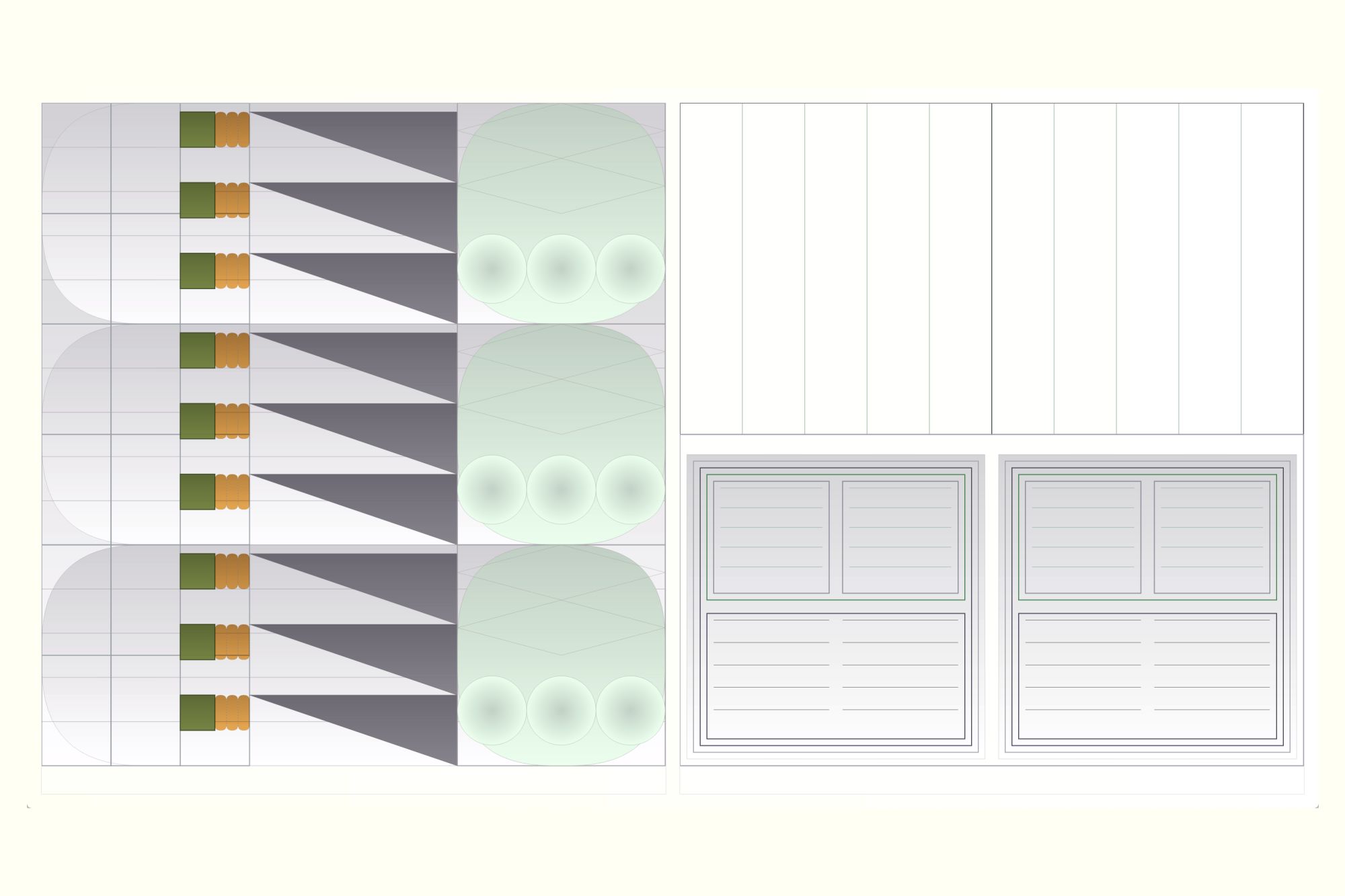
Two specimens from one population. The left one repeats a single row three times; in each row a pale green rounded square contains three circles. The right one sets white vertical stripes above two identical framed panels. Both are built by subdivision, and both repeat what they subdivide.
A tree for a chromosome
In Death Imitates Language each specimen carried a linear chromosome, a string of genes. The exhibition text of Uninnocent Bystander (Lehmann + Silva, Porto, 2019) gives the reason for the change (text): "To overcome the size restrictions imposed by creating works using a linear chromosome as a primary reference point (which is how genetics function in nature), van den Dorpel turned to a hierarchical form of organization which he encountered in the analysis of natural human language." The series text names the source: "The specimens are configured in nested recursive 'tree' structures similar to those used in the first iterations of Chomskyan linguistics", the phrase-structure trees of Noam Chomsky's early work. When he sold the two populations as tokens in 2018, the species were described in exactly these terms: Death Imitates Language as "Linear chromosome cross-over population", Nested Exchange as "Tree shaped chromosomes ledger exchange" (→ Protocol, Taste, and Systems, under Collective taste). The code of the web version, which carries the same list of species, calls the nested one "Nesting FYI". His presentation notes of 2018, quoted in the catalogue of E-State Realisms, describe the life of a work: "the artwork begins its life as a digital specimen that lives in the cloud. It is ascribed pseudo-biological properties such as a chromosome to breed and birth children across generations and form part of a population" (catalogue).
The web version of Nested Exchange, still online at exchange.harmvandendorpel.com (page title "Nested Exchange (web version), 2018"), shows what such a tree is made of. Every node is an instruction for a rectangle. Some nodes split it, in halves or in thirds, and hand each part to a child. Some draw in it: a fill, a rounded fill, a circle, an ellipse, a triangle, a framed box, a window. Most change the state that later nodes inherit: a colour channel up or down, a blending mode, a margin, a rotation, dashed or solid outlines, rounder or squarer corners, the direction of a gradient. The leaves draw nothing. A picture is the tree read from the root, each part taking its place and colour from the parts that contain it.
Repetition is built into the splitting nodes. One kind gives each half or third its own branch; another draws the same branch in two or three places. The works repeat whole groups of forms in just this way: the left specimen above reads as one branch drawn three times, and Peached Renitencies Mercer (below) is one branch drawn twice, side by side. The reasons he later gave for leaving nesting, that it "implies a hierarchical document, with a schema, types and modules", are on The Grid, under From nesting to the grid.
The exchange
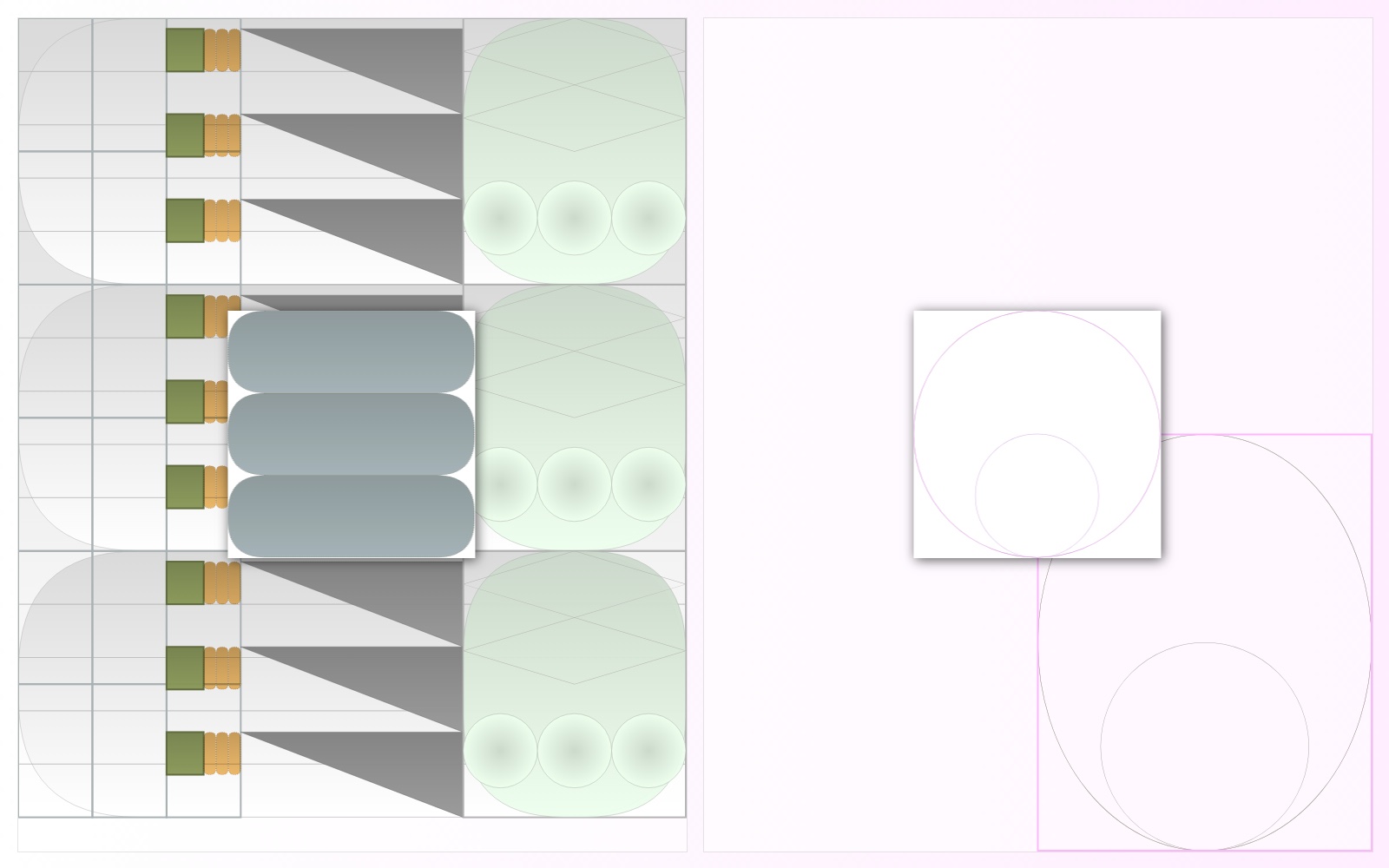
The series text: "Two works are taken from a determined population and communicate - gossip if you will - by flipping a node of their nested structure." The exhibition guide of Proof of Work (2018) puts it more plainly: two designs "communicate by swapping a node from their respective structures" (guide).
The web version performs this on screen. It shows two works side by side, half the time the two parents of one family in the population, otherwise two works drawn at random. It picks a node with children somewhere in each tree, picks one child of each, and swaps the two branches. Each branch is drawn as a small thumbnail over its work, the thumbnails cross, and both works are redrawn with the other's branch in place. The capture above was taken mid-exchange: a stack of three grey rounded bars leaves the left work, a circle in a square leaves the right one. A pair exchanges eight times, sometimes a few more; then one partner is replaced by another work, or a new pair is shown.
Two checks in the code match sentences of the series text. After every swap the program counts the nodes of both trees and discards the result, with an error, if the total has changed. The series text: "in the work no new information - per se - is produced, but existing information is recombined." The second check rejects a swap if either exchanged branch renders as an empty picture, so that every exchange changes what is seen.
The hipster algorithm
The criterion of selection is difference. The series text: "The imperative of the work is to produce the greatest diversity possible, so each specimen is driven to be as different as it can be from those around it (I've also called this my "hipster algorithm")." In Spike #70 (2021/22) he told Tina Rivers Ryan that each specimen "was judged as being more successful the more it was different from all the others. Each one wanted to be as unique as possible in the population, just like at a music festival, where everybody thinks they're unique, but also looks quite similar to everyone else there." Evolutionary Logic sets this criterion beside the others he has used: his own choice in Death Imitates Language, the visitors' in Hybrid Vigor .bio, simple construction against complex appearance in Mutant Garden.
The web version does not measure difference. Its two checks only make sure that an exchange conserves the nodes and can be seen. The selection for diversity that the series text and the interview describe is not in this code, and where it ran is not recorded. What the web version shows is the exchange itself, without an end.
Snapshots and the ledger
"The system records its changes between states as 'snapshots', leaving a complete history of itself in a manner similar to a blockchain ledger" (series text). In the web version each child is given a fingerprint of its tree, the fingerprints of its two parents and a generation number, one higher than its parents'. The press release of Pattern and Presence (Upstream Gallery, Amsterdam, 2018; press release), his first solo show with the gallery, describes the series as "printed transparent work (which is a continuation of his earlier series 'Death Imitates Language')" focused on "the structure of 'nesting': a strong organizing principle found in architecture, software development and human language", and says each work was assigned "a unique identifier (a hash or fingerprint)" on the Ethereum blockchain, which leads it to ask: "are the works in fact the works? Or, are they representations of an external, less material essence?" The Proof of Work guide makes the same comparison: "The artwork produced is a record of a moment in this automated evolution. This mirrors blockchain's ledger system".
The titles carry the generation when it is known. The guide lists Lammer Asbestus (Second Generation); harm.work keeps Wyn (generation unknown). Several titles were longer when first shown. The E-State Realisms catalogue of 2018 lists Windbags Disfrocked Sensualist, Readjusted Electrotype and Colonialists Criminate Rashes, all dated 2018; harm.work shortens the first words to initials, as Sensualist (its address keeps the w-d), R. Electrotype and C. C. Rashes. Both prints are of 2018, as the catalogue has it (the artist, November 2026).
The works
The wall works are of two kinds, all 100 cm square. Four are acrylic panels, 4 cm deep on harm.work, mounted off the wall on steel bolts; the Proof of Work guide describes two of them as "UV Print on 3 CNC routed sheets of acrylic glass". The other six are prints; harm.work gives the paper only for R. Electrotype, UltraChrome on Hahnemühle.
The acrylic panels
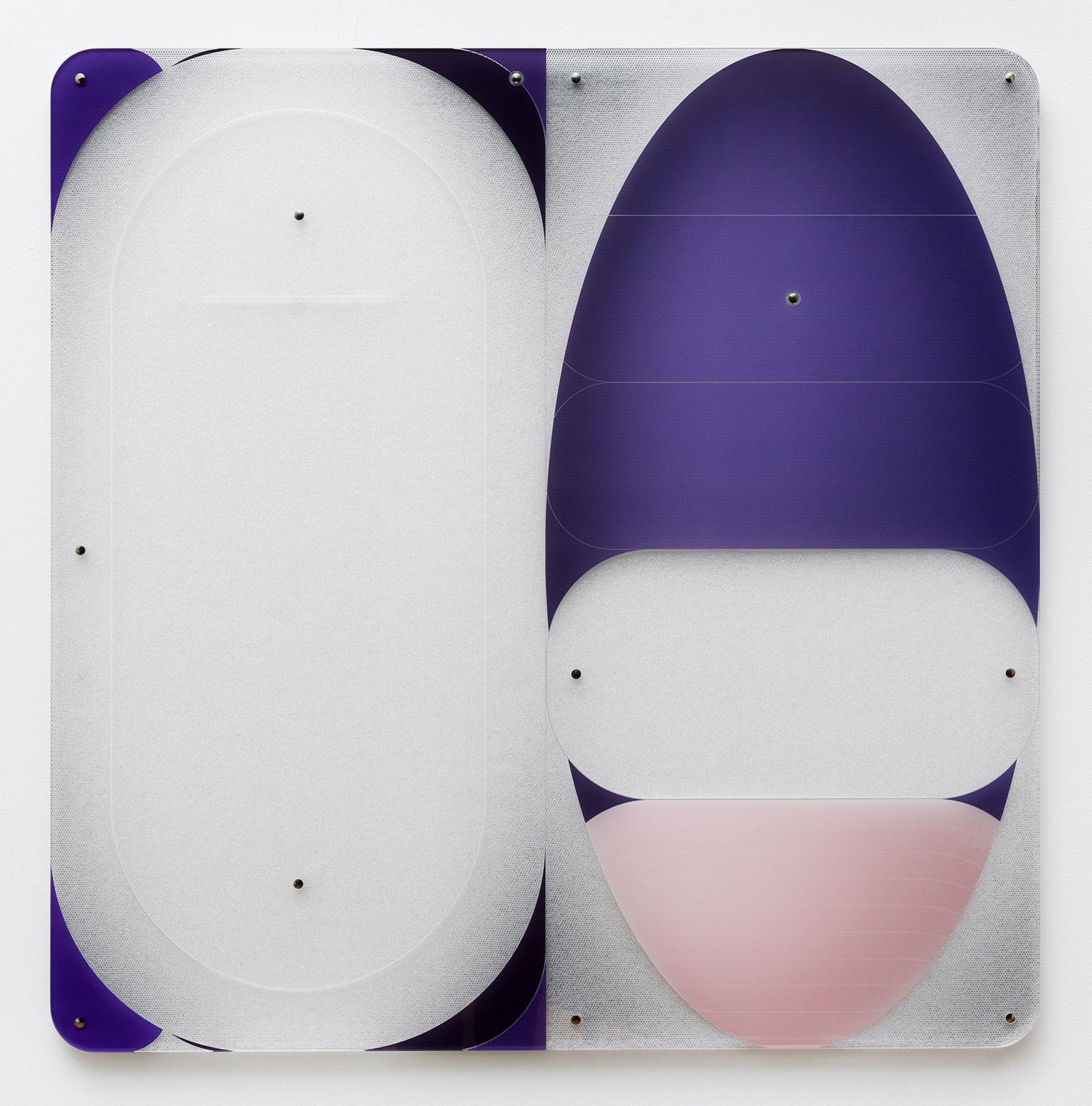
Hexamerisms splits the square into two halves. The left half is a tall white rounded column with violet in its corners. The right half is a violet egg divided across into bands: violet at the top, a white rounded bar in the middle, pink at the base.
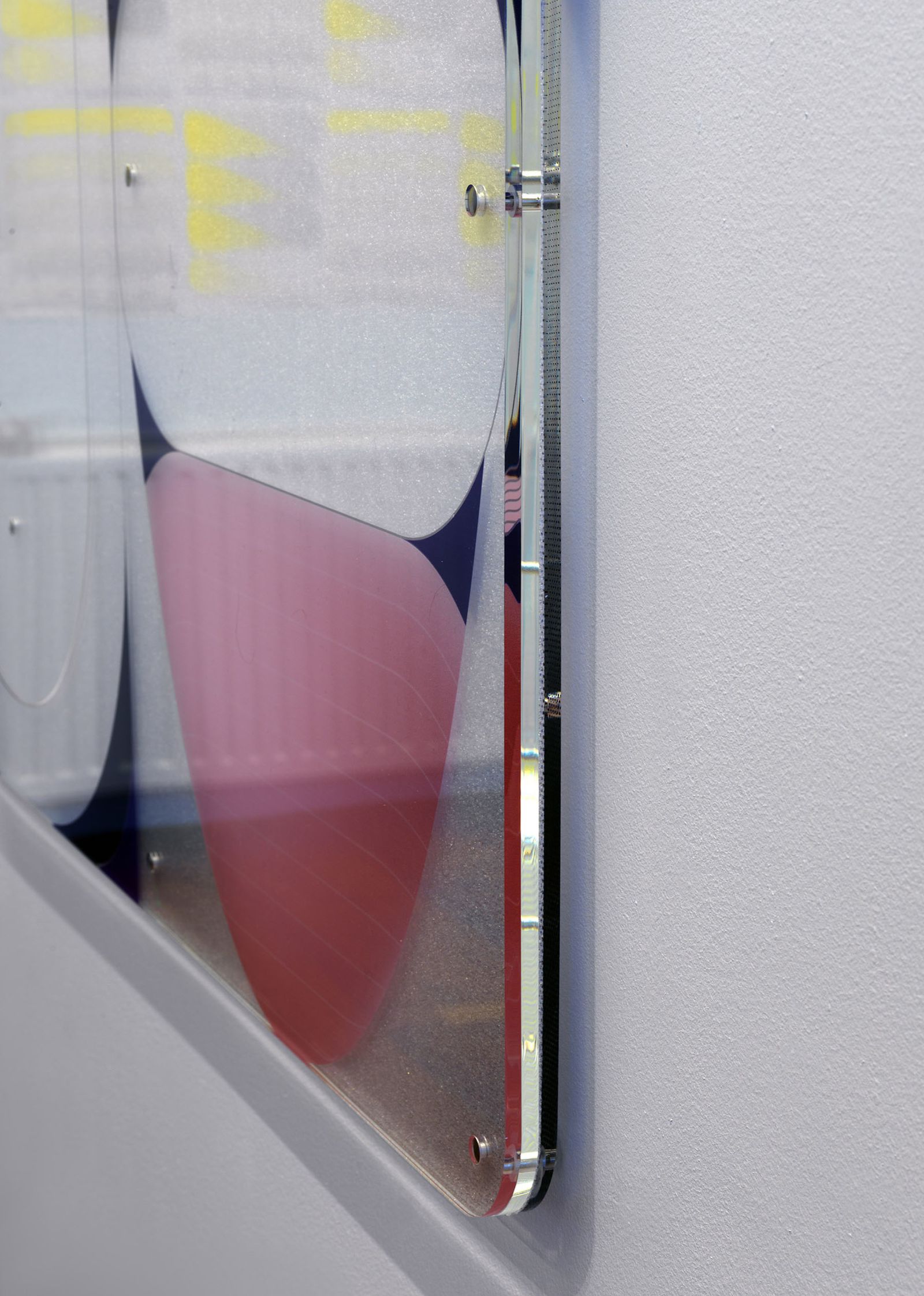
Seen from the side, the panel is a stack of acrylic sheets spaced apart by steel standoffs, and the pink form shows through the frosted front sheet.
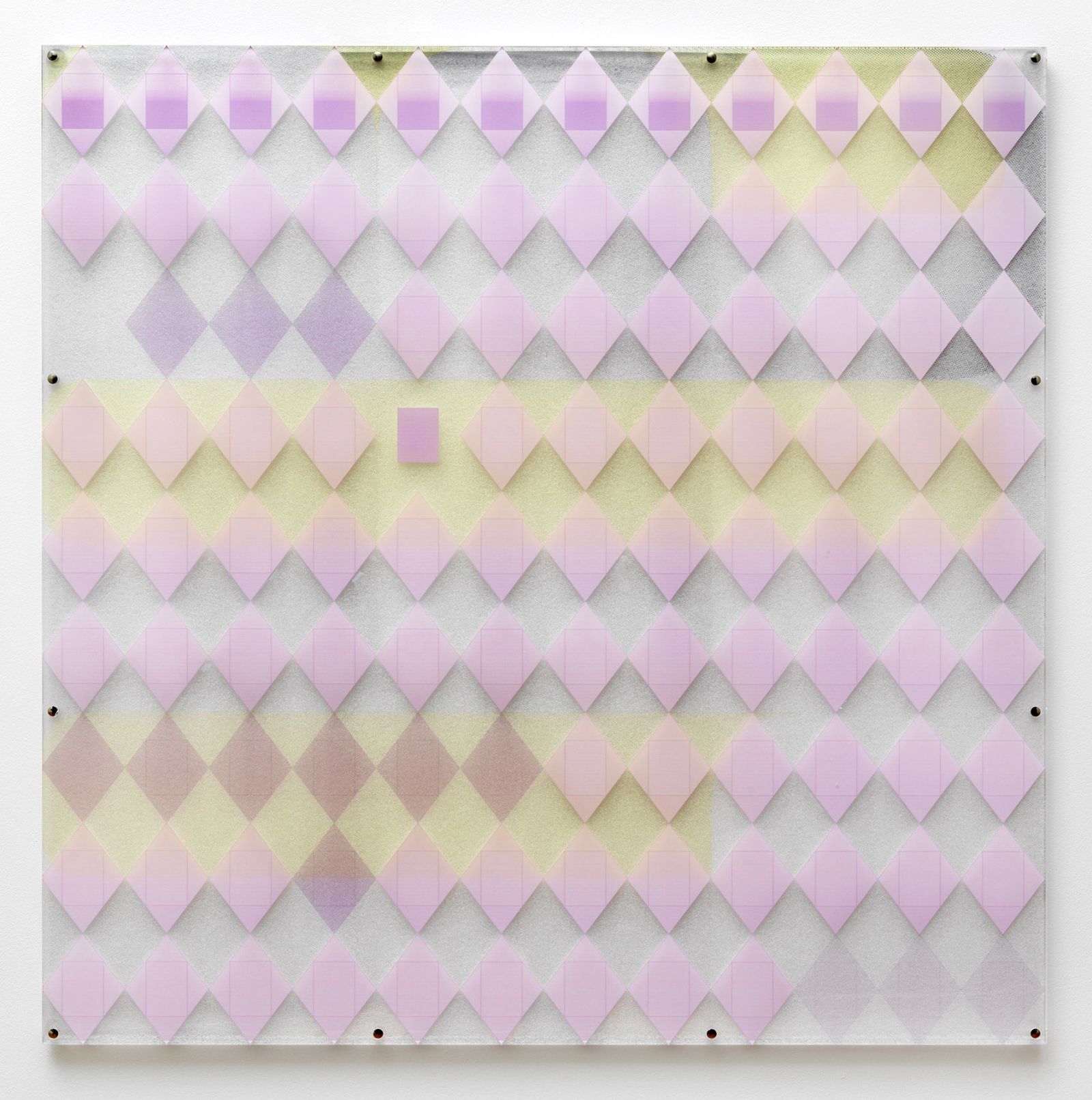
Fissured Petrolling Mridangam is the most regular work in the series: rows of lozenges in pale pink, yellow and violet cover the panel, with a small violet square in each lozenge of the top row and one stray square lower down. In the terms of the web version's code, a lattice like this is what a split that repeats one branch gives when it is applied level after level. In 2022 he filed this panel in an are.na channel called Alternating grids (→ The Grid, under Nesting in the earlier work).
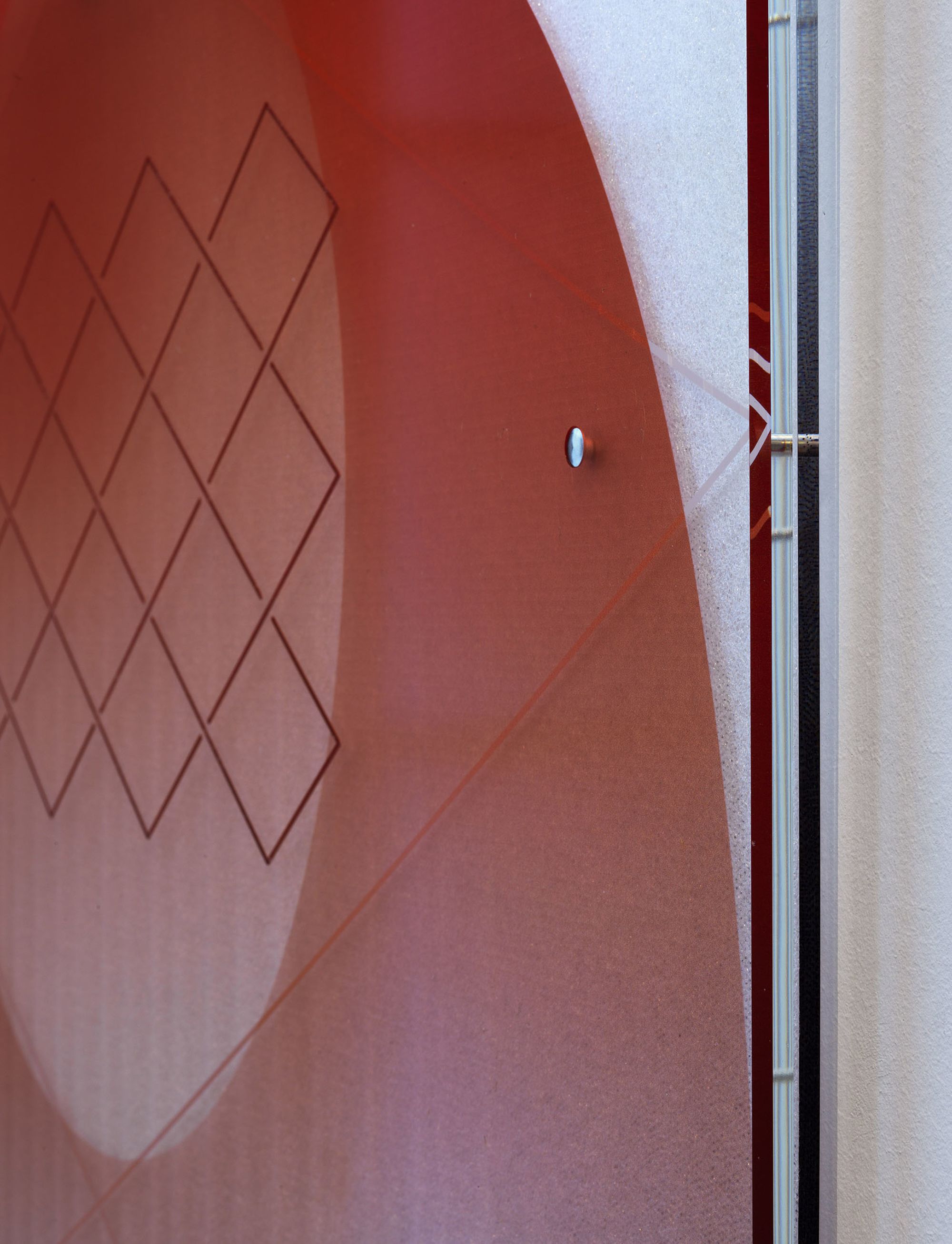
Lammer Asbestos prints a rounded square shading from orange to grey (→ The Squircle, under The wall objects of 2017–2018). The detail shows a lattice of thin diamond lines over the soft red-to-pink colour, a bolt head, and at the edge the stacked sheets. Wyn (generation unknown), the fourth panel, has two rounded lower corners and is printed with pale yellow and pink circles, framed squares and groups of parallel lines; he later filed it first in an are.na channel called Mandala (→ Sacred Geometry).
The prints
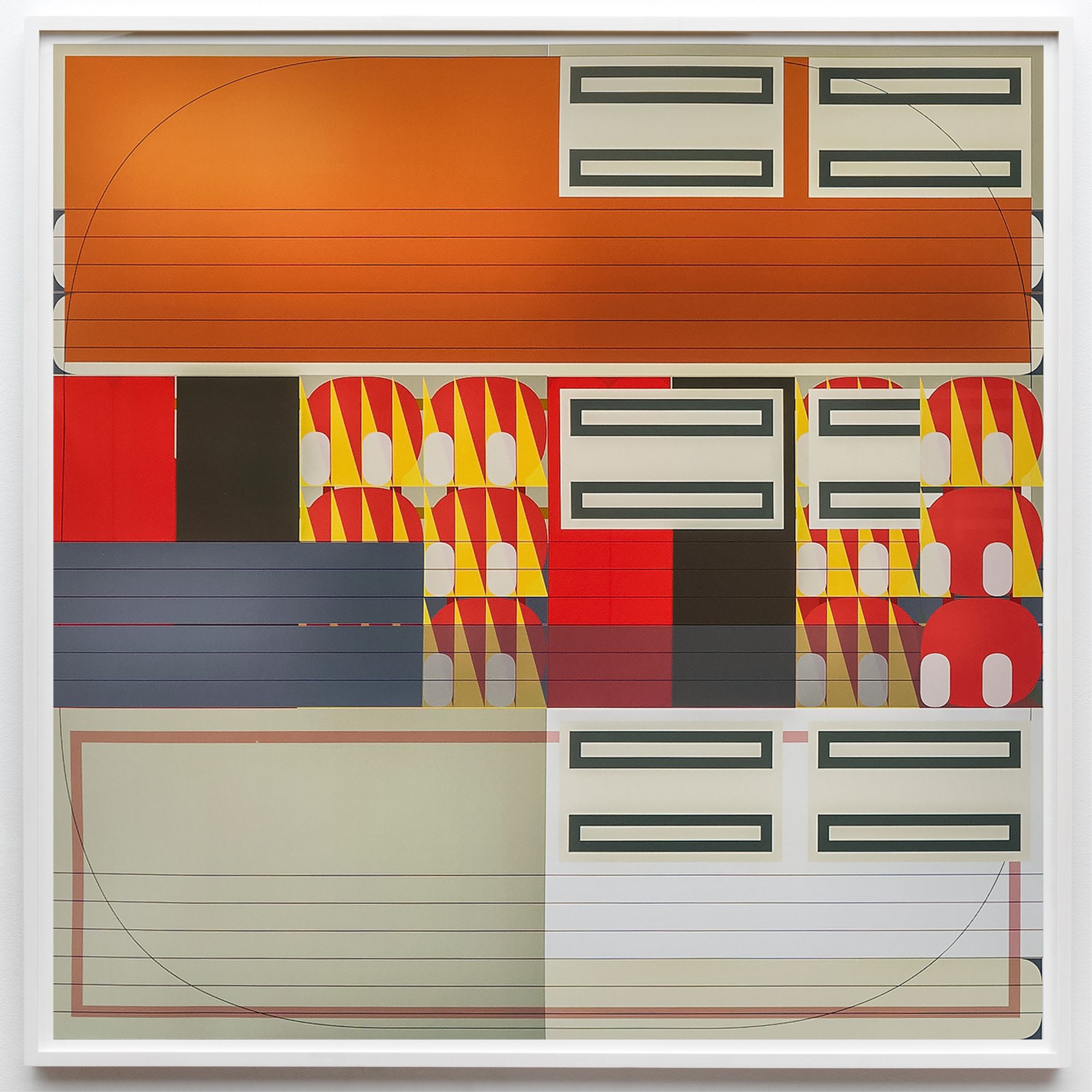
C. C. Rashes is built in horizontal bands: orange ruled with lines at the top, then red and black blocks with arched red-and-yellow motifs, a slate-blue band, and a pale band at the bottom. A pale panel with two dark-framed slots appears four times, at the upper right, the centre and the lower right, each time the same branch.
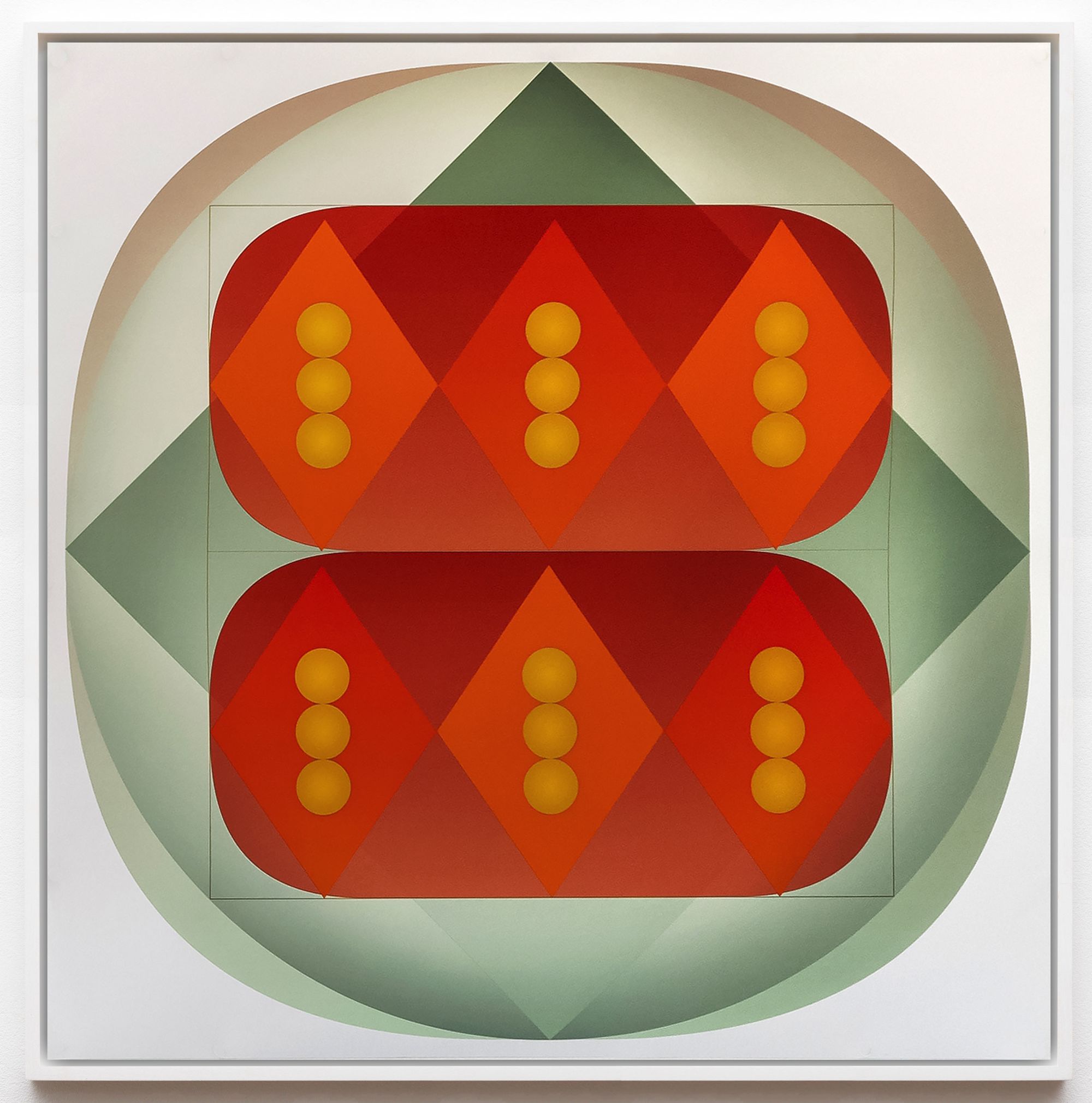
Sensualist is symmetrical. A pale green rounded square contains a green lozenge, and over it two red rounded bars, one above the other. Each bar carries three orange diamonds, and each diamond a column of three yellow circles: a tripled branch inside a doubled one.
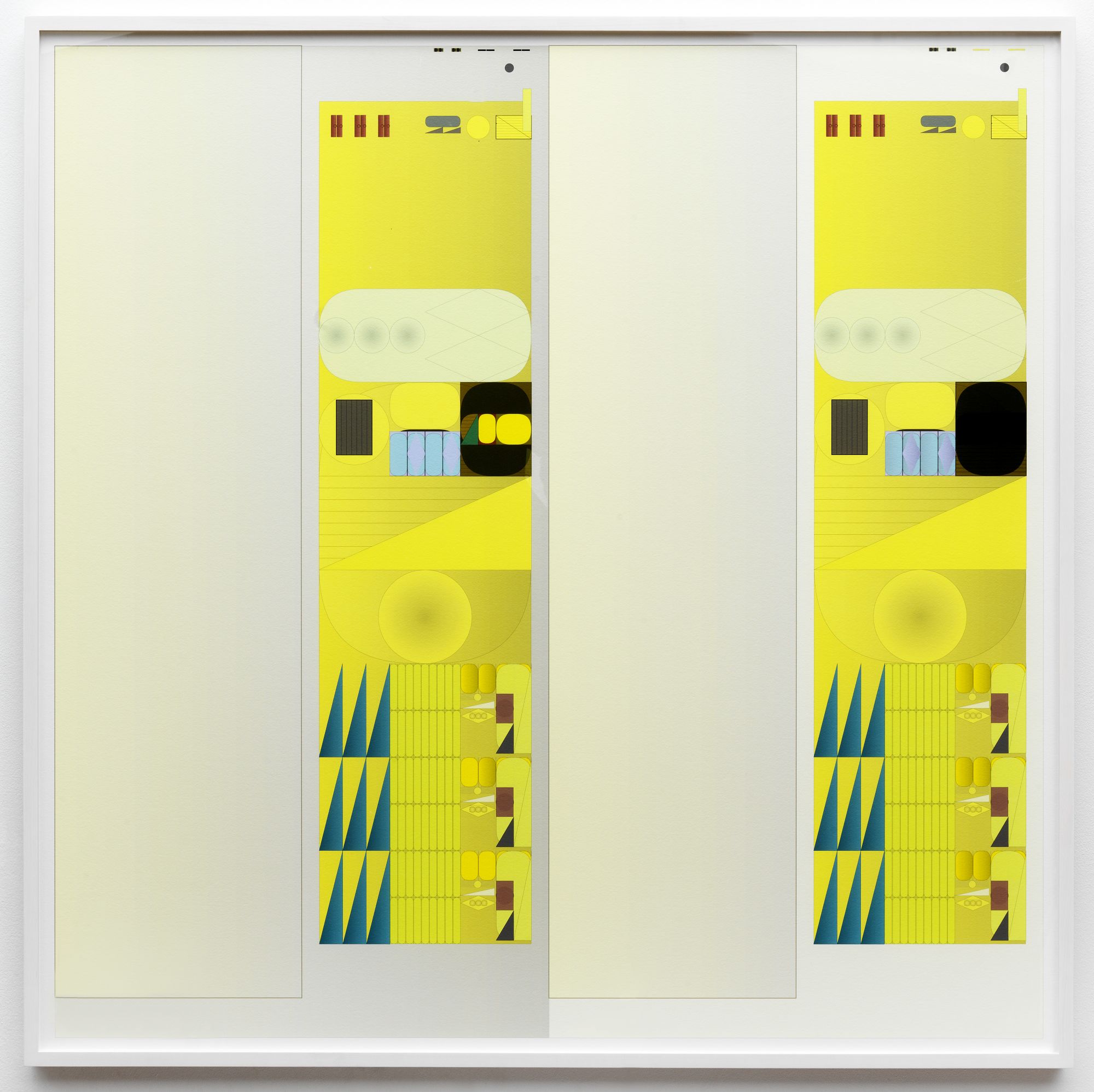
Peached Renitencies Mercer is split at the root into two identical halves. Each is a pale column beside a tall yellow strip packed with small forms: a pale rounded bar with three circles, a black rounded square, ruled blocks, a circle, and rows of blue-green triangles at the foot.
The remaining prints are illustrated elsewhere in the wiki. Seul (2018) repeats one module of orange bars, circles and a green lozenge three by three over a violet disc (→ Works Overview). Cussos Unfence Thermographers (2019) sets two groups of violet rounded squares, three by three, above pale circles and ruled bands (→ Spike #70). R. Electrotype (2018) is the one with shaded spheres, violet, pink and a gold double sphere, among ruled pink bars (→ Evolutionary Logic).
The software and the tokens
Nested Exchange (2017), the software, is the population at work; the Proof of Work guide lists it as "Generative software, infinite duration, no sound, 4K". Two outputs became tokens years later.
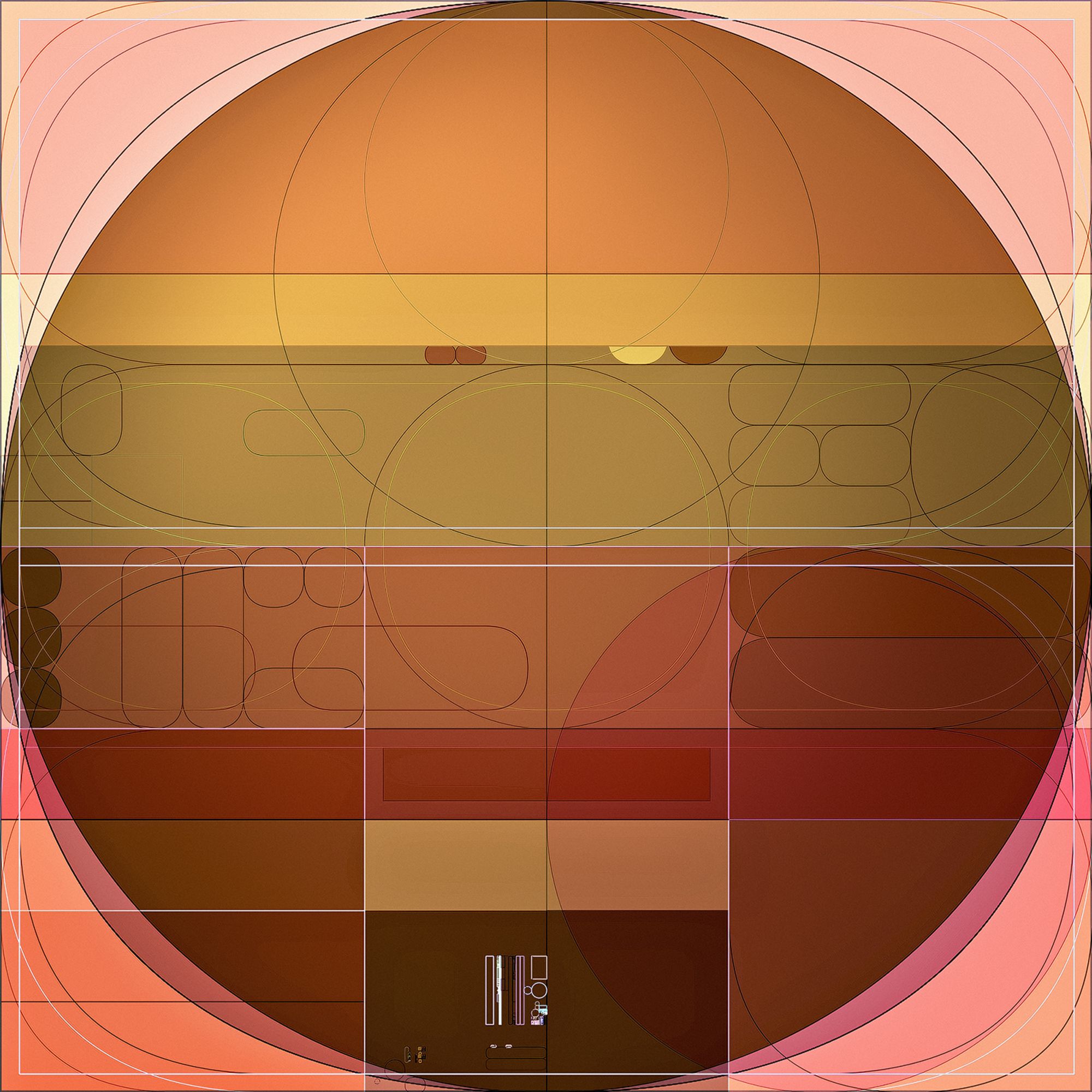
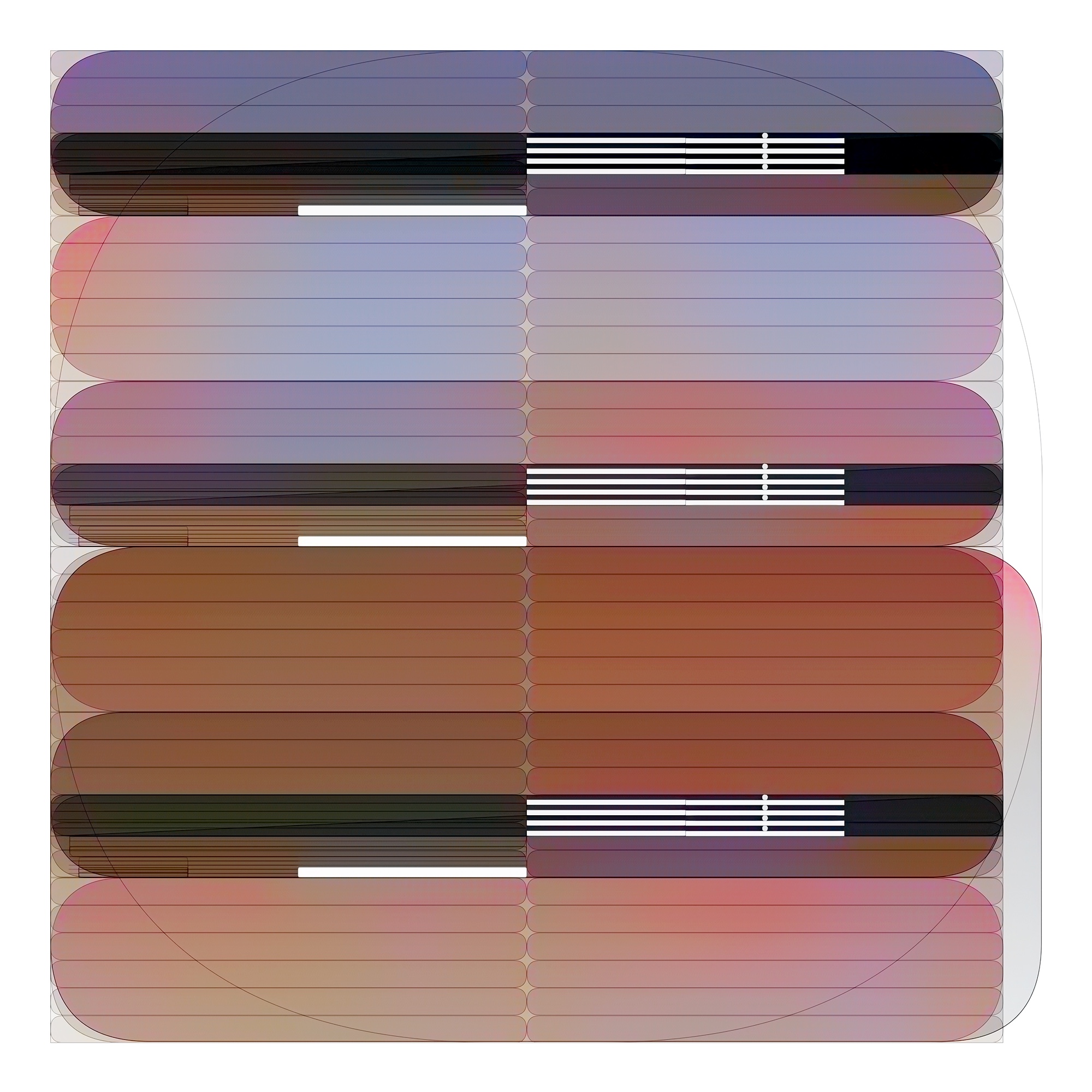
Protorb was "Rendered in 2017, remastered and minted in 2022": a large orb of orange, ochre and brown bands on pink, crossed by thin outlines of circles and rounded rectangles. It is also token 59 of the Protoseeders, a collection harm.work describes as "curated early outputs of the Mutant Garden algorithm". Segfault was "Created with the Nested Exchange algorithm (remastered in 2023)": six rounded bands stacked down the square, each split into a left and a right half, three of them crossed by a black strip of white lines.
Exhibitions
harm.work records six shows with Nested Exchange works.
- Pattern and Presence, Upstream Gallery, Amsterdam, 2018, solo: the software, Lammer Asbestos, Wyn (generation unknown), Hexamerisms and Fissured Petrolling Mridangam, with works from other series. The title is taken from N. Katherine Hayles's How We Became Posthuman (1999) (→ Pattern and Presence).
- Proof of Work, Schinkel Pavillon, Berlin, 8 September – 20 December 2018, curated by Simon Denny with others, the artist among them: the software, Lammer Asbestos and Wyn (generation unknown) (guide; → Proof of Work).
- E-State Realisms, ArtCenter/South Florida (now Oolite Arts), Miami Beach, 25 July – 30 September 2018, curated by Emer Grant: the software and prints. The catalogue reproduces Peached Renitencies Mercer, Sensualist, R. Electrotype, C. C. Rashes and a fifth print, Specktioneer Globulous Literators in conversation with Classical Addable Uxoriously, which harm.work does not list, with a token explainer. In her catalogue essay Grant calls the exchange of genetic information "gossiping," "a nod to informal networks and their continued influence across power" (catalogue; → E-State Realisms).
- Vertiginous Data, MMCA, Seoul, 23 March – 28 July 2019, curated by Deoksun Park: the software, Sensualist, C. C. Rashes, Seul and R. Electrotype (→ Vertiginous Data).
- Uninnocent Bystander, Lehmann + Silva, Porto, 2019, solo: Cussos Unfence Thermographers and Wyn (generation unknown), beside works of 2019 (→ Uninnocent Bystander).
- Mutant Garden, Upstream Gallery, Amsterdam, 2021, solo: Cussos Unfence Thermographers (→ Mutant Garden).
The Porto exhibition text marks the hand-over. Its "newest series" borrowed "Cartesian Genetic Programming", whose programs are grids that draw nested pictures (→ Evolutionary Logic; The Grid, under Dating the change).
See also
- Death Imitates Language — the linear-chromosome population before it
- Evolutionary Logic — the fitness functions compared; Cartesian genetic programming
- The Grid — nesting and the turn to the grid; the Nesting and Alternating grids channels
- Protocol, Taste, and Systems — the token shop of 2018
- The Squircle — the acrylic wall objects of 2017–2018
- Recursion and Self-Reference — nested structures across the practice