
Uninnocent Bystander — Lehmann + Silva, Porto (2019)
Solo exhibition, Lehmann + Silva, Porto, 11 May – 29 June 2019 (the gallery's website now gives 22 June). Photographs by Dinis Santos. Text: unsigned, written by the artist with William Kherbek and then rewritten ("it was a bit messy", the artist recalls, November 2026), exhibition text, also on harm.work.
Uninnocent Bystander was his first solo exhibition in Portugal, at a Porto gallery that had opened in late 2017 and now trades as Lehmann. It came at a turn in the work. In the last week of March 2019 he had begun breeding images with Cartesian genetic programming (CGP); the show opened six weeks later with some of the first results, beside panels from the system that preceded it, Nested Exchange. The CGP line became Mutant Garden.
The text
The text tells the project as one work in three steps. "In this extended work, initially labelled "Death Imitates Language", a set of originary images are combined and recombined via a genetic algorithm to generate new sets of "descendant" images." Then: "To overcome the size restrictions imposed by creating works using a linear chromosome as a primary reference point (which is how genetics function in nature), Van den Dorpel turned to a hierarchical form of organization which he encountered in the analysis of natural human language." That is the tree of Nested Exchange. Then: "To create the newest series the artist borrowed from what is known as "Cartesian Genetic Programming". CGP allows for programming code to mutate, in order to create a broad variation among many syntactically valid, and potentially meaningful, programmes. This technology from 1999 has mostly been superseded by neural networks." 1999 is the year Julian F. Miller's method got its name; he and Peter Thomson had developed it from 1997 (→ Evolutionary Logic, Miller interview).
The rest of the text is about stopping. The works "concern themselves with the dynamics of progression and halting - one of the animating questions of early computational science. Whether or why a given process or programme ever completes (or gets perpetually stuck) underwrites inquiries that stretch beyond the realms of computing". It cites the Turing machine and the halting problem: "it would never be possible to know the status of all potential computing programmes." Against "the melancholic epistemological implications", it finds "considerable scope for growth and surprise", a "lack of closure" that the artist "frequently celebrates", "arguing against the notion of the artwork as a finalised object subject to the sort of Groysean archiving that amounts to a kind of death sentence for a given piece". The adjective points to Boris Groys, whose writing on the archive and the museum the text does not cite further. It ends: "his works are environments as much as they are objects: evolving to produce specific states at specific moments, but they are never complete. The works are snapshots of a joint creative endeavour between Van den Dorpel and the logics he engages, and which engage him."
The version on harm.work, copied from his former website, leaves out "(or gets perpetually stuck)". The gallery's PDF has it.
Six weeks of CGP
His are.na channels date the start. On 26 March 2019 he saved a first output captioned "Cartesian genetic programming"; on 28 March he opened a channel, Structures of Redundancy, for the outputs, the earliest filed on 2 April (→ Evolutionary Logic). The show opened on 11 May.
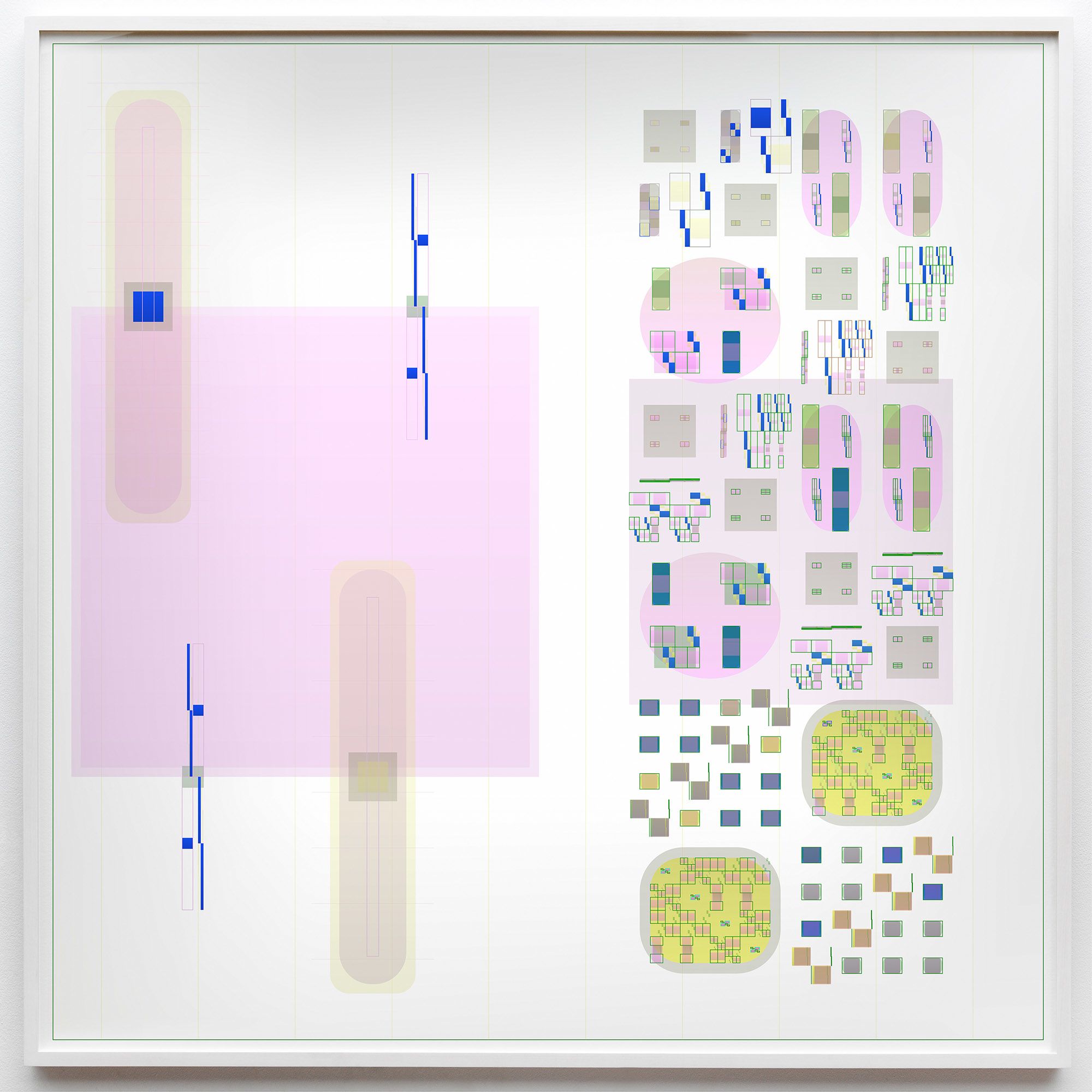
Untitled (1554993052565) is one of those outputs, and its title says when. 1554993052565 is a Unix timestamp in milliseconds: 11 April 2019, 14:30:52 UTC, 16:30:52 in Berlin. The print was rendered a month before the show. His former website filed the photograph as "cgp-1554993052565-framed", and harm.work files the work under Mutant Garden. In a white frame, on the left half of the sheet, a large pink square lies over two pale yellow vertical bars with rounded ends, crossed by thin blue lines that carry small blue squares. The right half is crowded: pink circles and capsules filled with tiny grids of coloured cells, small grey squares, and two yellow rounded blocks packed with even smaller patterns. The same kind of title, written out as a date, names the later Ambi-framed Protoseeders prints (→ Ambi-framed Protoseeders).
The rooms
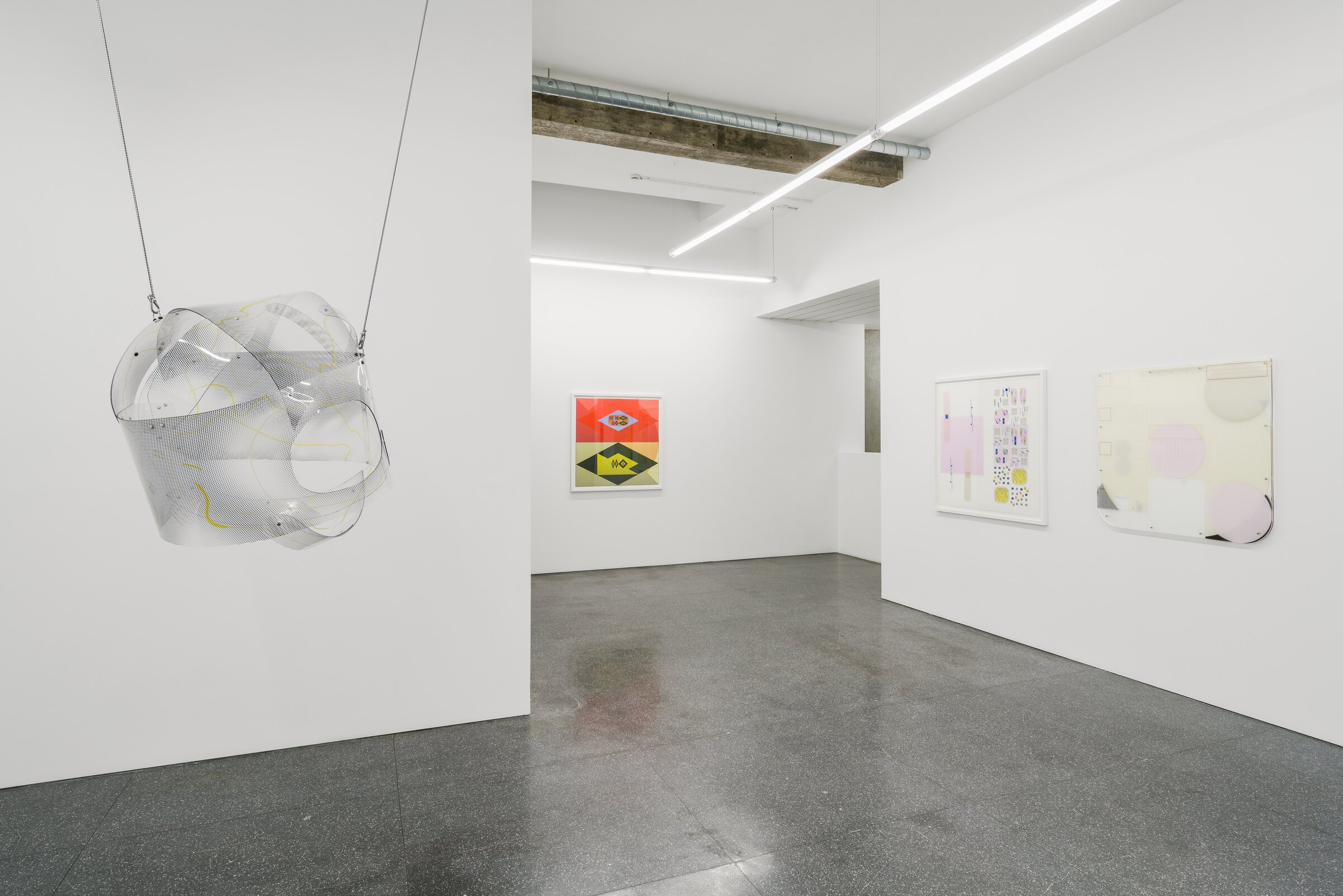
The gallery is a set of white rooms with a polished stone floor and fluorescent tubes. In the first, a sphere of clear strips hangs from two steel cables, close to the wall. Its strips are printed with a fine dot screen and loose yellow lines, It is Assemblage (new) (2018), which harm.work does not list for the show (the artist, November 2026). On the far wall hangs Symbol No Aggression, on the right wall Untitled (1554993052565) and the rounded acrylic panel Wyn (generation unknown) (2018). Further on, Cussos Unfence Thermographers, Bars and Push Forth Specter hang in white frames; Cussos and Wyn belong to Nested Exchange and are illustrated on Spike #70 and Sacred Geometry.
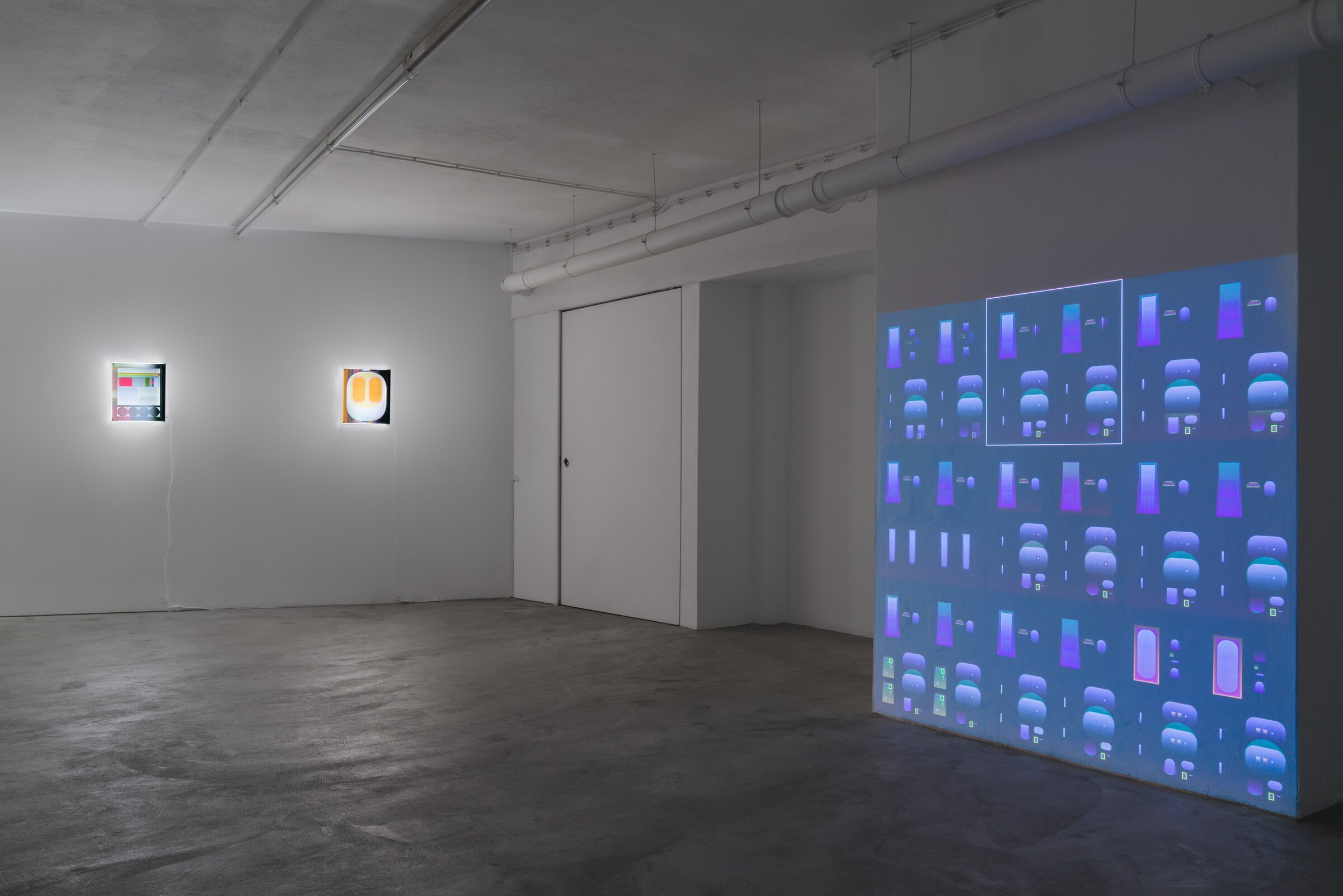
A second room is kept dark. Two backlit panels glow on the left wall, their power cables running down to the floor. On the right a projection fills the face of a freestanding wall: a three-by-three grid of compositions, each built of rounded bars, capsules and small rectangles in blue and violet, one cell outlined in white. In another photograph from the gallery the same grid has turned pink and magenta, so the projection changes as it runs. His former website captioned it "Decompressions (autobreeder), 2019" and filed one view as structures-of-redundancy-projection. On 8 June 2019, during the show, he filed a frontal photograph of a projection of this kind on are.na as Structures of Redundancy (autobreeder); it is reproduced on Evolutionary Logic. harm.work does not list the projection. An autobreeder shows the population as it breeds, where the prints on the walls are single states taken out of it.
The works on the walls
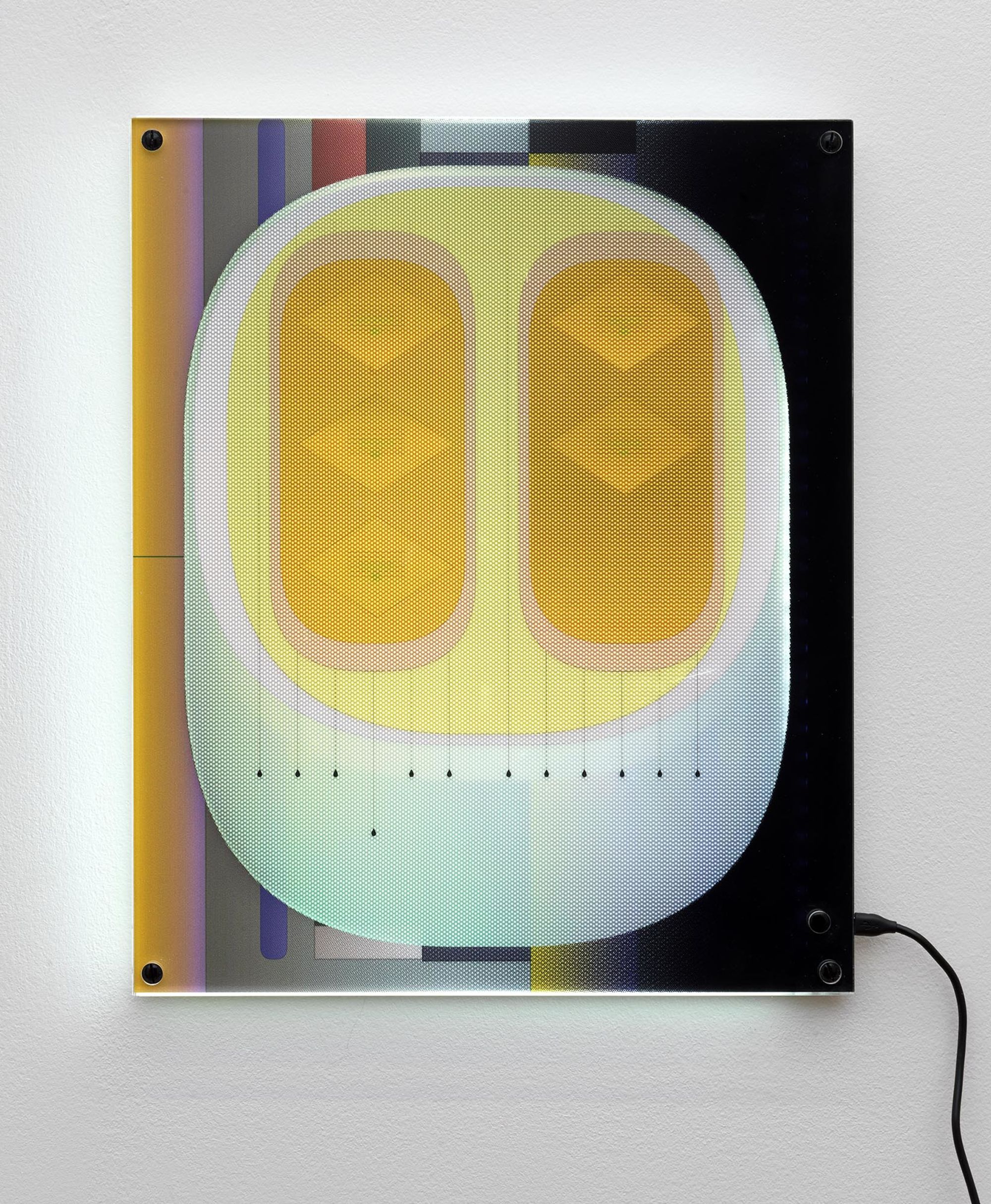
Subprioress (2019) is one of the two backlit panels: a print lit from behind, bolted at the corners, with a black cable leaving it at the lower right. Inside a pale rounded shape that shades from white to mint sit two tall yellow capsules, each holding a column of faint diamonds; a row of thin strings hangs from them, each ending in a black dot. Vertical bands of yellow, violet, grey and black run behind.
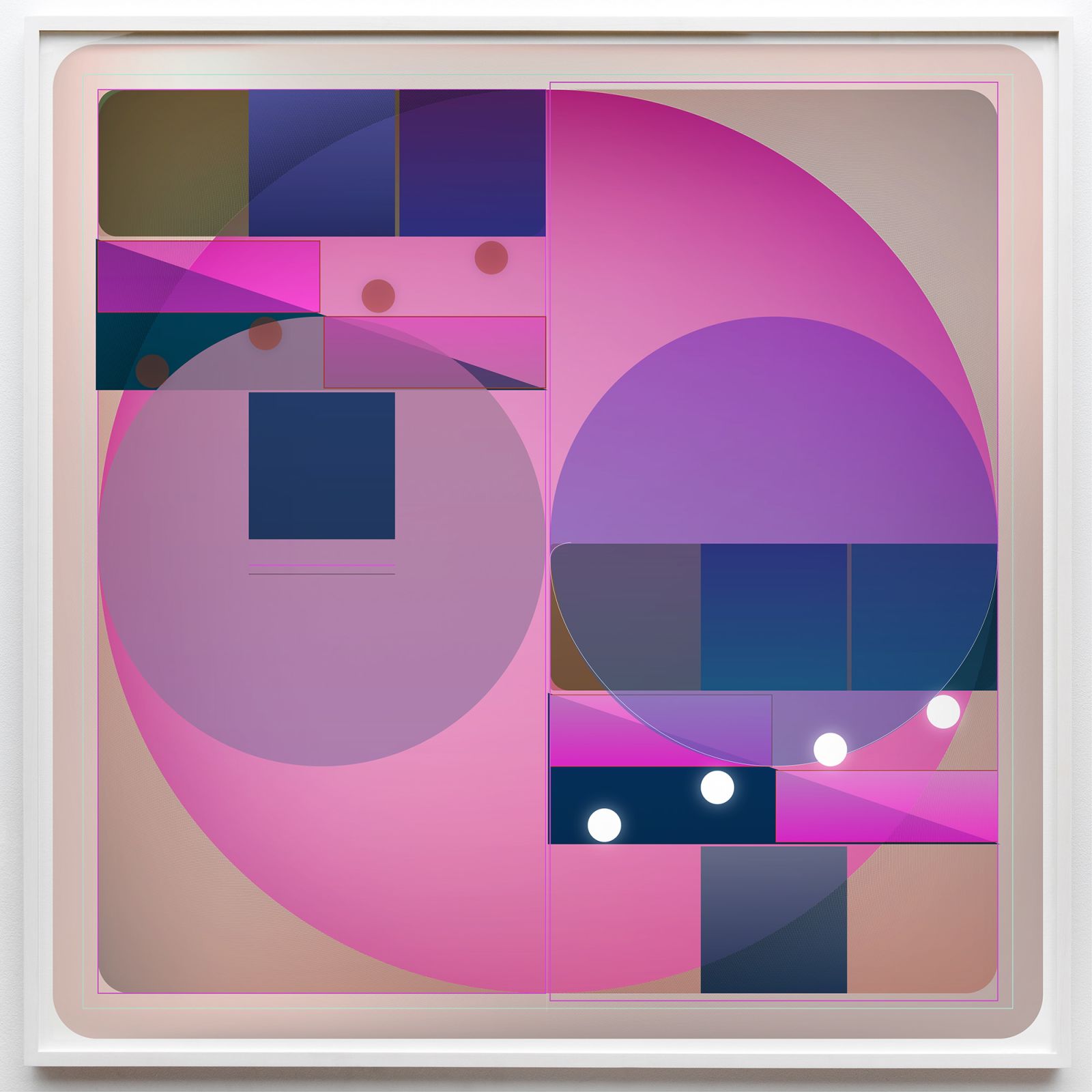
Push Forth Specter (2019, "UltraChrome print on Hahnemühle paper", 100 × 100 cm) sets a large pink circle and two smaller grey and violet circles over rows of navy, violet and olive blocks, with a few white dots, inside a pale rounded border.
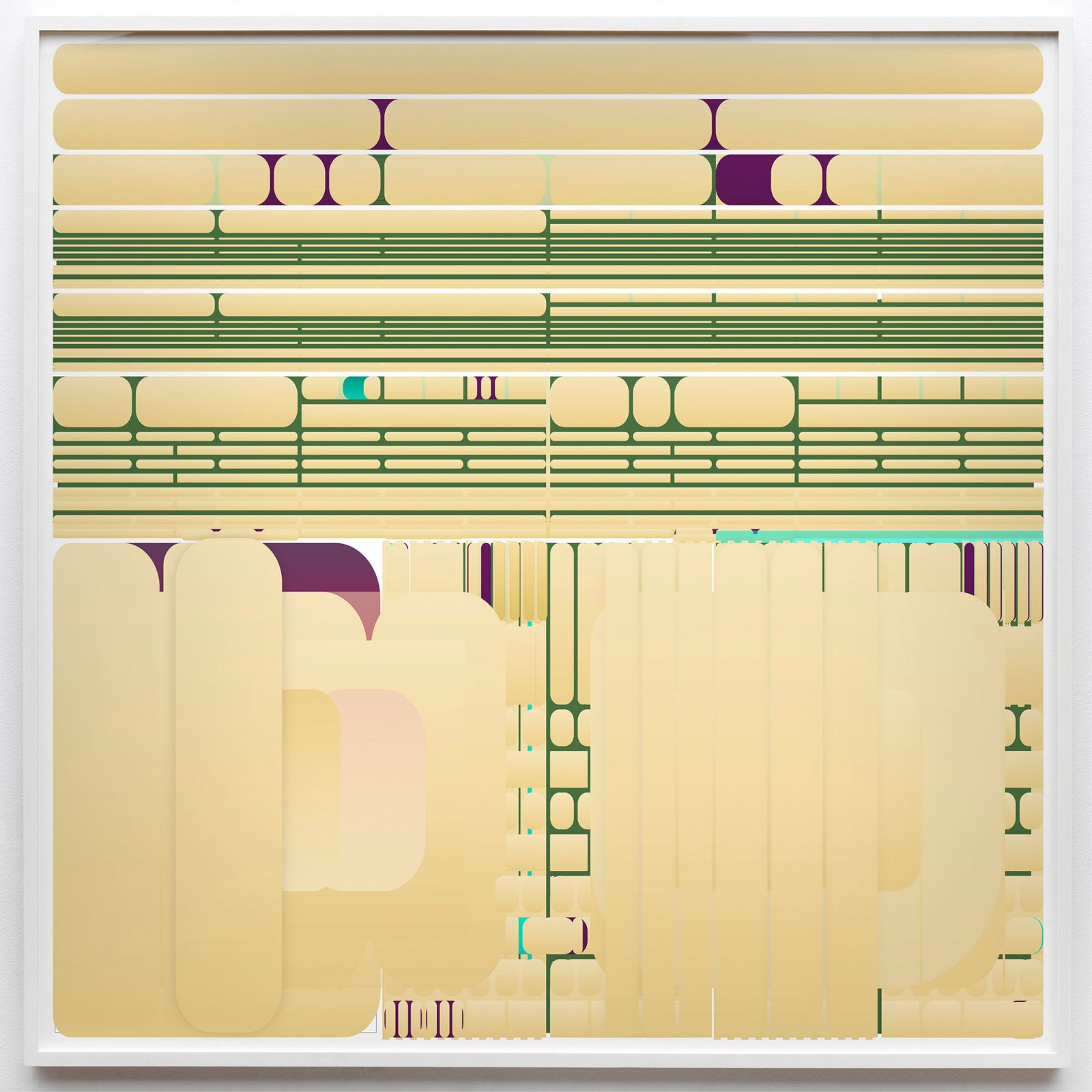
Bars (100 × 100 cm, "UltraChrome print on Hahnemühle German Etching paper") is built of cream rounded bars: in the upper half they lie in rows divided by thin dark green lines, in the lower half they stand upright and overlap, with flashes of purple and teal between them. It is of 2019, as his former website gave it (the artist, November 2026), and so is Cussos Unfence Thermographers.
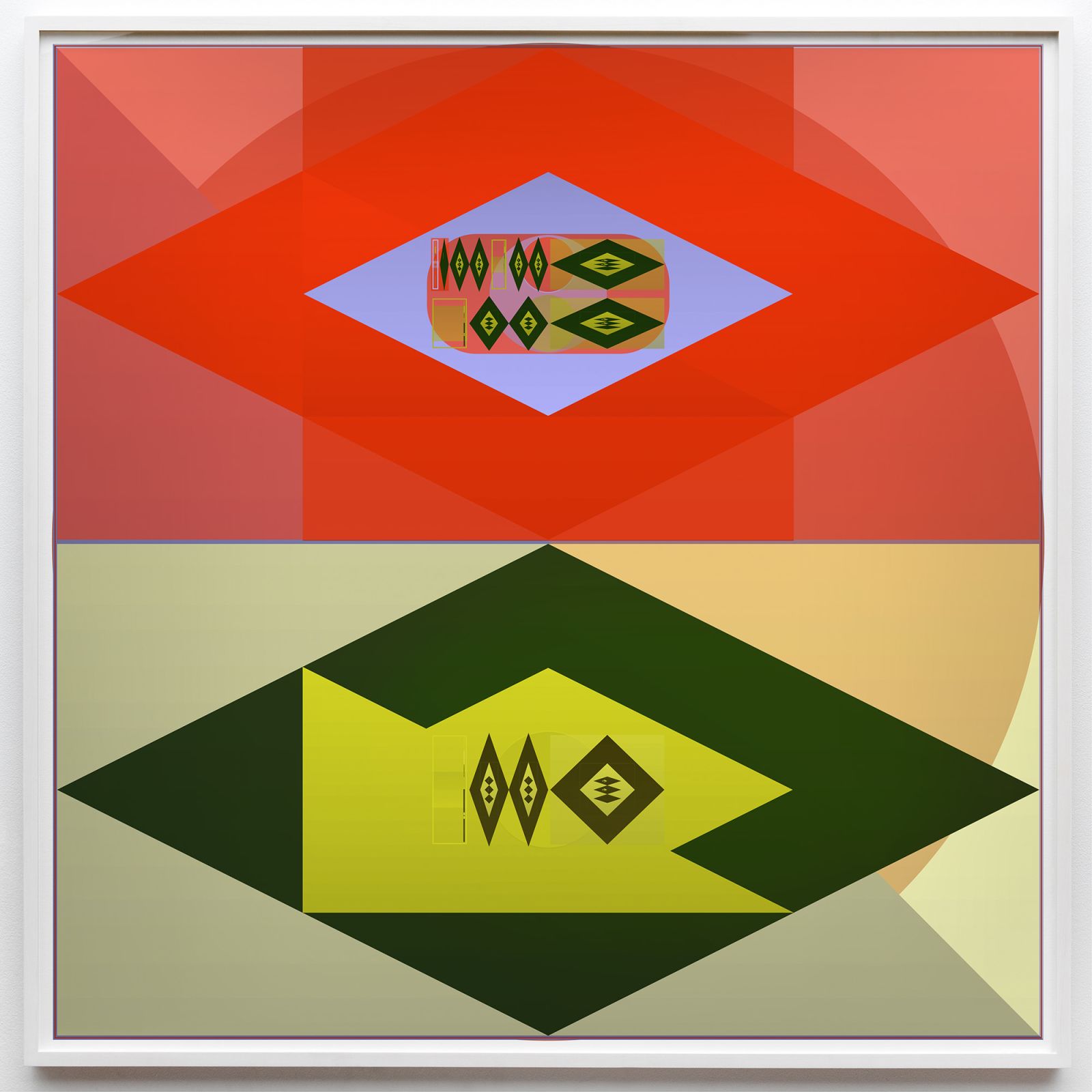
Symbol No Aggression (2019, 100 × 100 cm) is cut in two horizontally. The red upper half carries a wide red lozenge with a lilac lozenge inside it and, at the centre, a small capsule patterned with green diamonds. The olive lower half carries a dark green lozenge holding a yellow notched shape, like an arrowhead or a fish, with two small diamond motifs (→ The Lozenge).
harm.work files Untitled (1554993052565) under Mutant Garden and Cussos and Wyn under Nested Exchange; it gives the other four no series. They are early outputs of Cartesian genetic programming, the Mutant Garden algorithm, like Untitled (1554993052565) (the artist, November 2026): the show was the first of that work.
The title
The title is not explained. In a 2021 interview the artist described his position in generative art: "you are, on the one hand, a creator, and [because] you cannot fully prepare yourself for what is coming out of this algorithm…you're also a bystander" (ZORA ZINE). The wiki's reading: Uninnocent Bystander names that position two years earlier, with a qualification. He watches what the algorithm produces, but he wrote the algorithm and chose what was printed, so he is not innocent of it (→ Subconscious Computation, under Creator and bystander).
Agent's reading: programs that halt, a population that does not
Thesis. The exhibition text puts the work on the side of the unhalting: works about "progression and halting", "lack of closure", "never complete", against the archive as "a kind of death sentence".
Antithesis. The algorithm the show introduced is one that never meets the halting problem. A CGP program is a graph that only feeds forward, so every decoded program finishes. In his introduction to the 2021 interview with Miller he says he turned to it because "most mutations of computer code cause infinite loops"; with a grid of layers and nodes he "could safely mutate without ever getting stuck in an infinite loop" (→ Miller interview, Evolutionary Logic). Read literally, the text celebrates the one thing the chosen method was built to avoid.
Synthesis: the halt moves from the program to the print. Each program halts and returns one image; that guarantee is what lets mutation run freely. What does not halt is the population: the breeding goes on, and the autobreeder in the dark room shows it going on. The print on the wall is the halted state, one of the "specific states at specific moments" the text names, and the title Untitled (1554993052565) records the millisecond of that halt. The open-endedness the text praises is real, but it sits at the level of the population and its selection, not inside any program. On this reading the archive the text fears is no death sentence either: an archived print is one halted state, and the population that produced it can go on breeding.
Reception
No review of the show has been found.
See also
- Evolutionary Logic — Cartesian genetic programming and the first outputs of March–April 2019
- Mutant Garden — the series the CGP outputs became
- Nested Exchange — the tree-structured system before CGP
- Ambi-framed Protoseeders — the other prints titled with their render times
- Pattern and Presence (2018) — the solo show before, with the nested panels
- Subconscious Computation — creator and bystander
- Uninnocent Bystander — exhibition text