
Pattern and Presence — Upstream Gallery, Amsterdam (2018)
Solo exhibition, Upstream Gallery, Kloveniersburgwal 95, Amsterdam, 24 February – 30 March 2018. Photographs by Gert Jan van Rooij. Text: the gallery's press release, with the epigraph and captions of the artist's own page for the show; also on harm.work.
Pattern and Presence was his first solo exhibition with Upstream Gallery, where he later showed Mutant Garden (2021) and Our Inner Child (2023), among others. The gallery's text describes "works from multiple series that react to different moments in the history of cybernetics". The gallery is a canal house with panelled walls, a marble fireplace and a columned niche. Its rooms had software running on a screen and projected on a wall, layered acrylic panels, framed prints, plotter drawings, two hanging spheres and two arrays of risograph posters. The title had gone into his are.na list of candidate show titles on 9 December 2017, eleven weeks before the opening (Show titles).
The title: Hayles
The press text: "Pattern and Presence, the title of the show, is taken from the book 'How we became posthuman' by N. Katherine Hayles (1999), in which she describes the historical development of cybernetics and politics of disembodiment." In How We Became Posthuman Hayles argues that information technologies bring the pair pattern/randomness to the front and push presence/absence into the background, and that the result is "a systematic devaluation of materiality and embodiment". Her own proposal follows: "Entirely different readings emerge when one entertains the possibility that pattern and presence are mutually enhancing and supportive"; the task is "seeing pattern and presence as complementary rather than antagonistic" (chapter 2, "Virtual Bodies and Flickering Signifiers"). Note 805 copies passages from the same chapter, on information as pattern and on flickering signifiers (→ Randomness and Pattern, Mediation and the Archive).
The artist's own page for the show, dated February 2018, set a different passage of the book above the press text, linked to a PDF of it:
We can understand the complexity of the outer world only because our codes for constructing the inner world are similarly diverse and complex. In this sense, we are a metaphor not only for ourselves but also for the larger system in which we are embedded.
Hayles is describing Mary Catherine Bateson's Our Own Metaphor (1972), her account of a cybernetics conference organised by her father, Gregory Bateson. The passage goes on: "because the worlds are coupled, they must in the (last) analysis be regarded as a single system." Both passages argue against keeping information and body apart.
The text
The gallery's text says he "wants to demystify both the romantic notion of the 'artistic genius' as well as the 'black box' of computer algorithms", and that instead of making works by hand he "programs software and trains it by looping continuous feedback through its output". It names the new work: "this new series of printed transparent work (which is a continuation of his earlier series 'Death Imitates Language')", built on "the structure of 'nesting': a strong organizing principle found in architecture, software development and human language", with which he "refers to the painterly question of how to fill the two-dimensional plane using composition and layering". It gives three ancestors for the algorithms: "'Turtle graphics' by Seymour Papert (late 1960s); research of feedback, reflexivity, nesting and recursion (Autopoiesis, Varela & Maturana, 1972); and Artificial Life (Christopher Langton, 1986)."
The last paragraph is about tokens. Each work gets "a unique identifier (a hash or fingerprint)" on the Ethereum blockchain, which "changes the status of the artwork to a form of currency – or a representation of itself – which circles back to the initial question of embodiment: are the works in fact the works? Or, are they representations of an external, less material essence? Do we have a body or are we a body?" harm.work prints the text without that last question. The artist's page linked the "Tokens Website (ÐApp)", the shop at tokens.harmvandendorpel.com where specimens of Nested Exchange and Death Imitates Language were sold as Ethereum tokens in 2018 (→ Protocol, Taste, and Systems).
Nested Exchange: the software and the panels
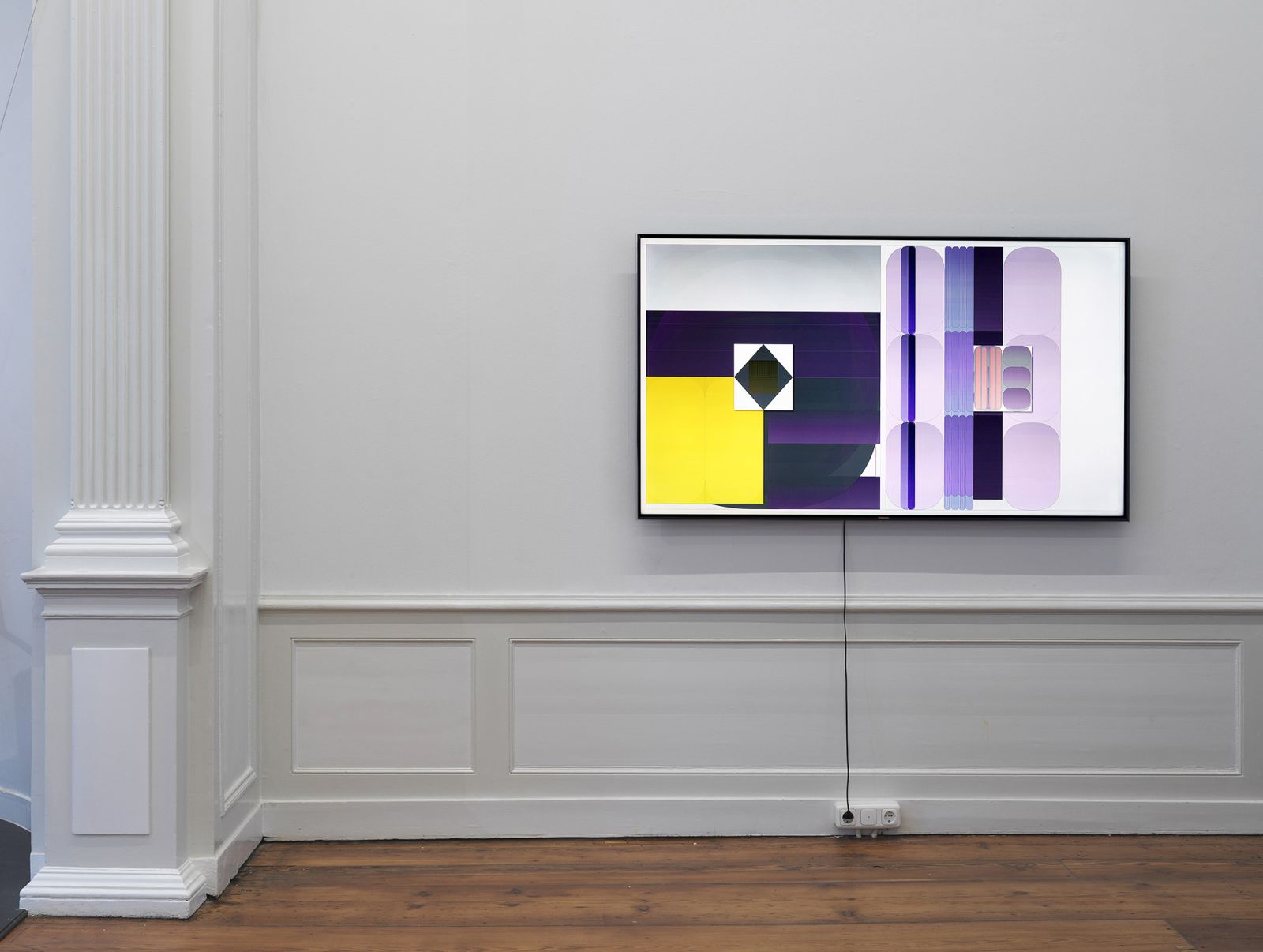
A flat screen beside a pilaster runs Nested Exchange, which the artist's page calls "Exchange, 2018". In the frame it shows a yellow square under violet fields with a black lozenge in a white diamond, beside a column of lilac rounded bars. The series text calls the specimens "configured in nested recursive 'tree' structures similar to those used in the first iterations of Chomskyan linguistics", exchanging nodes two at a time so that each becomes "as different as it can be from those around it" (series text). The program and its construction are on Nested Exchange.
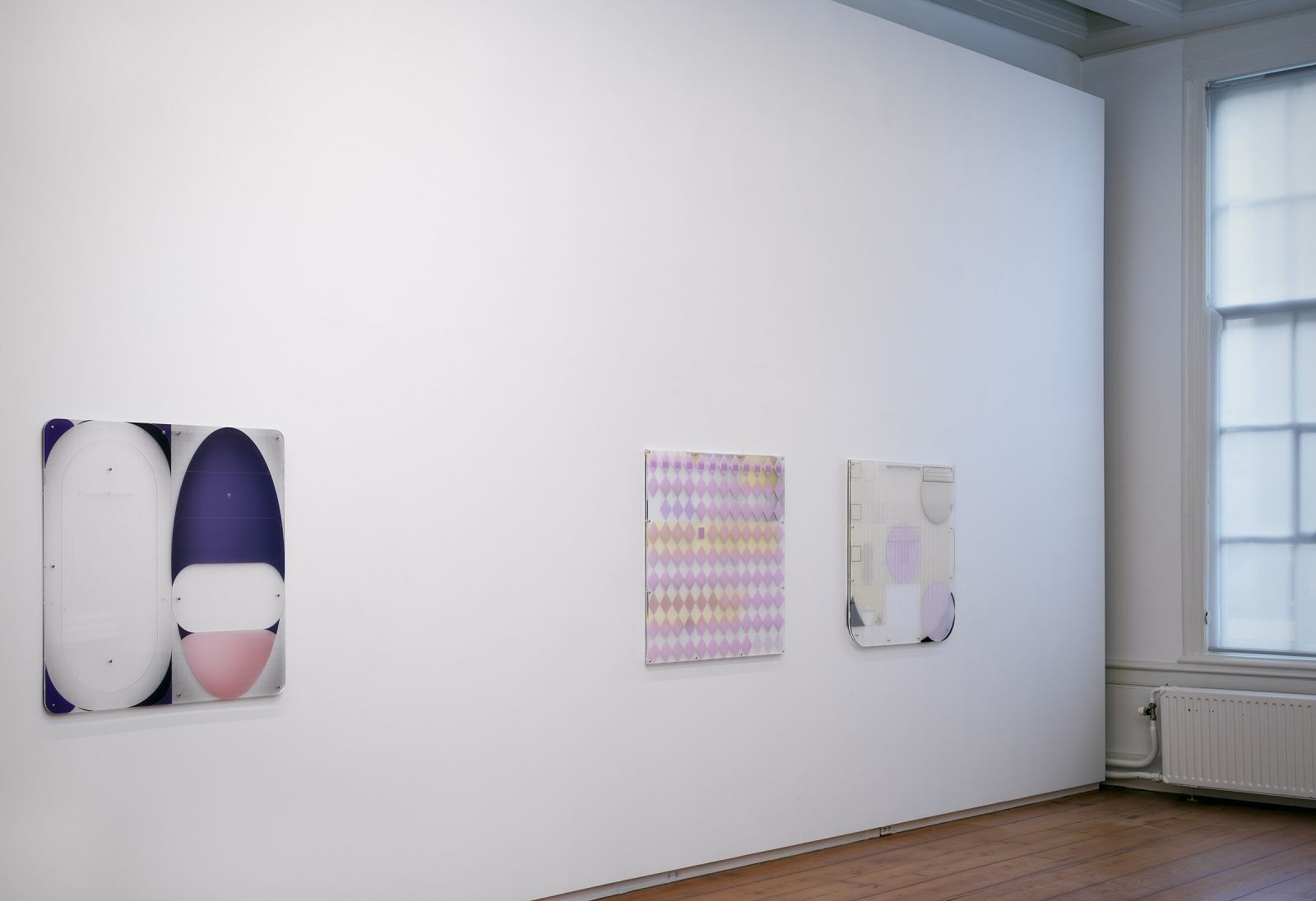
The "printed transparent work" of the text is four panels of layered acrylic, 100 × 100 cm and 3 to 4 cm deep, bolted off the wall on steel standoffs: Hexamerisms, Fissured Petrolling Mridangam, Wyn (generation unknown) and Lammer Asbestos (spelled "Lammer Asbestus" on the artist's page). The view above shows three of them on one wall. Hexamerisms, at left, splits its square into a white rounded column and a violet egg banded with white and pink. Fissured Petrolling Mridangam is covered in rows of pale lozenges. Wyn, at right, has rounded lower corners and carries lilac and pale yellow circles among outlined rectangles; it is the work he later filed first in his are.na channel on the mandala (→ Sacred Geometry). Lammer Asbestos, a rounded square shading from orange to grey, hung in the room with the niche (→ The Squircle). Because the print is spread over sheets set apart from each other, the forms shift slightly against each other as you move.
Algues Artificielles: prints and projection
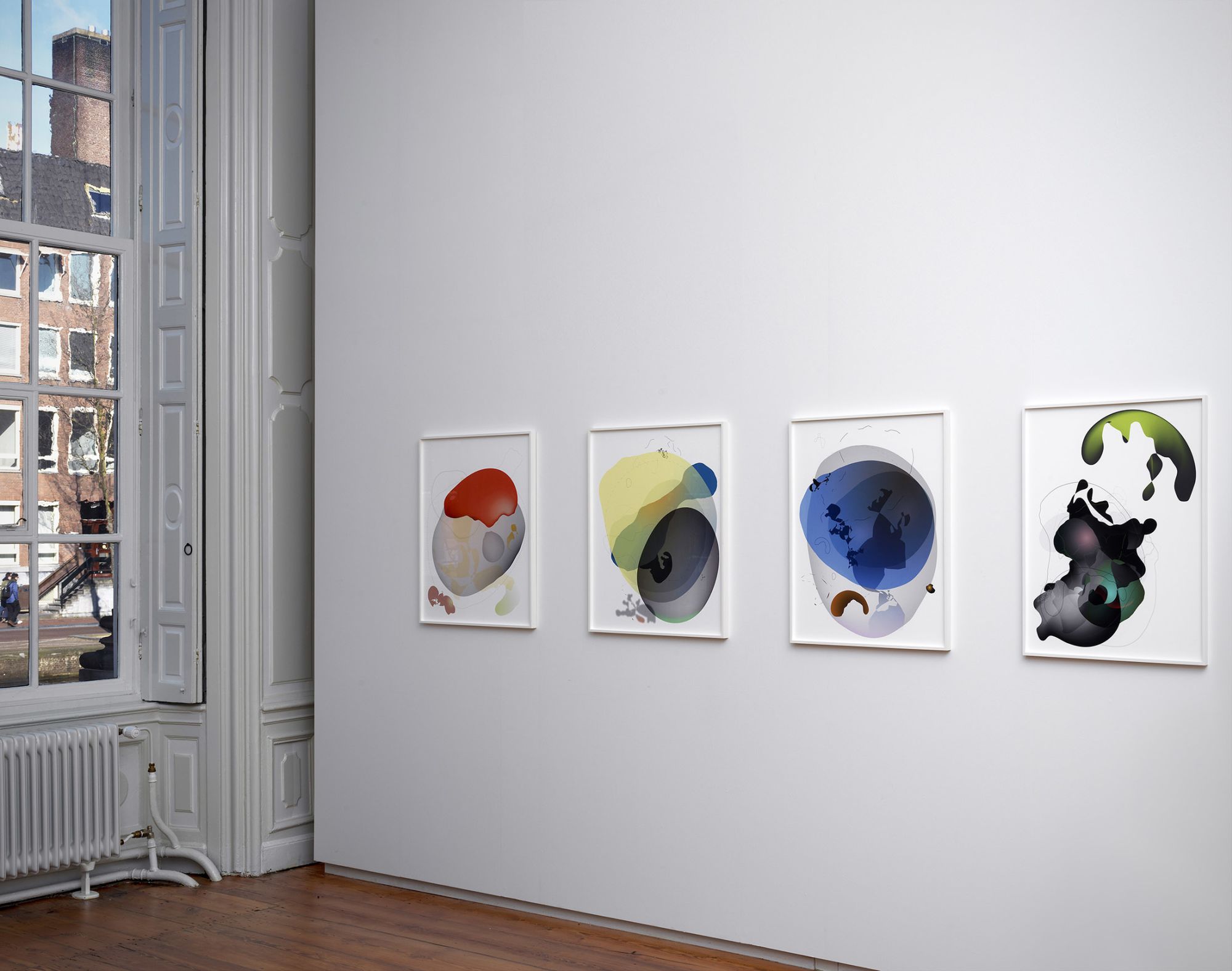
Four Algues Artificielles prints of 2018 hang in a row beside a canal window: Eponymous Seedling, Freeling Tristesse, Unscripted Relinings and Bemused Aversatility, each an "Ultrachrome HDR print on Hahnemühle paper", 80 × 64 cm. They are the first prints of the smaller format and the first with two-word titles; the 2016 prints shown in Asking for a Friend were 100 × 80 cm with one invented word each (→ Algues Artificielles).
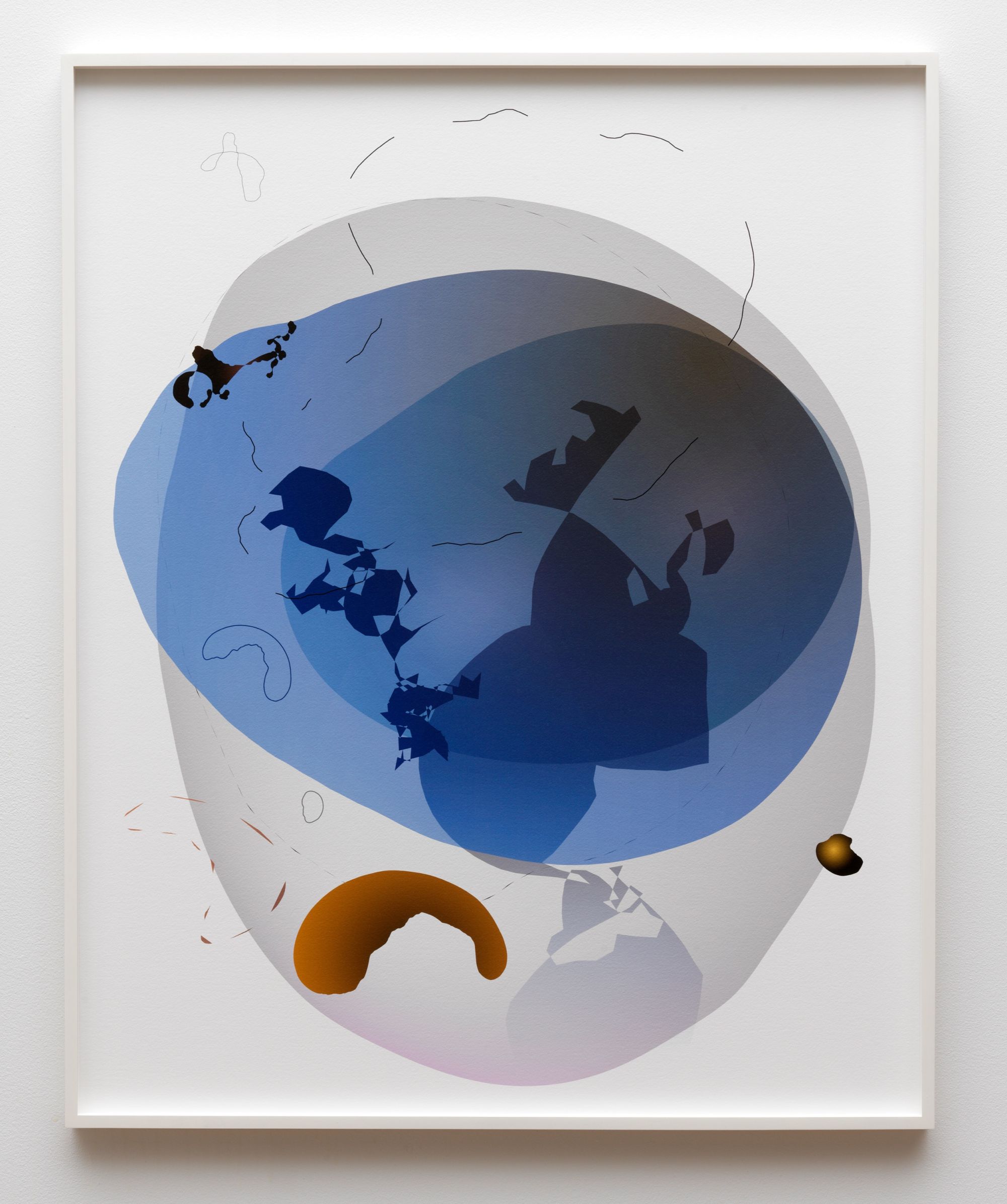
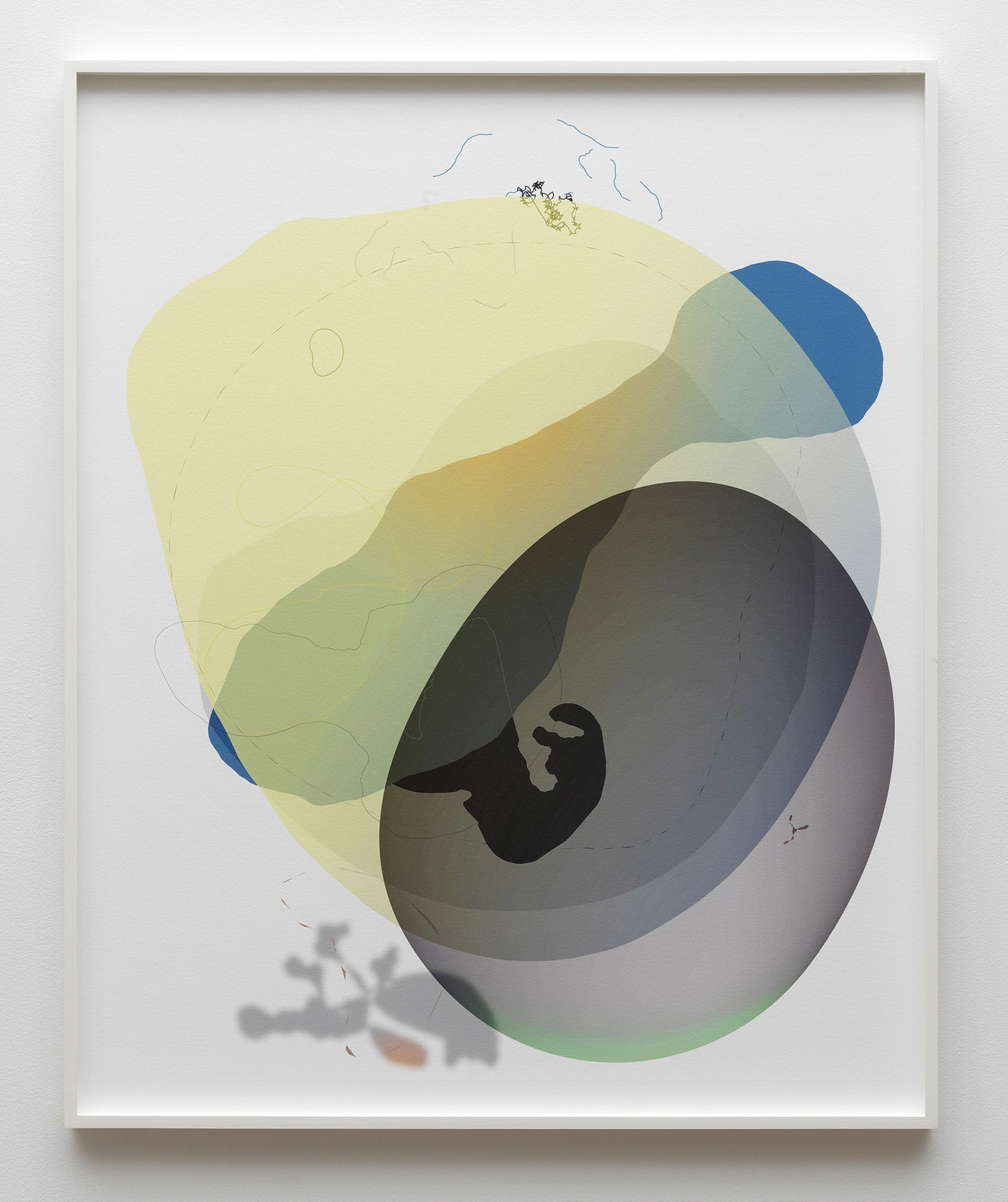
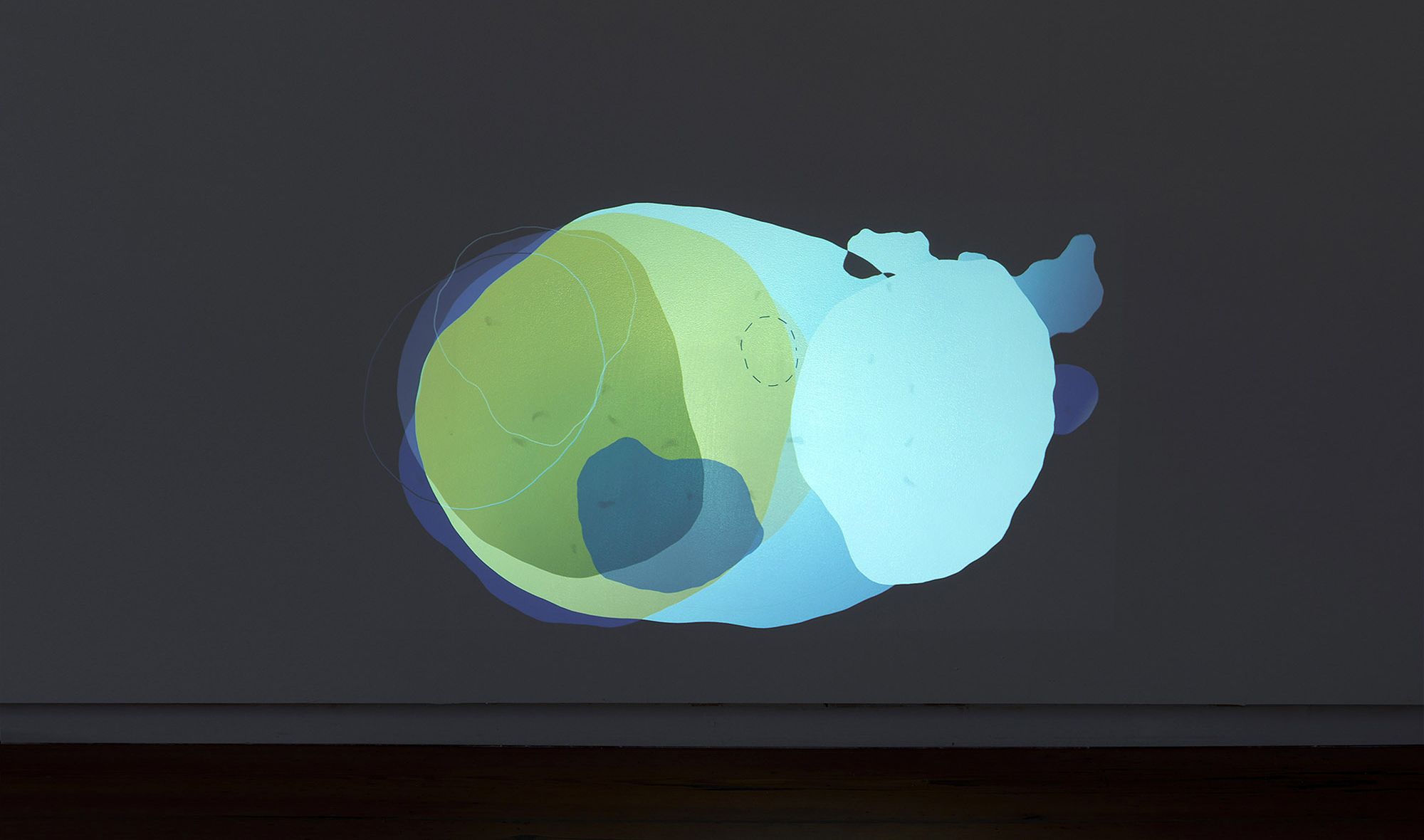
Freeling Tristesse, which harm.work keeps unpublished, is a large blue form over a grey oval, with dark shapes like torn paper floating inside it and a flat orange crescent below. Unscripted Relinings lays a pale yellow form over a dark grey oval in which a black silhouette sits, with a blue patch at the edge and a greyed shadow-shape at the bottom. In a darkened room the software Algues Artificielles (2017) projected its specimens onto the wall as they were drawn: overlapping translucent shapes in green, yellow and pale blue.
Drawings, spheres and posters
The plotter drawings Thistle (left), Thistle (right), Metaballs and Metaballs ⁱⁱ (2017) hung in pairs on the two walls of a corner by the fireplace. They had been shown three months earlier in London; the Automated Drawings page has the installation view and the press text's link from "Turtle graphics" to his turtle drawings of 2018.
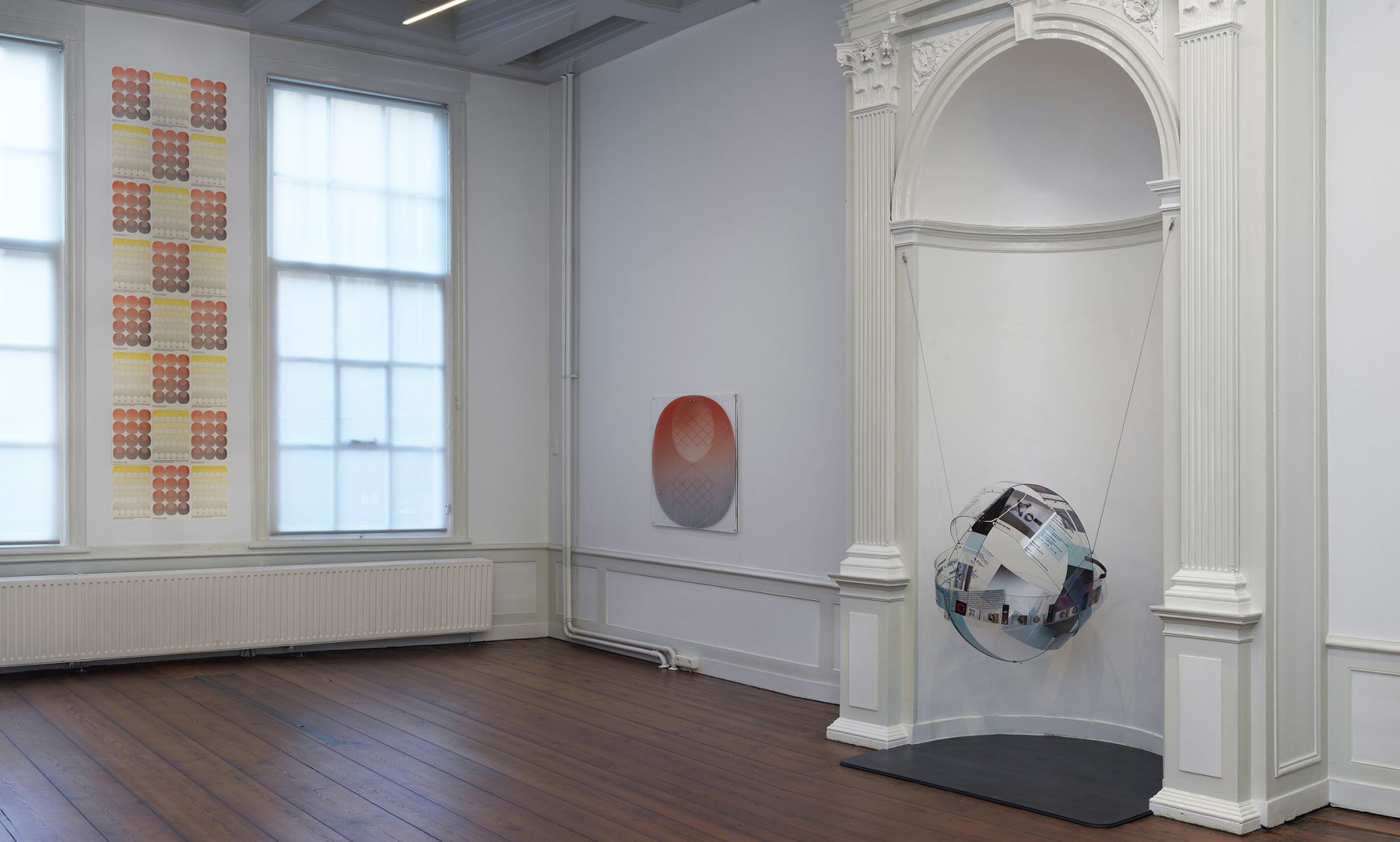
In the largest room a sphere hangs on two cables in a white niche framed by fluted pilasters, above a black mat on the floor. It is Assemblage (About), its clear strips printed with screenshots of web pages. It is the sphere he made in 2012 from the reviews of his London show, remade for this exhibition (the artist, November 2026; → About (2012)); harm.work dates the remake 2018. Assemblage (new) (2018, "Ø 85cm" on the artist's page), printed with a halftone dot screen and loose yellow lines, hung in the same show (→ Sculpture and the Object).
Between the two windows runs a strip of risograph posters, sheet above sheet, printed with rows of circles in orange, yellow and violet. The artist's page lists two such arrays, "Array of risograph posters (Intimate Fear, Sensu Strictu), 2018. 90×336cm" and "(Intimate Fear, Rational Mind), 2018. 150×252cm". harm.work does not catalogue them. The square panel with an orange-to-grey form, right of the window, is Lammer Asbestos.
Pattern and presence in the room
The wiki's reading: the show gave Hayles's two terms a form of their own. The same bred populations appeared as pattern, running on a screen and a wall, and as presence: printed into acrylic, onto paper, drawn by a pen, hand-cut into spheres. They appeared a third time as tokens, a hash standing in for the object. The press text asks which of these is the work. The show's answer, by hanging all of them, is that none of them alone is, which is 992's "The Work = The Work + Its Documentation" extended to the program and the token. Hayles asks that pattern and presence be read as "complementary rather than antagonistic"; Jeppesen, writing on About in 2012, had put the artist's version as virtual and actual works "said in different ways, enunciated using two separate dialects". The question at the end of the press text, whether we have a body or are one, is put to the works and left open.
Reception
No review of the show has been found. The gallery's text is the only contemporary account.
See also
- Nested Exchange — the tree-structured breeding system behind the screen and the panels
- Algues Artificielles — the prints and the projected software
- Automated Drawings — the plotter drawings
- Protocol, Taste, and Systems — the 2018 token shop
- Randomness and Pattern — Hayles's pattern and randomness in the archive
- Asking for a Friend (2017) — the London show three months earlier
- Uninnocent Bystander (2019) — the next solo show, where Cartesian genetic programming replaced the tree
- Pattern and Presence — press release