
Asking for a Friend — narrative projects, London (2017)
Solo exhibition, narrative projects, London, 23 November 2017 – 20 January 2018 (the gallery's website now gives 3 February 2018). Text: the gallery's press release, also on harm.work.
Asking for a Friend was his second solo show with narrative projects, two years after IOU. It showed, in the press release's words, "a selection of recent works from multiple series of semi-algorithmically generated work", with "software from which the work emerged" on display beside the "wall works, which function as preliminary material conclusions". The series were the two genetic-algorithm projects he had begun in 2016, Death Imitates Language and Algues Artificielles, and the plotter drawings he made alongside them in 2017. It was the first time the breeding work had a solo show in London.
The title and the text
The press release starts from the phrase. "The expression 'asking for a friend' is used when the person asking feels embarrassed and pretends to be asking for somebody else. The subject that poses the sensitive question introduces an imaginary constructed proxy onto which feelings of shame or guilt might be projected." Then: "Similarly, Harm van den Dorpel does not create his work directly himself. Rather, he devises software, which stands in for him, raising questions about artistic agency and identity in our era of artificial intelligence and increased automation." The friend is the software. The invitation image printed with the release is a photograph of a young macaque on a stone reaching out to touch the fingertips of a human hand.
The text then describes the breeding. "Each artwork has virtual chromosomes, parents and relatives." He "crossbreeds pieces, emphasising desired traits and eliminating unwanted aesthetics, akin to the process of breeding dogs or flowers", and "Multiple factors such as promiscuity, fertility and interconnectedness of specimen inform the artist's decision as to whether or not a work is contingently 'fit' enough to be materialised." It ends: "In this possibility space, the final works are haunted by the eliminations of all the potential pieces that were not meant to be." That sentence is the clearest early statement of selection as subtraction, which the wiki follows on Evolutionary Logic and, as a negative way, on Apophatic Theology.
One paragraph looks forward. "Underlying the most recent works are "tree" shaped chromosomes. The use of a tree as a recursive structure is derived from his interest in natural language analysis, such as the X-bar theory of Noam Chomsky. The artist asserts that in human language, the essential meaning of a word is indefinitely deferred, and can only be approximated by taking into account the definitions of all the other words that it is not." The deferral is the idea the wiki reads as Derrida's différance, and that note 952 puts as "Identity is deferred" (→ Différance). The tree-shaped chromosome belongs to Nested Exchange, begun in 2017. None of the works documented from this show is catalogued under it; its wall panels were first shown three months later in Pattern and Presence.
The room
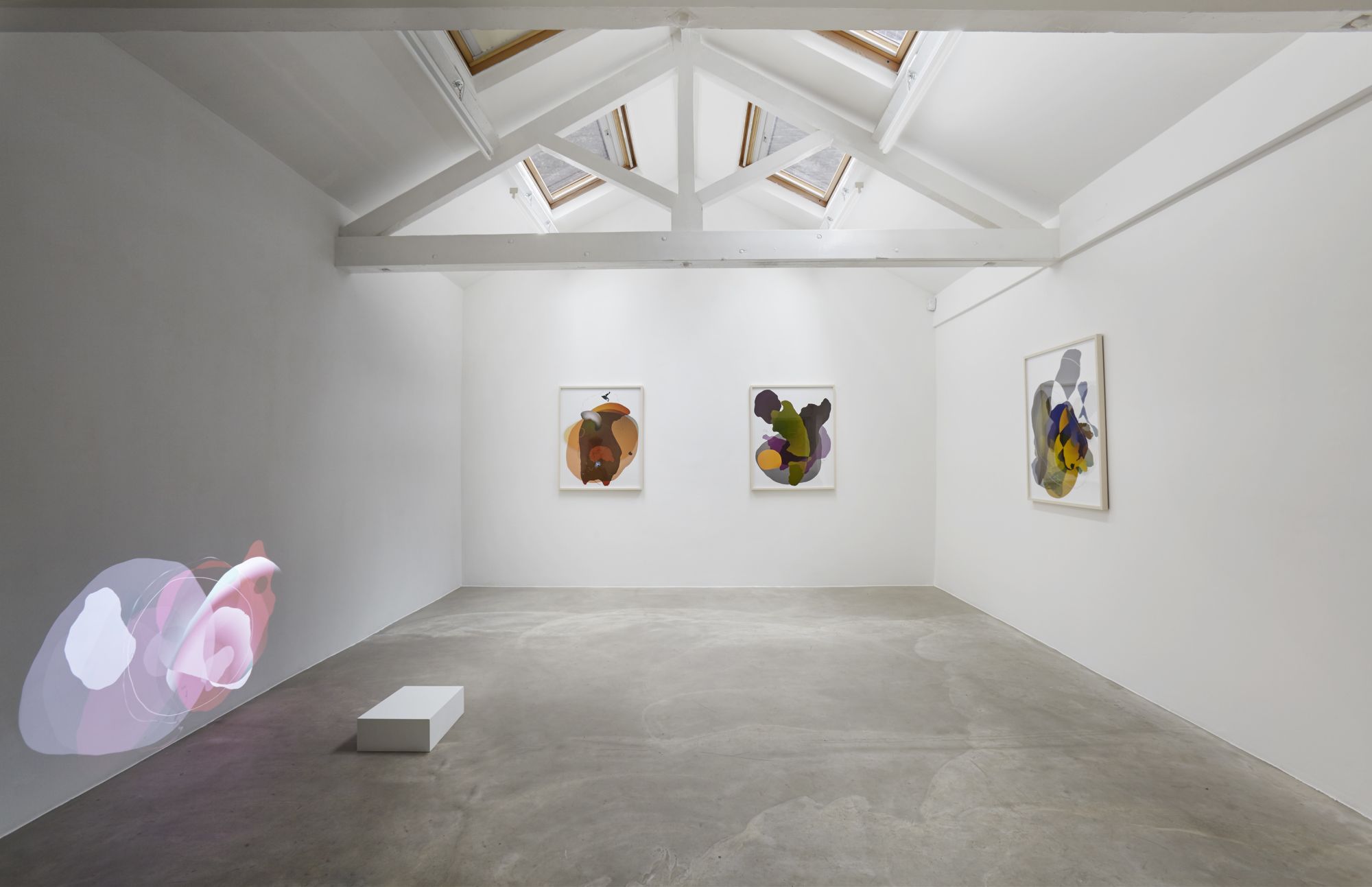
The gallery is a white room under a pitched roof with skylights between the trusses and a concrete floor. A projector housed in a low white plinth throws soft pink and white shapes onto the lower part of the left wall. Two framed prints hang on the far wall and one on the right.
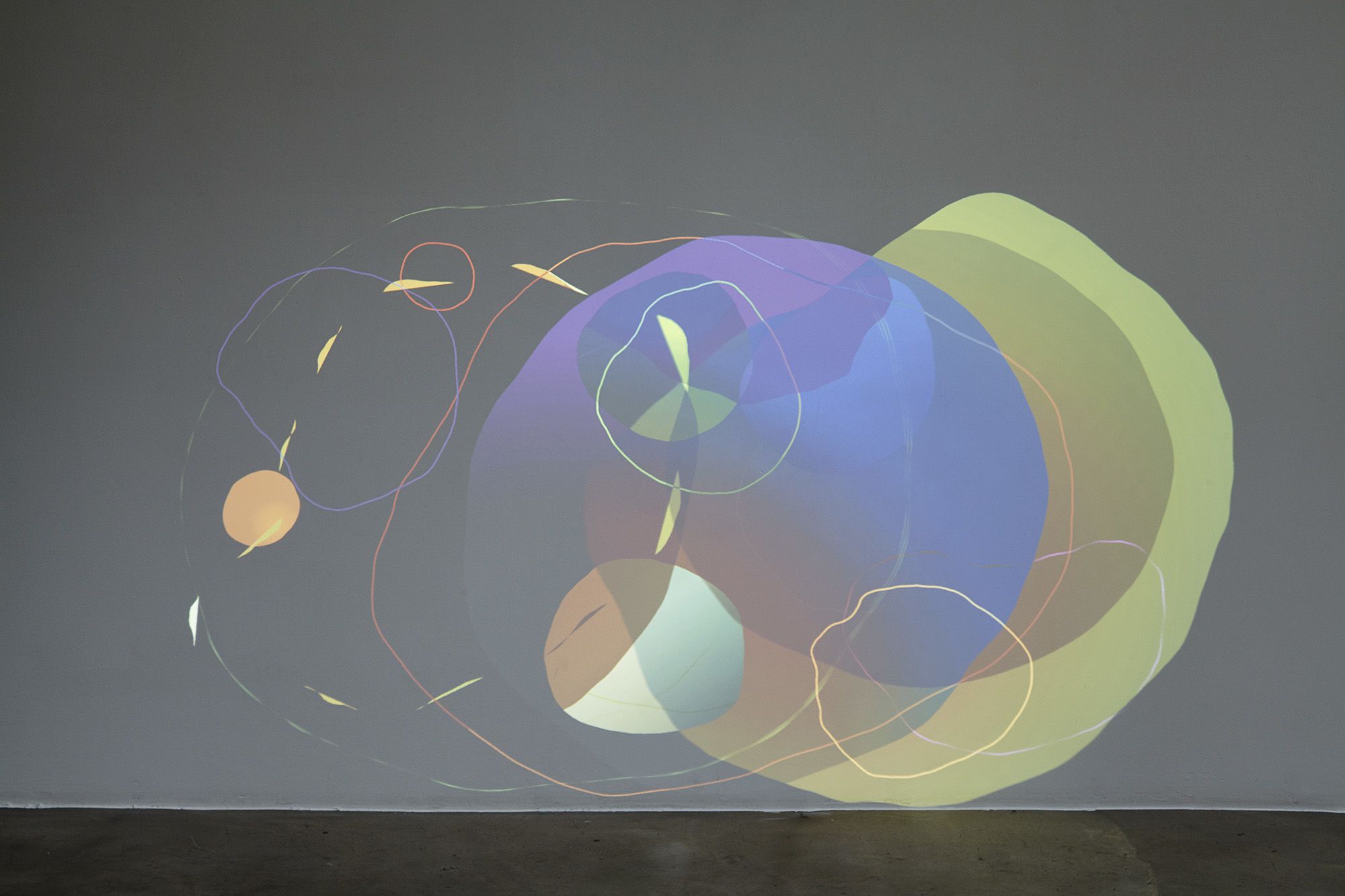
The projection is the software Algues Artificielles (2017), which the artist's page for the show lists as "Software projection, edition 5+1AP". It draws one specimen after another: overlapping translucent blobs in violet, blue and pale yellow, with thin looping lines running through and around them. The same breeding system runs on the website Hybrid Vigor .bio, where visitors pick the parents.
The Algues Artificielles prints
The framed prints are four of the six Algues Artificielles specimens of 2016, each a digital archival print of 100 × 80 cm. Each is a single bred drawing: a cluster of rounded, overlapping shapes on white paper, with fine lines drifting at the edges.
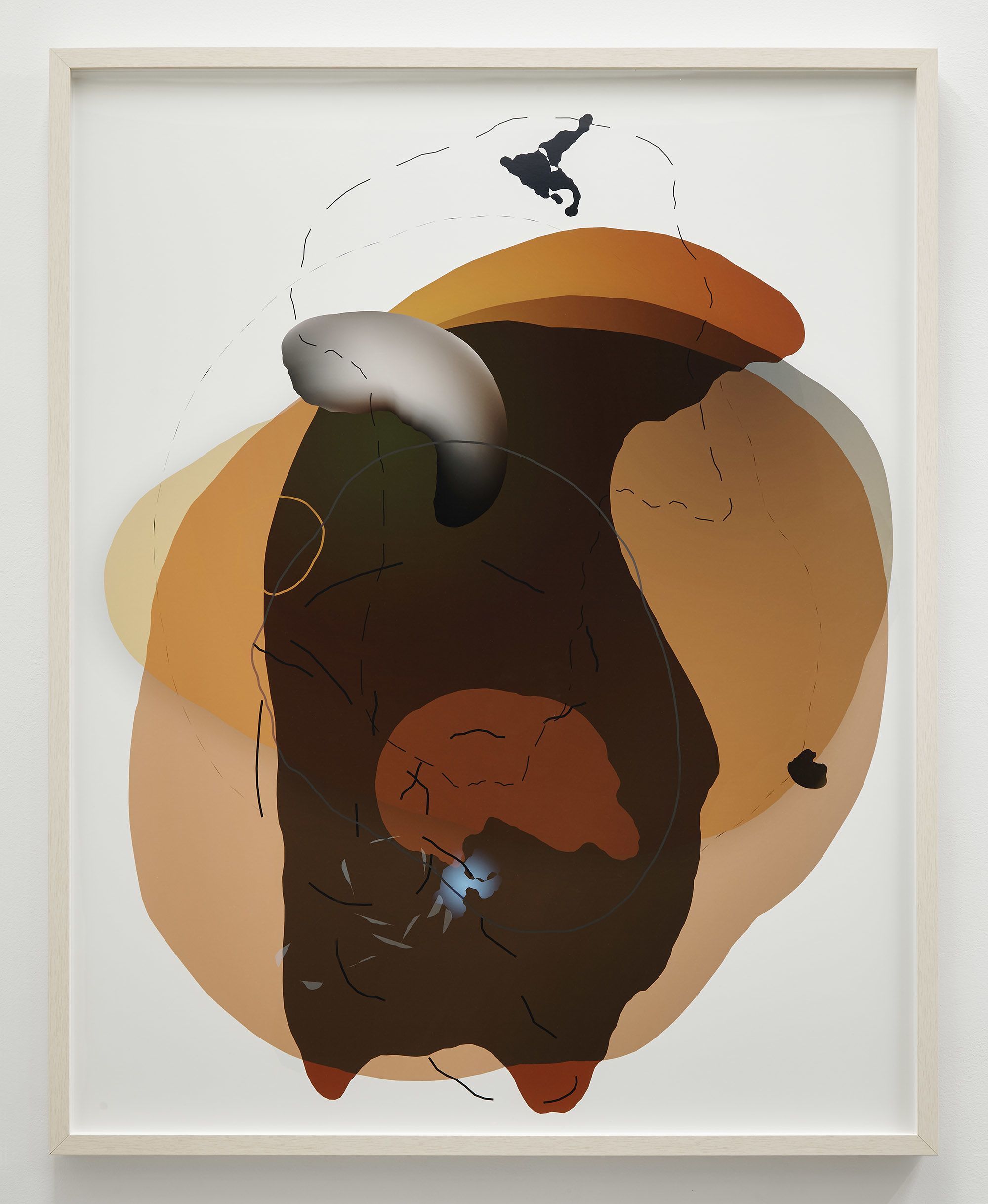
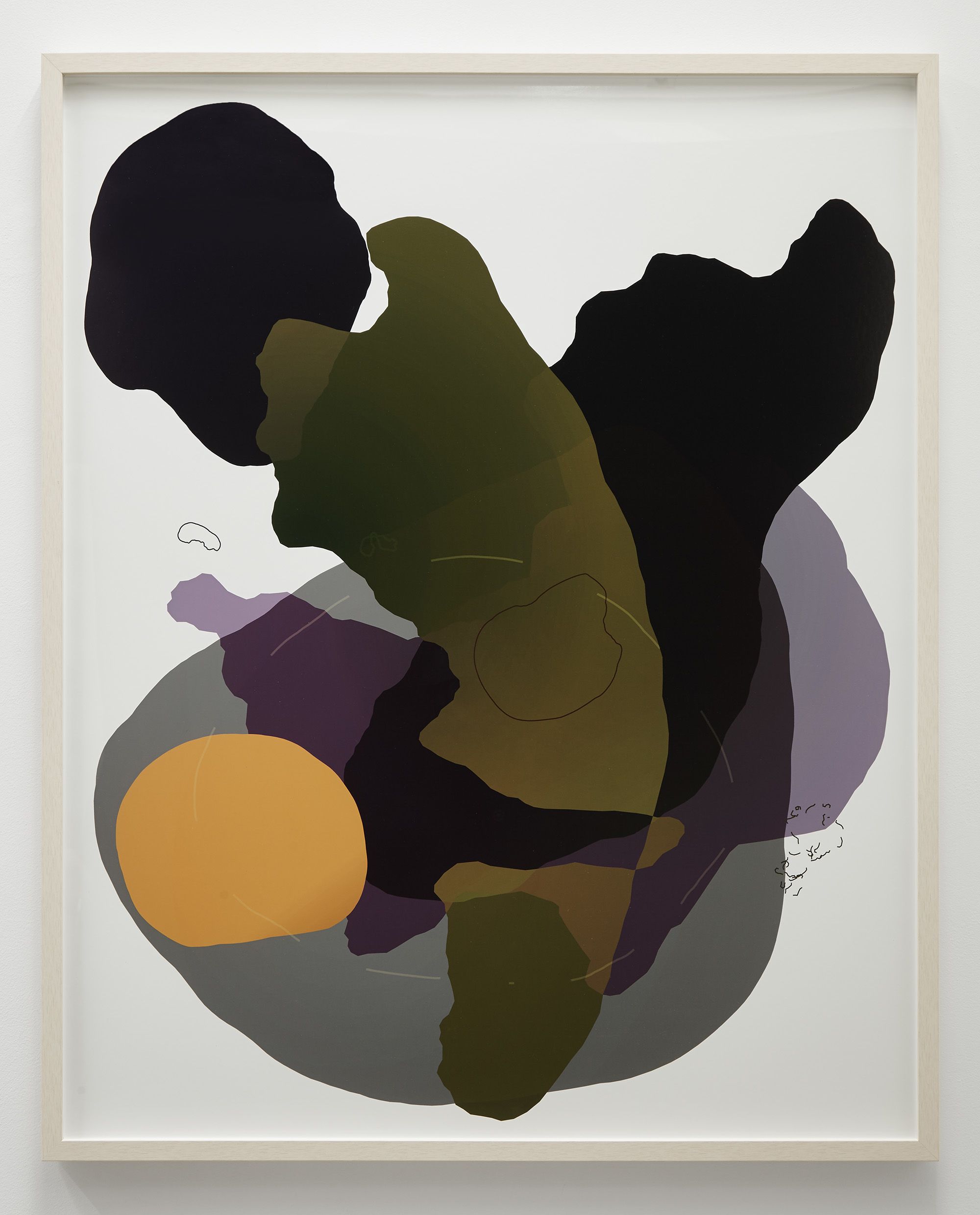
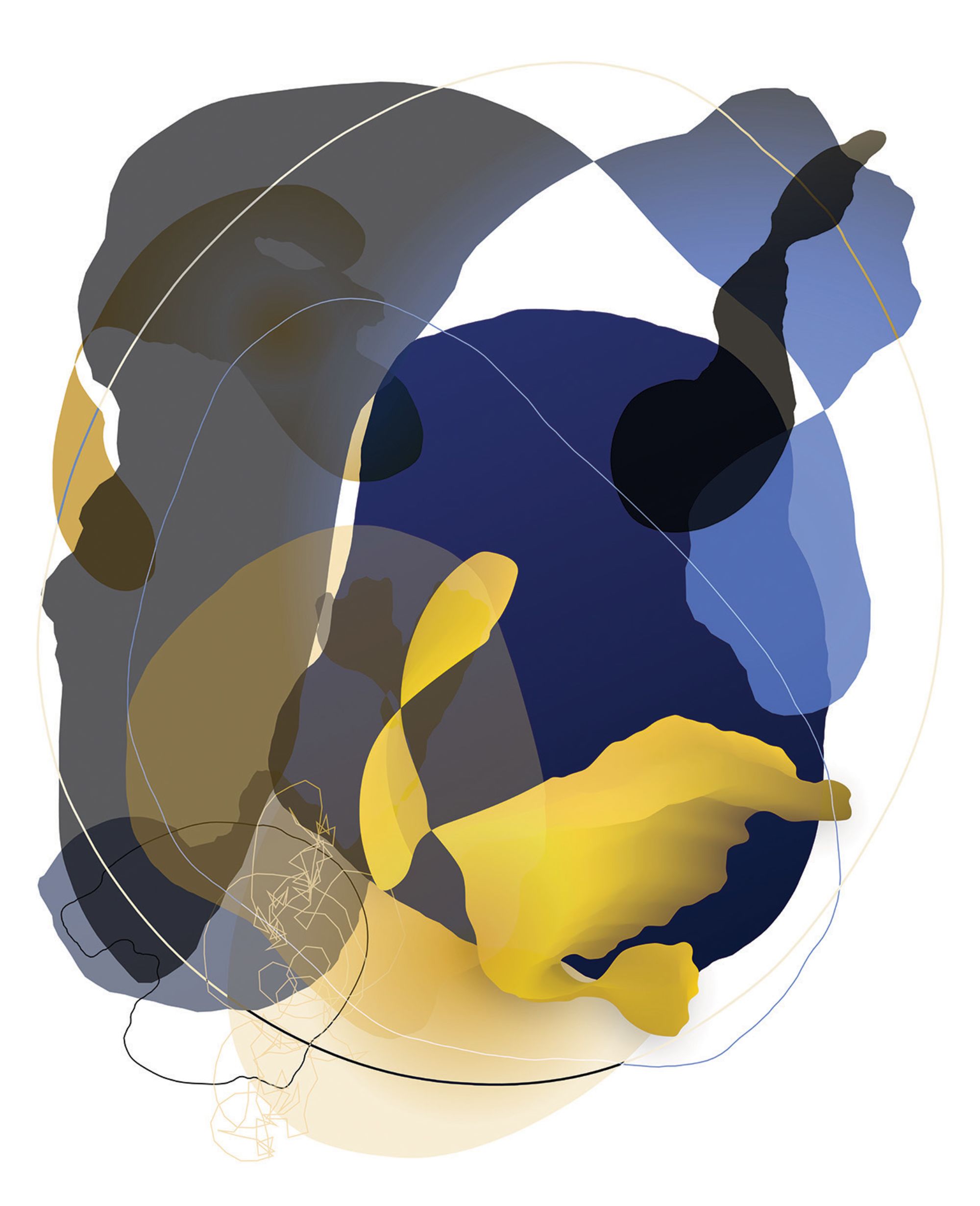
Adoreway is a mass of browns and orange, a dark body with a grey hook on top and a small blue spark inside. Availablesky (illustrated on Degrees of Disruption) packs yellow, olive and a deep blue under a grey crescent, with a checkerboard where two shapes overlap. Frouters sets black and olive shapes, like torn paper, over a grey oval, with one flat orange disc. Bluena is a dark blue oval with grey forms above it, a black tendril climbing its edge and a yellow shape spilling out below. harm.work lists all four under the show; the artist's own page for it shows Frouters, Availablesky and Adoreway.
Death Imitates Language and Autobreeder
From Death Imitates Language the show had a frozen specimen as a wall object, Juancar Zolim Juancar (2017, 100 × 100 × 4 cm), and the program Autobreeder (2016). The artist's page for the show adds a second panel of the same size and year, Joa Dereck Pitcher, which harm.work does not list.
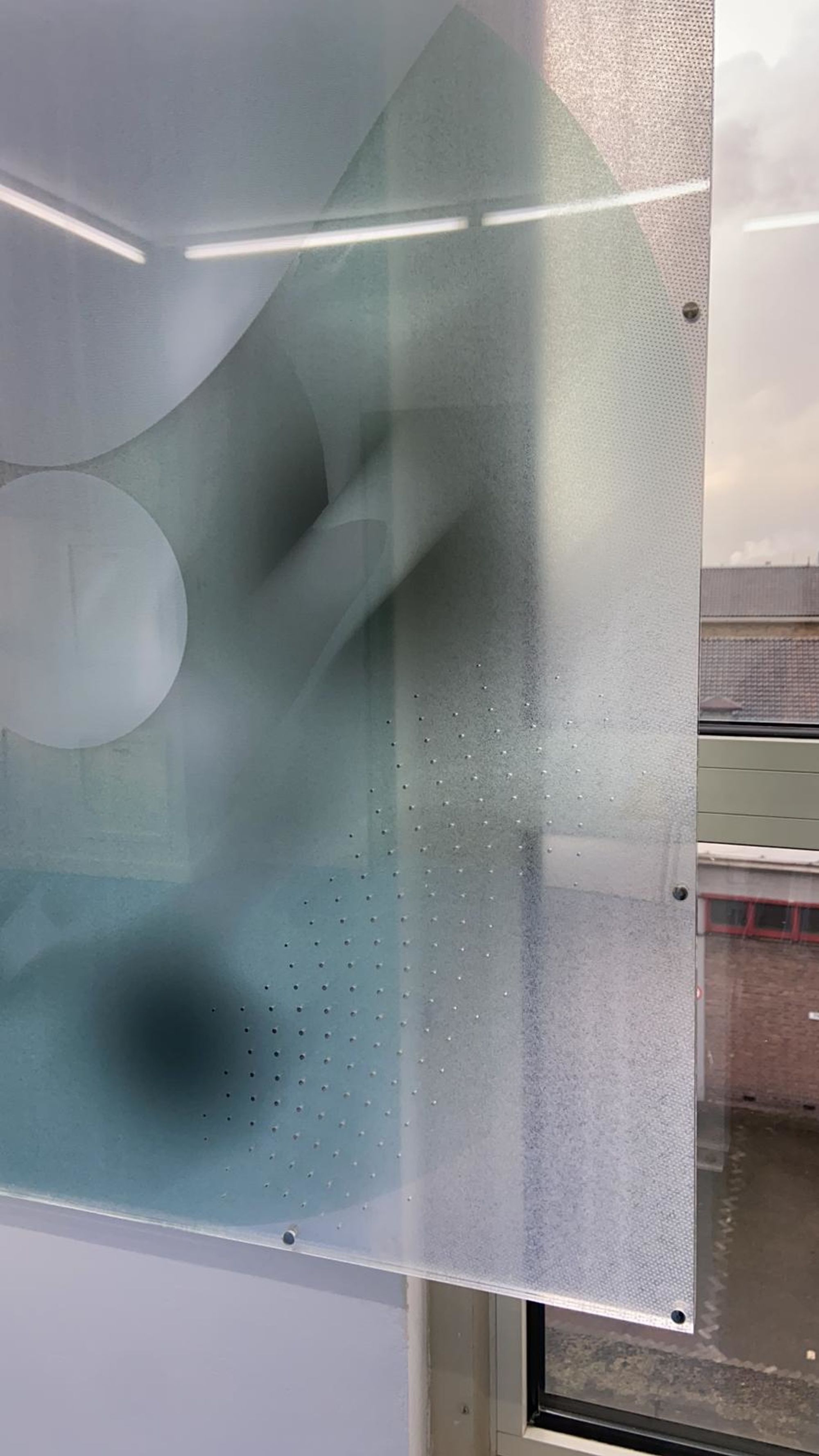
In this view the panel is held up against a window. It is frosted acrylic printed with soft teal and grey forms and a pale disc, perforated with rows of small holes and bolted at the edges, so the daylight and the buildings outside show through the print.
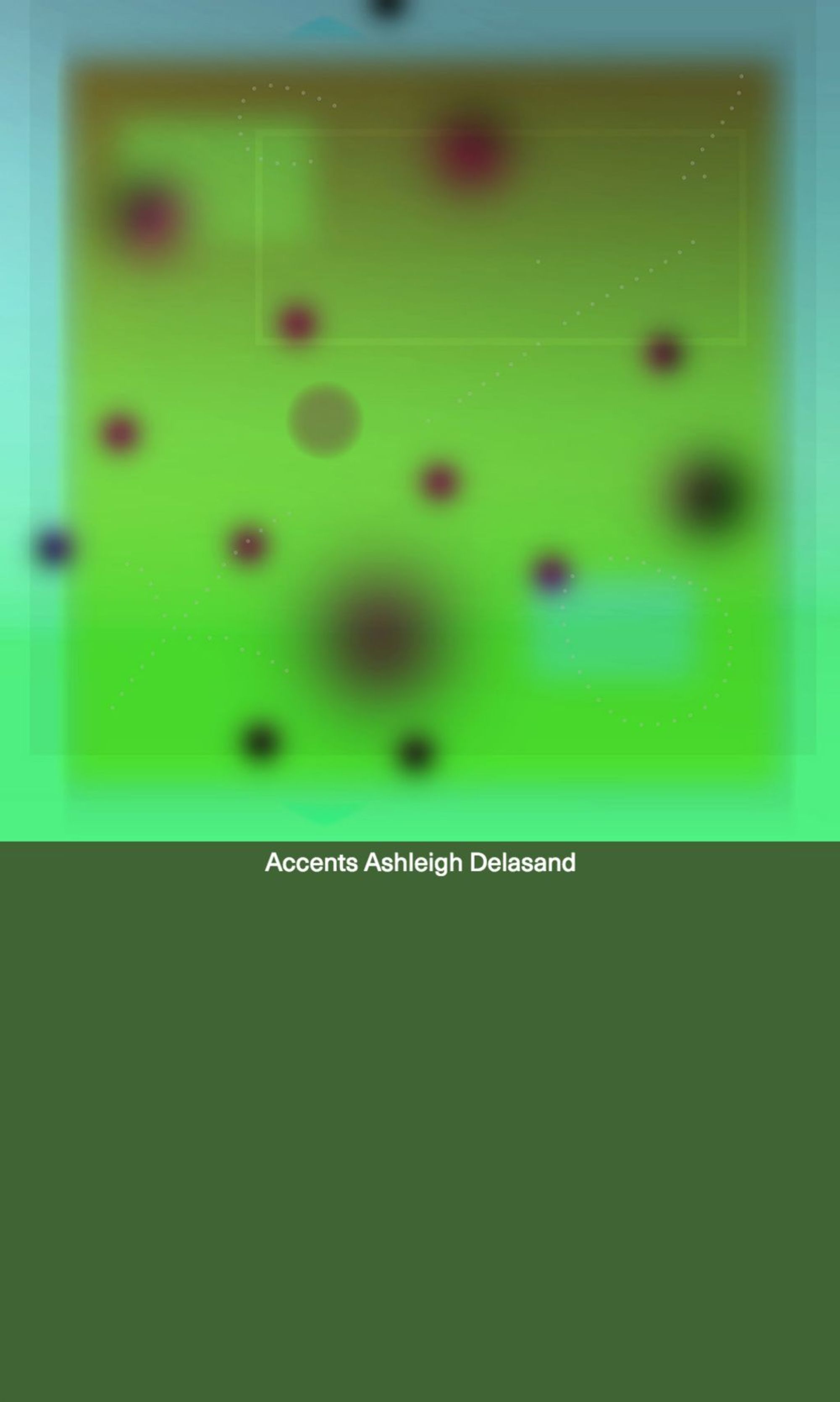
Autobreeder is, in the harm.work description, fullscreen software that "autosurfs the massive genealogy of the 'death imitates language' project, containing the entire population, bred by a genetic algorithm, and selected by micro-feedback of the artist": "offline, duration infinite, not interactive, silent, macOS". On the screen above it shows one specimen, a green field scattered with blurred red and black dots and a faint dotted outline, with its name underneath: "Accents Ashleigh Delasand". The artist's page for the show linked to an Autobreeder (lite) "available on left gallery"; harm.work now lists Autobreeder (lite) as Ethereum tokens of 2018, "a selection from massive genealogy of the 'Death Imitates Language' project, containing the first 12.000 specimen" (→ left gallery).
The plotter drawings
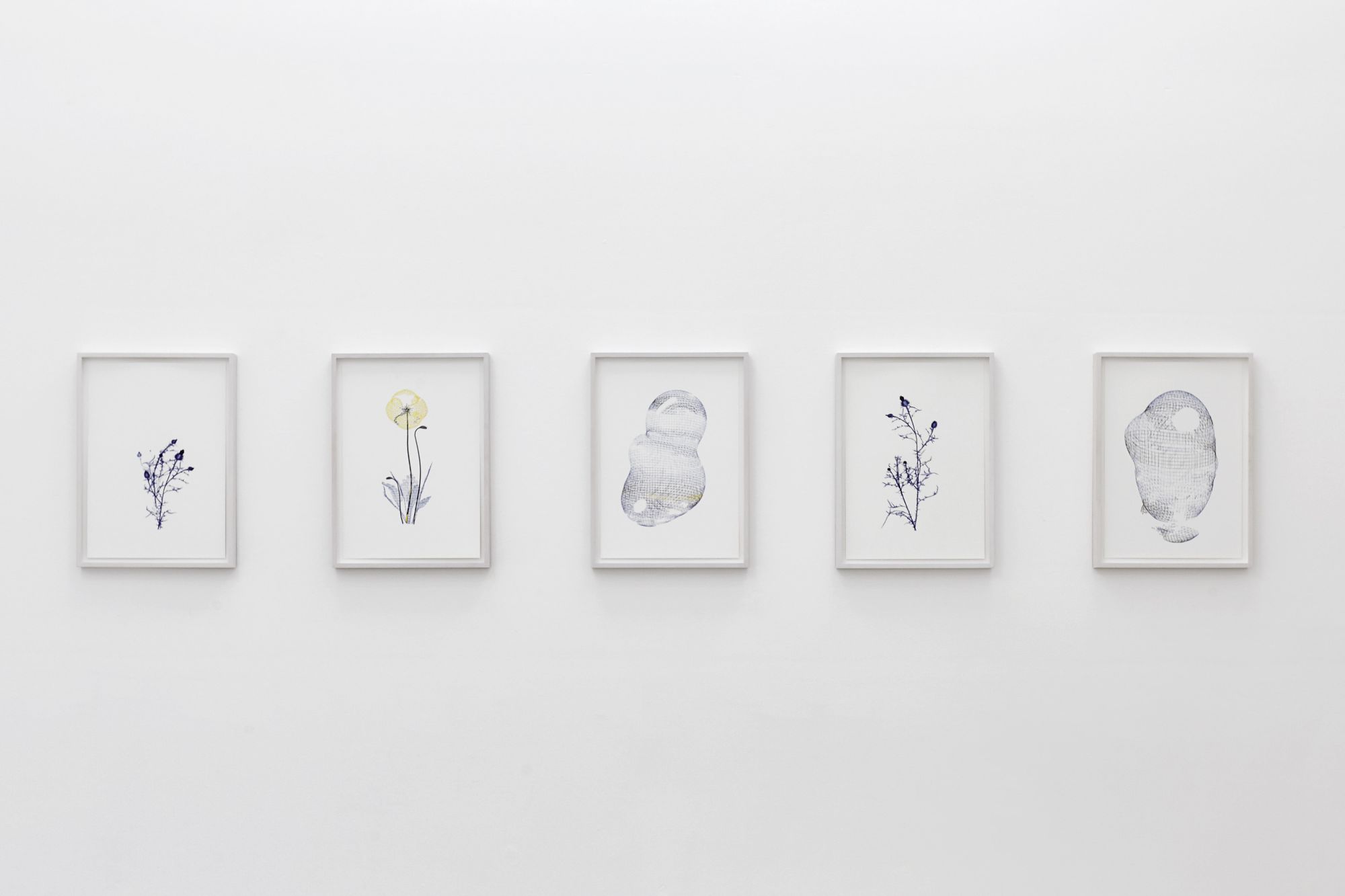
harm.work does not list them under the show, but the artist's page for it and this photograph do: five ballpoint plotter drawings of 2017, each 46 × 34 cm, in pale frames in a row. From the left: a thistle sprig in blue ink; Papaver Somniferum, a poppy whose petal is washed in pale yellow; a wireframe blob; a second thistle; and a second blob. The thistles are Thistle (left) and Thistle (right), drawn from the same model. harm.work catalogues Metaballs and Metaballs ⁱⁱ; the artist's page calls them "Metaballs (1)" and "Metaballs (2)". The botanical sheets are traced from 3D plant models; the Metaballs sheets plot wireframe blobs. On all of them he pulled or changed the pen by hand while the plotter ran (→ Automated Drawings, Early Plotter Drawings). The thistles and both Metaballs went on to Pattern and Presence in 2018.
The names
The titles in this show sound like words and are not: Adoreway, Availablesky, Frouters, Bluena, Juancar Zolim Juancar, Joa Dereck Pitcher, Accents Ashleigh Delasand. The press release does not explain them. CLOT Magazine's notice of the show (12 January 2018) does: "The pieces are named with passwords that people actually use in real life, found on the internet. This also recalls this feeling of shame, as some can be particularly bizarre." CLOT ties the names to the title's shame: a password is something one would not want to say out loud as oneself. The Death Imitates Language page had guessed a password-list origin for the specimens' names from their look alone; CLOT's sentence was the first source to say so, and the artist confirms it: the names are leaked passwords (November 2026).
Reception
The only coverage found is CLOT Magazine's notice, "Exhibition: Harm van den Dorpel at Narrative Projects" (12 January 2018), which paraphrases the press release, calls him "a key figure in the post-internet art movement", adds the line on passwords, and links the show to the Death Imitates Language website. The are.na channel in which he keeps candidate exhibition titles, Show titles, opens with "Asking for a friend" on 9 December 2017, sixteen days after this show opened; "Pattern and Presence", the next show's title, followed forty-nine minutes later.
See also
- Algues Artificielles — the seaweed system, its prints and Hybrid Vigor .bio
- Death Imitates Language — the population, its names and Autobreeder
- Automated Drawings — the plotter drawings of 2017–18
- IOU (2015) — his first solo show at narrative projects
- Pattern and Presence (2018) — the next solo show, with the nested panels
- Evolutionary Logic — how the breeding systems choose
- Asking for a Friend — press release