
Automated Drawings — Plotter and Hand (2016–2018)
Automated Drawings is the name harm.work gives to the plotter drawings van den Dorpel made in 2017 and 2018: "Drawings on paper made with a CNC-router, disturbed and complemented by my own hand. Various scripts and custom software were programmed to generate each unique drawing." The series lists thirteen works, from Metaballs (2017) to Typographic Trace (2022), most of them ballpoint and pencil on paper between 21 × 30 and 46 × 34 cm. His are.na captions date the method to 2016. In 2017 and 2018 Kunstverein Freiburg and the London gallery narrative projects, which offered and showed them, called them automatic drawings.
Eight of the drawings, and the stories of how several were made, are in the artist's own note for Lohaus Gallery, Early Plotter Drawings. This page covers the series as a whole, the drawings of the same years that harm.work files outside it, the texts written about them at the time, and the shows they were in.
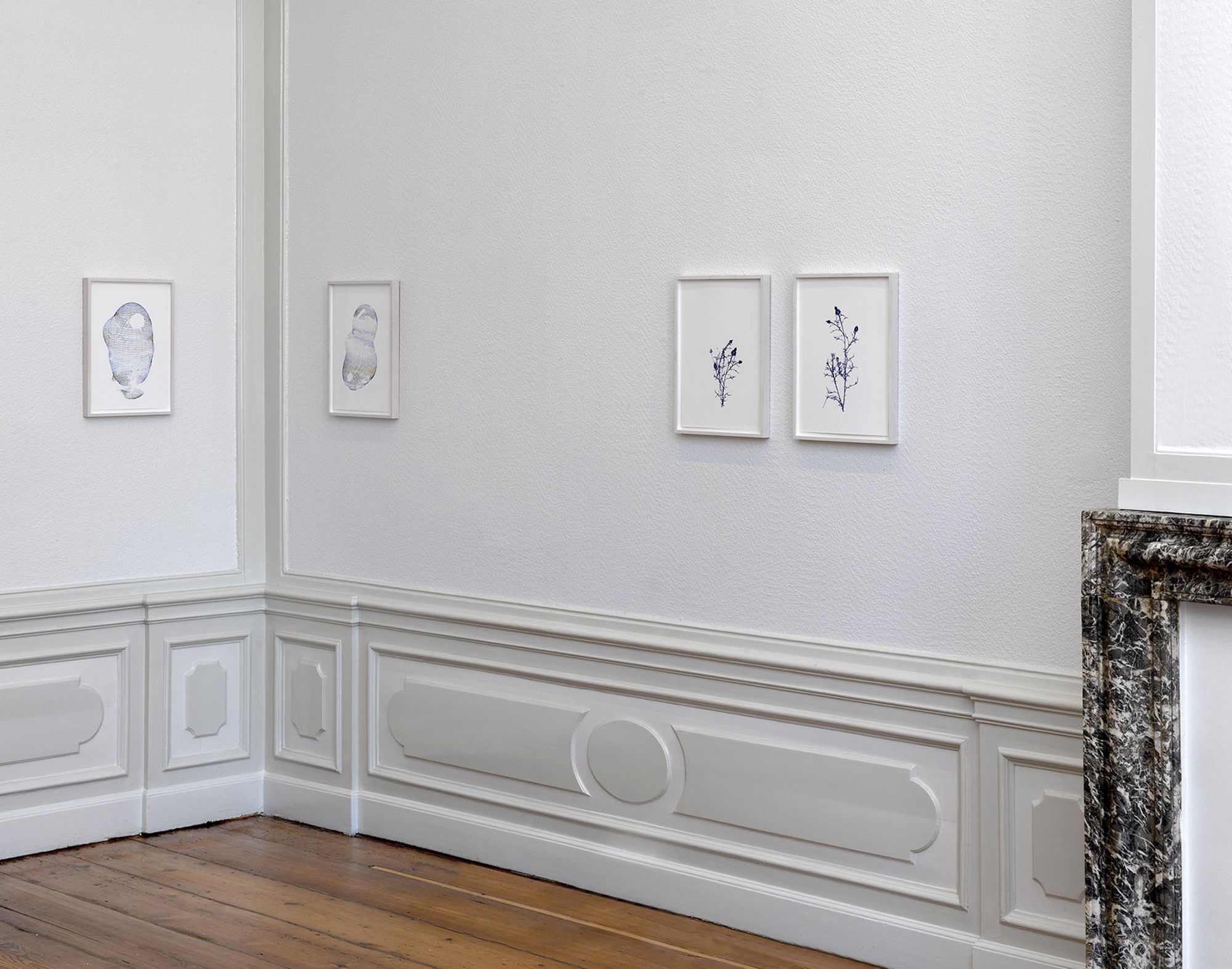
Four framed drawings hang on a panelled wall beside a marble fireplace: the two Metaballs on the left, the two Thistles on the right.
How they were made
The series text on harm.work is in the artist's voice. He made the drawings while working on other series, Death Imitates Language among them, from "small ideas, formal explorations". On screen or from a laser printer these looked "a little flat and lifeless to me, not dynamic enough. I wanted to make them a bit more 'live', and, so, ironically, I introduced a machinic dimension." He goes on:
"I would set up a plotter that would begin drawing with a ballpoint pen, and then I would interfere in the drawing process. Sometimes I would pull out the pen or change the pen in the plotter as it was moving. It resulted in some very interesting effects. I particularly liked cases when, for instance, there would be horizontal line, and then a vertical line, and the movement of the plotter would displace the ink that hadn't dried in the previous line. This created pleasant, unexpected painterly qualities. In a way, these are quite classical works, concerned with form and the temporal dimension - they take a lot of time to create which allows me to get bored and experiment with the process. They are something like classical cyborg art works."
The sources varied. The botanical sheets trace 3D models of plants, often open-source assets made for games; Metaballs ⁱⁱ began as a Cinema 4D structure whose exported lines he cut open in Illustrator; Uttered Modality plots an L-system (→ Early Plotter Drawings). Two kinds of interference recur: during the run (pen pulled out, pen swapped for another colour) and after it, lines and marks added by hand in pencil and pen. Meditative Labour calls the first mode the hand interrupting the plotter and places it among four ways hand and machine have worked together in the practice.
Automatic or automated
The harm.work text reads the title as "a nod to the 'automatic drawings' made by the surrealists". The two texts written while the series was being made use that name.
Kunstverein Freiburg, offering the drawing Bamboo as an annual edition in 2017, wrote that for his "automatische Zeichnungen" he works with a CNC plotter which, "controlled by software he programmed himself", draws "in steps precise to the millimetre and is sometimes disturbed by the artist's hand" (source, the wiki's translation). For Art on Paper in Brussels, in September 2018, narrative projects presented "Automatic Drawings by Harm van den Dorpel, an ongoing series of works made with a mechanical cnc-plotter and the artist's own hand", and drew a conclusion about authorship: "the artist does not create his work directly himself. Rather, he devises software and a robot, which stands in for him, raising questions about artistic agency and identity in our era of artificial intelligence and increased automation" (same source).
The artist's account runs the other way. He brought the machine in because the image on screen looked lifeless, and what he values in the result is what happened while it ran: the pen pulled out, the wet line dragged by the next one. In the surrealists' automatic drawing the hand moved without conscious control. In these drawings the machine is the automatic part, and the hand is where the decisions come in, during the run as well as after it. The gallery's "robot, which stands in for him" describes the plotter's share; the artist's text describes the hand that kept stopping it. harm.work's title, Automated, names the machine's share alone.
The works
Botanical drawings
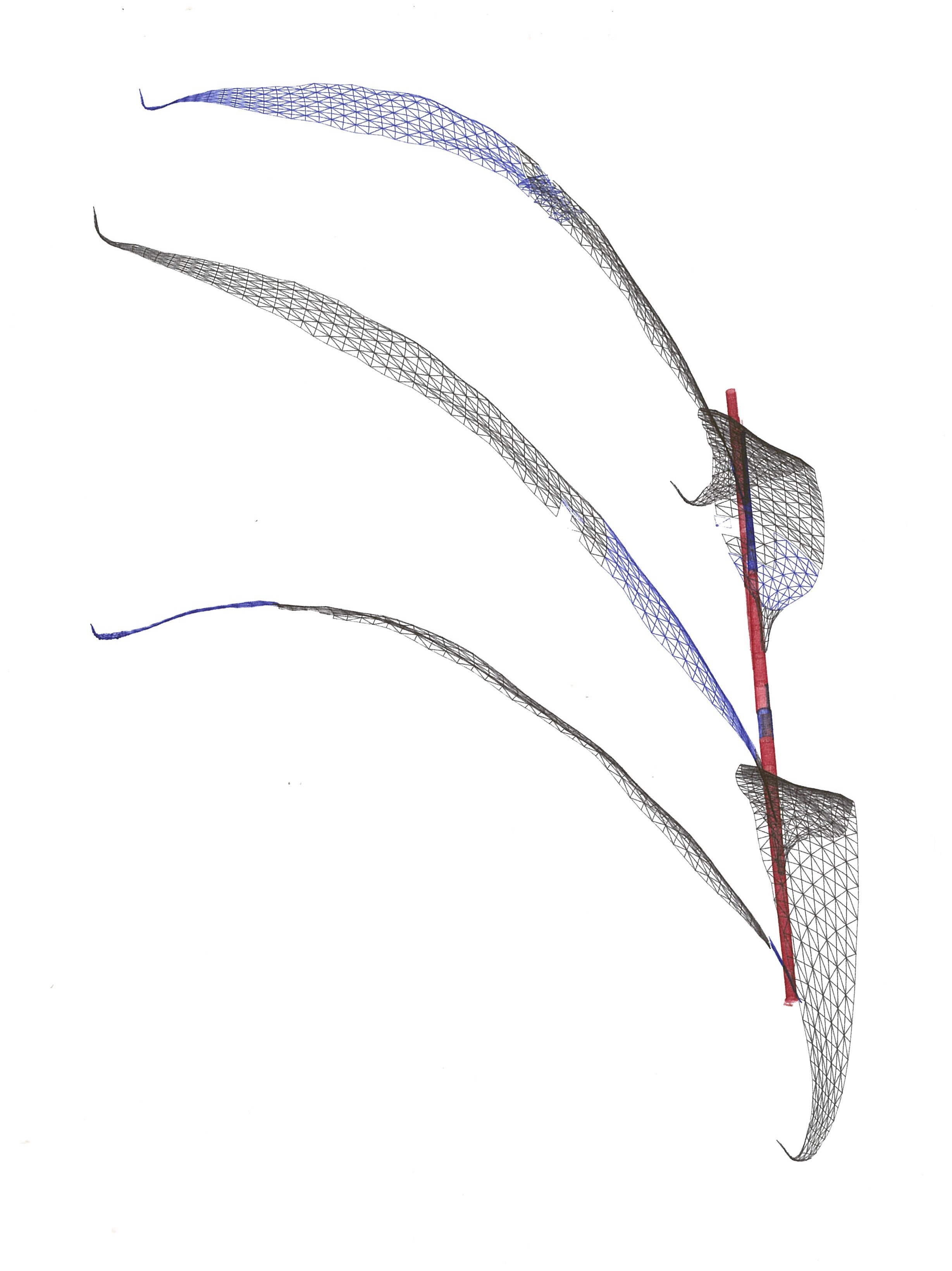
Bamboo is not on harm.work. Three long leaves are drawn as triangulated wireframe meshes, mostly in black ballpoint with stretches in blue, and join a stalk drawn as a narrow red cylinder at the right. Kunstverein Freiburg issued it in 2017 as an annual edition of three (the database lists number 2/3) and showed its editions from 15 November 2017 to 7 January 2018; the artist filed it on are.na in October 2018 as "Ballpoint on Hahnemühle paper / unique / 21 × 30 cm" (block). Each copy of a plotted edition is drawn separately, so "unique" and "2/3" need not conflict. The Kunstverein's text points out what the motif usually stands for: bamboo in ink drawings, used as decoration "in lobbies, offices, sushi bars or wellness oases", "signals meditative contemplation of nature and spontaneous artistic creation". Here a machine draws it.
In the series itself the botanical sheets are Thistle (left) and Thistle (right), "based on a processed generated 3D model, with some manual interruptions", and Untitled Flower, a dandelion (→ Early Plotter Drawings). A tree and Papaver Somniferum, made the same way, are listed under no series.
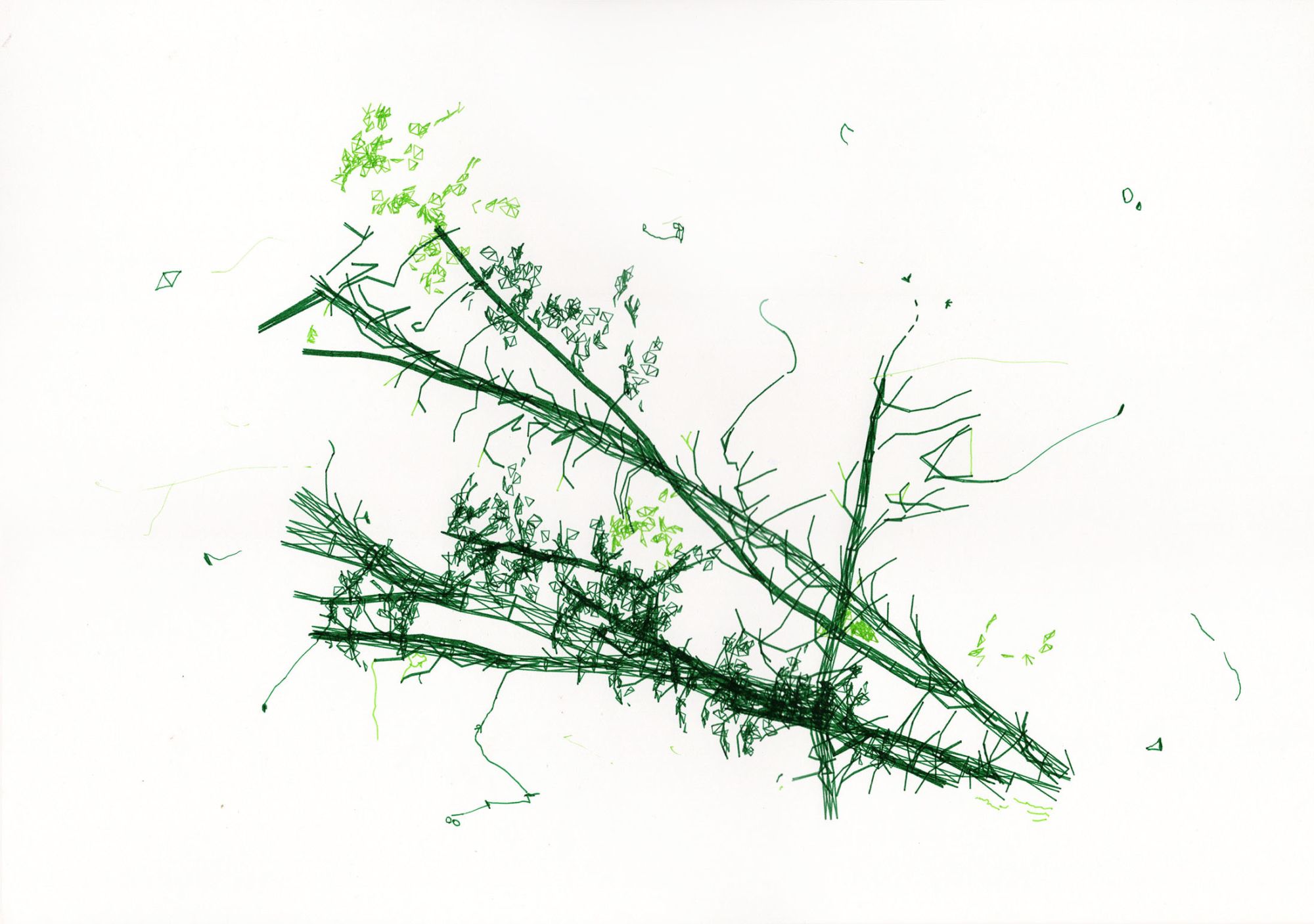
One of the three sheets titled Untitled is botanical too. Dark green branches cross the landscape sheet diagonally, each drawn as a bundle of parallel strokes, and the leaves are clusters of tiny triangles in light green, as if fragments of a mesh had come loose from the branch. Stray tendrils end in open space. The artist posted it to his Drawings channel on 10 April 2018.
Metaballs
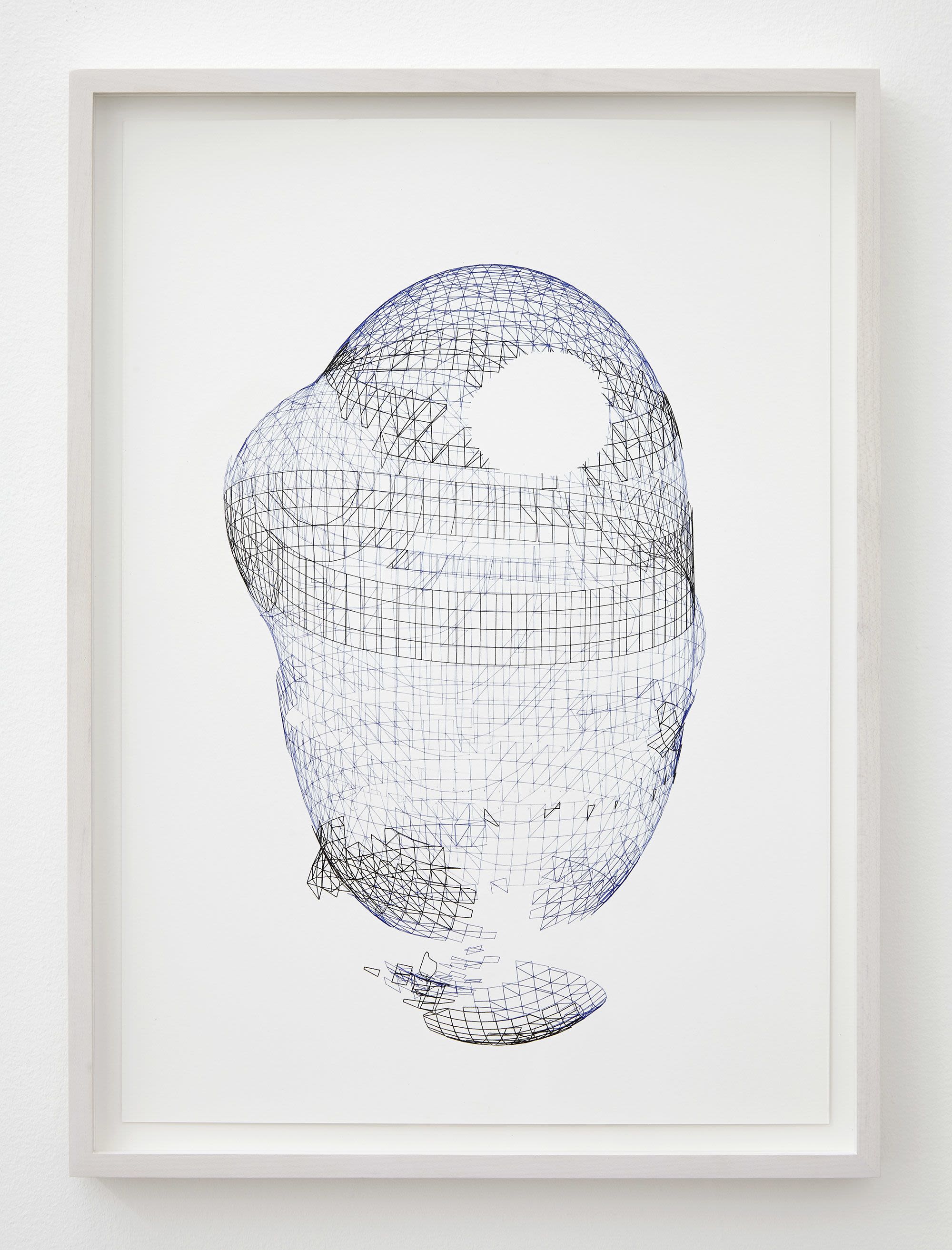
Metaballs are a graphics technique for surfaces that fuse when they come close, a standard way of making organic-looking volumes in 3D software. In Metaballs two such volumes have merged into one lumpy body, drawn as a wireframe of quadrilaterals in black and blue ballpoint; an oval opening is cut into its upper right, and a separate fragment of mesh hangs below it. Its companion Metaballs ⁱⁱ has the void at the lower left and a yellow band where a pen was replaced. On are.na in May 2018 the two are "Metaballs (1)" and "(2)", both "Ballpoint on Hahnemühle paper / unique" (1, 2). Rounded, fused volumes return in the artist's work in other materials, from the seaweed shapes of Algues Artificielles to the squircles of the Mutant Garden (→ The Squircle).
Line fields and the hand
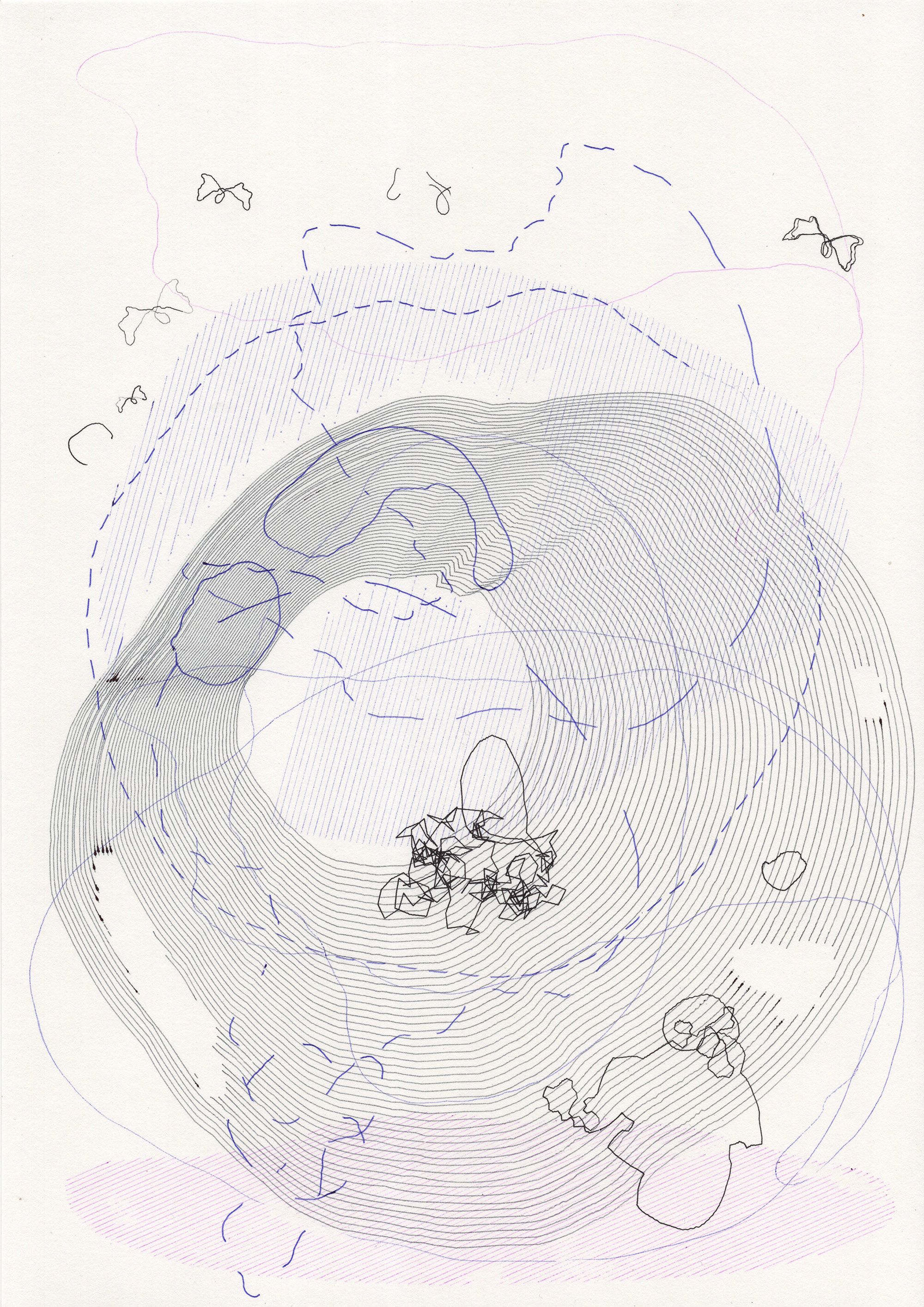
In Untitled (30 × 40 cm) a ring of concentric black contour lines lies on a field of short vertical strokes in blue, like the rim of a bowl seen from above. A violet hatched ellipse sits under it like a shadow. Over it run dashed paths in blue and a thin violet outline, and small knots of black line, some shaped like bows, are scattered at the top and in a dense tangle at the centre.
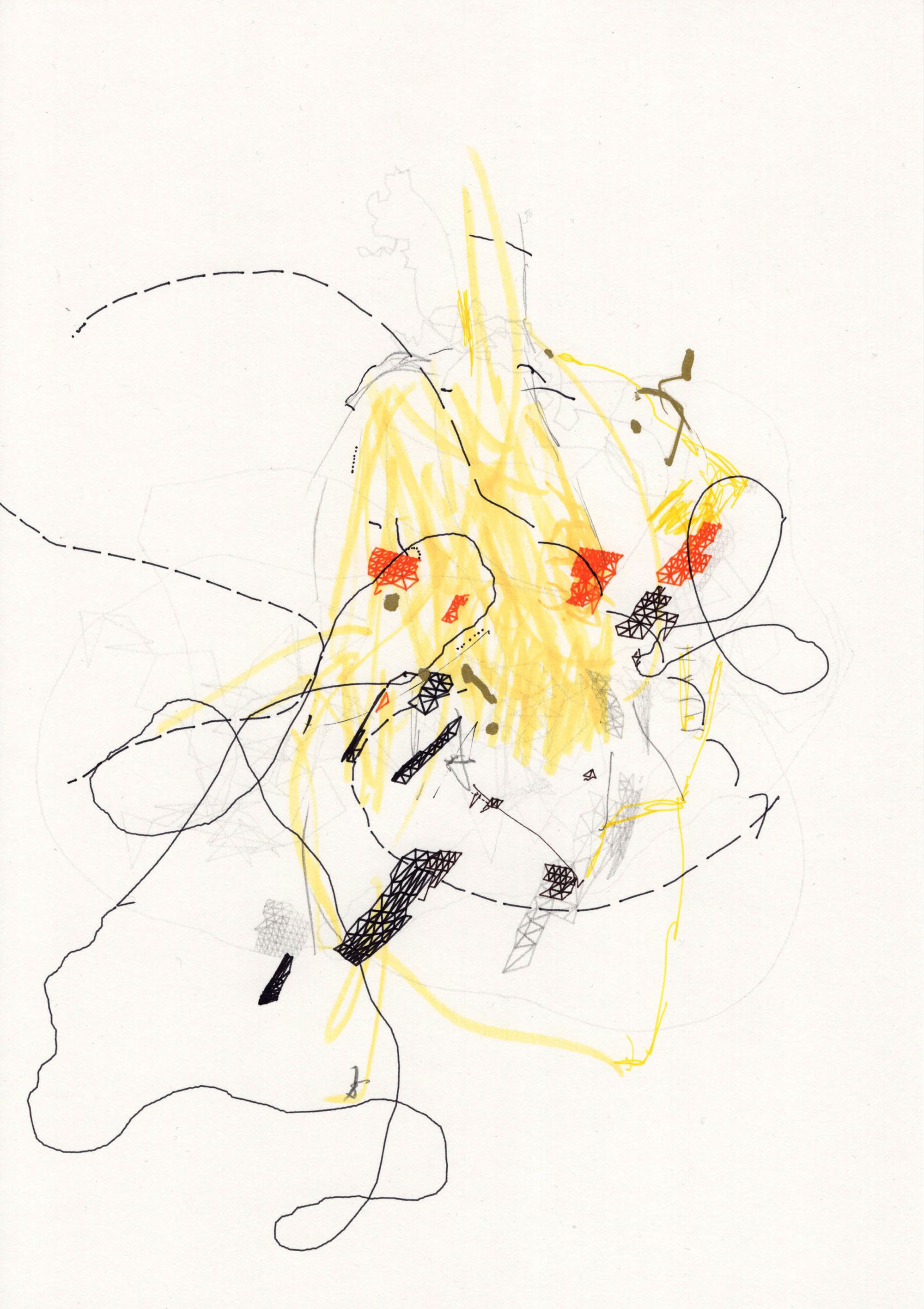
The smallest sheet, Untitled (21 × 30 cm), is the loosest. A single black line wanders round the sheet in loops, a dashed line crosses it, and a mass of yellow strokes gathers in the centre. Inside the yellow are small wireframe patches, a few filled red-orange and others black, fragments of a mesh like those in the botanical sheets.
Yellow Snow (2017, 29 × 20 cm, not published on harm.work) is a block of close horizontal pen lines with a patch of yellow at its left edge; the artist posted it to are.na as "Don't eat the yellow snow", the title of a Frank Zappa song of 1974, and captioned it "2016 / semi automatic drawing (cnc + hand) / pen and pencil on paper" (block; reproduced on Meditative Labour).
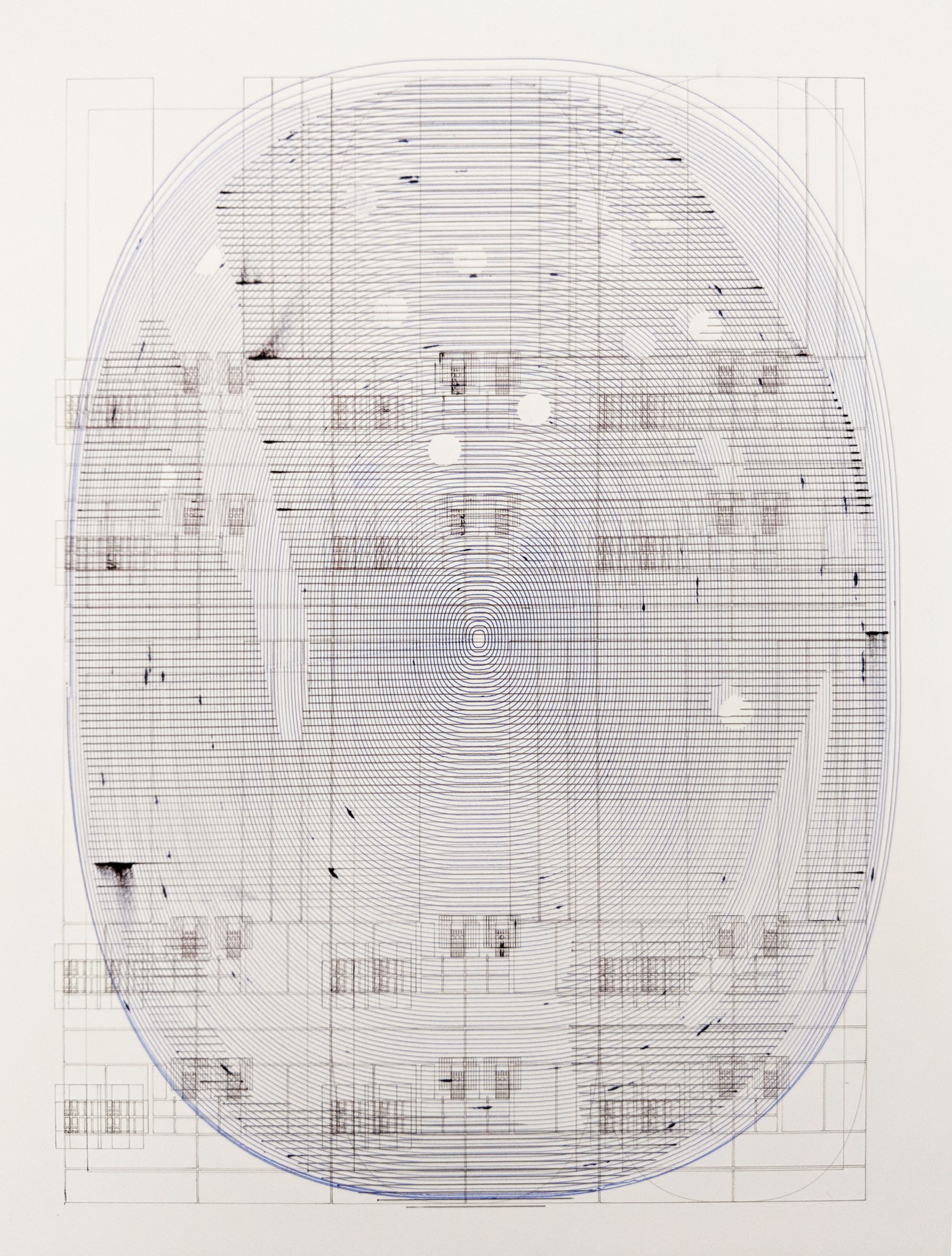
Fingerprinting is built from two layers. Concentric rounded rectangles in blue pen contract towards a small centre, like the whorl of a fingertip. Over them a grey grid of ruled bands carries rows of small nested rectangles. A few small circles are left blank, and where the pen rested the ink pooled into blots and short smears. The artist has not explained the title. The text of Pattern and Presence, the show of the same year, uses the word for the hash that identifies a work on the blockchain: "a unique identifier (a hash or fingerprint)".
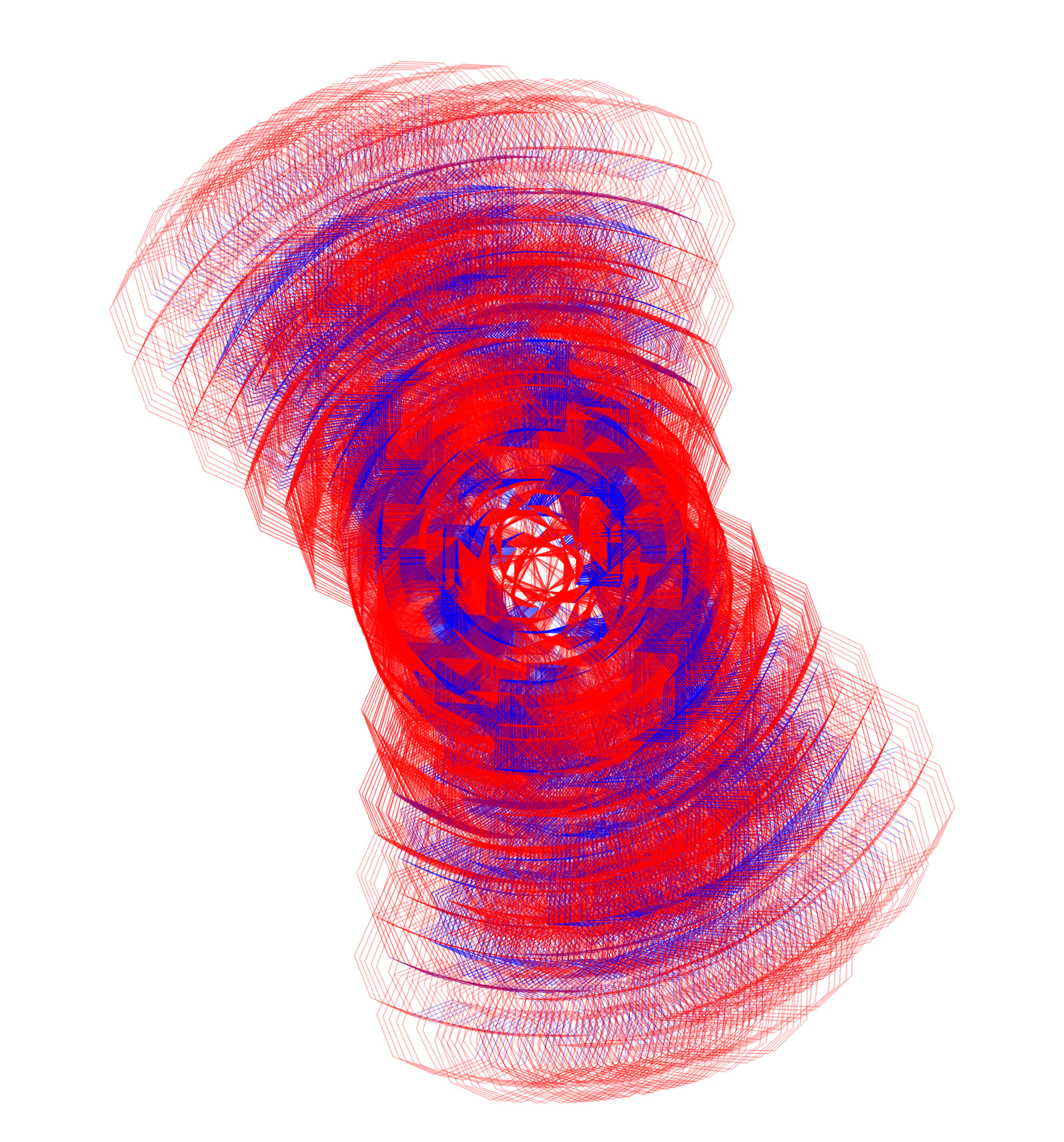
harm.work shows Diaphragm with the image the program produced before plotting: hundreds of polygon outlines in red and blue, each turned a little against the last and shifted outward along a diagonal, so that the stack twists into an S round a dense centre. The drawing is ballpoint only. By the artist's account the pen went over the same areas so often that it began to eat into the paper, and the drawing was the last the old plotter made before it failed and dragged its pen back to the origin (→ Early Plotter Drawings). Set side by side, source and drawing separate what the program decided from what the pen and paper did with it (→ Process Legibility).
Typographic Trace (2022)
Typographic Trace, the one later work in the series, is a "Plotter drawing on Hahnemühle paper, with manual colour pencil retouches" (50 × 45 cm): letter-like rounded forms over blue construction lines. It was shown with Uttered Modality and Diaphragm in Context Switch in 2022 and is reproduced on Context Switch. harm.work also files it under the Mutant Garden series, as the one plotter drawing there; the hand-coloured Mutant Garden drawings of 2025 are on Quadra, Features and Soft Shield.
Nested drawings (2017–2018)
harm.work files a second group of plotter drawings of the same years under no series. They share a structure with the Nested Exchange works of 2017–2019: compartments inside compartments.
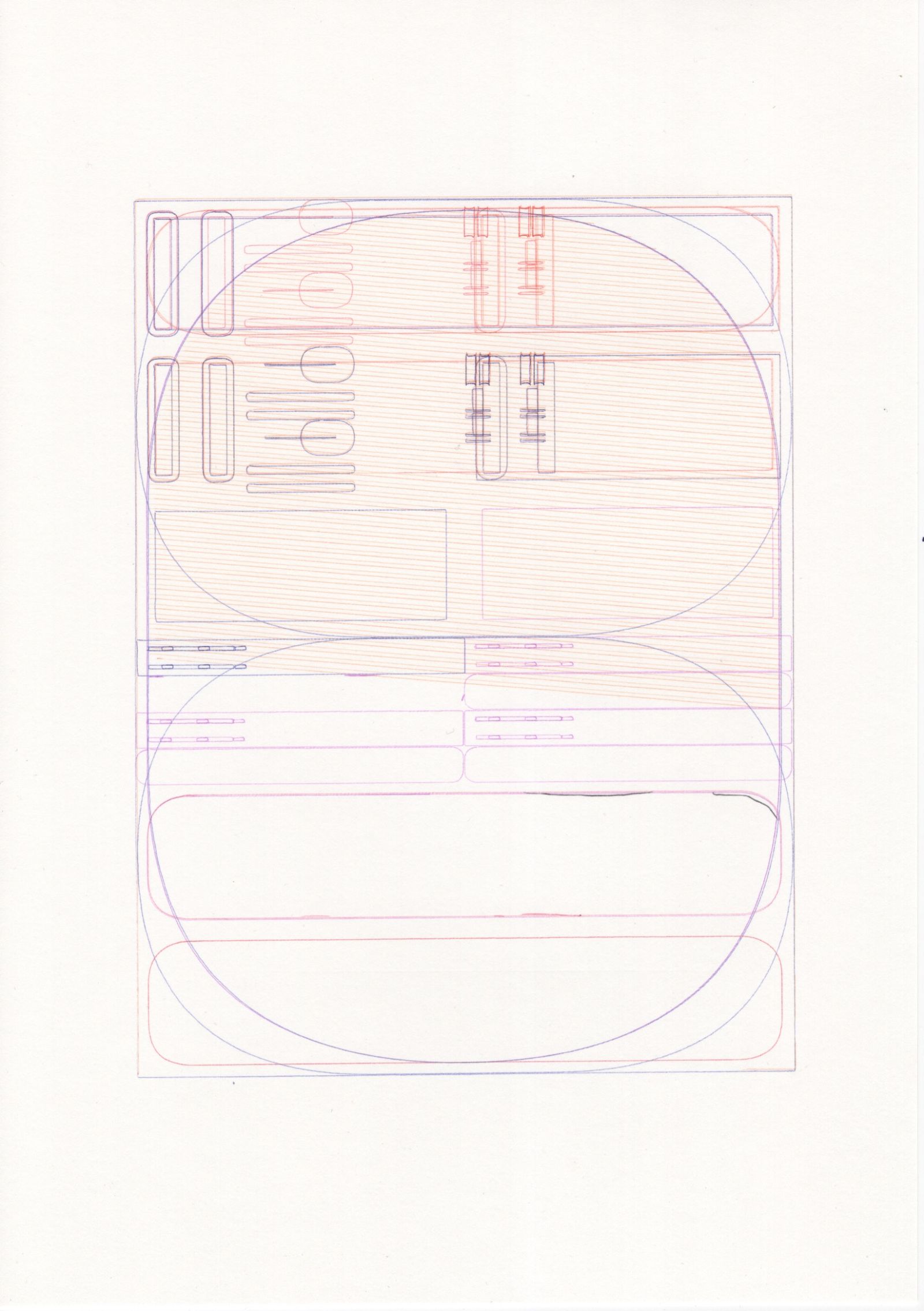
Nested Drawings (2017) is shown on harm.work as four sheets, with the note "Bento Optimizations", after the Japanese lunch box divided into compartments (bento). Each sheet is divided by rounded rectangles in pink, blue and violet pen into smaller rectangles, and those again into bars, slots and circles; some compartments are filled with fine parallel hatching. On 21 December 2017 he posted one of the four to are.na as "ballpoint on hahnemühle paper, a4" (block).
Of the four, the sheet shown above is the most open, a few hatched compartments in a rounded frame. The third on harm.work is the most layered: two rounded frames overlap and cross, one hatched in pale orange, with stacks of ruled rectangles in red and blue inside them.
The are.na record dates the structure. The artist's Nesting channel collects screenshots of nested compositions from 30 September 2017 on, the months before these sheets (→ The Grid, From nesting to the grid). The text of Pattern and Presence (2018) describes the same principle in the Nested Exchange prints: "the structure of 'nesting': a strong organizing principle found in architecture, software development and human language", which lets him "compare the construction of language to the construction of artworks" and take up "the painterly question of how to fill the two-dimensional plane using composition and layering". The drawings put that question to the pen.
Untitled Nested Composition 1 (2018) is a "Hand coloured plotter drawing (pen and pencil) on paper", 30 × 42 cm. Its plotted rectangles, rhombi and circles are coloured in by hand with pink, orange, yellow and pale blue pencil; it is reproduced on Meditative Labour, among the early examples of the plotter finishing and the hand filling.
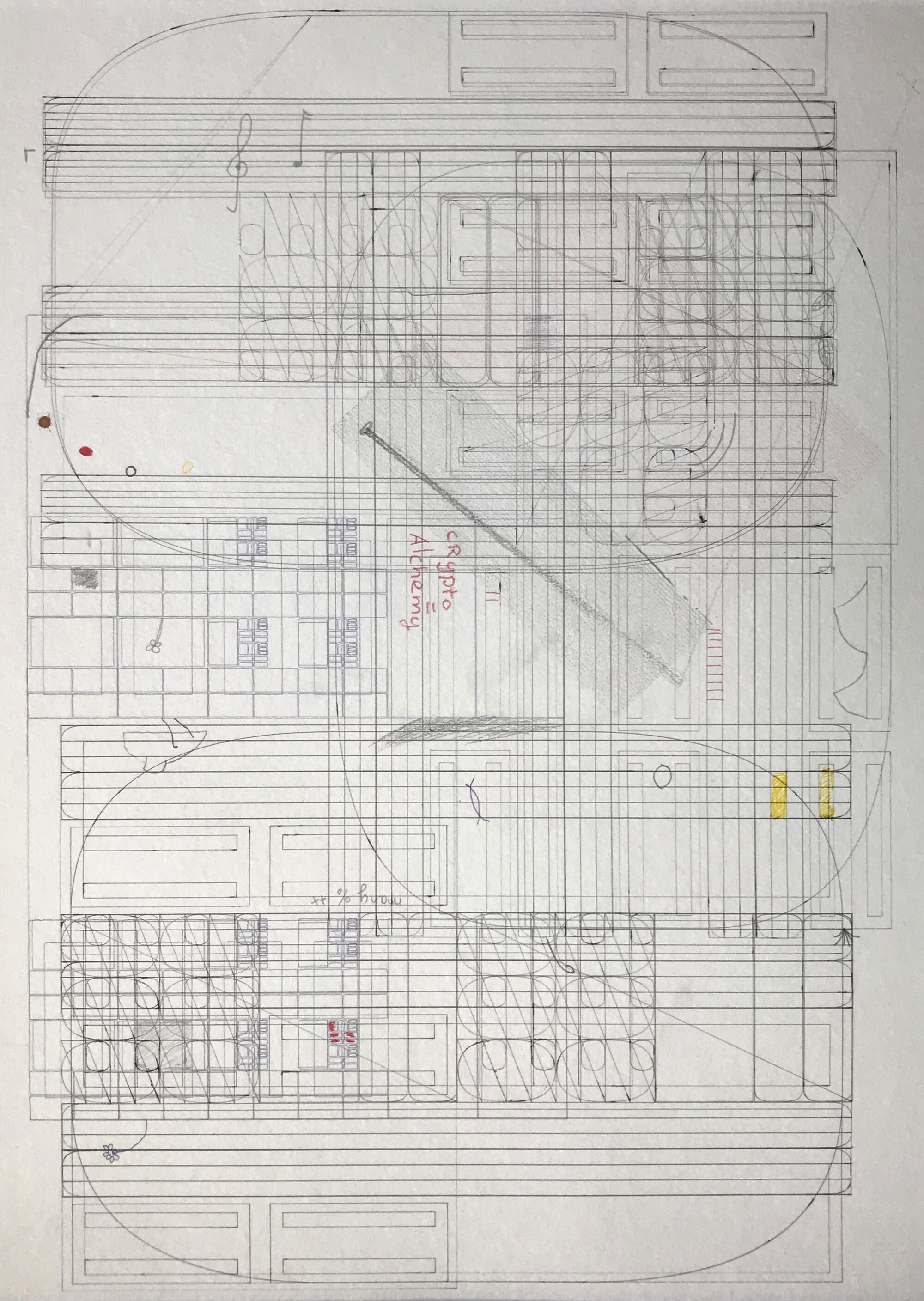
harm.work's page for Untitled Nested Composition 2 says: "Gave it away right when I finished it during a studio visit. Can't remember to whom, and I only have this cell phone photo left of it." The photograph shows an upright sheet ruled with horizontal and vertical lines in grey, rounded frames and rows of small boxes, a long diagonal stroke, a few red and yellow marks and a short red handwritten note. The same drawing, framed, is in his are.na Drawings channel on 30 June 2018 without a caption (block). An are.na block of 19 August 2018 carries the same title for a different drawing. That drawing is a work of its own, catalogued in November 2026 as Untitled Nested Composition 3 (the artist).
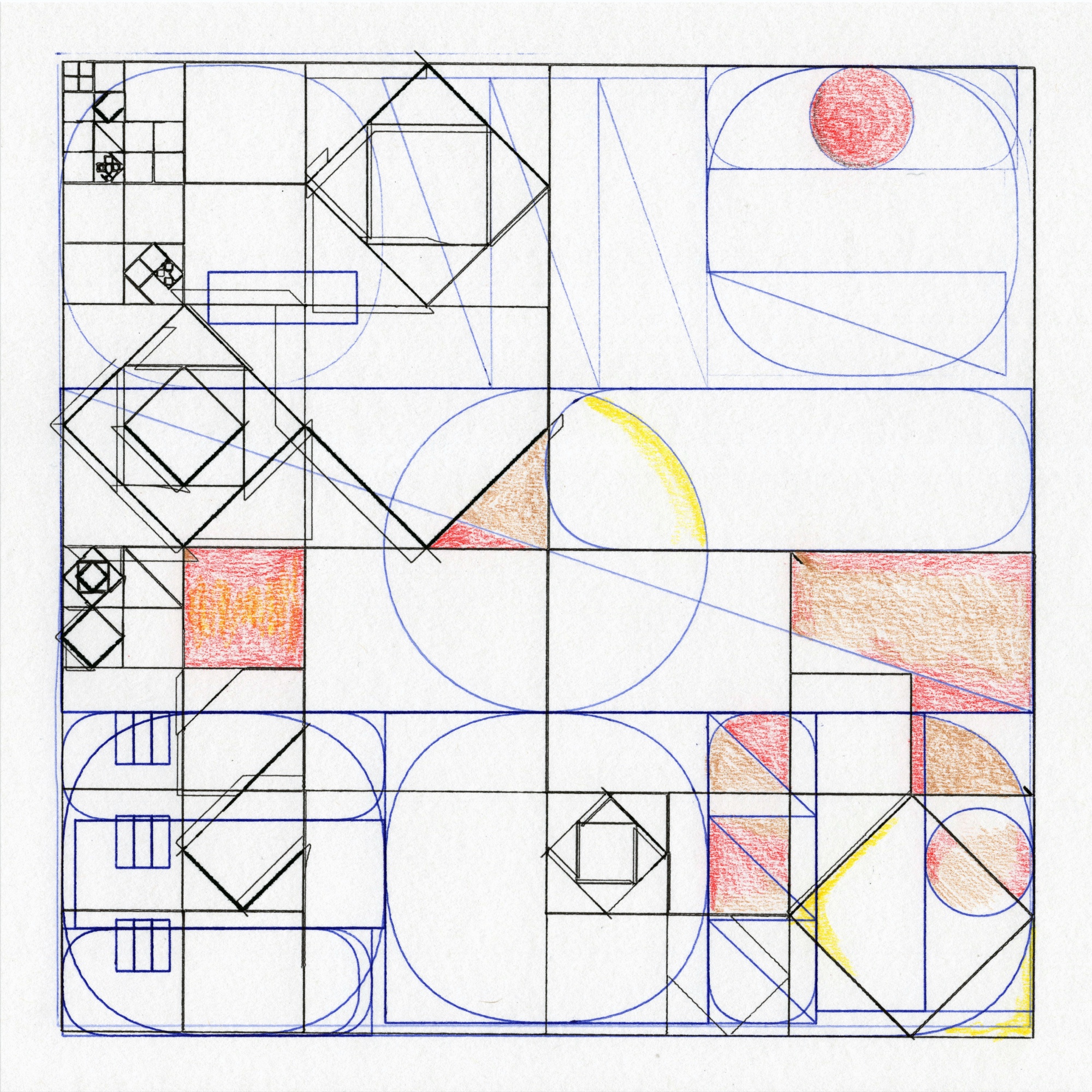
Untitled Nested Composition 3 (2018) is a square sheet. In black pen the plotter ruled a grid of squares and divided some of them again, down to a cluster of small quartered squares in the top left corner, and set squares turned 45° inside upright ones. Over that grid a second layer in blue pen draws circles, rounded rectangles and capsules that run across several cells, crossed by a few long diagonals. About a dozen of the shapes, a disc, wedges, half-moons and rectangles, are filled in by hand with pencil. On are.na the artist showed it turned onto its corner, which is how The Lozenge reads it.
Turtles (2016–2018)
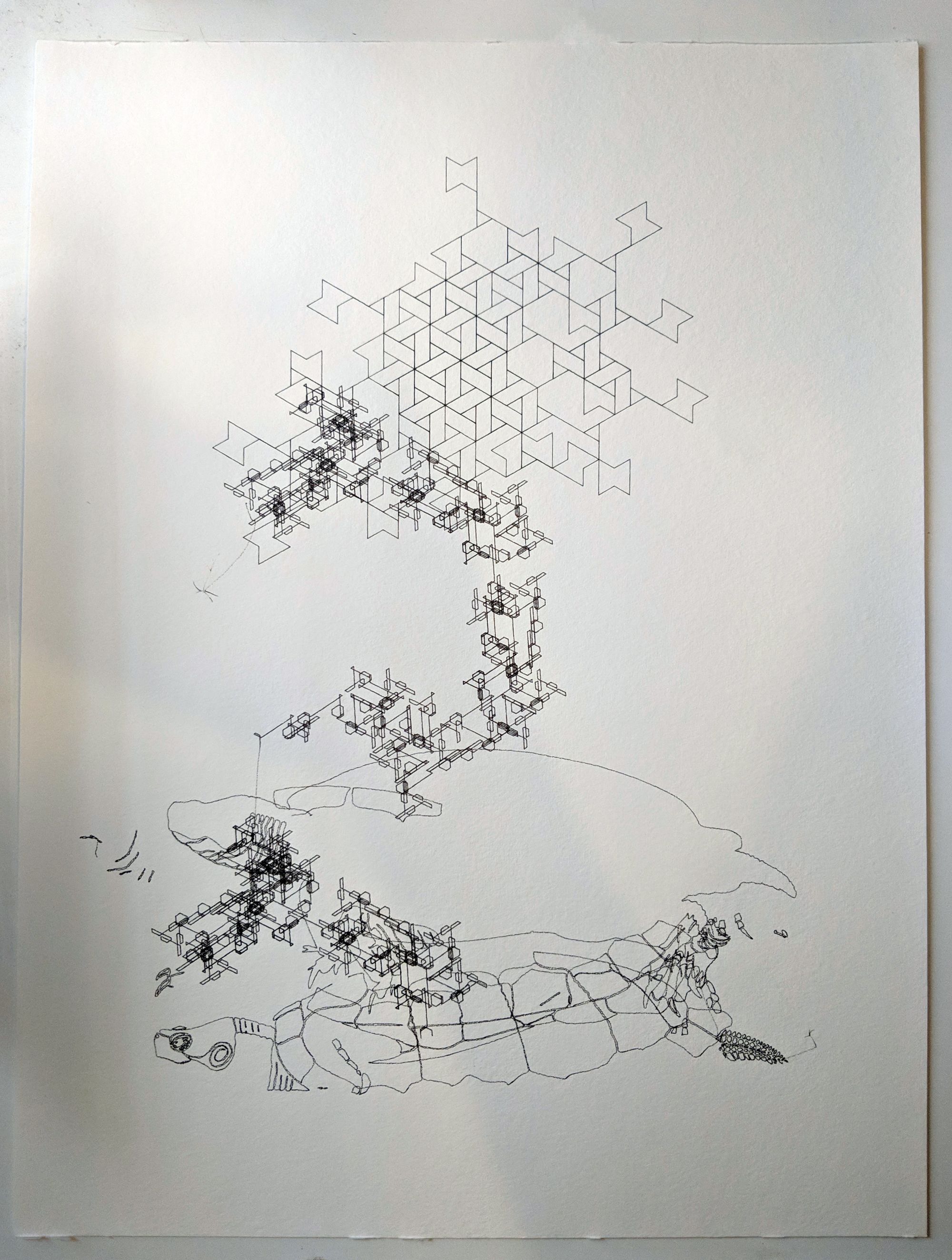
System with a Turtle (dated 7 December 2018 on harm.work, 29.7 × 42 cm) has a turtle drawn in outline along the bottom edge, its shell divided into plates. From the shell rises a chain of small square modules that branches as it climbs and opens at the top into a lattice of chevrons and arrowheads. On 19 December 2018 the artist posted the same photograph to are.na as "NEW. work in progress (ik kleur nog delen in met de hand)", "I am still colouring parts in by hand" (block); whether the colouring was done is not recorded. The composition puts the system on the turtle's back, where the World Turtle of several cosmologies carries the world; the artist has not said whether that was meant.
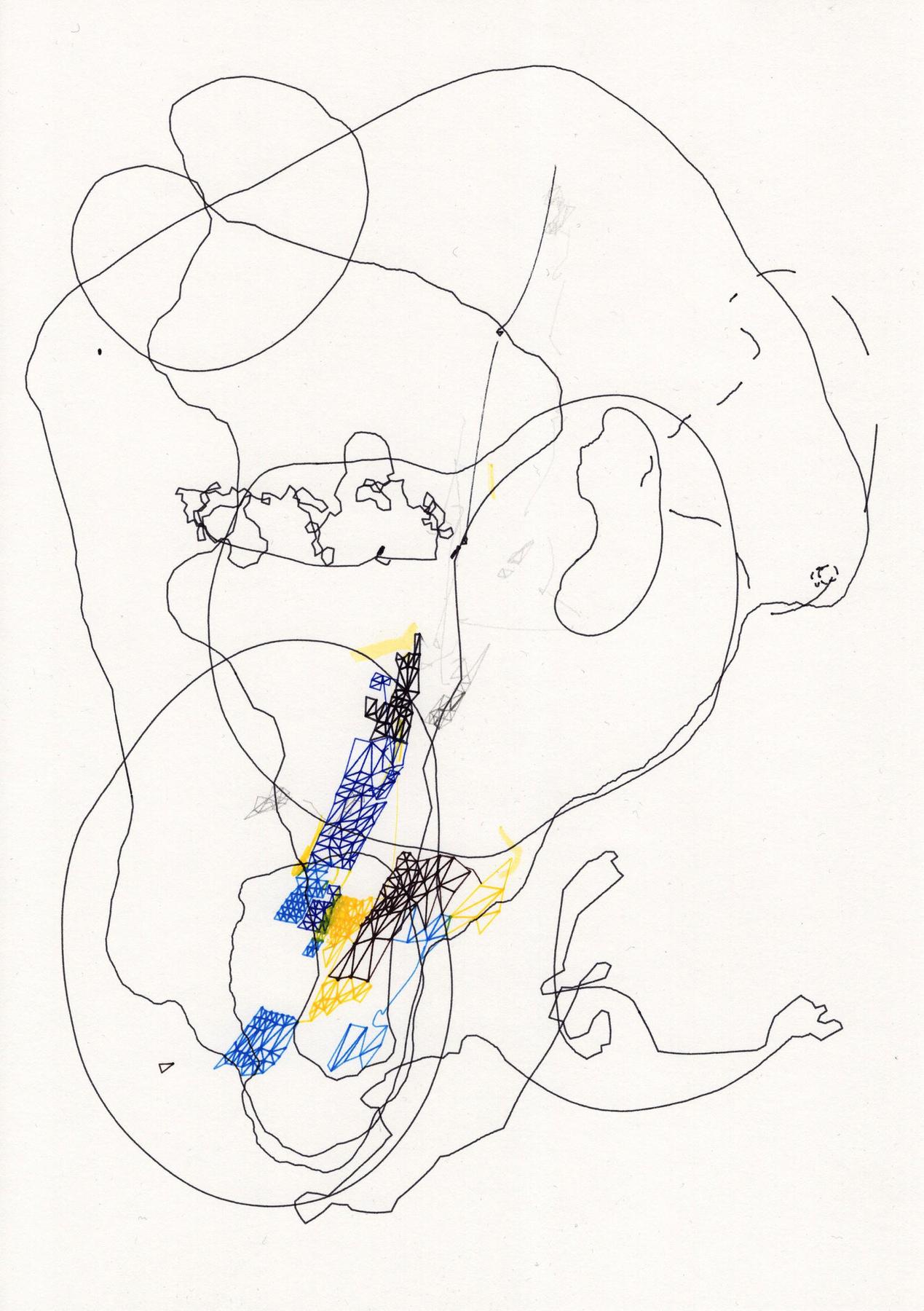
An earlier sheet in the are.na channel, captioned "Turtle Drawing with Ladders / 2016 / pen and pencil plotter drawing on paper", is not on harm.work. One long black line loops round the sheet in wide curves, and across its middle runs a column of short ladder-like segments, hatched in blue, yellow and black.
Both titles name a turtle. The press text of Pattern and Presence lists among the sources of his algorithms "'Turtle graphics' by Seymour Papert (late 1960s)". In turtle graphics a line is drawn by a cursor that moves relative to its own position and heading, and Papert added it to the Logo language in the late 1960s to drive a floor robot that drew with a retractable pen. A pen plotter is the same kind of machine, a pen moved over paper by commands and lowered or raised between strokes. In these drawings the artist stops it while it runs, pulls its pen and puts in another.
Where they were shown
- Asking for a Friend, narrative projects, London, 23 November 2017 – January 2018: five drawings in a row, the two Thistles, two Metaballs and Papaver Somniferum, by the artist's page for the show and an installation view (→ Asking for a Friend).
- Pattern and Presence, Upstream Gallery, Amsterdam, 24 February – 30 March 2018, his first solo show with the gallery (→ Pattern and Presence): Thistle (left), Thistle (right), Metaballs and Metaballs ⁱⁱ, with the Nested Exchange prints and two Assemblage sculptures. The title is taken from N. Katherine Hayles's How We Became Posthuman (1999) (→ Randomness and Pattern for Hayles's pattern and randomness). The artist's own project page for the show captions the Thistles "Ballpoint on Hahnemühle paper, unique, 46×34cm" (press release and captions).
- Art on Paper, Brussels, 6–9 September 2018: narrative projects showed "an installation of a group of framed drawings" (source).
- Context Switch, Galerie Noah Klink, Berlin, 12 November 2022 – 29 January 2023, a duo show with Achraf Touloub: Typographic Trace, Uttered Modality and Diaphragm (→ Context Switch).
- Summer: Sur Real Real, Lohaus Gallery, Munich, 2 July – 5 September 2026: eight drawings of 2017–2018, six of them from the series, hung in one row (→ Summer: Sur Real Real, Early Plotter Drawings).
Achillea Millefolium (2026)
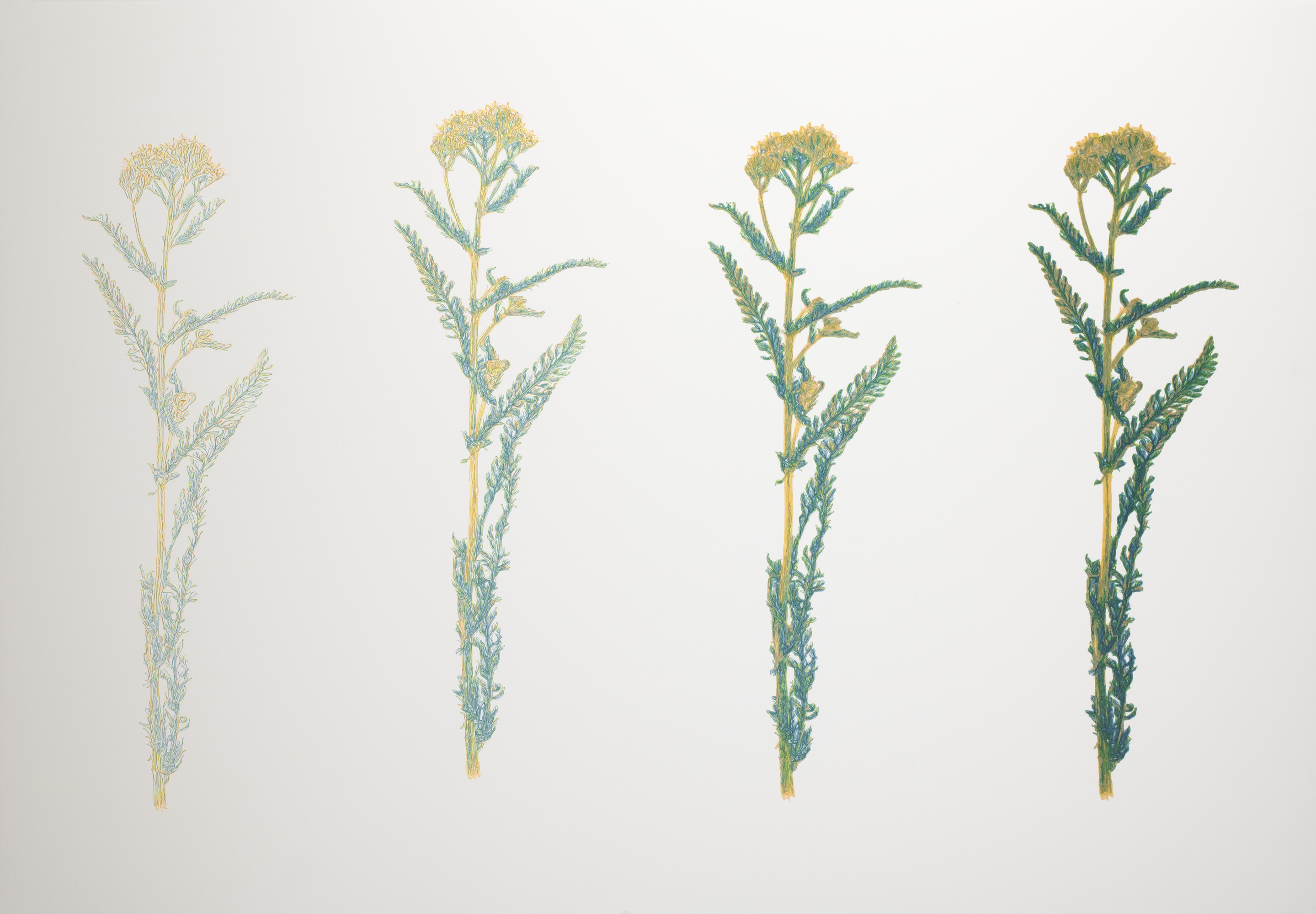
Nine years after the botanical sheets the plant returns, with a different source. The 2017 drawings traced the wireframe of a 3D model; Achillea Millefolium starts from a photograph. The artist's text on harm.work:
"This work began with a photograph I took of a yarrow plant (Achillea millefolium) growing by the roadside near my studio in spring. I formulated an algorithm to derive the grain of the plant: the directions in which its stems, leaves and flowers run, the course of its fibres and veins. These directions were reconstructed as Bézier curves in light green, dark green, orange-pink and yellow, and drawn onto paper with a pen plotter. The plant appears four times, and from left to right the number of curves increases. It grows again, not organically, but through accumulation in granularity. What begins as a sparse network of lines gradually becomes dense fields of colour: from drawn towards painted."
The four yarrows stand in a row with the same outline. In the first, single curves follow each stem and leaflet and the paper shows between them; in the fourth, curves lie so close that the leaves read as solid. The drawing turns the claim of Early Plotter Drawings, that the organic and the geometric lie on one continuum of complexity, into a sequence read from left to right: one rule, four densities. The yarrow is drawn with Bézier curves, where the plants of 2017 were straight segments of a mesh.
See also
- Early Plotter Drawings — the artist's note on eight drawings of 2017–18 and two of 2026
- Meditative Labour — the four ways hand and plotter work together; Yellow Snow and Untitled Nested Composition 1 as early hand-filled plots
- Automatic Drawings — Kunstverein Freiburg and narrative projects — the two texts of 2017–18
- The Grid — nesting, and the move from nesting to the grid
- The Lozenge — Untitled Nested Composition 3, shown on its corner
- Process Legibility — the plotter's line and the visible rule
- Death Imitates Language — the series made in parallel
- Monochrome Drawings Edition — brush plotter drawings of 2025
- Quadra, Features and Soft Shield — Mutant Garden compositions plotted and coloured by hand, 2025