
Monochrome Drawings Edition (2025) — Eight Brush Plotter Drawings
The Monochrome Drawings Edition is a "Suite of eight monochrome plotter drawings" of 2025. harm.work describes how it varies: "The mechanical plotter and the calligraphy brush introduce subtle variation in direction, stroke width, and ink density, so no two are identical." The page adds "Edition of 20" and "Signed and stamped". Each work is listed as a "Sakura brush plotter drawing on watercolour paper", 36 × 48 cm. The eight are Tires, Bamboo, Pole, Rotan, Serif I, Serif II, Bones and Plateaux (monochrome). harm.work dates Plateaux (monochrome) 5 March 2025 and the other seven 1–3 July 2025; their pages exist but are not yet published in its listings.
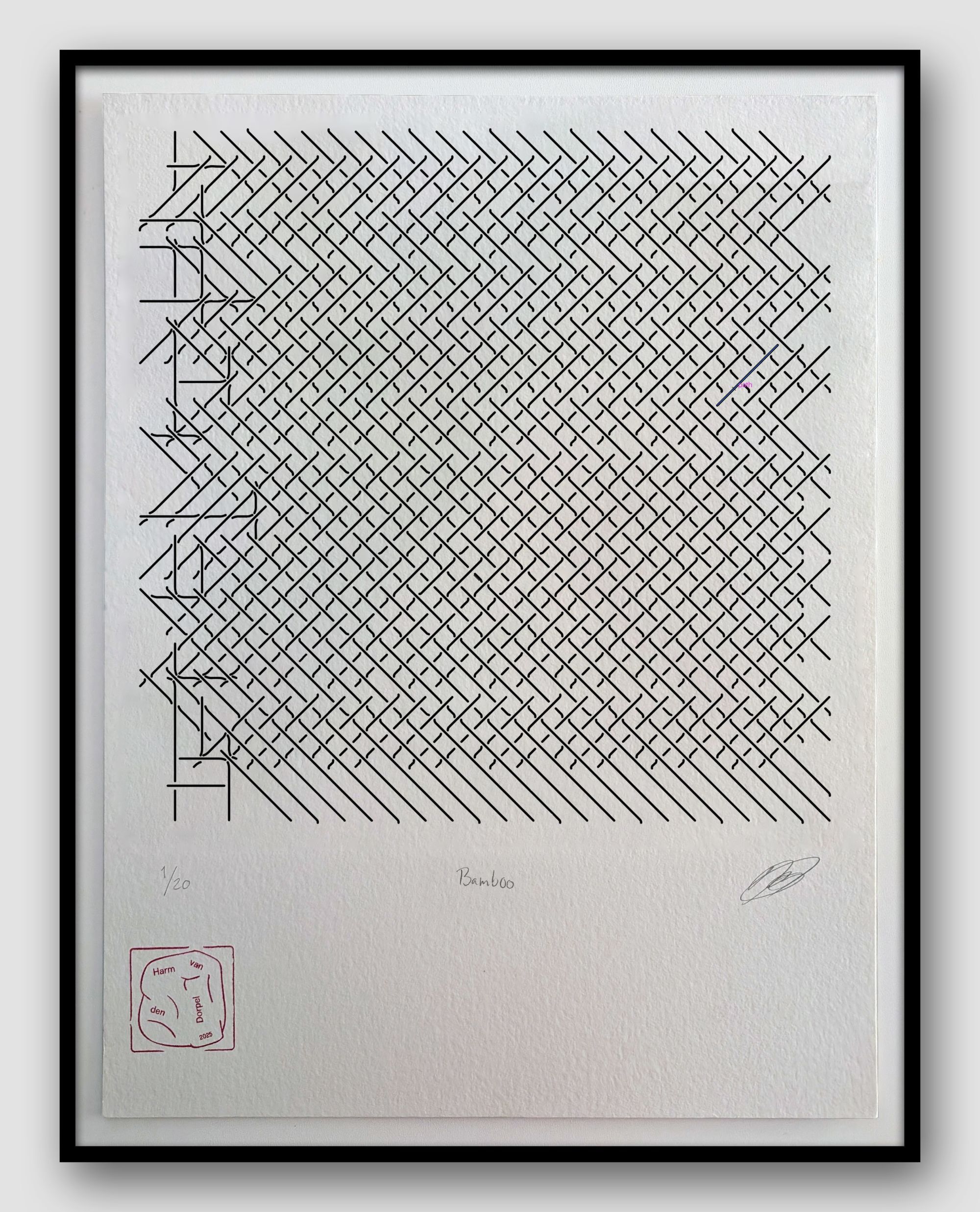
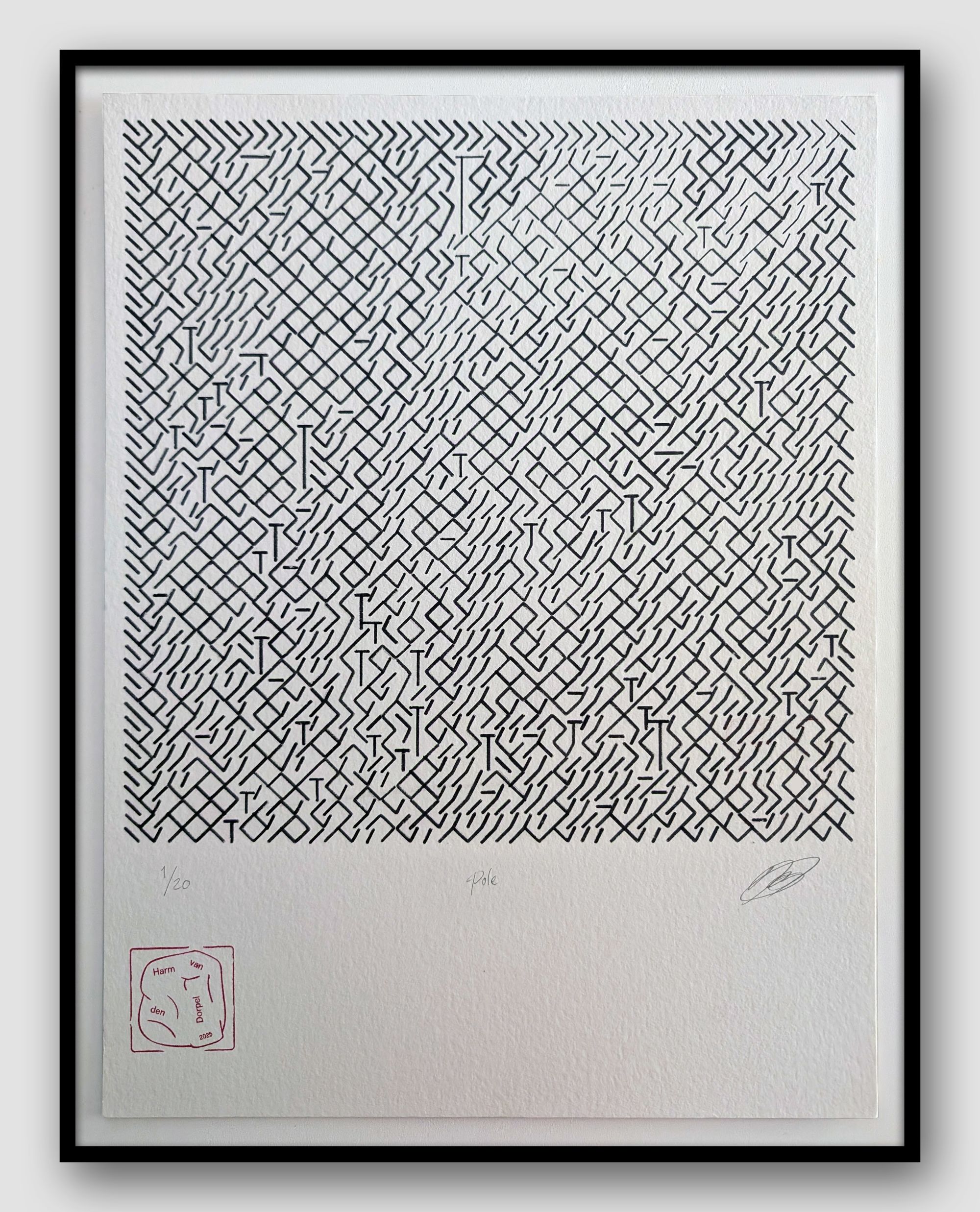
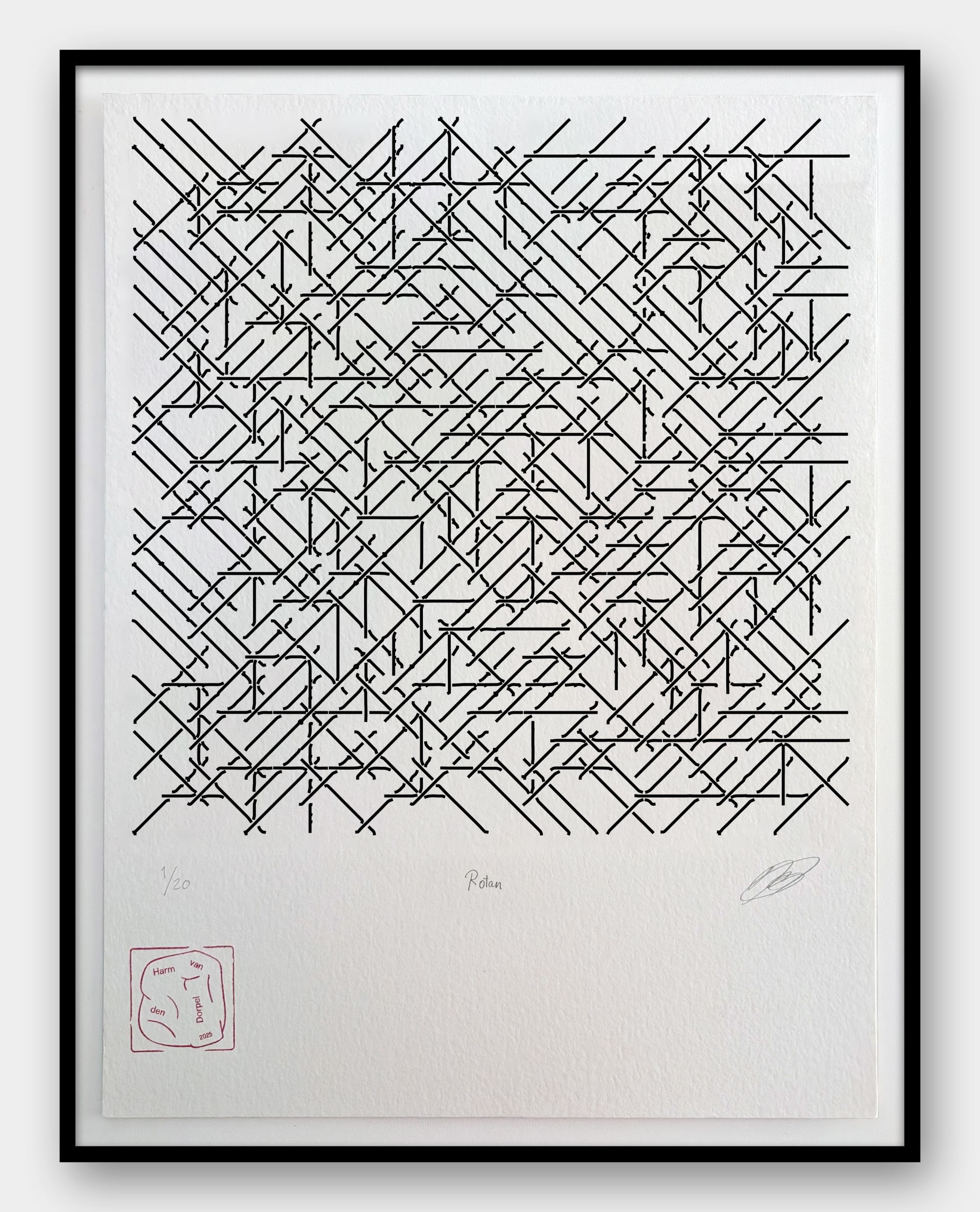
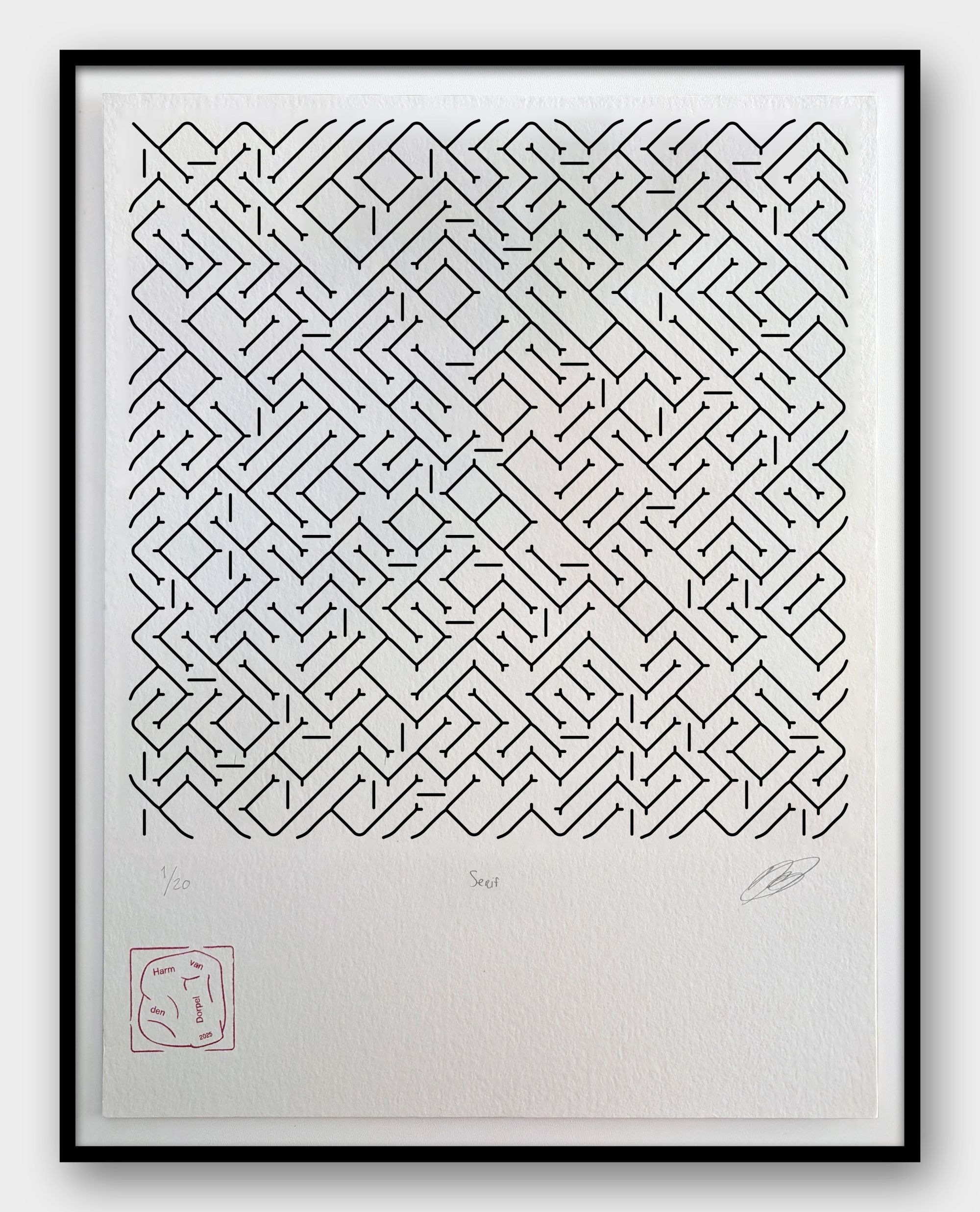
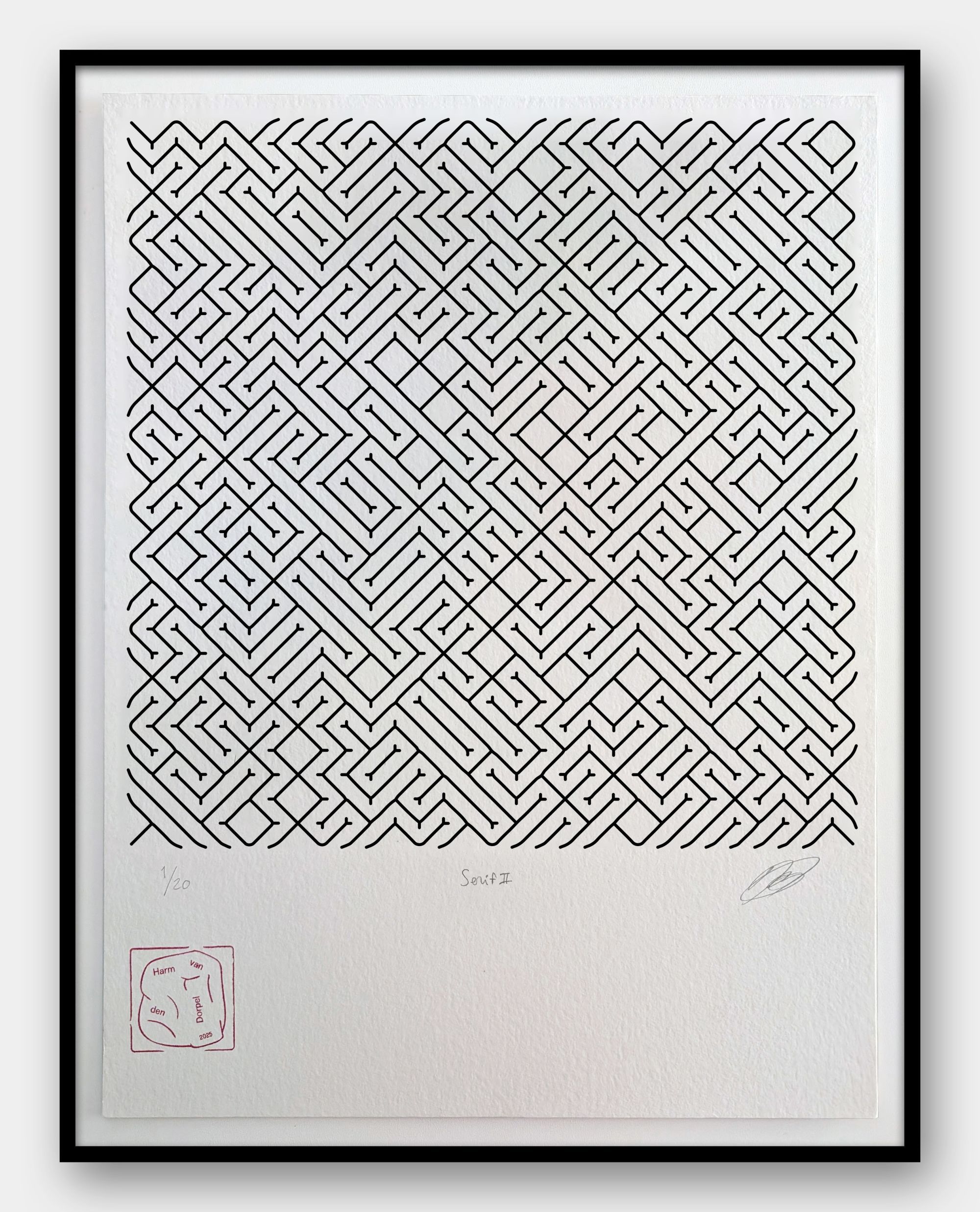
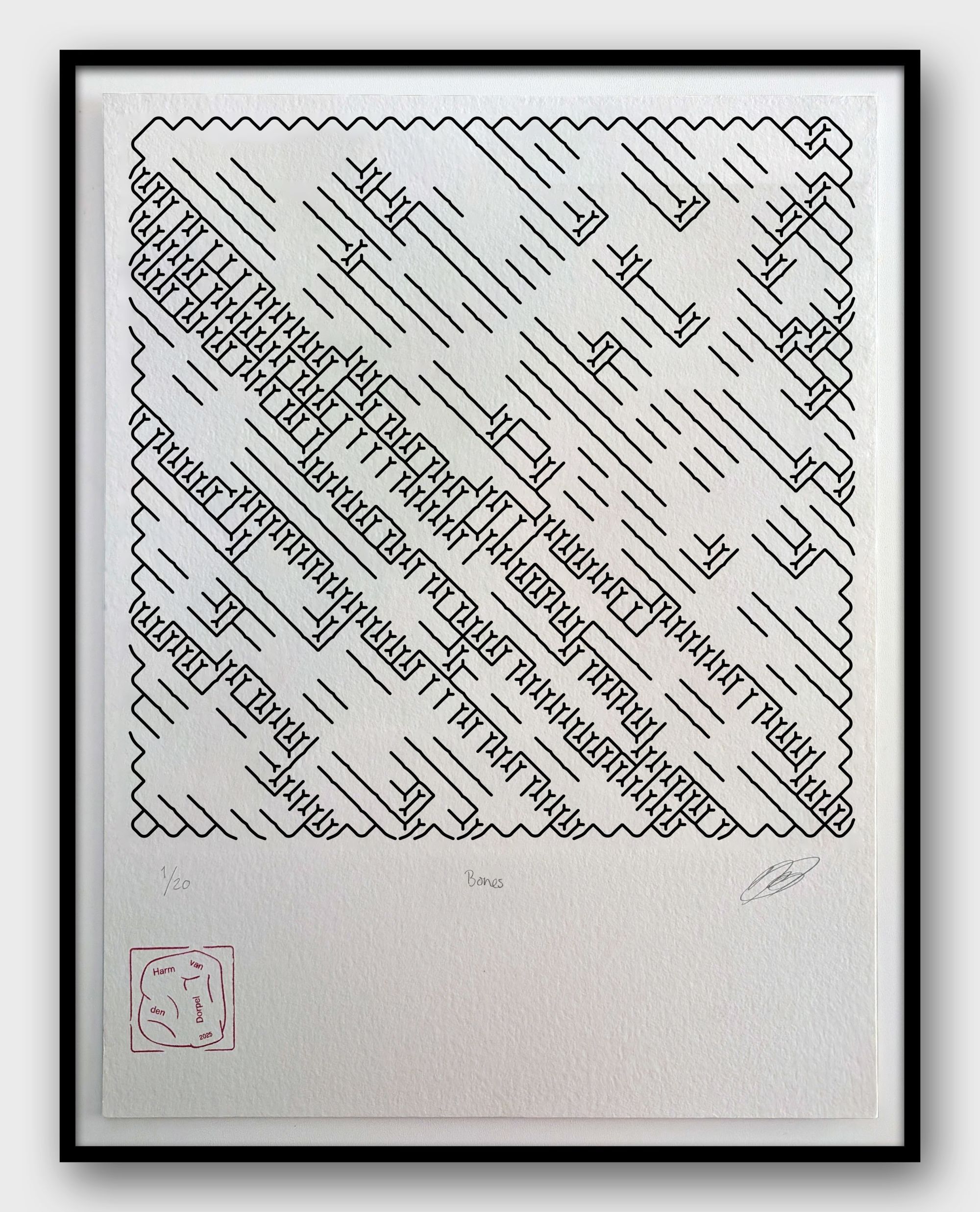
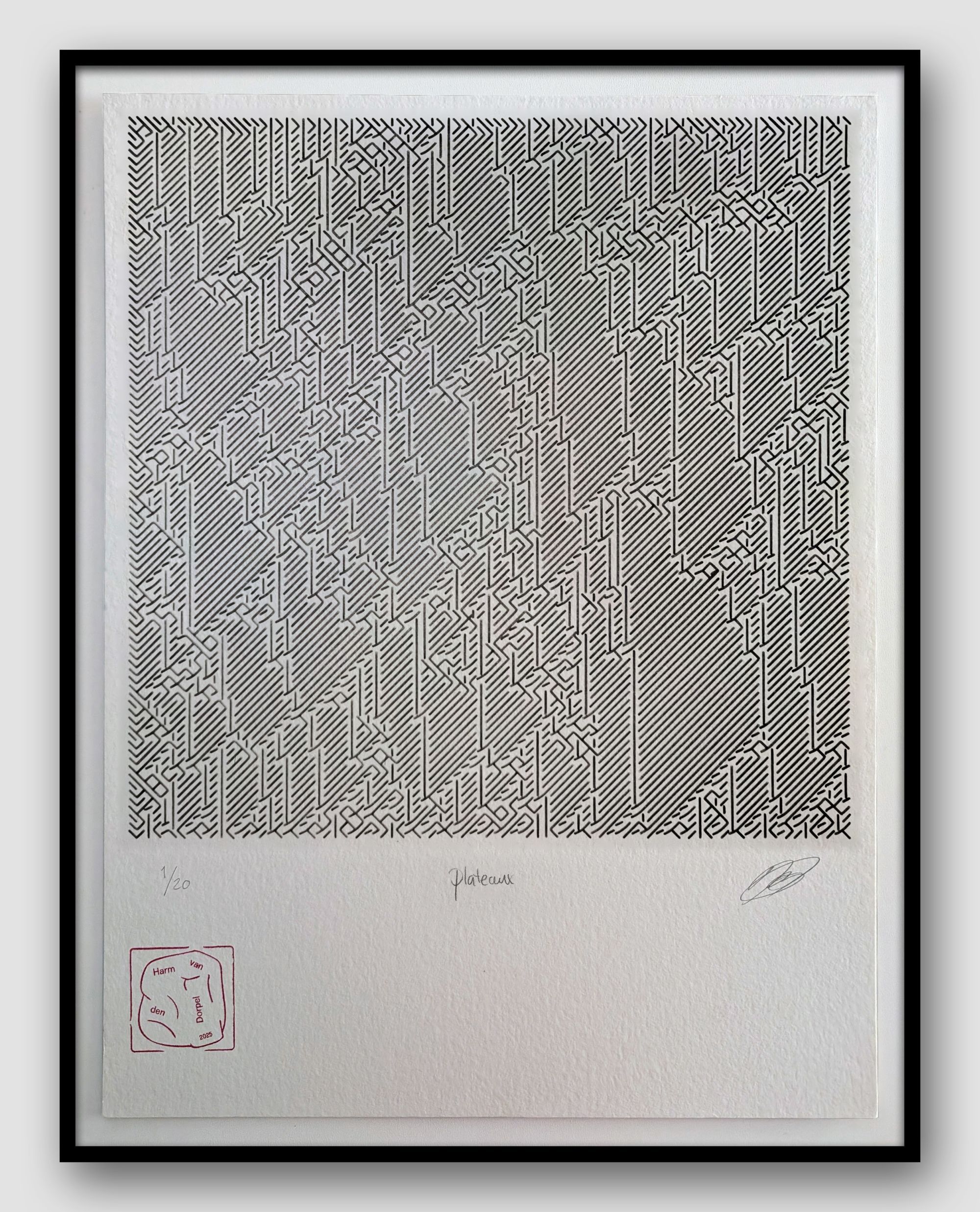
Each sheet has the same layout. A square field of black strokes fills the upper part of the upright sheet. In the margin below it, the edition number ("13/20" on one copy of Bamboo) is written in pencil at the left, the title in the middle, the signature at the right, and a red seal is stamped under the number, its outline enclosing the words "Harm van den Dorpel 2025".
The brush on the plotter
A plotter usually draws with a pen whose line has one width. A brush pen has a flexible tip, so the width of its stroke changes with the pressure and with the direction the plotter moves it, and the amount of ink varies along a stroke. These are the variations harm.work names: "direction, stroke width, and ink density". In the photographs the strokes have rounded ends and slightly uneven edges.
The edition is a set of twenty performances of each composition. The artist made the same point about his earlier plotter drawings: in his note on the drawings of 2017–2018 he writes that the source file can be rerun but the drawing cannot be repeated (→ Early Plotter Drawings). A drawing of those years, Bamboo (2017), was already issued in an edition of three by Kunstverein Freiburg (→ Automated Drawings). Venster — the writing gives the wiki its terms for this: the code is the score and each rendering a performance of it. Here the brush is the performer.
The brush on the plotter goes back at least to Drift (2024), a "Calligraphy brush plotter drawing on Hahnemühle paper", 47 × 61 cm, in the Cloud Writings series: a black field of diagonal strokes, dense on the right and thinning to the left. Stairs and Crosses (worn) (2025) is drawn with "Sakura brushes" at 110 × 100 cm (below), and in 2026 one of the Entfaltung drawings, Wending, adds a brush pen to the pen.
The eight drawings
All eight are drawn on a square grid, with strokes that run horizontally, vertically or diagonally between its points. Each sheet has its own rule for which strokes appear, how they join and where they stop.
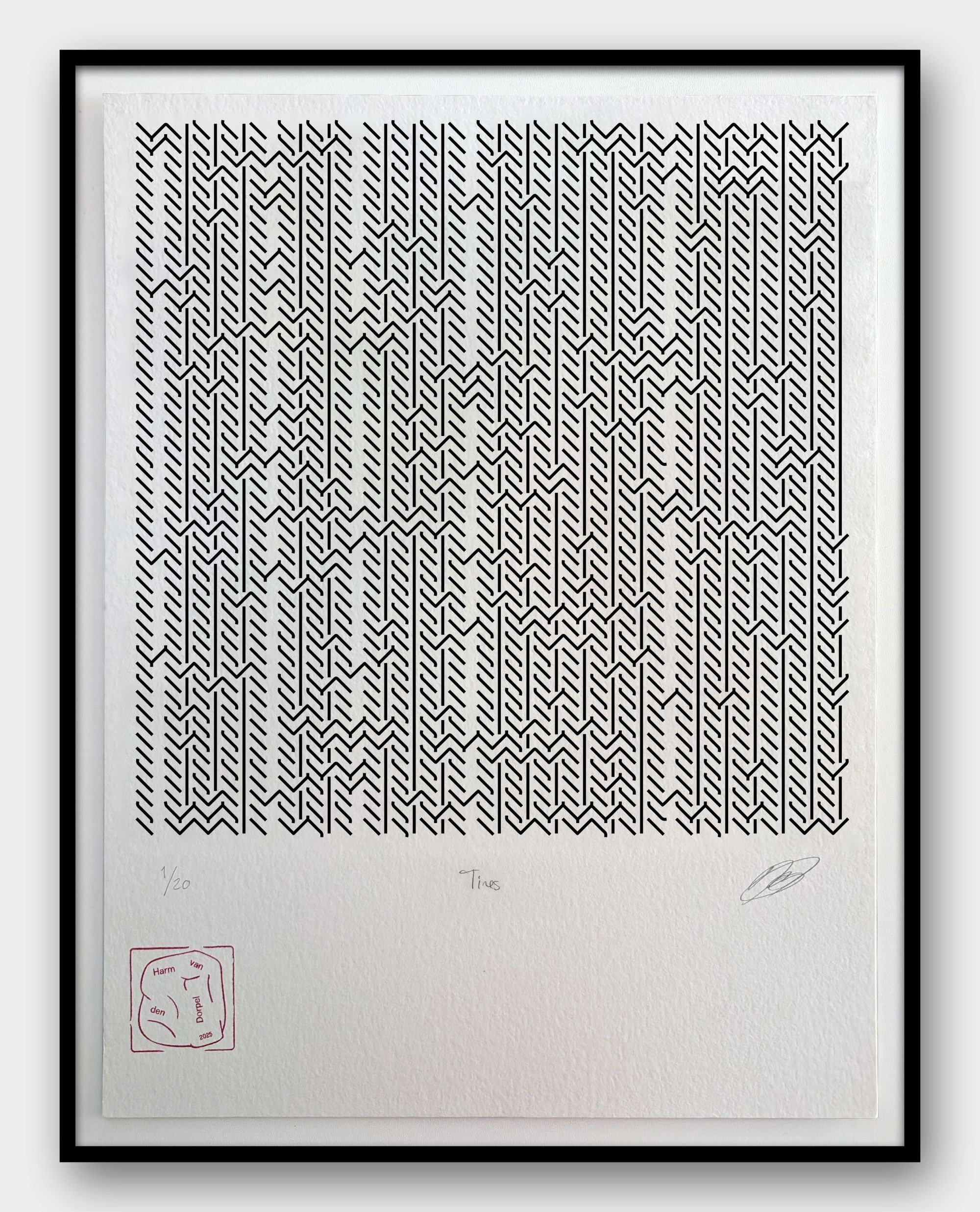
Tires. Vertical columns of short parallel diagonals. Where the diagonals switch direction a column folds into a chevron, so each column reads as the tread of a tyre. The columns have the structure of Stairs and Crosses, drawn the same month.
Bamboo. Diagonal strokes in both directions interlock into a lattice like woven strips. Along the left edge the field breaks off raggedly, and vertical strokes with short crossbars stand there like stalks with nodes. The composition was on the artist's screen fifteen months earlier: on 25 March 2024 he saved Bamboo and Bamboo (II) to his are.na channel Modular Aesthetic Systems, and Bamboo (II), "diagonal hatching across a square with a ragged left edge", is this drawing's layout (block; → Modular Aesthetic Systems). The title had been used once before, for a ballpoint plotter drawing of 2017 whose leaves are triangulated meshes; Kunstverein Freiburg then read bamboo as the decorative sign of ink painting (→ Automated Drawings). In 2025 the motif is drawn with a brush.
Pole. A field of short diagonals forms a loose diamond lattice. Scattered through it are T-shapes, a horizontal bar on a vertical stem, which grow more frequent towards the lower left, and the lattice changes density along a line that runs down the sheet. The title is close to that of Poles (2024), a Cloud Writings drawing with the note "Probabilities transition gradually based on the coordinates within the canvas (x/y)"; harm.work does not say whether Pole uses the same rule.
Rotan. Rotan is the Dutch and Indonesian word for rattan, the cane used in wickerwork. Long horizontal, vertical and diagonal lines cross in all three directions, and at many crossings one line stops short of the other and resumes beyond it, so that the lines seem to pass over and under one another as cane does in a woven chair.
Serif I and Serif II. Diagonal lines meet at right angles and turn into corridors, closed diamonds and rounded hooks, a maze. Many line ends carry a short stroke across them, the way a serif finishes the stroke of a letter. Serif II is denser, with more closed diamonds. In the statement for Cloud Writings (Tokyo, 2026) the artist says his grid drawings "refer to the process of writing text and the process of weaving textile" (→ Cloud Writings); in this suite Serif takes the first of these, Rotan and Bamboo the second.
Bones. Most of the field is open. Parallel diagonals run from the upper left to the lower right, and along a few of them short units with forked ends, like small bones, are strung into chains. A zigzag edge closes the field at the top and the right.
Plateaux (monochrome). The densest sheet: fine vertical and diagonal strokes packed so closely that the field turns grey, broken into terraces that step down diagonally across the sheet. Its colour counterpart is Plateaux (layered), a Cloud Writings drawing on grey paper of the same date, 42 × 42 cm, in which fields of the same kind of strokes are drawn over one another in several colours.
Stairs and Crosses (2025)
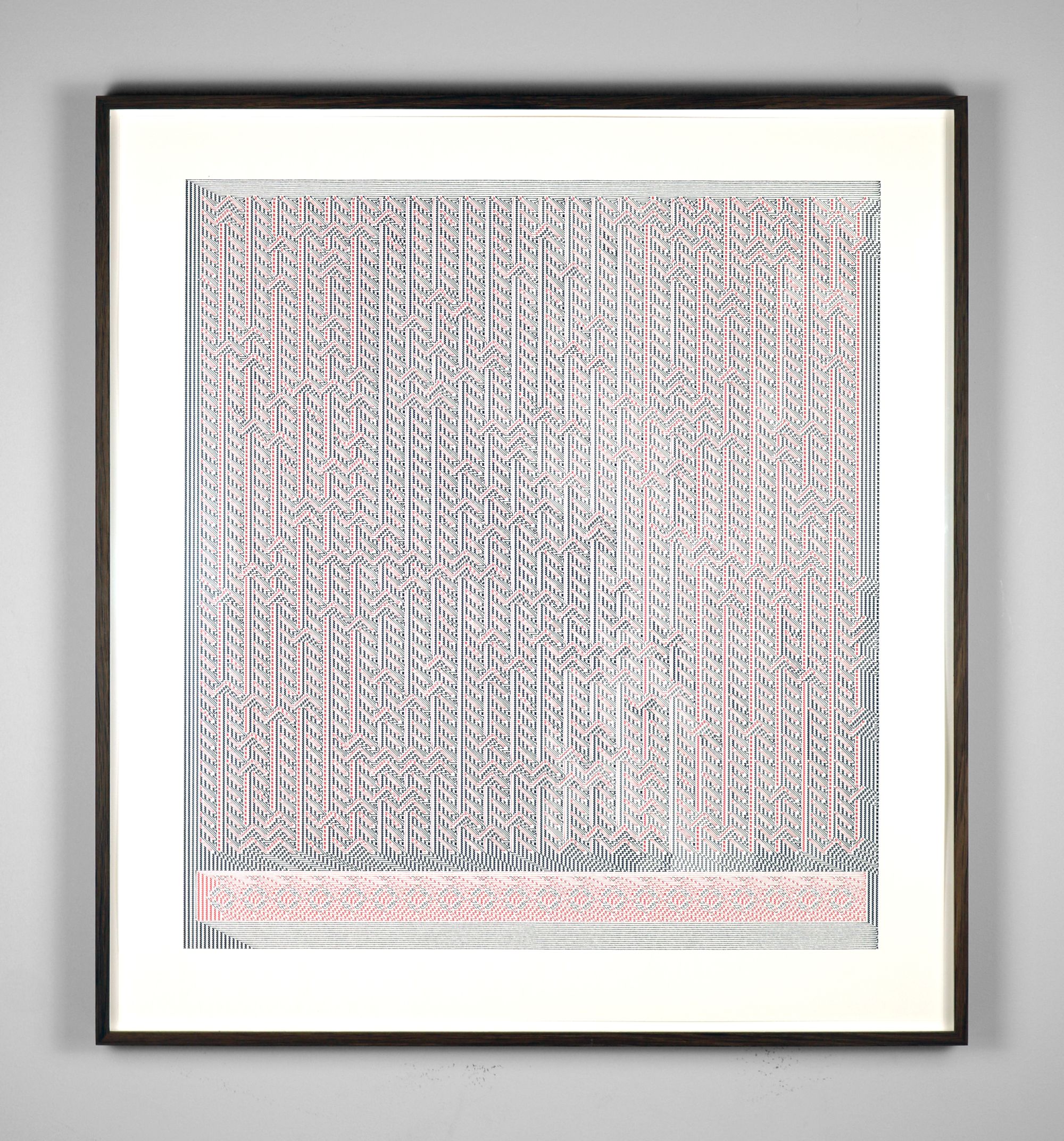
Stairs and Crosses is not part of the edition. harm.work's note is four words, "A non-regular ornament", and the work is unique, "Framed in smoked oak behind museum glass". It is drawn with a fineliner, not a brush. Vertical columns, each built of fine dashes in dark grey and red, step sideways in chevrons like flights of stairs; ruled lines close the field at the top and the left; at the foot a separate band carries a row of small crosses in diamond frames. No two columns are alike: each steps sideways at its own places. It has the size and medium of Leaky Abstraction (63 × 69 cm, Sakura fineliner), which harm.work dates three days later.
Stairs and Crosses (worn), dated September 2025, takes the same composition to 110 × 100 cm and draws it with "Sakura brushes". Its stair columns are patchy, dense in some places and pale in others, and the band of crosses is pink. It was shown in Cloud Writings at Takuro Someya Contemporary Art, Tokyo, in 2026, whose statement says the drawings "touch on religious and heraldic imagery" (→ Cloud Writings, Sacred Geometry). Tires in the edition keeps the stair columns and leaves out the crosses.
Where the suite sits
Fields of short strokes on a grid are the vocabulary of the Cloud Writings drawings of 2024–2025. One of them, Sediment, harm.work describes as "Built from a highly granular grid of short connecting line segments", with Vera Molnár's Interruptions as its starting point (→ Early Plotter Drawings, Interruptions). Those drawings mostly use several colours, and several are drawn twice over, mirrored or rotated. The edition draws eight compositions of this kind in one colour with one tool, twenty times each, so that the variation comes from the brush instead of the palette or a second pass.
See also
- Automated Drawings — the plotter drawings of 2016–2018 and the 2017 Bamboo
- Early Plotter Drawings — the artist on the plotter, the hand and the continuum of the organic and the geometric
- Cloud Writings (2026) — Stairs and Crosses (worn) in Tokyo; writing and weaving
- The Grid — the grid algorithms of the practice since 2019
- Venster — the writing — score and performance
- Process Legibility — the plotter line and the visible rule