
Degrees of Disruption — V&A South Kensington, London, 2026
Display, V&A South Kensington, Cromwell Road, London, Rooms 88A & 90, 16 October 2026 – 30 May 2027. Curated by Melanie Lenz, Curator of Digital Art. Free entry. The V&A's texts and catalogue records: sources/ingested/degrees-of-disruption-v-and-a-2026.md. harm.work: Degrees of Disruption: Vera Molnár and Generative Art.
The Victoria and Albert Museum shows more than fifty works by Vera Molnár (1924–2023) and by artists working after her. Van den Dorpel is in the contemporary part of Degrees of Disruption with two works from Algues Artificielles: the print Bluena (2016) and the breeding software Algues Artificielles (2017), running on a screen. harm.work lists a second print, Availablesky (2016). The V&A acquired Bluena and the software in 2021, with the print Dechayotic.
The display
The V&A's page says Degrees of Disruption "explores how Molnar's early experiments with computers and algorithmic thinking continues to resonate with digital art today". The announcement of Lenz's members' talk on 20 October puts the aim more exactly: the works "reveal how Molnar used algorithms, executed by hand or machine, to question what art could be, while tracing the continued influence of her practice on contemporary generative artists." Among the highlights the page lists Molnár's Interruptions (1969), (Des)Ordres (1974) and two plotter drawings of 1986 titled Bonne Annee; Casey Reas's MicroImage (2002); a plotter painting by Licia He (2023); a print by William Mapan (2023); and Bluena.
The wall text for the section that holds his work is called "Generative Principles". It defines the term the display is built on:
"Generative art is created by designing a system that produces the work. Rather than directly making an image, object, or performance, the artist defines a set of rules, instructions, or algorithms that generate it. The artist specifies parameters and constraints, then hands over some decision-making to the system, often introducing an element of randomness."
It ends: "The works in this section ask questions of agency, authorship, and creativity, reflecting on what emerges when an artist designs a process and relinquishes a measure of control."
Peter Bauman's editorial for Le Random, published on the opening day, reads the hang as a history that "starts with painting, moves to human-executed rules, then to computer-executed rules and ends with machine-learned models" (sources/ingested/le-random-degrees-of-disruption-2026.md). He calls the last section "perhaps the most argumentative" and names van den Dorpel among its artists with Reas, He, Mapan, Zach Lieberman, Matt DesLauriers and Entangled Others, without discussing the works one by one. According to Bauman the display also includes a Molnár self-portrait never shown before, Autoportrait à la Sainte-Victoire (2004).
Bluena
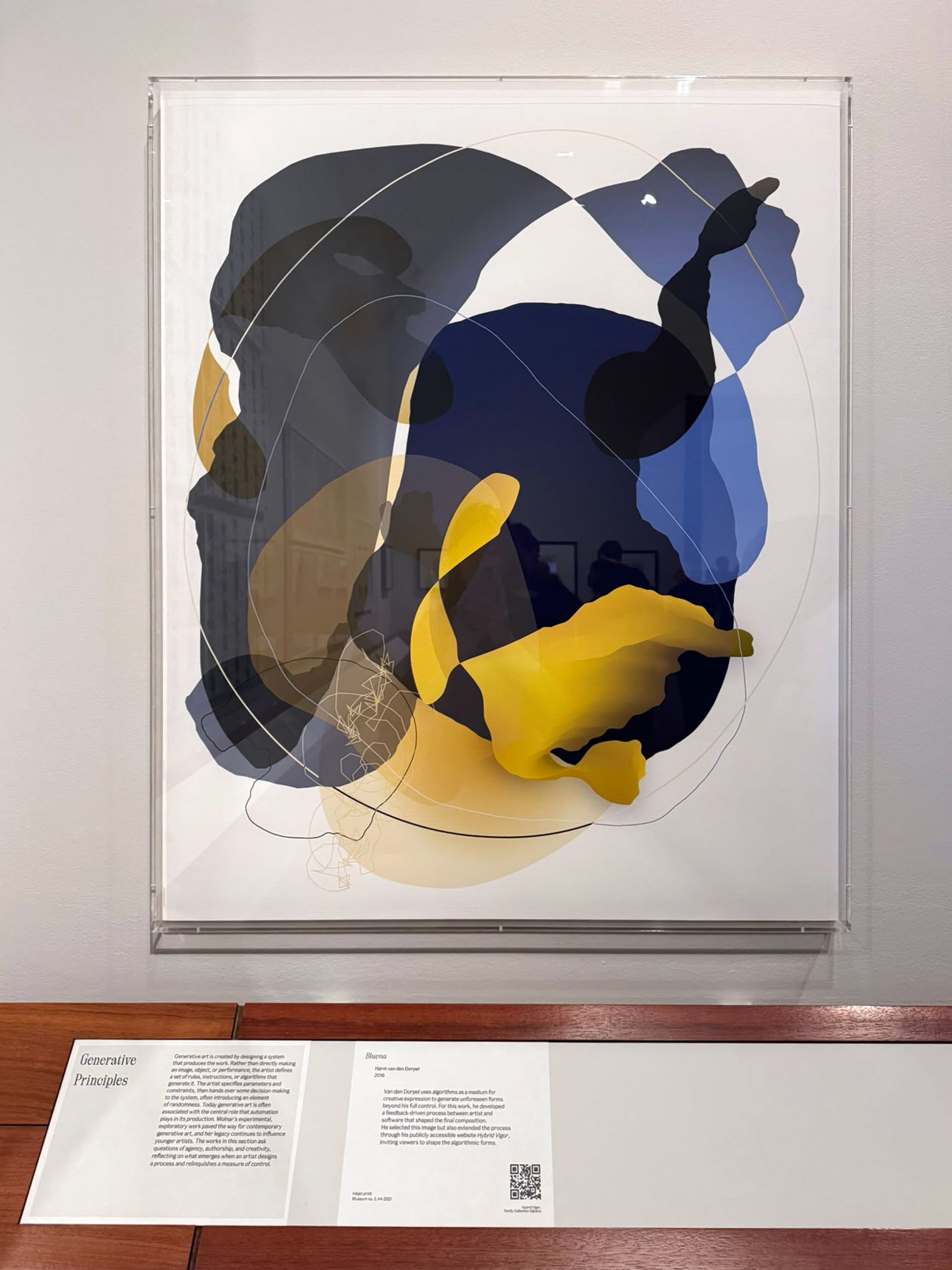
Bluena is the one work of his that the V&A names among the highlights of Degrees of Disruption. It hangs in a clear acrylic box above a wooden rail that carries the section text and its own label. Translucent shapes overlap on white paper: a dark grey-blue mass across the top, a deep navy oval in the centre, lighter blue forms at the right edge, and an ochre field at the bottom with a bright yellow shape folded over it like a petal. Thin outline curves in white, beige and black loop around the whole group, and at the lower left a fine yellow line wanders in short angular steps. The V&A catalogues it as a digital print, 101 × 81 cm, made in 2016, and describes it as "overlapping blue, yellow and brown irregular curved shapes".
The object label explains how it was made:
"Van den Dorpel uses algorithms as a medium for creative expression to generate unforeseen forms beyond his full control. For this work, he developed a feedback-driven process between artist and software that shaped the final composition. He selected this image but also extended the process through his publicly accessible website Hybrid Vigor, inviting viewers to shape the algorithmic forms."
A QR code on the label leads to Hybrid Vigor .bio, credited "Family Collection Dijkstra". The label says what the series page says in more detail: the system bred generations of drawings, he picked two from each to cross, and the website handed that choice to visitors (→ Algues Artificielles). The V&A's catalogue adds that each generation has "less and less diversity, until finally, there is a singular artwork left".
Algues Artificielles on a screen
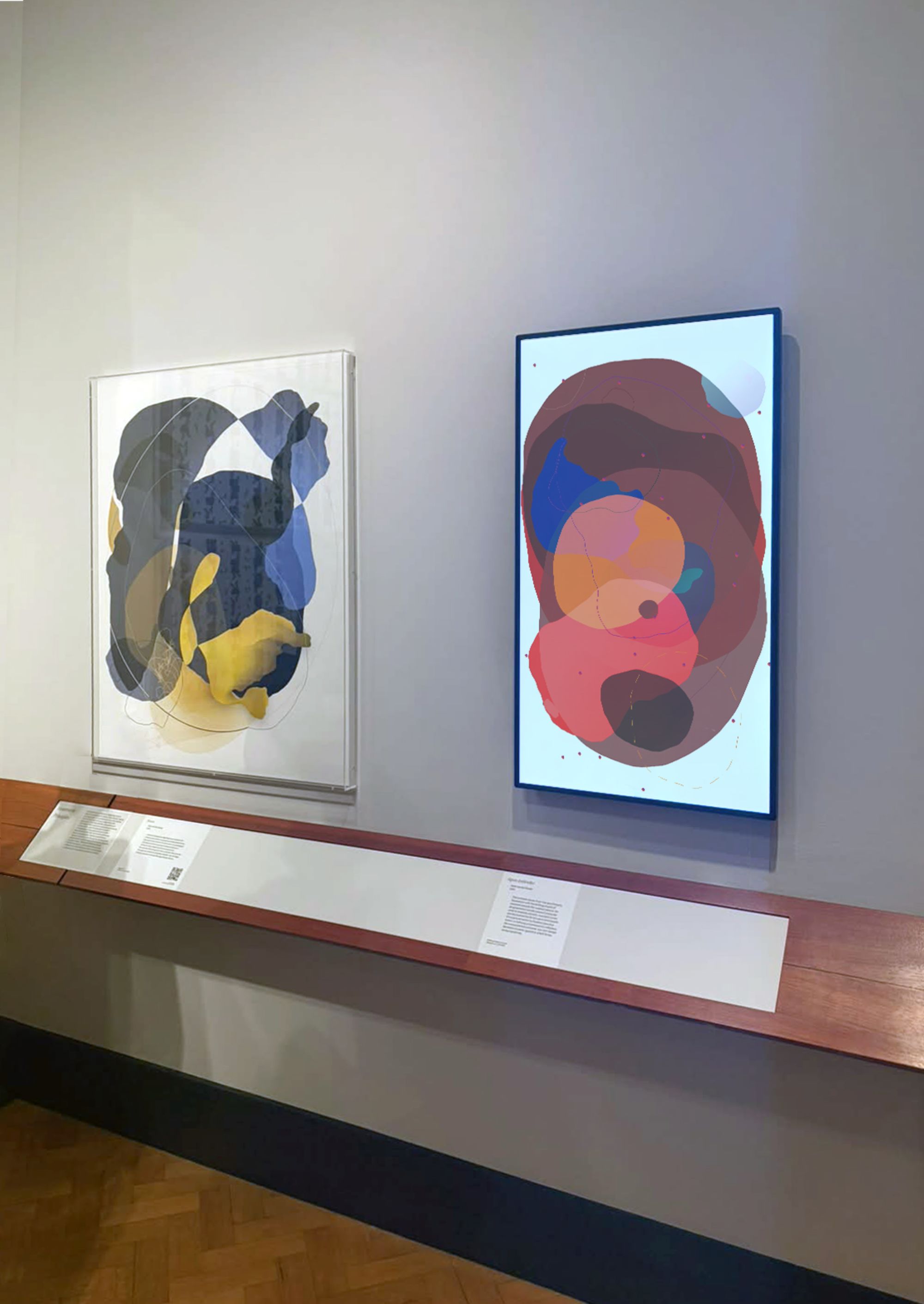
To the right of the print a portrait-format screen in a dark blue frame runs the software. In this view it shows one specimen: large overlapping shapes in maroon, salmon, orange and blue on a pale blue-white ground, with a few small dots and dashed outlines. The specimen changes as the program breeds; the print beside it is one such specimen fixed in 2016.
The V&A's record is exact about what it owns: a "Version controlled (Git) set of files including a JavaScript app bundle, an HTML/CSS page and a Shell script to launch the artwork, amongst others stored on a USB contained in a metal box". The work's size is "Variable as work is projected". Algues Artificielles is an edition of five; harm.work links the first edition to a token, "Algues Artificielles", edition 1/5, among his software editions. The V&A's copy is not one of these five: it holds the software as 1/1 (the artist, November 2026).
Availablesky
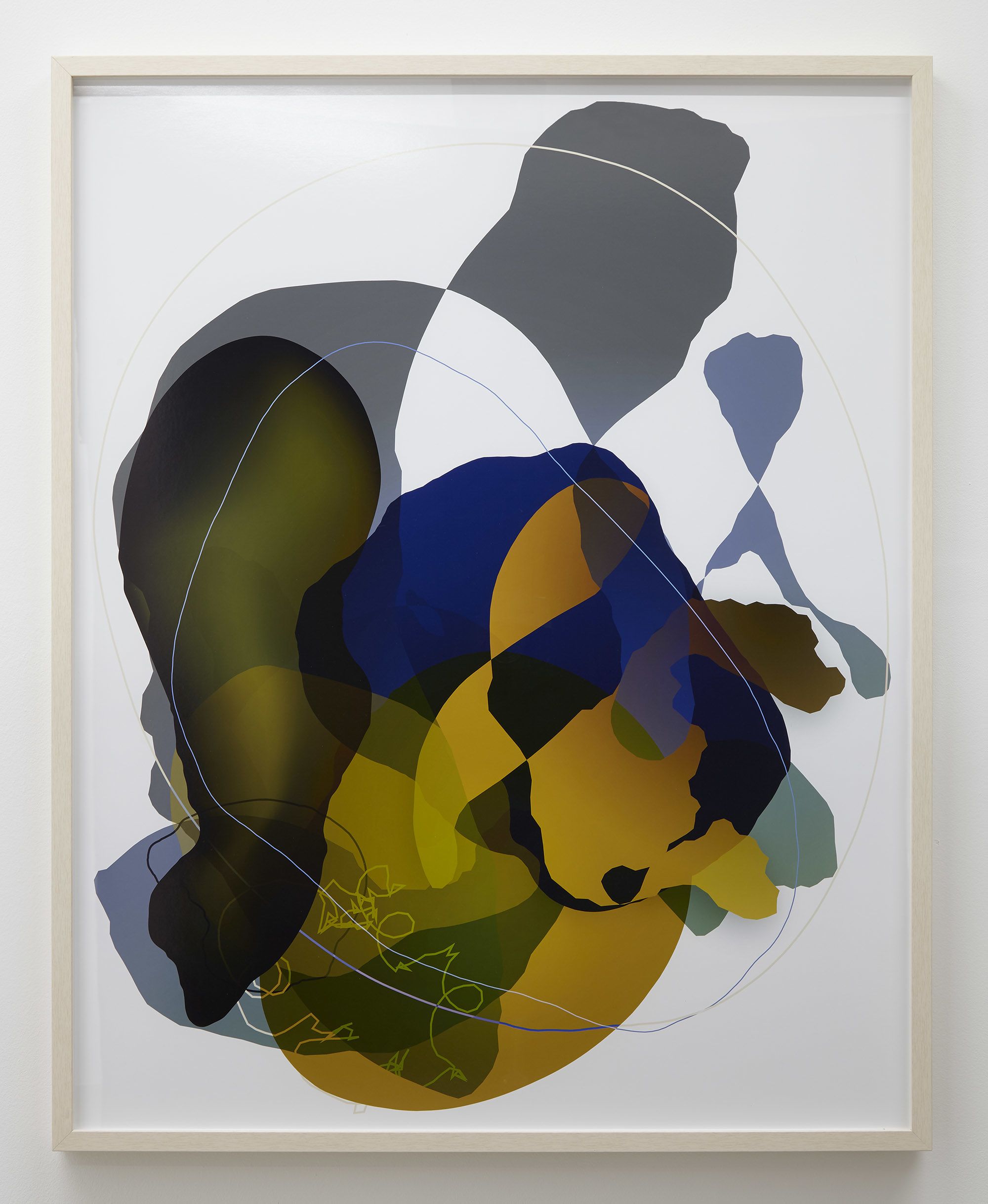
harm.work names Availablesky as the second print in the display. In a pale wooden frame, a grey shape like a stretched torso rises to the top edge; a black-olive mass fills the left side, a navy oval sits in the middle, ochre and yellow shapes collect at the bottom, and a lilac-grey hourglass form stands at the right. A blue outline curve and a fine yellow-green line tangle cross them, as in Bluena. It was one of four 2016 prints shown in Asking for a Friend at Narrative Projects, London, in 2017. It is in the V&A's collection and on display (the artist, November 2026), though it is not among the three objects of 2021 in the museum's online records and none of the V&A's texts names it.
Three works enter permanent collection V&A London (2021)
On 17 January 2021 van den Dorpel posted on harm.work: "Very honoured that three of my works from the Algues Artificielles series entered the permanent collection of the Victoria and Albert Museum in London." The post, Three works enter permanent collection V&A London, links to the series page.
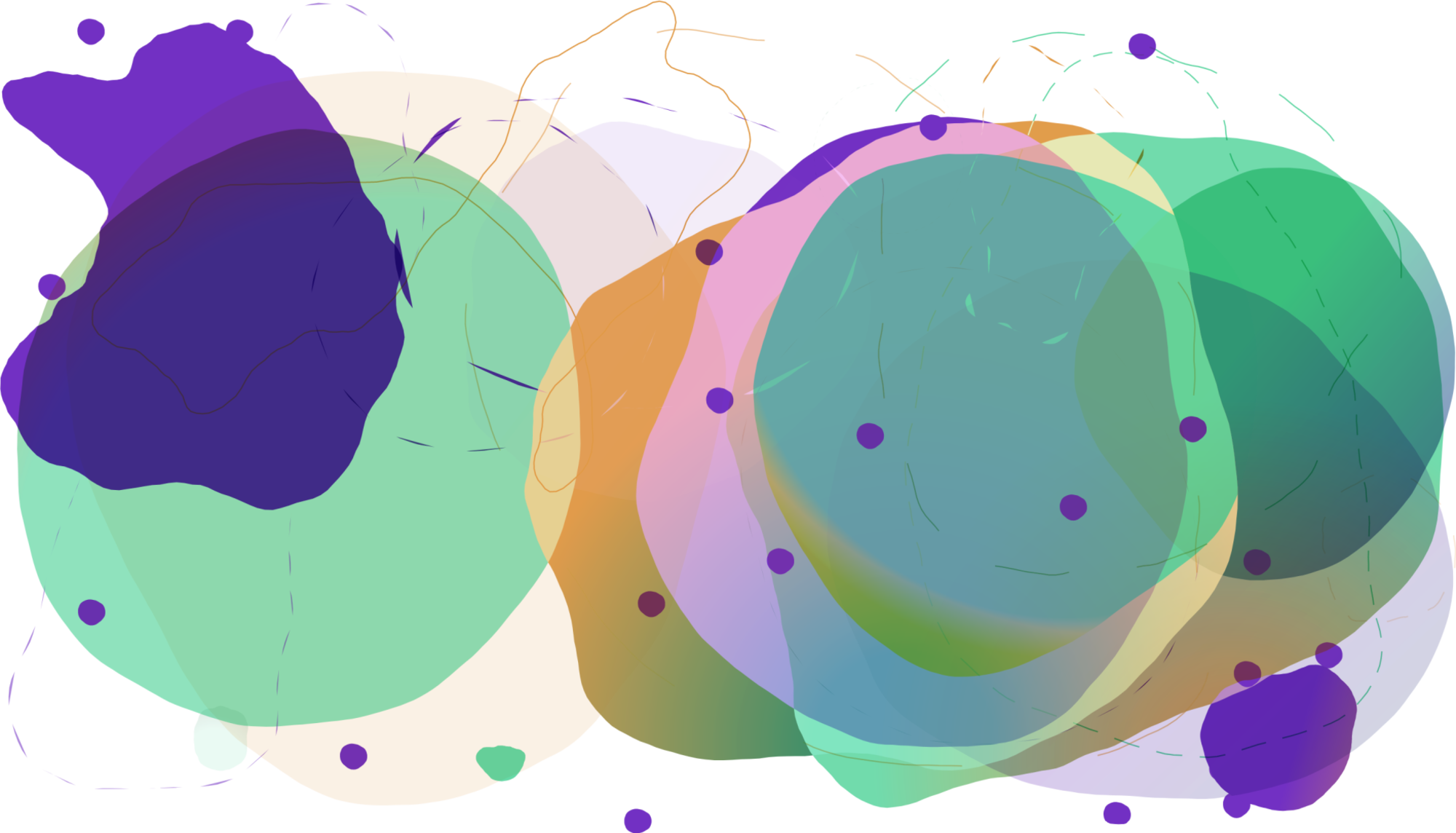
The image published with the post is a wide specimen on a transparent ground: overlapping rounded shapes in violet, orange, mint green and pink, spotted with small purple dots and crossed by dashed and freehand lines.
The V&A's records give the three objects and their numbers. Dechayotic (E.43-2021) and Bluena (E.44-2021) are 2016 digital prints of 101 × 81 cm in the Prints, Drawings and Paintings collection; the software Algues Artificielles (E.45-2021) is dated 2017. All three were accessioned in 2021. The prints are reproduced in Digital Art: 1960s – Now (Thames & Hudson with the V&A, 2024), by P. Arreola, C. Gardner and Lenz, on page 119 as figures 26 (Bluena) and 27 (Dechayotic).
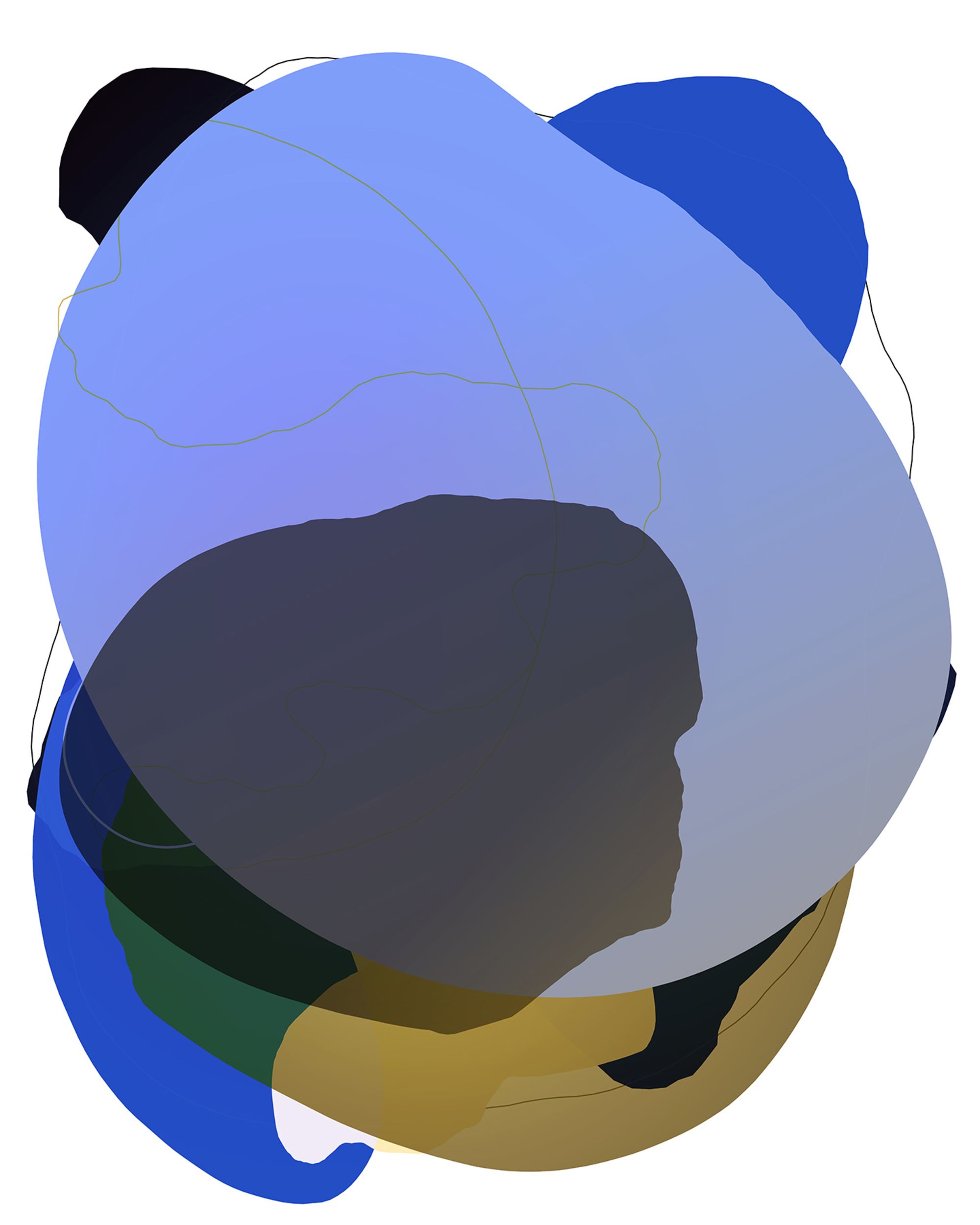
Dechayotic is fewer and larger shapes than Bluena: one pale blue-violet oval covers most of the sheet, with a dark grey form showing through it, saturated blue shapes at the top right and lower left, a black cap at the top left and an olive-ochre band underneath. Thin olive and black outline curves trace other contours. The V&A's description reads "overlapping blue and brown irregular curved shapes". It stays in the Prints & Drawings Study Room and is not in the display.
What the V&A's text says about him
The three records share a two-paragraph biography. It opens with a claim: "He is the first artist to sell a work purchased by cryptocurrency to a museum – his 2015 Event Listeners to the Austrian Museum of Applied Arts". The sale is the MAK's Bitcoin purchase of 20 editions of Event Listeners in April 2015, which his own essay of 2021 and Tina Rivers Ryan in Spike #70 also call a first, each in different terms (→ left gallery, Vienna Biennale (MAK, 2015)). It then dates his work with the internet from the Revenant series of 2006 and the websites Ethereal Self .com and Ethereal Others .com of 2008, and names Death Imitates Language (genetics), Nested Exchange (linguistics) and the Resolution Paintings (pixels). The catalogue spells the website "Hybrid Vigour"; the site and the label say Hybrid Vigor.
Molnár and van den Dorpel
Degrees of Disruption connects him to Molnár through work of 2016–17. His own work after Molnár came later. Since 2019 he has researched the grid work of Molnár with that of Anni Albers, Charlotte Posenenske and Tauba Auerbach, by the account of the 2024 exhibition text for Angles Morts, his two-person show with Molnár's works at LOHAUS SOMINSKY in Munich (→ Angles Morts). That show included the animation Pression des pairs (2024), built on a 1959 work of hers, and in 2026 he made the five on-chain tokens of Interruptions after her series of the same name (→ Interruptions, Algorithmic Archaeology).
The V&A chose a breeding system instead, and its label puts the weight on what the "Generative Principles" text calls handing over "some decision-making to the system": forms "beyond his full control", a "feedback-driven process between artist and software", and a website on which viewers shape the forms. In the wiki's reading, that is a different relation to Molnár from the one in Interruptions. There he starts from her rules and runs them through his own engine; here the work shares her question, how much of the decision an artist can give away and still make the work. Algues Artificielles answers it by keeping the selection for himself, or giving it to the public, while the software does the drawing (→ Evolutionary Logic, The Generative Threshold).
See also
- Algues Artificielles — the series: Brittany, Hans Arp, genome and crossover, Hybrid Vigor .bio
- Angles Morts (2024) — the two-person show with Molnár in Munich
- Interruptions (2026) — tokens after Molnár's Interruptions
- Algorithmic Archaeology — Molnár in the timeline of rules rebuilt
- Evolutionary Logic — selection as the artist's remaining decision