
Vienna Biennale — MAK, Vienna, 2015
Group exhibition "24/7: the human condition", MAK Design Lab, MAK – Austrian Museum of Applied Arts / Contemporary Art, Vienna, 11 June – 4 October 2015, curated by Marlies Wirth, part of the Vienna Biennale 2015. Exhibition text and review: sources/ingested/mak-24-7-the-human-condition-2015.md. harm.work: Vienna Biennale.
The Museum of Applied Arts (MAK) launched the first Vienna Biennale in June 2015 under the title Ideas for Change, joining art, design and architecture. Its director, Christoph Thun-Hohenstein, initiated it; four curators made six exhibition projects, at the MAK and at the Kunsthalle Wien, the University of Applied Arts and the Architekturzentrum. (The sentence on harm.work's exhibition page that says so is taken from Max Henry's review in Spike.) Van den Dorpel's part was one work in one of the MAK's own exhibitions, 24/7: the human condition: the screensaver Event Listeners (2015).
24/7: the human condition
Marlies Wirth's exhibition text starts from two sources. One is On Kawara's postcards stamped "I GOT UP" with the time of day, sent daily from 1968 to 1979. The other is Hannah Arendt's The Human Condition (1958) and its three terms, "labor, work, and action". The text describes a "non-stop society" in which the line between labour and leisure has gone, and names the measure applied to its workers:
"The value and assessment of (invisible) human work are at the center of mechanisms of social evaluation; our activities are measured by their speed, accuracy, and efficiency—in short, people are measured against machines. But the complex processes that constitute human decisions and thus our ability to act cannot be taken over by artificial intelligence."
Action, "political and artistic", is the text's way out: it "cannot be definitively evaluated in terms of performance and therefore attain the status of permanence."
Eighteen artists took part, most of them based in Vienna: Ben Thorp Brown, Verena Dengler, Carola Dertnig, Andreas Duscha, Andreas Fogarasi, Franz Graf, Kathi Hofer, Peter Jellitsch, Lazar Lyutakov, Mahony, Christian Mayer, Ulrich Nausner, Danica Phelps, Lili Reynaud-Dewar, Valentin Ruhry, Seth Weiner, Anna Witt and van den Dorpel, listed as "Berlin".
Event Listeners in the cellar
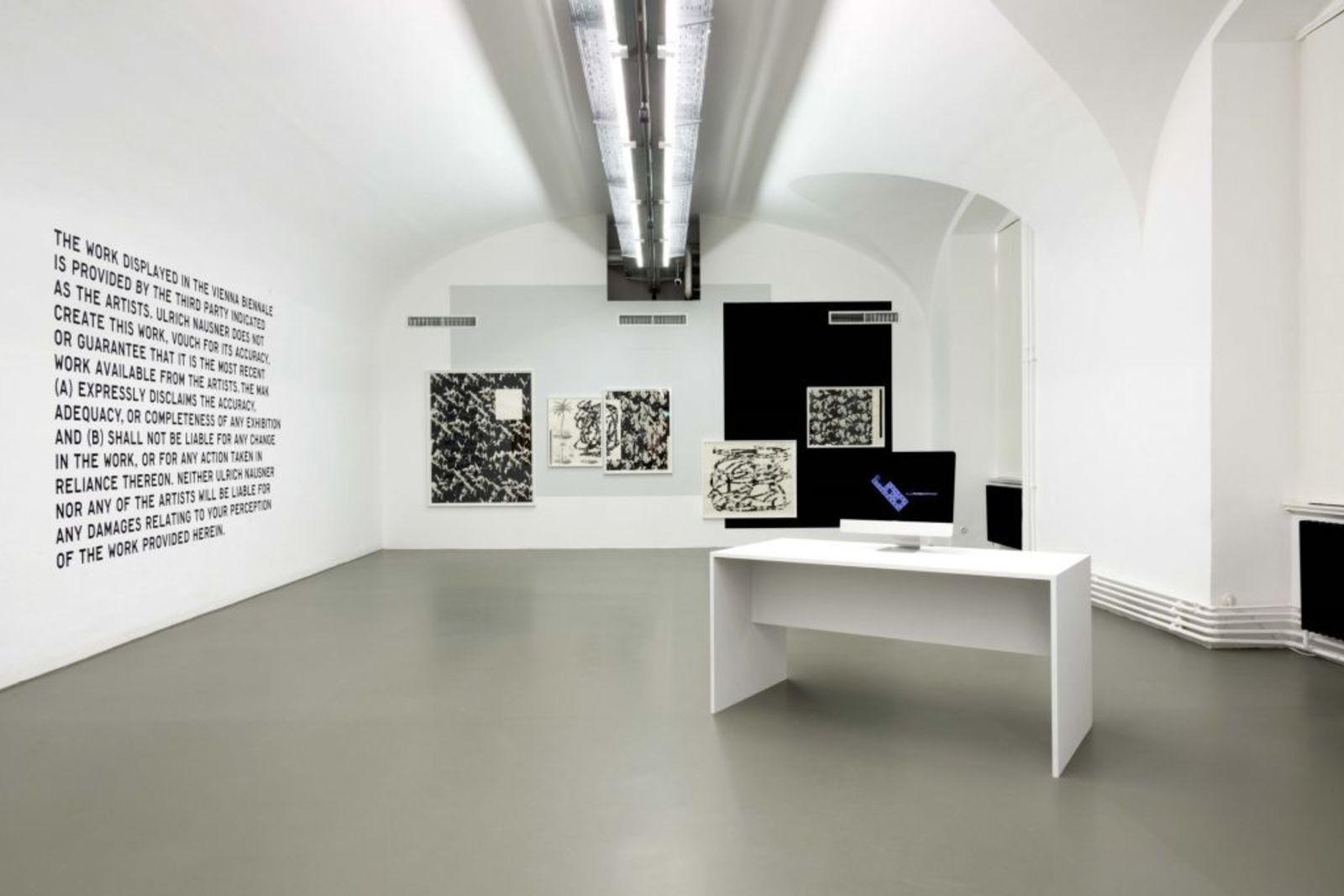
The exhibition was in a vaulted space on the MAK's lower floor, which Henry calls "the cellar space". In this view an iMac stands alone on a white table in the middle of the room. Behind it, on a grey panel and a black one, hang black-and-white works on paper by another artist. The left wall carries a text in capitals:
"THE WORK DISPLAYED IN THE VIENNA BIENNALE IS PROVIDED BY THE THIRD PARTY INDICATED AS THE ARTISTS. ULRICH NAUSNER DOES NOT CREATE THIS WORK, VOUCH FOR ITS ACCURACY, OR GUARANTEE THAT IT IS THE MOST RECENT WORK AVAILABLE FROM THE ARTISTS. THE MAK (A) EXPRESSLY DISCLAIMS THE ACCURACY, ADEQUACY, OR COMPLETENESS OF ANY EXHIBITION AND (B) SHALL NOT BE LIABLE FOR ANY CHANGE IN THE WORK, OR FOR ANY ACTION TAKEN IN RELIANCE THEREON. NEITHER ULRICH NAUSNER NOR ANY OF THE ARTISTS WILL BE LIABLE FOR ANY DAMAGES RELATING TO YOUR PERCEPTION OF THE WORK PROVIDED HEREIN."
It is Nausner's work, which Henry gives as Limitation (2015): a legal disclaimer in the voice of the institution, covering every work in the room, Event Listeners included.
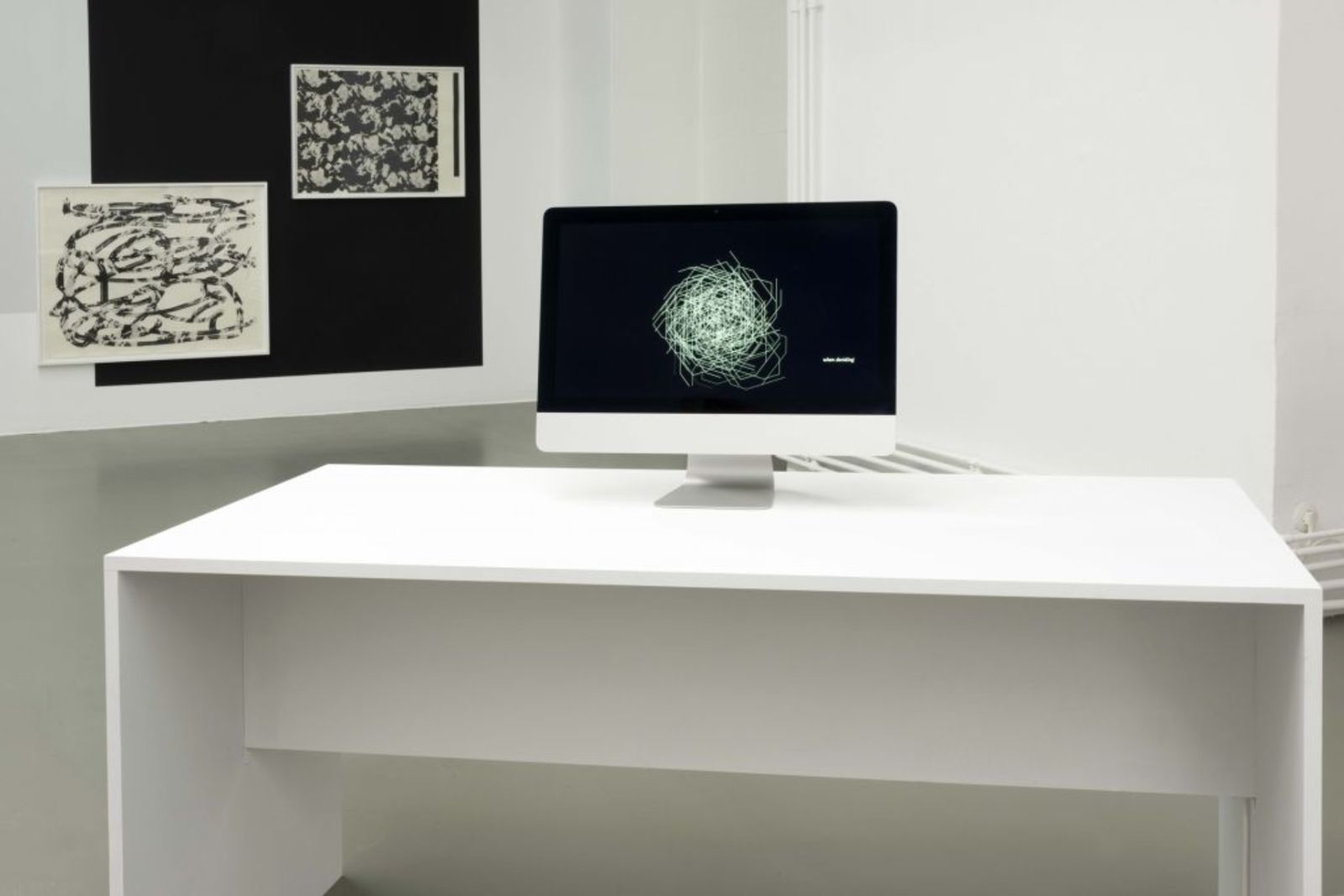
On the screen a knot of pale green line segments turns on black, with a short line of white text to its right. The segments join at angles into branches that fold back on themselves. harm.work describes the work as "Generative Lindenmayer systems iterating over dissociative feels of social inadequacy", "A screensaver for MacOS". An L-system grows a figure by rewriting a string of symbols with fixed rules, step after step, and drawing the result as turns and lines; the same method later produced the plotted structure of Uttered Modality (2018) (→ Early Plotter Drawings). A screensaver is what a computer shows while nobody is working at it.
Henry's review in Spike is hostile to the Biennale as a whole ("Mission Failed") and to most of 24/7. He singles out Verena Dengler's needlepoint embroideries, Sponsors (2001–2014), as "a hermetic counterpoint to all things digital", and pairs them with van den Dorpel's work:
"Her work corresponds to Harm van den Dorpel's screensaver Event Listeners (2015). Consider that algorithms hold sway in the movement of global capital and that automation makes certain kinds of human labor obsolete. Here, human thought (via text) and artificial image combine in an automated structure resembling the stalks of a plant."
Henry reads the text on the screen as "human thought" and the branching as plant-like, and sets both against the exhibition's theme of labour replaced by automation. It is the only review of this showing the wiki has found.
The MAK's purchase
The showing came two months after the purchase. In April 2015 the MAK bought 20 of the 100 editions of Event Listeners with Bitcoin, through the Vienna platform Cointemporary; the editions had been registered with ascribe.io on the Bitcoin blockchain. Van den Dorpel later called it "the first time a museum bought NFTs, and paid with a cryptocurrency", and the sale led him and Paloma Rodríguez Carrington to found left gallery (→ Tokenising Sustainability, Subdued Iconoclasm). Whether the iMac at the Biennale ran one of the MAK's editions is not recorded. The V&A's catalogue records of the works it acquired in 2021 repeat the claim (→ Degrees of Disruption).
harm.work files the exhibition under one token of the later Ethereum edition, Event Listeners #31. Its description says: "This Ethereum NFT version was programmed and deployed in 2018. A maximum of 100 tokens can be minted." The editions the MAK bought were the 2015 ones registered on Bitcoin through ascribe; the Ethereum version followed three years later.
See also
- left gallery — the gallery the MAK purchase led to
- Tokenising Sustainability (2021) — his account of ascribe.io and the sale
- Spike #70 — Tina Rivers Ryan on Event Listeners as an editioned program
- Mediation and the Archive — records that outlast the means of reading them