
About — Wilkinson Gallery, London (2012)
Solo exhibition, Wilkinson Gallery, upper gallery, 50–58 Vyner Street, London E2, 2 March – 22 April 2012. Text by Travis Jeppesen: Revenge of the Spheres. Notice by Paul Hobson for the Contemporary Art Society: Hobson's Choice. Also on harm.work.
About filled the top floor of Wilkinson Gallery with six hanging spheres from the Assemblage series and three framed collages in several parts. On harm.work the artist calls it "My very first real solo exhibition." His CV of the time lists two earlier solo shows, at Senko Gallery, Viborg (2009) and Fabio Paris, Brescia (2010) (935). Wilkinson had shown him the year before, in a group show and at a fair. The making of the spheres is told on Sculpture and the Object. This page is about the show: the room, the works on the walls, the text written for it, its press, and the sculpture its press became.
Before About: a render and a fair stand
The series text on harm.work says the spheres began as Cinema 4D renders of imaginary exhibitions, posted online to see whether blogs would run them beside real installation views, until "a gallerist in London saw the images online", took them for physical works and asked to show them. The text names neither gallery nor gallerist.
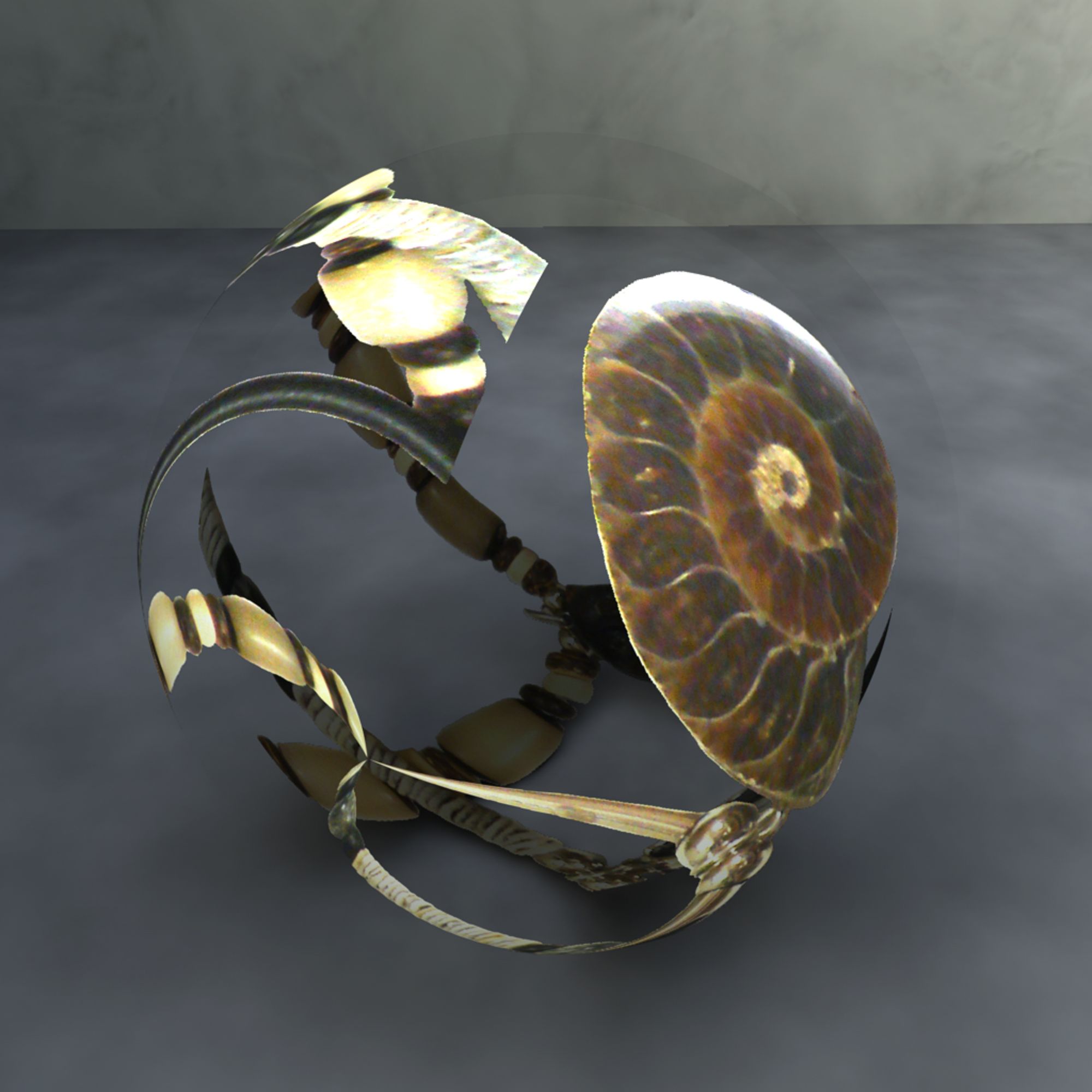
harm.work keeps one of those renders among the images of Assemblage (shell). A loose sphere of curved strips sits on a grey, softly lit ground. One strip ends in a large disc textured with a fossil ammonite; others carry a string of pale beads, horn and a woven pattern. The built work in About kept the ammonite disc and the strip structure. In the render the strips are opaque and metallic; in the gallery they became transparent synthetic glass you can see through.
Wilkinson showed him before About. He was in the gallery's group show Where Language Stops in 2011 (935); 595, an installation view with Lena Henke and Nader Ahriman, is filed as wilkinson_wls.jpg. 643 records an Assemblage "at Frieze 2011, wall left: Joan Jonas, wall right: George Shaw", both Wilkinson artists, in a photograph filed as harm-van-den-dorpel-assemblage-wilkinson-gallery.jpg. The spheres' first public appearance was therefore on Wilkinson's stand at the Frieze Art Fair in October 2011, five months before the show.
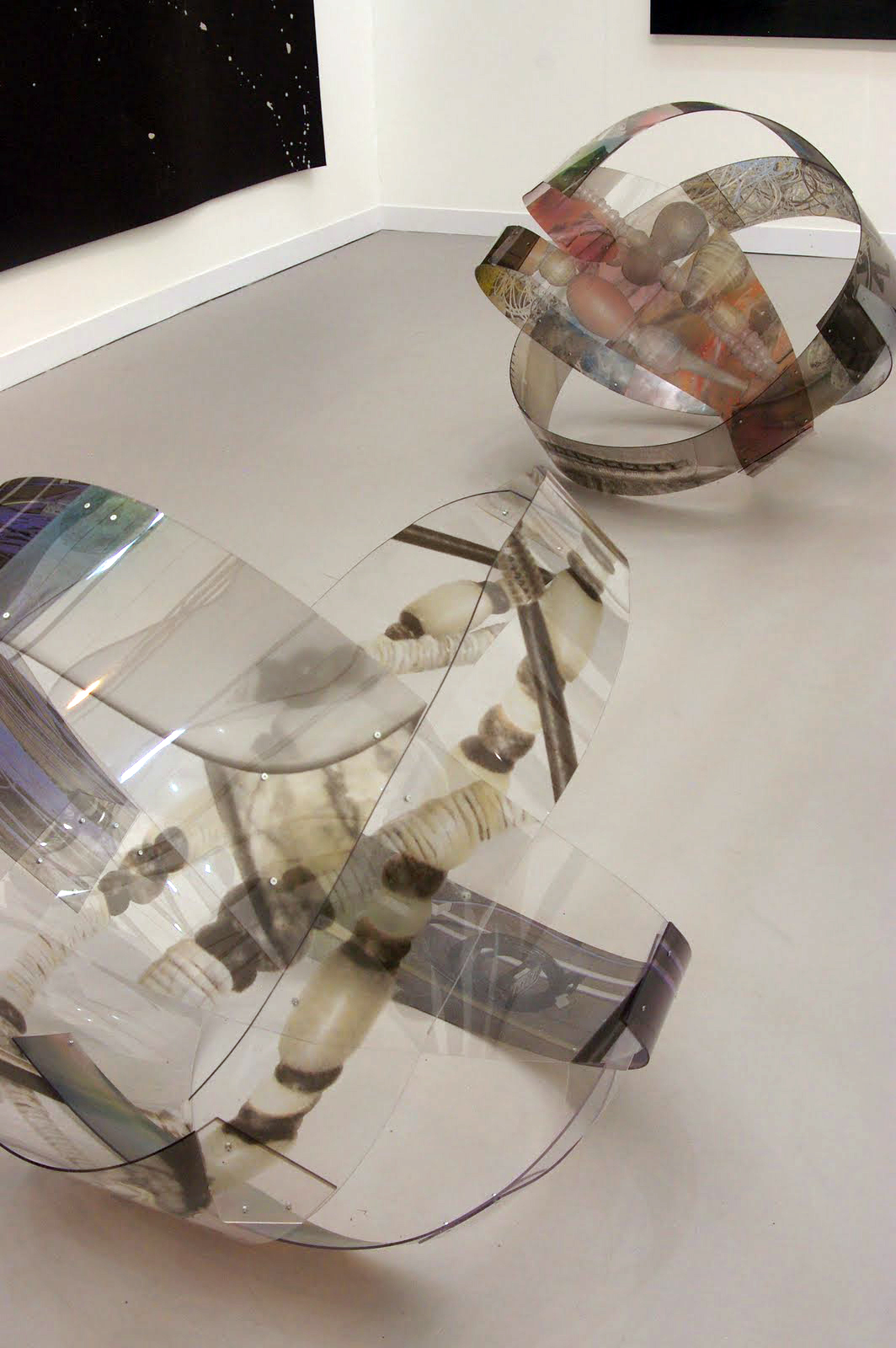
At the fair the spheres were not hung. 924 shows two of them resting on a grey floor in front of black works on the wall: in the foreground two clear bands crossing in an X around a string of pale beads, behind it a rounder sphere printed in reds and greys.
The room
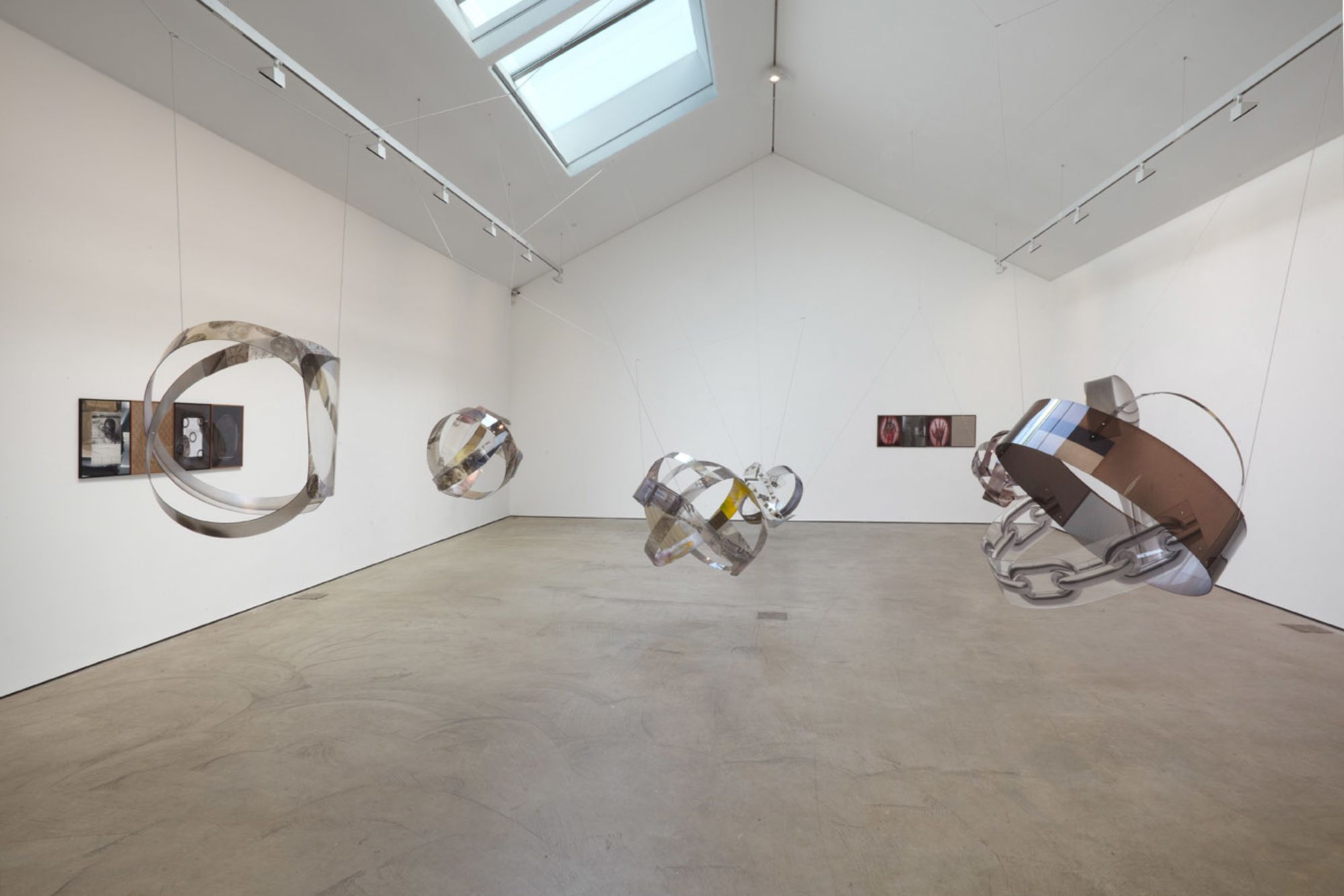
The upper gallery has a pitched ceiling with two skylights and a bare concrete floor. Fine cables run from the ceiling and the walls to each sphere, so the spheres hang at different heights and angles, some well above head height. Paul Hobson described them as "suspended in complex systems of fine metal chains of the sort one associates with office blinds". On the left wall hangs a four-part framed work, on the end wall the four-part work with the red hands.
The six spheres, by the artist's notes and the gallery's own captions:
- Assemblage (chain), the one with a band printed with heavy steel chain links (790: "Digital UV print on hand cut synthetic glass (85 × 95 × 85 cm)"; harm.work gives 100 cm).
- Assemblage (shell), with the ammonite disc (779: 90 × 95 × 100 cm). harm.work dates it 2011; the gallery captioned it "Assemblage, 2012".
- Assemblage (canvas), printed with a scanned canvas weave (777: 85 × 95 × 85 cm).
- The sphere the notes later call Assemblage (armor) (778: 76 × 87 × 70 cm).
- Two untitled spheres of 95 × 95 × 95 cm (782, 788), one of them dated 2011 by the gallery.
The gallery titled all six simply "Assemblage", with a year, the materials ("Digital UV print on hand cut synthetic glass, spray paint") and the size. The words in brackets came later, in the notes and on harm.work.
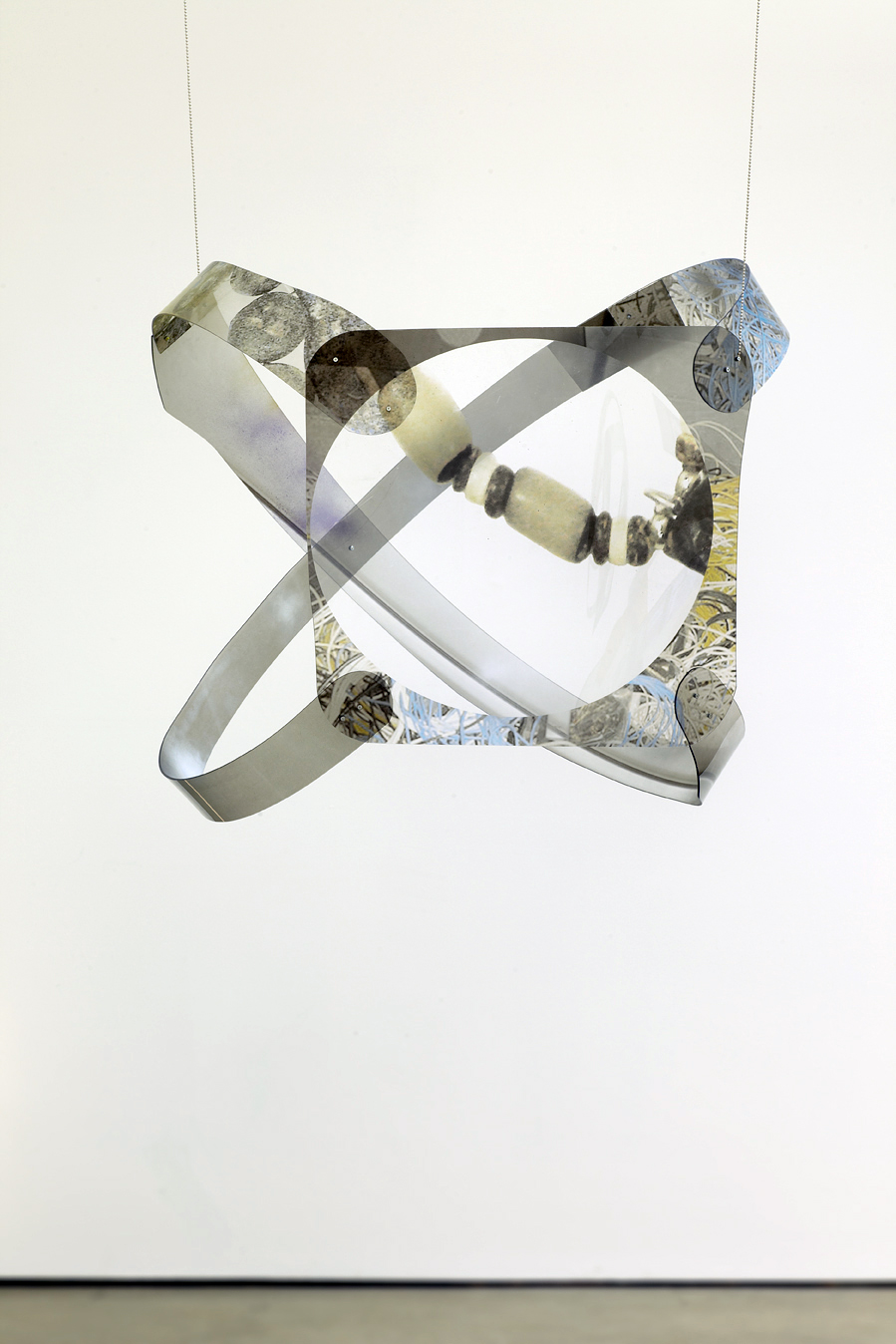
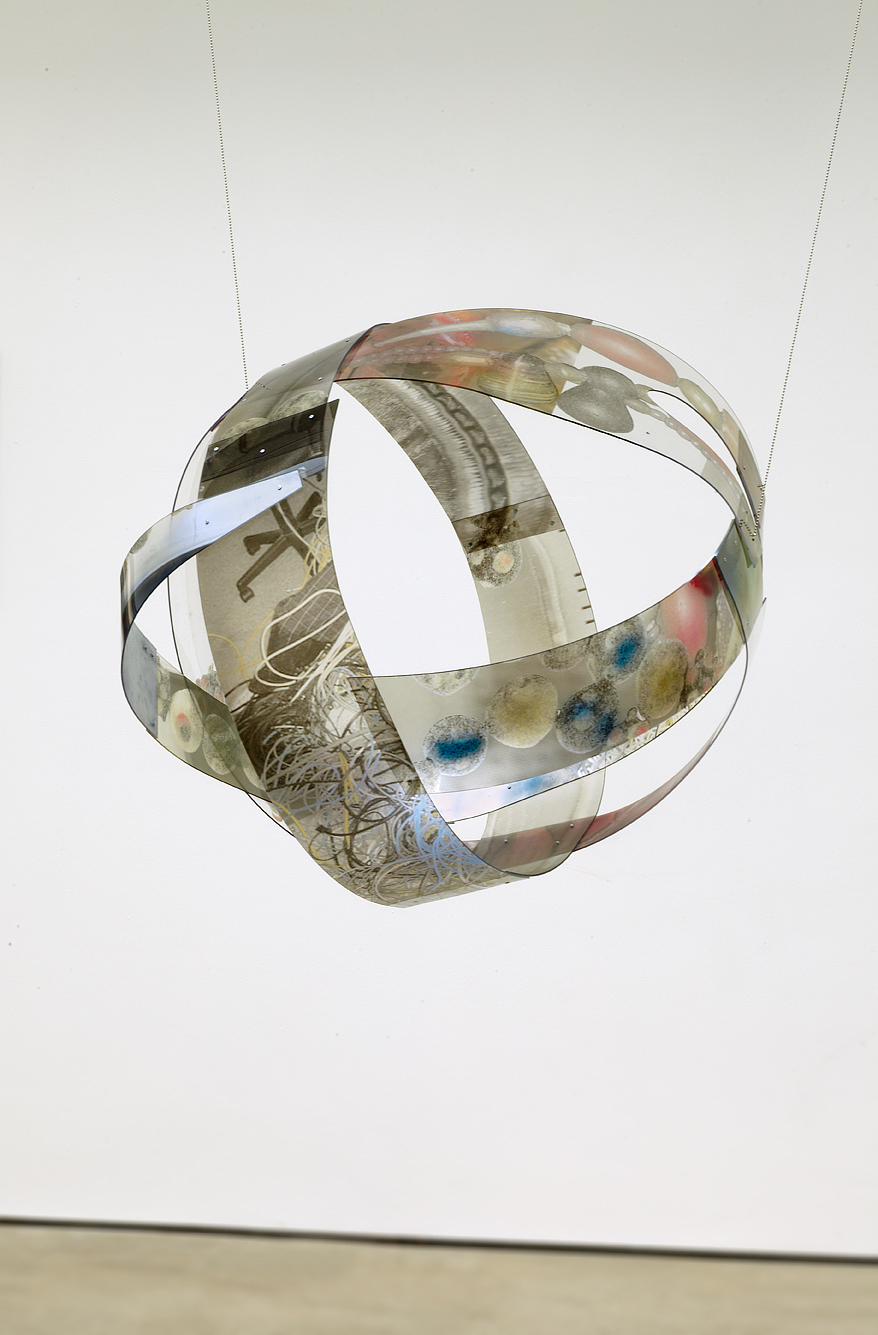
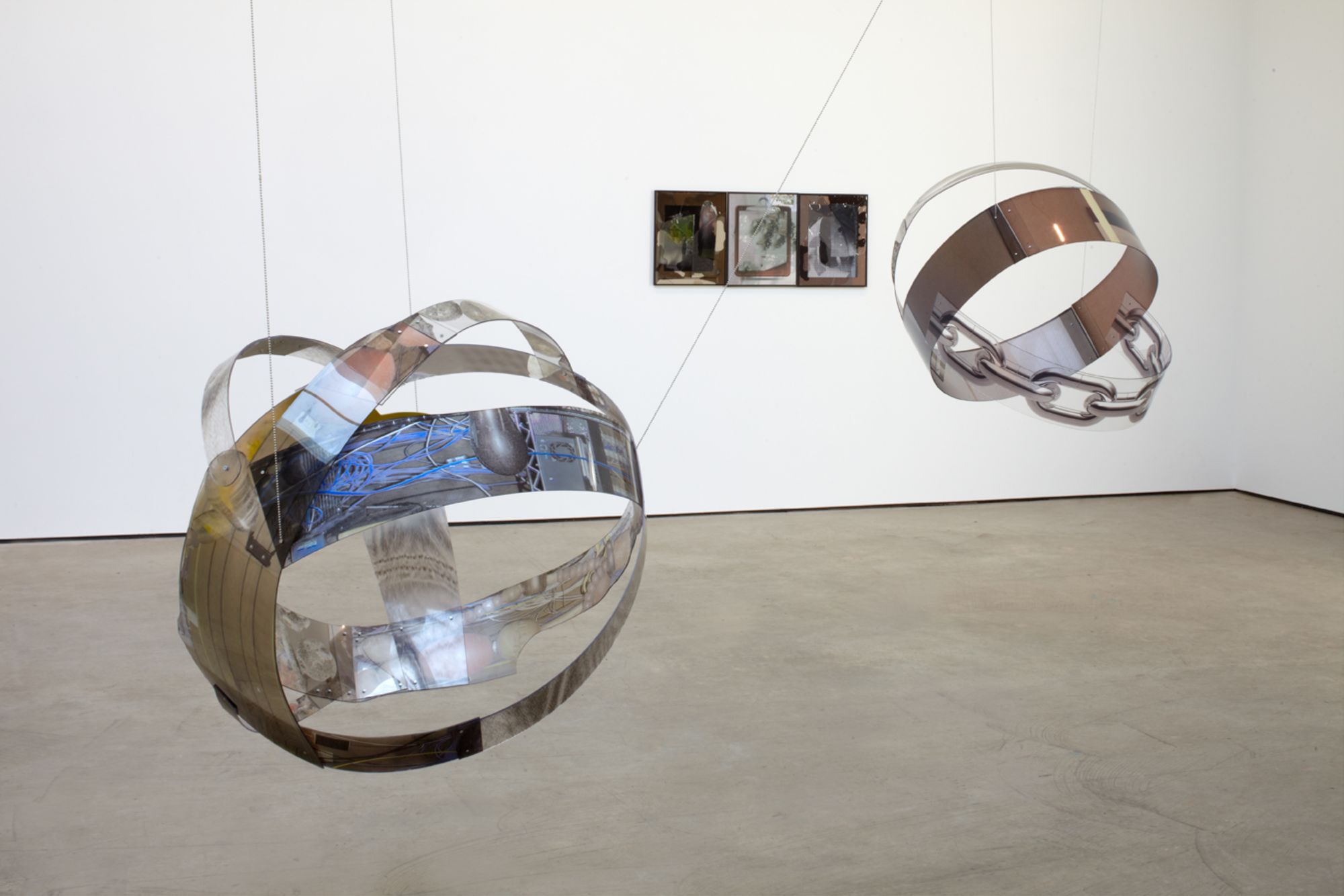
Assemblage (armor) is two broad smoky bands crossed in an X, holding a squarish frame printed with a necklace of pale cylindrical beads and grey discs. The untitled sphere of 788 is printed with eggs, pills, coloured glass balls and a pencil-drawn coil, the strips overlapping so that the prints on the far side show through the near ones. In the third view the sphere of 782 hangs close to the camera: one broad band printed with tangled blue cables and thin yellow wires wraps it, with a smoked strip and rivets at the joins. These are the "images of cables sourced from the Internet, jewellery, chains and organic matter" Hobson listed.
The framed works
Three framed works hung on the walls. The gallery captioned one of them "Untitled, 2012, Mixed media (etched) (4 parts, 50 × 40 cm each)"; the artist's notes give the materials as "Digital prints, plastics, resin, frame glass etched by hand" (776, 780, 781). Each panel is a collage of printed images, cut plastic and poured resin behind its glass, and on the glass itself he scratched line drawings by hand, so that a white outline floats in front of the image.
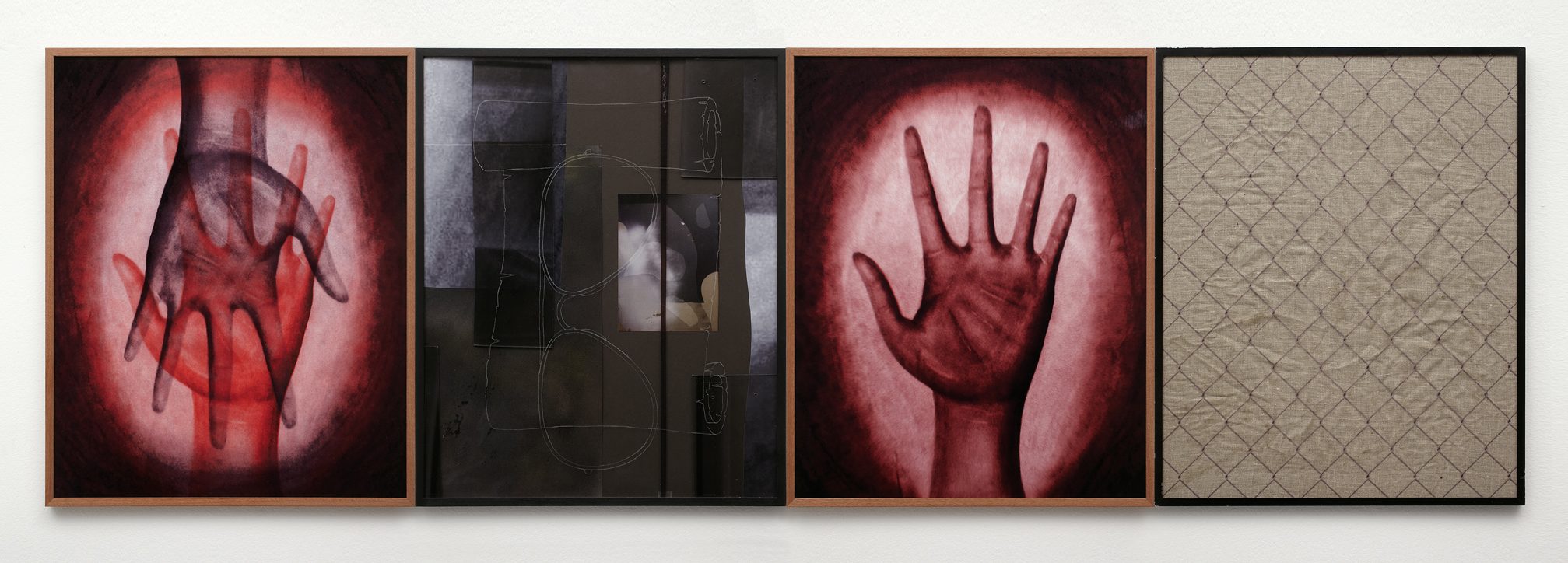
The four-part work on the end wall (781) opens with Untitled (collage with hands): a red hand and a grey hand laid over each other, fingers spread, in a pale glow on a dark red ground. The other panels are a single raised hand on the same red ground, a dark collage with a pair of spectacles drawn in white line on the glass, and a sheet of linen crossed by a diamond lattice. The two hand panels sit in light wooden frames, the other two in black. The press release of Release Early, Release Often (2013) says the hand was drawn by someone else and appropriated from DeviantArt, and that this collage was "the lead image" for the show. harm.work now lists the image as a token, Hands, among his JPGs, described as the "Invitation image of my first solo exhibition at Wilkinson Gallery London, 2012" (→ Editions and Small Collections).
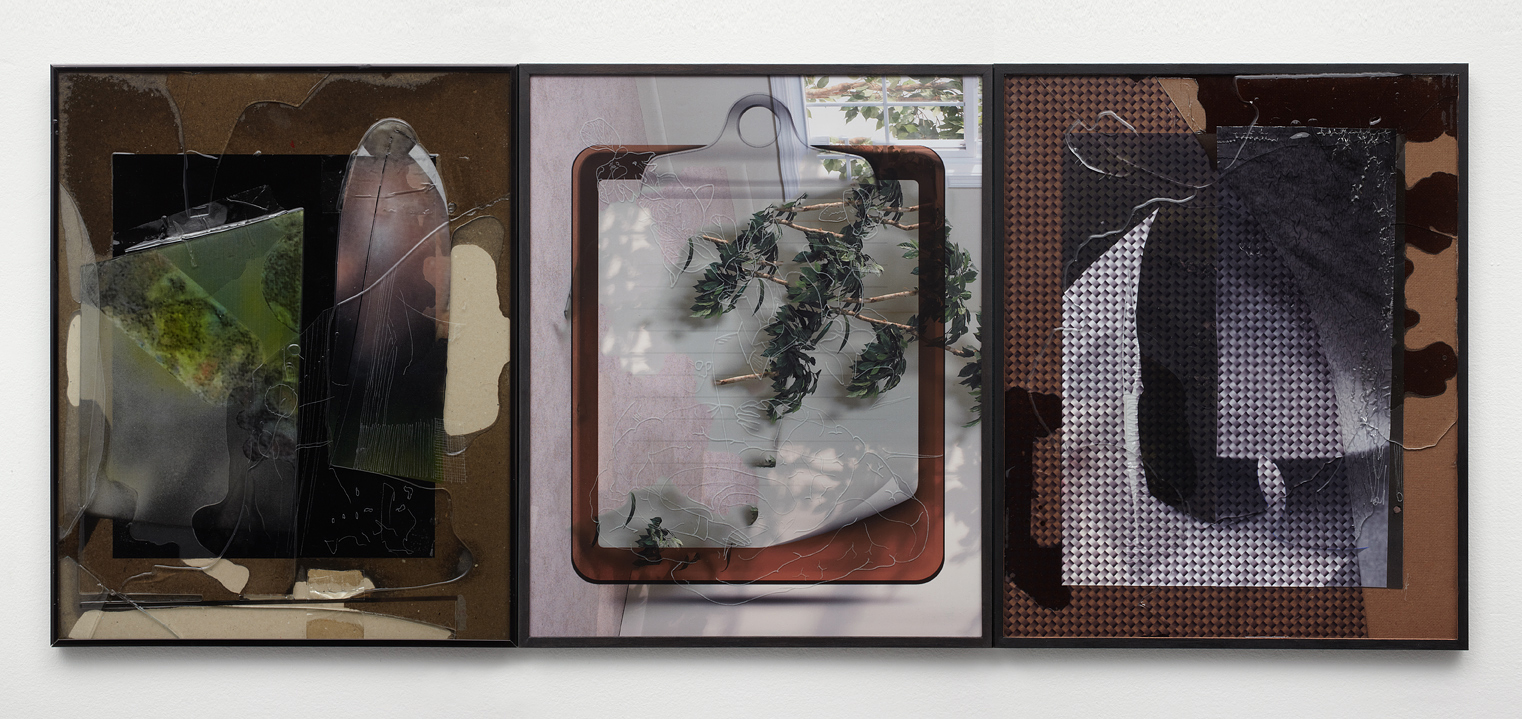
The three panels of 776 are a brown ground with poured resin, a shard of green glass and a smoky oval; a photograph of a houseplant seen through the outline of a chopping board with a hole for hanging, the board drawn in white on the glass; and a woven brown and grey texture with a dark cut-out shape over it.
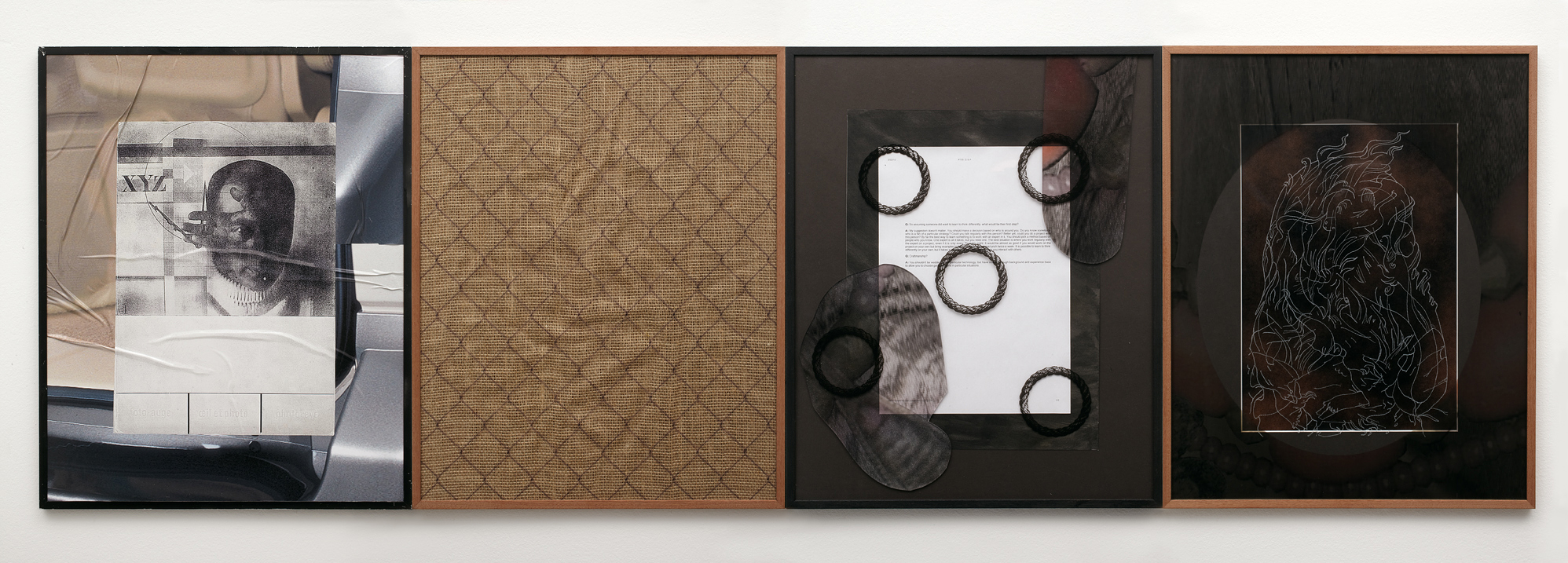
780 carries a question as its title: "SO ASSUMING SOMEONE WANTS TO LEARN TO THINK DIFFERENTLY, WHAT WOULD BE THEIR FIRST STEP?" The first panel lays a reproduction of El Lissitzky's self-portrait The Constructor (1924), the face with a compass hand and the letters XYZ, over a photograph of a car interior. The second is burlap with a drawn diamond lattice. The third prints a page of questions and answers under five braided black rings; its text is note 758, which answers the title: "By far the best way to learn something is to work with an expert in it." The note names no source. The fourth is a dense white line drawing scratched over a dark ground.
Revenge of the Spheres
Travis Jeppesen's text for the gallery is a run of short fragments, not an essay with a thesis. harm.work prints one paragraph of it; the whole text survives in the press kit the artist kept, ingested as Revenge of the Spheres.
It starts in the room: "He enters the room, he sees himself entering it." "Some things hang, some things framed on the wall." "Going back and forth between the two types of object." Then a compressed biography, in Jeppesen's words: "He is born into an evangelical family, father a theologian" (an evangelical preacher trained in theology, the artist specifies, November 2026); "At the age of eleven, he discovers computer programming. A new system of laws"; a breakdown and psychoanalysis at twenty-three, after which "He finds out that it is his calling: to break them." The upbringing is taken up on Apophatic Theology and, in the artist's own conversation with his parents in 2009, on Codec Breeze.
The text quotes two sentences in inverted commas without naming the speaker; they are the artist's own (November 2026): "Nobody cares anymore if something is real. You're no longer a fraud if you make something that doesn't exist." "There are no sketches. Everything is the work." The first fits the render that a gallerist took for a sculpture. The second is close to 992's "The Work = The Work + Its Documentation" (→ Mediation and the Archive).
The paragraph harm.work quotes states the position: "Even now, it doesn't matter to him so much which of his works are realized, in the physical, and which remain virtual. Both, to him, are objects, completed works. They are just said in different ways, enunciated using two separate dialects." harm.work's excerpt drops "dialects", and also "to" and "was" later in the paragraph ("For him, the virtual was never a critique or evasion of the actual"); the full text restores them.
Two passages reach past 2012. Jeppesen asks what a visitor should judge: "to what degree the object is determined and to what degree it is spontaneous", and whether it wears "its traces of determination" or has repelled them, "either through a clever act of concealment on the part of the maker or through an abrupt, 'natural' process of irruption into being". The same question of concealment returns on Process Legibility and Magicians Conceal, Artists Reveal. And he ends on dissociations.com, then two years old: "Now, he spends his days data-mining his own intuitive systems. He puts the results out there on the web for all to see. Click on an image, you'll get a different arrangement each time. All arrangements, however, have been preordained. There is a god in every machine." Just before that comes: "Assemblage theory disassembled. Disassemblage theory, actualized. These things only look like collages." The assemblage theory in the archive is Manuel DeLanda's, copied in 639 (→ Assemblage Identity).
Press
Paul Hobson, then Director of the Contemporary Art Society, made About his exhibition of the week on 23 March 2012 (Hobson's Choice): "There is a beautiful exhibition upstairs at Wilkinson by Dutch artist Harm van den Dorpel, whose work I especially admire." He glosses "post-Internet" as "not in the sense that the Internet is over, but that its impact as an event has already happened", describes "Smokey Perspex strips" "roughly cut with a jigsaw and curved to form orbital shapes that remind one of futuristic visors or helmets, and molecular structures", and notes that the works "have been created in a sequence based on virtual versions created digitally". His reading: "Whilst adopting formats that suggest the representation of information, these sculptures actually withhold information, giving them a mysterious, almost sinister mode of operating that is visually codified and mute." He ends: "A stunning show by an artist to watch."
The artist kept the coverage as screenshots. Two "information about" sheets in his media folder (one is the image of 843, "Press and reviews screenshot texture") collect: the artnews.org listing, with Untitled (collage with hands) as its image; a Tumblr post by Ben Vickers, a photograph captioned "Harm van den Dorpel @Wilkinson" and posted at 7:55 pm on 1 March 2012, the evening before the opening date; Hobson's notice; a post of 21 March 2012 on a blog about "art, architecture, music and mathematics"; a longer anonymous blog review with footnotes that quotes Jeppesen's "two separate dialects"; and a page listing the works with their captions.
The press becomes a sphere
The sheets were printed onto strips of synthetic glass and bent into a new sphere, Assemblage (About reviews and press) (851: "Digital UV print on hand cut synthetic glass (95 × 95 × 95 cm)"). It was shown that May in the group show Motion at Seventeen Gallery, London (849, 932), and in 2013 at Abrons Arts Center in New York, where Karen Archey's press release made it the last step of a chain: a hand drawing from DeviantArt, the collage, the lead image of About, the reviews of About, a screenshot of a review on a strip of Plexi, a sculpture. The chain is set out on Release Early, Release Often (2013) and read on Recursion and Self-Reference.
In 2018 a sphere printed with the same kind of web pages hung in a niche at Pattern and Presence in Amsterdam. It is the sphere of 2012 (851), remade for that show (the artist, November 2026); harm.work catalogues the remake as Assemblage (About), 2018 (→ Pattern and Presence (2018)).
What the show set up
The wiki's reading: About already had the loop the later work runs on. A record of the work (the render, the reviews) becomes the material of the next work, and the artist chooses what passes. In 2012 the choosing was his alone and the loop ran once per sculpture. From 2016 he built software that runs it continuously, breeding images from images and keeping some (Death Imitates Language, Evolutionary Logic). Jeppesen asked how much of an object is determined and how much spontaneous. In those systems the answer is no longer read off the finished object: it is set in the program, as the rate of mutation and the rule of selection.
See also
- Sculpture and the Object — the Assemblage series as a whole, its method and its later forms
- Release Early, Release Often (2013) — the next solo show, and the hand-drawing chain
- Recursion and Self-Reference — the reviews of a show printed into a work
- Assemblage Identity — DeLanda's assemblage theory, which Jeppesen "disassembles"
- Loomer (2015) — Assemblage (shell) in Los Angeles
- Revenge of the Spheres — Travis Jeppesen's full text
- Hobson's Choice — Paul Hobson's notice, Contemporary Art Society