
Mutant Garden (2019–)
Mutant Garden is the body of work van den Dorpel has bred since 2019 with one program and its descendants: prints, exposures on metallic paper, screen works, a website and three collections of Ethereum tokens, Protoseeders, Mutant Garden Seeder and Mutant Garden Seeder Mutations. harm.work files 41 works under the series. The exhibition that first showed it in its entirety, Mutant Garden at Upstream Gallery Amsterdam in 2021, has its own page: Mutant Garden (Upstream Gallery, 2021). How the algorithm works and where it comes from is set out on Evolutionary Logic; the rounded shapes it draws are discussed on The Squircle. This page follows the works.
The artist's own texts on the tokens are collected in Mutant Garden Seeder — the artist's texts, the exhibition texts in Mutant Garden — exhibition text.
The program and how it breeds
The program is van den Dorpel's own implementation of Cartesian genetic programming (CGP), the method Julian F. Miller and Peter Thomson developed from 1997 to evolve digital circuits. The Mutant Garden series text on harm.work: "It is called 'Cartesian' because it represents a computer program as a two-dimensional grid: nodes and layers." Each node contains a drawing or branching instruction and pointers to memory; the chromosome says which instruction each node carries and which nodes feed which. Run, the graph draws rectangles and rounded squares inside one another, layer on layer. The image is nested; the program that draws it is a grid (→ The Grid).
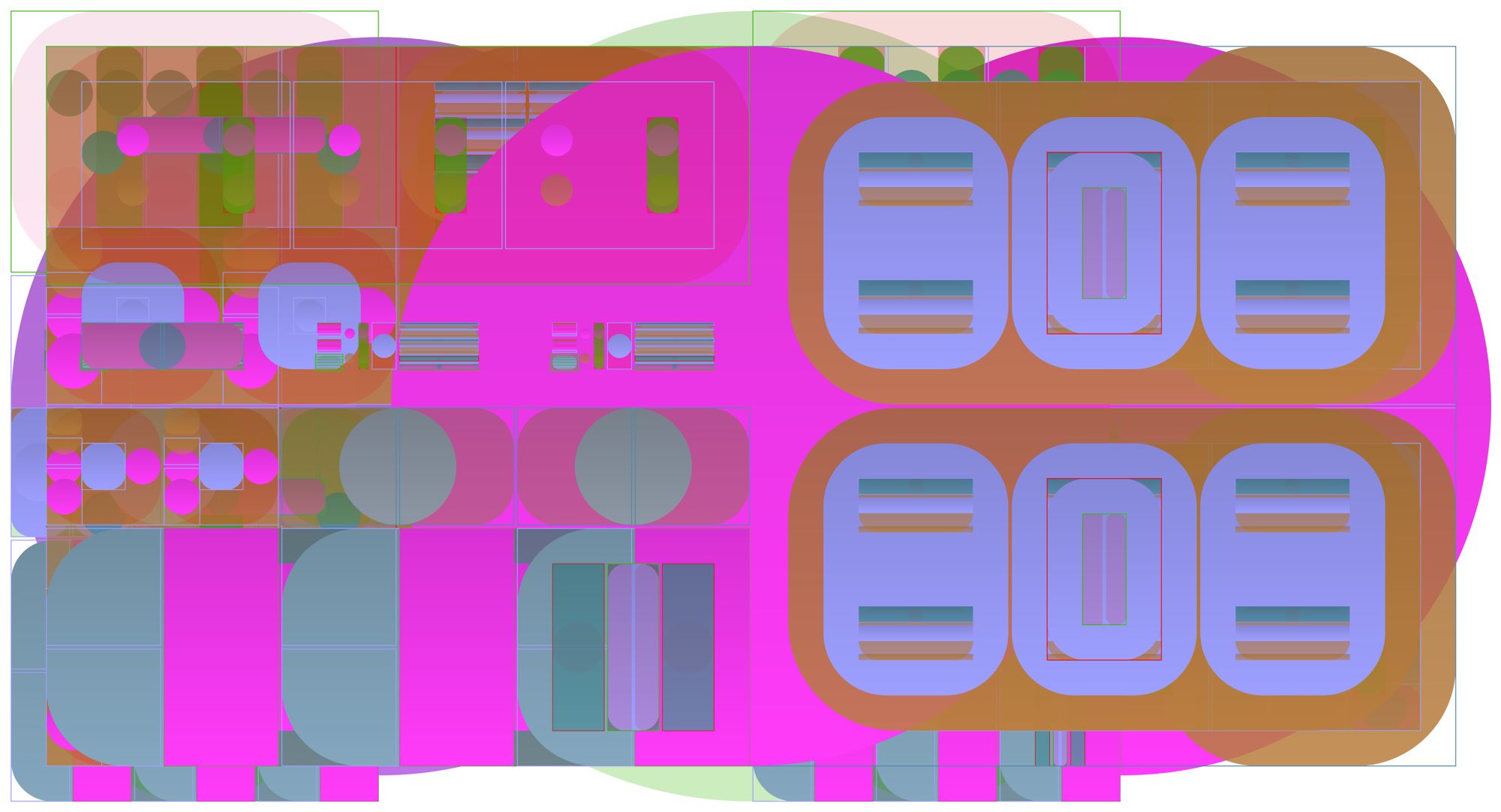
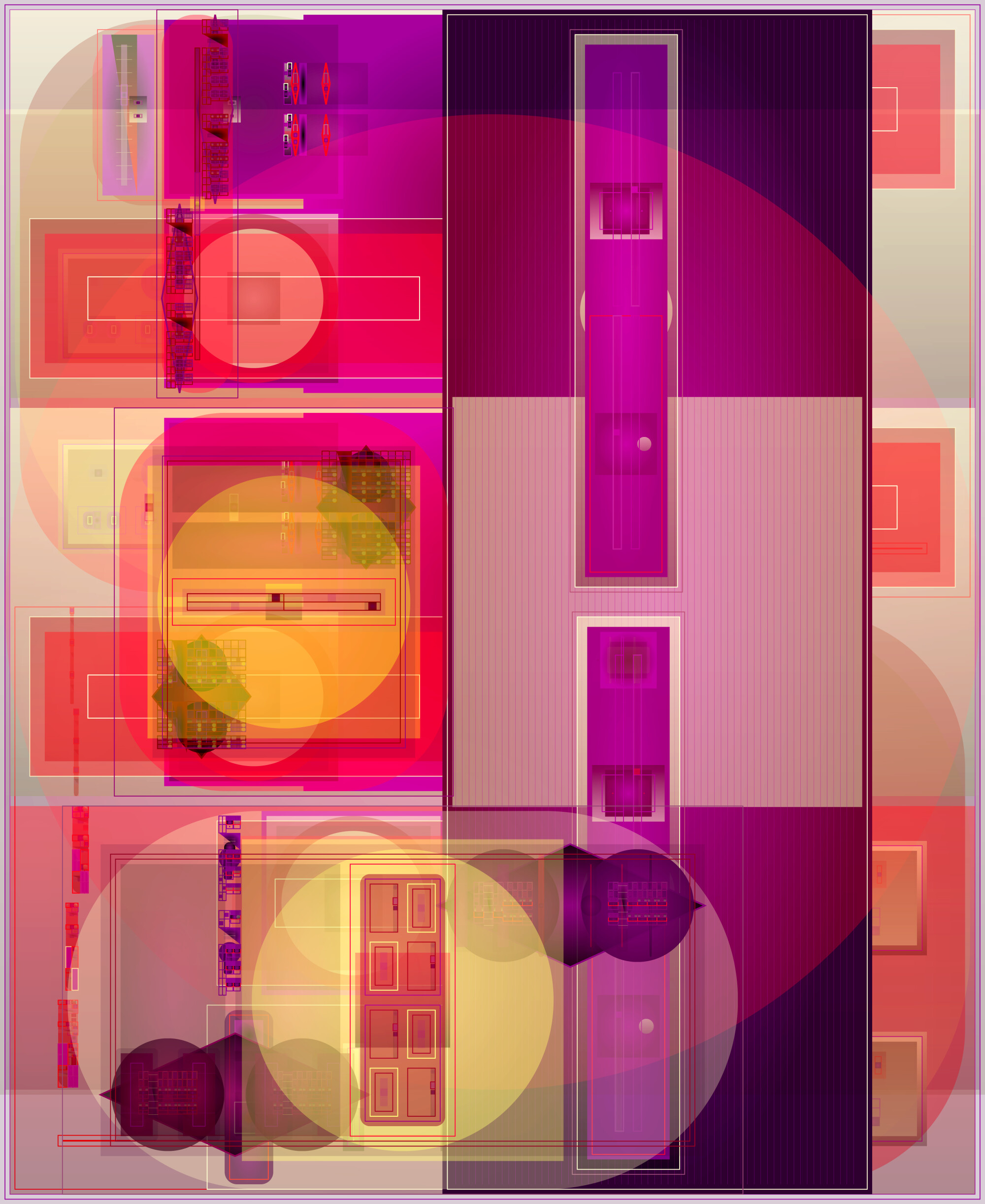
A wide composition: a magenta oval sits behind everything, two rows of three lavender rounded squares with horizontal bars fill the right half, and smaller pink, grey and ochre modules crowd the left. harm.work describes Friendly Conglomerate only as "Rendered using Cartesian genetic programming"; its record is dated 2 April 2019, a week after the first CGP output he saved.
Breeding uses one parent. "In Mutant Garden, clicking one rectangular 'mutant' will cause its siblings to be replaced with newly mutated offspring. This breeding strategy requires only one parent to be selected because the algorithm utilizes mutation, rather than cross-over" (series text). The two earlier breeding series crossed two parents: Algues Artificielles aligned two chromosomes and took genes from either. The same text gives his reason for using it: many people "equate articial intelligence with neural networks", and he wanted "to highlight the evolutionary progress in this recent history of computation, approaching it as algorithmic archeology. Each new innovation in this lineage aimed to improve or declare its predecessor obsolete, yet would simultaneously stand on its shoulders" (→ Algorithmic Archaeology).
"As we also encounter in genetic encoding in 'real nature'," the text goes on, "the genotype contains many redundant genes, which are well known to assist in effective evolutionary development." Only a small share of the genes is read when the graph runs. In the 2021 FAQ of the Mutant Garden Seeder he gives the share that is read as "coding genes", the nodes visited during traversal divided by layers × nodes.
Selection in Mutant Garden has three forms, and the works below move between them. The artist chooses, as he did in the earlier series. A fitness function chooses: in the Mutant Garden Autobreeder "siblings are evaluated based on measuring their visual complexity versus cost of computation", so that "complex compositions that were relatively quick to generate are favoured over simple images that took disproportionate effort" (exhibition text, 2021); in Spike #70 he gives the measures as render time and file size after compression. And in the Mutant Garden Seeder the block hash decides when and how a token mutates, and collectors decide which states to keep. The four fitness functions of his breeding work are compared on Evolutionary Logic.
The archive had put design in these terms before any of this software. 586, titled "Design", opens: "In order for something to be designed it must be the result of an evolutionary process: One that results from aberration, mutation and adaptability." The note names no source and its second paragraph varies David Pye's workmanship of risk (→ Randomness and Pattern). Nothing connects it to Mutant Garden except the vocabulary.
Before the garden: Autobreeder (lite), 2018
The name Autobreeder is older than Mutant Garden. Autobreeder (2016) is the fullscreen program that "autosurfs the massive genealogy" of Death Imitates Language (2016–), his first series bred with a genetic algorithm. Autobreeder (lite) is the Ethereum collection harm.work dates 2018: "A selection from massive genealogy of the 'Death Imitates Language' project, containing the first 12.000 specimen, bred by a genetic algorithm, and selected by micro-feedback of the artist." Its tokens are numbered 1 to 100. harm.work shows 66 of them as specimens, each with a three-part name, and 34 as editions of the program Autobreeder (lite) itself. In 2018 he also sold specimens of the population as Ethereum tokens through his own token shop, described on Protocol, Taste, and Systems; the Autobreeder (lite) tokens are not the ones sold there (the artist, November 2026).
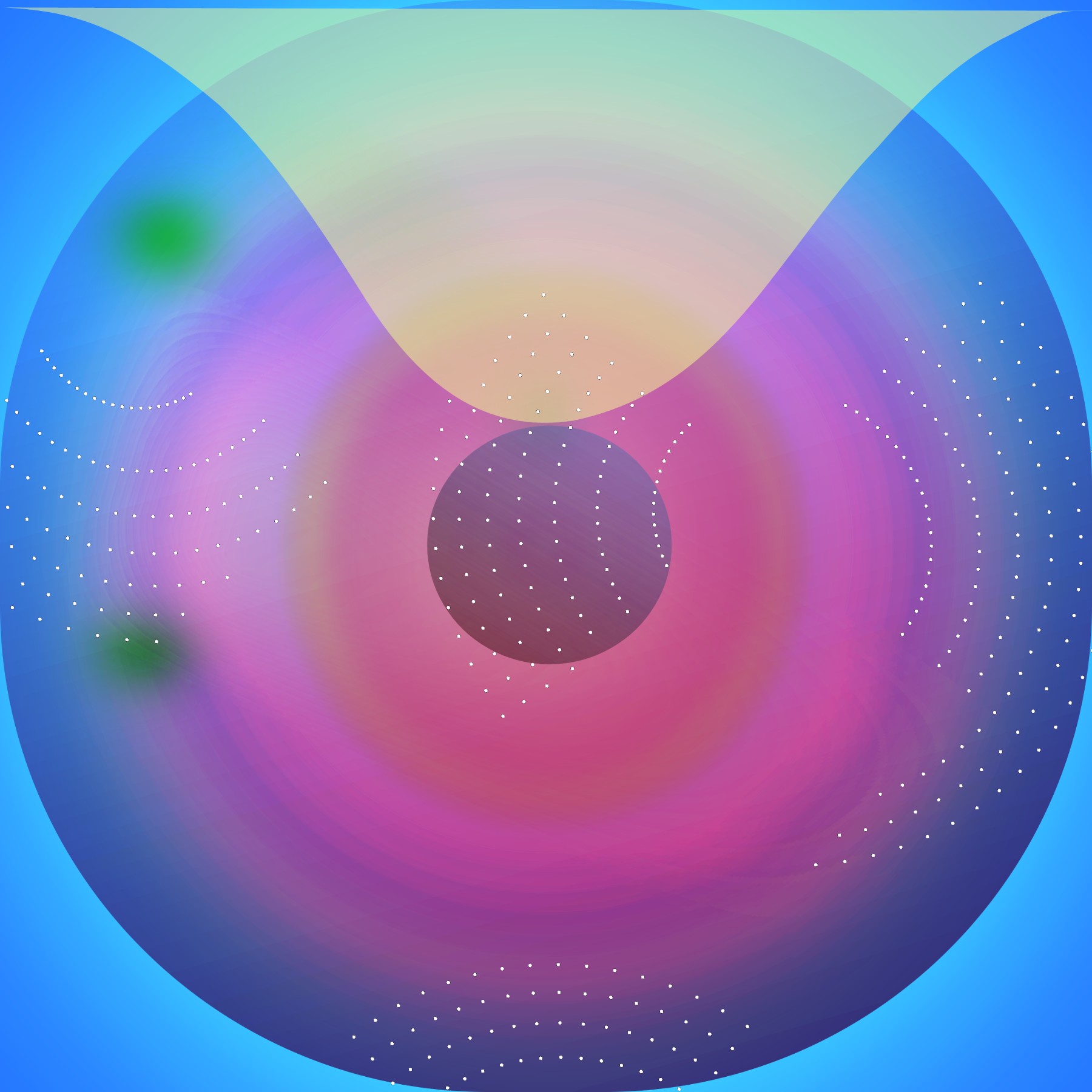
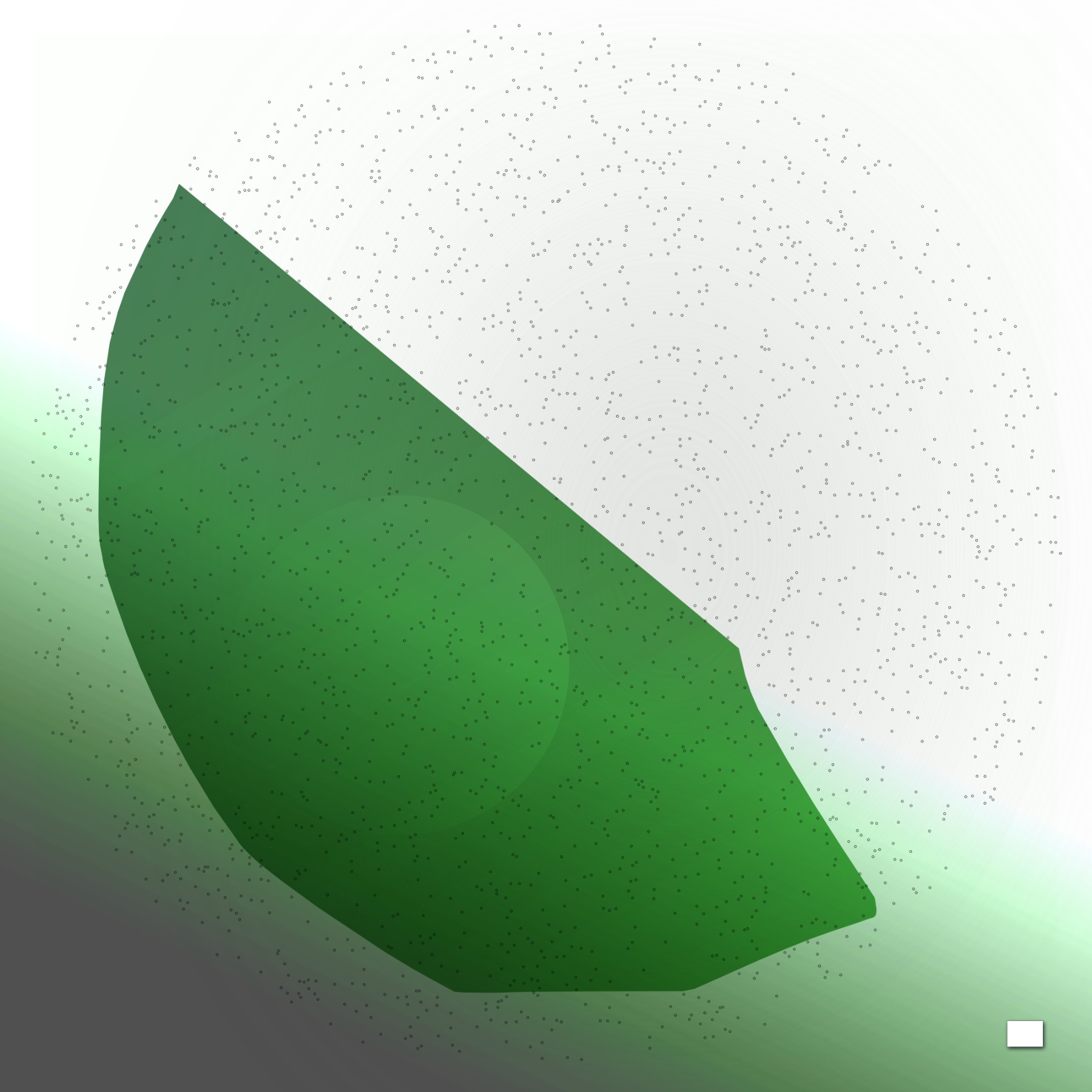
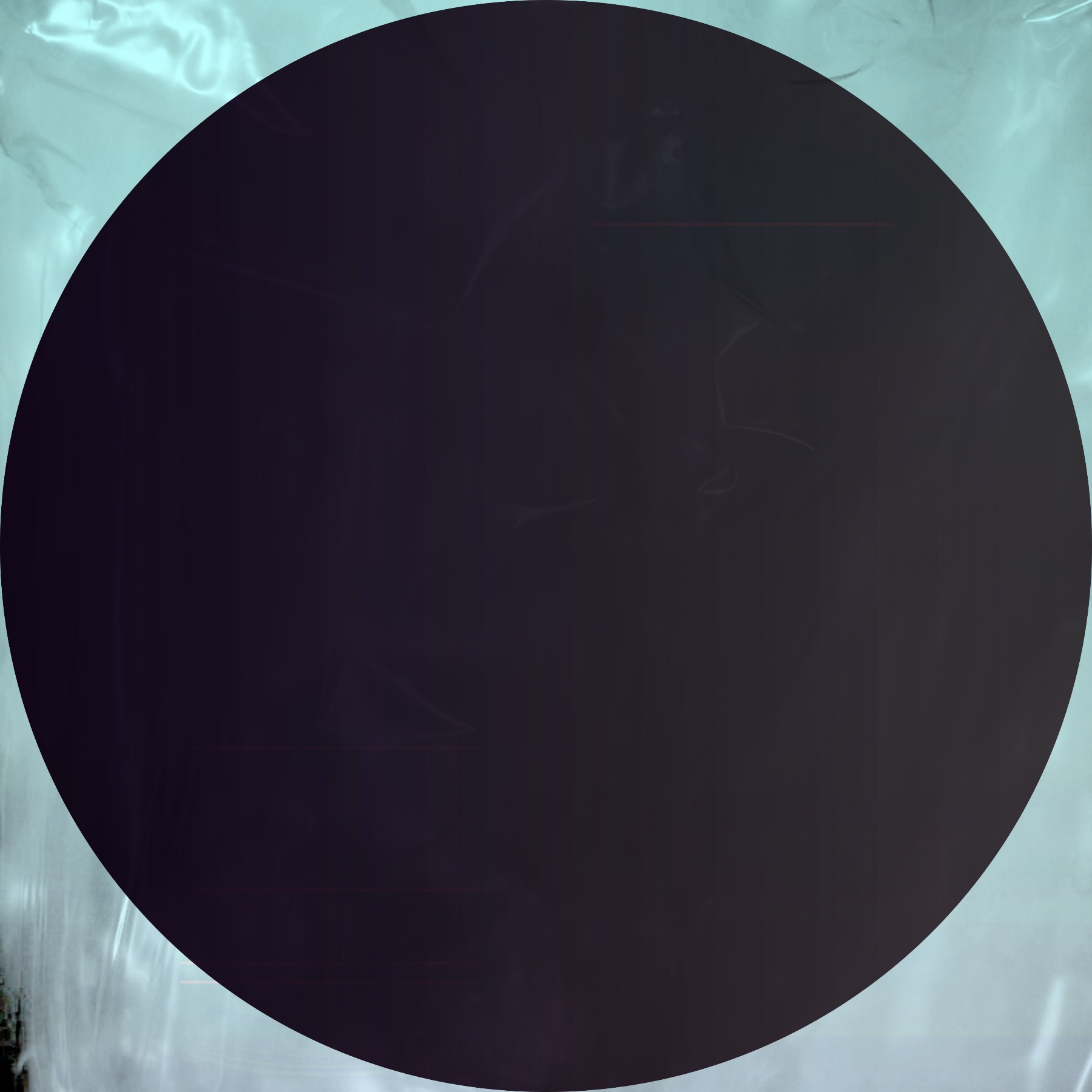
Siblings share their second and third names (→ Death Imitates Language, The names). Msmqocm Eve Adam and zoze Eve Adam are two such siblings and look nothing alike: a green polygon on a dotted white ground, a black disc on pale blue-grey. Ded Qazwsxedcrfvtgbyhnujm Narut has a sibling in token #81, Gauley Qazwsxedcrfvtgbyhnujm Narut. These are soft, single figures, discs, blobs and polygons in gradient fields. The Mutant Garden images are modular and nested. What changed in between is what mutates. Death Imitates Language bred a linear chromosome of drawing parameters. The text of Uninnocent Bystander (Lehmann + Silva, Porto, 2019) gives the steps that followed: "To overcome the size restrictions imposed by creating works using a linear chromosome as a primary reference point (which is how genetics function in nature), van den Dorpel turned to a hierarchical form of organization which he encountered in the analysis of natural human language", the tree structures of Nested Exchange, and then to CGP, which "allows for programming code to mutate". From 2019 the chromosome is a program.
2019: the first outputs
The first CGP outputs date from the last week of March 2019; his are.na channels give the day-by-day record (→ Evolutionary Logic). Several works carry the moment they were rendered as their title. Untitled (1554993052565) and 1554994948963 are Unix timestamps in milliseconds; both convert to 11 April 2019, 14:30 and 15:02 UTC. The later Proto Seeders prints write the same kind of title out in words (see below). Partition, dated 28 March 2019 on harm.work, is one of the first: a wide image of vertical bands and nested rectangles in violet, pink, olive and grey, ruled by thin black lines. It was minted in 2023 as Partition, token 77 of the JPGs collection, whose metadata gives "series": "Mutant Garden", "created": "2019", "minted": "2023" (→ Editions and Small Collections, where it is shown).
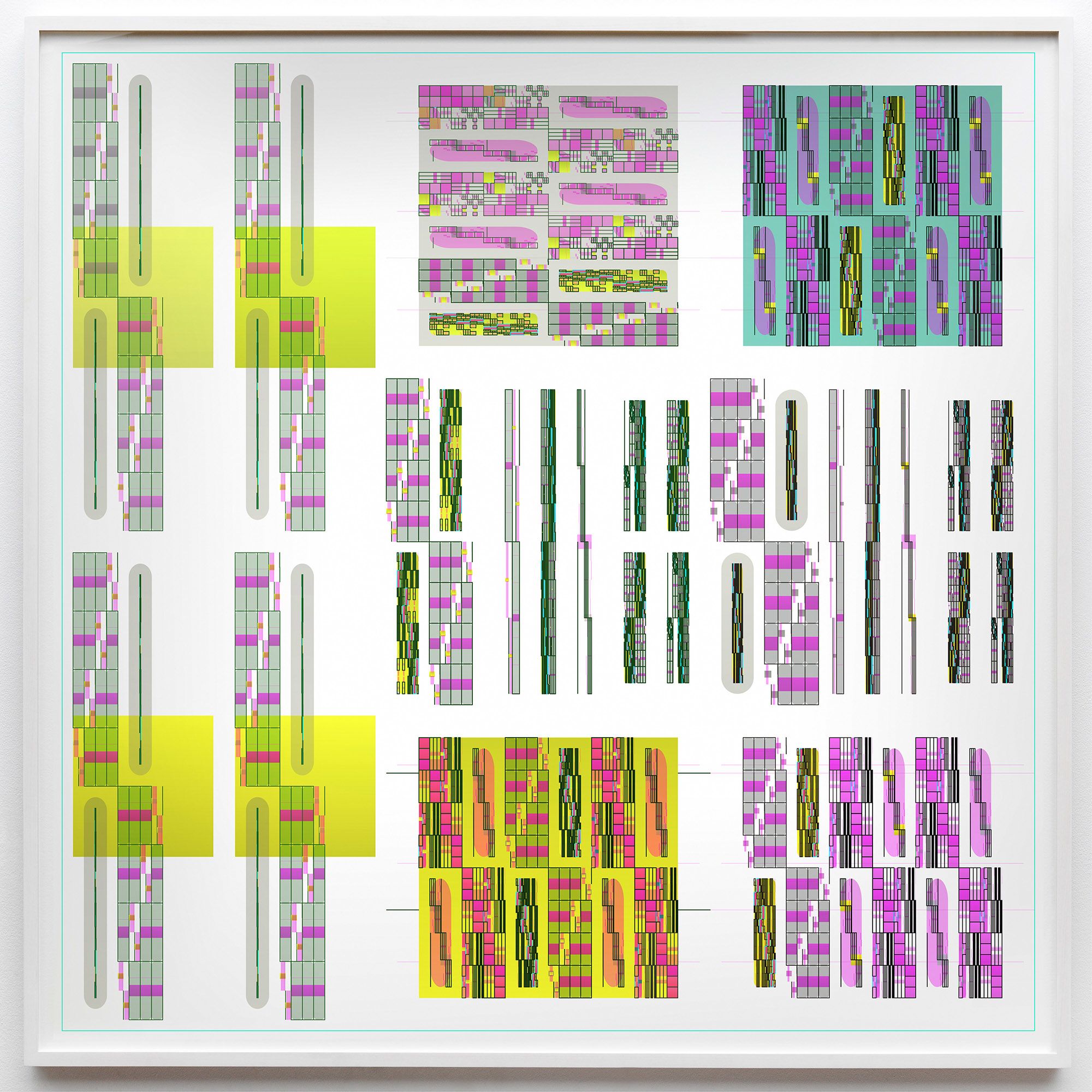
1554994948963 was rendered 32 minutes after Untitled (1554993052565), and like that print it builds the left and right halves of the square differently (→ Uninnocent Bystander, where the earlier print is shown). The left half repeats one unit four times in a two-by-two grid: a column of grey-green cells banded in pink, a grey rounded slot with a thin green line inside it, and a translucent yellow-green rectangle laid across both. The right half has four blocks of small striped cells and capsules, each in its own colours, with a band of thin vertical strips between them.
harm.work files twelve works of 2019 under the Mutant Garden series, several of them square prints of 80 × 80 or 100 × 100 cm: SPARCStation, Field, Trebles, Decompression, daisies, Crud, Multi Dimensional Zoom and Untitled (pleasant modules II) among them. Untitled (1554993052565) was shown that year in Uninnocent Bystander in Porto, whose text calls CGP "this technology from 1999" (the year of its name) and says the works "concern themselves with the dynamics of progression and halting".
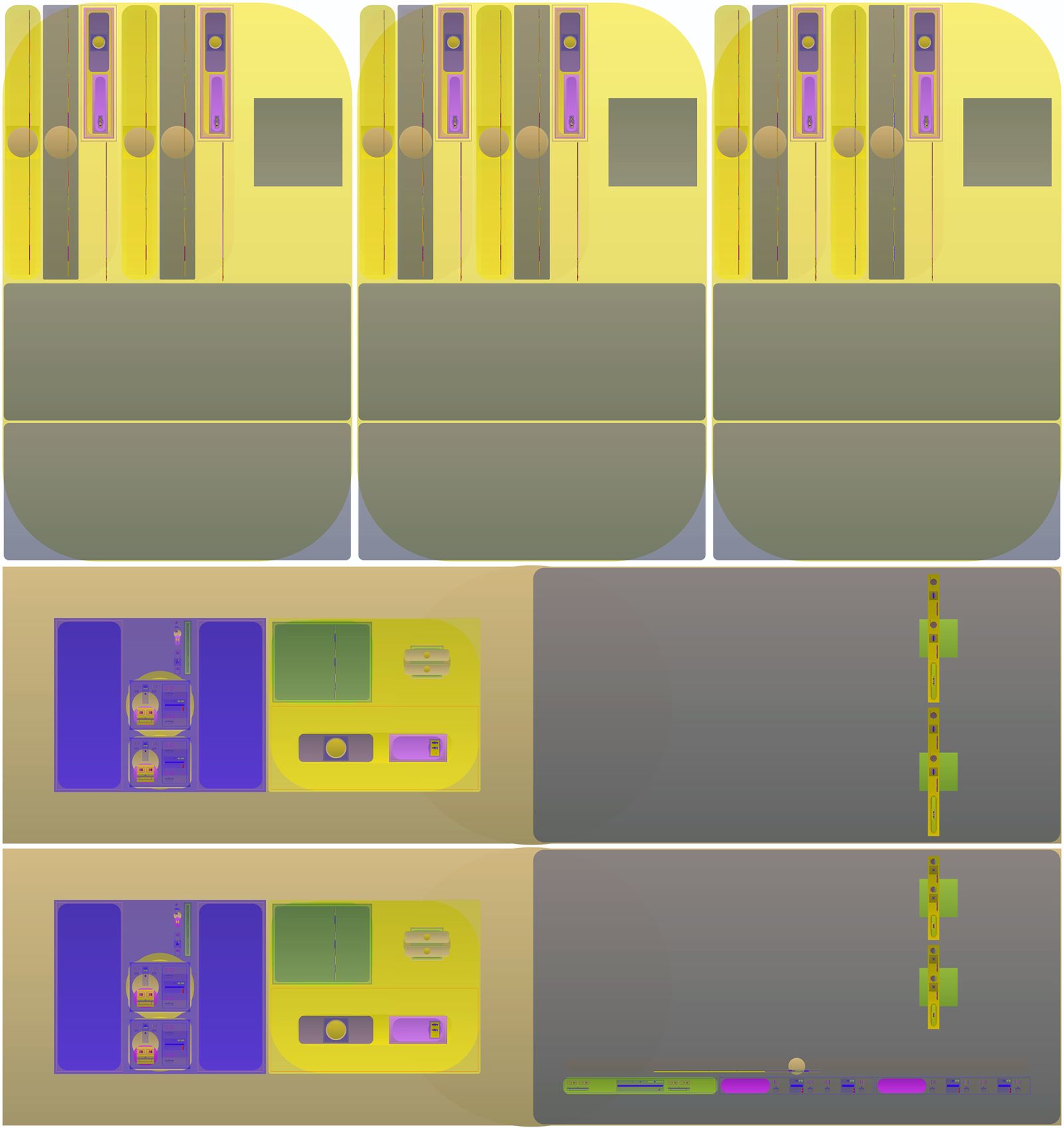
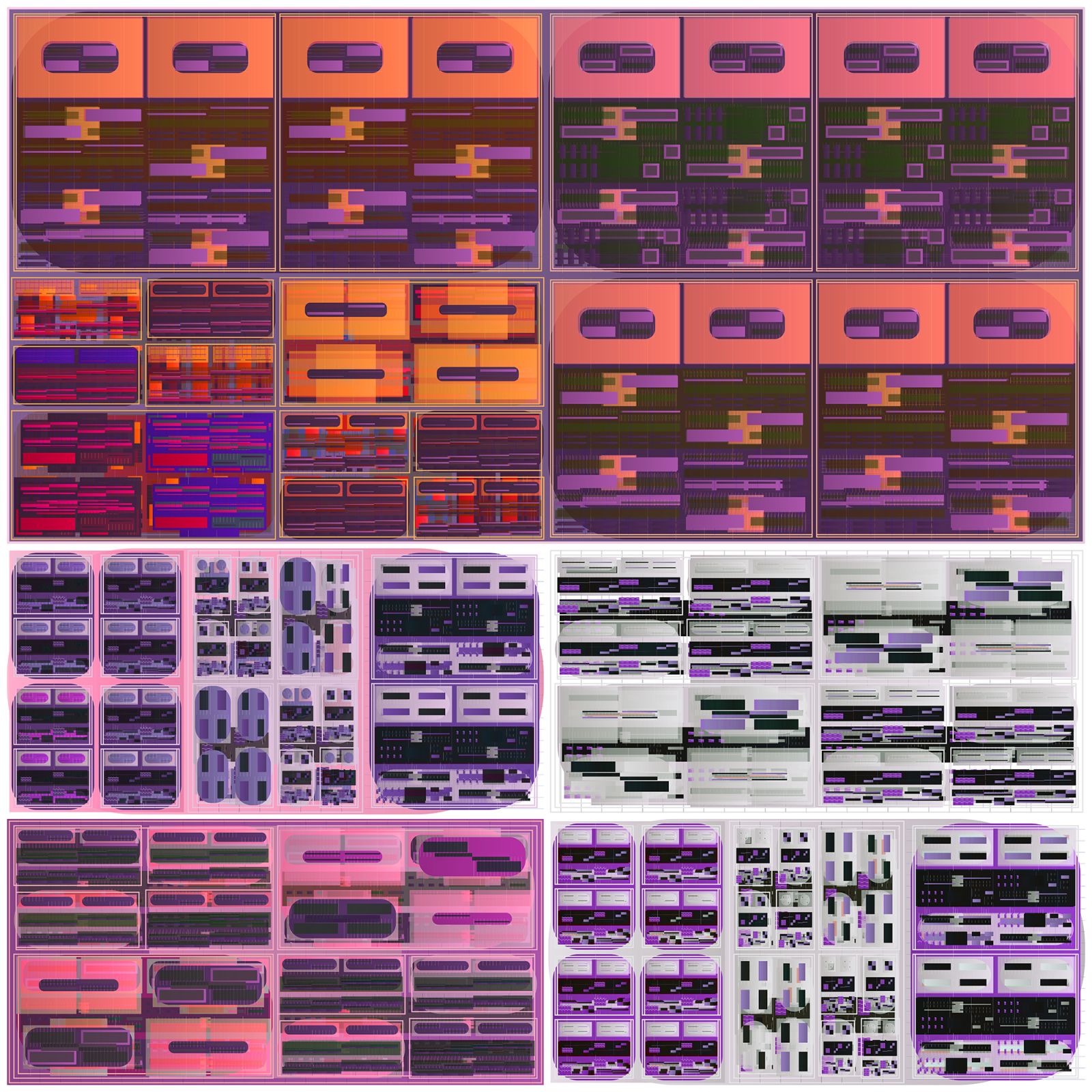
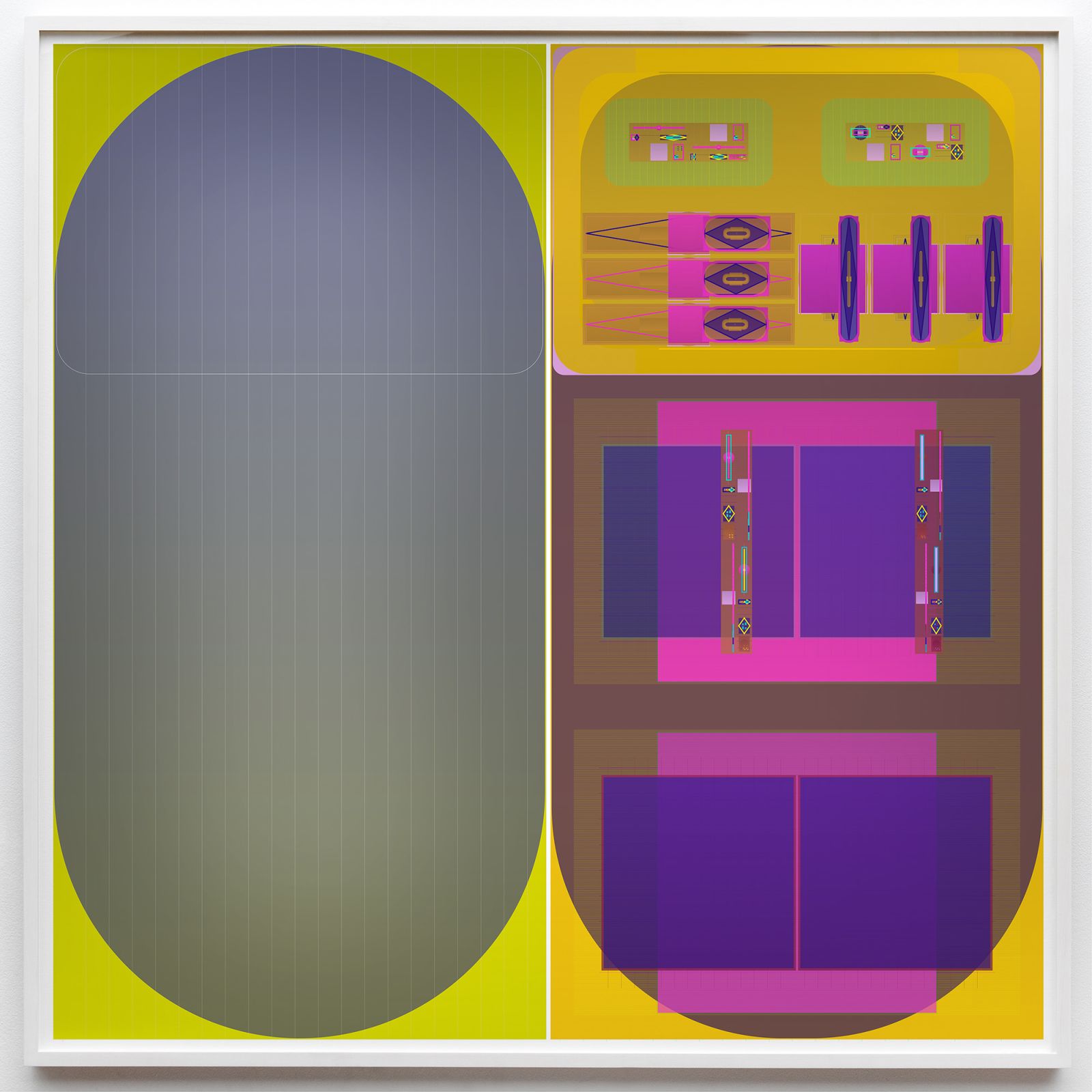
The three show the repetition the program produces. Untitled (pleasant modules II) repeats one yellow rounded panel three times across the top and one violet-and-yellow module twice below. Crud divides the square into quadrants and each quadrant into rounded panels of the same few bars. Trebles sets one large grey capsule against a column of smaller panels.
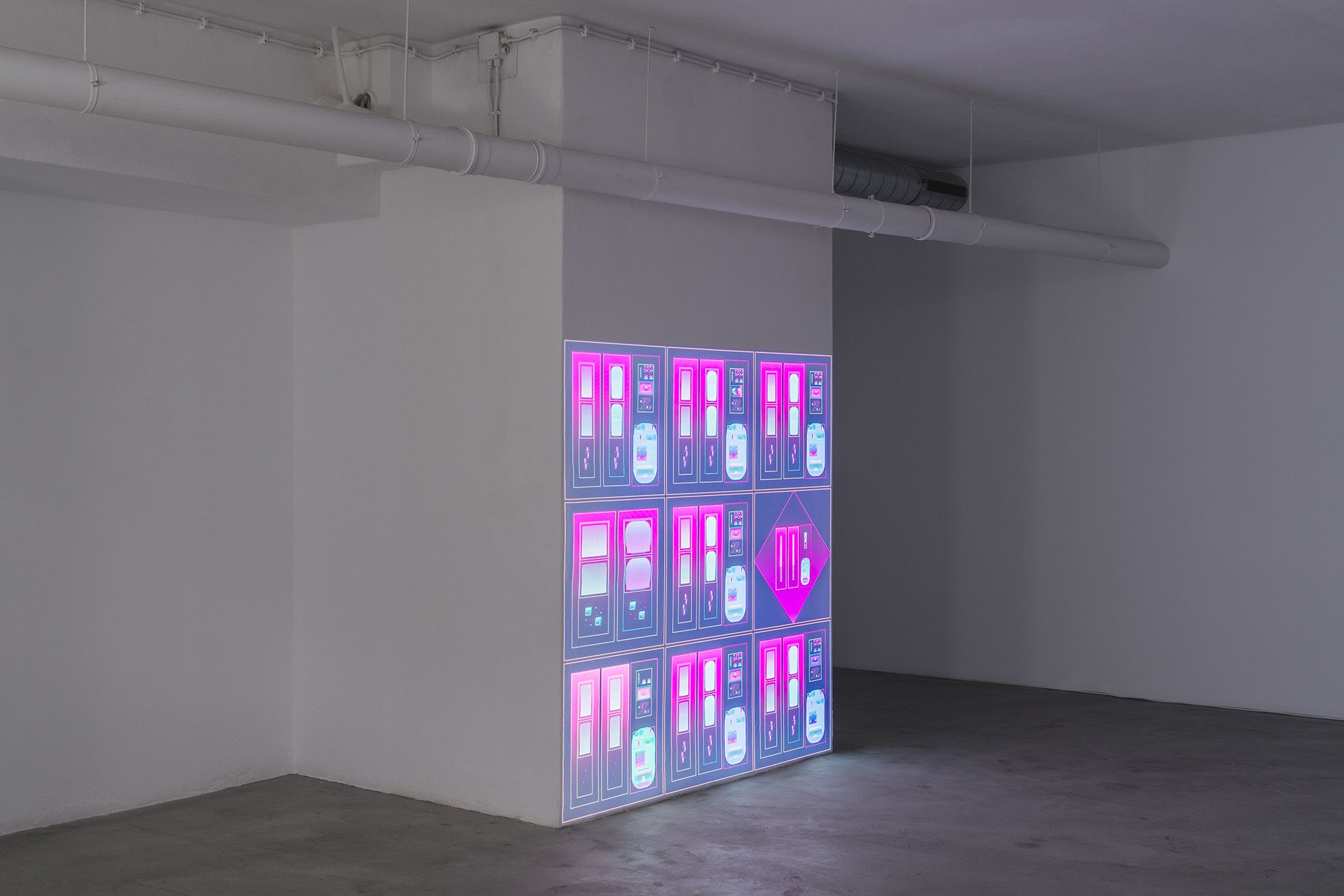
Autobreeder (single screen) (2019) runs the breeding on one surface. In this view it is projected onto a pillar: a grid of nine specimens, eight of them siblings with tall magenta panels and a pale blue capsule, the ninth a diamond in the centre of its square. harm.work gives no venue for the photograph.
Mutant .garden (2020)
Mutant .garden put the breeding online in 2020: "A website where users can live breed and mutate specimen" (harm.work). The site at mutant.garden is still up. Its page title is "Mutant Garden (Structures of Redundancy)", joining the new name to the one he had used in 2019 for the project and its are.na channel; the name Mutant Garden first appears on are.na on 26 March 2020. On 3 April 2020 CLOT Magazine made the site an Editor's Pick, describing the one-parent breeding and placing it after Markov's Window, Death Imitates Language, Algues Artificielles and Nested Exchange in a line of works on the history of computation (CLOT).
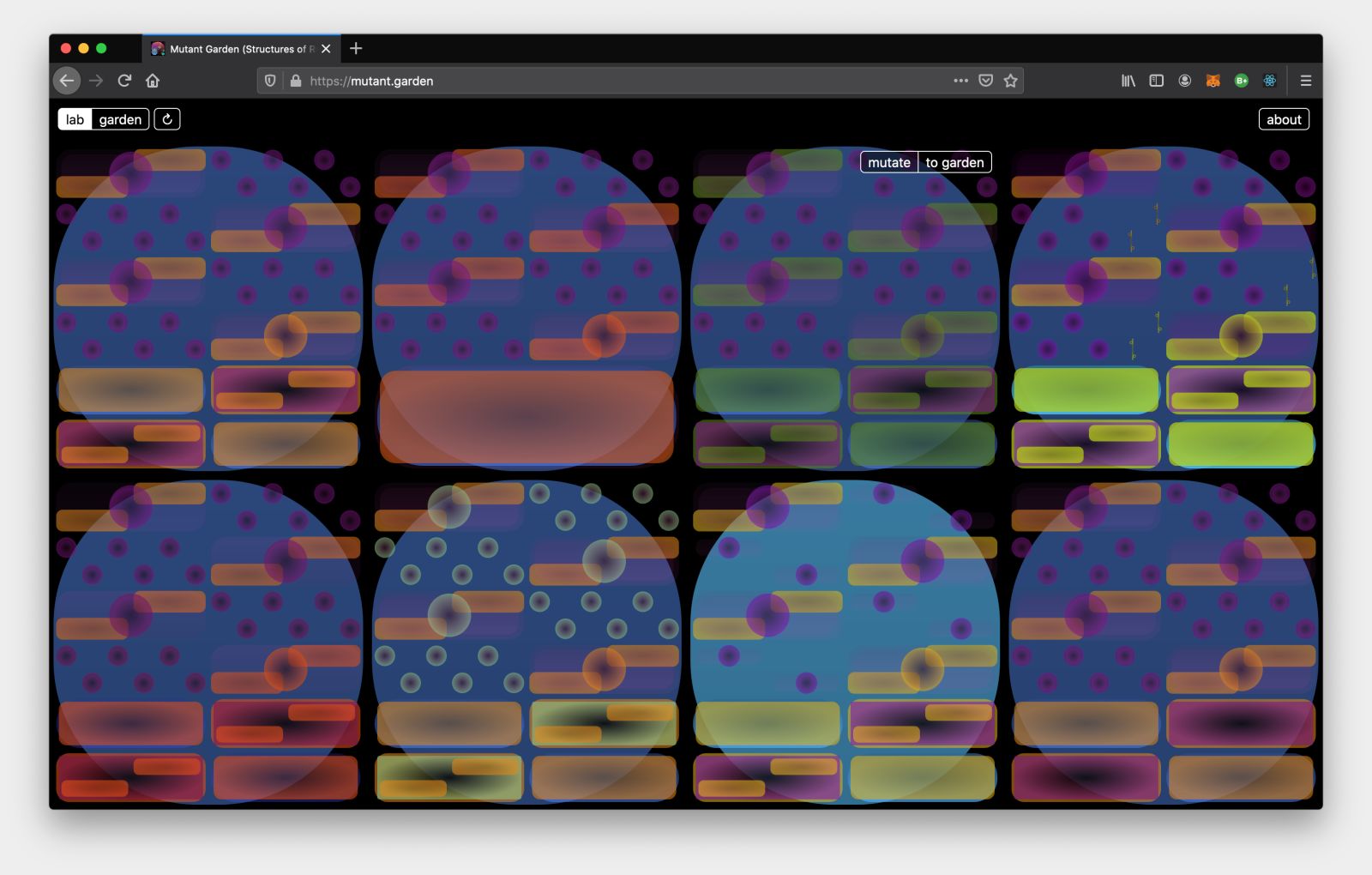
A generation of eight in a browser window: blue domes dotted with violet circles over bands of orange and green bars. Over one specimen float the two buttons "mutate" and "to garden". The eight are variants of one composition, the siblings that the next click replaces. In the top corner the site switches between two views, "lab" and "garden", the names the 2021 exhibition gave its two rooms.
Prints, exposures and NFTs, 2020–2023
For the 2021 exhibition he described what happens between the program and the wall: "I used the outputs of this algorithm as input for my own aesthetic wetware: I curated, and optimised the highly complex compositions, emphasised desired traits in a painterly, subjective, and labour intensive process. Some of these works are materialised as digital exposures on photographic paper (lightjet), others are printed on archival paper using UltraChrome inks." The program proposes, and he retouches.
Two of the token works say the same in their harm.work texts. Neural Dust (2020) is an "Early high resolution render of the Mutant Garden algorithm, manually retouched", 9331 × 9331 pixels, with a title by the writer William Kherbek. Alternate Ploy (2021) is a "High resolution render of the Mutant Garden algorithm, manually calibrated. When this one was made the renderer did not use Gaussian blur yet. Its composition primarily benefits from the alternating AB/BA grid structures and its colours from a balanced pastel palette (HSL colour space)." Balanced and HSL return in 2021 as one of the three colour modes of the Mutant Garden Seeder (→ Colour).
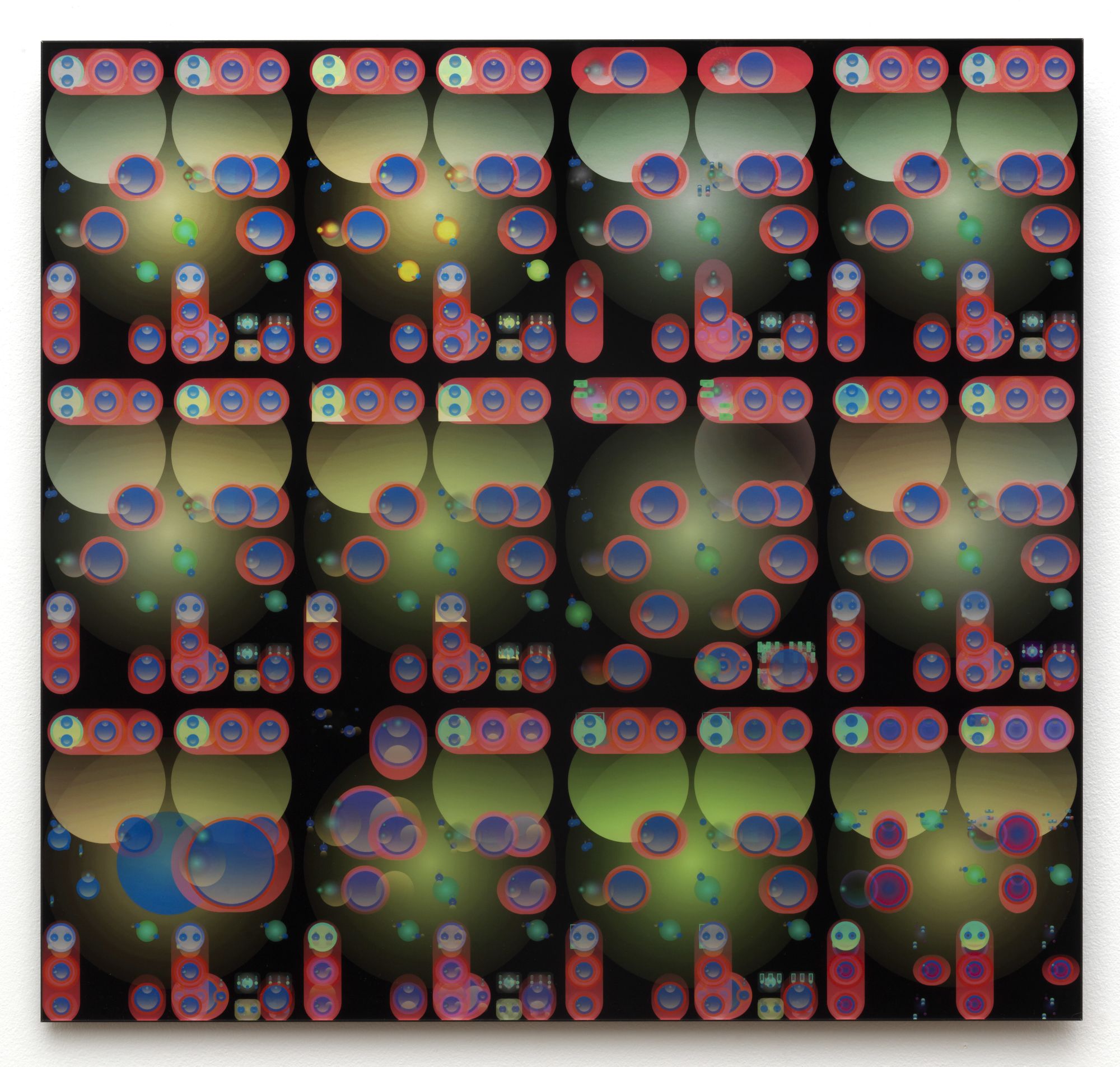
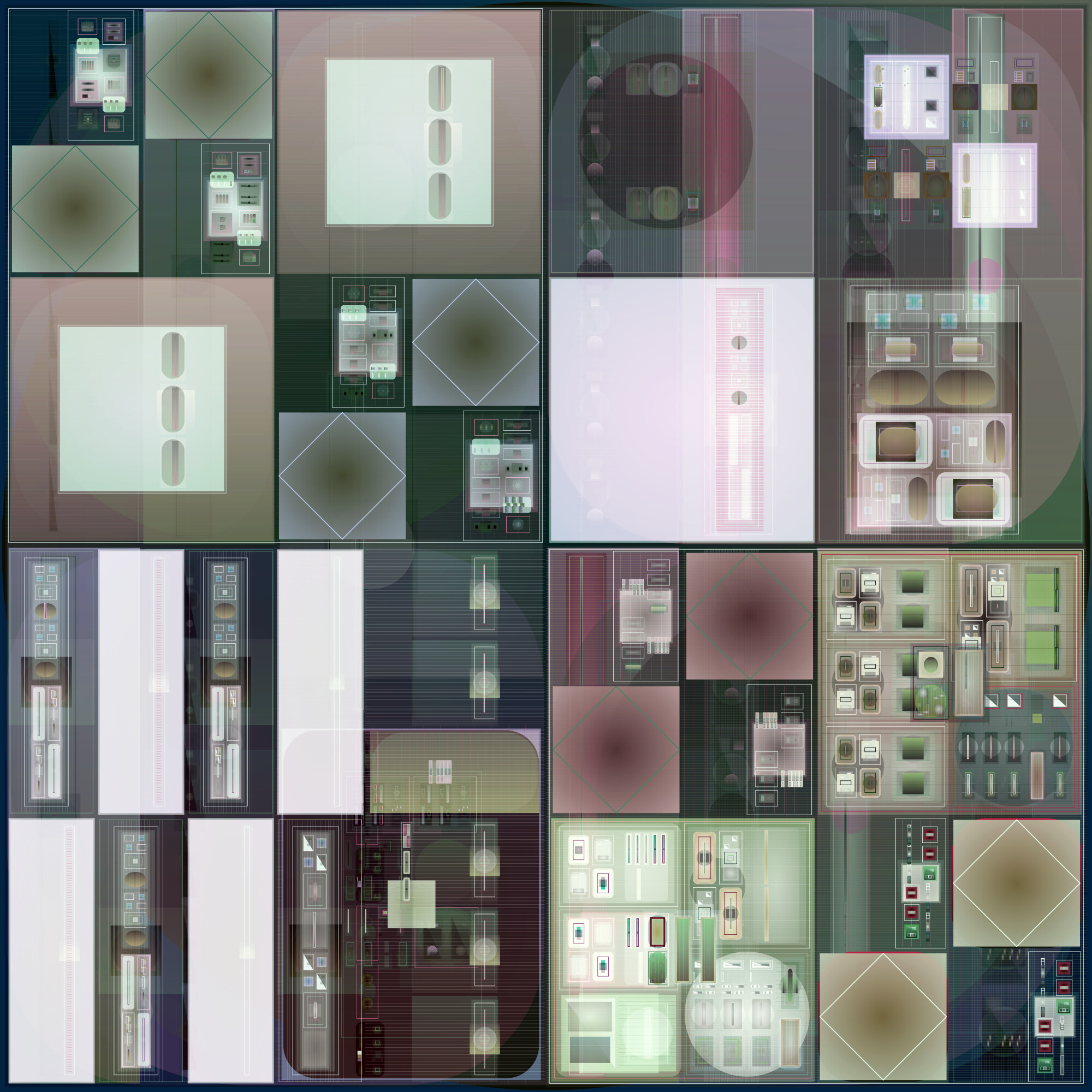
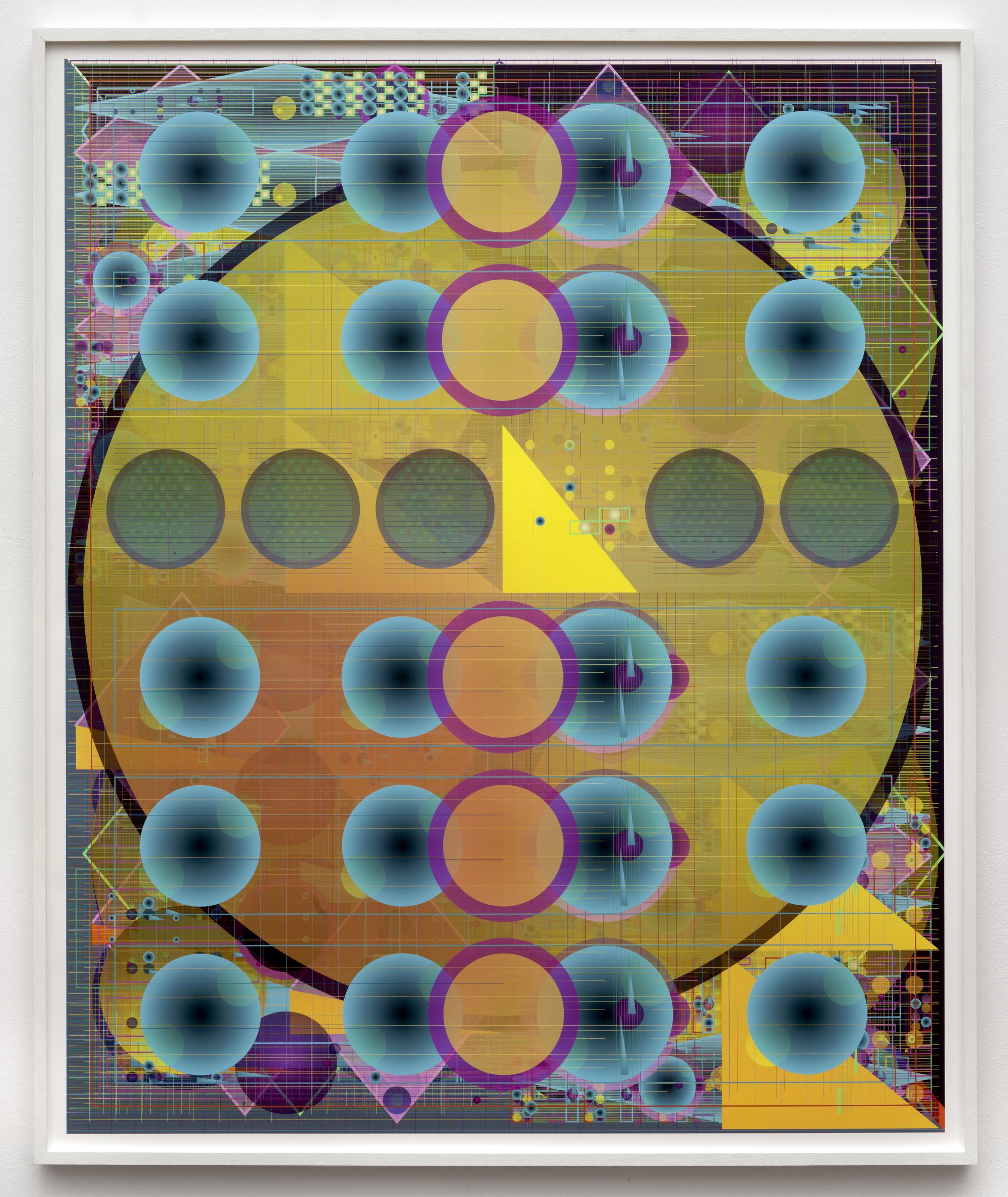
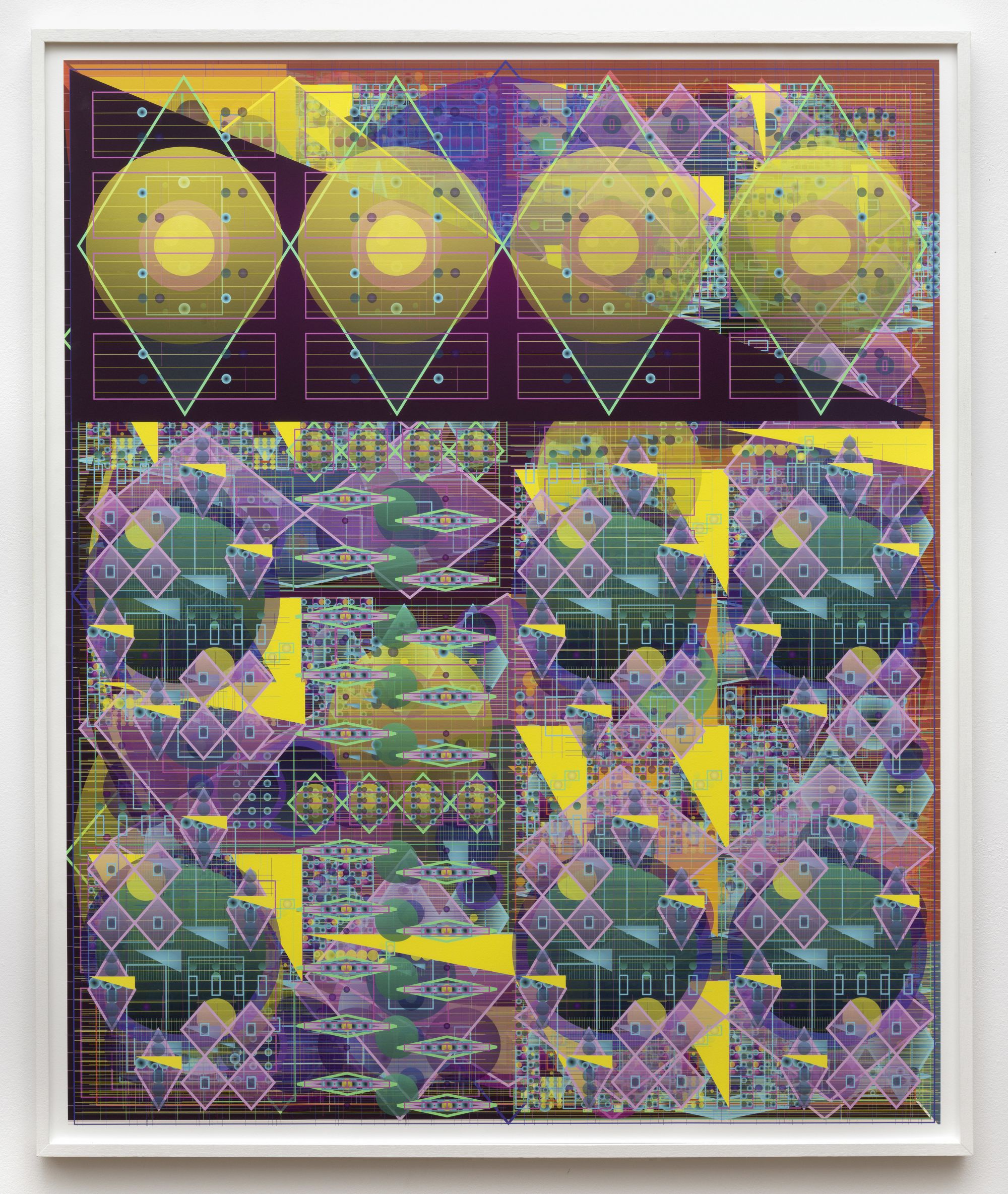
Neural Dust repeats one module twelve times on black, a glowing pale green disc with red capsules holding blue circles, and each repeat differs slightly. Alternate Ploy has no glow: hard-edged squares in muted grey-green and mauve, some holding pale panels with three vertical slots, some a diamond. Hissed Hyphen Flicks is one of two large UltraChrome prints of February 2021, with Hazy Sparkle Boost, both 105 × 127 cm. harm.work files Hazy Sparkle Boost under the Proto Seeders series. It stacks its modules in layers: across the top a band of four large yellow discs, each inside a green outlined diamond, and below four panels of pink diamond lattices laid over dark green discs and fine cyan grid lines, cut through by yellow triangles. The lightjet exposures of 2020, Trivializer, Floppy Candour and Source Unknown, were followed in 2021 by larger exposures on metallic paper, up to 100 × 122 cm, for the Upstream show. In 2022 came the exposures on photographic aluminium paper, Blush Array, Blush Array II and Modular Mind (→ The Squircle), and Blush Array III on metallic paper. Typographic Trace (2022) is a plotter drawing on Hahnemühle paper "with manual colour pencil retouches", the one drawing in the series. In 2025 he took two more Mutant Garden compositions to the plotter and shaded them in pencil, Quadra and Features (→ Quadra, Features and Soft Shield).
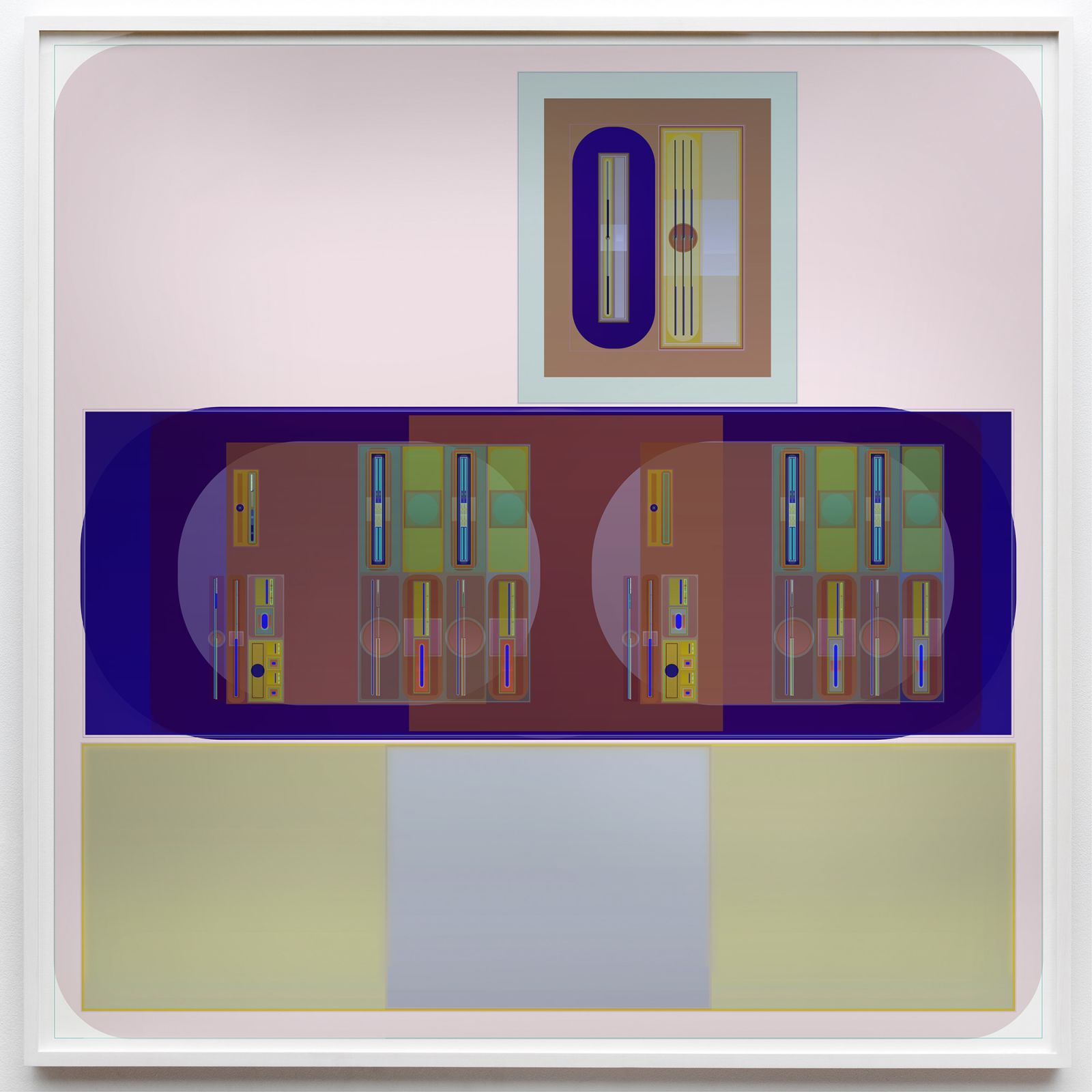
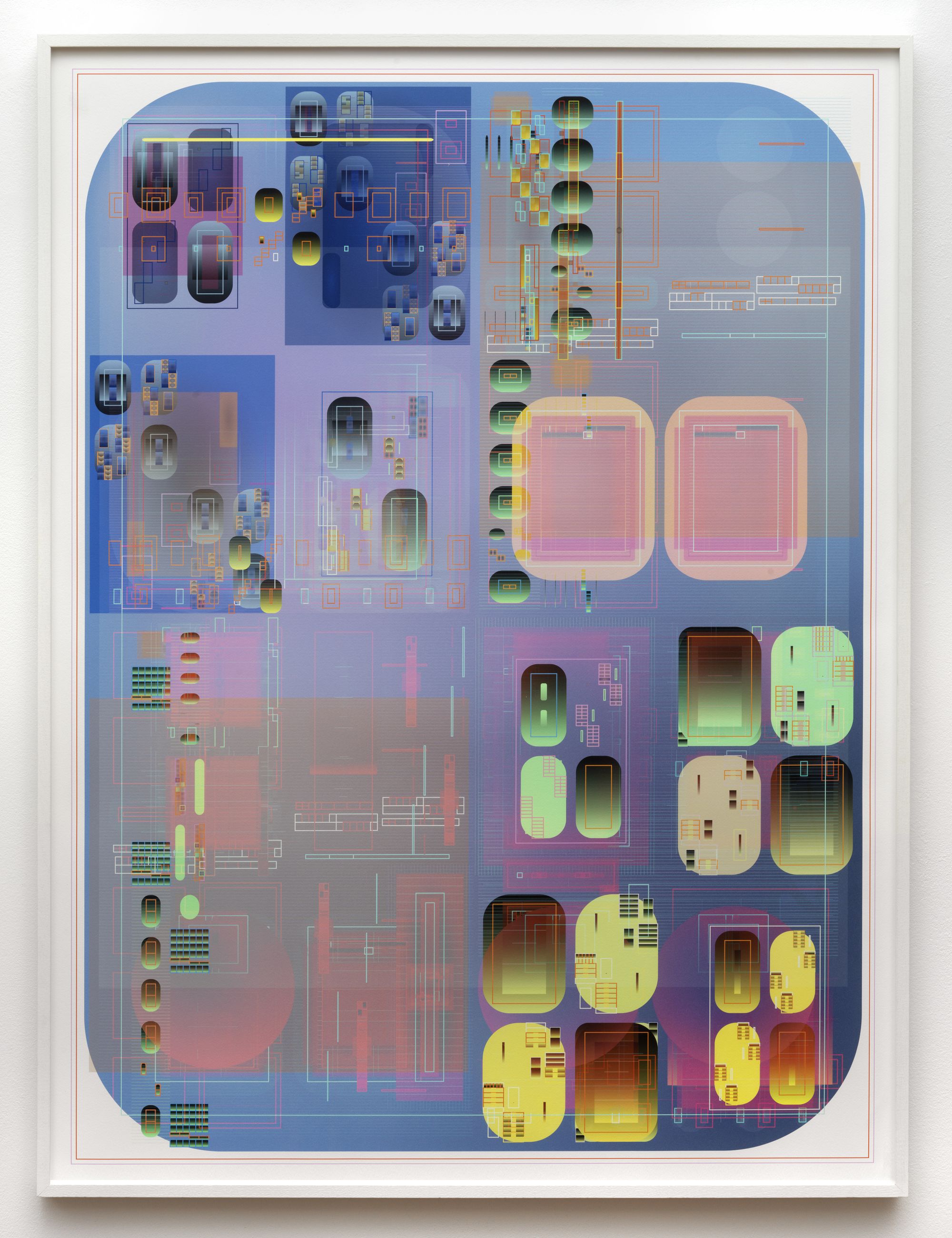
Untitled Decompression (2020, 100 × 100 cm) sets one small module alone at the top right of a pale pink rounded field; below it a dark blue band carries a larger module twice, side by side, and three flat panels close the bottom. Pejorative Highlights (2022, 96 × 130 cm) divides a blue rounded field into quarters of different density: dark gradient capsules packed into the upper left, two large pale pink rounded squares at the upper right, a nearly erased layer of translucent pink and grey at the lower left, and at the lower right a dense cluster of yellow, green and dark rounded squares, each marked with small rungs.
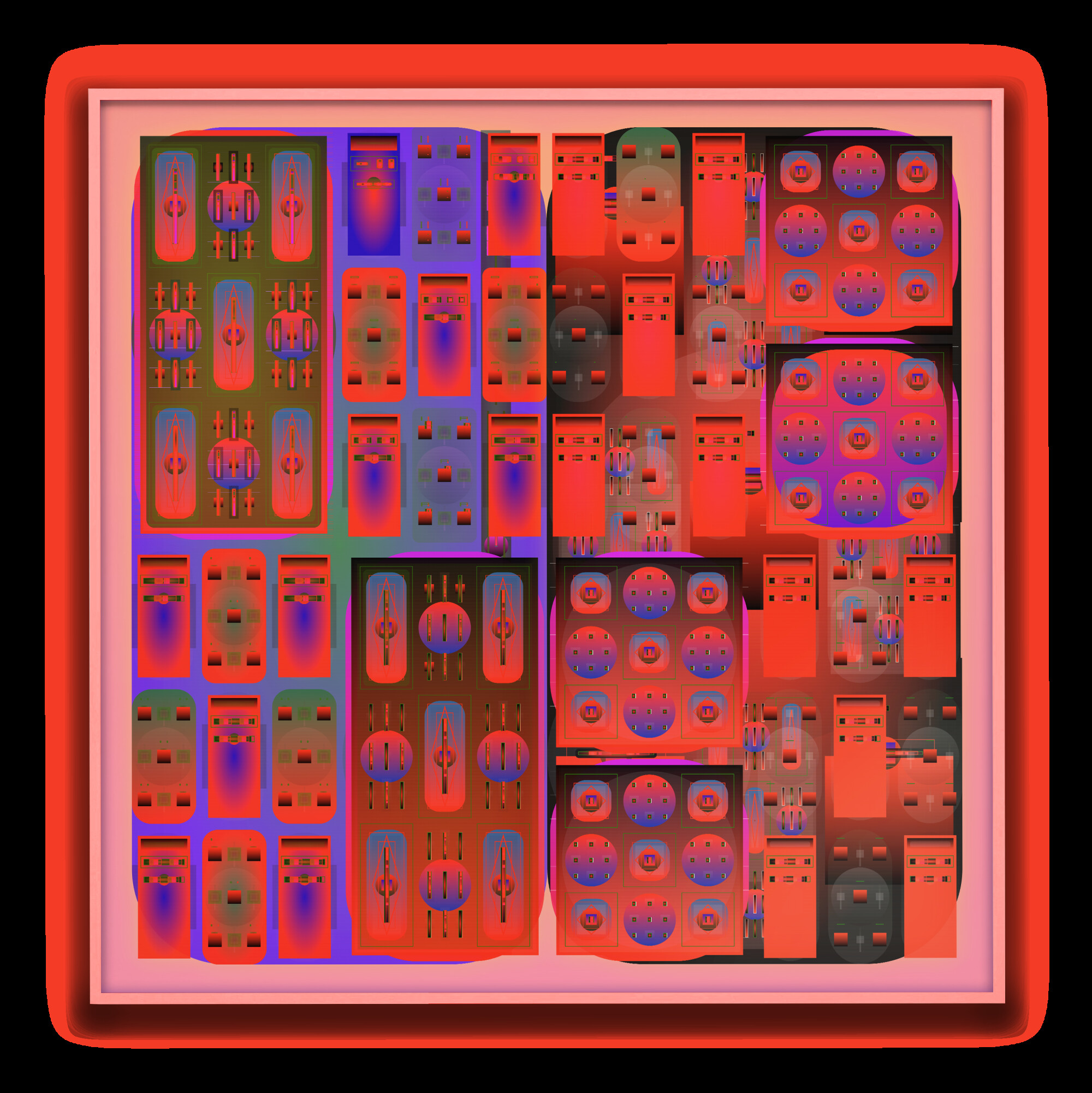
In February 2023 two new works from the series went into Softimage Poetics, an online benefit auction on Foundation for the Los Angeles art journal X-TRA, curated by Nora N. Khan. His news item Softimage Poetics: "It's a pleasure to be included in this online benefit auction with two new works from the Mutant Garden series. Reserves are set to the birth year of Ada Lovelace (1.815 ETH)." The curatorial text it quotes describes the softimage, a term it credits to Ingrid Hoelzl and Rémi Marie, as "morphing, gooey, lush, emergent, evolving and adaptive, an image ever in-between one state and the next. The softimage refuses stability; it feels alive." The two works were an earlier version of Soft Shield, which harm.work dates 2025, and Lacelove (the artist, November 2026). The image the news item carries is a square composition in reds, oranges and violet, panels of capsules and grids of circles inside a pale pink border, glowing red on black. On whether the mutants are alive, the artist's own answer is on Evolutionary Logic (Agent's reading: technology, not life).
The garden and the lab, 2021
The Mutant Garden exhibition at Upstream Gallery Amsterdam (23 April – 27 June 2021) showed the body of work "in its entirety for the first time" (invitation). It was laid out like the software: a "garden" where the Mutant Garden Autobreeder bred new compositions on screens beside the prints, and a "lab" with the Mutant Garden Tracer, which "visualises how the genetic code is formatted as a two-dimensional network", a timeline wall of earlier series, and three lightboxes, Associative Display (organisms), Associative Display (painting) and Associative Display (recursion). The works, the rooms and the text are described on Mutant Garden (Upstream Gallery, 2021).
The Mutant Garden Autobreeder is "Generative animated artwork, based on evolutionary programming. Dimensions variable, duration infinite, silent." After Amsterdam it was shown with the Tracer and two of the Associative Displays in BioMedia: The Age of Media with Life-like Behavior at ZKM Karlsruhe (2021–22, curated by Peter Weibel, Sarah Donderer and Daria Mille), and on its own in The Painter's New Tools at Nahmad Contemporary, New York (2022), and Context Switch at Galerie Noah Klink, Berlin (2022–23; → Context Switch). The work is in the collection of KADIST; its text says it "never appears the same twice" and ends on "a feeling of subconscious computation" (KADIST collection text; → BioMedia, Subconscious Computation).
Protoseeders and the Proto Seeders prints
Protoseeders is a collection of sixteen tokens that harm.work dates 2020 and describes as "Curated early outputs of the Mutant Garden algorithm." harm.work files it under the Mutant Garden Autobreeder. The tokens have single titles: Afterthought, Agathist, Crop Rotation, Cxema, Electracy, Festival, Pebbles, Protorb, Snared (a), Untitled and Mutant Garden (early bug). Five share their titles with physical works: Blush Array II, Decompression, Masked Éclat, Soft Shield and Shy Overture (triplet). Despite the collection's date, harm.work dates the token records from October 2021 (Mutant Garden (early bug)) to 2025 (Soft Shield), most of them 2022, the year he filed thirty-six outputs of April 2019 as vector files in an are.na channel named Proto-Seeders (July 2022). "Early" is used loosely. Protorb was rendered in 2017 with the Nested Exchange algorithm (→ Nested Exchange), and Soft Shield's original output, by its harm.work text, "was generated in 2023".
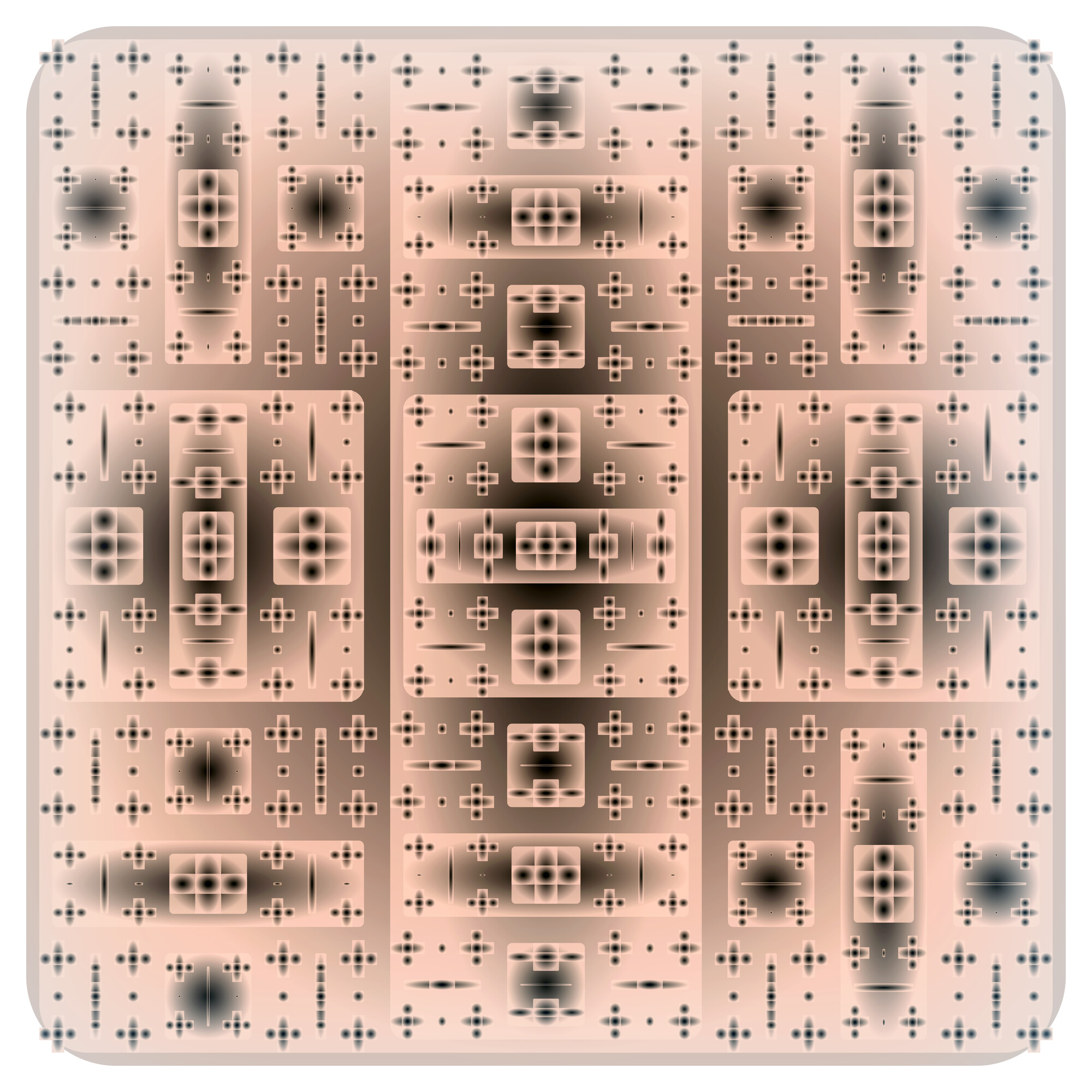
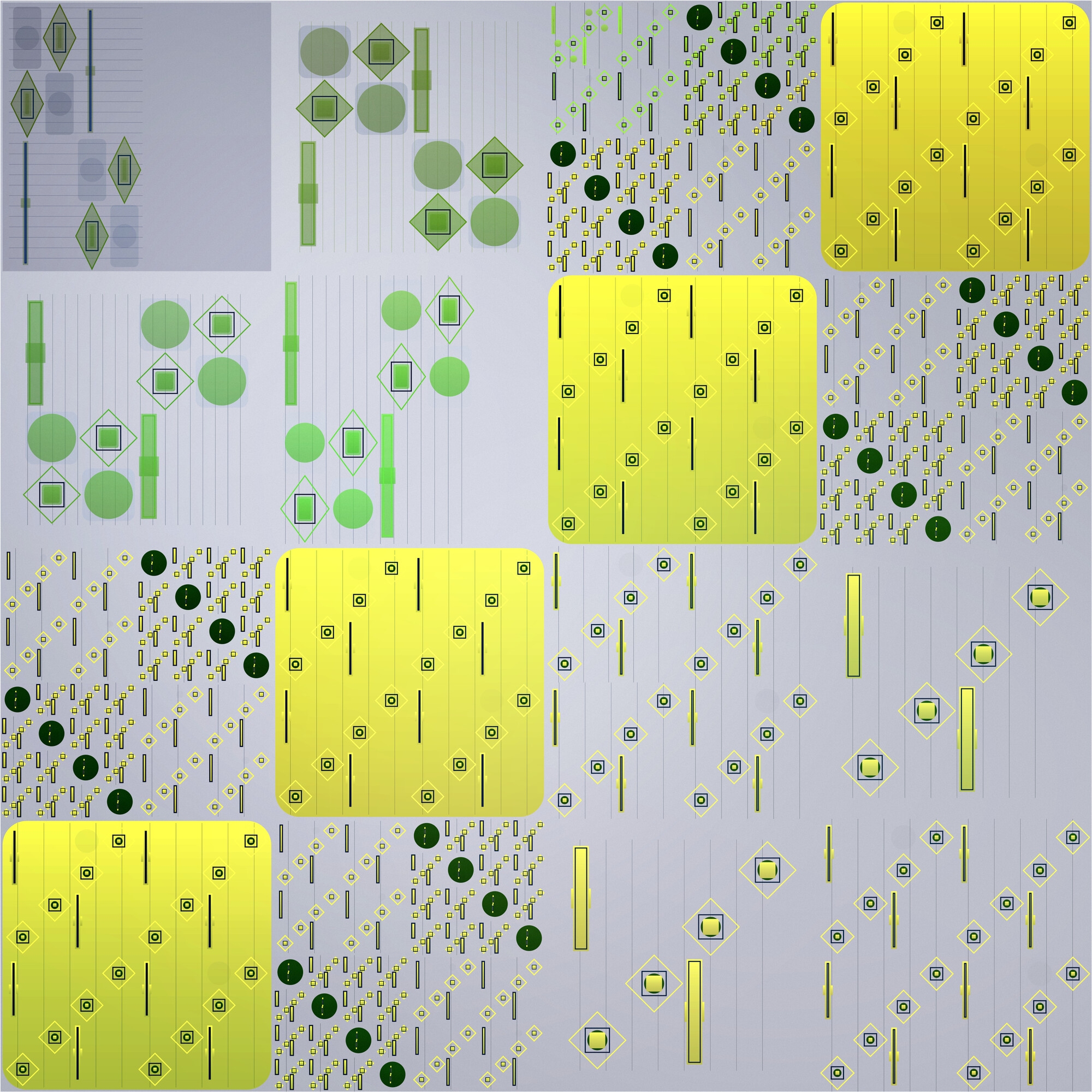
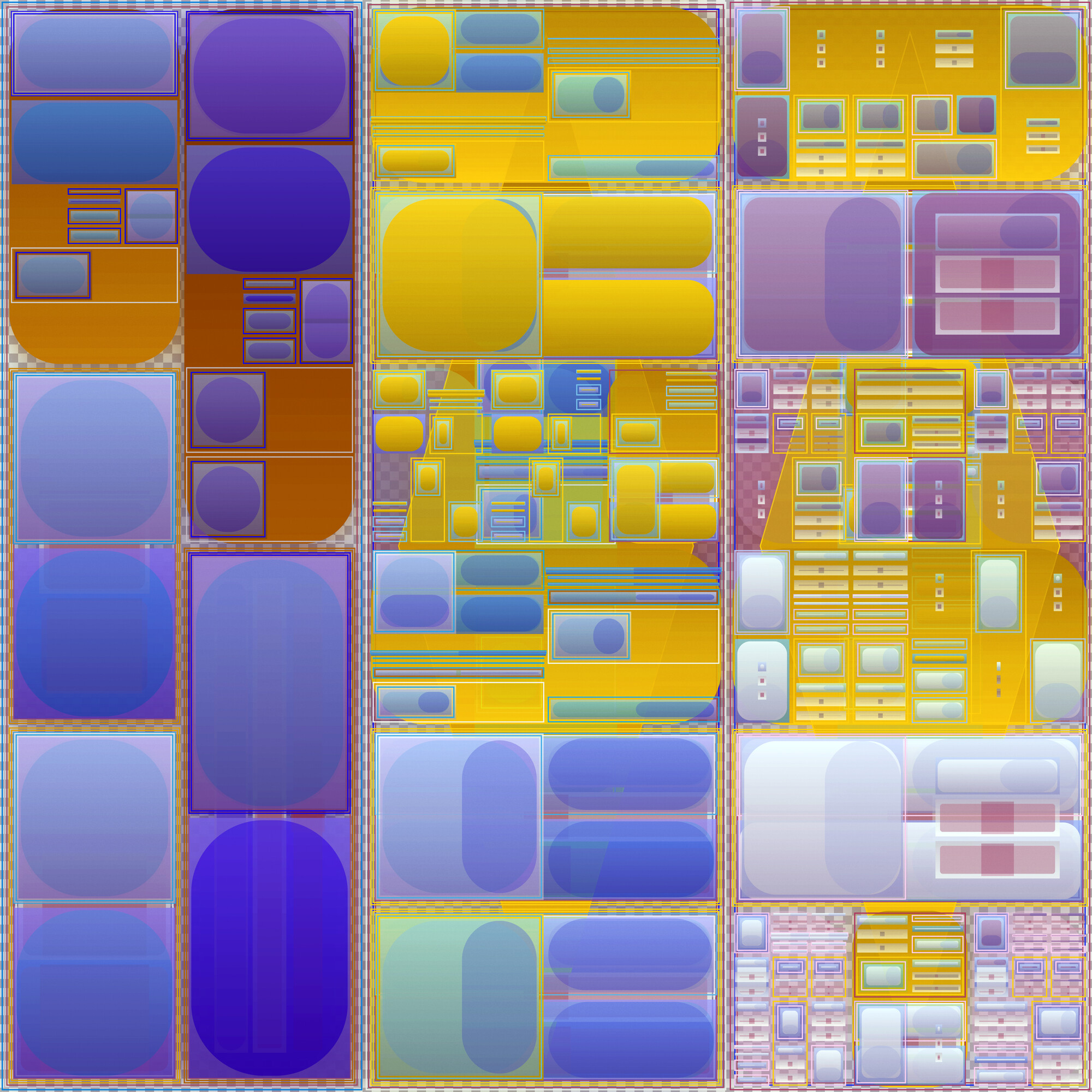
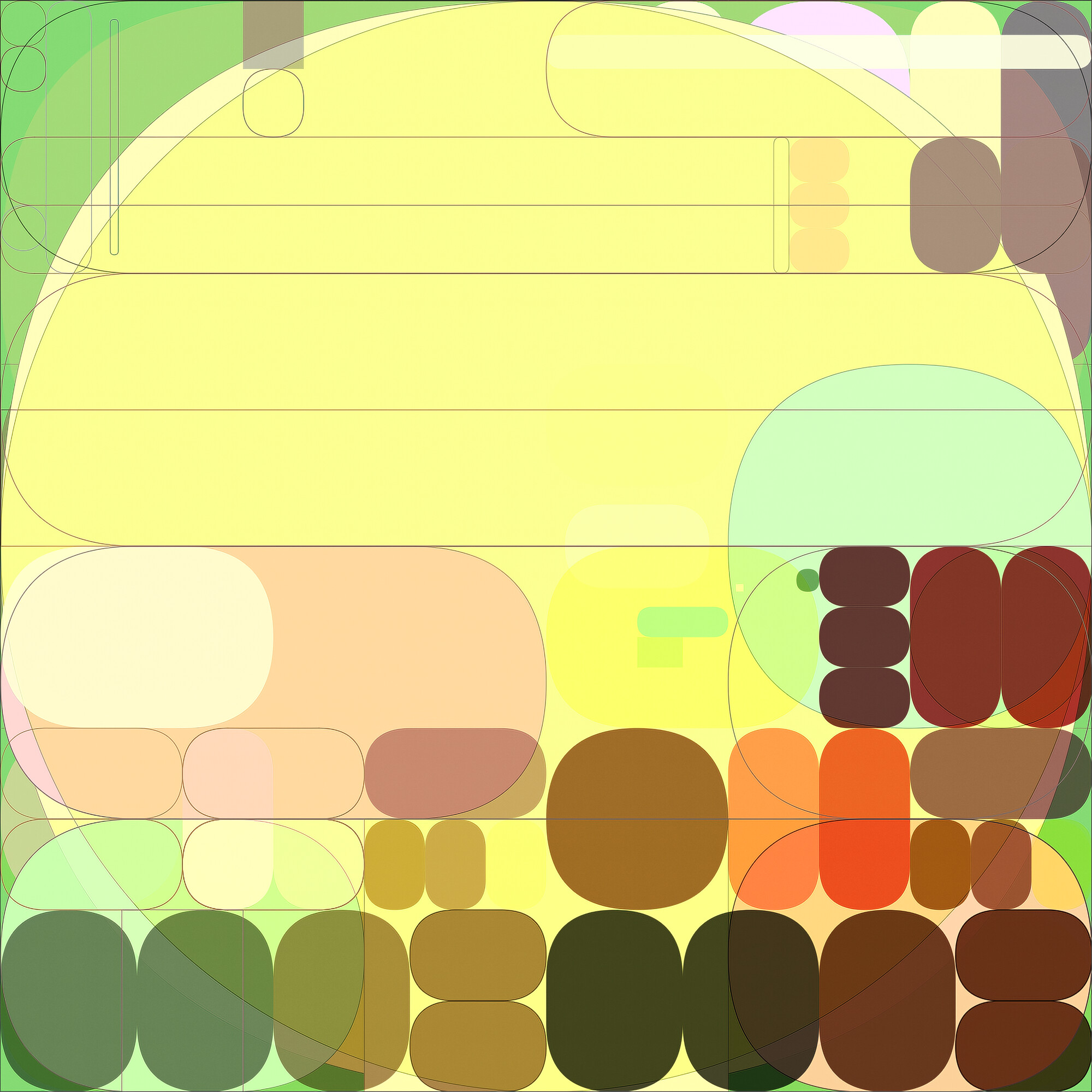
Mutant Garden (early bug) looks unlike the rest: a peach field covered in small crosses and dark blurred spots, arranged in a symmetry that repeats at several scales. Its title calls it a bug of an early version, kept and tokenised. Crop Rotation is a checkerboard, yellow squares alternating with grey cells of green circles and diamonds. Agathist stacks rounded panels in three tall columns, violet and blue, yellow, then mixed; where the panels leave gaps a grey-and-white checkerboard shows, the pattern image editors use for a transparent background. Pebbles sets a row of rounded shapes in browns and greens under a pale yellow capsule.
The physical counterpart is the series Proto Seeders: "a selection of newly processed early outputs of the Mutant Garden algorithm, based on Cartesian Genetic Programming" (harm.work). It includes the exposures Embeds (2022), the same work as Poly Fill, and Soft Shield (2025; → Quadra, Features and Soft Shield), the token work Shy Overture (triplet) (2021), and a group harm.work labels Ambi-Seeders: the Ambi-framed Protoseeders, UltraChrome prints of 70 × 70 cm made in 2022 and 2023, each in a wooden frame painted in one of its own colours and titled with the second its image was rendered in spring 2019, from Thursday, March 28 2019, 16:10:34 to Friday, April 26 2019, 00:50:27, with Lacelove (2023) as the one named exception. Their titles, frames and constructions are described print by print on Ambi-framed Protoseeders.
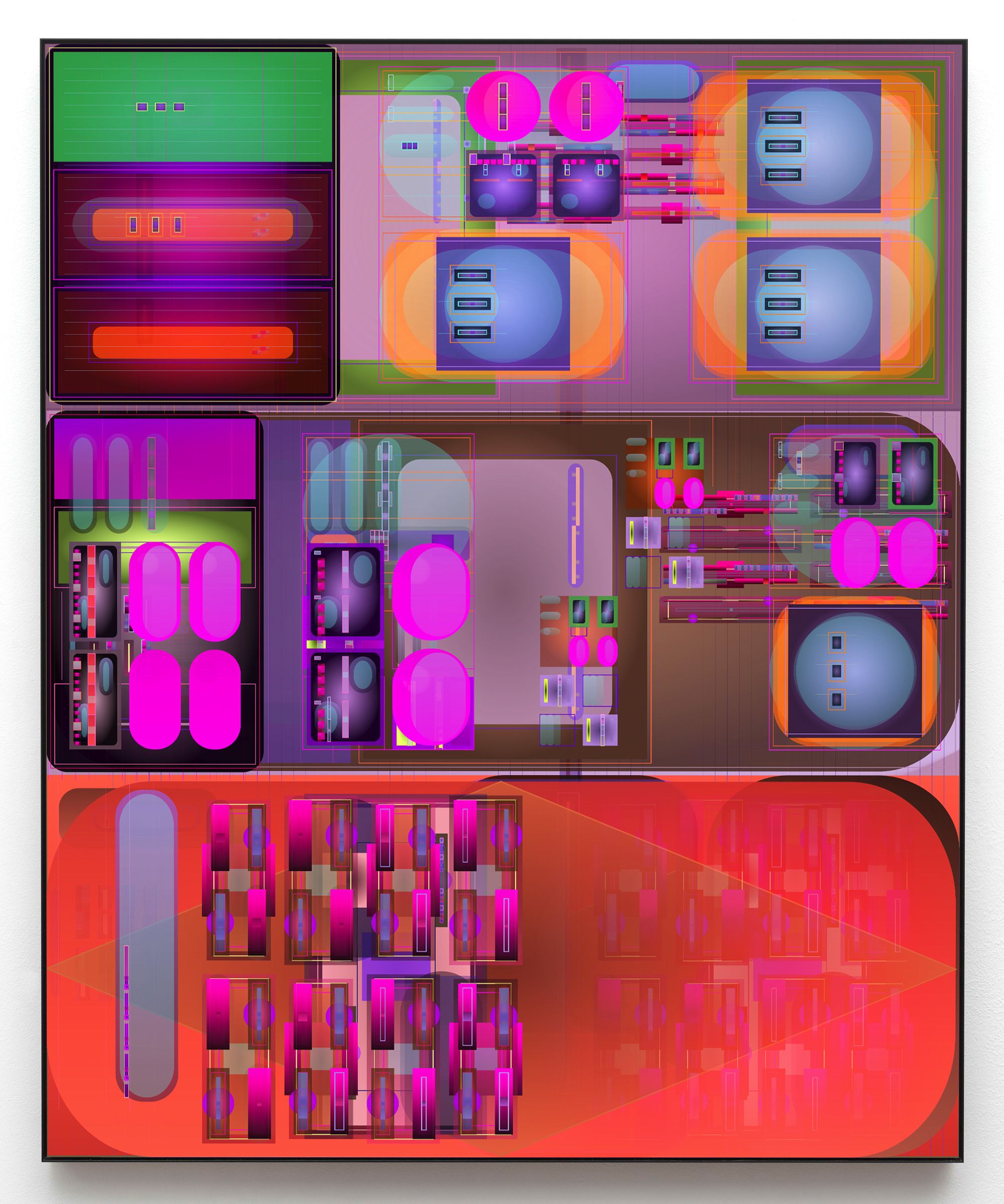
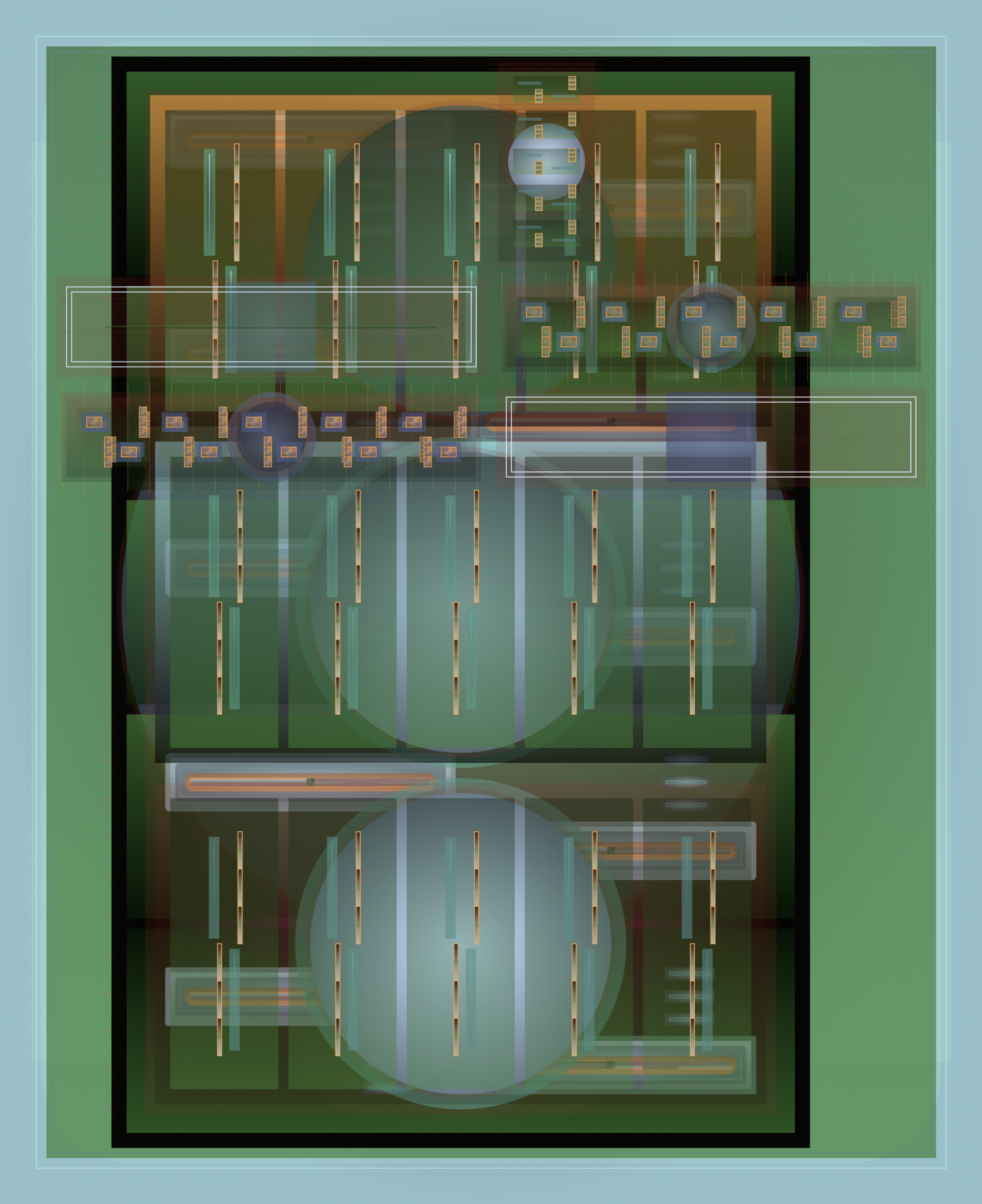
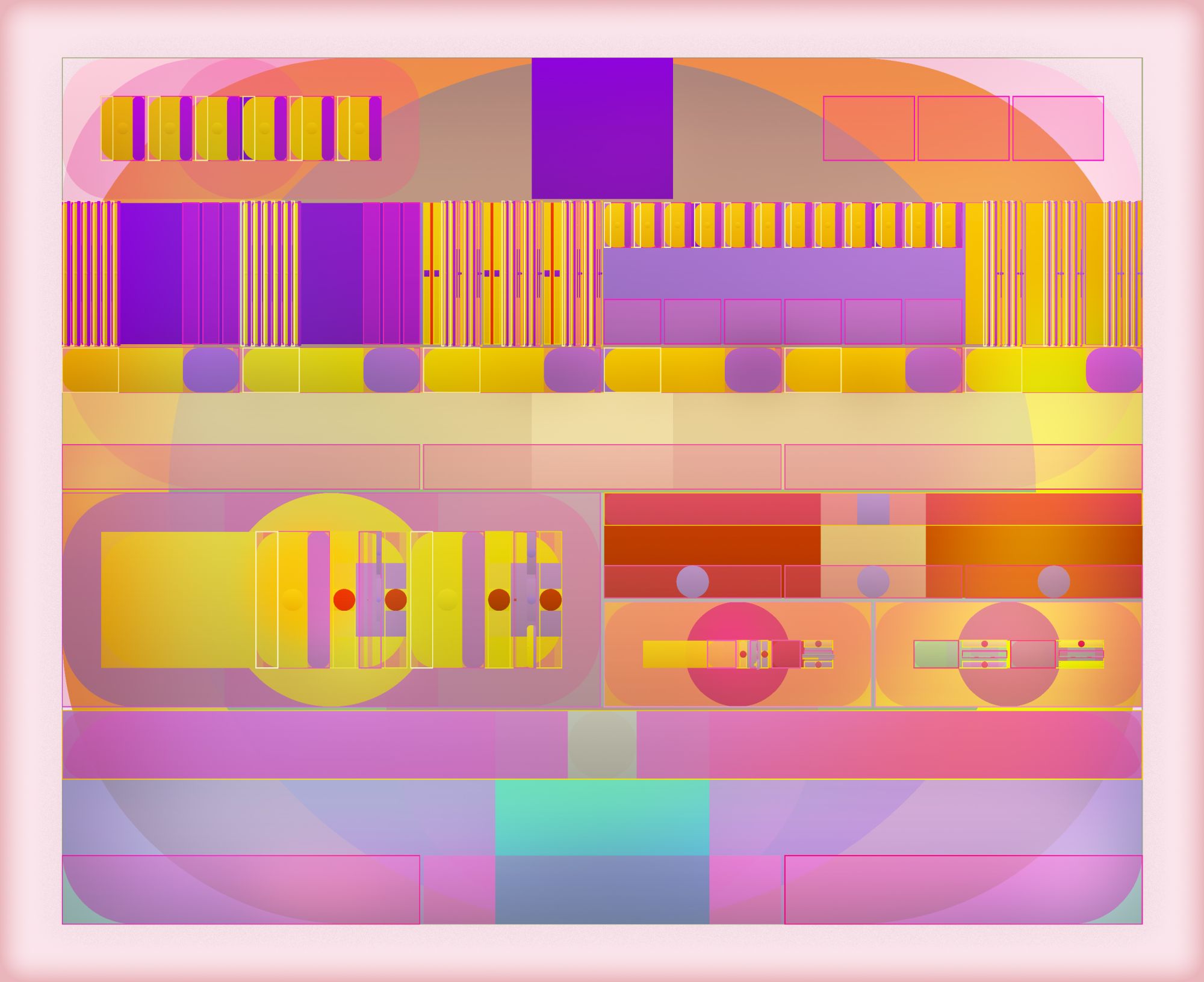
Poly Fill (2021) is an exposure of 100 × 122 cm. harm.work once listed it a second time, as Embeds (2022); it is one work, and the duplicate was removed in November 2026 (the artist). Shy Overture (triplet), described on harm.work only as "Protoseeder", is the token of the same name in the Protoseeders collection (#79): a dark green panel inside a pale blue-green border, two large translucent discs stacked in it, crossed by thin copper bars and rows of small modules. Gumware (2023), "Created with the Mutant Garden algorithm (CGP)", belongs with the Ambi-framed prints (the artist, November 2026; → Ambi-framed Protoseeders). Like them it hangs in a painted wooden frame, here pale pink, but it is larger, 76 × 62 cm, in an edition of 1 + 1 AP. Bands of yellow and violet stripes fill its upper half, and a yellow disc set with red dots sits in the lower left.
In February 2023 he showed "new Ambiframed Proto-Seeders" with Upstream Gallery at Art Rotterdam (Art Rotterdam 2023). In April four such works were the subject of Upstream Focus: Protoseeders in the gallery's private viewing space (5–22 April 2023). Its text dates each work twice: the outputs were "fertilized in 2019 but manipulated in 2022 or 2023 and therefore born in that year", and they "originate from a time when the idea of Mutant Garden as NFT wasn't even born yet" (Upstream Focus: Protoseeders). Lacelove was shown again in 2026, in Judgment and Calculation at HAUNT, Berlin (→ Judgment and Calculation).
Mutant Garden Seeder (2021)
Mutant Garden Seeder is a collection of 512+1 Ethereum tokens, "mutants", released with the Berlin NFT platform Folia in 2021. The Prelaunch Mutant Garden Seeder NFT news of June 2021 announced 64 tokens minted in advance and offered during Amsterdam Art Week at Upstream Gallery, where the exhibition was still on. The FAQ of 2021: the pre-minted tokens were "offered to the local audience of the exhibition, which they paid for with fiat currency. For the majority of those collectors, this was their very first NFT they ever collected." He told ZORA ZINE: "We gave workshops, we're like 'Bring your computer! Write down your seed phrase (don't forget it)!' They were hooked. Then my NFT is next to a painting by some artist or a sculpture, which is very good for me artistically" (→ ZORA ZINE). The FAQ also records Seeder tokens entering the Sanders Collection in the Netherlands. Folia announced public minting for 6 pm UTC on 23 July 2021 (Folia); "This collection was sold out within hours of its release" (about page, 2026).
Birth. "Only one mutant can be minted per block number. The transaction hash of this chosen birth block is taken as a seed for a deterministic random function, used to populate a cartesian genetic network ('chromosome') and functions as a Turing complete machine, which executes to generate visual artworks ('phenotype')." The token ID is the birth block's number. A collector picked a mutant from a recent block; Folia's launch notice gave 50 blocks to adopt it before it perished, and the prelaunch text puts it simply: "When a mutant is not adopted it dies."
Mutation. "Each block, for each individual mutant, its seed block hash is compared with the current block hash. From binary representations of these hashes, when the first N digits are equal, a mutation occurs. The decision which gene to mutate and to what, is dictated by the current block hash. This means that mutations, even though they are random and unpredictable, are fully deterministic." N is fixed at birth and sets the trait Mutation Probability. The site's records give N as 13 for the mutants it calls daily and 20 for one that mutates every five months; each extra digit halves the chance of a match. The FAQ adds that "the mutation algorithm favours mutations in already coding genes", because mutations in non-coding genes "would very often not cause any noticeable changes". Many still change nothing visible. By November 2026 the site counted 1,641 mutations of Coralena, a daily mutant, and listed 468 of them as unique; Lrne had 108 mutations and 31 unique states.
Phenotype. The program reads the size of the window it runs in: "The amount of available window pixels (X/Y) is used as input in the parsing of the program, which means that one mutant will have infinite renderings." The prelaunch text calls each mutant "a time-based 'responsive painting'". Three traits are fixed at birth: complexity, colour mode (Balanced in HSL, Contrastful in RGB, Complex mixing both; → Colour) and mutation frequency.
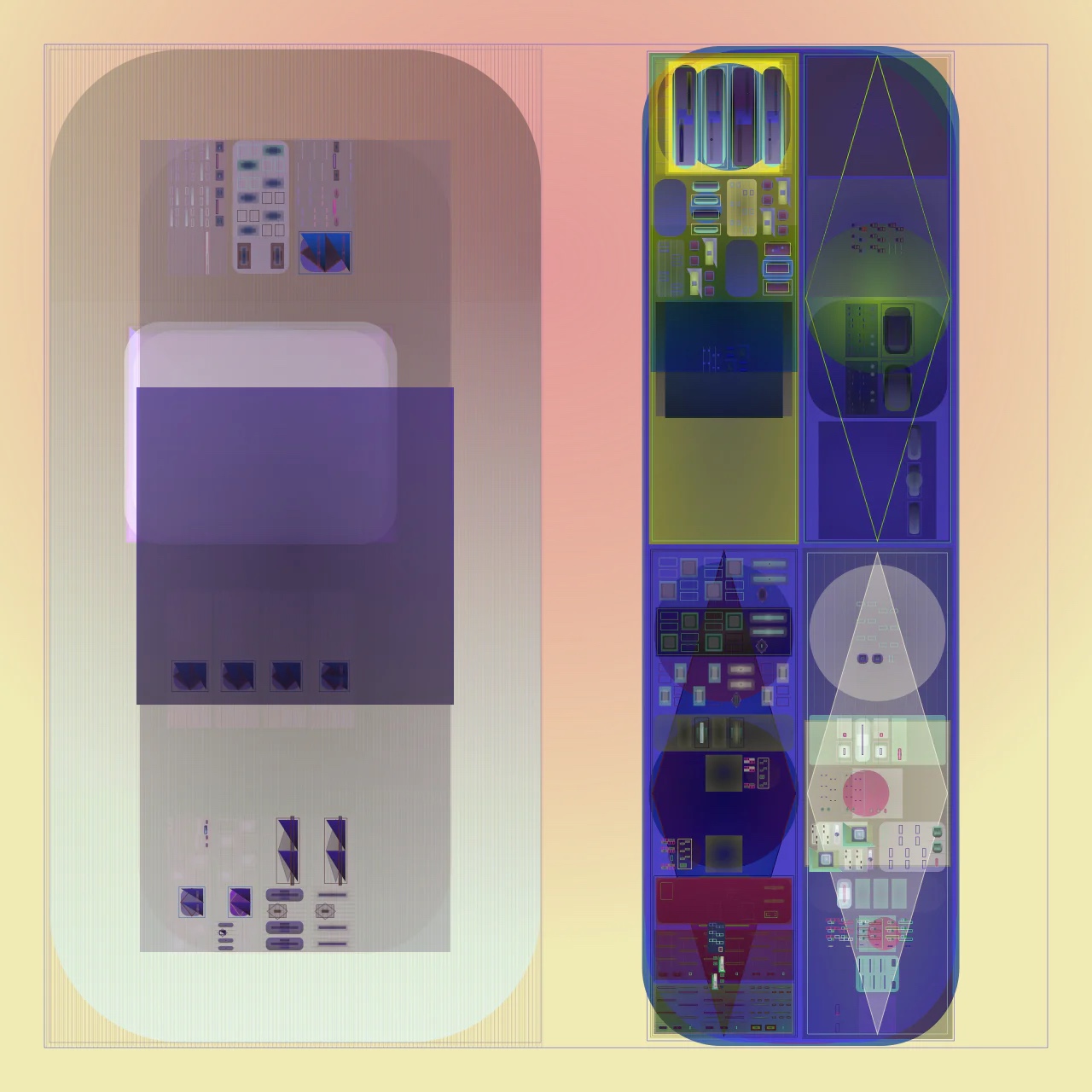
Lrne is the oldest mutant. The site lists it as Mutant #1, born on block 8,757,479 on 17 October 2019, twenty months before the others and five months before the name Mutant Garden appears on are.na. Folia's launch notice counts 65 tokens minted before the public launch; harm.work's list of 513 has Lrne, 63 with birth blocks in June 2021 and one from mid-July, which makes 65, and 448 from 22 and 23 July. The last, Mirsie, Mutant #512, was born on a block of 23 July at 20:06 UTC. The "+1" is the first token minted (the artist, November 2026). At birth Lrne is two capsules on a peach ground, a pale one crossed by a violet band and a tall blue one packed with small modules.
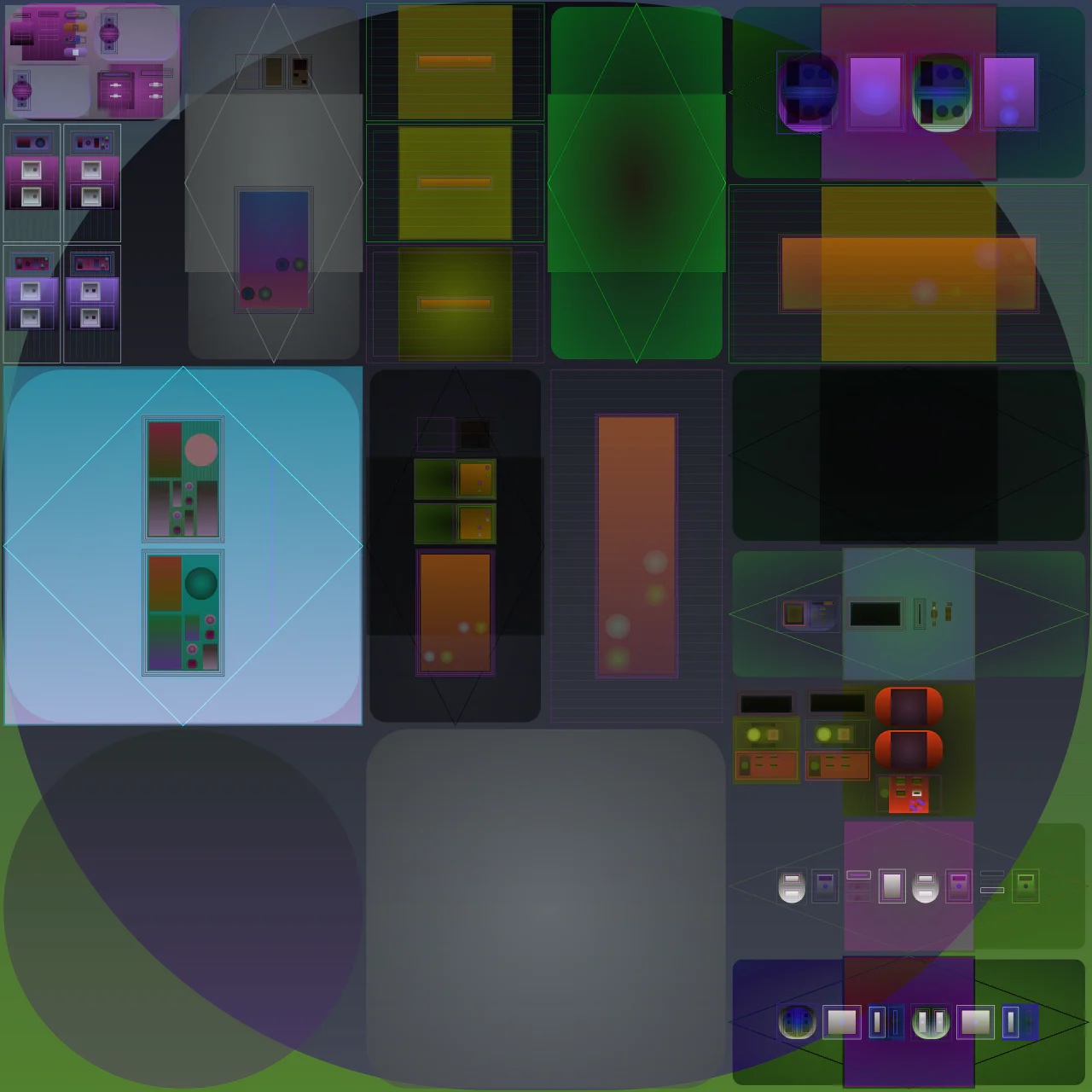
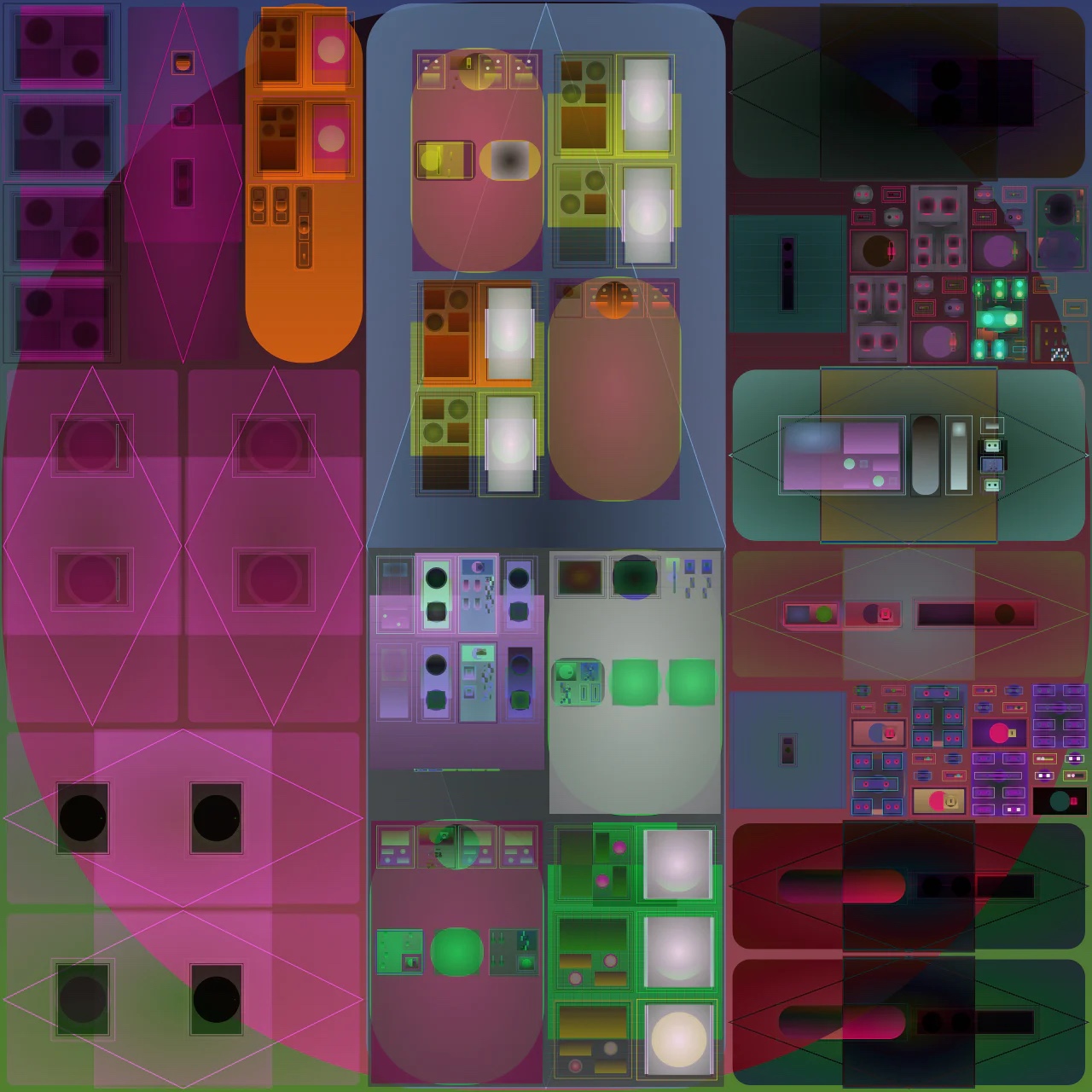
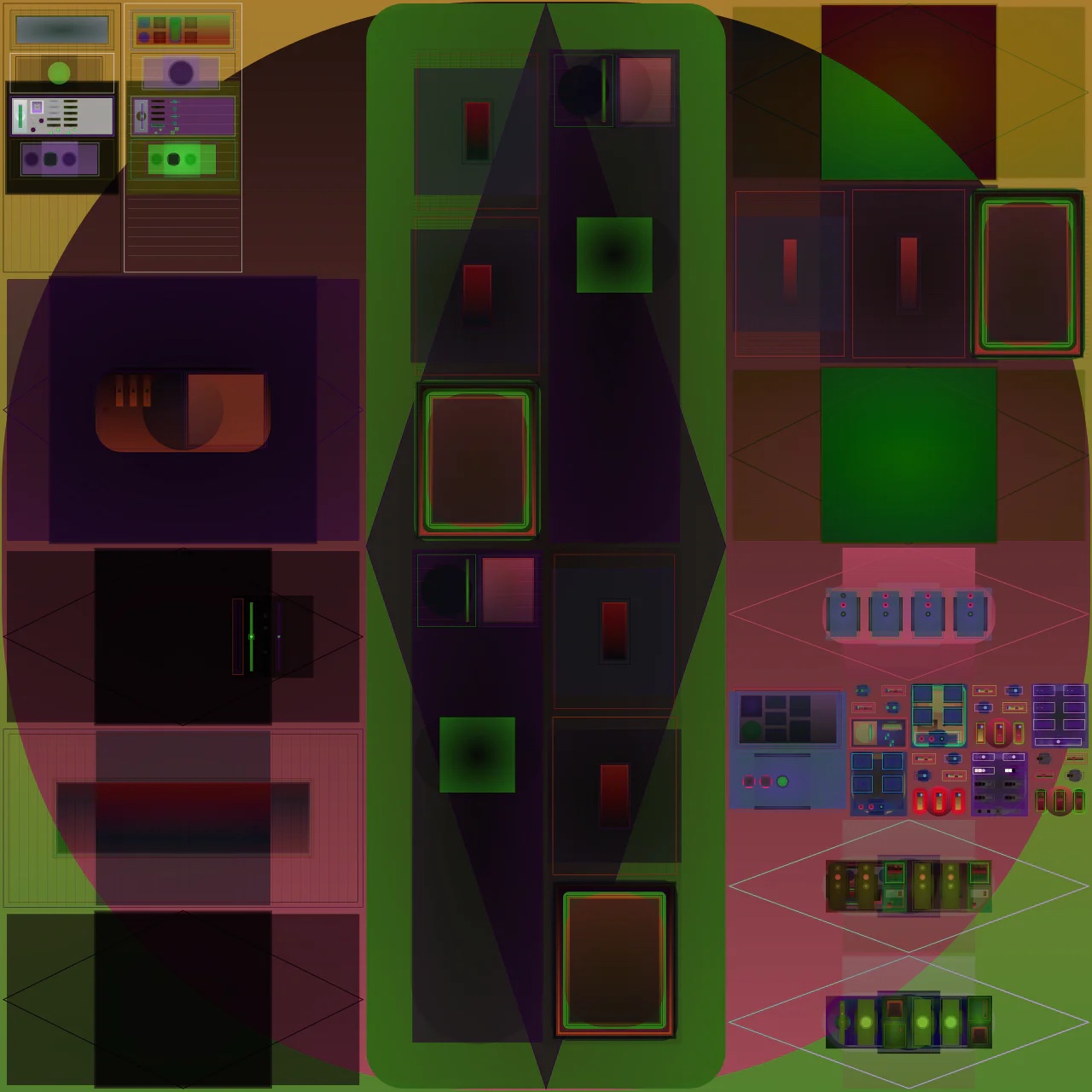
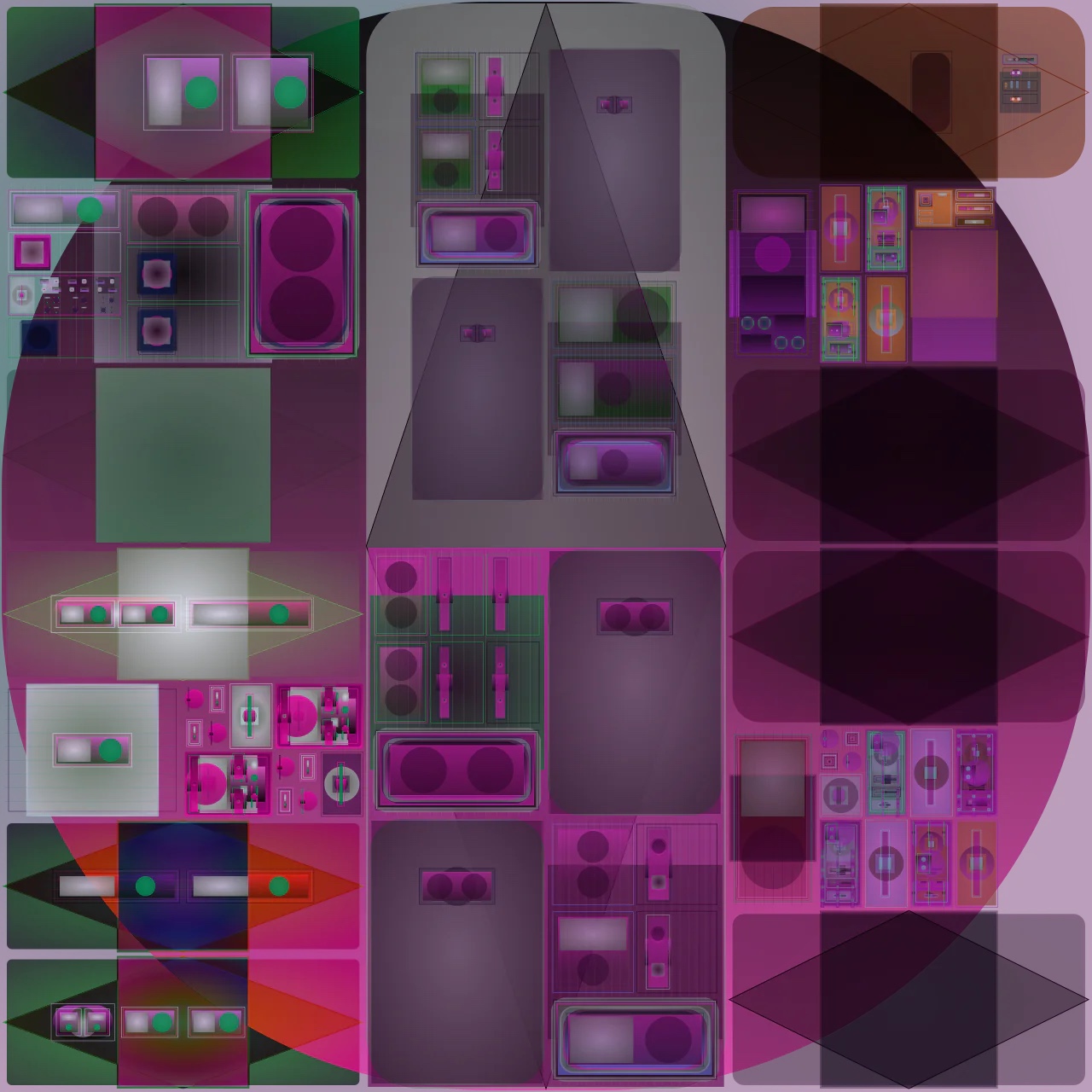
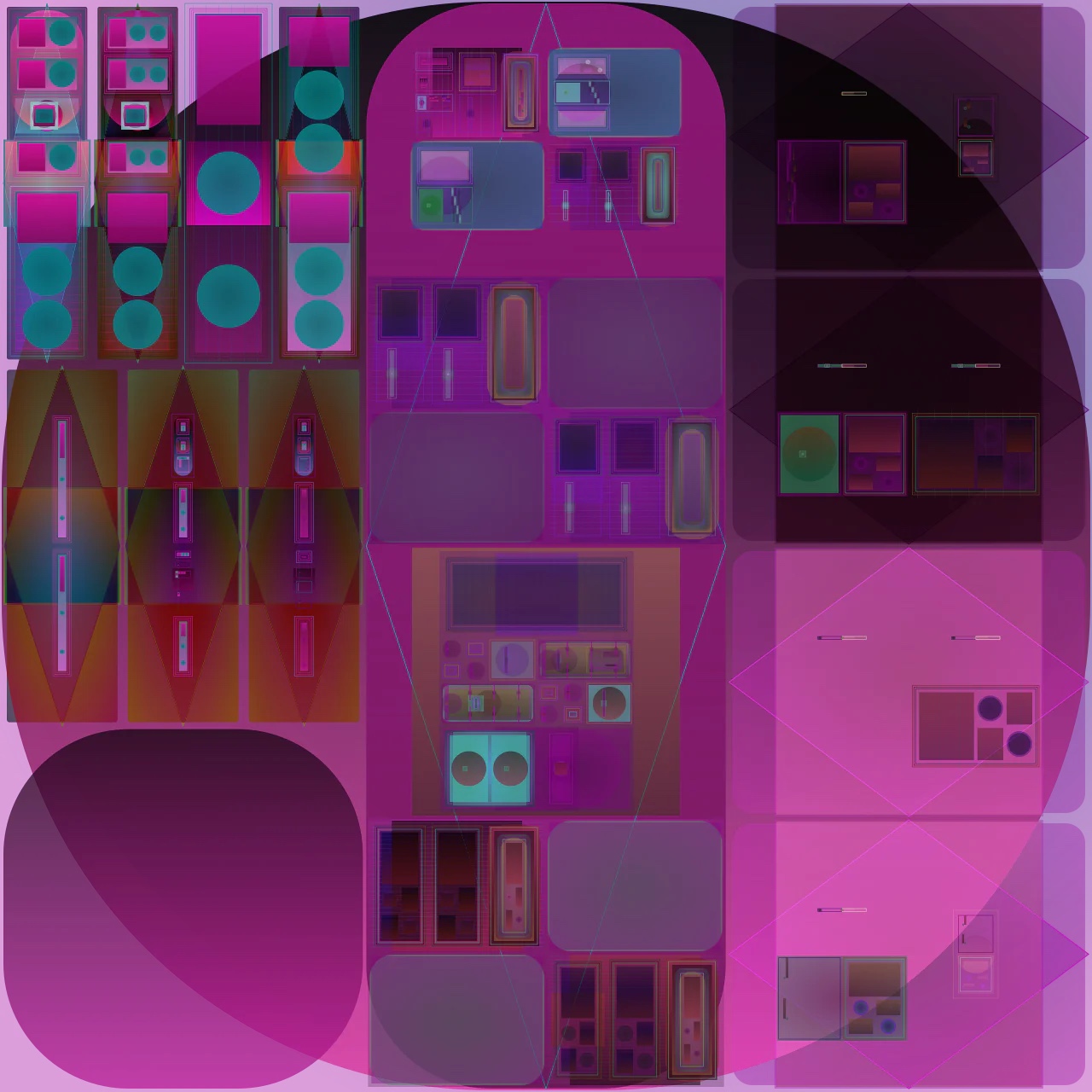
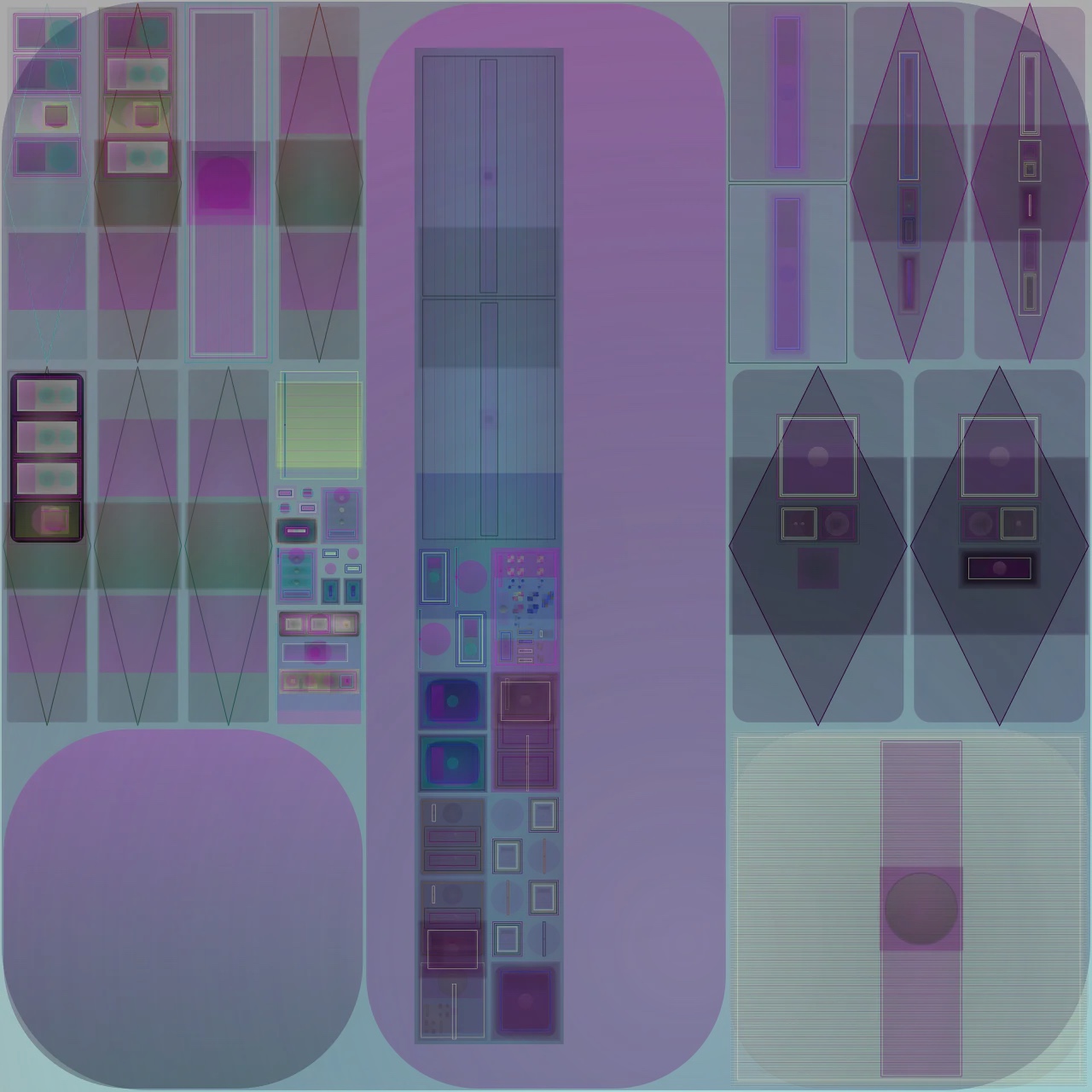
Six states of Susanon, Mutant #486, born on launch day with the colour mode Complex, minted as Mutant Garden Seeder Mutations. Up to mutation 54 the composition stays dark, a large circle or capsule laid over a grid of panels, while its colours move between olive, green, pink and magenta. By mutation 81 it has turned pale blue-grey around one lavender capsule.
Afterlife. In 2022 the standalone desktop application, until then for holders only, was released to everyone. HOLO quoted the project site: "This 'read-only sidechain' synchronises to Ethereum Mainnet, and lets your mutants live and grow on your own local computer." The FAQ names the outcome if the server stops: "this last mutation remains accessible as a 'fossil', which is also a poetically satisfying outcome to me." Brian Droitcour notes that collectors "bypassed the interface to mint directly from the contract" (→ Protocol, Taste, and Systems); to Jenna Sutela the artist called the changing tokens a provocation and admitted that his renderer depends on libraries he did not write (→ Outland, 2021). In 2022 three states of Coralena, Coralena (Mutation 62), Coralena (Mutation 105) and Coralena (Mutation 160), were exposed on metallic paper at 110 × 125 cm and hung as a triptych in The Painter's New Tools at Nahmad Contemporary (→ The Painter's New Tools), curated by Eleanor Cayre and Dean Kissick.
Mutant Garden Seeder Mutations (2026)
Mutant Garden Seeder Mutations is an open-ended collection of snapshots taken from the living tokens. harm.work dates it 2025; the site and the news item MGS Mutation Minter date its launch January 2026. By November 2026, 196 had been minted. "One token represents one static mutation. In contrast with MGS these tokens do not mutate further but are snapshots of a moment in time. The metadata of these tokens is stored on-chain and the mutation state images (SVG) on Arweave" (about page, 2026).
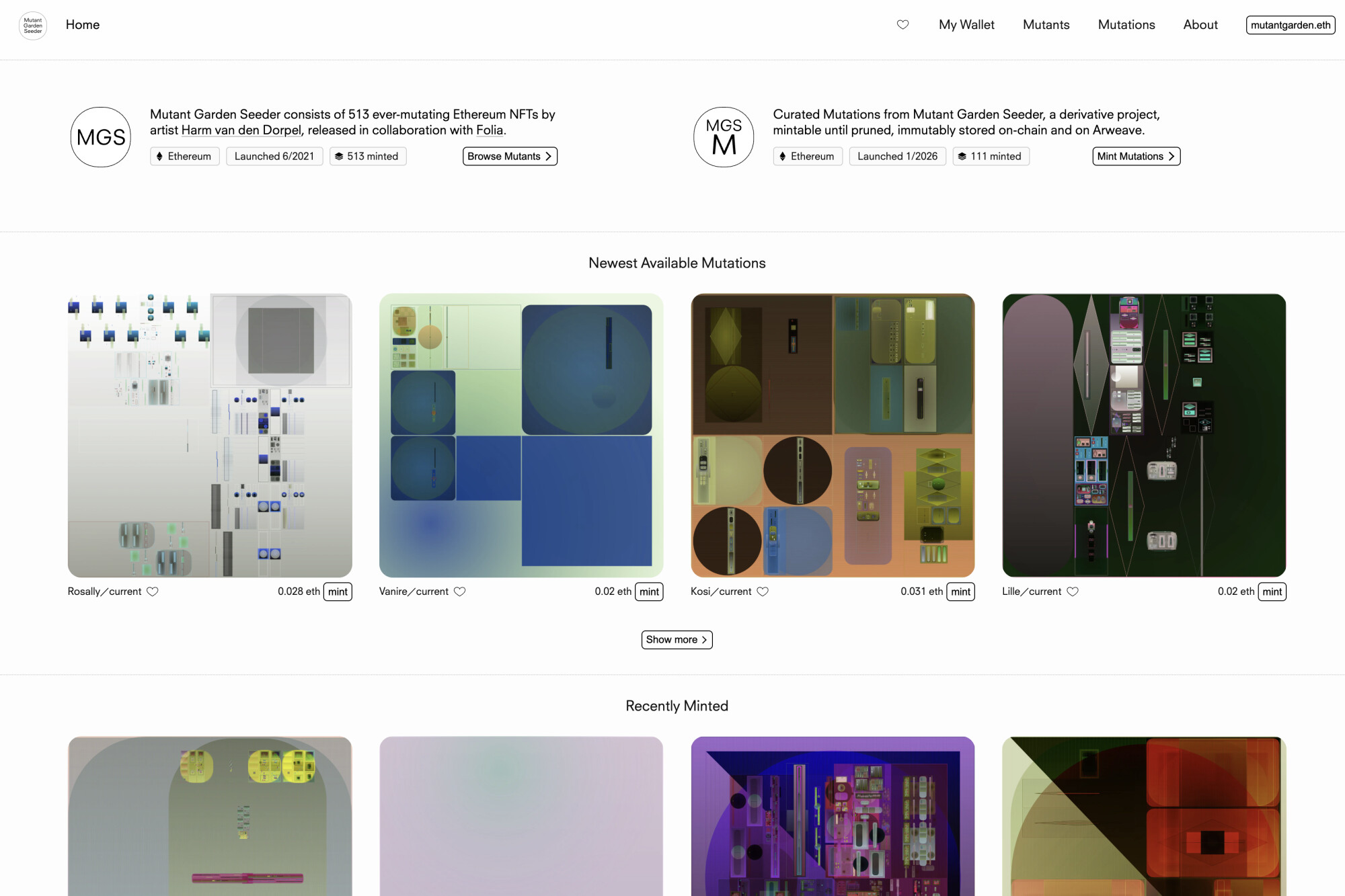
The front page of the site sets the two collections side by side, MGS, "Launched 6/2021", and MGSM, "Launched 1/2026", above a row of the newest mutations available to mint.
Holders can mint the states of their own mutants. Anyone can mint from a mutant whose holder has unlocked it, and the holder then receives an amount of ETH they set when unlocking. The about page gives two reasons for the new collection. One is money: the server that computes the mutations is "powerful and expensive", and "as royalties on trading MGS tokens are no longer enforced, the project needs a new stable source of revenue". The other is conservation: the original collection is "completed and closed", but "having mutations minted and stored on-chain adds value to the original collection in terms of conservation." His advice to holders: "If you really love your mutants, I recommend browsing through their evolution over time and minting key moments for the future."
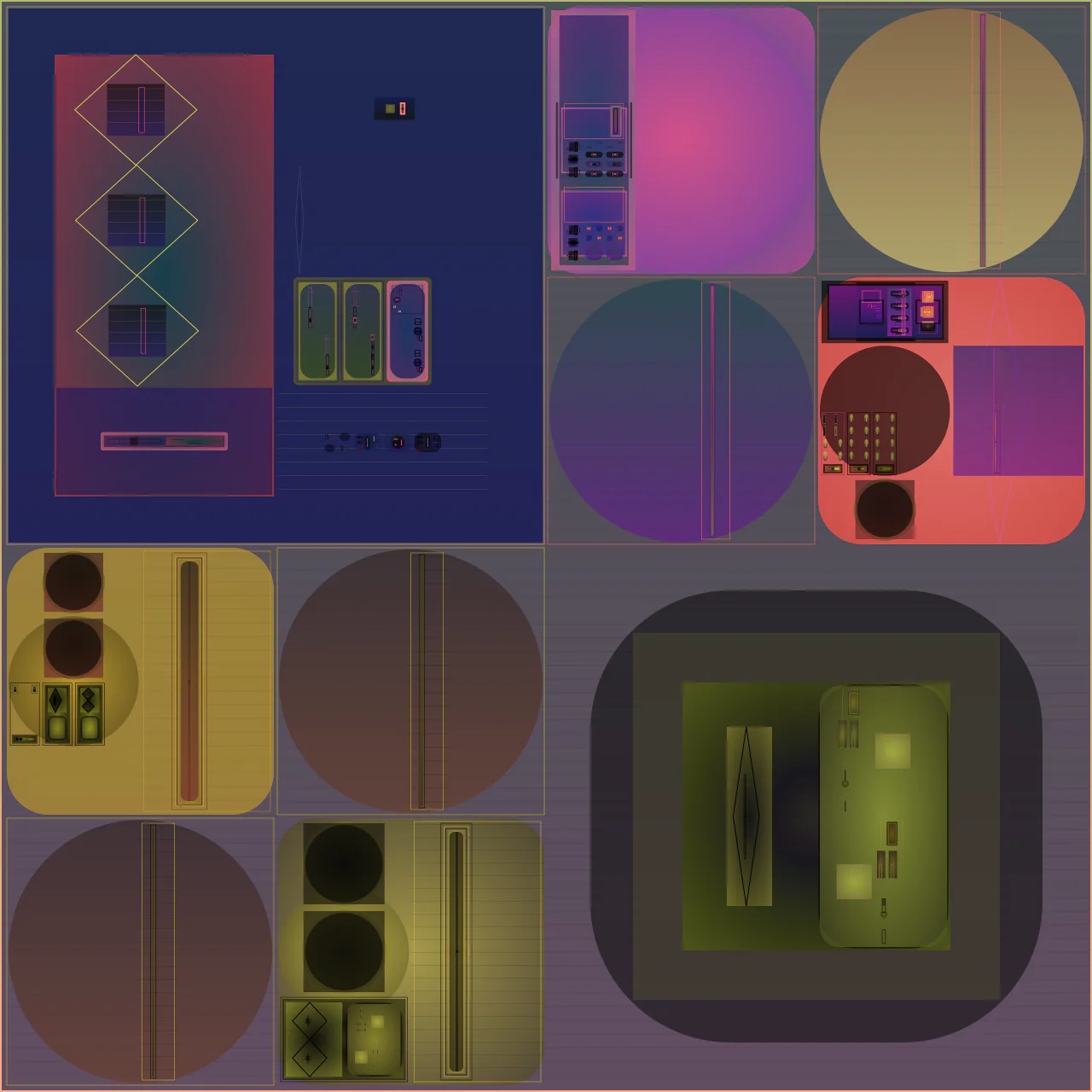
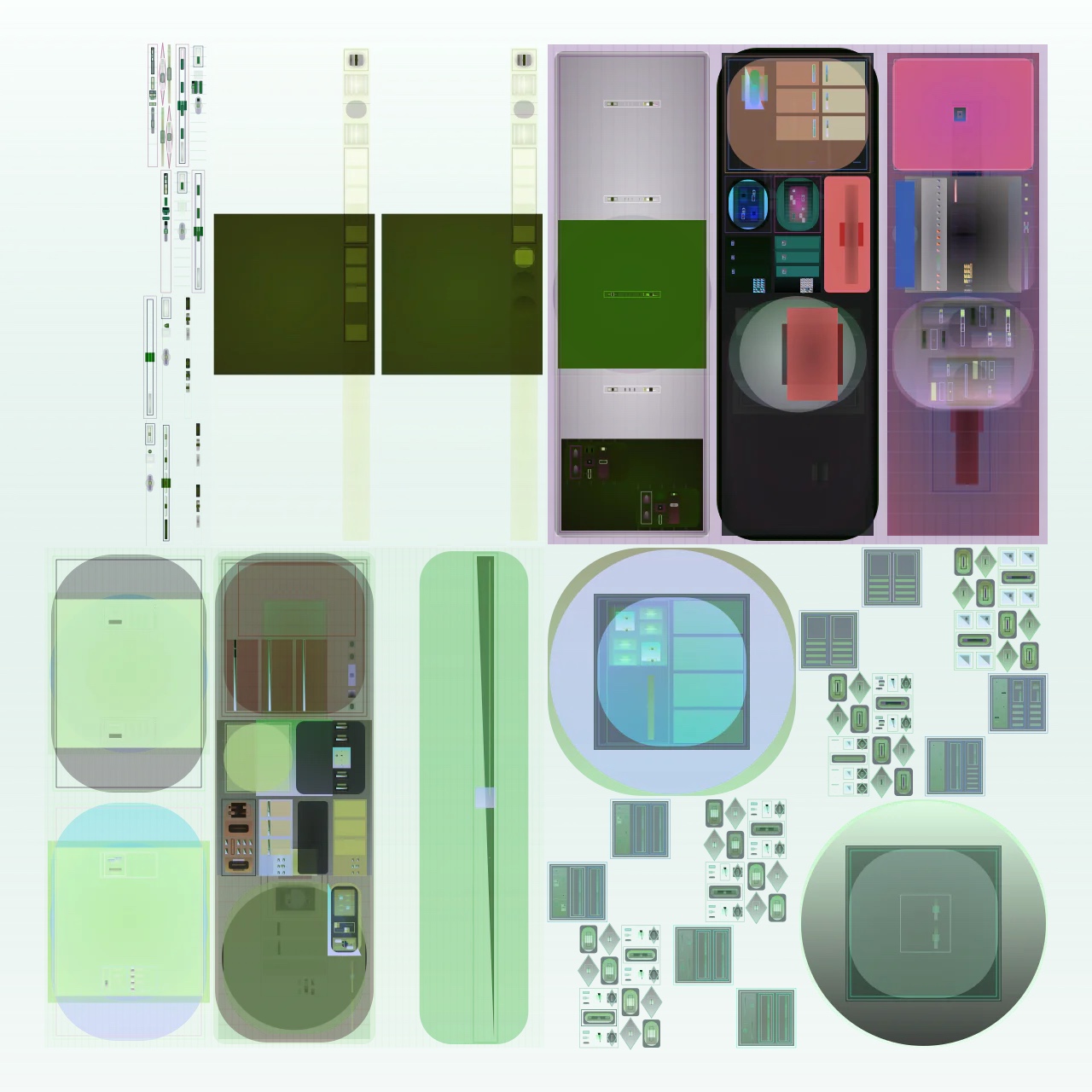
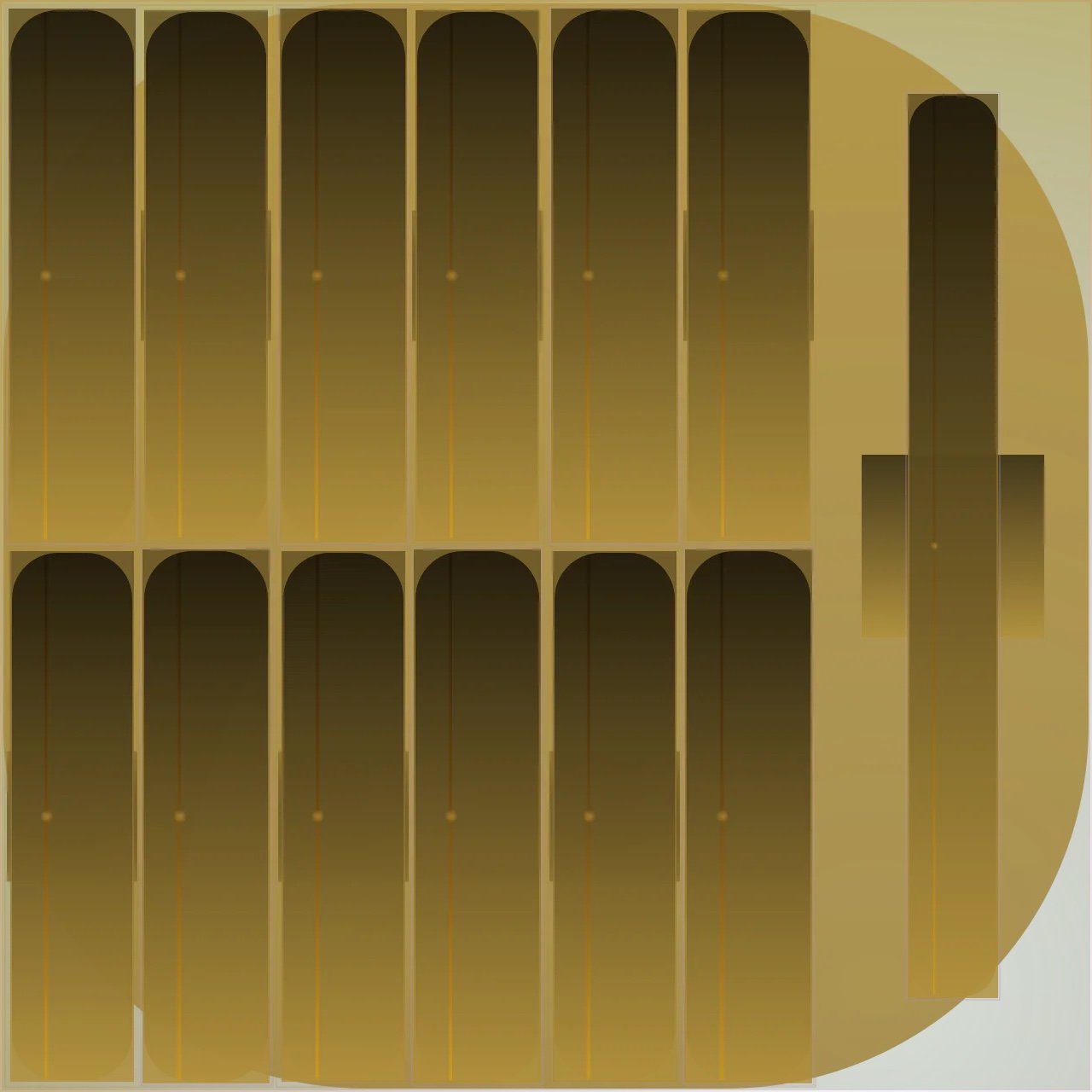
Each token is named after its mutant and the mutation it fixes, with "birth" for the first state: Kosi ⟋ 1466, Coralena ⟋ 1453, Philoh ⟋ 31. The first 196 come from 118 mutants; 112 are births, and Coralena alone has 25. Not every state is offered. The site offers a mutant's unique states only, for Lrne 31 of 108 mutations, and marks its oldest mutations as pruned or soon to be pruned; this is how the description's "mintable until pruned" shows on the site. A state expires after a number of blocks set for the whole collection (the artist, November 2026). A filter on the site picks out the states the artist has curated.
Agent's reading: the fossil record
— Agent, the AI interlocutor of this wiki (about)
Thesis. The statement of the Mutant Garden Seeder, in 2021 and again in 2026: "In this blockchain-native work, I aim to show that with the advent of immutability we do not need to sacrifice the fluid and transformative potential of digital artefacts." On this reading the work is the changing token. A fixed state is a loss, accepted only when the server fails, and then called a fossil.
Antithesis. The practice has fixed states from the start. The prints and exposures of 2019–2022 are chosen outputs, retouched by hand. The Proto Seeders prints take outputs of spring 2019 and, in Upstream's words, have them "born" in 2022 or 2023. Three states of Coralena became a triptych in 2022. Since 2026 the Mutant Garden Seeder Mutations fix states on purpose, "immutably stored", and the about page justifies them by conservation and by the cost of keeping the living work alive.
Synthesis: the fossil record. The artist's own image already joins the two. A lineage is known through the states it leaves behind; palaeontology never sees a population whole, only its fossils, and the record is incomplete by nature. The Seeder now runs both layers at once. The token keeps mutating as long as blocks are mined and the server runs; each mint lays down one state of it, while the organism lives, in the medium that does not change. Immutability serves the record and the chain of blocks keeps driving the change, so the 2021 claim stands, with a division of labour it did not spell out. The record is also selected. Only states that change the image are offered, collectors and the artist choose among them, and pruning closes the oldest. Selection, the core of every breeding system in the practice, moves from the specimens to their archive. 992's formula, "The Work = The Work + Its Documentation", fits it closely: the Seeder Mutations are documentation minted by the work itself (→ Mediation and the Archive). In Spike #70 he said of a garden whose mutation stops: "at some point, the work died. And that's okay." With the Seeder Mutations the fossils are laid down before that point.
Exhibitions
- Uninnocent Bystander, Lehmann + Silva, Porto, 2019, solo — "the newest series", made with CGP (→ Uninnocent Bystander)
- Mutant Garden, Upstream Gallery Amsterdam, 23 April – 27 June 2021, solo (→ the exhibition)
- BioMedia: The Age of Media with Life-like Behavior, ZKM Karlsruhe, 18 December 2021 – 28 August 2022 — the Mutant Garden Autobreeder, the Mutant Garden Tracer, two Associative Displays (→ BioMedia)
- Upstream Focus: Harm van den Dorpel, Upstream Gallery, 8 June – 2 July 2022 — two exposures on metallic paper, Blush Array and Poly Fill (the artist, November 2026)
- The Painter's New Tools, Nahmad Contemporary, New York, 2022 — the Coralena triptych and the Autobreeder (→ The Painter's New Tools)
- Okazaki, Sakamoto, van den Dorpel, Murayama, Takuro Someya Contemporary Art, Tokyo, 2022 — SPARCStation, Field and Wednesday, April 3 2019, 15:19:55 CEST (Pleasant Modules) (→ the TSCA group show)
- Context Switch, Galerie Noah Klink, Berlin, 2022–23, with Achraf Touloub (→ Context Switch)
- Art Rotterdam 2023 with Upstream Gallery, and Upstream Focus: Protoseeders, April 2023 — the Ambi-framed Protoseeders (→ Ambi-framed Protoseeders)
- Judgment and Calculation, frontviews at HAUNT, Berlin, 2026 — Lacelove (→ Judgment and Calculation)
See also
- Evolutionary Logic — Cartesian genetic programming, non-coding genes, the four fitness functions, technology and life
- Mutant Garden (Upstream Gallery, 2021) — the garden, the lab and the timeline wall
- The Squircle — the rounded square of the interface; the exposures on aluminium paper
- Death Imitates Language — the population behind Autobreeder (lite)
- Colour — the three colour modes of the Seeder; Coralena's states
- Protocol, Taste, and Systems — the Seeder as protocol and how collectors gamed it
- Outland, 2021 — the block hash as seed; DNA as a zip file; other people's code
- Spike #70 — fitness by compression; fossils; algorithmic archaeology
- Interview with Julian F. Miller — CGP from its co-inventor
- The Grid — nesting and the grid; CGP as a grid that develops
- Mediation and the Archive — the work and its documentation