
Okazaki, Sakamoto, van den Dorpel, Murayama — Takuro Someya Contemporary Art, Tokyo, 2022
Group exhibition, 16 July – 10 September 2022, TSCA, TERRADA Art Complex, Higashi-Shinagawa, Tokyo; in cooperation with Upstream Gallery. Exhibition page: harm.work/exhibition/okazaki-sakamoto-van-den-dorpel-murayama; the gallery's text and profiles in English and Japanese: sources/ingested/tsca-group-exhibition-2022.md. Photographs: Shu Nakagawa.
The exhibition
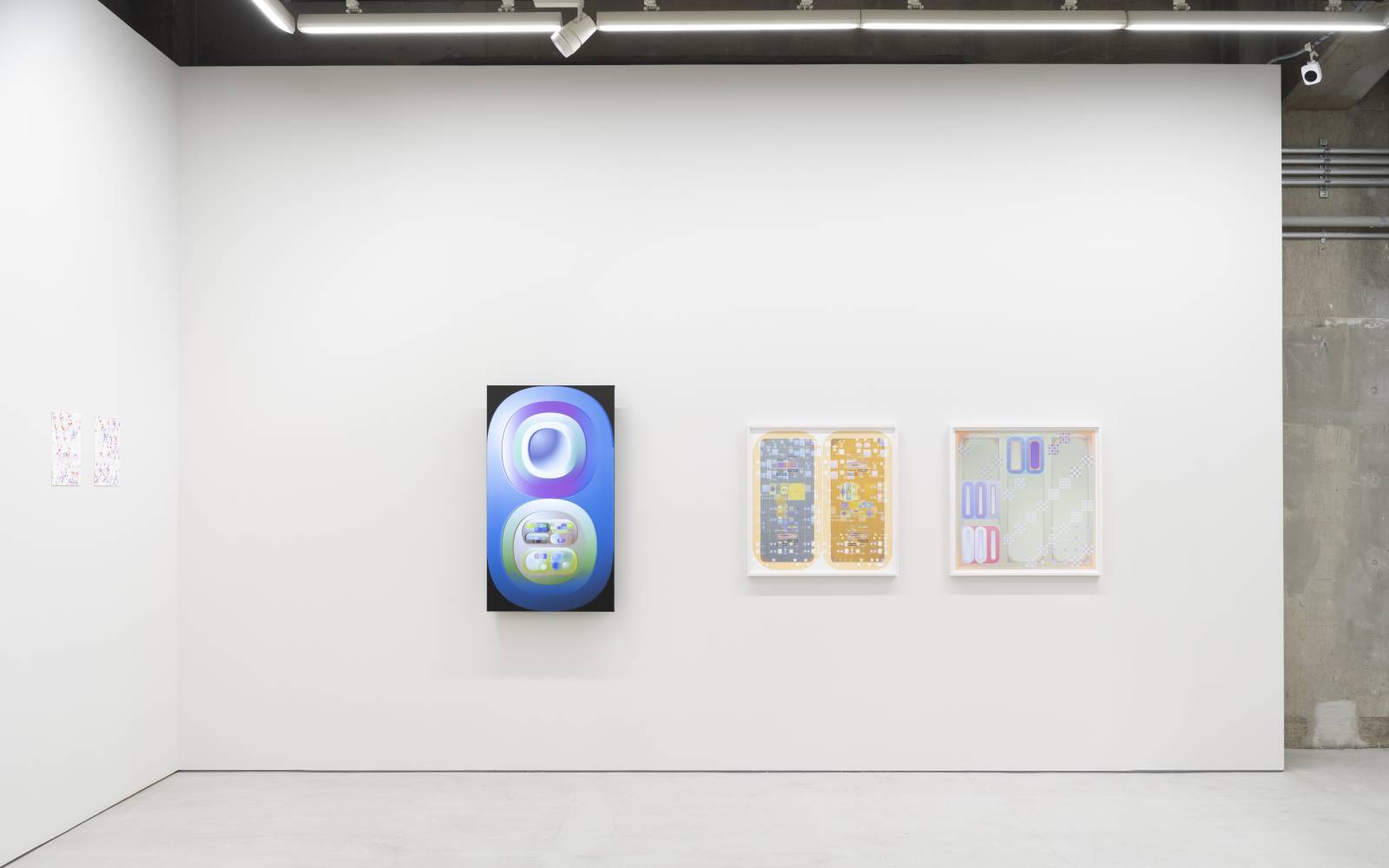
Okazaki, Sakamoto, van den Dorpel, Murayama put four artists in the gallery's space in the TERRADA Art Complex in Higashi-Shinagawa. Takuro Someya curated it. The gallery's text is short: "This group exhibition presents an opportunity to consider the natural process of artistic production in which there are no distinctions between the virtual and the real. The abstract is conceptualized not merely as an expressive form but rather primarily as an omnipresent element of nature that exists irregardless of human perception."
The four:
- Kenjiro Okazaki, painter, sculptor, landscape architect and critic, with two paintings: an early work from his Zero Thumbnail series and one from TOPICA PICTUS, made in 2020 "during the early days of the pandemic".
- Chinoko Sakamoto, who studied in London and works in Nagasaki prefecture, with hand-built ceramics "at the largest scale she has worked in thus far". In the photographs these are a tall white column with bulging, pitted sides and smaller stepped brown towers on mirrored bases.
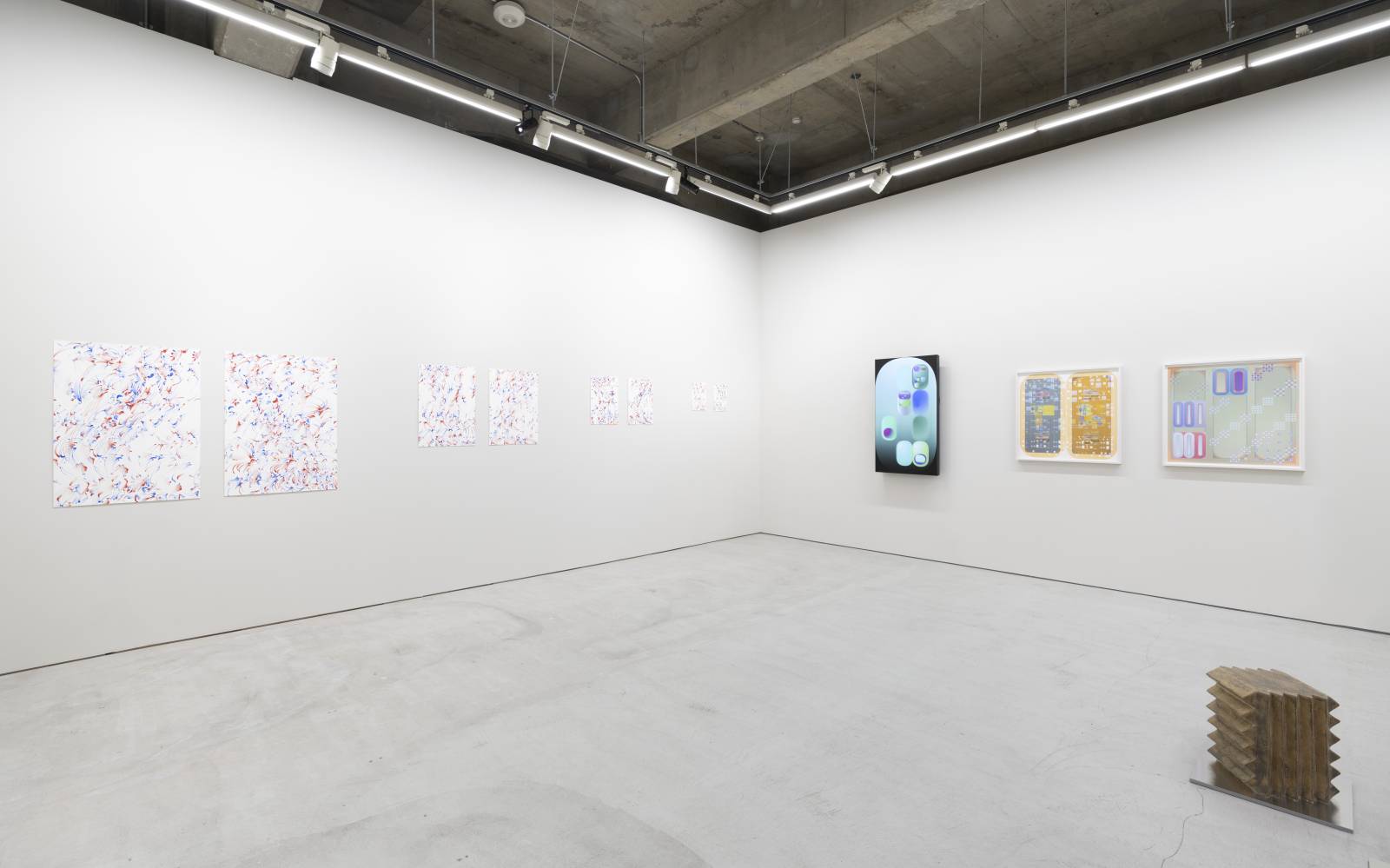
- Goro Murayama, who "works in various media including drawing, painting, and knitting, using computer simulations as his motif"; "His works are produced within a set of recursive rules based on biological processes and patterns such as evolution, learning, and self-organization." He showed drawings from the series Disruptor and Regenerative Drawing (2020, per the Japanese text), dense fields of short red and blue marks on white sheets.
- Harm van den Dorpel, introduced as "a pioneer among artists working with NFTs" who "runs his own online gallery". The online gallery he had co-founded, left gallery, had closed in March 2022.
The profile also records that his work "was exhibited in Japan for the first time last year at a collaborative booth between TSCA and Upstream Gallery (the Netherlands) at Art Collaboration Kyoto", and that "This exhibition will feature his first NFT work shown in Japan in addition to his representative print works."
The works
His three works hung together on one wall: a portrait screen and two framed square prints. harm.work lists SPARCStation, Field and Wednesday, April 3 2019, 15:19:55 CEST (Pleasant Modules). All three belong to Mutant Garden, the images he bred from 2019 with Cartesian genetic programming: programs written as grids of nodes, mutated from a single parent and selected (→ Mutant Garden, Evolutionary Logic). The series text on harm.work ends: "As many people nowadays tend to equate articial intelligence with neural networks, I wanted to highlight the evolutionary progress in this recent history of computation, approaching it as algorithmic archeology."
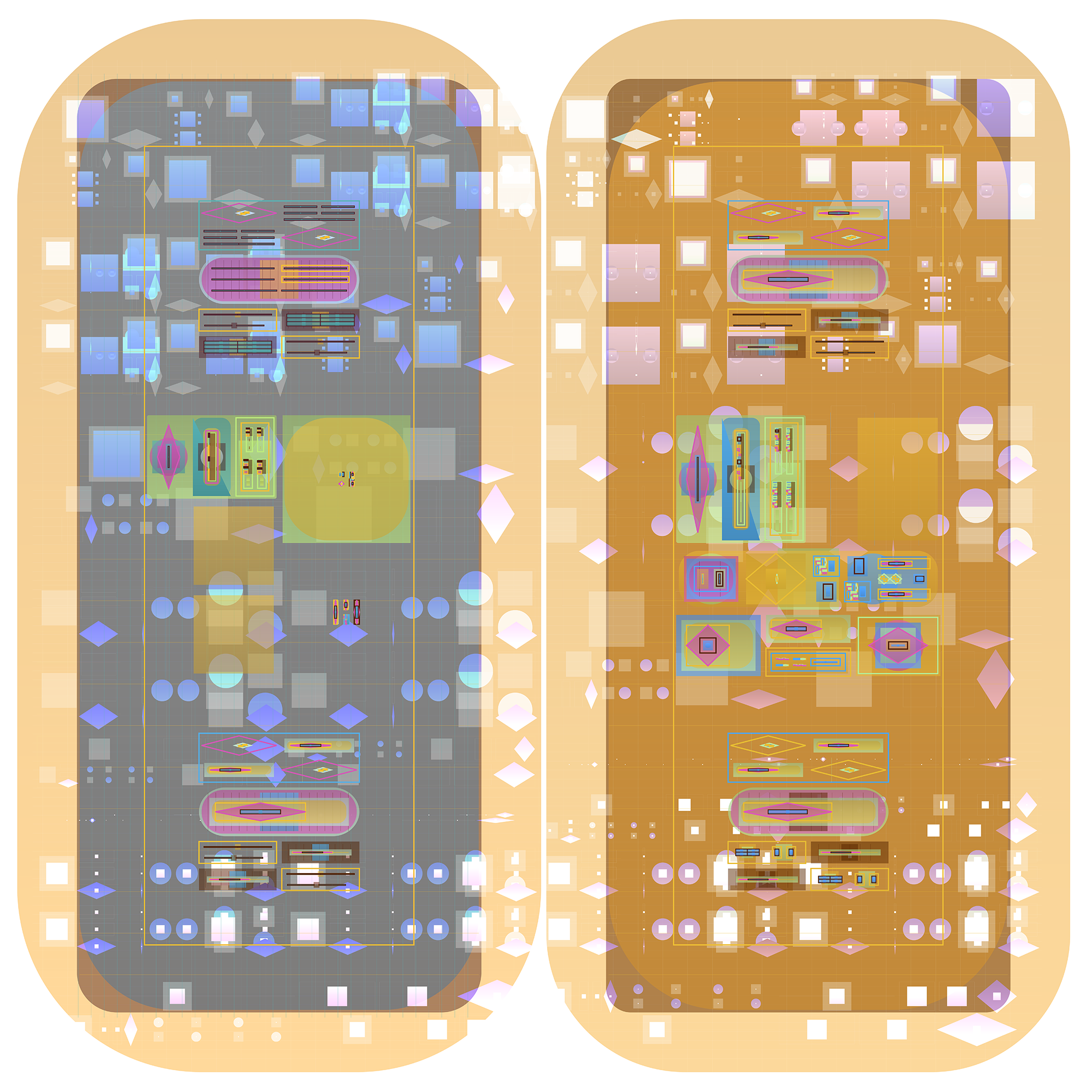
SPARCStation (2019) is an UltraChrome print on Hahnemühle paper, 80 × 80 cm. Two tall rounded panels stand side by side, one grey-blue and one gold, each crowded with small squares, diamonds, framed bars and capsules, like two circuit boards. harm.work gives no text for it. The title is the name of the Sun workstation the artist describes in his text for Markov's Dream: "I was delighted by the Sun SPARCstation we had on campus, with its square user interface and unlimited fast internet", in 1998, as he began to study computer science (Memories and Memorylessness). Whether the print was named for that machine harm.work does not say.
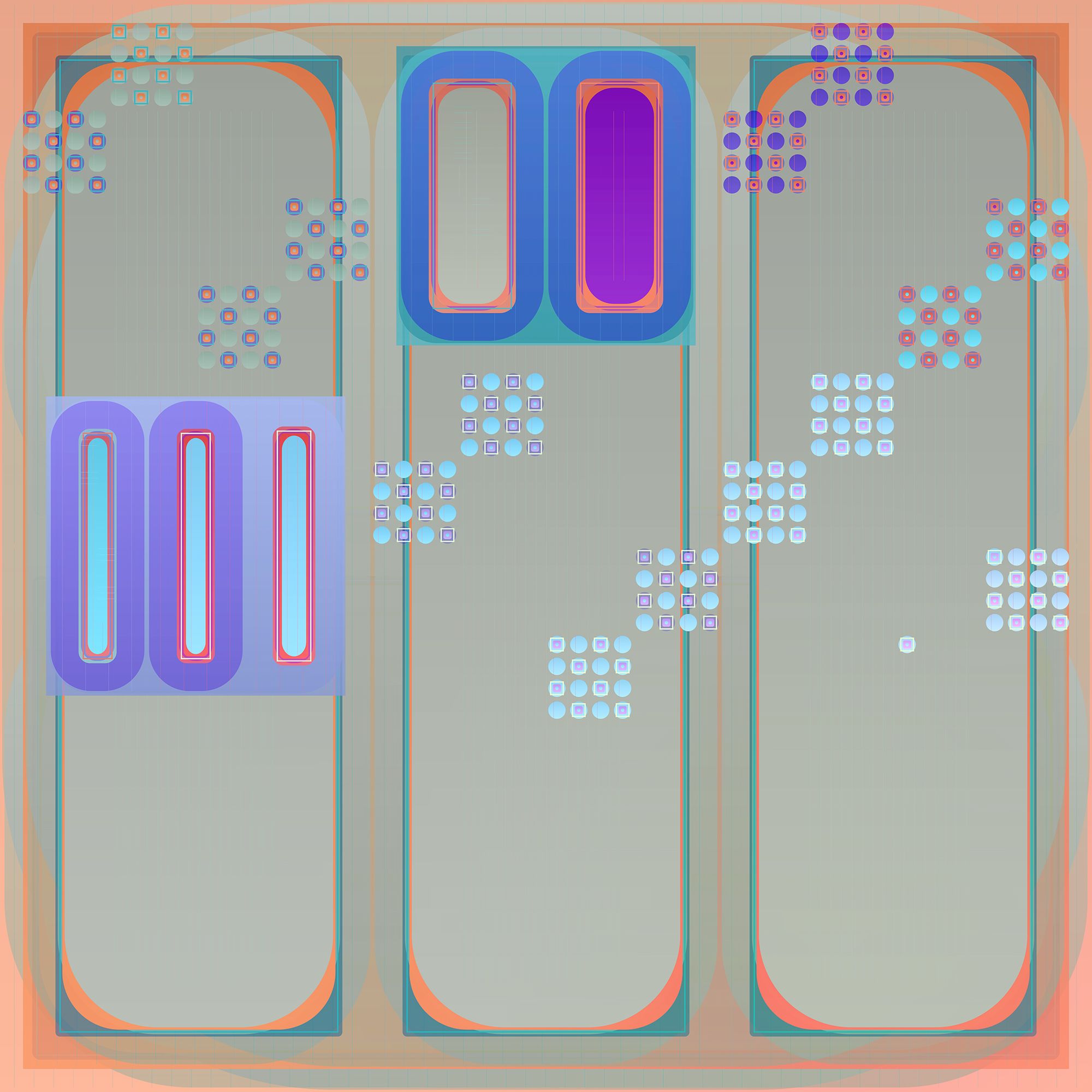
Field (2019), the same size and medium, is not published on harm.work's series page but has its own entry. Three tall rounded columns fill the square. A pair of violet capsules sits in the top of the middle column, a row of three blue capsules on the left, and runs of small dotted squares cross the columns on the diagonal. In the gallery's light the ground reads pale green rather than the salmon of the harm.work image. It shares only its title with Field, the 2008 Flash animation later ported on-chain (→ Field (2008/2023)).
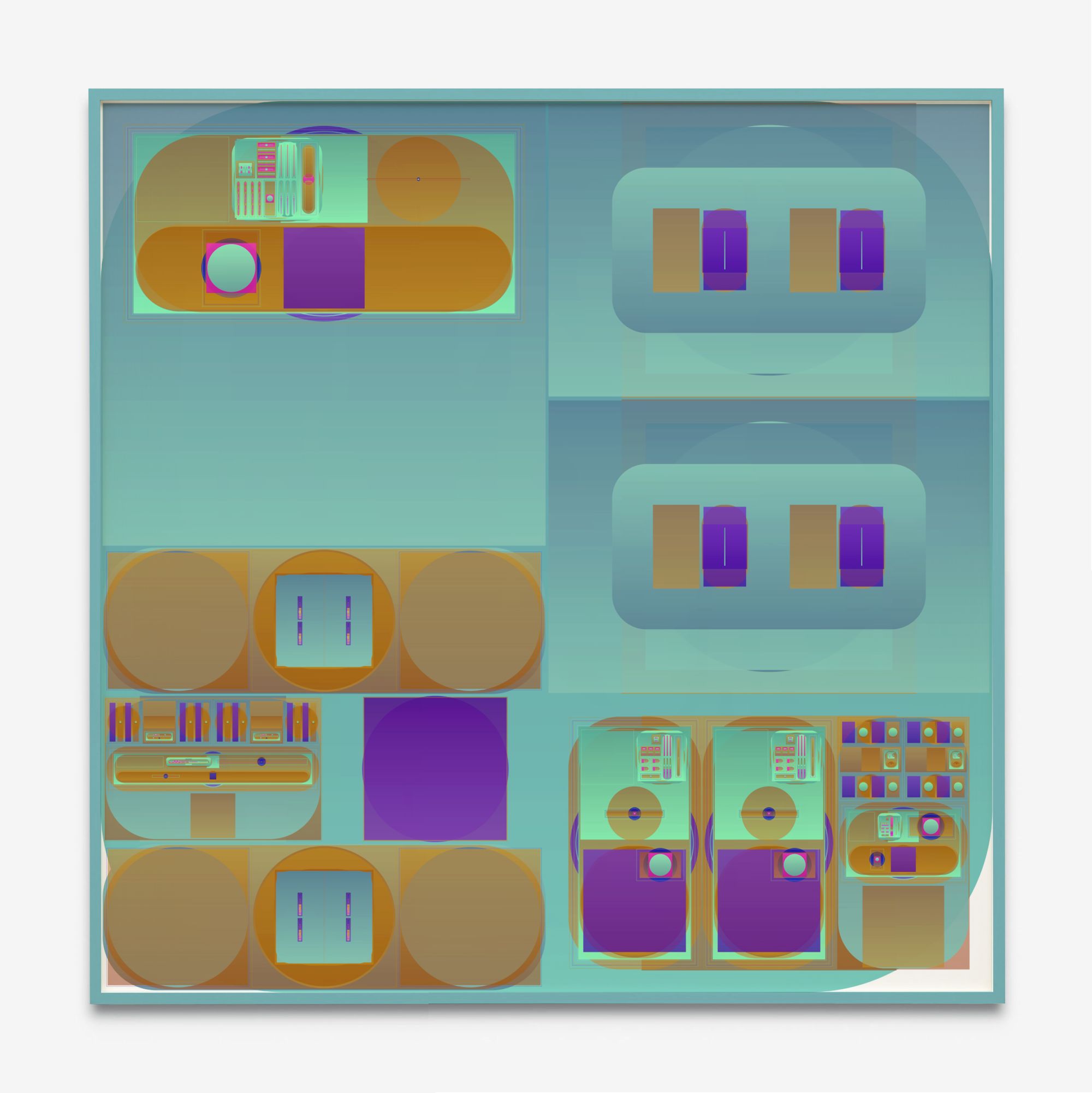
Wednesday, April 3 2019, 15:19:55 CEST (Pleasant Modules) is filed on harm.work as an NFT of 2022, 80 × 80 cm, linked to token 50 of the Protoseeders contract on Zora. Its image on harm.work is a photograph of a framed square print: teal-green fields divided into rectangles, ochre rounded panels, violet squares and clusters of small framed modules. The title is the moment the image was rendered, written out in words, the convention of the later Proto Seeders prints, and "pleasant modules" is a name he had already used in 2019 for Untitled (pleasant modules II) (→ Mutant Garden, under Protoseeders and the Proto Seeders prints; Protoseeders on harm.work).
The installation photographs show the two prints framed in white beside a black portrait screen. On the screen a rounded capsule form in blues, greens or lavender contains smaller capsules and modules, different in each view. This is the animated work the gallery called his first NFT shown in Japan. Neither the gallery nor harm.work names the work on the screen, and the square image filed for Pleasant Modules does not match its portrait format, so which work ran there is not settled.
Murayama and the rules
The hang put his wall at right angles to Murayama's drawings. Both artists make images by rules modelled on biological processes: Murayama sets "recursive rules based on biological processes and patterns such as evolution, learning, and self-organization" and carries them out in drawing, painting and knitting; the Mutant Garden prints are outputs of programs bred by mutation and then chosen. The gallery's proposal of a process "in which there are no distinctions between the virtual and the real" fits these two walls more closely than the rest of the show: in both, a process that could run in a computer is carried out or fixed on paper.
The two artists met again over the mandalas. After van den Dorpel's solo exhibition at the gallery in 2026, Murayama sent him three questions, about which mandalas he uses, Jung, and how a local algorithm relates to the mandala's cosmic scale (→ Mandala Q&A).
Afterwards
Two months later the venue biography for Systems of Belief in Graz listed "Takuro Someya Contemporary Art in Tokyo" first among his recent shows (→ Systems of Belief). TSCA gave him his first solo exhibition in February 2026, Cloud Writings: plotter drawings after Anni Albers, Vera Molnár and Charlotte Posenenske, with Shu Nakagawa again photographing the rooms (→ Cloud Writings).
See also
- Mutant Garden — the body of work, from the first CGP outputs of 2019 to the Seeder
- Cloud Writings (2026) — the solo show at the same gallery
- Mandala Q&A — Goro Murayama (2026) — Murayama's questions
- The Painter's New Tools (2022) — the Coralena prints in New York the same summer
- TSCA exhibition text — the gallery's text and artist profiles