
Systems of Belief — Halle für Kunst Steiermark, Graz, 2022
Group exhibition, 25 September 2022 – 8 January 2023. Curator: Cathrin Mayer. Exhibition page: harm.work/exhibition/systems-of-belief; the venue's page, with views, texts and reviews: halle-fuer-kunst.at. Press text: sources/ingested/systems-of-belief-press-text-2022.md.
The exhibition
Systems of Belief opened at HALLE FÜR KUNST Steiermark, a Kunsthalle in a 1950s pavilion on the Burgring in Graz, on 24 September 2022, as part of the parallel programme of steirischer herbst. Cathrin Mayer curated it. The nine artists were Jordan Belson, Harm van den Dorpel, Storm de Hirsch, Antonia De La Luz Kašik, Richard Kriesche, Paul Laffoley, Irina Lotarevich, Lee "Scratch" Perry and Marta Riniker-Radich. Four of them had died: Belson in 2011, de Hirsch in 2000, Laffoley in 2015 and Perry in 2021. Van den Dorpel was the only one of the nine showing NFTs. The harm.work record thanks Jan Tappe, who also gave a curatorial tour in November.
The programme ran beside the show: a talk organised with the magazine profil, an "NFT Lecture" by Anikó van Nie on 20 October, a mindfulness workshop, a card reading, a lecture by Marc Siegel titled "Lensable Belief" and a dub concert in December (venue page).
Markov's Dream on four screens
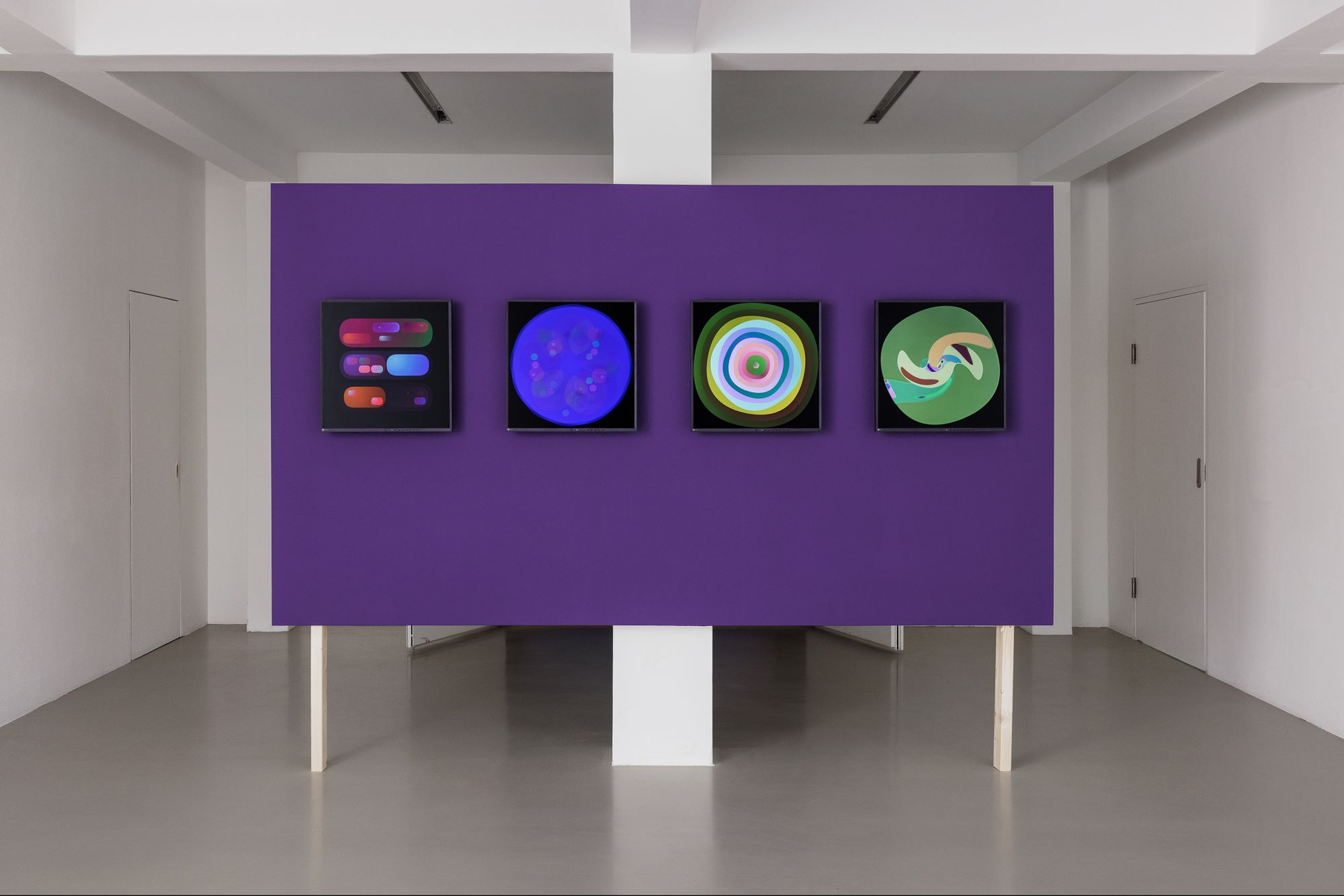
The venue's caption reads: "Harm van den Dorpel, Markov's Dream, 2022 / Softenon (II); Hedphelym; Orb; Keta / Four out of a series of 32 generative animations / Minted as ERC-721 NFT, on EIZO square screen / Courtesy the artist & Collection Hammerline; Collection Abosch; Collection Akkerveeken; Upstream Gallery, Amsterdam." The four screens hang in a row on a purple wall that stands free of the room's walls on timber legs, in a white side room with a pillar behind it.
The four were Keta, Hedphelym, Orb and Softenon (II), as the venue's list has them (the artist, November 2026). harm.work's record of the show listed Fruity (#13) in place of Softenon (II) until it was corrected in November 2026.
Markov's Dream is a collection of 32 tokens, "gradually released over time", each "animated, coloured, and nested, as a 'setting' of a computer programme created by me" (harm.work). Every token is one setting of the same program, recorded as traits: colours, fill, behaviour, maximum nesting depth, "breathing", outlines. The four in Graz differ mainly in their behaviour.
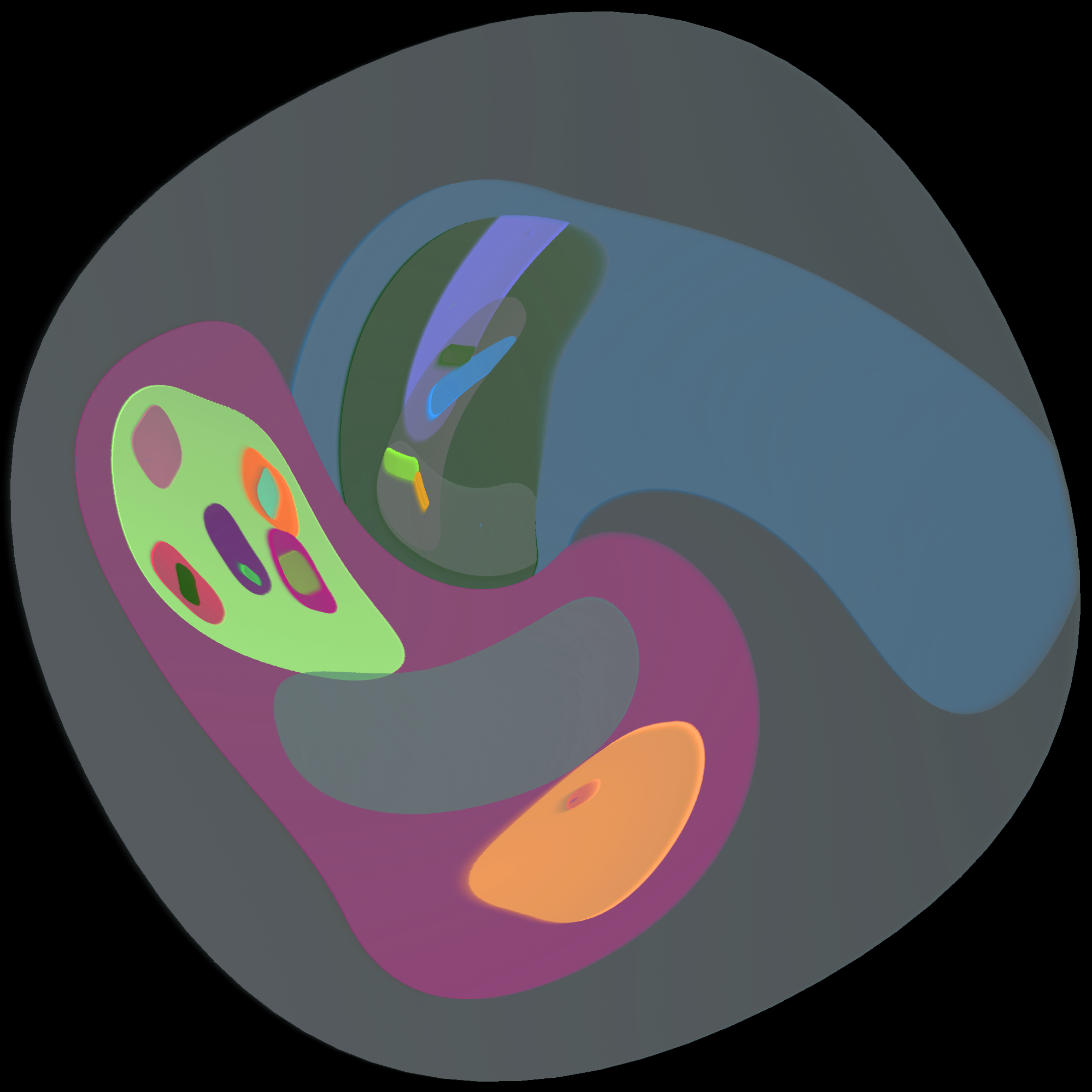
Keta (#17) has no description beyond its date. Its traits are "hand picked" colours, "linear & radial gradients", "constant rotation & sliding" and a nesting depth of 5 (fourteen of the 31 tokens stop at 4). In the still, curved blue and magenta bodies wind around each other inside a grey rounded field, like the two halves of a yin-yang that have lost their symmetry. A lime cell contains small coloured pods. In the photographs from Graz the same forms fill a green field in one view and a violet one in another. The Kleine Zeitung printed Keta as its image of his work.
Hedphelym (#9) is "Named after the Aphex Twin track" (harm.work). Its behaviour is "mayhem rotation & sliding": blue and violet rounded forms overlap, spin and drift. Its relation to Duchamp's spinning discs and to the later Maschine is on Afterimage.
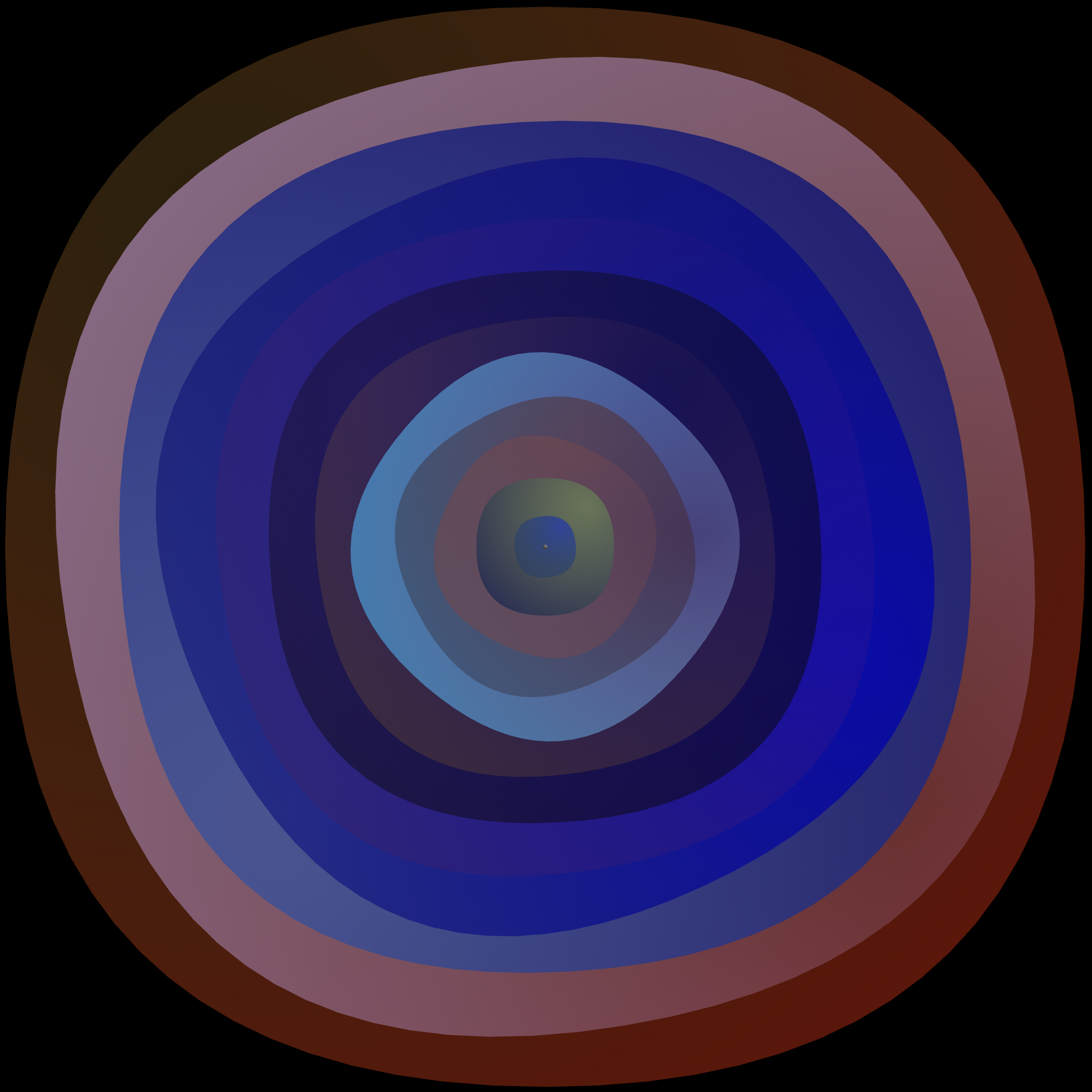
Orb (#15): "Concentric embeddings". Its nesting depth is "15 (absolute padding)", the deepest in the collection, where most tokens stop at four to six: each rounded square contains one slightly smaller one, down to a small centre. Fill "radial monotone gradients", behaviour "smooth rotation". The still runs from brown at the rim through mauve and blue to a green-grey centre; in Graz the rings showed green, white and pink. It has a fully on-chain spin-off of 512 tokens, Orb (lite) (→ Orb (lite)). It is the clearest case in the collection of the property Markov's Window (2004) was built on: a square that may contain a square (→ Recursion).
Softenon (II) (#6): "Layered and nested rounded squares, radial gradients, colours tend to red." It is "stationary": its forms do not travel, but they breathe in "translucence & volume". It was also on the wall in Munich that spring (→ Screens and Skin).
What the press text claims
The press text starts from technology as "a mediator between a factual external world and its perception and processing", whose "technological and digital structures and systems are expressions of technocratic mechanisms that shape our public sphere". In that sphere, it says, "any form of irrational action within those apparatuses seems impossible". The show "takes this supposed space of the impossible as its point of departure" and looks for "worlds in which technology is not used for the purpose of conformist regulations, but becomes a generator of disorder, an expression of unorthodox dogmas and spiritual self-knowledge and self-realization".
It names van den Dorpel once, in the group of artists whose works "demonstrate that technological means such as lenses, servers, or electronic synthesizers have had a direct or indirect impact on art production": "The artists mentioned above use technological means not to make work processes more efficient, but to express irrational and transcendent experiences that are not tied to the material value of things." Servers are the only item on that list that fits his work. The others are Belson's and de Hirsch's 1960s and 1970s films, Kašik's analogue optics and Perry's studio.
The artist's own text for the collection gives a narrower reason for the work (Memories and Memorylessness, 2022). Software that used to be called "tools" became "platforms" owned by corporations, and "UX designers gradually began to give all square-shaped user interface elements (e.g. windows, buttons, input fields) rounded edges, shadows, and gradient colours". "'Markov's Dream' is a response to this phenomenon. The pure Platonic forms of 'Markov's Window' have been replaced by impure circles or rounded squares in the dream space." The press text places the work among means of expressing transcendent experience; the artist describes it as a reply to interface design. Both refuse the screen as a tool of efficiency, which is the point the press text makes about all five artists. The rounded square as interface ideology is followed on The Squircle.
Chance is the other point of contact. The press text speaks of "a generator of disorder". In the artist's account the parameters "are fed with random numbers", so that "the chance the generative process will repeat an image is close to zero", and the Markov process behind the title only ever knows its present state (→ Randomness and Pattern, The Markov's Dream Palette).
Reception
Of the reviews the venue lists, one discusses his work. Wenzel Mraček, "Reisen durch Raum und Zeit", Kleine Zeitung, 30 September 2022 (PDF):
"Der Niederländer Harm van den Dorpel dagegen paraphrasiert mittels algorithmenbasierten Animationen das nach dem russischen Mathematiker Markow benannte Modell, nach dem Systeme ihren Zustand jeweils nur nach dem vorherigen ändern. Demnach zeigen van den Dorpels Animationen jeweils aus sich selbst generierte, immer neue Bildfolgen."
In English (the wiki's translation): "The Dutchman Harm van den Dorpel, by contrast, uses algorithm-based animations to paraphrase the model named after the Russian mathematician Markov, by which systems change their state each time only according to the previous one. Accordingly, van den Dorpel's animations show ever-new sequences of images, each generated out of itself." The "by contrast" sets him against Laffoley's diagrams of the body and Christ in the sentence before. The article illustrates him with Keta.
Stefan Grissemann's review in profil (25 September 2022) and Iona Lowe's "Tech, Drugs, Same, Same" in Damn magazine discuss de Hirsch, Belson, Kašik, Perry and Laffoley and do not mention him. Lowe quotes Mayer: "Drugs are also a kind of technology."
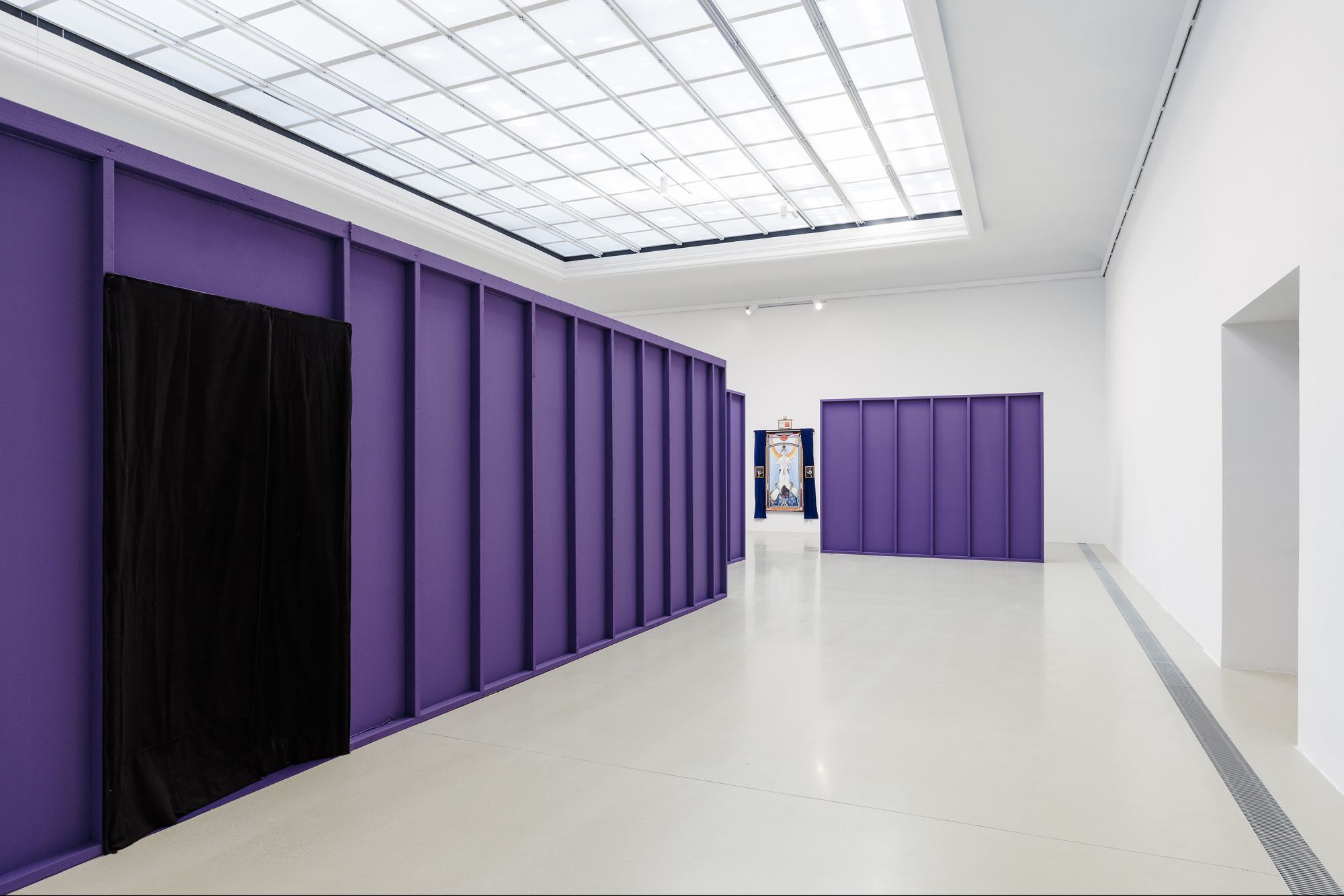
Dagmara Genda's review for Berlin Art Link ("The Anxiety of Art", 19 December 2022, online) is about the exhibition architecture, the "crate-like purple constructions" Mayer designed for the hall. "Purple, with its connotations of mysticism and royalty, is the dominant colour in many of the works and was thus chosen as the connecting thread for the show. In reality it is also a divider serving to box the artworks in." Genda does not discuss his screens. They hung on one of the purple walls, which in the photographs matches the violet that recurs in Hedphelym and Keta.
In the practice
Six months before Graz, five tokens of Markov's Dream, Softenon (II) among them, had hung on square screens at Galerie Rüdiger Schöttle in Munich (→ Screens and Skin). The venue's artist biography lists his recent shows as Takuro Someya Contemporary Art, Tokyo, Nahmad Contemporary, New York, Villa Schöningen, Potsdam, and Galerie Rüdiger Schöttle, and names Upstream Gallery, Amsterdam, and Galerie Rüdiger Schöttle, Munich, as his galleries (→ the Tokyo group show, The Painter's New Tools, Sammeln).
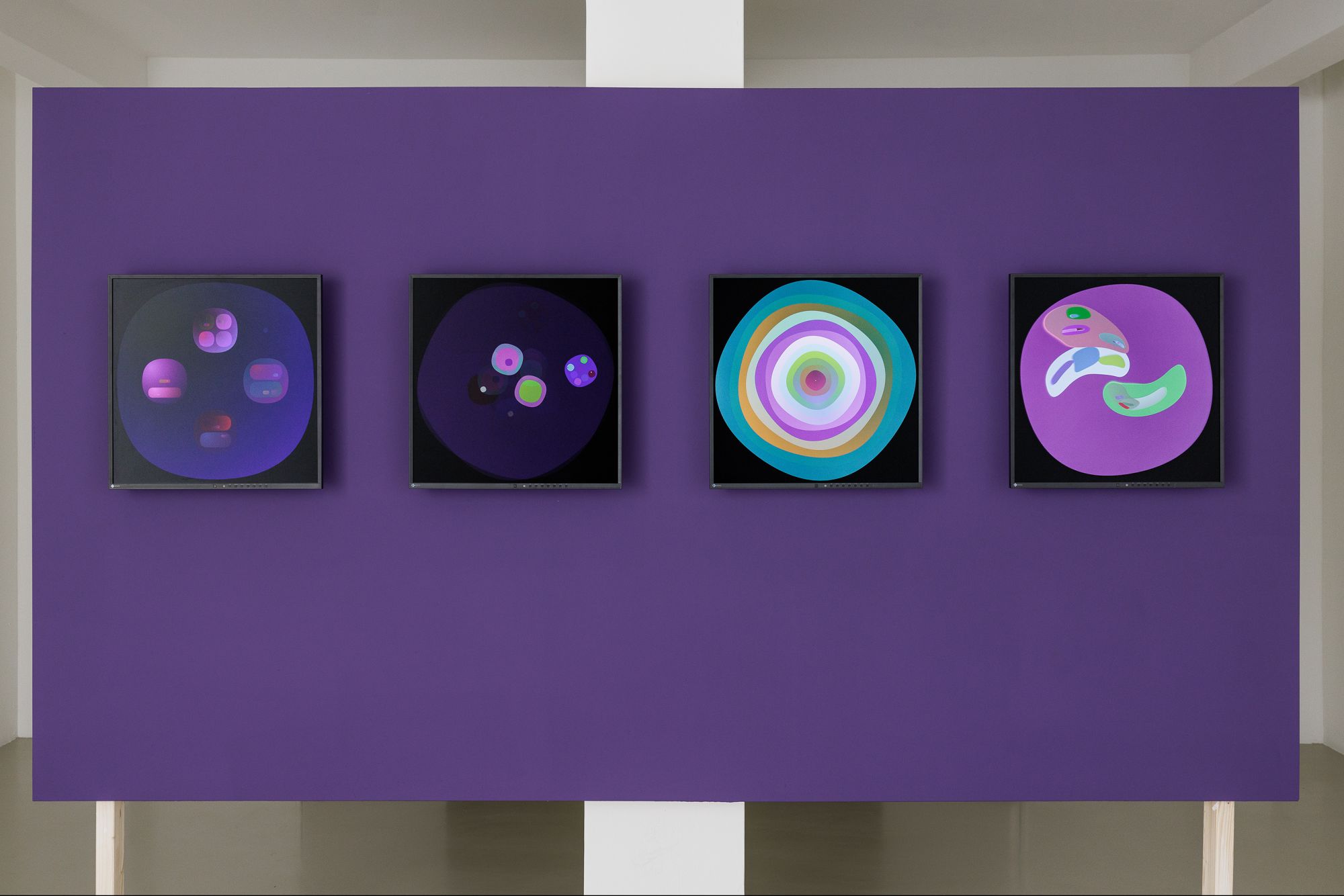
Two views of the same wall, taken at different moments, show two different sets of four images: the first screen changes from rounded bars to a single violet cell, the third from green rings to teal ones. This is the property the artist sets against video in his text: "This is in strong contrast with, for example, video art, which often depends on a predefined order of appearance, a beginning, and an end." Belson's Chakra (1972, 5:23 minutes) and de Hirsch's Third Eye Butterfly (1964, 10 minutes), shown in the same building, are films of fixed length; Genda notes that de Hirsch's two-projector piece was "digitised and seamlessly looped" for the show.
See also
- Screens and Skin (2022) — the Munich showing of Markov's Dream six months earlier
- The Markov's Dream Palette — Markov's Window (2004) and the palette's returns
- The Squircle — the rounded square as interface ideology
- Afterimage — Hedphelym and Rotorelief
- Memories and Memorylessness — the artist's text for the collection (2022)
- Systems of Belief press text — the venue's text in full