
Sammeln — Villa Schöningen, Potsdam, 2022
Group exhibition, 19 June – 28 August 2022. Curator: Sonia González; curatorial assistant: Pola van den Hövel. Exhibition page: harm.work/exhibition/sammeln; the villa's text in English and German: sources/ingested/sammeln-exhibition-text-2022.md.
The exhibition
Sammeln ("collecting") was a summer exhibition at Villa Schöningen, a villa designed by Ludwig Persius in 1843 beside the Glienicke Bridge in Potsdam, opened as a privately funded museum and exhibition house in 2009. Sonia González, the villa's director, curated it. harm.work's record has two lines: "Group exhibition about collections, and collecting."
The villa's text opens with a question to the visitor, "What do you collect?", and lists the collections on show: "missing pet posters, a collection of Spitzweg paintings, the extensive Sound Collection Guy Schraenen, a loan from the Center for Artists' Publications, Weserburg Museum for Modern Art (Bremen), or a collection of Japanese woodcuts from the Edo period featuring works by Utagawa Hiroshige and Hiroshige II." The contemporary artists listed beside van den Dorpel were Billie Clarken, Lea Draeger, Einsiedel & Jung, Roman Moriceau, Ouazzani Carrier, Lukas Sonnemann and Bruno Schleinstein, with paintings by Carl Spitzweg and woodcuts by Hiroshige, and collections ranging from The Night Climbers of Cambridge to Doris van den Hövel's herbarium of 67 pressed plants and The Infamous Collection's 666 videocassettes.
The text closes on the museum's problem, what to keep, store or return: "Most of them display only a fraction of the works they have stored", and "which works that entered the collection unlawfully should be returned to their original owners, and which should stay, also to serve as a memory?" It ends: "The current exhibition 'Sammeln' can itself be seen as a collection and will continue to evolve beyond the opening."
Indiscreet Units in the show
The text names his work in the paragraph on identity:
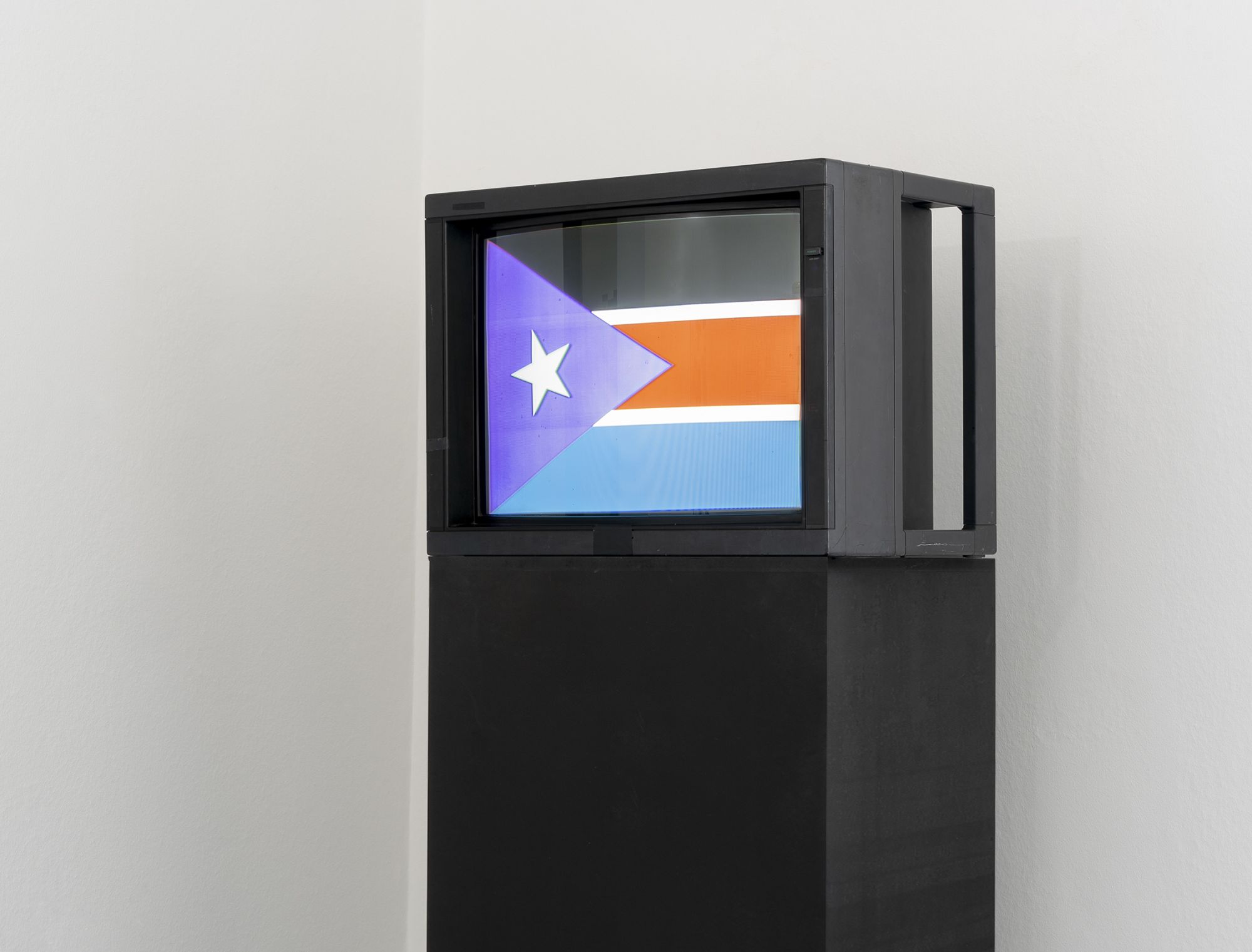
"Collecting is always something personal, identity-affirming: This is also the theme of Lea Dreager's work 'Ökonomische Päpste und Päpstinnen' (Economic Popes and Popesses). She has now created more than 6,000 postage stamp-sized portrait drawings that she uses to explore her upbringing with Catholicism. On the other hand, Harm van den Dorpel's 'Indiscreet Units' deals with dissolving identities: He displays 266 national flags, whose shades are constantly changing – a continuous algorithm generates new nuances from the original flag color codes."
(The text spells her name Dreager; the villa's list of artists has Draeger.)
Indiscreet Units (2022) was "The inaugural commission by Chemsex Benelux in 2022", "a selection of 266+ hue-rotating flags, stored on the Ethereum blockchain and IPFS" (harm.work). The flags include states, territories and regions, and Benelux itself. Each is an SVG file with one rule added: its hue turns through the full circle every twenty seconds and starts again, while white and black stay as they are (→ Indiscreet Units). The villa's "continuous algorithm generates new nuances" describes that rule loosely: nothing is generated beyond the turning, and every colour of a flag turns by the same angle at the same time, so its colours keep their relations while each one leaves its official value.
In Potsdam the work ran on a black cathode-ray television set on a black plinth. The photograph catches one flag with a white star in a violet triangle at the hoist and stripes of white, orange and light blue. Which flag it is cannot be read from the colours, since they were not its own.
A collection in a show about collections
Sammeln put collections of things next to artworks. Indiscreet Units is both. It is a set of 266 tokens, each a flag that can be owned on its own, and its subject is the most rule-bound kind of collection, the list of national flags with their official colours. The villa's text reads it as an image of identity dissolving. The Chemsex Benelux about page, quoted in note 3005, frames the project as offering "souvenirs to help you integrate the limit-experiences you never had" (→ Limit Experience). Both readings rest on the same mechanism: the flag keeps its drawing, its stripes, stars and crests, and its white and black, and loses the colours that make it official.
The title belongs to that mechanism. The project's about page sets colours treated "as discrete units" against hue as a continuum; on a flag each colour is such a unit, with a name and an official value, and the rotation turns it into a moving point on a circle (→ Indiscreet Units, Colour).
Sammeln was one of four 2022 shows that the venue biography for Systems of Belief listed that September, with Takuro Someya Contemporary Art, Nahmad Contemporary and Galerie Rüdiger Schöttle (→ Systems of Belief).
See also
- Indiscreet Units — the collection, its 266 flags and Chemsex Benelux
- Limit Experience — Chemsex Benelux and its sources
- Colour — colour as a set of relations
- Sammeln exhibition text — the villa's text in English and German