
Screens and Skin — Galerie Rüdiger Schöttle, Munich, 2022
Two-person exhibition with Raphael Weilguni, 18 March – 7 May 2022. Exhibition page: harm.work/exhibition/screens-and-skin. Exhibition text by Sofia Sominsky, English and German: sources/ingested/screens-and-skin-exhibition-text-2022.md.
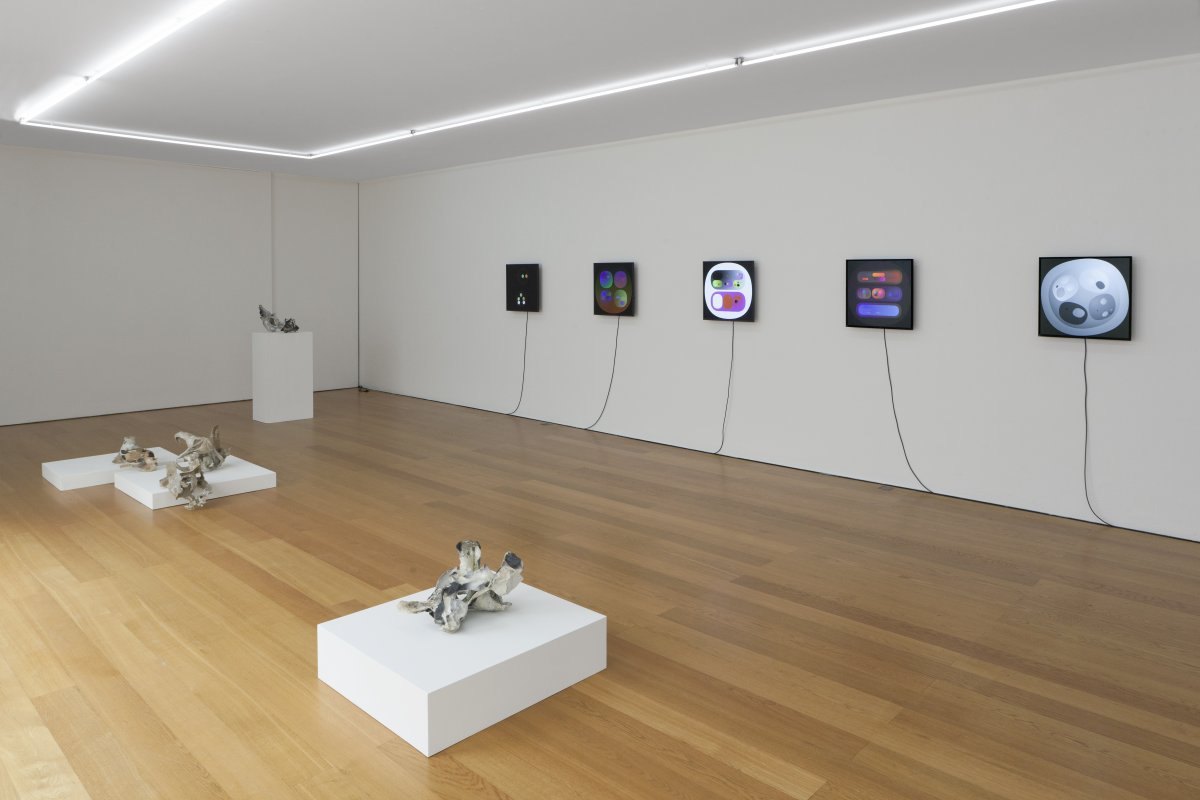
The exhibition
Screens and Skin paired van den Dorpel's Markov's Dream with ceramics by Raphael Weilguni. The gallery called it the first time it "presents an exhibition in which digital art enters into a dialogue with ceramic sculptures". In the room five square screens hang in a row along the long wall, each with its cable running to the floor, and Weilguni's sculptures stand on low white plinths on the wooden floor in front of them, with one on a tall plinth in the far corner. Weilguni's three listed works, Fossilized Fall, SnapShock and Ejection Seat (all 2022, glazed ceramic), are tangles of pale, cracked, folded clay.
harm.work files the show as a solo exhibition. Its text reads "Duo exhibition with works by Harm van den Dorpel and Raphael Weilguni", and the gallery page credits both artists. In 2022 the gallery represented van den Dorpel together with Upstream Gallery, Amsterdam (artist biography of HALLE FÜR KUNST Steiermark, September 2022).
The exhibition text is by Sofia Sominsky. At the end of that year she and Ingrid Lohaus opened the Munich gallery LOHAUS SOMINSKY (gallery's about page), which showed his two-person exhibition with Vera Molnár, Angles Morts, in 2024 (→ Angles Morts).
What the text claims
Sominsky's text sets the two bodies of work against each other: "The NFTs of Harm van den Dorpel are juxtaposed with the fragile sculptures of Raphael Weilguni, creating a confrontation between the vivid and the frozen, a synthesis of the physical, tangible and the abstract, two-dimensional. It is up to the viewer to decide which of the works to call alive and physical, and which digital and frozen."
On the tokens, it starts from Markov: "To calculate a prognosis, he focused exclusively on the current situation while ignoring past events. Harm's generative art is determined by random numbers: The animation's color scheme and arrangement on screen are never reiterated but always elicit new, unpredictable compositions." Then the form: "The rounded square is a recurrent visual ingredient in the artist's aesthetic vocabulary. It refers to the specific elements in user interface design, which the viewers encounter in their daily lives. These design features are often used in the optimization-focused discipline of user experience design to give various software a more 'human' or organic note. Harm goes even further by letting the rounded square look like a living, breathing cell, thus blurring the line between determined programming and an autonomous, 'living' organism. Poetically speaking, the artist invigorates what was once frozen."
Weilguni's ceramics run the other way. He lets them "unfold to a certain degree in a seemingly uncontrolled way, only to freeze them at the apex of their autonomy": in raku firing a piece is taken from the kiln at the peak of the firing and cooled fast, and "Control over the firing process in the raku method is limited, so that each item is unique and inimitable." In both of the text's directions, digital forms brought to life and clay stopped in motion, the maker sets a process going and does not fully steer it.
Neither the gallery nor harm.work explains the title. The wiki's reading: the screen is the surface the tokens live on, and skin is the surface of a body, and of glazed clay.
The rounded square: two accounts
The artist's own text for the collection, published the same year, makes a sharper claim about the same form (Memories and Memorylessness, 2022). It describes how software once called "tools" became "platforms" owned by corporations, and how designers gave interface elements "rounded edges, shadows, and gradient colours" so that everything on screen is "rounded and 'organicised'": "This is all in an effort to make the UX more metaphorically connected with human bodies, which have no hard edges. Computers become platforms for humans who become tools in the profit sequestration chain." Directly under this paragraph the text places a photograph captioned "'Markov's Dream' installed at Galerie Rüdiger Schöttle, Munich", and goes on: "'Markov's Dream' is a response to this phenomenon. The pure Platonic forms of 'Markov's Window' have been replaced by impure circles or rounded squares in the dream space."
Sominsky's text and the artist's start from the same observation, that interface design rounds its squares to make software feel human. Sominsky takes the form further toward life: the square becomes a breathing cell. The artist names the rounding as a device that makes users into tools and presents the tokens as a response to it. The tokens carry both. Their trait "Breathing", with values such as "volume" and "translucence & volume", names the life the gallery text describes, and they are built from the rounded squares the artist's text criticises. The squircle as interface ideology, and the Markov's Window (2004) behind the series, are followed on The Squircle and The Markov's Dream Palette.
The five tokens
The gallery's captions give each token as "Generative animation minted as ERC-721 NFT, presented on EIZO square screen", with a link to the live token. The gallery's list is right (the artist, November 2026): the fifth token was Softenon (III) (#7), which harm.work's record of the show gave as Softenon (#5) until it was corrected in November 2026.
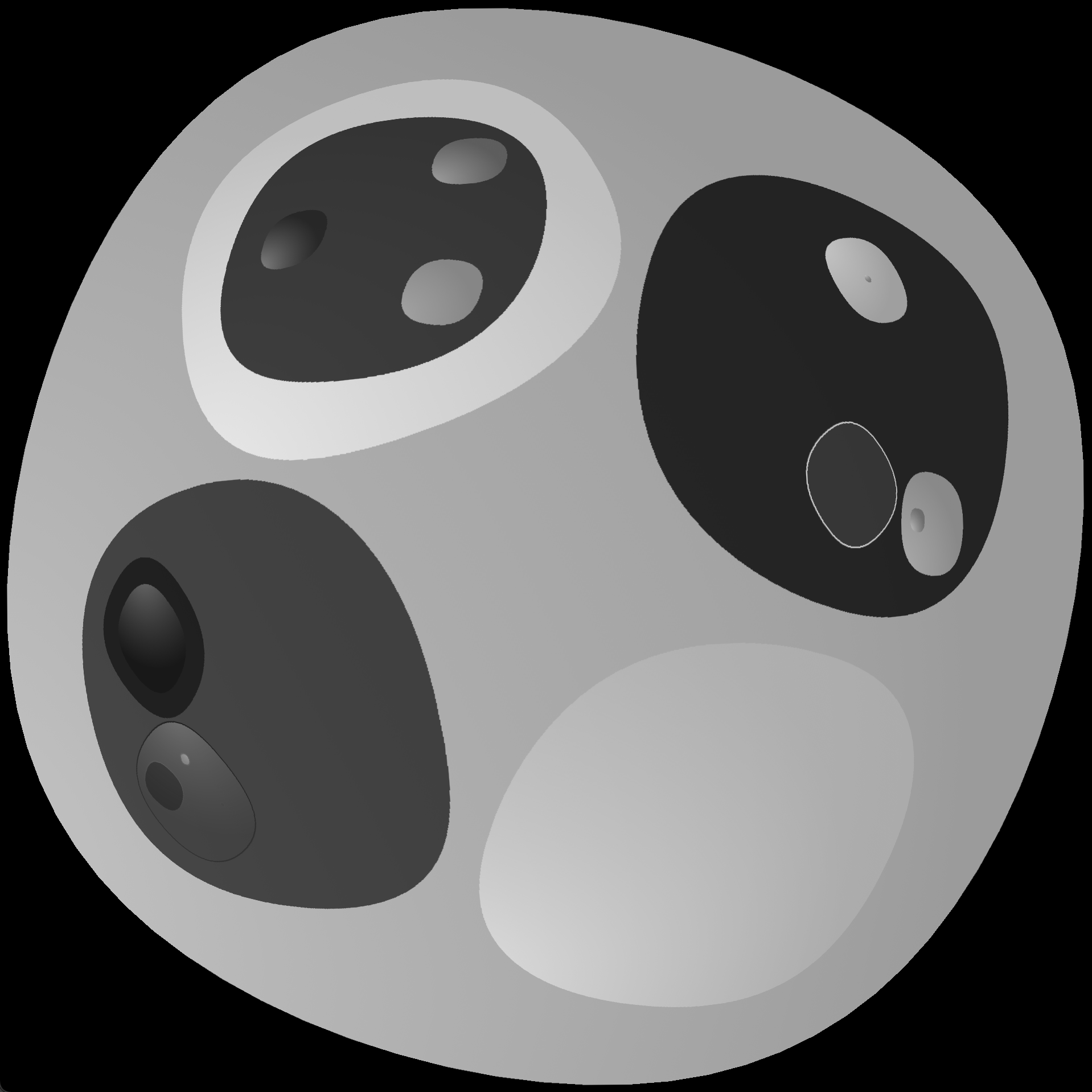
Kodama (#8): "Monochrome gradients, slowly rotating, inspired by Studio Ghibli Kodama" (harm.work). The kodama of Japanese folklore are tree spirits; in Studio Ghibli's Princess Mononoke (1997) they are small white figures with round heads and dark holes for eyes and mouth. The token keeps the grey: a large grey cell contains darker and lighter rounded cells pitted with pale spots, which reads as a face only by accident. Its traits are "hand picked" colours, "radial monotone gradients" and "smooth rotation & sliding", with outlines "sometimes". It is the only token in the room without colour.
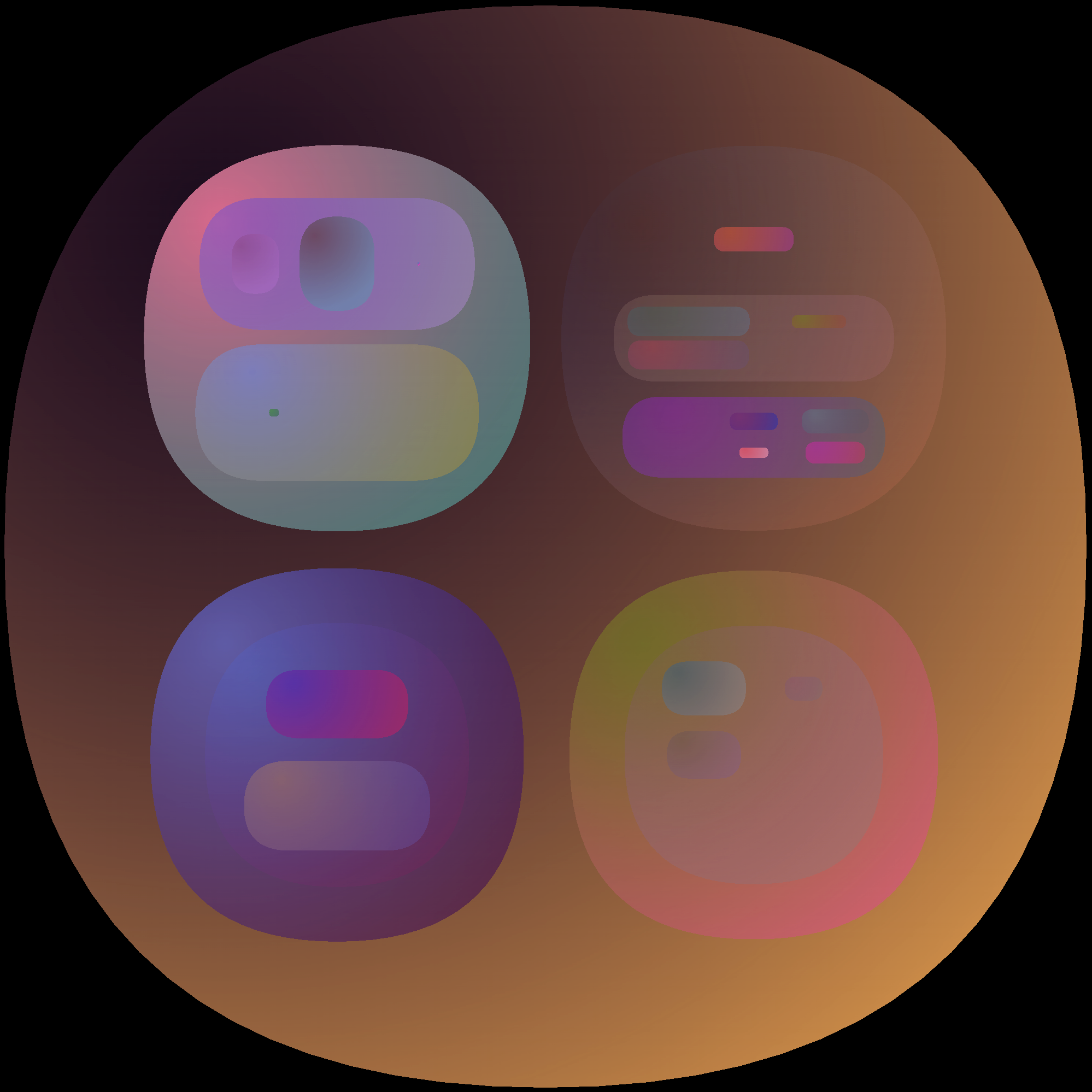
Softenon (II) (#6): "Layered and nested rounded squares, radial gradients, colours tend to red." Four rounded cells in a two-by-two grid sit inside one large rounded square; each contains smaller bars and cells. The colours are random with a "red bias", the behaviour "stationary", the breathing "translucence & volume". The token went on to Graz that autumn (→ Systems of Belief).
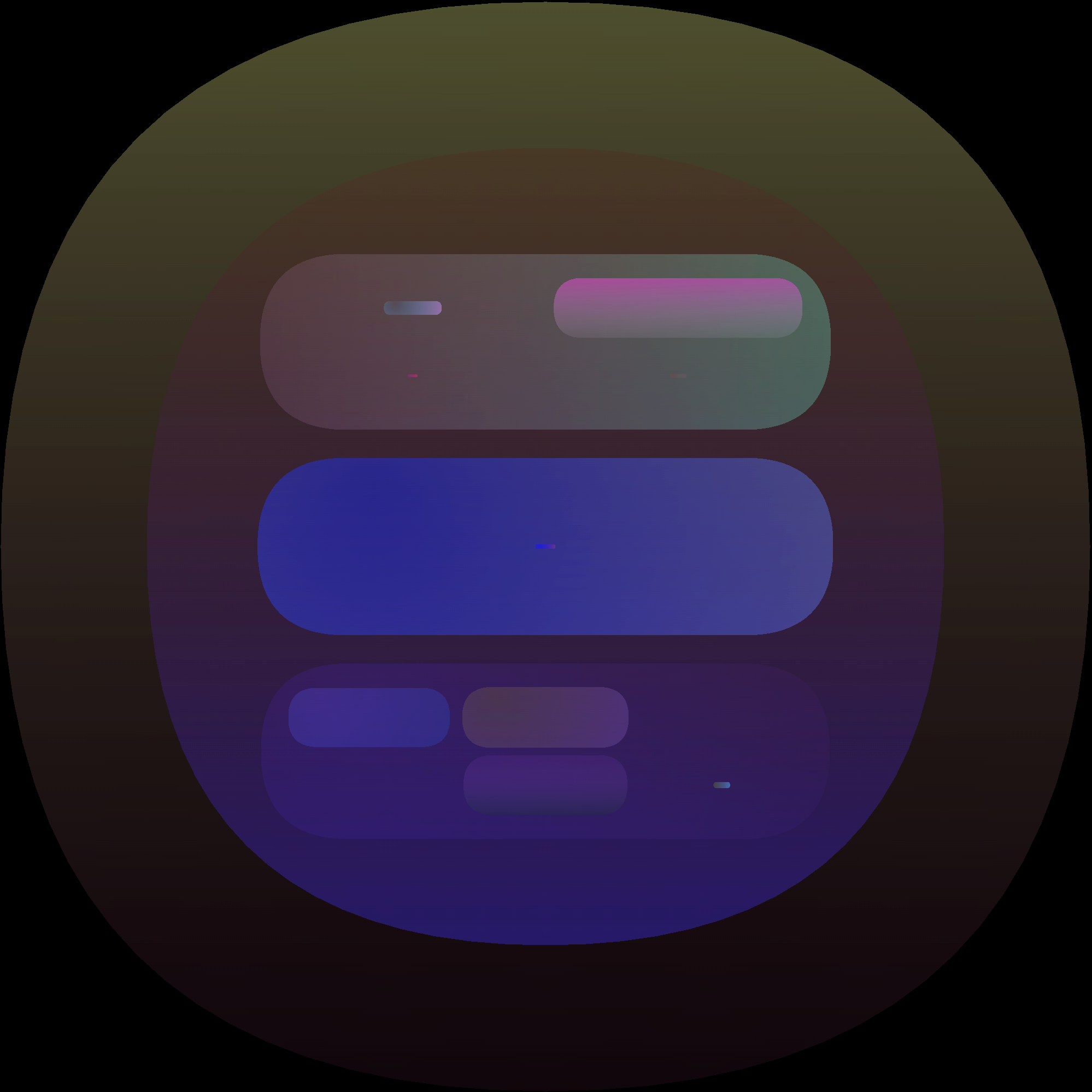
Softenon (III) (#7): "Layered and nested rounded squares, radial and linear gradients, colours tend to green and blue." Same structure as Softenon (II), with a "blue bias" and both kinds of gradient. In the still three translucent bands of rounded bars float in a dark field; in the gallery's photograph of the screen the field was violet. The name is that of the drug: Softenon was the trade name under which thalidomide was sold in the Netherlands and Belgium (the artist, November 2026).
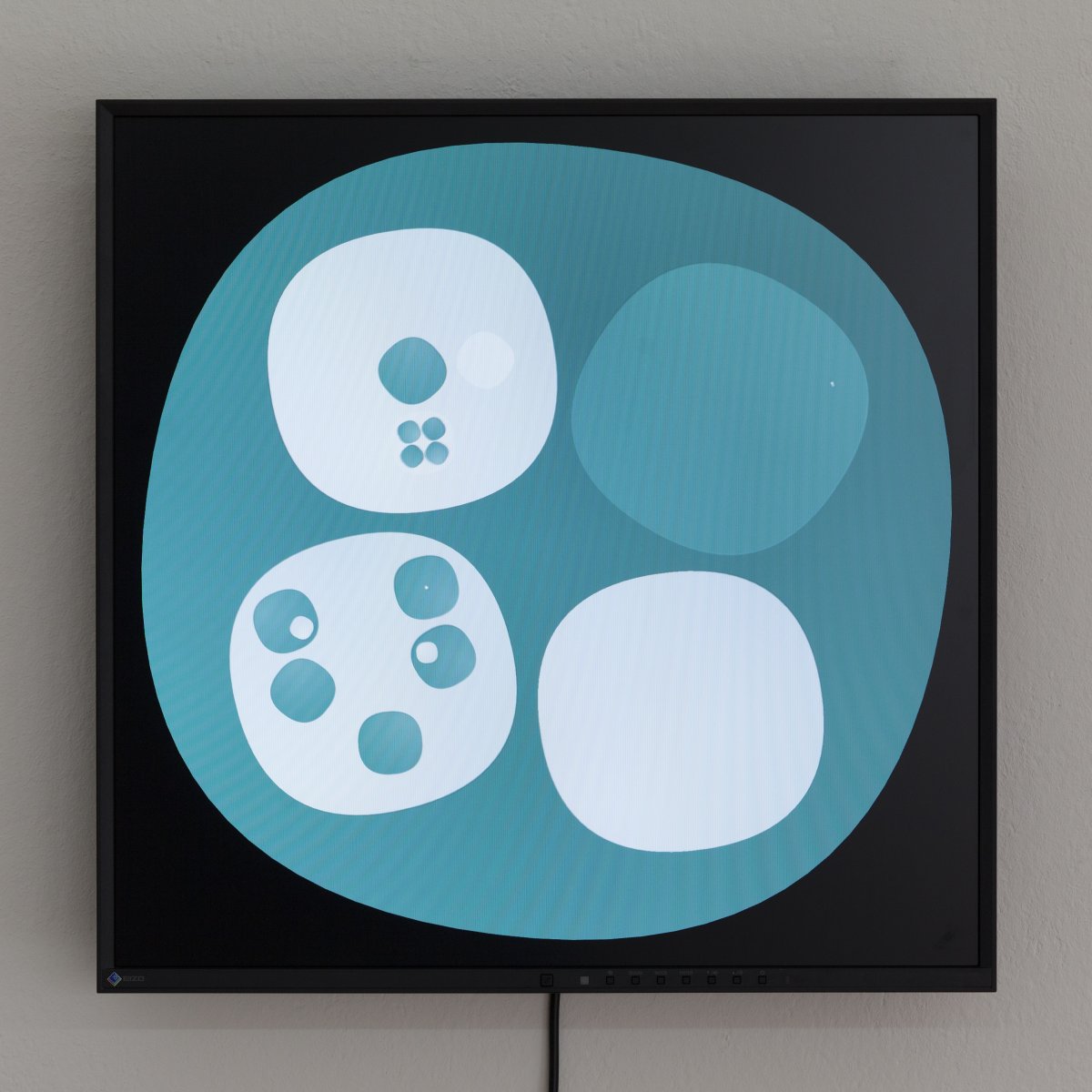
Rotorelief (#10): "Inspired by the Rotorelief series by Marcel Duchamp. Using identical colours." It turns constantly ("constant rotation"). In the gallery's photograph of the screen, white rounded cells dotted with teal circles turn on a teal field. Duchamp's Rotoreliefs (1935) were printed discs to be spun on a gramophone; the relation is followed on Afterimage.
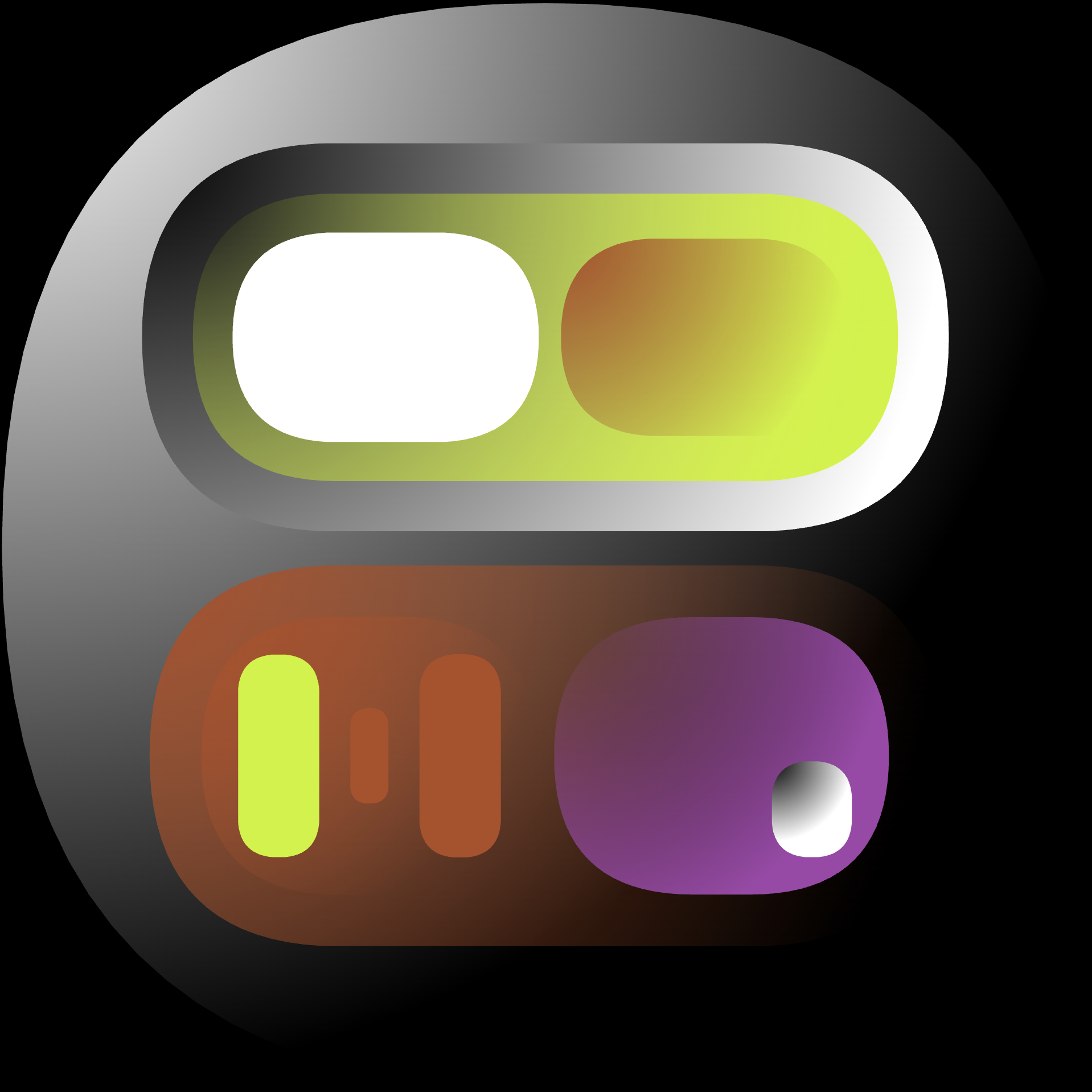
Markov's Dream (II) (#2): "A remake of the 2004 work Markov's Window, with hand picked green-purple-brown palette." It slides ("sliding"), with radial gradients and a nesting depth of 4. A black-to-grey rounded form contains two bands: above, a lime band with a white cell and an orange one; below, a rust band with lime bars beside a purple cell with a small white-to-black square. The hand-picked green, purple and brown take the place of the 2004 blue, green and magenta; the black-to-white gradient stays (→ The Markov's Dream Palette).
After Munich
Six months later four tokens of the collection, Softenon (II) again among them, hung on a purple wall in Systems of Belief at HALLE FÜR KUNST Steiermark, Graz, where the press text placed them among works that use technology "to express irrational and transcendent experiences" (→ Systems of Belief). He still recommends the same square EIZO monitors for square works; the photograph of five such screens in a row on How to display your NFT was taken in this room.
See also
- Systems of Belief (2022) — four tokens in Graz, with the press text and the one review that discussed them
- The Squircle — the rounded square in interface design and in the work
- The Markov's Dream Palette — Markov's Window (2004) and its returns
- Afterimage — Rotorelief and Duchamp
- Memories and Memorylessness — the artist's text for the collection, with the photograph from this show