
Proof of Work (Schinkel Pavillon, 2018)
Proof of Work was a group exhibition in the Schinkel Klause, the lower floor of the Schinkel Pavillon in Berlin, which the exhibition text describes as "labyrinthine" and "a former GDR restaurant". It ran from 8 September to 20 December 2018. The show brought together, in the venue's words, "works engaged with the culture around Bitcoin and blockchain, entertaining crypto as a possible new infrastructure for money, computing, and organizing": art made by crypto builders, crypto experiments made by artists, and "a small number of paintings and drawings that resonate with crypto, but predate Bitcoin" (exhibition text and guide). The title is the consensus algorithm of Bitcoin; the text quotes the Bitcoin wiki: "A Proof of Work is a piece of data which is difficult (costly, time-consuming) to produce but easy for others to verify and which satisfies certain requirements."
Harm van den Dorpel took part three times over: as one of the curators, as an artist with Nested Exchange, and as co-founder of left gallery, which the artist list credits to "Harm van den Dorpel and Paloma Rodríguez Carrington".
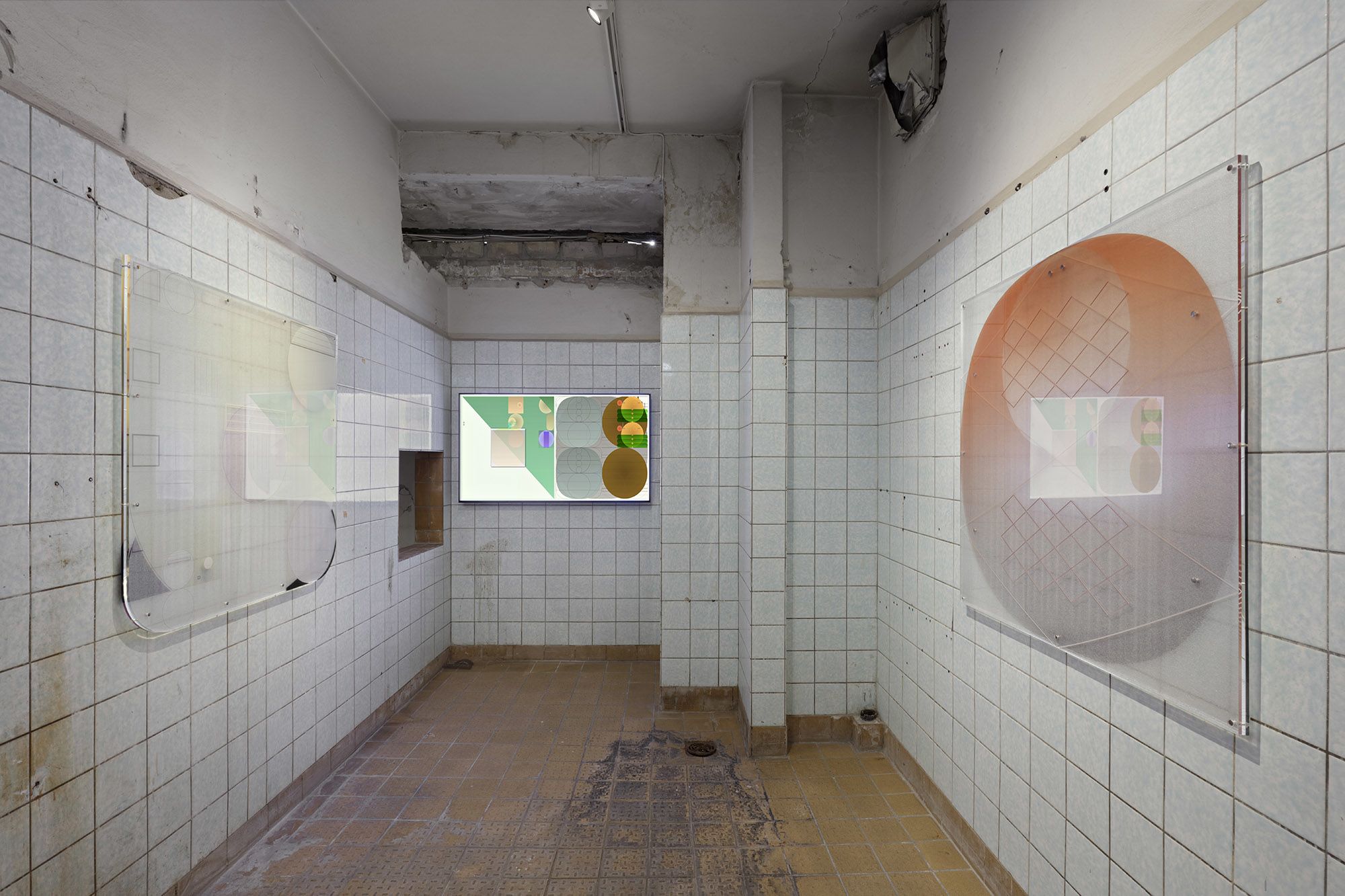
The room has white tiles to shoulder height, a tiled floor with a drain, and a ceiling where the plaster has come away from the beams. Wyn (generation unknown) hangs on the left wall, a pale square panel with rounded lower corners; Lammer Asbestos faces it on the right, an orange oval fading to grey with diamond lattices. Between them, on the end wall, a screen runs the Nested Exchange software.
Curators as nodes
Other artists in the show included Aria Dean, Mark Lombardi, Jonas Lund, Hayal Pozanti, Jason Rohrer, 0xΩ (Avery Singer and Matt Liston), FOAM, terra0, Rob Myers, Wayne Lloyd, Billy Rennekamp, Miljohn Ruperto and Ulrik Heltoft, the Decentralized Autonomous Kunstverein and CryptoKitties. New Models (Caroline Busta, Lil Internet and Daniel Keller) ran a conversation programme.
The selection was made by a protocol. Simon Denny curated the show "in dialogue with" Distributed Gallery, van den Dorpel, Sarah Hamerman and Sam Hart, Kei Kreutler and Aude Launay; the printed guide adds Anna-Lisa Scherfose. The exhibition text explains the structure:
A series of creators-as-decision-making-nodes were invited to propose positions they felt resonated with blockchain, pushing back on the idea of curating as a singular point of centralized decisionmaking. The result is a partial picture of activity in this area that is formed by a pre-defined organizational protocol.
An organisational diagram of the nodes and their choices was shown with the exhibition and printed at the front of the guide. The guide states that the "curatorial nodes and protocol" were "selected by Simon Denny", and ends each node's biography with the positions that node chose. Van den Dorpel's biography gives the 2015 sale to the MAK in Vienna, paid in Bitcoin, as "the first transaction of its kind" and ends: "(Selects Harm van den Dorpel p. 25, left gallery p. 27)". His node pointed at his own work and at his own gallery, left gallery, and the protocol put that choice on the record, in the diagram and in the guide.
Nested Exchange in the Schinkel Klause
The guide lists three works under his name: the Nested Exchange Series (2018), "Generative software, infinite duration, no sound, 4K", and two panels, Lammer Asbestus (Second Generation) and Wyn (Generation Unknown) (both 2018), each "UV Print on 3 CNC routed sheets of acrylic glass", 100 × 100 cm. harm.work catalogues them as the software Nested Exchange (2017) and the wall objects Lammer Asbestos and Wyn (generation unknown), 100 × 100 × 4 cm.
The guide's text describes the process:
To produce each artwork, two designs are taken from a determined population and then communicate by swapping a node from their respective structures in a process that can be described as "gossiping." This process is designed to encourage diversity. Each specimen is designed to evolve towards being as different from all the others as possible: The total amount of information shared among all specimens in the population does not increase over time and is rather merely recombined towards an optimal diverse distribution.
It reads the history of the population as the show's subject: the snapshots of each change "can be compared to a blockchain ledger in that they are a record of all activity that made them." The series text on harm.work makes the same comparison in the artist's words: "The system records its changes between states as 'snapshots', leaving a complete history of itself in a manner similar to a blockchain ledger." In Spike #70 he called the selection rule his "hipster algorithm": a specimen did better the more it differed from all the others (→ Evolutionary Logic, Spike #70).
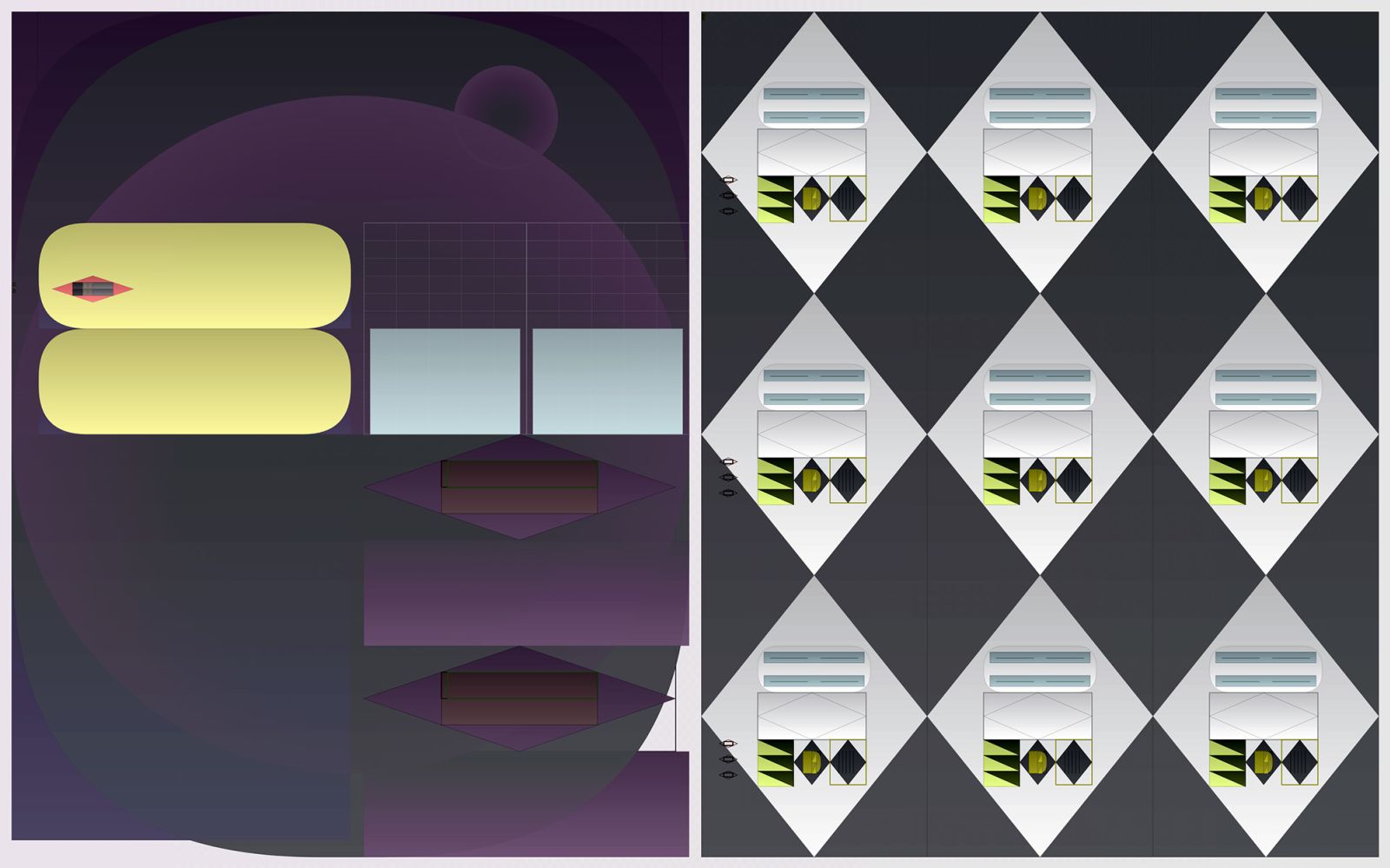
The software shows specimens side by side. On the left, a dark purple field is filled by a large circle, with two pale yellow rounded bars, two grey-blue rectangles and two flattened lozenges inside it. On the right, nine white diamonds stand on a dark grey ground, and each diamond contains the same motif: two grey bars, a box, and a row of three small shapes in yellow, olive and black. Shapes sit inside shapes; the specimen is a tree drawn as a picture. Where one specimen is a single nested figure, the other repeats one branch nine times.
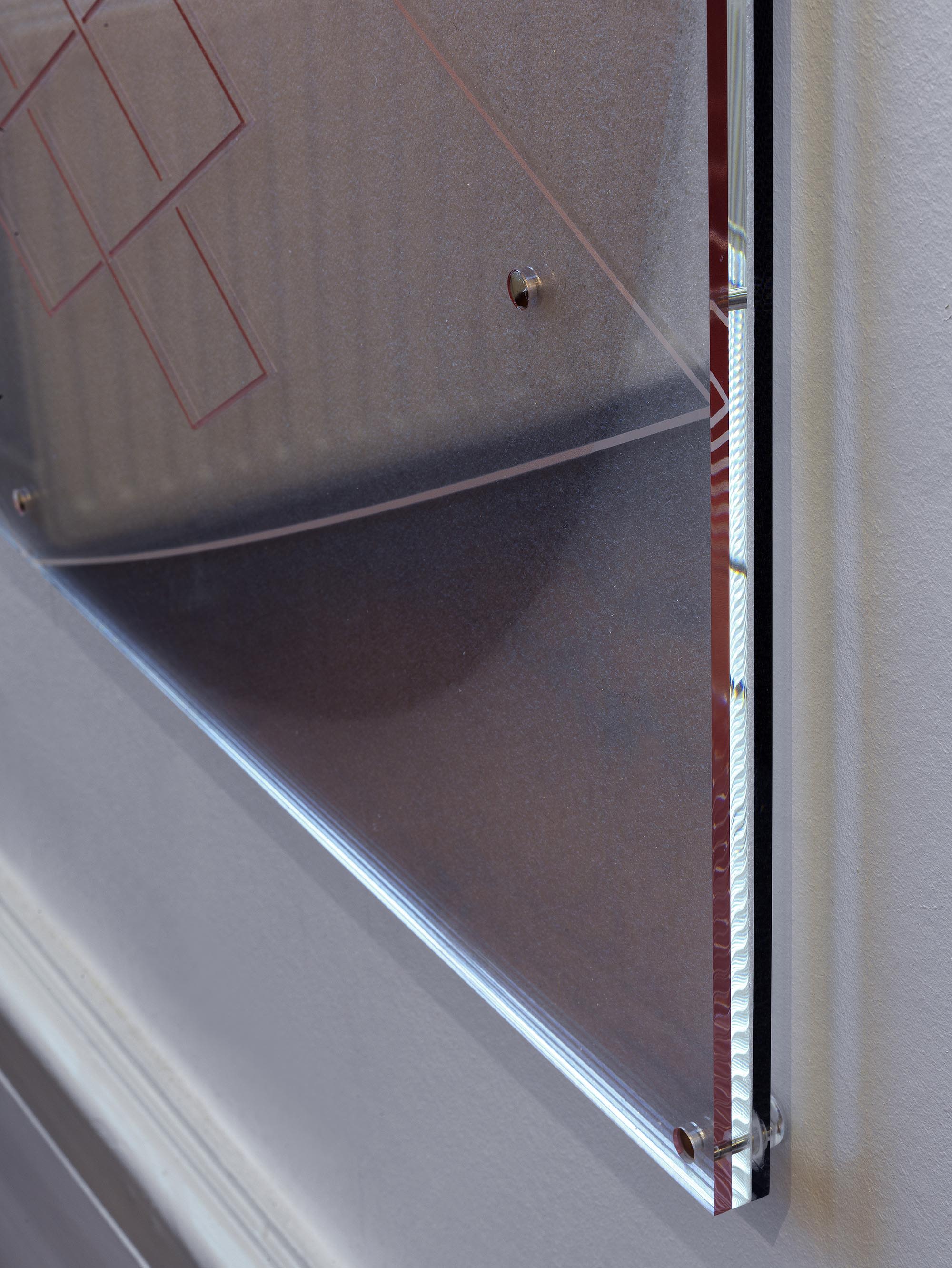
The detail shows how the panels are built. The front sheet is frosted and printed with the thin red lines of a diamond lattice; a curved line crosses it where a shape on another sheet ends. At the edge the sheets show as a stack of clear layers with one dark layer between them, and steel stand-off bolts keep the panel a few centimetres off the wall. The Art Viewer captions add "white channel between CNC-cut plexiglass" and "screw system". The Squircle describes the rounded square printed on Lammer Asbestos and the later squircles of Mutant Garden.
left gallery Explainer
left gallery's position in the show was an animation by van den Dorpel, left gallery Explainer (2018), "Software, no sound, loop, 21 minutes". The guide describes it as "an animated lecture" in the style of Khan Academy videos, connecting "digital ontology, artificial scarcity, tokenization, and provenance on the Ethereum blockchain", made by "combining his scribbly drawing style with subjective annotations" so that the subject might become "accessible – and perhaps sometimes even funny". It adds that he learned much of what he knows about cell division and genetics from Khan's videos, which joins the two halves of his contribution: the genetics of the specimens and the economics of the gallery were explained in the same register.
The timing matters. In 2018 he also deployed an ERC-721 contract and minted Ethereum tokens for the left gallery editions already sold, and offered Nested Exchange and Death Imitates Language works as set and wildcard tokens at tokens.harmvandendorpel.com (→ left gallery, Protocol, Taste, and Systems). In April 2018 he had opened an are.na channel called "I want to believe" and filed blockchain criticism in it beside left gallery's press. The show caught him building on the chain while keeping the doubts on file.
The same works in other shows
Nested Exchange was in three group shows within eight months (→ Nested Exchange). Six weeks before Berlin, at E-State Realisms in Miami Beach (July–September 2018), the software stood in a window over Lincoln Road beside framed prints and a "Wildcard Token Explainer" (→ E-State Realisms). Six months after it, at Vertiginous Data, MMCA Seoul (March–July 2019), four prints hung with the software and an explainer animation (→ Vertiginous Data). Simon Denny was in the Seoul show too, and in I Was Raised on the Internet at MCA Chicago in 2018, and he contributed a poster to left gallery's rite of access at Stroom Den Haag in 2019 (→ left gallery).
See also
- Proof of Work — exhibition text and guide — the Schinkel Pavillon text, the curatorial nodes, and the guide's entries on van den Dorpel and left gallery
- left gallery (2015–2022) — the gallery, its tokens, and rite of access
- Evolutionary Logic — the fitness functions, among them the "hipster algorithm"
- The Grid — nesting as the structure of the earlier generative work, and the move away from it
- Tokenising Sustainability (2021) — his later account of proof of work and proof of stake