
E-State Realisms (ArtCenter/South Florida, 2018)
E-State Realisms was a group exhibition at ArtCenter/South Florida, the Miami Beach non-profit since renamed Oolite Arts, on the second floor of 924 Lincoln Road, from 25 July to 30 September 2018. It was curated by Emer Grant, then a fellow at the centre, with work by the GALA Committee, Felice Grodin, Nicolas Lobo, Jillian Mayer and Harm van den Dorpel. The opening began with a panel on the GALA Committee and digital technology between Nora Khan and Max Wolf of Red Bull Arts New York, moderated by Grant (exhibition text and catalogue). Van den Dorpel showed Nested Exchange: the software, framed prints of its specimens, and a token explainer.
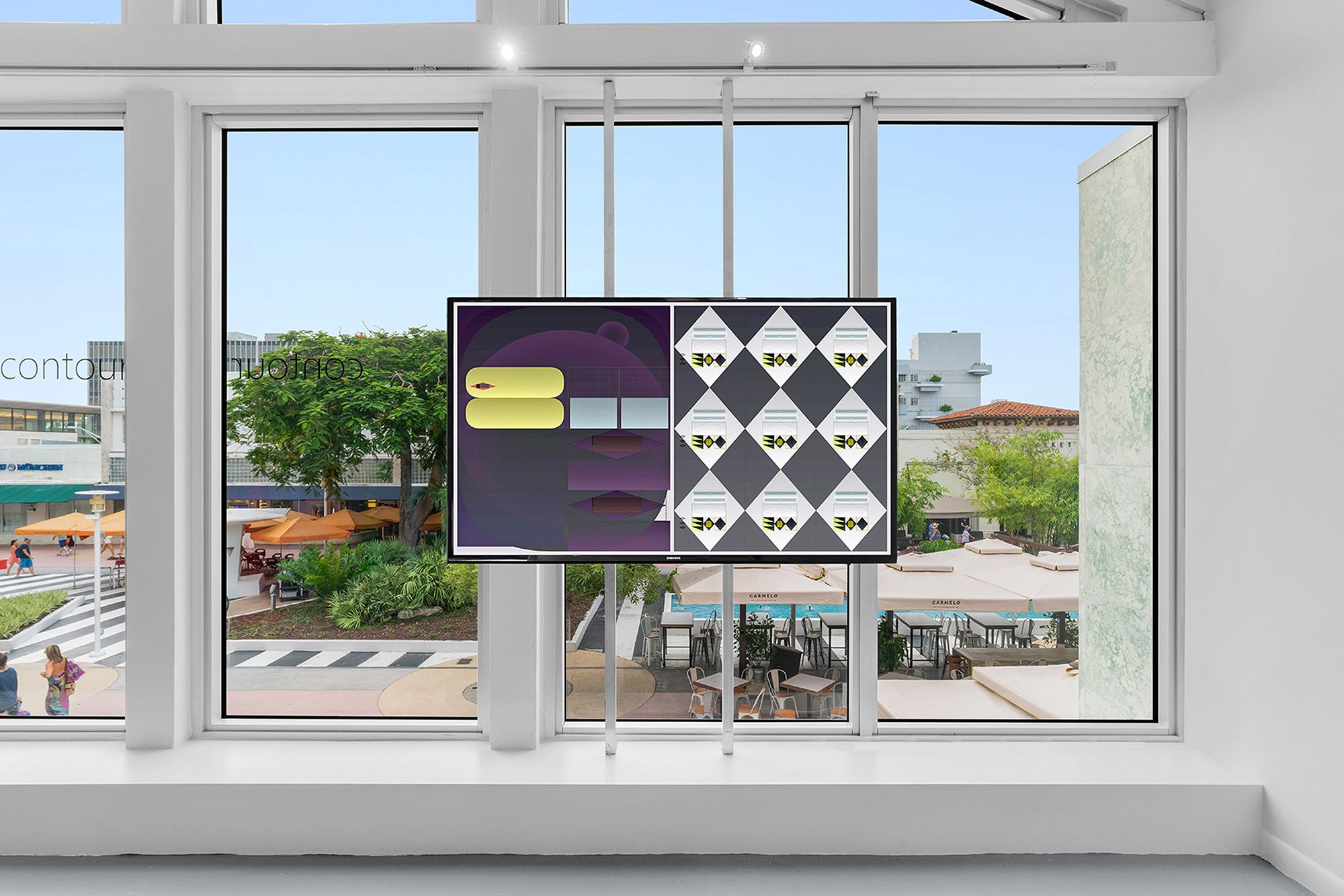
The screen hangs on two poles in front of the gallery's window, so the specimens are seen against the pedestrian mall below: palms, a café with umbrellas, shoppers. On it two specimens stand side by side, one purple with pale yellow rounded bars, one a lattice of white diamonds on grey.
What the exhibition argued
The exhibition text starts before the internet, with "rarely-exhibited works by the GALA Committee, the artist collective created by conceptual artist Mel Chin in the 1990s", which "flooded the popular soap opera Melrose Place with artworks as props in disguise". The props were later sold at auction "with this broadcast value factored in". From there the text moves to the present:
Artworks are now made to exist in two realms: the physical one from which they originate, and the digital one in which they continue to circulate globally. This digital manifestation of the object becomes a negation of the artwork, precisely because it creates a system of value based on circulation, not proximity or ownership.
"Complicity is inevitable for all involved: the artist, curator, institution and spectator alike." The works, it says, "tackle a range of topics from blockchain, to luxury real estate and e-commerce", and "Some are documents of pieces that exist purely online."
In her catalogue essay Grant reads Miami as "hyperreal, a composite of the unreal, the digital, and the fake", with Keller Easterling's term "extrastatecraft" for the private infrastructure behind it. Felice Grodin, an architect, showed 3D Assets, coloured columns and text about architecture built as investment; Nicolas Lobo Full Size Maquette of John Holding His Own Head, a 3D-printed bust made with his friend Jon after a fall from scaffolding, its scan detailed by digital labourers working remotely; Jillian Mayer E-Estonia Today, her pitch to become brand representative for Estonia's E-Residency programme. Grant ends on the claim that "artists are dealing critically with and not about the digital/IRL landscape. They are active players in the systems they critique."
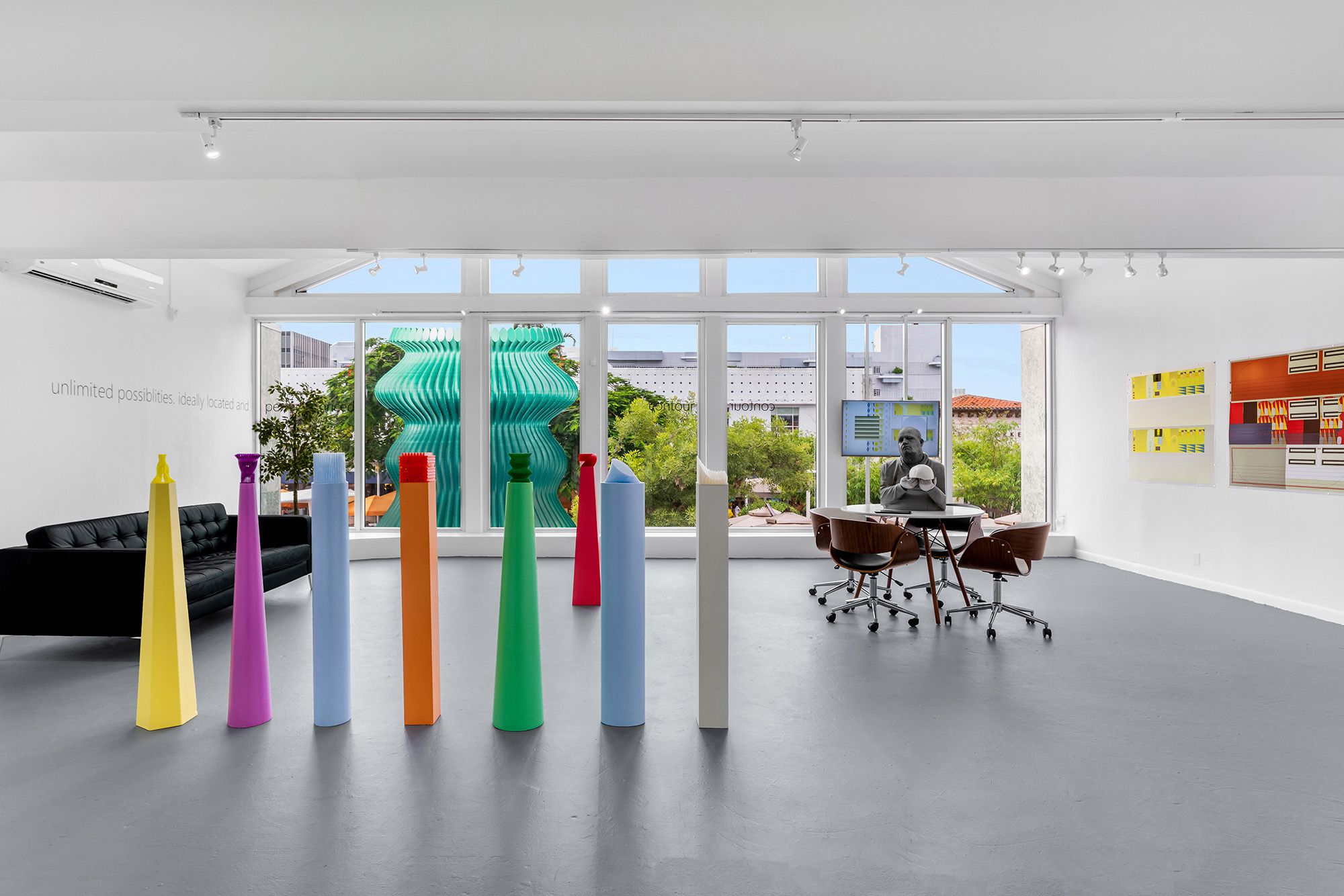
Grodin's columns stand in the foreground; behind them a wall text runs "unlimited possiblities. ideally located and", in the language of real-estate sales. Lobo's grey bust sits on a round table among office chairs. On the right wall hang two of van den Dorpel's prints, the yellow Peached Renitencies Mercer and the red and orange C. C. Rashes.
Nested Exchange in Miami Beach
The catalogue lists the software as Exchange, 2018, "Software, duration infinite, no sound", lent by the collector Hans van Luijk; harm.work catalogues it as Nested Exchange (2017). It reproduces five prints under three-word names: Peached Renitencies Mercer, Windbags Disfrocked Sensualist, Readjusted Electrotype, Specktioneer Globulous Literators in conversation with Classical Addable Uxoriously and Colonialists Criminate Rashes, all 2018. harm.work lists four of them for the show under shortened titles: C. C. Rashes, Sensualist (its address keeps the initials, w-d-sensualist), R. Electrotype, a print in UltraChrome inks on Hahnemühle paper, 100 × 100 cm, and the software; Peached Renitencies Mercer has its own page. The catalogue, published in September 2018, reproduces C. C. Rashes and Sensualist as 2018 works, the date the artist confirms (November 2026).
The prints are described one by one on Nested Exchange. C. C. Rashes, which hung on the right wall, is built of horizontal bands, an orange band ruled with thin lines above red and black blocks and red-and-yellow arched motifs, and repeats one pale panel with two dark-framed slots in several places: the same branch, copied into different parts of the tree.
Grant's essay, quoting van den Dorpel's 2018 presentation notes, gives the life of a specimen: "the artwork begins its life as a digital specimen that lives in the cloud. It is ascribed pseudo-biological properties such as a chromosome to breed and birth children across generations and form part of a population." Breeding happens by "exchanging genetic information, reframed as 'gossiping,' a nod to informal networks and their continued influence across power", and "The 'fittest' then make it through to become frozen as an immutable data set, appearing in E-State Realisms as prints." In the series text on harm.work the selection rewards difference: "each specimen is driven to be as different as it can be from those around it (I've also called this my 'hipster algorithm')" (→ Evolutionary Logic).
The token explainer
The prints were offered as tokens. Grant writes that "These works exist on the ethereum blockchain, where each artwork is assigned a speculative value mediated through the various iterations of presence and movement throughout culture", and Khan that "Visitors might buy a token through the exhibit". The catalogue reproduces three stills of a Left gallery token explainer (2018); the artist filed it on are.na on 28 June 2018 as "Wildcard Token Explainer", "As part of" the exhibition (block 2368362). The stills are white line drawings on a maroon-to-purple ground with subtitles: two boxes, A and B, either side of a spiral, "of a continuous algorithmic feedback loop"; a face with a question mark, "the artist complicates his agency"; three numbered rows of blobs, "across generations". At his token shop, tokens.harmvandendorpel.com, a "Wildcard Token" could be bought before the work it would be bound to existed, and bound to one later, once (→ Protocol, Taste, and Systems). Six weeks after the opening left gallery showed an animated left gallery Explainer at the Schinkel Pavillon (→ Proof of Work).
Pictures of looking
His section of the catalogue also contains two photographic works.
The first, captioned Gallery Museum Exhibition Show (2008), is three snapshots of an office room hung as an exhibition, with strip lighting, blinds and potted plants, in which the framed pictures show what is in the room: a woman with long auburn hair stands before a picture of the back of a head with long hair, a picture of a leafy plant hangs above a leafy plant, and three people with name badges stand under a picture of a pair of legs. They are the images harm.work issued in 2021 as the tokens Art Gallery 1, Art Gallery 2 and Art Gallery 3 of the JPGs collection. The token text says he first posted them in 2008 on the surf club Spirit Surfers as "INFOsembler", and that "The photos used were accidentally found with Google Image Search, and manipulated with Adobe Photoshop": the contents of the frames were replaced with details from the same photograph (→ Small Collections, Surf Clubs).
The second, Installation view (2018), a work of his (the artist, November 2026), ends the section: three framed photographs of two women in white T-shirts looking at small works on a white wall. The same three photographs hang on the wall behind Lobo's bust in the installation view below. Grant's essay says that "Three images show how the act of looking co-authors the work, its essence scattered and its aura seemingly impossible to pin down"; these three are probably what she means. Both works put the viewer, and the documentation of the viewer, inside the picture, as his formula The Work = The Work + Its Documentation puts the record of a work inside the work (992; → Mediation and the Archive).
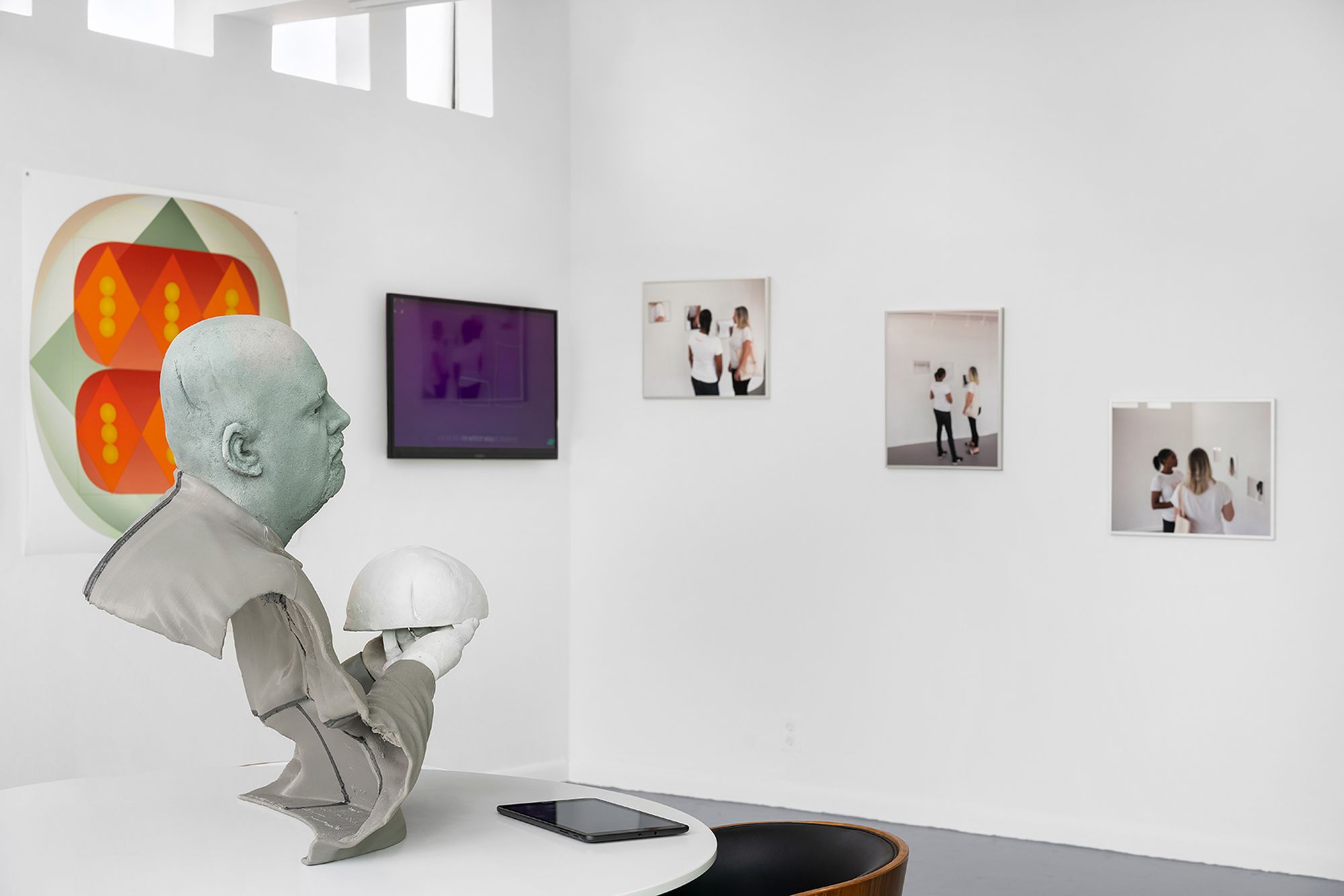
On the left wall, behind the bust, hangs Sensualist: two red rounded bars, each holding three orange lozenges with three yellow dots in each, laid over a green diamond inside a rounded square.
Nora Khan: Associative Systems
Nora Khan wrote the catalogue's essay on van den Dorpel, "Associative Systems" (summary and quotations). She had written on Death Imitates Language for Art in America ("Family Function", edited by Brian Droitcour) and first saw Nested Exchange in person at Pattern and Presence, his solo show at Upstream Gallery, Amsterdam, earlier in 2018. Of the prints of both series she writes: "They are frozen artifacts pulled from a living, generative process. They feel like the work of an alien that came down and only studied abstract art."
Her reading of Nested Exchange is that its "tree-shaped chromosome ledger exchange" is "organized around a different principle" from Death Imitates Language: "how we create provisional and changeable meaning through exchange of information, communication." The work is "multilayered commentary: on how gossip functions as a network, on the social construction of any one piece of information about anything, on the internet as architecture that accelerates this." She demonstrates nesting with a sentence that grows ambiguous as clauses are embedded in it, and reads the prints as what "each flipped node, each communication exchange produces: rising moons of suggestion, graying or lightening waves of drama". The artworld's own valuation of objects, she adds, works the same way.
On the tokens she is guarded: the ledger is one more way "to track the aesthetic as a commodity", while "the essence and aura escape", and she asks, "if we know what happened to the open web, how subversive will blockchain be?" The second half of the essay is about Deli Near Info, his social network without a feed, which she compares to Aby Warburg's Mnemosyne Atlas and calls "an alternative to the rigidity of interface and system design". Seven years later Droitcour discussed both Death Imitates Language and Deli Near Info in his account of "protocol art" (→ Protocol, Taste, and Systems).
Grant's essay opens with a conversation with van den Dorpel about "decentralised networks as inspiration": the moment of waking in a dark room when "furniture is recast as looming figures, lighting becomes texture", before "consciousness becomes the computation that sorts the visual environment into a reality that permits bodily response". She calls that "alien dimension of haze, randomness, and anarchy before the reassertion of cognition" the space the exhibition occupies. The wiki's page on Subconscious Computation collects his other statements about outputs that arrive before the deciding mind does.
A year later Grant co-curated, with van den Dorpel and Lua Vollaard, left gallery's rite of access at Stroom Den Haag (→ left gallery).
See also
- E-State Realisms — exhibition text and catalogue — the Oolite text, the list of plates and Grant's essay
- Associative Systems — Nora Khan — the catalogue essay on van den Dorpel
- Proof of Work (Schinkel Pavillon, 2018) — Nested Exchange in Berlin six weeks later
- Vertiginous Data (MMCA Seoul, 2019) — four of the prints in Seoul
- Protocol, Taste, and Systems — the 2018 token shop and Droitcour's protocol art
- Evolutionary Logic — the "hipster algorithm" among the fitness functions