
Maschine (2023)
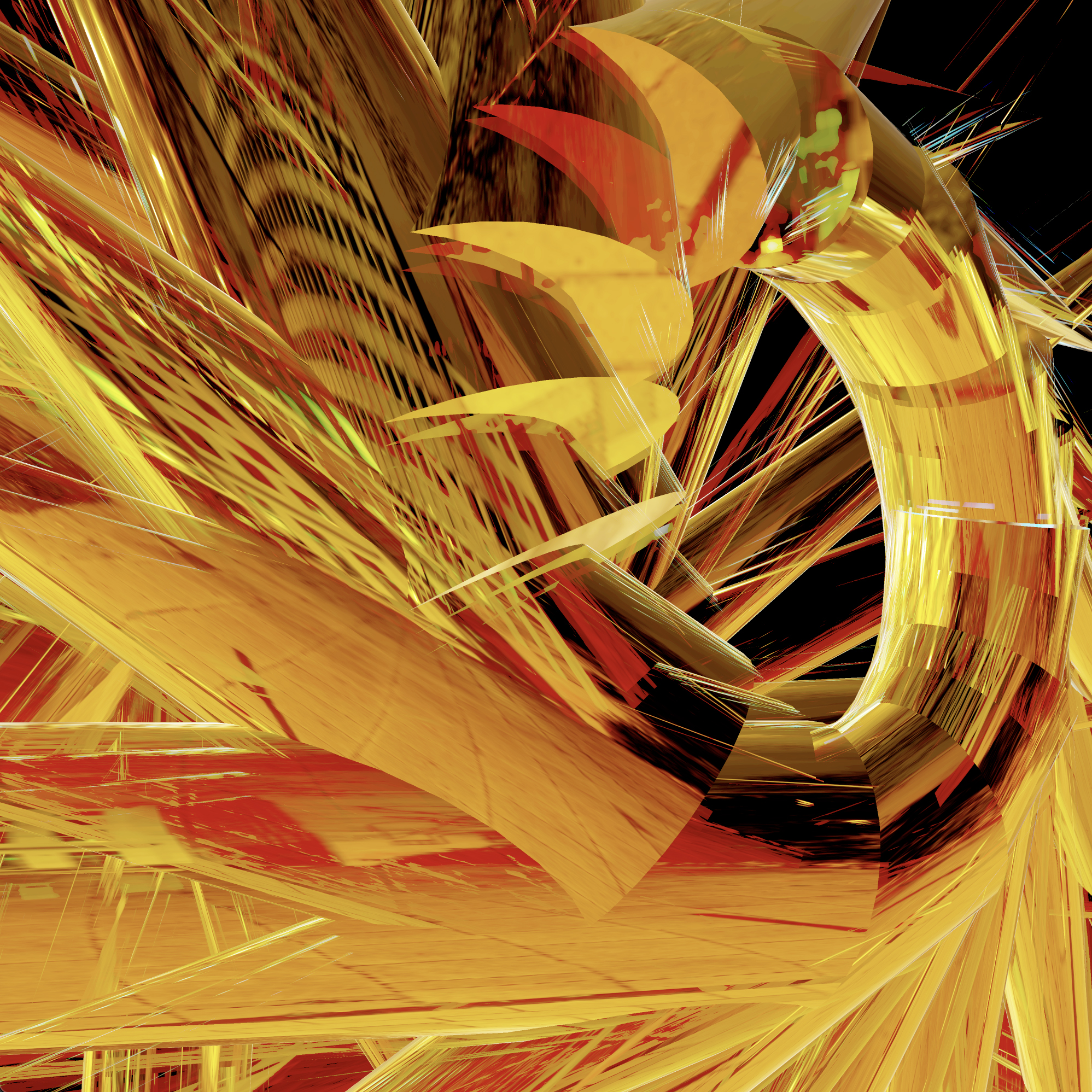
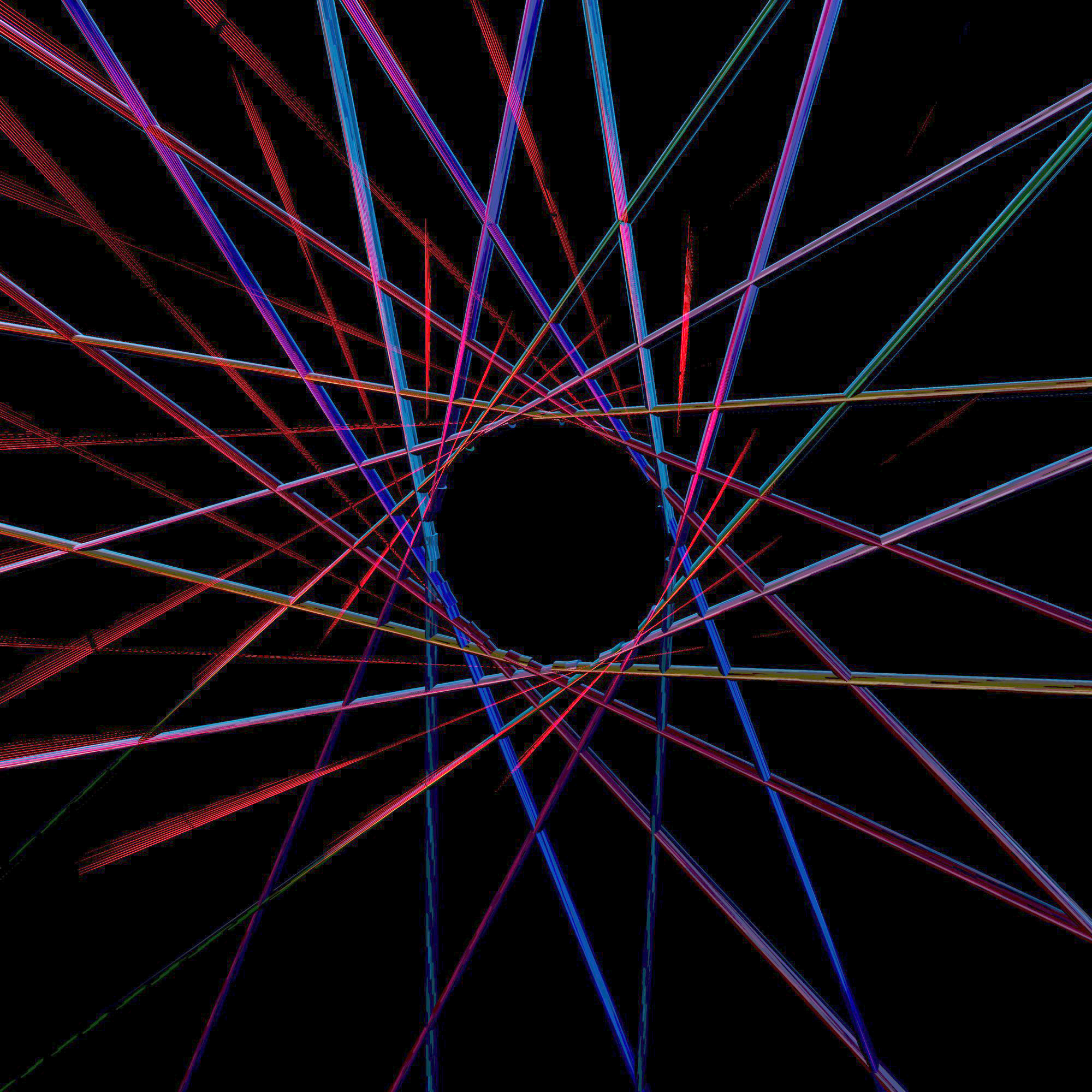
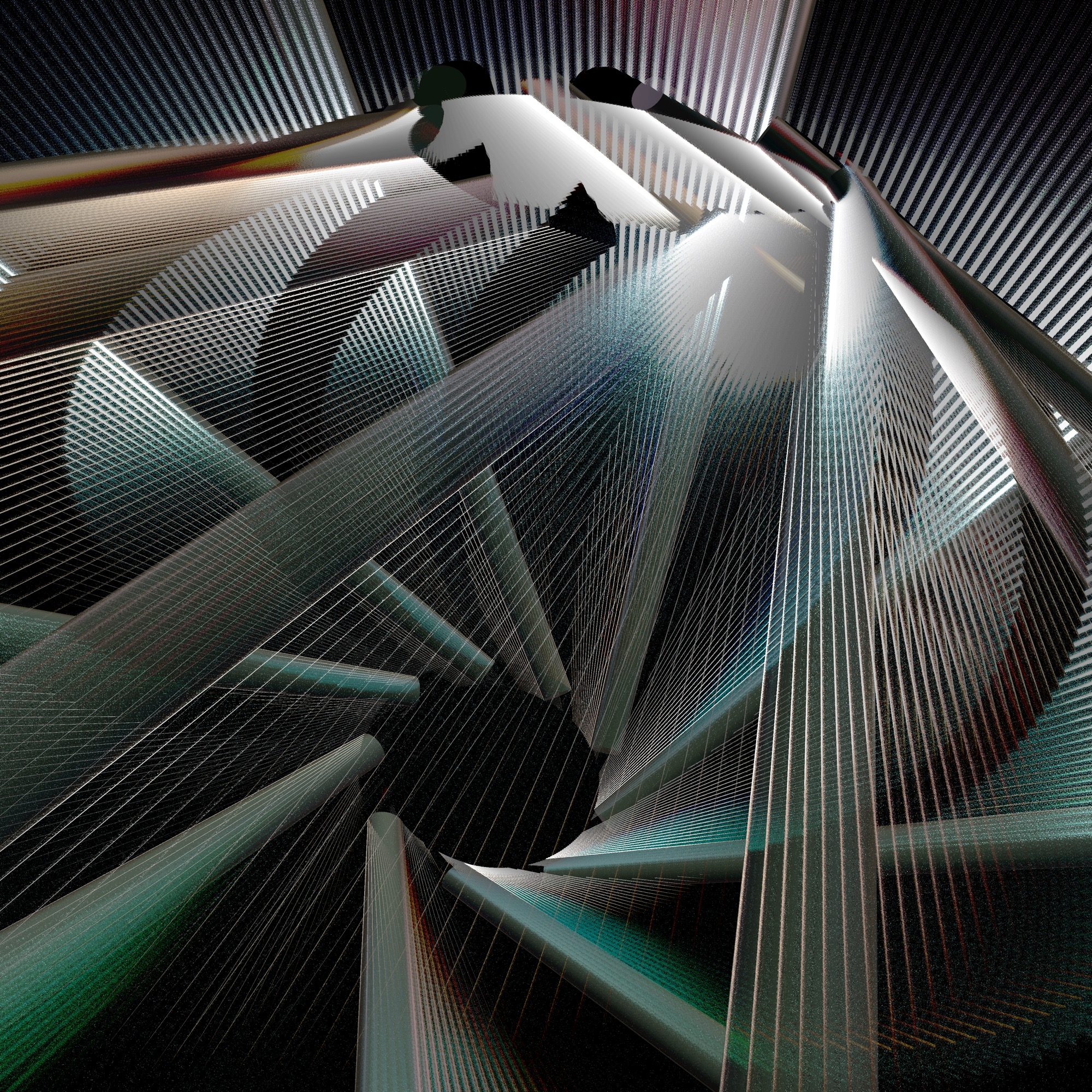
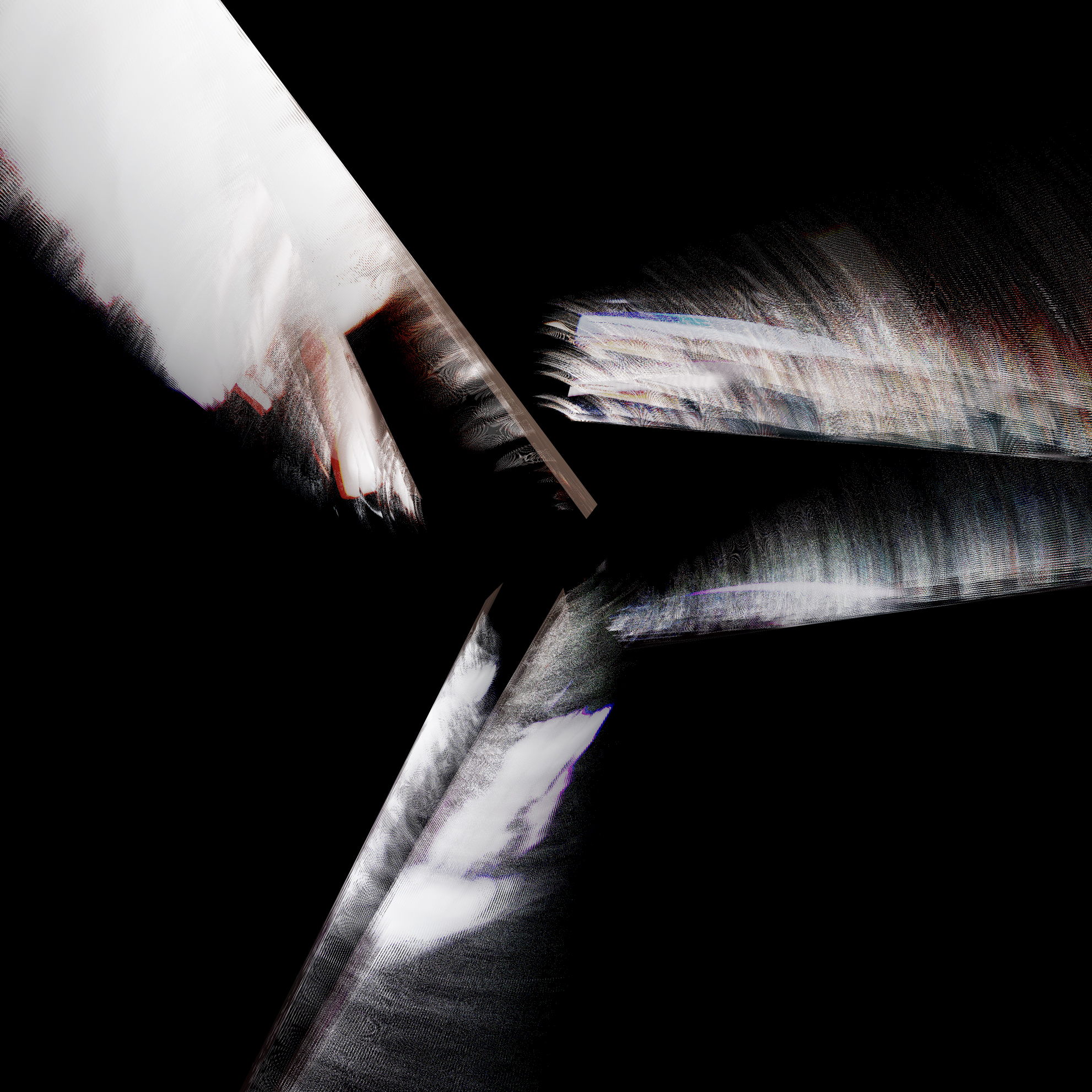
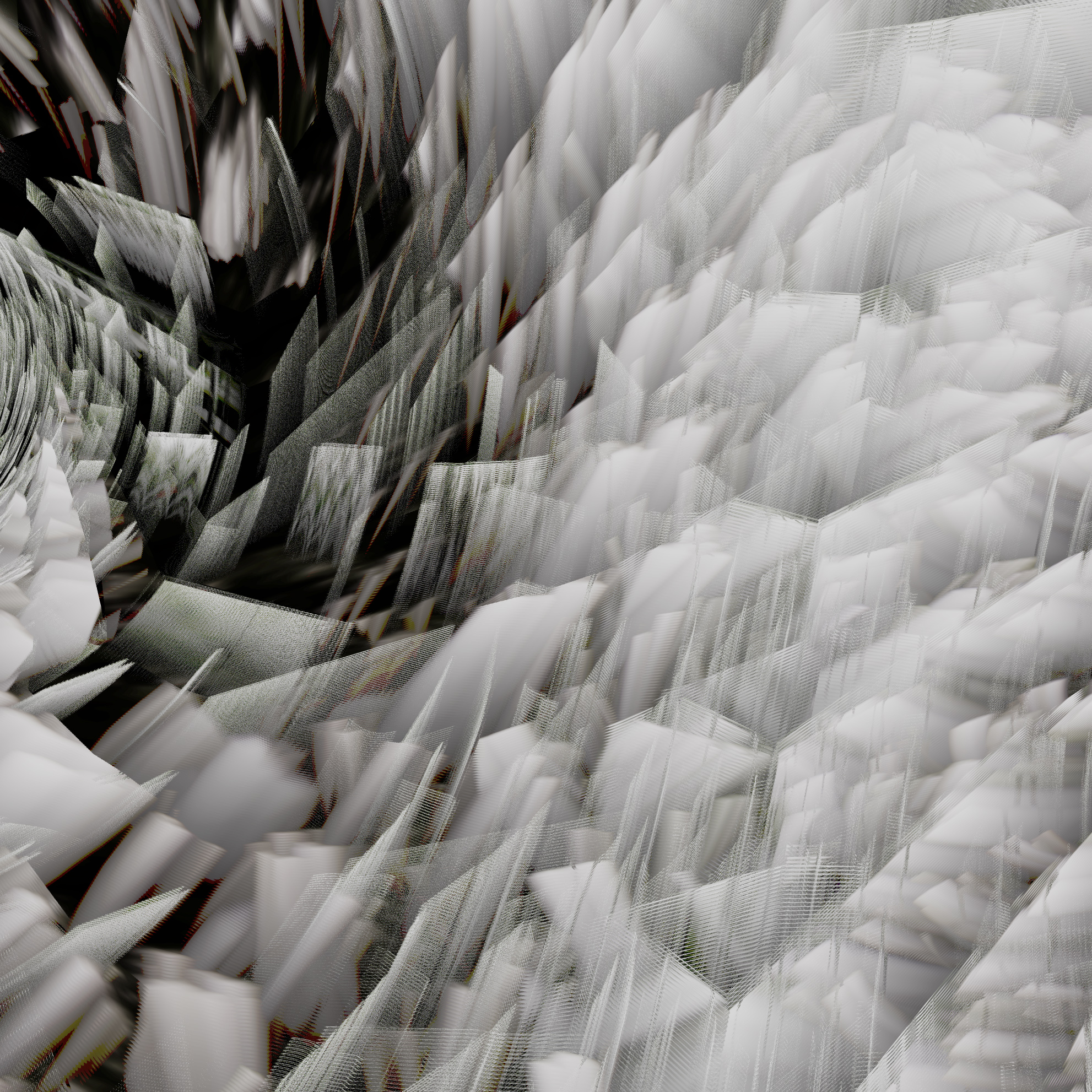
Maschine (German for machine) is a collection of 1,000 tokens on Ethereum, which harm.work describes as "a collection about velocity and perception, created by Harm van den Dorpel in collaboration with Fingerprints DAO & Mercedes-Benz NXT, 2023." Mercedes-Benz commissioned it; Mercedes-Benz NXT was the carmaker's unit for digital collectibles, and Fingerprints DAO, a collectors' organisation for generative art, guided the project and sold the tokens on its website on 7 June 2023 in a rebate Dutch auction, where the price falls until the edition sells out and earlier buyers are refunded the difference (Upstream Gallery announcement). Each token runs as a full-screen animation in the browser: a wheel seen at speed in three dimensions, its spokes leaving trails of light.
The artist's account of the work is a text published on harm.work on 27 June 2023, written in his first person "as told to Habib William Kherbek", who also edited the Markov's Dream essay and wrote the Struggle for Pleasure press release. It is ingested in full as Maschine (sources/ingested/maschine-writing-2023.md), and this page reads it.
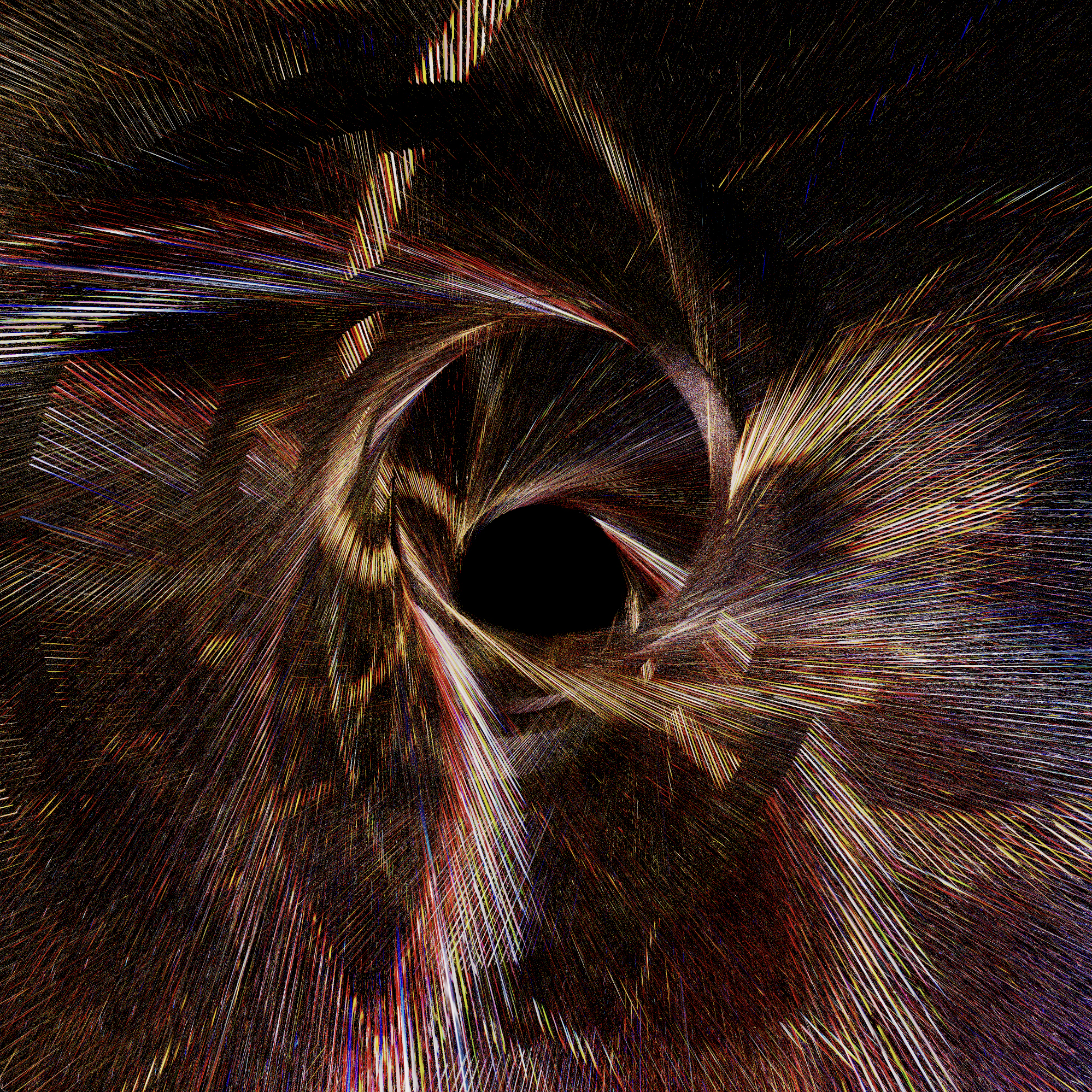
Fine streaks of gold, white and red curve into a black hole at the centre, so densely that the spokes they came from can no longer be counted. This is the token whose animation harm.work shows beside the text; its traits are the environment "berlin", 13 spokes, "full" afterimage trails and a "reflective" material.
Rims that turn backwards
The text opens with music. "Though I haven't been a particular aficionado of the automobile growing up, I have always loved and been inspired by music," and thinking about the commission he found himself "increasingly drawn to hip hop videos where often high performance cars play a central role as aspiration, inspiration, and sometimes as alternative protagonists." He was drawn to the rims: "As a car appeared to accelerate, for example, glittering spinning rims inside the wheel would often appear to slow down and move in an antagonistic direction. The image worked as visual paradox, but also as physics puzzle."
The announcement names the effect: the wagon-wheel effect, "by which spoked wheels appear to rotate in a way that seemingly contrasts with their true speed and direction." On film it arises because the camera records the wheel at a fixed rate: when the wheel turns slightly less than the angle between two spokes from one frame to the next, each spoke seems to have moved a little backwards, and the wheel seems to turn slowly in reverse. A spoke count is therefore a variable of the illusion, and the collection makes it one of its traits.
From the rim he moves to its structure, "the hub-and-spoke structure in which rotating projections spin at the edges of an essentially stationary hub, creating an effect defined by both stillness and motion", and from there to the spiral: "The spiral form is not merely a visual structure, it is also an informational structure; one may think of the groove in a vinyl record, or the spinning of a hard drive in a computer's housing." The collection's sign on harm.work, set between title and description in every token ("Maschine ✇ a collection about velocity and perception…"), is the Unicode character named TAPE DRIVE, a reel. The material came from the company itself: he photographed "the rims of various models of Mercedes-Benz, perhaps to the bemusement of the workers who let me into the storage rooms."
The tracer: a painting's wheel in three dimensions
The Upstream announcement calls Maschine his "first work fully in 3D". The text gives the problem he set himself: 3-D imaging produces immersive "environments" that "rely on familiar expectations which make it difficult to avoid cliches or established visual tropes." His answer was a tracer, an effect that would "leave behind a trail of light as the image rotated." That trail brings back what a flat picture does: "The spinning wheel in a painting spins in our minds; in a 3-D version, the wheel just spins. I sought a way of weaving these two regimes of seeing together so that the work contained elements of 2-D aesthetics and 3-D aesthetics."
The trail has its own trait, "afterimage trails", with three values: "full" on 778 tokens, "strong" on 221 and "mild" on one, Maschine ₈. The wiki's page on the afterimage follows the same trace from Duchamp's Rotoreliefs through Markov's Dream #10 and #9, which turn flat on the picture plane, and reads the Maschine are.na channel (opened 13 January 2023), whose screenshots show the disc tilted and then the viewpoint moved down a tunnel into it. Read beside that page, Maschine is where the afterimage stops being the eye's and becomes the image's: the trace is drawn into the frame.
A visual synthesiser and a network that learned his preferences
"I began to develop something like a visual synthesiser," the text continues. As a musical synthesiser yields endless sounds from "three essential parameters (filtering, amplification, and signal oscillation)", he built "a simple set of visual parameters I could adjust to alter the images." The token traits on harm.work read as that synthesiser's settings:
| Trait | Values across the 1,000 tokens |
|---|---|
| spokes | 2 to 20 |
| spoke type | single sharp, single round, single round alternating, double round, double round alternating |
| material | complex (404), fixed carbon fiber (212), reflective (181), iridescent (172), diffuse (30), golden (1) |
| afterimage trails | full (778), strong (221), mild (1) |
| colours | eleven palettes, among them dark, light, bright, corporate, optimistic, scala, rgb and three custom sets |
| environment | eighteen, among them escape, circuit, grim, moon, studio, forest, lab, canyon, neon, garage and berlin |
The materials answer a sentence of the text: "I explored the ways in which different materials produced different iridescence and light fracturing under the effects." The rarest values all fall among the first tokens: the only golden material is Maschine ₁, the only white colouring and the only "cloudy" environment are Maschine ₁₁, the only mild trails Maschine ₈.
A thousand images "was beyond my physical limits, and so I turned to another technology for help: neural networks." He used "a kind of 'off the rack' neural network consisting of only three layers (an input, a single 'hidden layer' where operations take place, and an output layer), and submitted the images to the network with parametric input from me regarding which images I preferred." The announcement says the same from the other side: he "created and trained a neural network to identify and select generated outputs in line with his own artistic preferences," the first time he used "a custom neural network". Read together, the network was a learned version of his own choice. The synthesiser proposed settings; a model trained on what he had preferred judged them.
This is the selection step of his earlier breeding systems in another form. In Death Imitates Language (2016) he chose which specimens lived; in Hybrid Vigor the visitors chose; in Mutant Garden Seeder the collectors (→ Evolutionary Logic). In Maschine a small network stands in for the artist at a scale he could not judge by hand, and the result still surprised him: "the effects created were often surprising even to me." The wiki's reading of where the deciding mind goes in such systems is on Subconscious Computation and Protocol, Taste, and Systems.
Kupka, and technology that moves backward
The text places the images in "an aesthetic lineage". He "recalled the work of an early pioneer of abstraction", František Kupka, whose painting Around a Point he had filed in the are.na channel on 20 February 2023 and whose image the published text carries. Kupka's works, "rather similar to the works of other early abstractionists including Hilma af Klint and Wassily Kandinsky touch on themes of transcendence and divinity, an escape from earthly strictures. This longing, and its frustration, became touchstones for this work."
The other lineage is the one he refuses. "Movements such as the Futurists or the Vorticists, inspired as they were by early technological advances in the 20th century, embraced a one-sided approach which fed into the grotesque political viewpoints which have come to define their legacies. To believe such mythology about the capacity for technology to liberate was naive in the extreme then; today it is simply fatuous." His own position follows: "Technology may well move us forward, but it may also move us backward - perhaps even at the same time. These are the kind of contradictions that animate my work."
The wheel that seems to turn backwards while the car speeds up is that sentence as an image. Speed and the impression of speed part ways, and the image keeps both. The artist does not draw this link; the wiki does. A work commissioned by a car company, about cars as what they "signify in our culture" rather than their "physical reality", is built on a perceptual error, and its text grants the company's own theme, "the potential for advanced technology to empower, and to liberate", only as "an evocation that speaks to people".
Release and exhibition
The Upstream announcement credits Gorden Wagener, Mercedes-Benz's chief design officer, with working "closely with van den Dorpel to creatively shape the concept and coordinate creative directions"; the artist's text does not mention him. The auction was open only to collectors in the EU, Brazil, Japan, Singapore, the United Kingdom and the United States, "due to regulatory and taxation requirements". Maschine was shown at the DA Z Festival in Zürich from 31 October to 10 November 2024 (Upstream Gallery). Earlier, Maschine ₇ ran on a monitor in the group show Mixed Feelings at Upstream Gallery, Amsterdam, 1 July – 5 August 2023 (→ Mixed Feelings).
See also
- Maschine — the artist's text, in full
- Upstream Gallery announcement (2023) — the release, the wagon-wheel effect, the neural network
- Afterimage — Duchamp's Rotoreliefs, Markov's Dream #9 and #10, and the Maschine are.na channel
- Evolutionary Logic — the selection criteria of the breeding systems, against which the trained network is one more
- Protocol, Taste, and Systems — taste made explicit and handed to a system
- Quantization and Dithering — the hardware lineage of a later collection, against this collection's 3-D rendering