
Cloud Writings — Plotter Drawings (2024–2026)
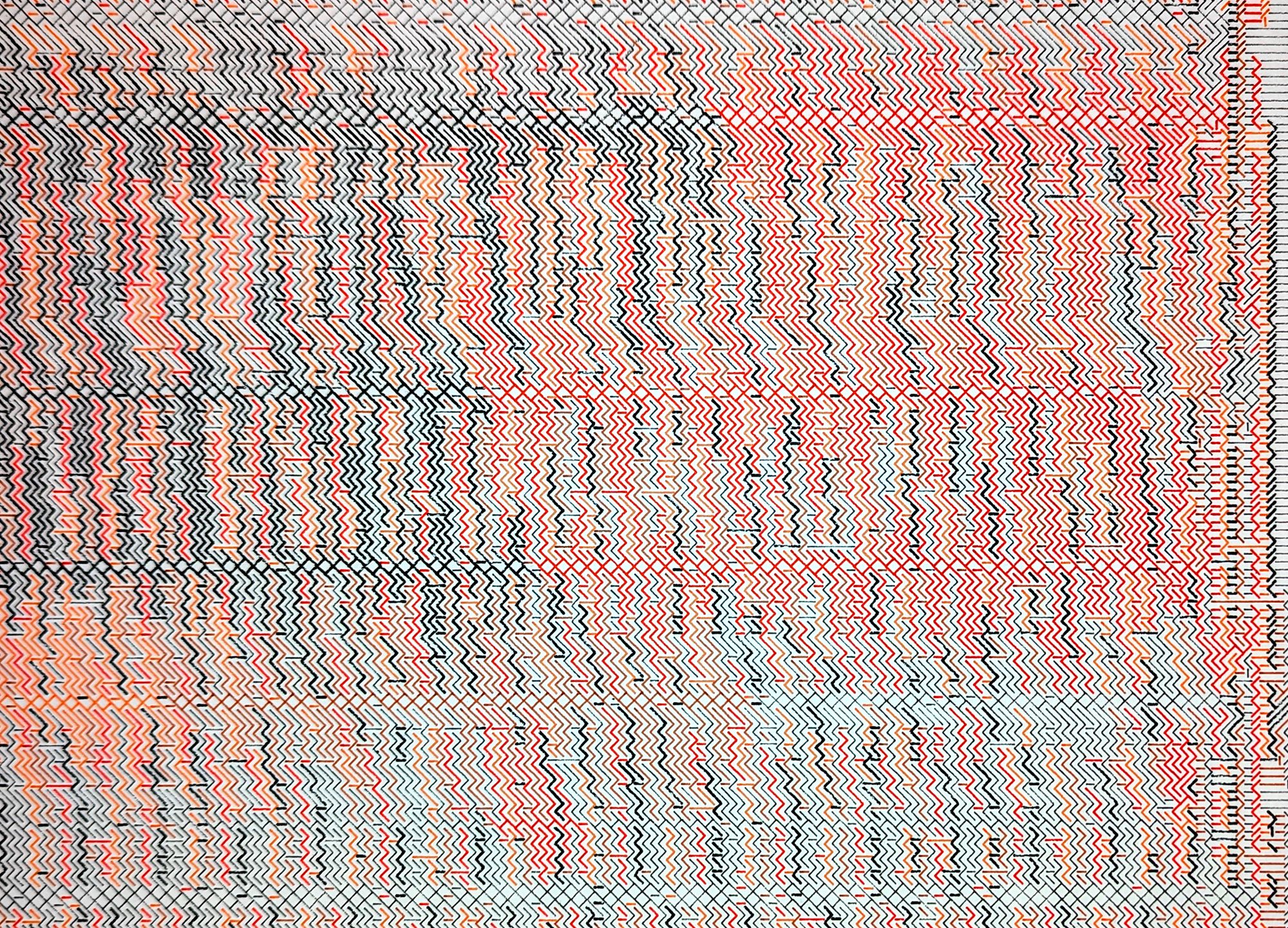
Cloud Writings is an "ongoing series of plotter drawings on paper and PVC", in the words of harm.work, "premiered in the exhibition Angles Morts". The series page was set up on 22 April 2024 and now lists 36 works, the last of them Tract (2026). Twenty-one hung in Angles Morts at LOHAUS SOMINSKY, Munich, in the autumn of 2024, beside works by Vera Molnár (→ Angles Morts). His first solo exhibition at Takuro Someya Contemporary Art, Tokyo, Cloud Writings (2026), took the series' name and showed two of its drawings among later work (→ Cloud Writings, Tokyo).
The image above, uploaded on 23 April 2024, shows the construction most of the series shares. The sheet is a grid of small cells, and each cell contains one short straight line: horizontal, vertical or one of the two diagonals. A run of cells with the same orientation becomes one long stroke, alternating diagonals become a zigzag, and where the orientation keeps changing the lines close into a maze. In his statement for the Tokyo show the artist describes the drawings as "composed of two-dimensional grid structures: rows and columns of repeating elements. They refer to the process of writing text and the process of weaving textile." The groups below follow those rows and columns, and the other ways in which a rule can change across a sheet.
The cell and the plotter
The Grid names the program behind several of the drawings. Vermis, Current, Atlas, Girl/Boy Song, Sediment and Tract run the rotating-line algorithm of Pression des pairs (2024), his generative animation after Molnár's Quatre éléments distribués au hasard (1959). That program writes the grid in reading order and draws each cell's orientation by weighted chance from four cells already written: two to its left, one above and one above-right. Lines that continue one another, or meet in a chevron, form a group and take one colour (→ Interruptions). The patches and streams of colour in the drawings look like such groups. For the other sheets no source names the program, but they show the same cell.
Three texts on harm.work name what varies. For Poles and Valley: "Probabilities transition gradually based on the coordinates within the canvas (x/y)." For Atlas: "The probability of downward diagonal streams increases towards the bottom side of the drawing, creating the impression of curvature, as if hovering a planet." When the chances depend on position, the field changes character from one edge of the sheet to the other.
The machine adds what the program does not specify. The harm.work text for Sediment says so: "The plotter itself is an unpredictable mechanical device: as it draws, it introduces its own texture of aberrations such as slight slips, pressure variations, and pens wearing out, that no part of the algorithm specifies." In Embroidery the artist turned one of the plotter's habits into the image: for some black lines he left the pen down while the machine moved to the next location, which drew "threads" between the cells, "reminiscent of the backside of traditional embroidery" (harm.work; → Angles Morts, Process Legibility).
The first sheets: Coral, Ridge and Cliff
Six drawings were entered on harm.work on 22 April 2024, the day the series page was made. Three of them, Weaving, Cuneiform and Scene, later hung in Munich. The other three are smaller sheets, 36 × 48 cm, drawn with a Sakura fineliner on Hahnemühle paper, and they remain unpublished on harm.work, two of them with the note "(cell phone photo)". In these three the field is sparse: many cells are empty, and single lines can be followed across the sheet.
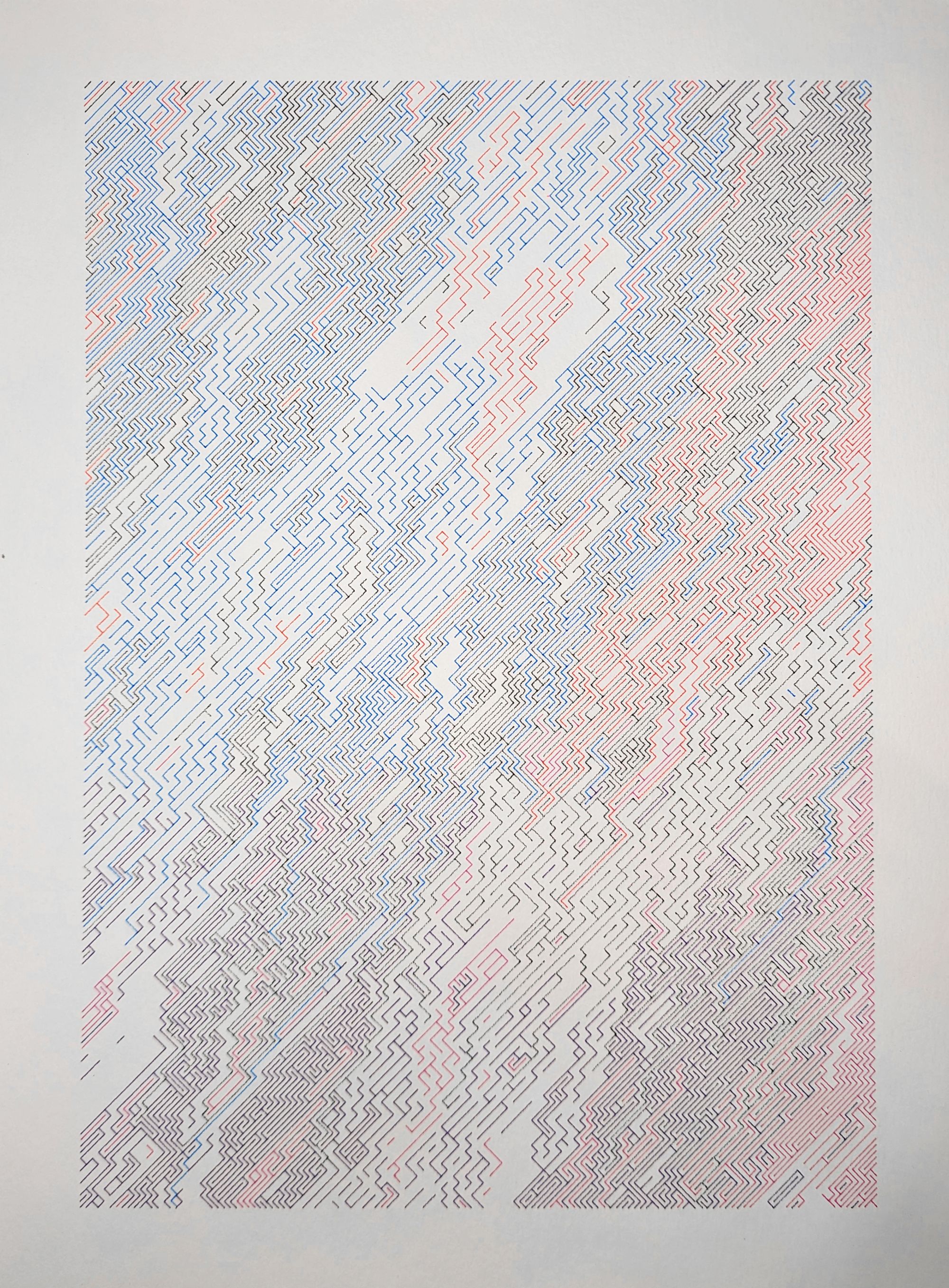
In Coral the lines are diagonals that turn into one another at right angles. They form corridors one cell wide that branch and dead-end, a maze with patches of empty paper between its arms.
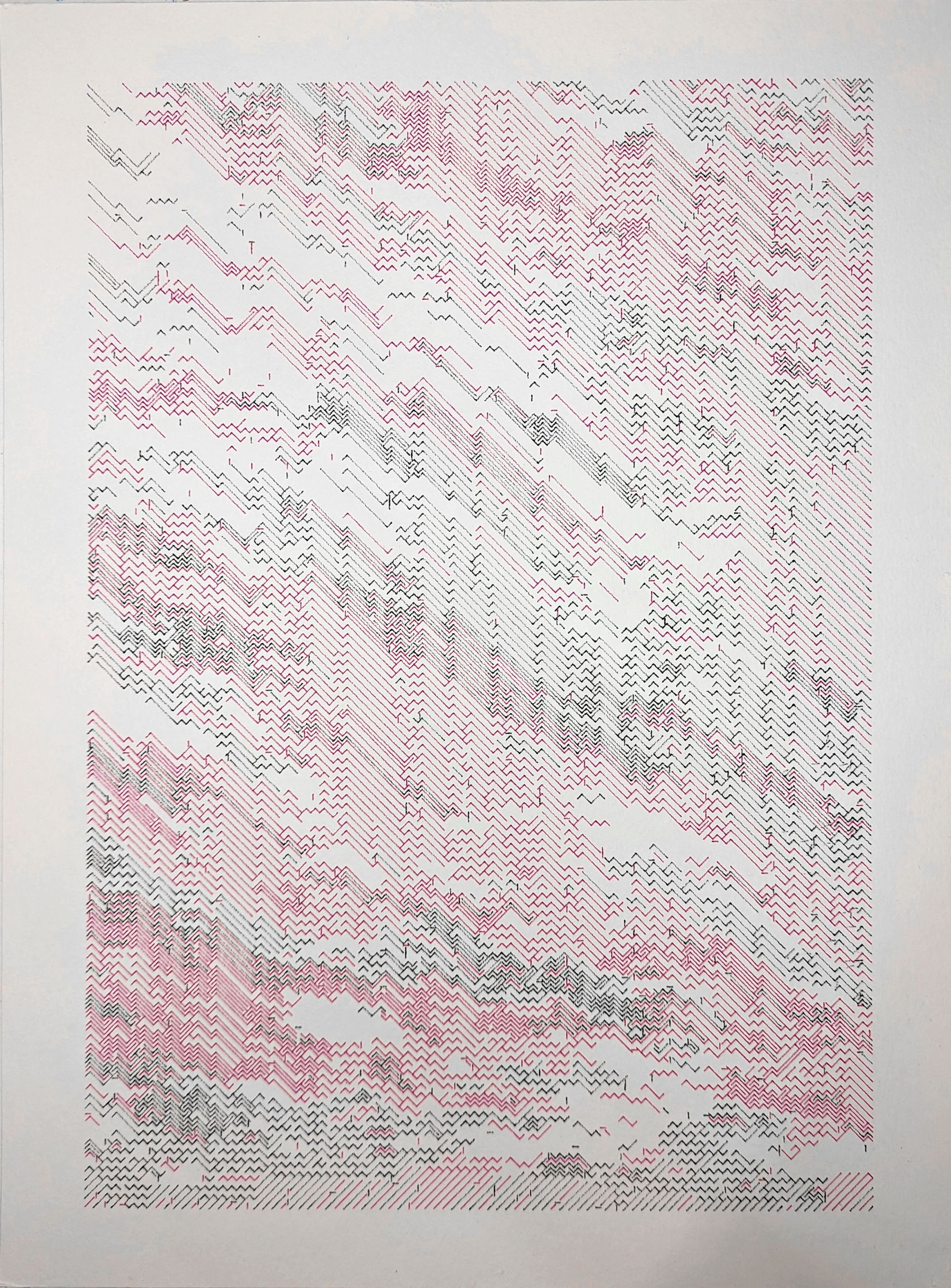
Ridge runs mostly one diagonal, descending to the right in long parallel strokes. Where the orientation alternates, the strokes turn into zigzags, and blank bands cross the sheet between the drawn ones. Toward the foot of the sheet the rows close up into horizontal zigzags.
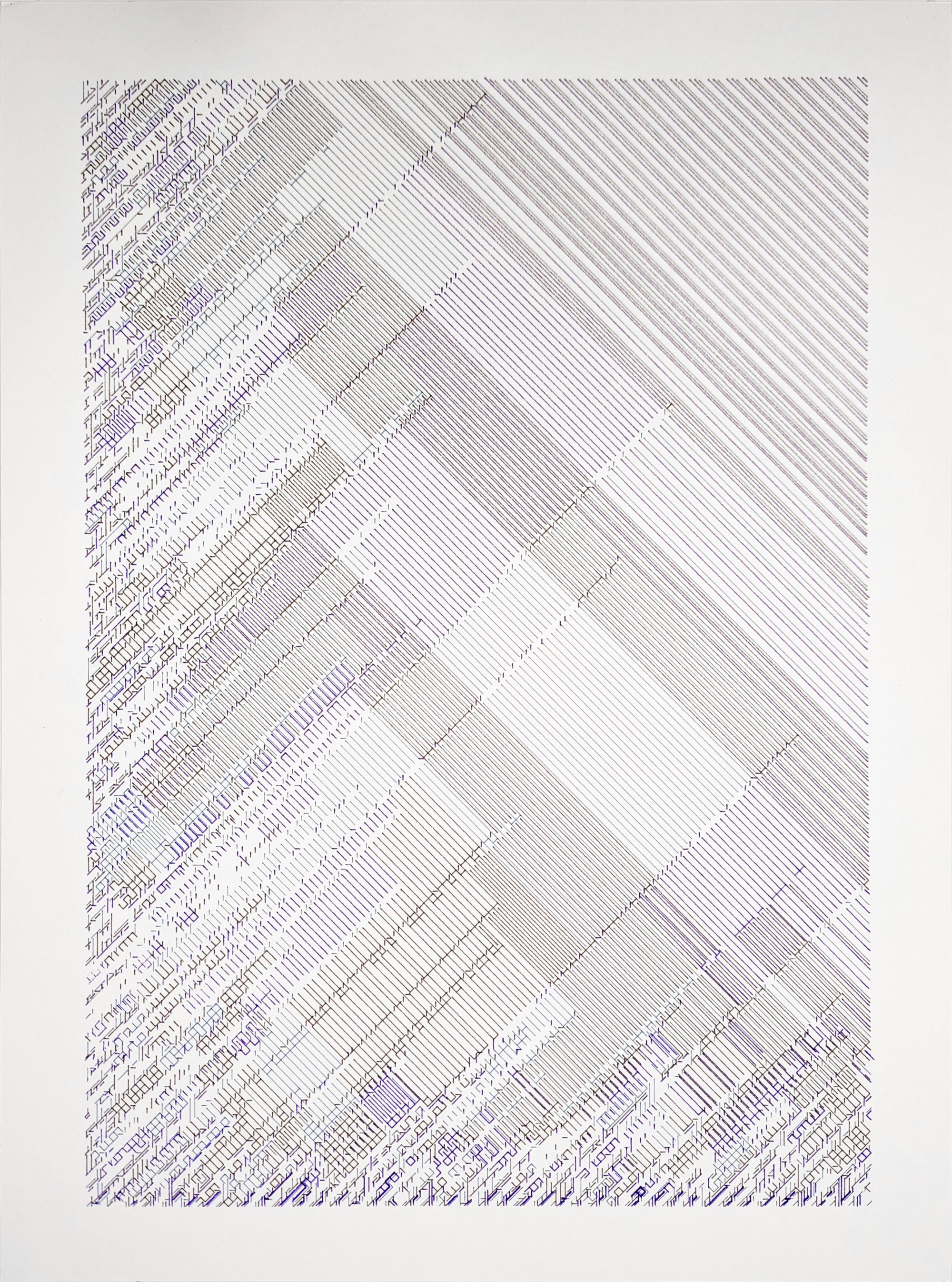
Cliff fills its right side with long parallel diagonals. Toward the left they break into short fragments and empty cells, and blocks of denser and lighter hatching step down across the field.
Rows: Weaving (square), Vapour and Scene
The two crafts of the Tokyo statement are plainest in the sheets built row by row. Weaving and Cuneiform, both on Hahnemühle paper, set short marks in horizontal lines like lines of script; Weaving is shown on Algorithmic Archaeology, Cuneiform and its title on Angles Morts.
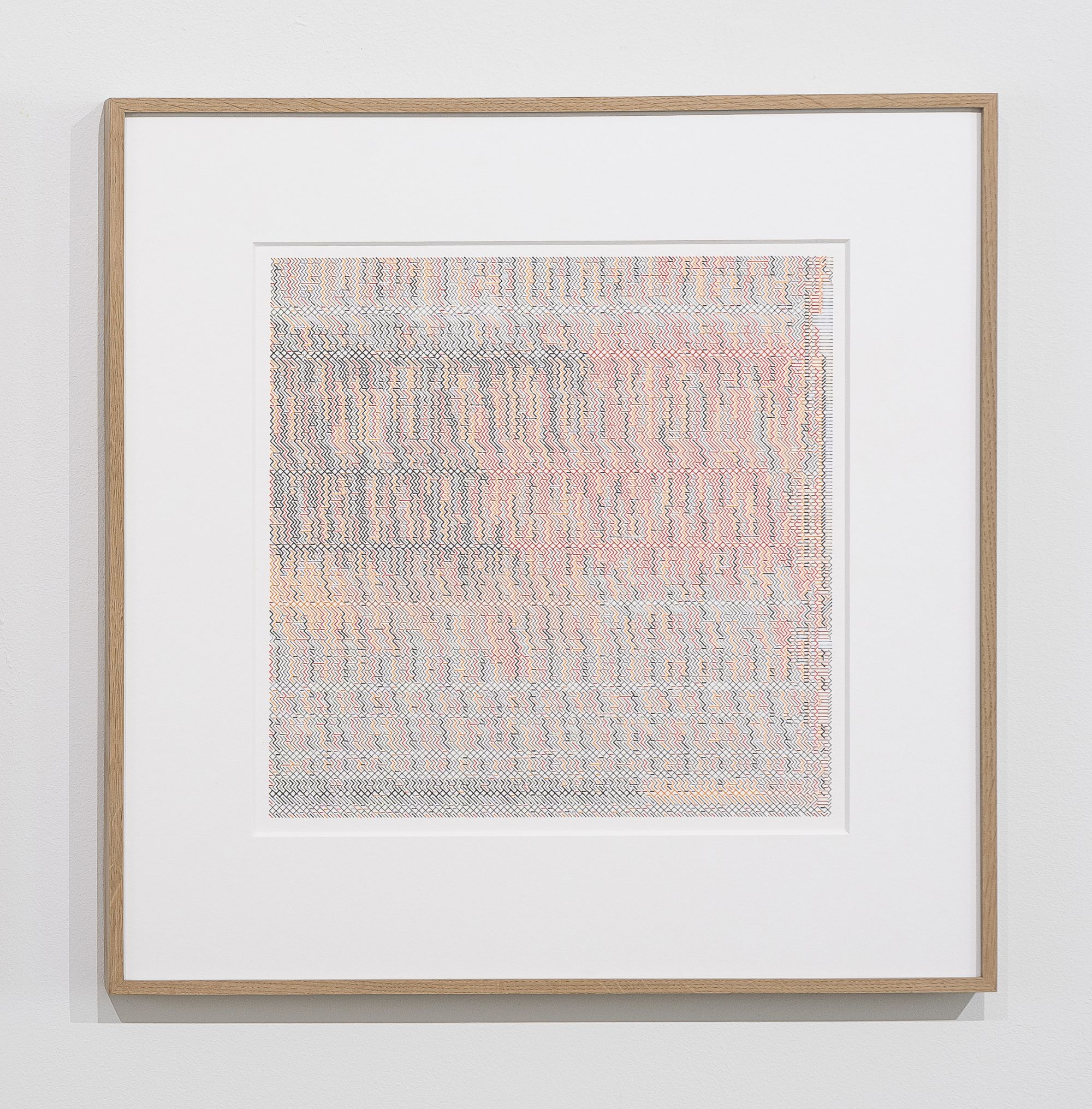
Weaving (square) is built in horizontal bands. Inside a band each column is a stack of short zigzags, upright like the warp of a loom, and between the bands run rows of horizontal lines like the weft. The zigzag columns shift sideways from band to band. On 23 April 2024 he added the drawing to his are.na channel Modular Aesthetic Systems, the same day as the harm.work page of the series (sources/ingested/arena-modular-aesthetic-systems.md). The series image at the top of this page is a sheet of the same construction.
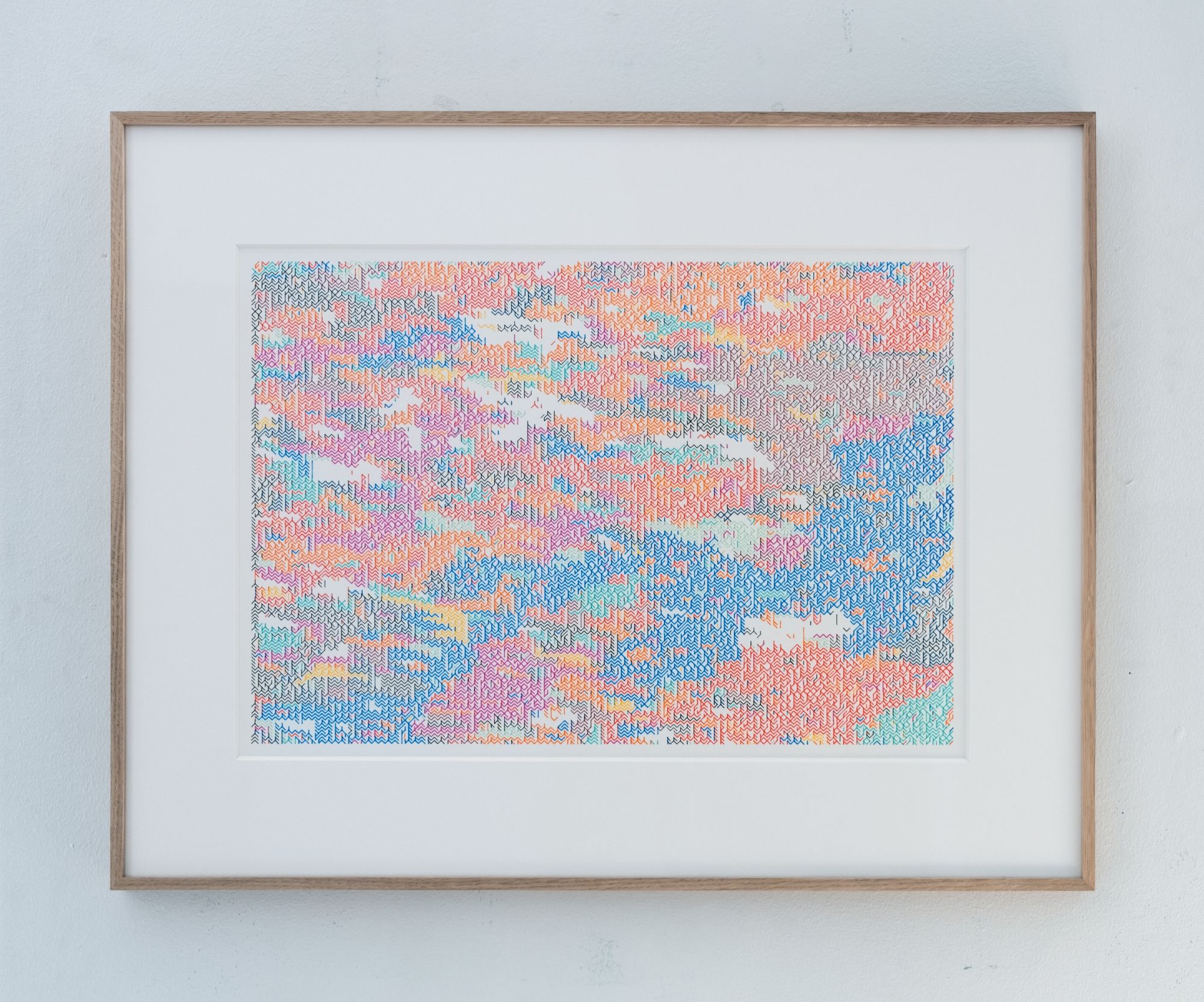
Vapour, a horizontal sheet, is made of rows of small zigzag cells, each a short up-and-down stroke. Cells of one colour join into long horizontal patches, and cells left empty open white gaps between them, so the rows drift sideways across the sheet in banks.
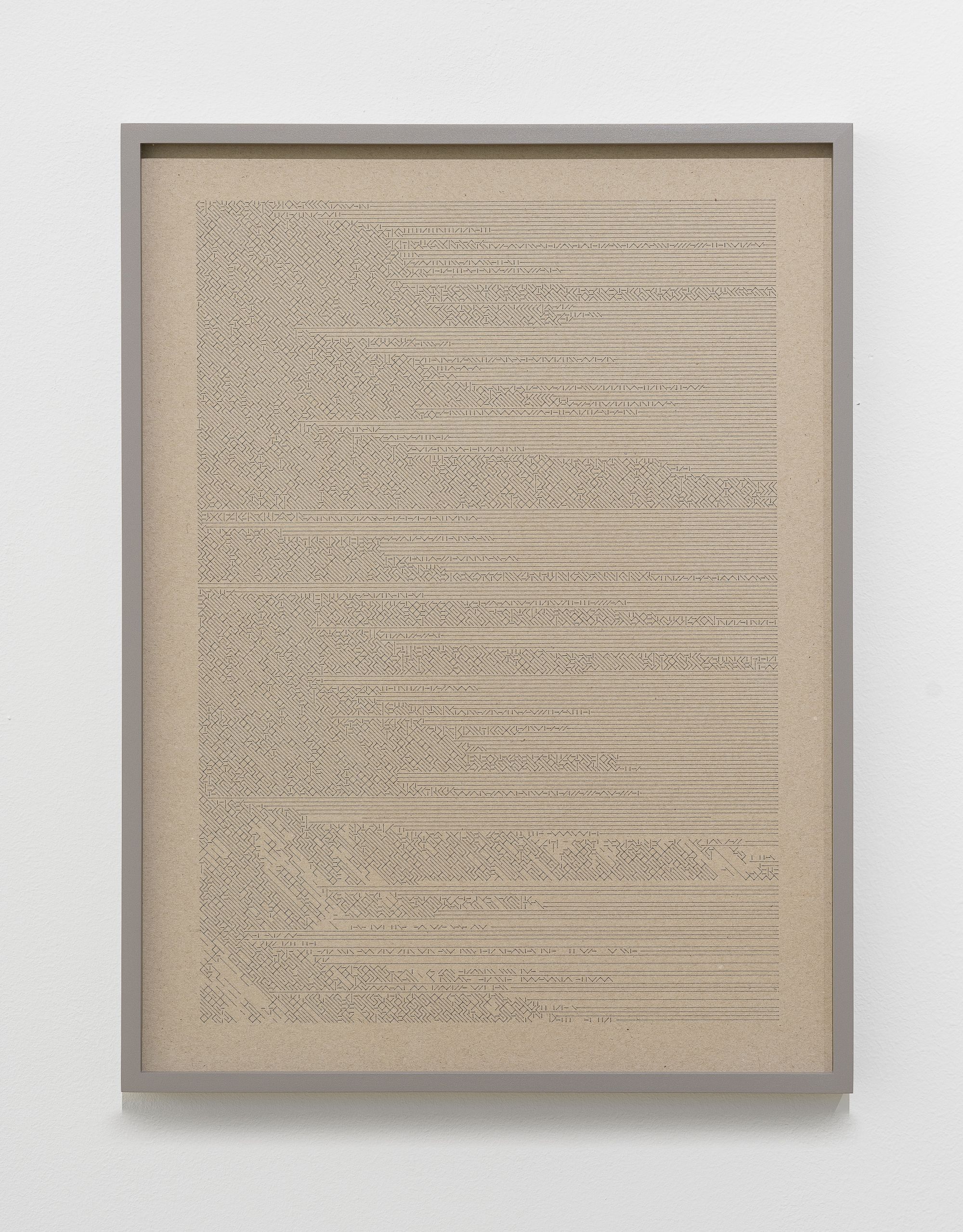
Scene is the one sheet on carton board, drawn in one dark colour on the brown board. Every row starts at the left edge as a stretch of mixed cells, diagonals, zigzags and small knots, and once a cell turns horizontal the row mostly continues as one straight line to the right edge. The rows stop at different points, so the sheet looks like a page of text in which every line ends where the next ruled line begins.
Columns: Été, Fait Divers and Current
Turned upright, the same cells build columns.
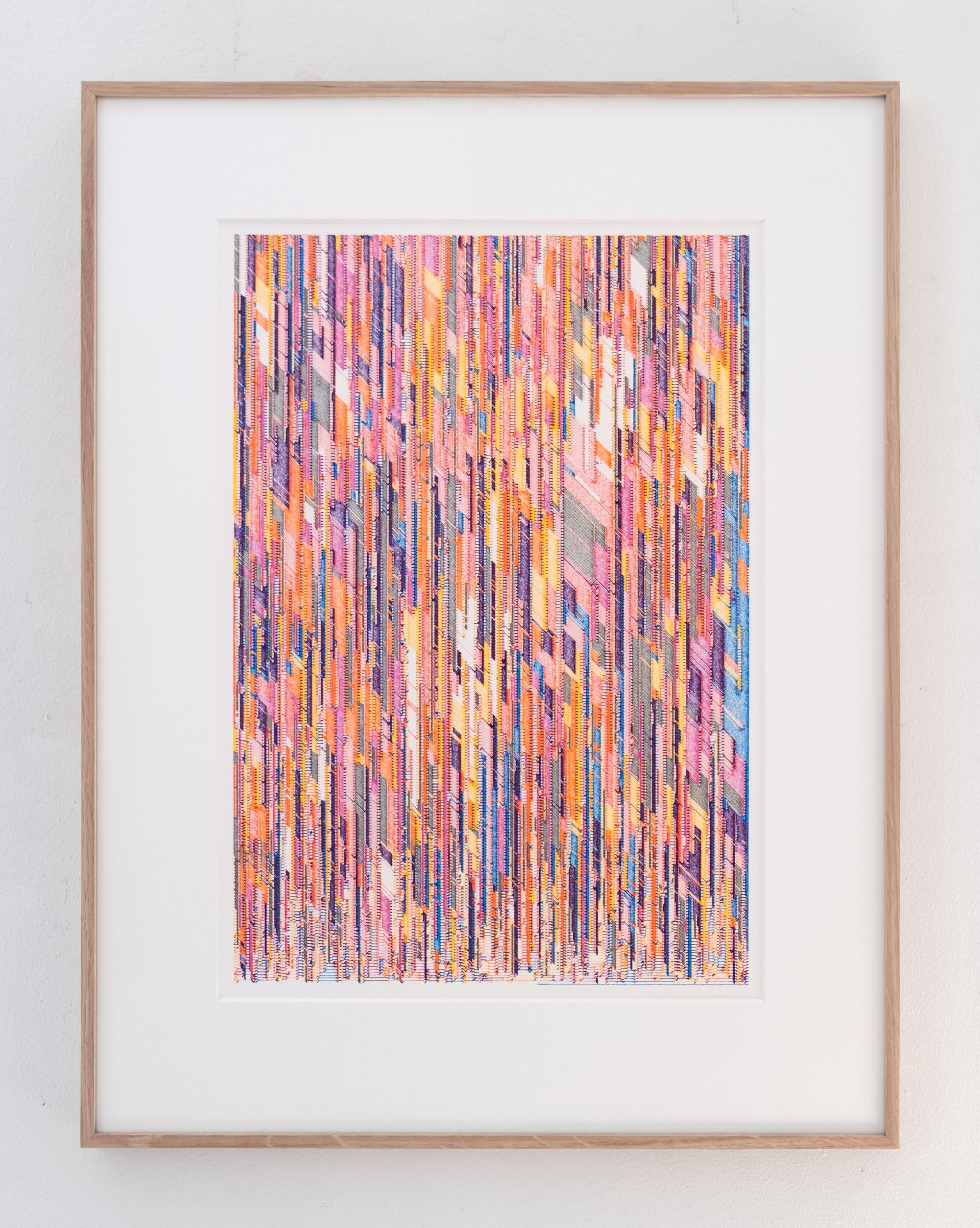
Été (summer) is built in vertical strips. Each strip is either a ladder of short horizontal ticks or a run of long parallel verticals, and short blocks of diagonal hatching cross from one strip to the next. Nothing in the field runs horizontally for long, so the sheet reads as bands falling from top to bottom.
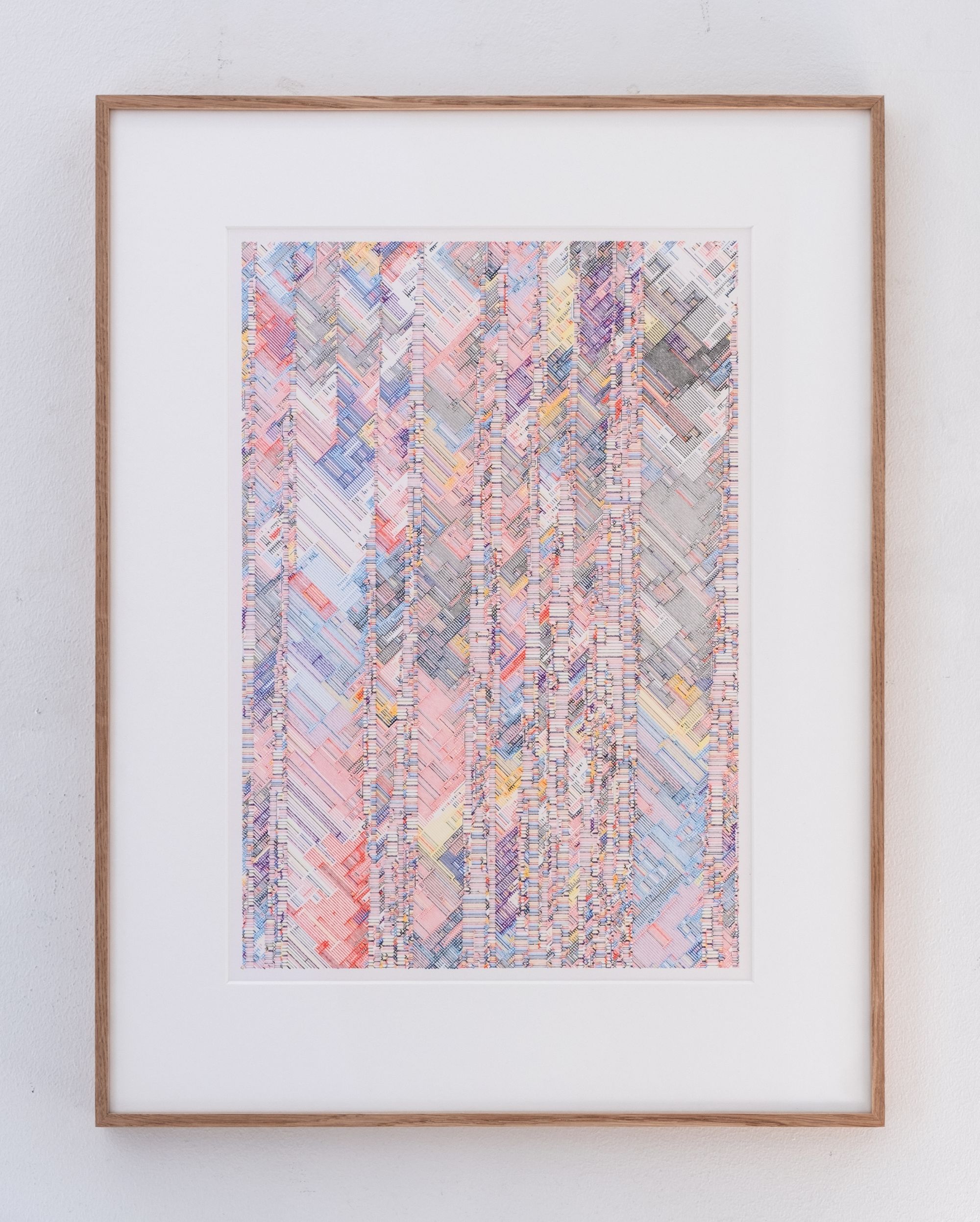
Fait Divers uses the same construction more openly. Narrow columns of stacked ticks run the height of the sheet, and between them slanted blocks of parallel diagonals, each a small parallelogram of hatching, step down the field. Fait divers is French for a short news item, the minor story in a newspaper column.
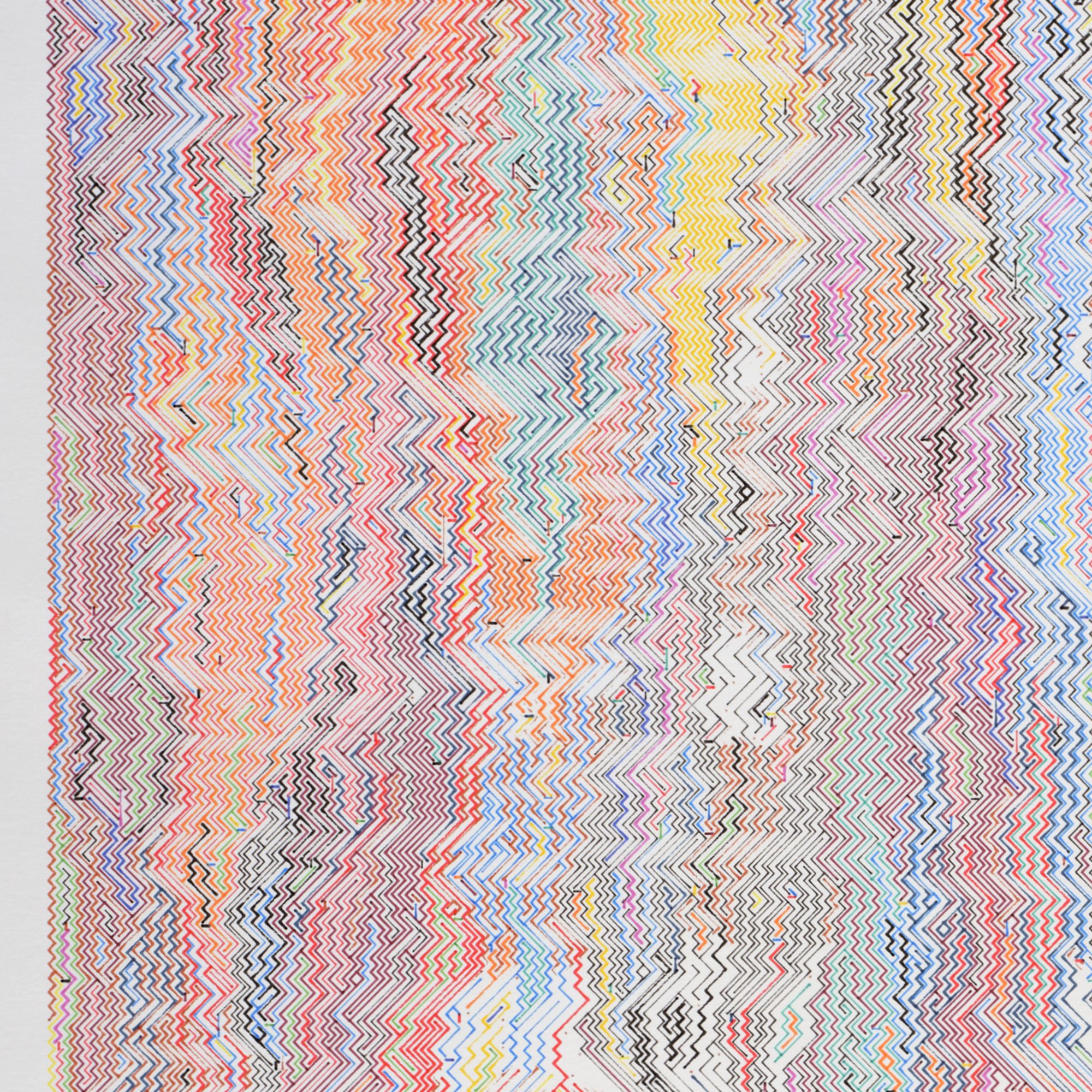
In Current, one of the two sheets shown in Tokyo, the columns are stacks of zigzags in many colours that bend left and right as they run down the sheet. Early Plotter Drawings shows the whole sheet and reads its title against the "rivers" of typesetting.
Probability across the sheet: Poles, Valley, Printemps and Mid
In these drawings the rule itself changes with position. Poles and Valley carry the note "Probabilities transition gradually based on the coordinates within the canvas (x/y)." In Poles the field thins out toward the top, long diagonals gather at the lower right, and faint vertical seams divide the sheet into strips. In Valley long diagonals descend from both side edges toward the middle of the lower edge, so the streams form a V around a centre of short broken cells. Both are reproduced on Angles Morts and Works Overview. The gradient of Atlas runs from top to bottom (→ Early Plotter Drawings).
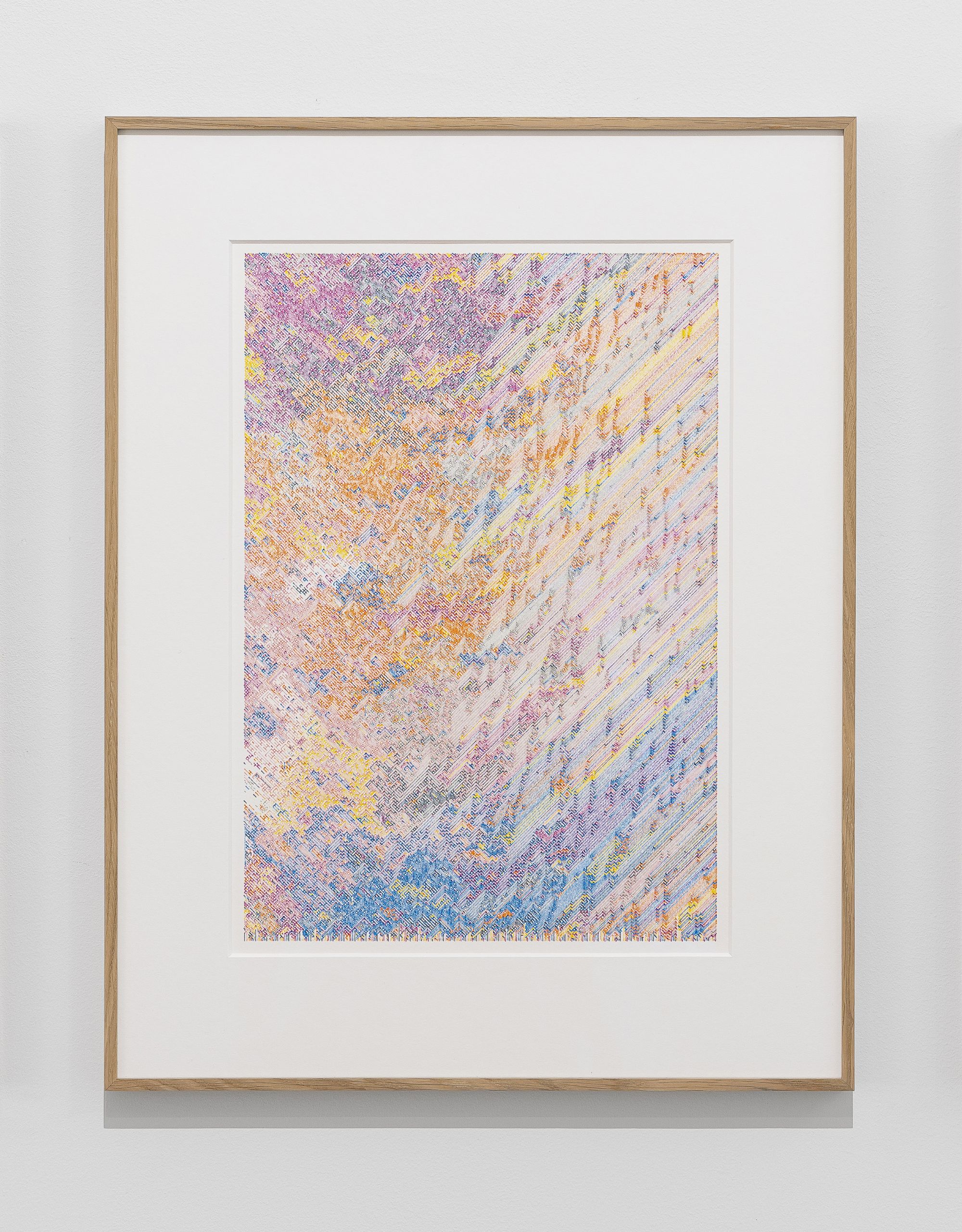
Printemps (spring) changes from left to right. On the left the cells form a dense field of short lines in patches of colour. Toward the right more and more cells take the same rising diagonal, until long parallel strokes run up to the right across the right half of the sheet.
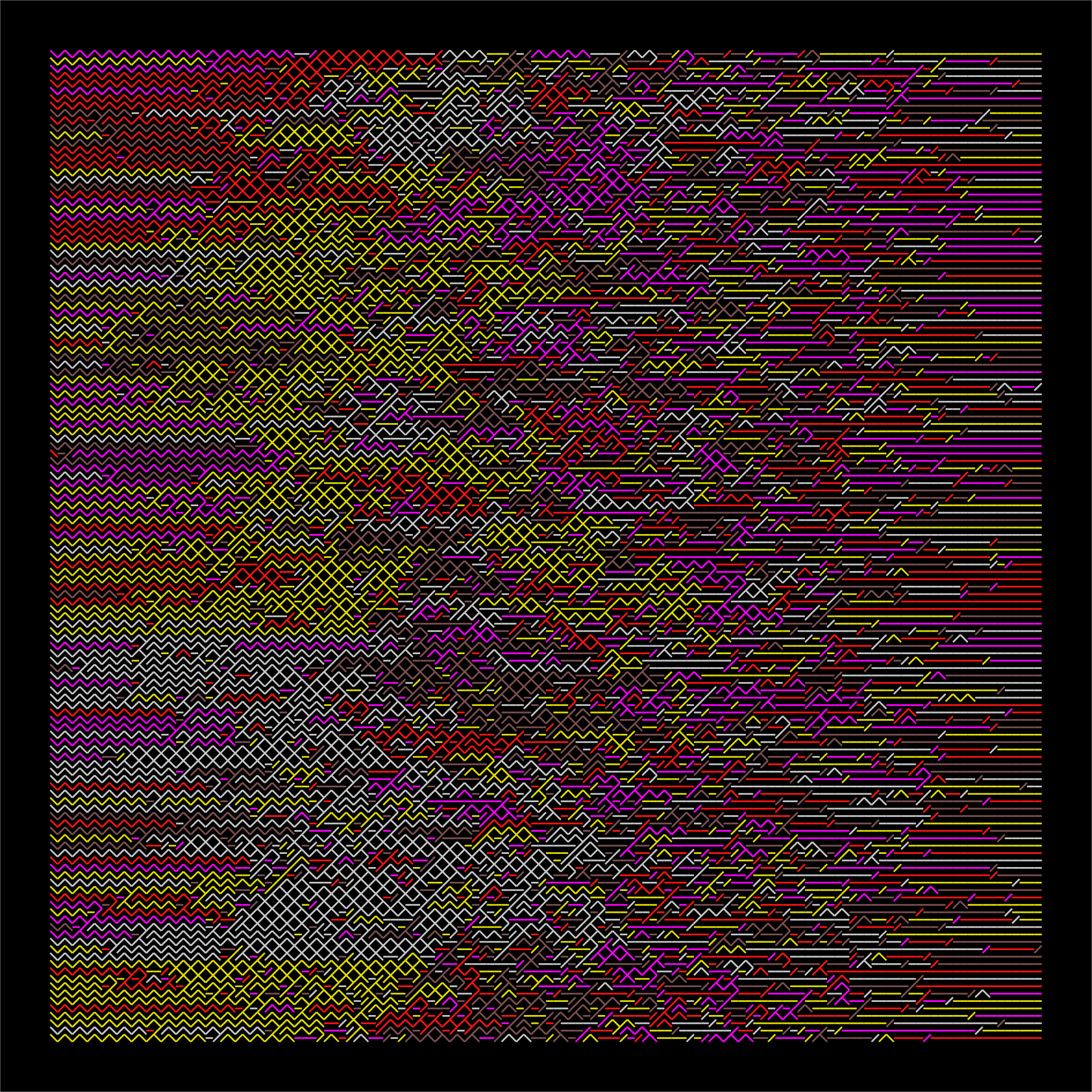
Mid exists as files only. harm.work lists it as an unpublished entry of the kind NFT, with no medium and five SVG files. The main file is a square of 55 cm, the size of the PVC drawing Even Flow, and sets coloured lines on a black ground. Its change runs along the horizontal. At the left edge every row is a zigzag of alternating diagonals; through the middle, diagonals and horizontals mix into small diamonds and knots; at the right edge nearly every cell is horizontal, so the rows end as straight lines. The other four files are smaller squares of the same kind of field.
Chevrons: Pineal, Girl/Boy Song, Peaking and Divide
When the rule depends on the distance from the vertical centre line, the two halves of a sheet lean in opposite directions.
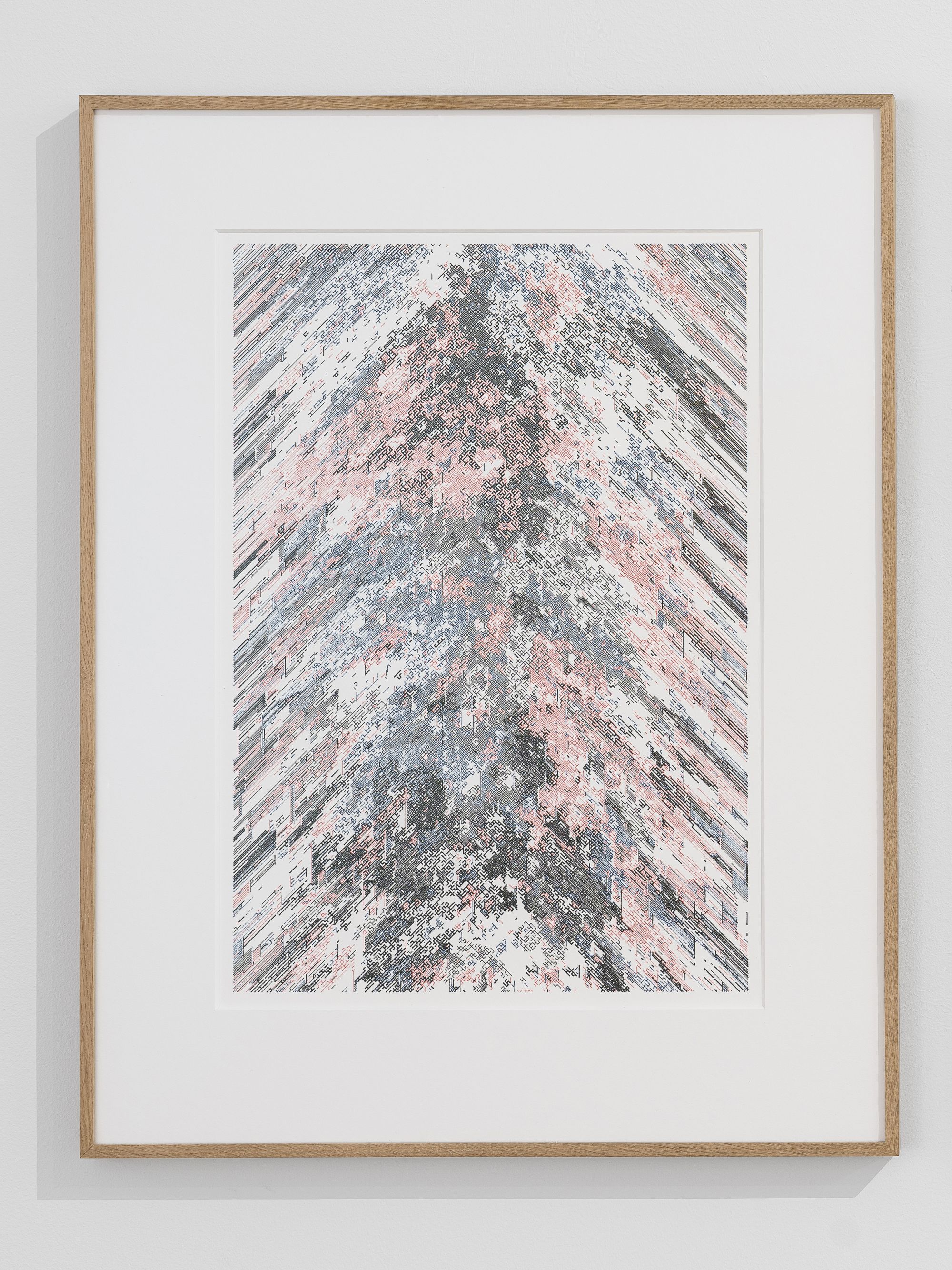
In Pineal the strokes on the left half rise to the right and those on the right half rise to the left, and they meet along the middle in a chevron pointing up. At both edges the cells join into long diagonal strokes; toward the centre they break into short fragments and small mazes. Only the direction is mirrored: the patches of colour differ on each side.
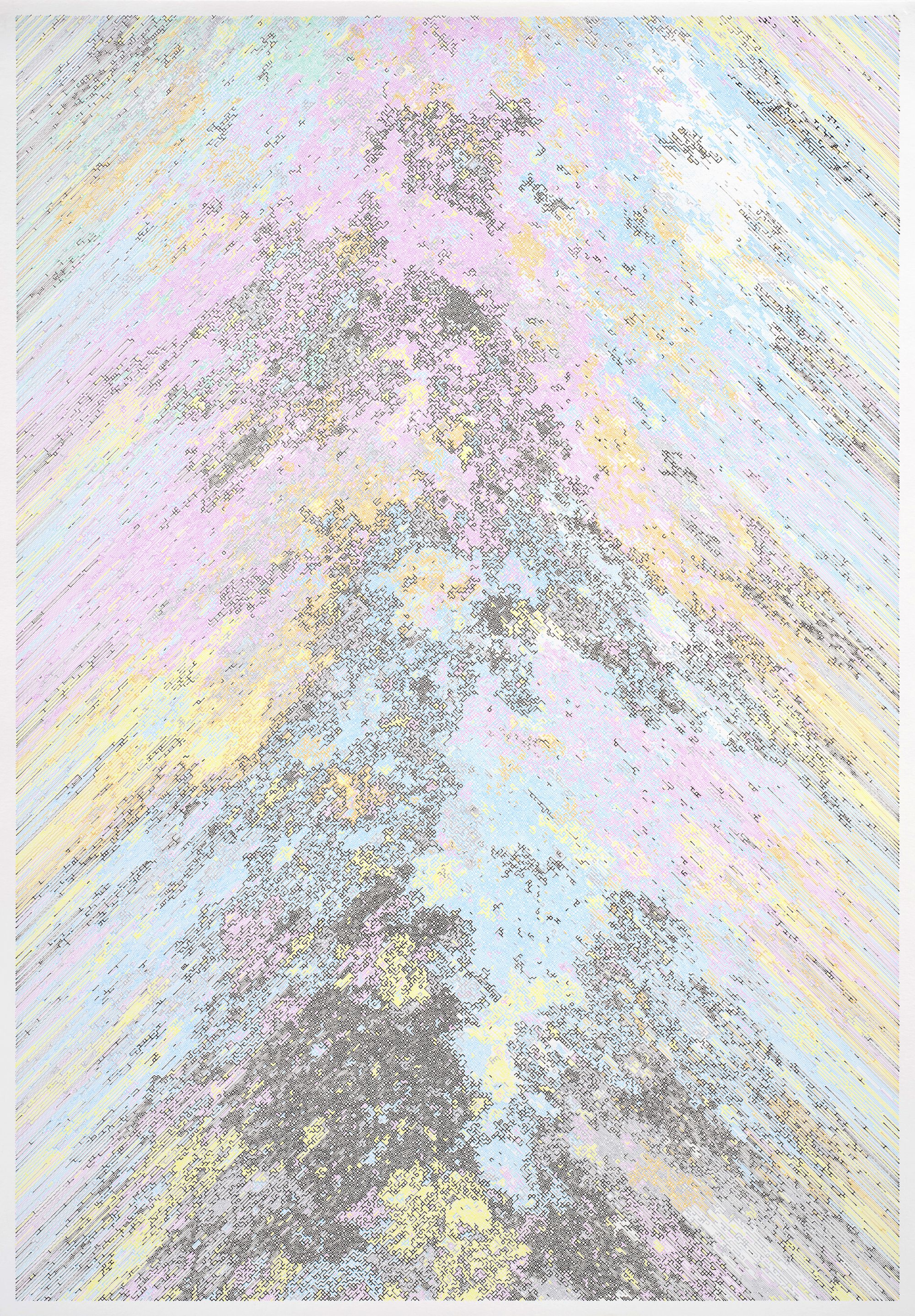
Girl/Boy Song takes the same construction to 59.4 × 84.1 cm with a finer cell: diagonals rise from both edges toward a central spine, where the cells are densest. It is named after the Aphex Twin track of 1996 and was the second sheet of the series shown in Tokyo.
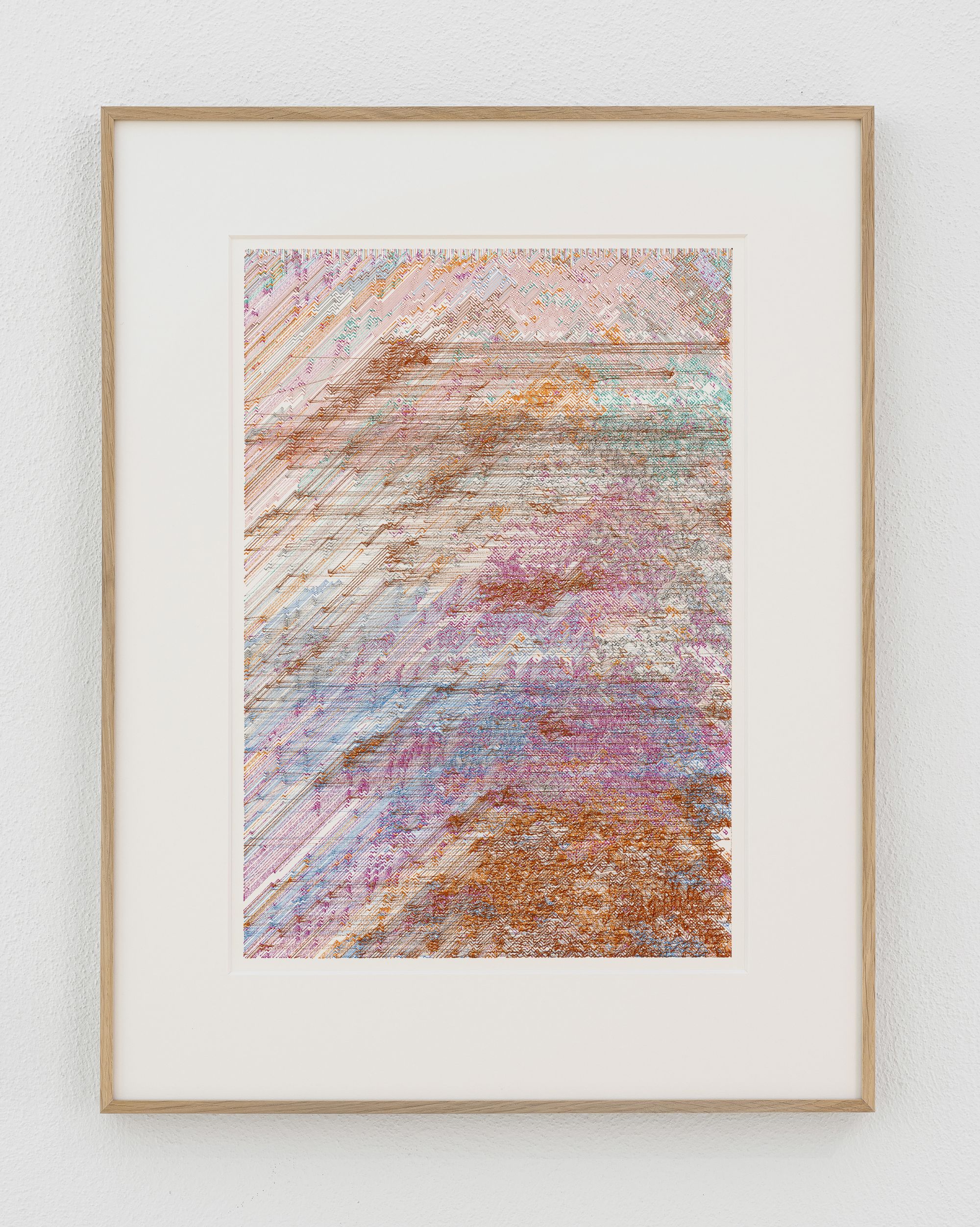
Peaking is built mostly from long runs. Down the left side the cells join into rising diagonals. Across the upper half whole rows of cells take the horizontal and become lines that cross most of the sheet. Along the top edge and in the dense field at the foot the cells alternate into rows of small peaks, zigzags pointing up.
Divide, in pen and marker on Hahnemühle paper, parts its field with a pale wedge that rises from the lower edge (→ Angles Morts). Valley, above, is the chevron turned upside down.
Streams: Hail, Helmgras, Vermis, Derelic
In the densest sheets single lines disappear into texture, the colour groups grow into regions, and runs of one diagonal become streams. Hail is a field of patches into which long diagonal streaks cut from the left edge; Breeze, a square sheet, tilts short runs of zigzags up to the right across the whole field; Ascent is the one sheet on black paper. All three are reproduced on Angles Morts.
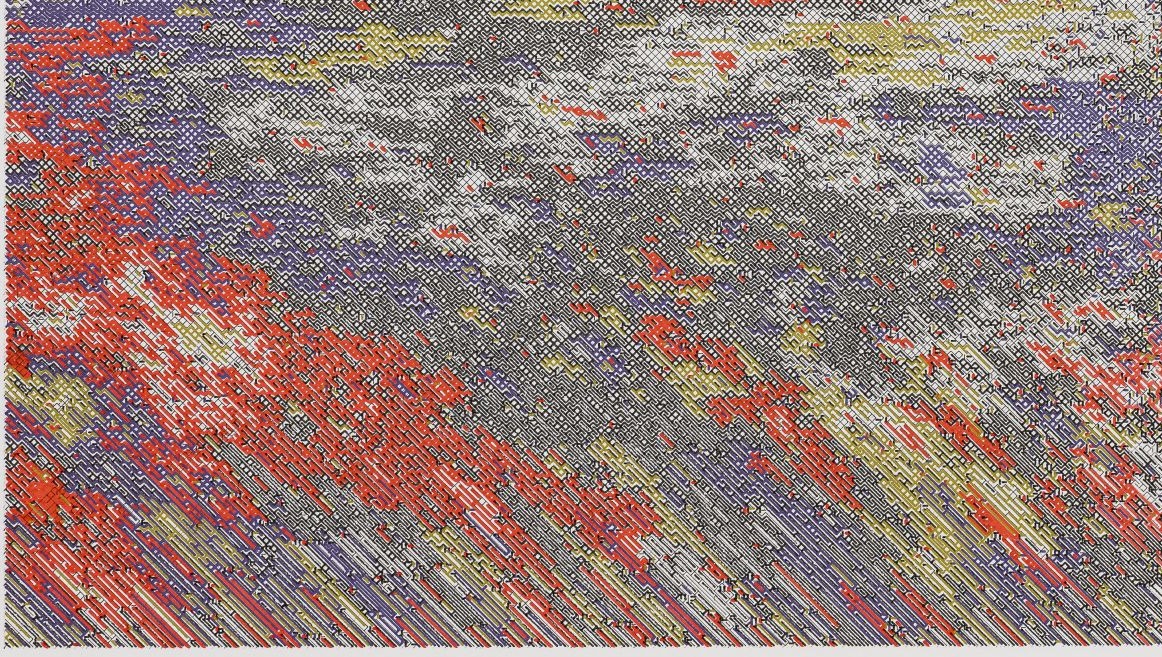
Helmgras is a horizontal sheet. Its upper two thirds are a tight field of crossing cells, small diamonds whose colour patches drift sideways. Along the lower edge, the part shown in the detail, the cells lengthen into long diagonal strokes that descend to the right side by side. Helm is the Dutch name of marram grass, the long-bladed grass planted on the dunes of the Dutch coast. The whole sheet is on Works Overview.
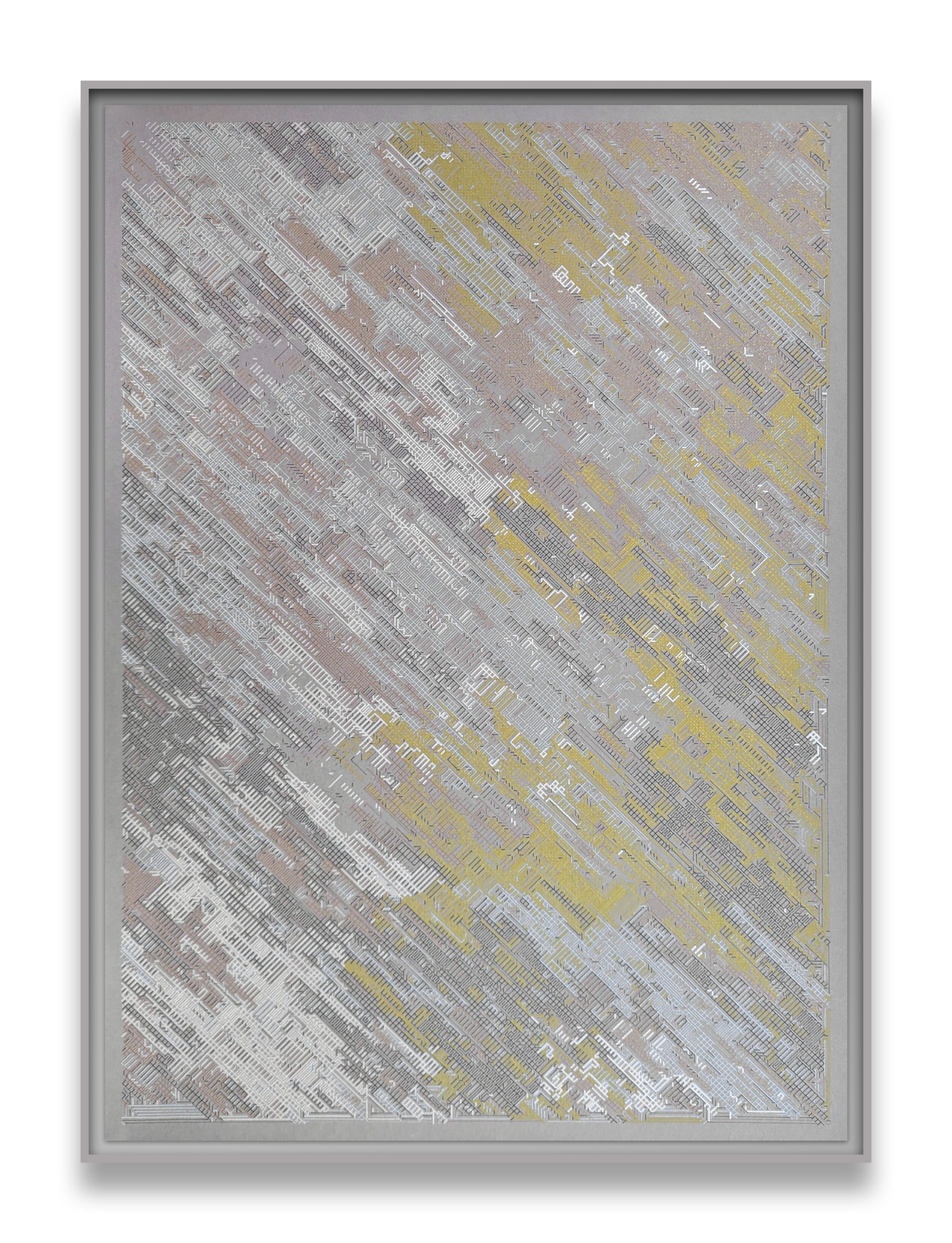
Vermis (Latin for worm) is drawn on grey paper. Most of its cells are horizontals and verticals, stacked into ladders and small squares, and they line up in bands that run from the upper left to the lower right. The colour groups stretch along the same direction, so the whole sheet is crossed by parallel bands. It is one of the drawings that The Grid names as running the Pression des pairs algorithm.
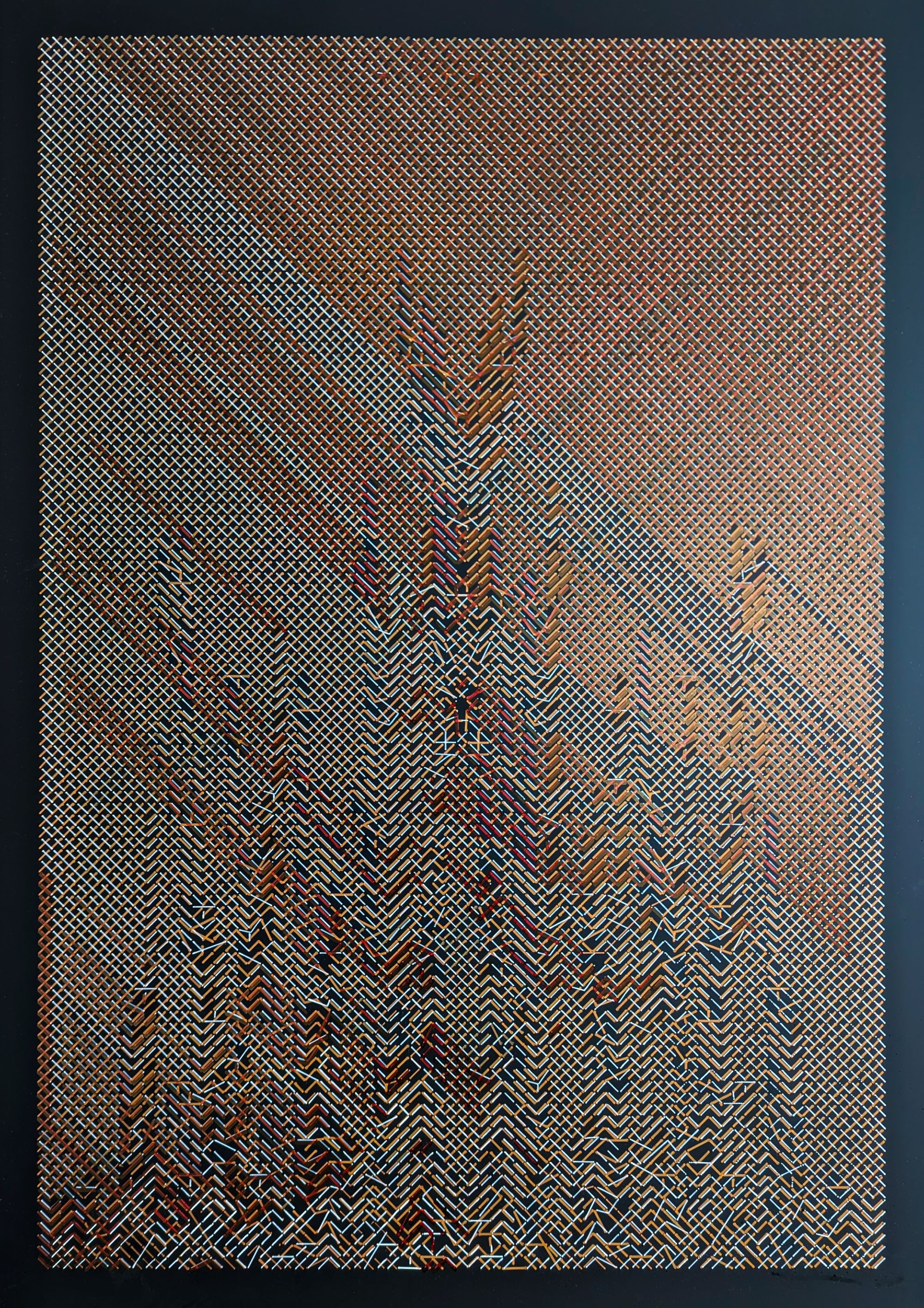
Derelic is the drawing on PVC that the series description mentions: marker on a black sheet, 65 × 95 cm, in "White, copper and red" (harm.work). Its cells are mostly diagonals, so neighbours meet in zigzags and diamonds. In the upper right the same diagonal repeats along whole rows and the field turns into long parallel streaks; the lower half breaks into chevrons and loose fragments, crossed by short runs of red. On 20 October 2024 he added it to his are.na channel art deco, opened in 2020 with an art deco cocktail set. Even Flow, drawn in permanent marker on black PVC the same year, is not listed in the series; it is on The Grid.
Drawn twice: Shroud, Mold and Plateaux (layered)
Some sheets are drawn twice over the same field. His notes on are.na name the operation: Shroud is "Mirrored overdrawn, creating a mild symmetry", Mold "Rotated overdrawn". The mirrored second pass, and the imperfect symmetry it produces in Symmetrical Overdub and Shroud, are the subject of a section on The Grid (The imperfect mirror), with the are.na channel Shrouds / Rorschach that pairs them with the Shroud of Turin.
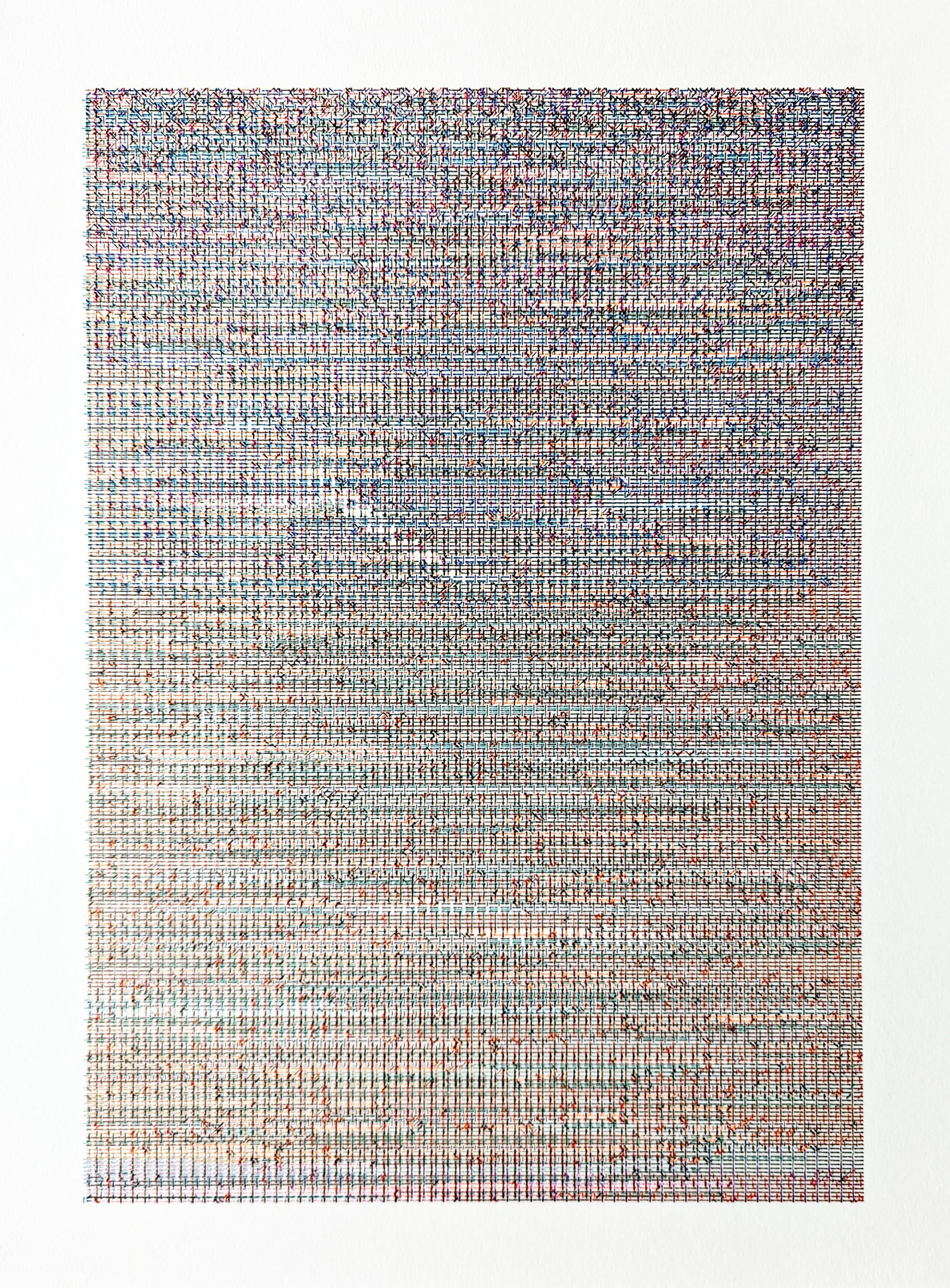
Shroud is a field of short horizontal dashes and vertical ticks in rows, close to a woven ground. The mirrored pass shows in the upper half, where a shallow chevron opens about the vertical axis. It measures 36 × 48 cm.
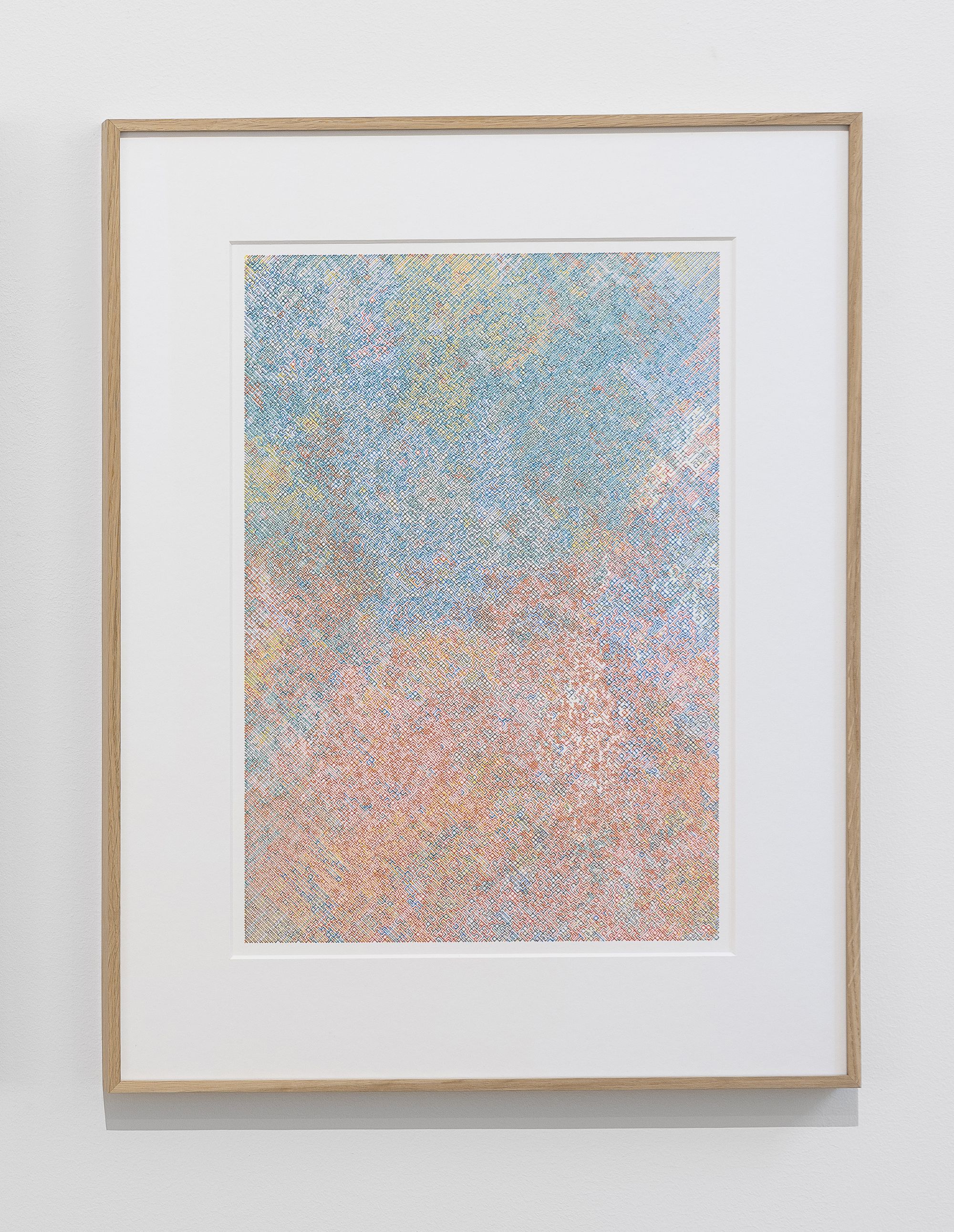
Mold is a dense mesh. Its field of short, maze-like lines was drawn a second time, rotated, and where the two passes cross, the cells close into small squares and crosses, so that no single line can be followed far.
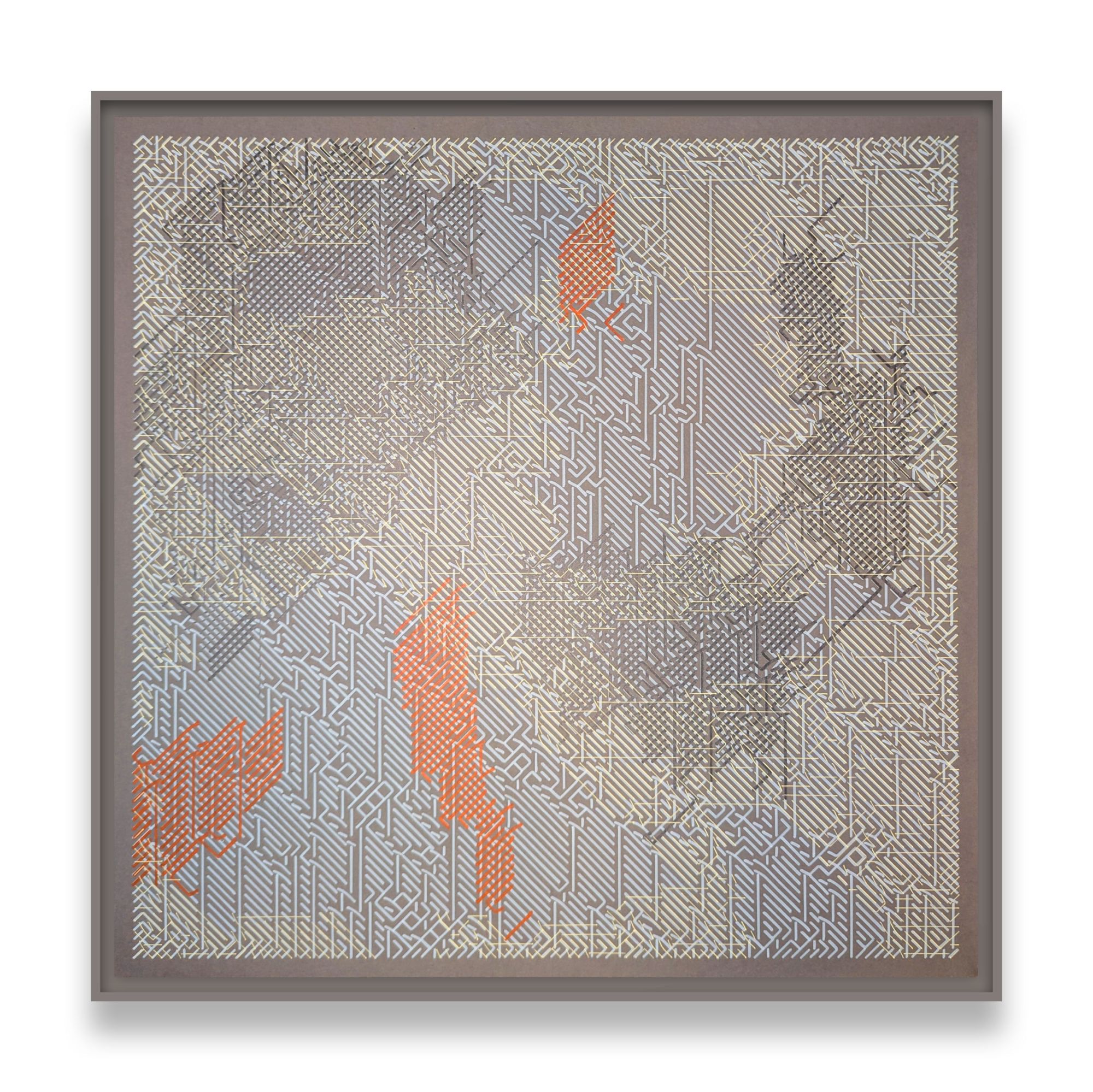
Plateaux (layered) lays several fields over one another on grey paper: a ground of light lines in long diagonal and vertical runs, a network of thin pale lines over it, darker cross-hatched areas that form a loose ring, and three small patches where a further colour cross-hatches the ground. The fields do not line up, so each layer can be told apart. Its single-colour counterpart, made with a brush pen, is Plateaux (monochrome) in the Monochrome Drawings Edition (→ Monochrome Drawings Edition); harm.work dates both 5 March 2025.
Made otherwise: Rapture and Drift
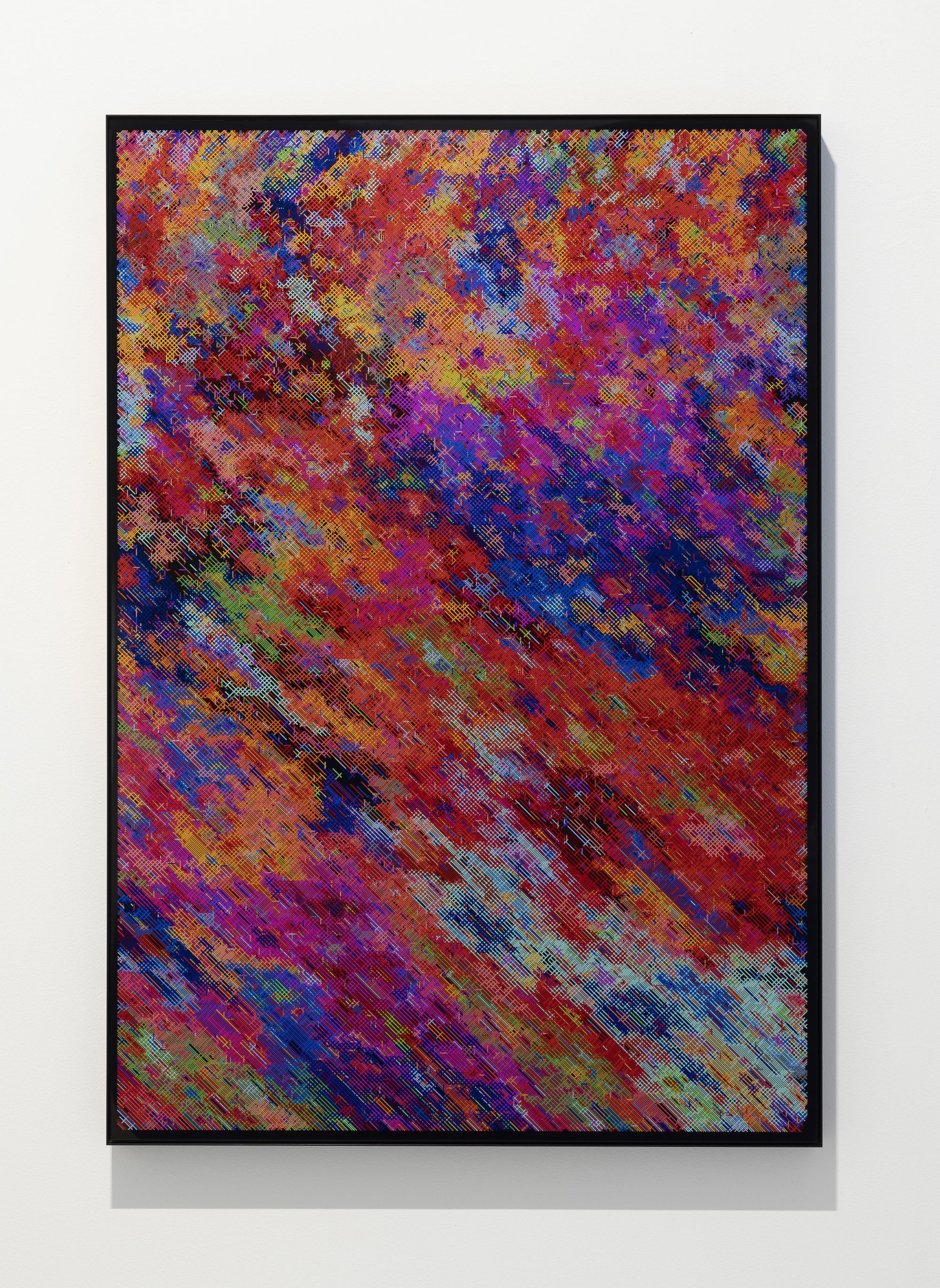
Rapture is the only work in the series that is not drawn. harm.work lists it as a photographic exposure on metallic paper, 81 × 117 × 5 cm, "In black aluminium frame". The image is a field of crossing diagonal segments on black, with the colour regions running in diagonal bands. The lines are even in width and edge, without the pressure and ink of a pen: the exposed image is a raw output of the algorithm, exported as SVG (the artist, November 2026). Photographic exposure on metallic paper is also the medium of the four exposures of Swallow, Only Shallow (2024; → Swallow, Only Shallow).
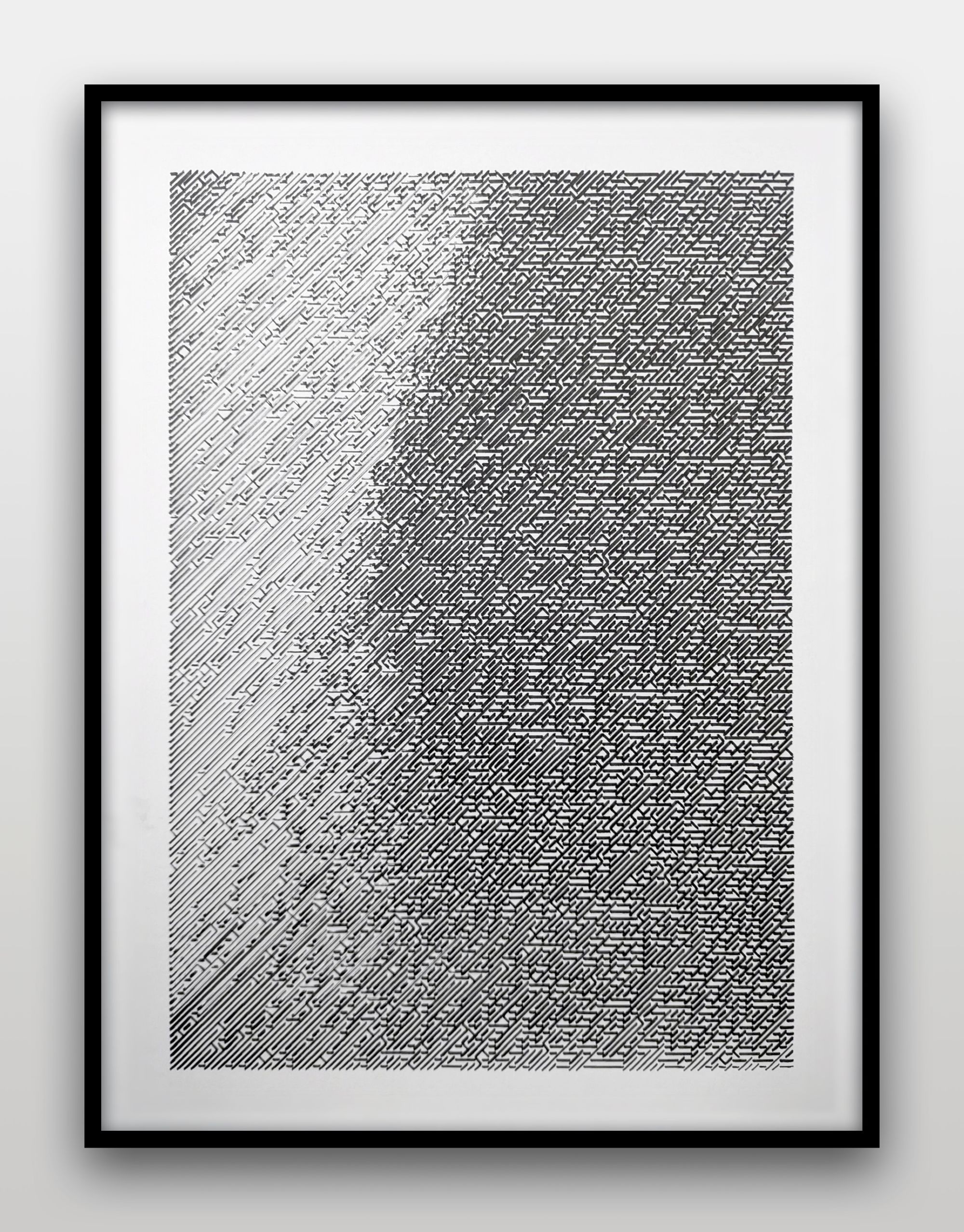
Drift, unpublished on harm.work, puts a calligraphy brush in the plotter. The field is diagonal strokes in black, dense on the right and thinning toward the left into separate marks. The brush returns in the Monochrome Drawings Edition (2025), whose page traces it back to this sheet. Embroidery, with the pen left down between locations, is described above.
2025 and 2026: Sediment, Swath, Tract
The later sheets are larger and their cells finer. Sediment (2025, 60 × 85 cm) starts, by its harm.work text, from Molnár's Interruptions and adds one rule: "when neighbouring segments touch, they form a group, and each group is assigned a shared colour from a predefined palette", so that the groups accumulate "as strata, in the geological sense" (→ Early Plotter Drawings, Interruptions). Swath (2025, pen and marker, 65 × 90 cm) and Tract (2026, 84.1 × 59.4 cm), to which he added pencil by hand and which he calls a hybrid, are shown on The Grid. In his note for Lohaus Gallery's summer show of 2026 the artist writes: "run a very simple rule far enough and its output begins to look organic, weathered, grown rather than constructed." The note gives Sediment, Atlas, Current and Tract as examples (→ Early Plotter Drawings, Randomness and Pattern).
Exhibitions
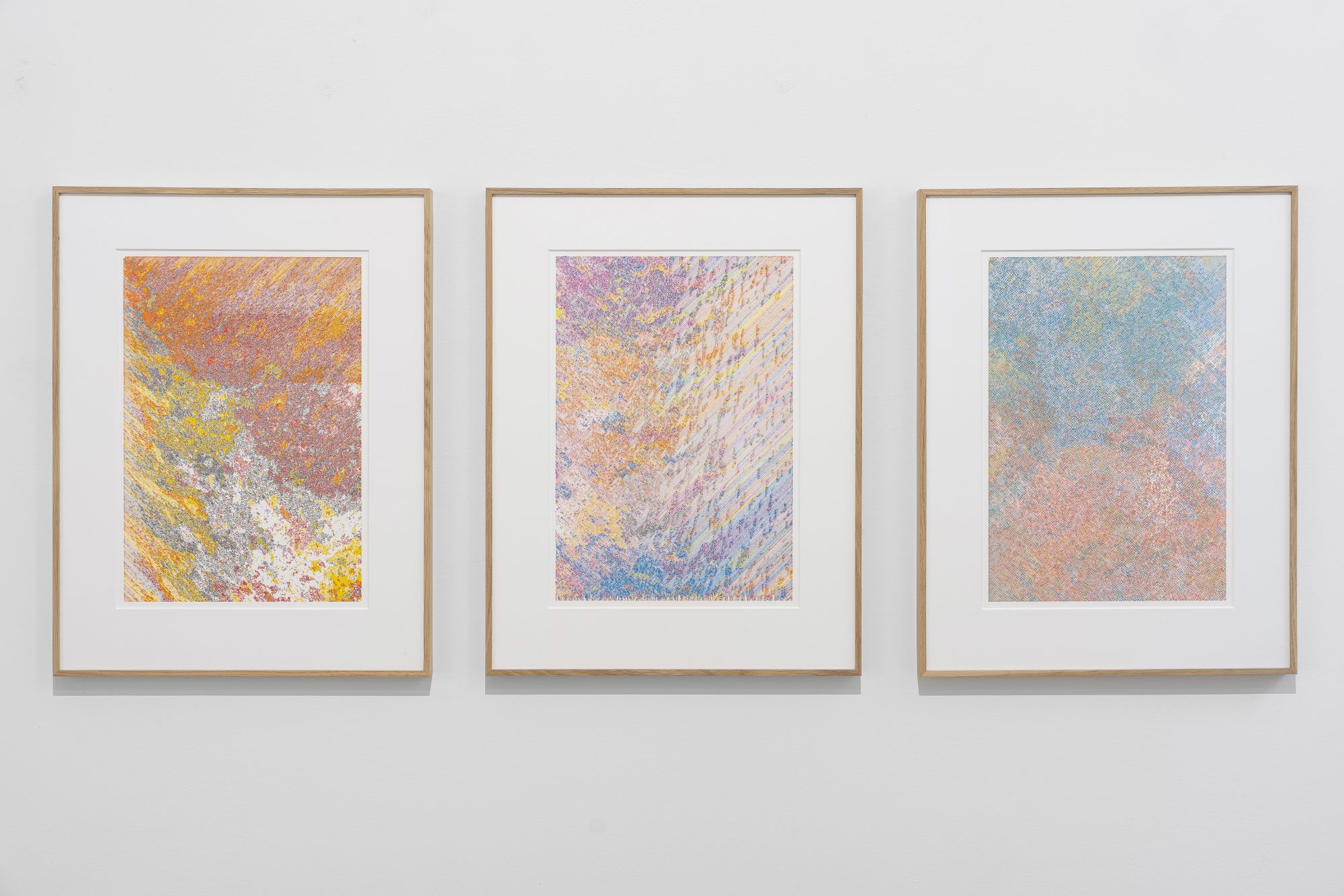
Angles Morts, LOHAUS SOMINSKY, Munich, 6 September to 2 November 2024. The two-person show with Vera Molnár premiered the series with twenty-one sheets: Ascent, Atlas, Breeze, Cuneiform, Current, Divide, Embroidery, Girl/Boy Song, Hail, Helmgras, Mold, Peaking, Pineal, Poles, Printemps, Scene, Shroud, Symmetrical Overdub, Valley, Weaving and Weaving (square). Beside them hung the four Interpolations after Hanne Darboven (→ Interpolations), the generative works Anni and Pression des pairs, and the hand drawing Kapitulation. The exhibition text, with its account of the women whose grid work he has researched since 2019, is set out on Angles Morts.
Cloud Writings, Takuro Someya Contemporary Art, Tokyo, opened 14 February 2026. The exhibition took the series' name but showed only two of its sheets, Current and Girl/Boy Song, among the drawings of 2025, the hand-coloured Beads, Interpolation V to IX, two screen works after Anni and two cut paper bags (→ Cloud Writings, Tokyo). Goro Murayama's questions after the show, and the artist's answers on mandalas and the plotter, are on Mandala Q&A (sources/ingested/mandala-qa-murayama-2026.md).
Fifteen works of the series have no exhibition on harm.work: Coral, Ridge and Cliff, Vapour, Été, Fait Divers, Mid, Vermis, Derelic, Rapture, Drift, Plateaux (layered), Sediment, Swath and Tract. In November 2026 Lohaus Gallery's artist page lists Breeze, Cuneiform, Hail, Mold, Pineal, Shroud, Valley and Weaving.
The titles
The artist made the series title up himself, "in a poetic attempt": some of the drawings have a cloud-like feel, and the cloud is also the metaphor for immaterial storage that in fact comes down to heavy data centres (the artist, November 2026). The work titles fall into a few kinds, and the wiki notes them without claiming a programme. Weather and moving air: Breeze, Hail, Vapour, Drift, Current. Land: Valley, Ridge, Cliff, Peaking, Ascent, Divide, Plateaux (layered), Sediment, Swath, Tract, Atlas, Poles. Growth: Coral, Helmgras, Mold, Vermis. Two seasons in French: Printemps and Été. Writing and cloth, the two references of the Tokyo statement: Cuneiform, Fait Divers, Scene, Weaving, Embroidery. Sound: Symmetrical Overdub and Girl/Boy Song. Three come close to religion: Shroud, which he filed beside the Shroud of Turin; Rapture; and Pineal, after the gland Descartes took for the seat of the soul. The Tokyo statement says the drawings' designs "touch on religious and heraldic imagery" (→ Sacred Geometry). The weather words match the cloud of the series title and the writing words its writings.
All works
Media and sizes as harm.work gives them; a dash where it gives none.
| Work | Year | Medium | Size | Shown |
|---|---|---|---|---|
| Coral | 2024 | Sakura fineliner on Hahnemühle paper | 36 × 48 cm | — |
| Ridge | 2024 | Sakura fineliner on Hahnemühle paper | 36 × 48 cm | — |
| Cliff | 2024 | Sakura fineliner on Hahnemühle paper | 36 × 48 cm | — |
| Weaving | 2024 | Plotter drawing on Hahnemühle paper | — | Munich 2024 |
| Cuneiform | 2024 | Plotter drawing on Hahnemühle paper | 61 × 46.5 cm | Munich 2024 |
| Scene | 2024 | Plotter drawing on carton board | 49.5 × 37.2 cm | Munich 2024 |
| Weaving (square) | 2024 | Plotter drawing on Terschelling paper | 47 × 47 cm | Munich 2024 |
| Breeze | 2024 | Plotter drawing on Terschelling paper | 47 × 47 cm | Munich 2024 |
| Symmetrical Overdub | 2024 | Plotter drawing on Terschelling paper | 47 × 47 cm | Munich 2024 |
| Valley | 2024 | Sakura fineliner on Terschelling paper | — | Munich 2024 |
| Poles | 2024 | Plotter drawing on Terschelling paper | — | Munich 2024 |
| Shroud | 2024 | Plotter drawing on Terschelling paper | 36 × 48 cm | Munich 2024 |
| Mold | 2024 | Plotter drawing on Terschelling paper | — | Munich 2024 |
| Hail | 2024 | Plotter drawing on Terschelling paper | — | Munich 2024 |
| Drift | 2024 | Calligraphy brush plotter drawing on Hahnemühle paper | 47 × 61 cm | — |
| Pineal | 2024 | Plotter drawing on Terschelling paper | — | Munich 2024 |
| Printemps | 2024 | Plotter drawing on Terschelling paper | — | Munich 2024 |
| Peaking | 2024 | Plotter drawing on Terschelling paper | — | Munich 2024 |
| Helmgras | 2024 | Plotter drawing on Terschelling paper | — | Munich 2024 |
| Été | 2024 | Plotter drawing on Terschelling paper | — | — |
| Vapour | 2024 | Plotter drawing on Hahnemühle paper | — | — |
| Divide | 2024 | Pen and marker plotter drawing on Hahnemühle paper | — | Munich 2024 |
| Rapture | 2024 | Photographic exposure on metallic paper, black aluminium frame | 81 × 117 × 5 cm | — |
| Fait Divers | 2024 | Plotter drawing on Terschelling paper | — | — |
| Vermis | 2024 | Plotter drawing on grey paper | 59.5 × 42 cm | — |
| Ascent | 2024 | Plotter drawing on black paper | — | Munich 2024 |
| Embroidery | 2024 | Plotter drawing on Hahnemühle watercolour paper | — | Munich 2024 |
| Atlas | 2024 | Plotter drawing on Hahnemühle paper | 84.1 × 59.4 cm | Munich 2024 |
| Current | 2024 | Plotter drawing on Hahnemühle paper | 59.4 × 84.1 cm | Munich 2024, Tokyo 2026 |
| Girl/Boy Song | 2024 | Plotter drawing on Hahnemühle paper | 59.4 × 84.1 cm | Munich 2024, Tokyo 2026 |
| Derelic | 2024 | Marker plotter drawing on PVC sheet | 65 × 95 cm | — |
| Mid | 2024 | SVG files (listed as NFT, unpublished) | 55 × 55 cm (file) | — |
| Sediment | 2025 | Plotter drawing on Hahnemühle watercolour paper | 60 × 85 cm | — |
| Plateaux (layered) | 2025 | Plotter drawing on grey paper | 42 × 42 cm | — |
| Swath | 2025 | Pen and marker plotter drawing on watercolour paper | 65 × 90 cm | — |
| Tract | 2026 | Hybrid plotter pen and hand pencil drawing | 84.1 × 59.4 cm | — |
The works are listed in the order in which they were entered on harm.work, from 22 April 2024 to June 2026.
See also
- Angles Morts (2024) — the premiere, beside Vera Molnár; the exhibition text on Albers, Molnár, Posenenske and Auerbach
- Cloud Writings (Tokyo, 2026) — the solo show named after the series; the artist's statement on writing, weaving and the plotter
- The Grid — the rotating-line algorithm and its drawings; the imperfect mirror of the overdrawn sheets
- Interruptions — the rotating-line cell measured in code; Molnár's line fields
- Early Plotter Drawings — the continuum from a simple rule to geological form
- Monochrome Drawings Edition — the same strokes in one colour with a brush
- Interpolations — the drawings after Hanne Darboven shown with the series in Munich and Tokyo
- Meditative Labour — the hand beside the plotter
- Algorithmic Archaeology — the women whose grid work the series answers
- Process Legibility — how the plotter line shows the process that drew it
- Mandala Q&A (2026) — Goro Murayama's questions after the Tokyo show