
Swallow, Only Shallow (2024)
Swallow, Only Shallow was released with Struggle for Pleasure, van den Dorpel's solo show at Verse SOLOS, London, in 2024. harm.work's text for the series, in his words: "A series of twelve works released in conjunction with my solo exhibition at Verse, London. Four of these are material works, eight released exclusively as Ethereum NFT." The tokens form the collection Swallow, only Shallow, described as "Processed images from metal, grunge & shoegaze memories. An addendum to, or spill over from the Struggle for Pleasure series. Four of these are materialized as wall pieces. Released in collaboration with Verse SOLOS, curated by Leyla Fakhr." Since November 2026 the collection is the work's one home on harm.work: the separate series page was removed and forwards to it (the artist).
The collection now lists fourteen tokens. Twelve were entered on harm.work in February 2024: the four wall works and eight more. Two, Glow and Transpire, were entered in June 2026, though the image of Transpire was already on harm.work in February 2024 (see Outside the collection, below).
Found images in the subdivision machine
The same text names the one change from Struggle for Pleasure: "These are created with a similar image subdivision algorithm as 'Struggle for Pleasure', but instead of making the decisions of which pixel operation to employ, or how to calculate the next colour in a geometric generative fashion, I fed it existing found images. The colours are sampled from these underlying images and undergo algorithmic operations in multiple colour spaces, like bit shifting, channel swapping (and some post production)."
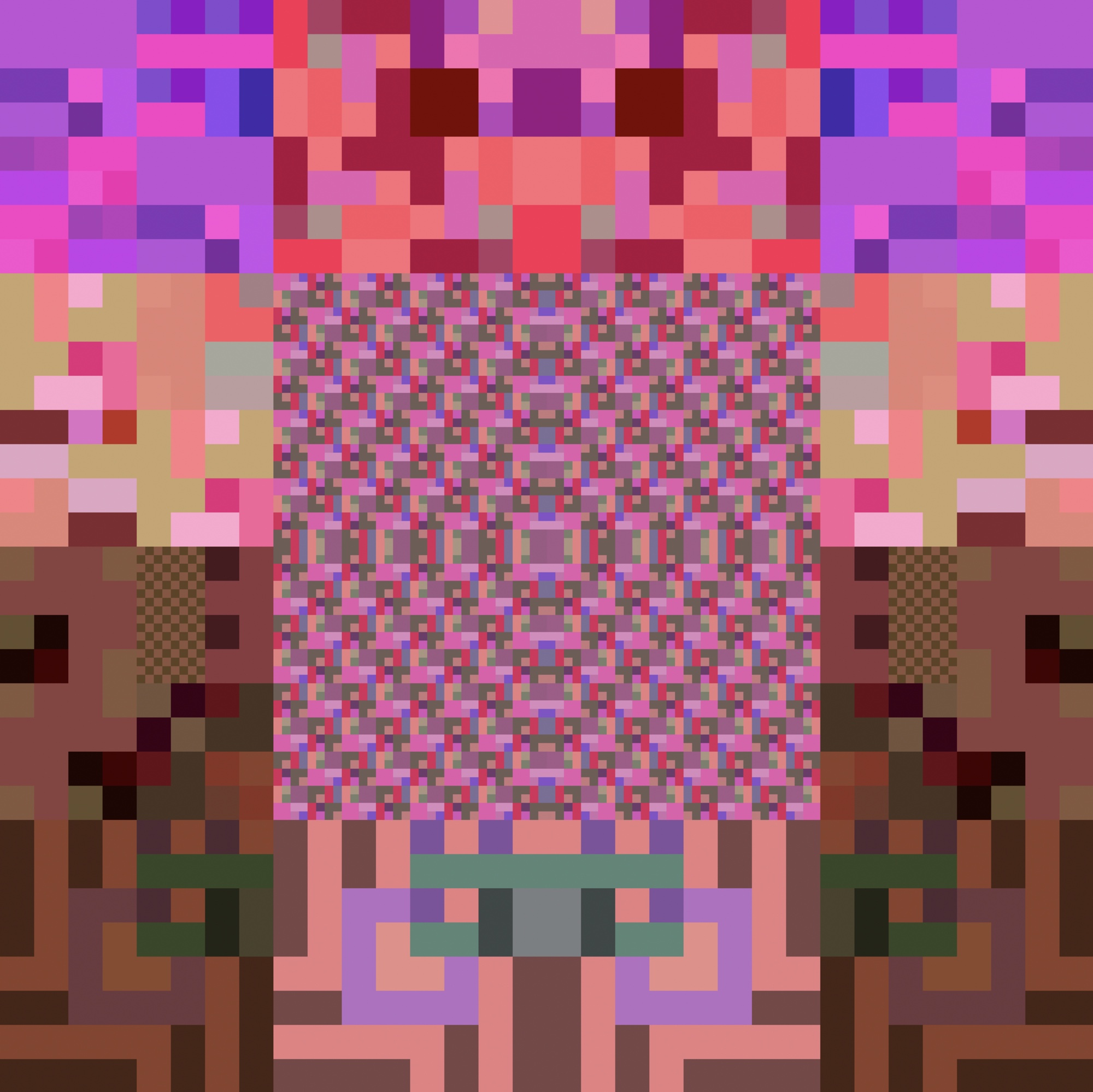
The generator it started from is seen in Symmetrical Composition, which harm.work calls an "Early output of the 'Struggle for Pleasure' algorithm"; it was entered there on 28 December 2023. The square is mirrored left to right: coarse blocks of pink, violet, brown and dark green frame a central square divided into a fine checkered pattern. Every operation and every colour there was chosen by the program, from its own palette.
His code and working files, read for the wiki in November 2026, show the steps (process notes). On 17 December 2023 he captured stills and short recordings of early-1990s concert films, music videos and television interviews playing on YouTube. On 19 December he turned the Struggle for Pleasure generator into what he called the pixelator. It fills the square with the average colour of the picture, then splits cells into four, partly at random, and fills each new cell with the average of the pixels beneath it, so the picture arrives from coarse to fine. The pixelator decides nothing about colour: every value is a mean of values in the found picture.
The bands come from a step before it. Colour values were pushed past 255, where they wrap to zero; the three channels wrap at different points, so a slope of tone becomes a cycle of hues. Several states of each work were saved at 8192 pixels on 2 and 3 February 2024, some with the division still unfinished in places, coarse blocks beside fine pixels, and the colour was then rotated and stretched with Hue/Saturation and Levels.
Shoegaze
The title joins two songs by My Bloody Valentine, "Swallow" (on the Tremolo EP) and "Only Shallow" (the first track of Loveless), both 1991. The series text: "The series is heavily inspired by the complex textures of distortion in Shoegaze music and turned out quite psychedelic."
In the Verse conversation before the show, Leyla Fakhr spoke of album covers; he corrected her: "It's actually more video stills from that era than album covers, but of course the album covers from that time share aesthetics." Then the comparison that explains the method: "with shoegaze it's almost as if the band is there only to supply signals for this half heavy signal processing chain, where the texture and the complexity of the harmonics is created by using lots of delays and echoes and all these other effects to create new textures." Applied to the series, the found still plays the part of the band, and the wrap and the subdivision are the pedals. Fakhr saw "an element of figuration" she had not seen before in his digital images (transcript; → Verse Twitter Spaces (2024); Afterimage for Loveless and his listening).
Asked about the Verse series and the blockchain, he set them apart from a protocol work such as Mutant Garden Seeder: "in this project it's about this idea of painting in a way, and all the manual, post-production steps I took which could not be easily defined in code," steps that "were once in a lifetime, I would not be able to reproduce them."
The wrap, found twice
In November 2026 he found the same operation on the covers of a computer-art yearbook of 1980–81: Herbert W. Franke's Transformation, Anton Bruckner, a photograph of the composer turned into contour bands by values that wrap past their maximum. He had not known it. He calls the series "a key example of a discovery made as part of algorithmic archaeology". The comparison, with Blow Out and A Man, is on Franke × van den Dorpel, under The photograph as data, and the wrap's place in his lineage on Algorithmic Archaeology. In the wiki's comparison, Franke kept one photograph and varied the rule; this series keeps one rule and varies the photograph.
The four wall works
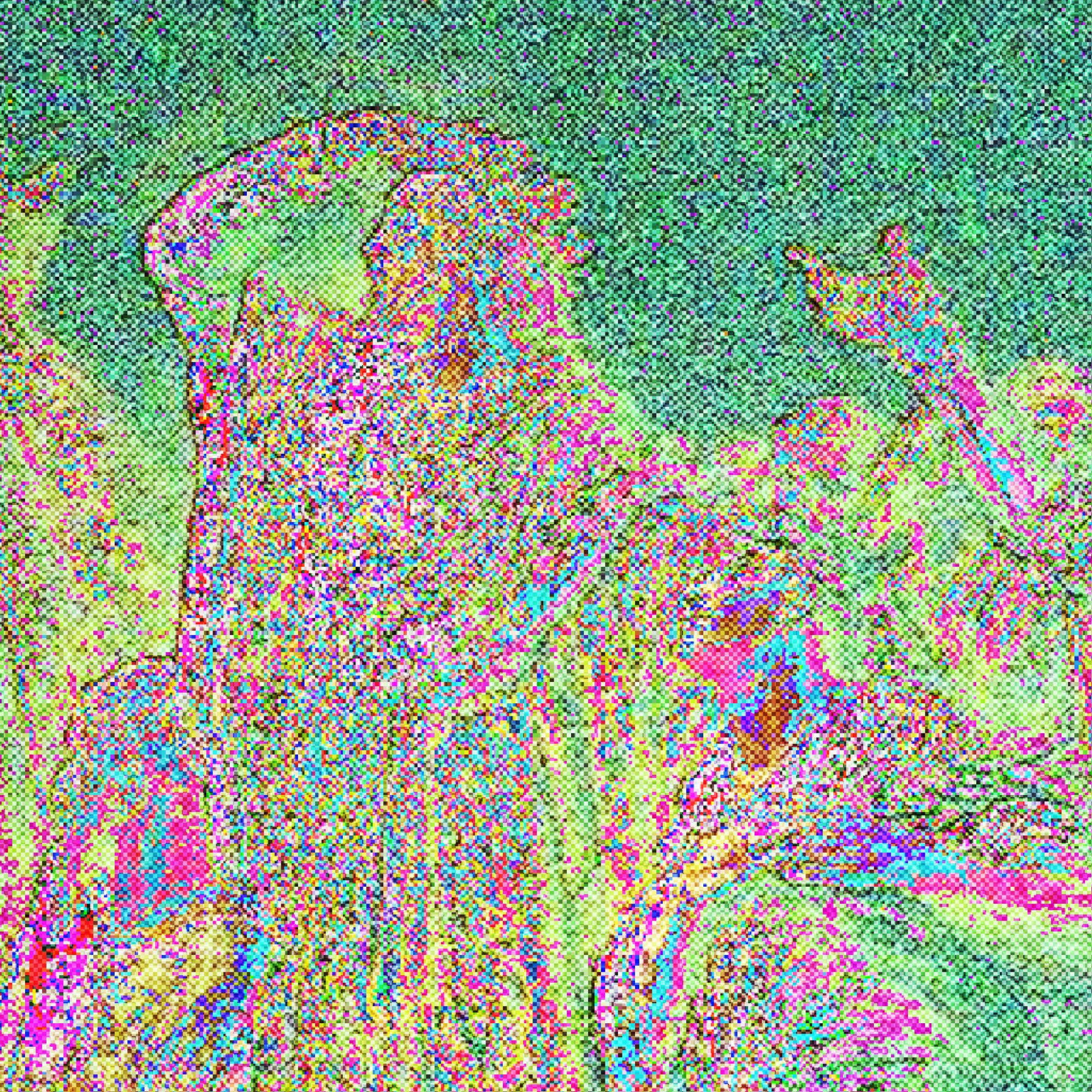
All four are photographic exposures on metallic paper, 100 × 100 cm, in editions of 2 + 1 AP. Two take their titles from works by Gustave Doré, whose reproductions are in the tool's image folder: the painting The Vale of Tears (1883) and the Bible plate The Creation of Light (process notes).
A Vale of Tears is a crowd of figures, several with raised arms, turned towards a bright area at the right, in green, cyan and magenta speckle; at full size, as in the detail, single figures dissolve into scattered coloured pixels. Creation of Light is a pale, glowing mass at the centre of a red and magenta field, its edges drawn out in thin bright filaments (→ Apophatic Theology for a reading of its title). Vortex is an eye of concentric rings, crimson and pale pink outside, a dark red ring with gold pixels inside, and a light oval at the centre. Person in a Field is a magenta upper half, a speckled field of yellow, orange and lilac below, and a small standing figure near the centre (→ Struggle for Pleasure for an installation view).
The tokens
Each wall work is also a token under the same title: A Vale of Tears, Creation of Light, Person in a Field and Vortex. The other ten:
- A Man: a standing figure in dripping violet bands beside three ringed spots (→ Franke × van den Dorpel).
- Blow Out: a long-haired musician's head and shoulders, from a television interview, in bands of orange, cyan and violet among flat blocks (same page).
- Array: an all-over mosaic of small rounded cells, each banded in red, violet, cyan and yellow.
- Attractor: a red swirl around a dark centre, streaked with violet and white.
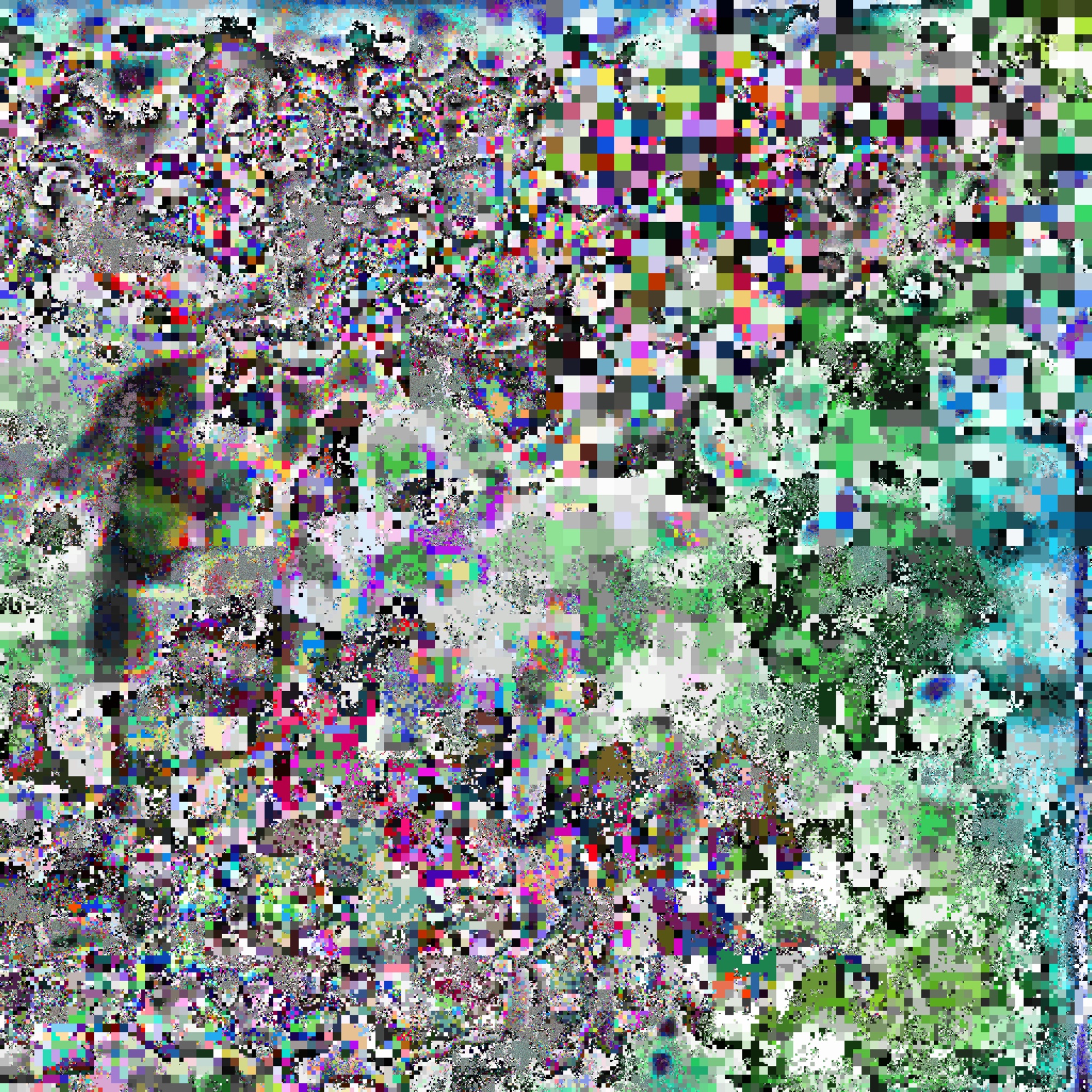
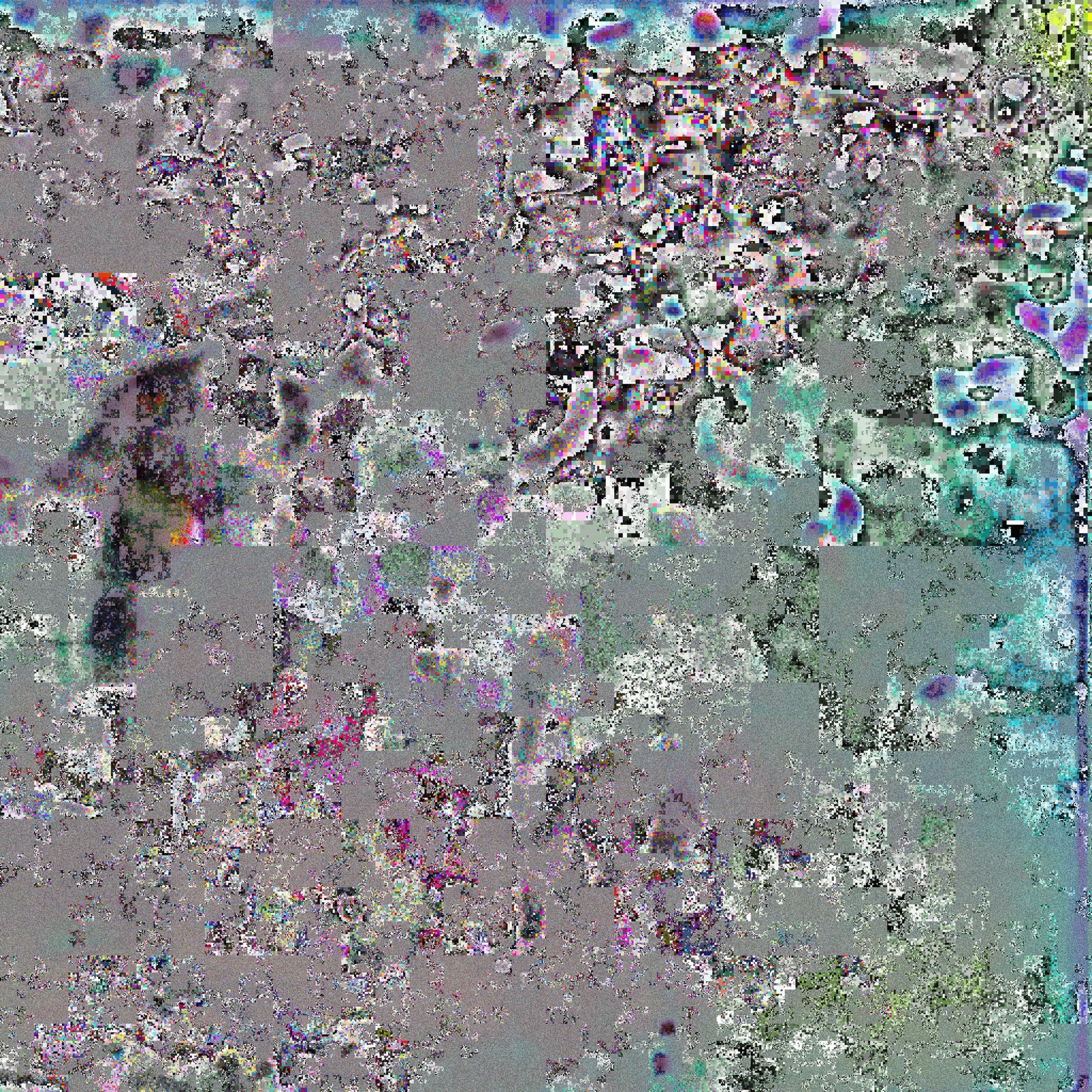
- Crowd and Crowd II: two versions of crowd footage from a 1993 concert film (process notes), a dark figure at the left of a speckled field; in Crowd II most of the field is left as flat grey blocks.
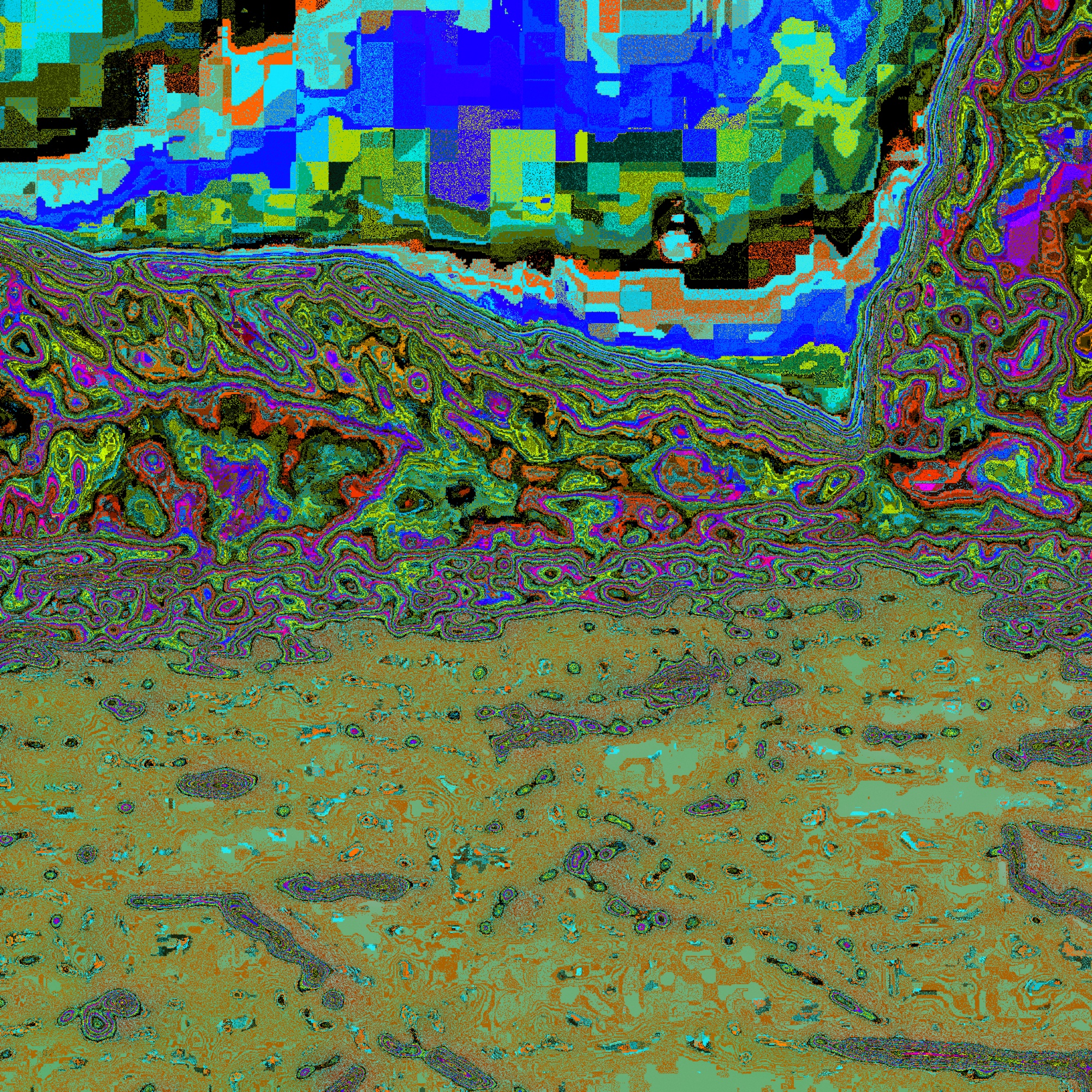
- Desert Sky: from a music-video frame of a cracked desert under a coloured sky; the ridge between them is drawn in dense contour bands, the sky in coarse blocks.
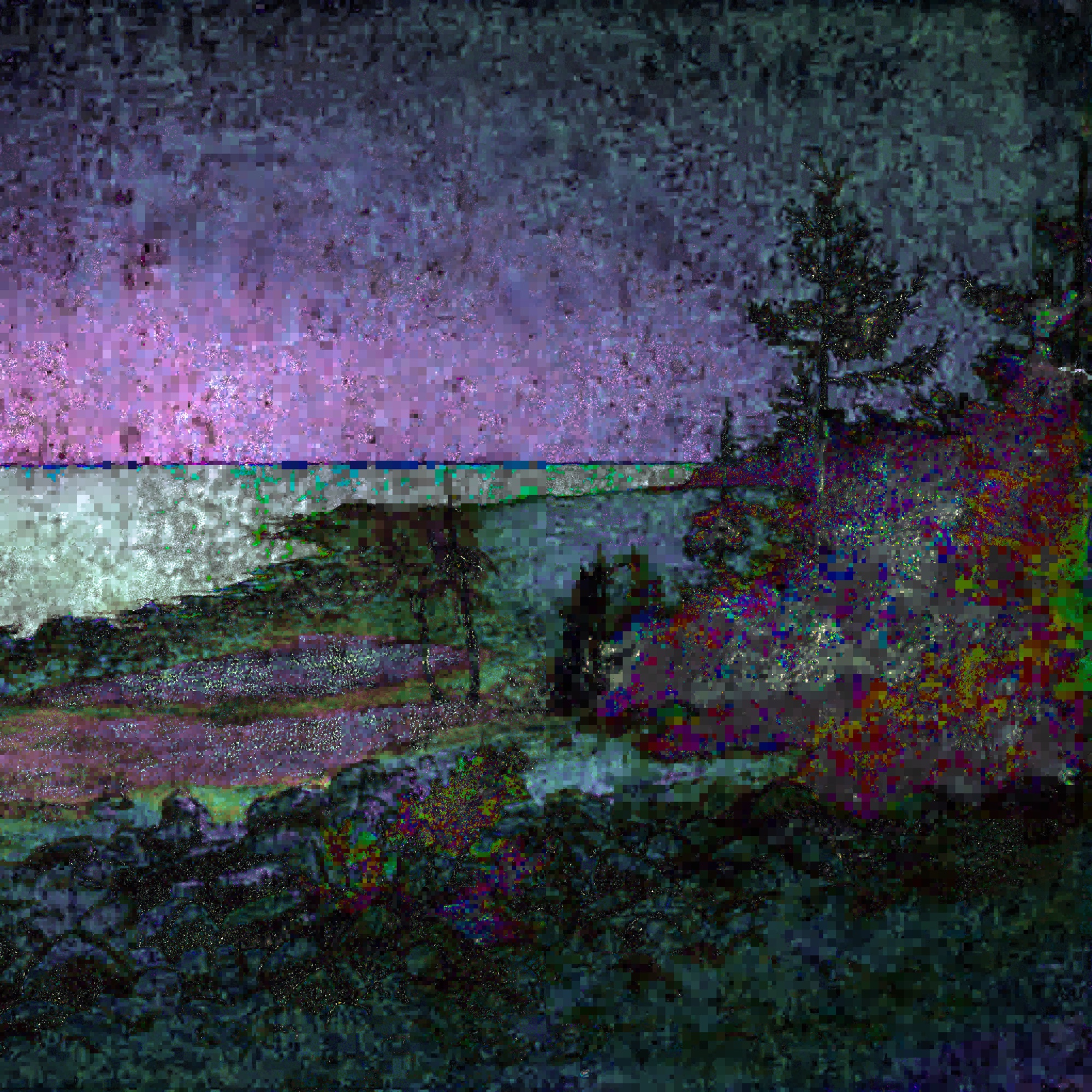
- Landscape: a rocky shore with pines and a strip of sea under a violet sky, dark and finely pixelated.
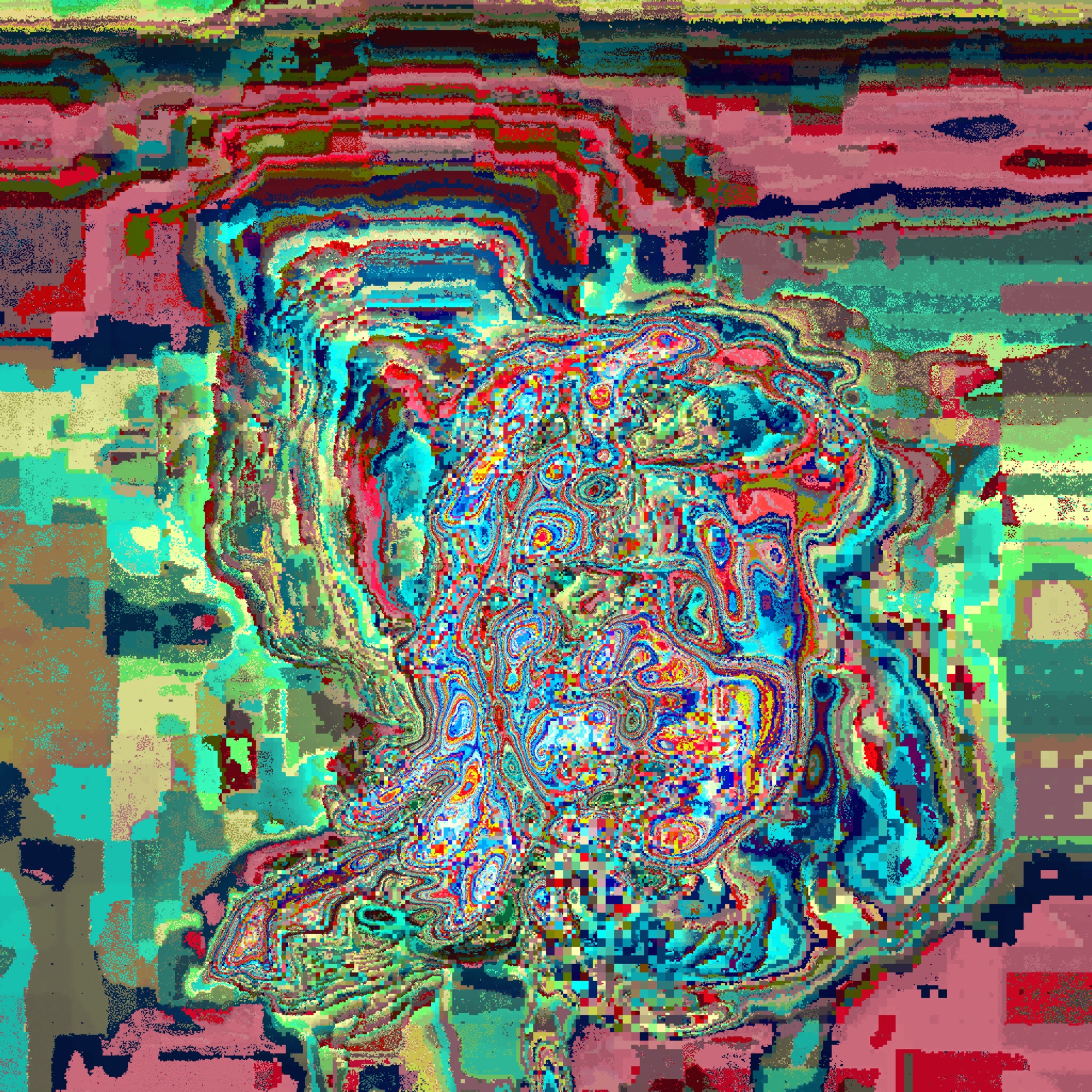
- Glow (added 2026): a head-sized mass of dense bands at the centre, framed by coarse pink, teal and ochre blocks.
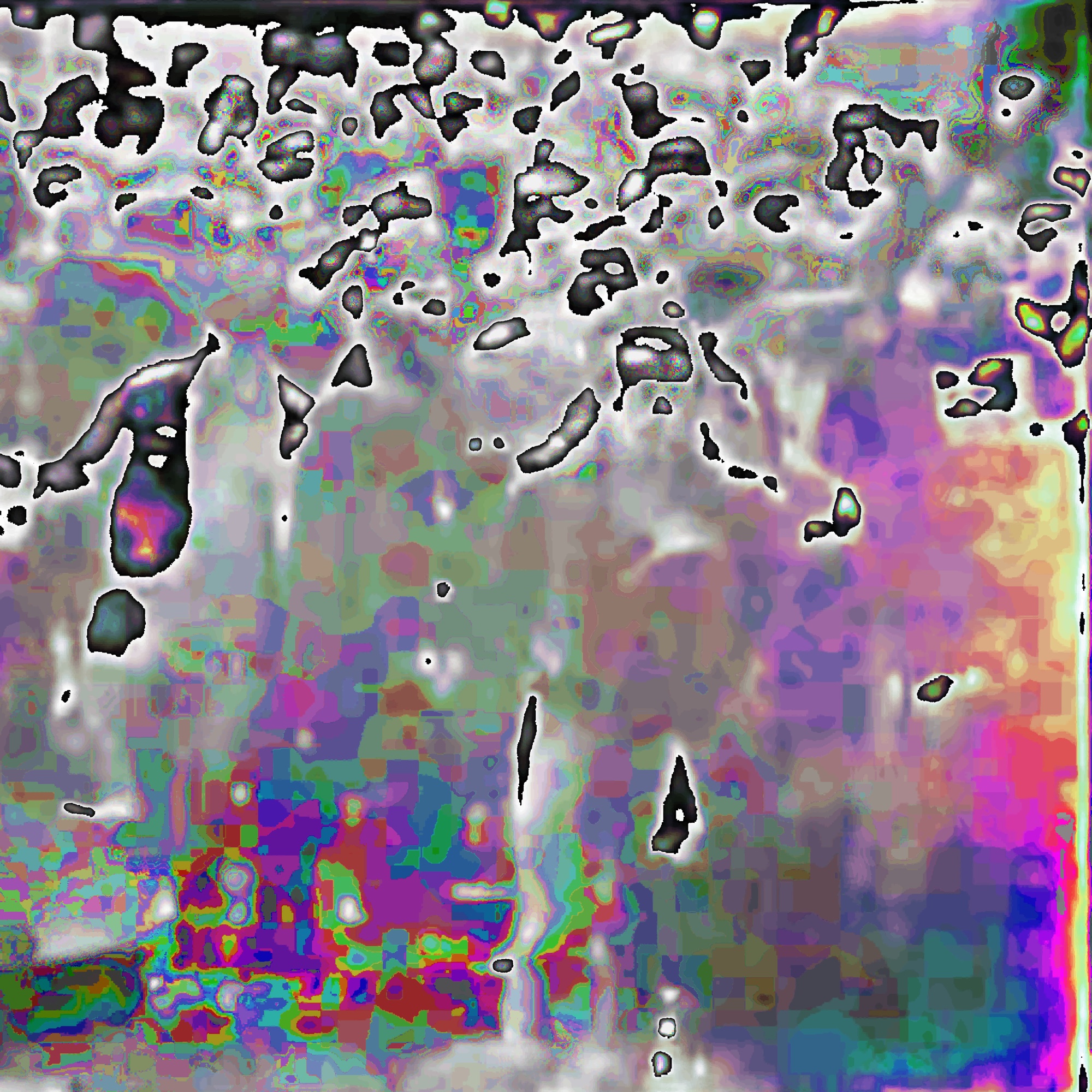
- Transpire (added 2026): a pale field of soft violet, pink and grey patches, with black-edged blots across the top.
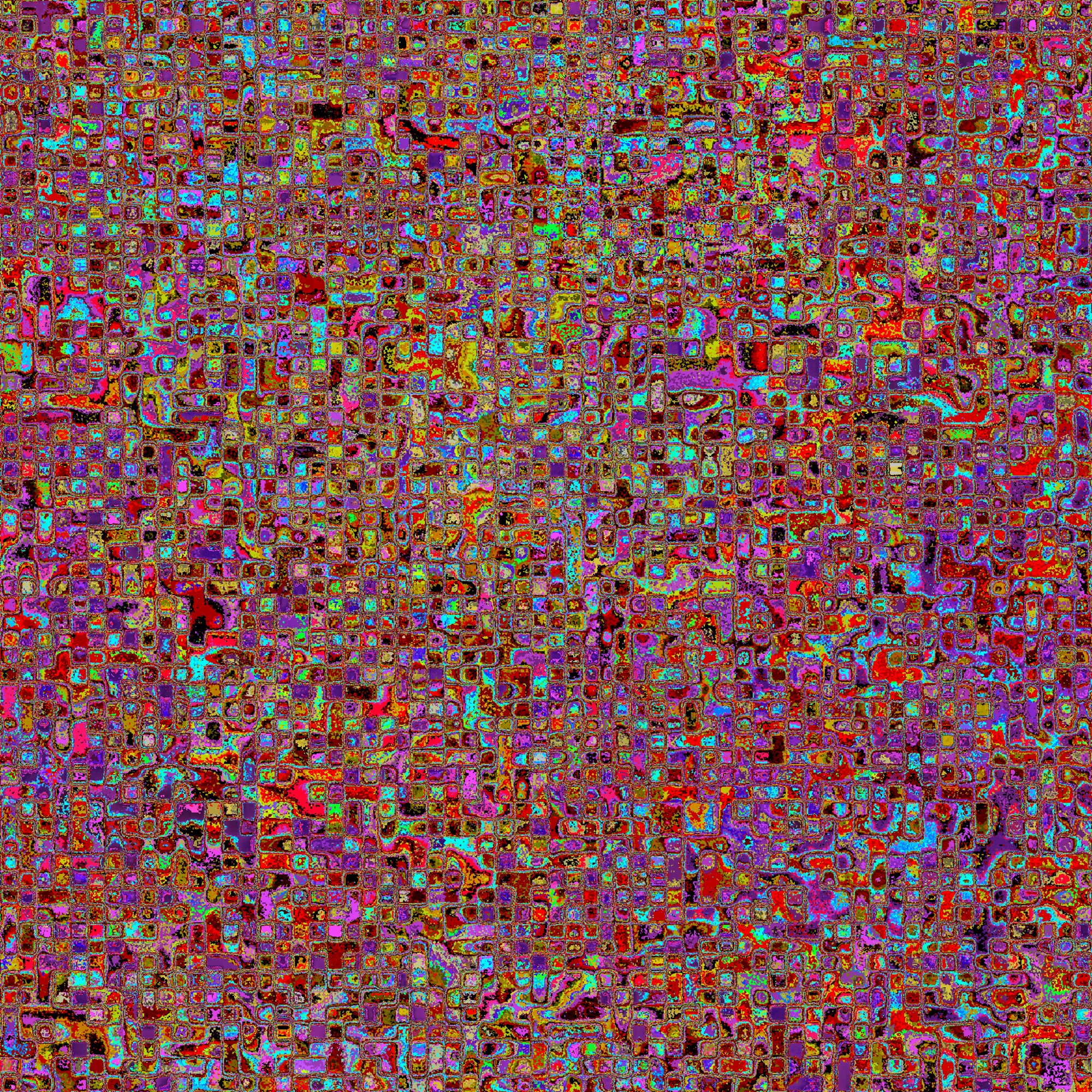
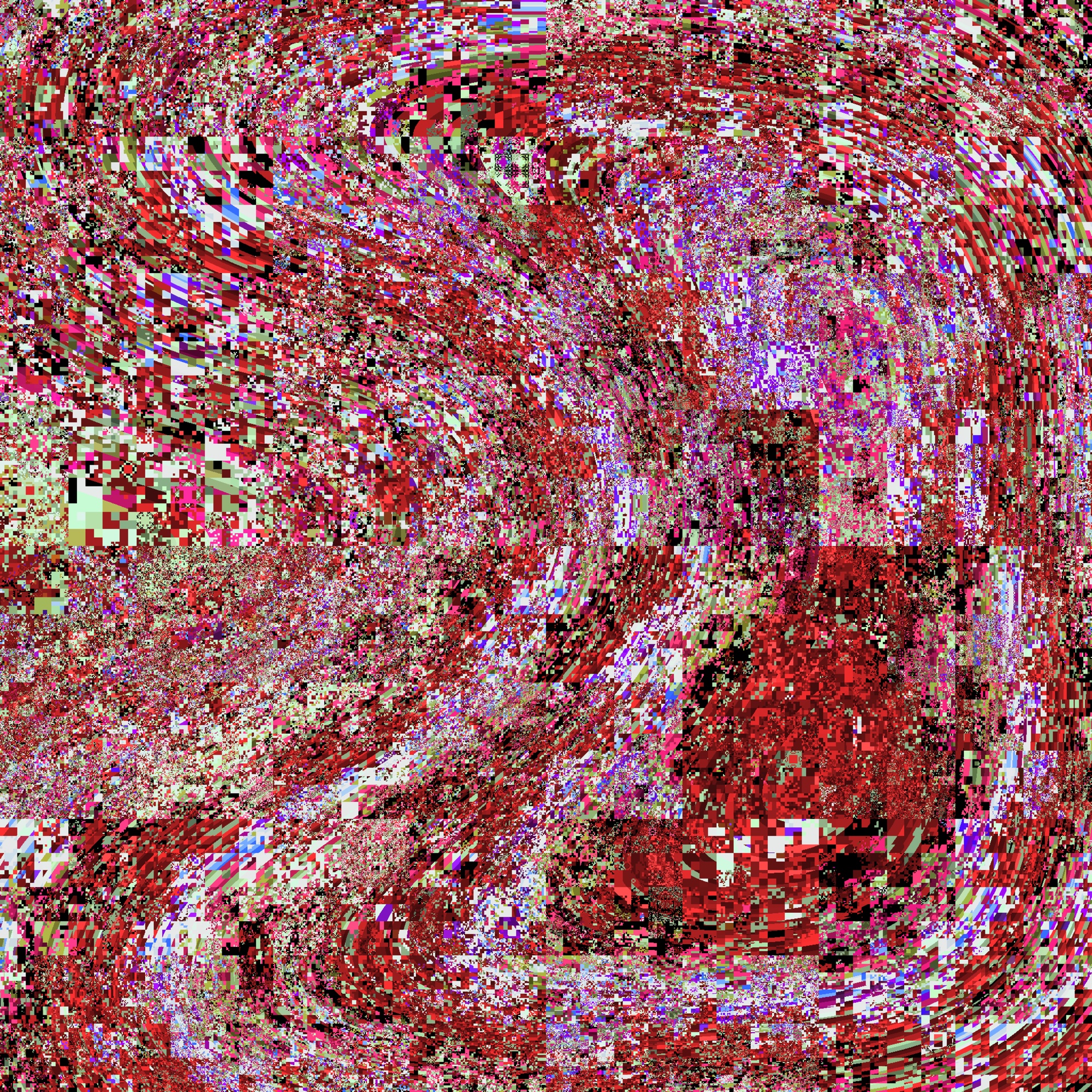
Outside the collection
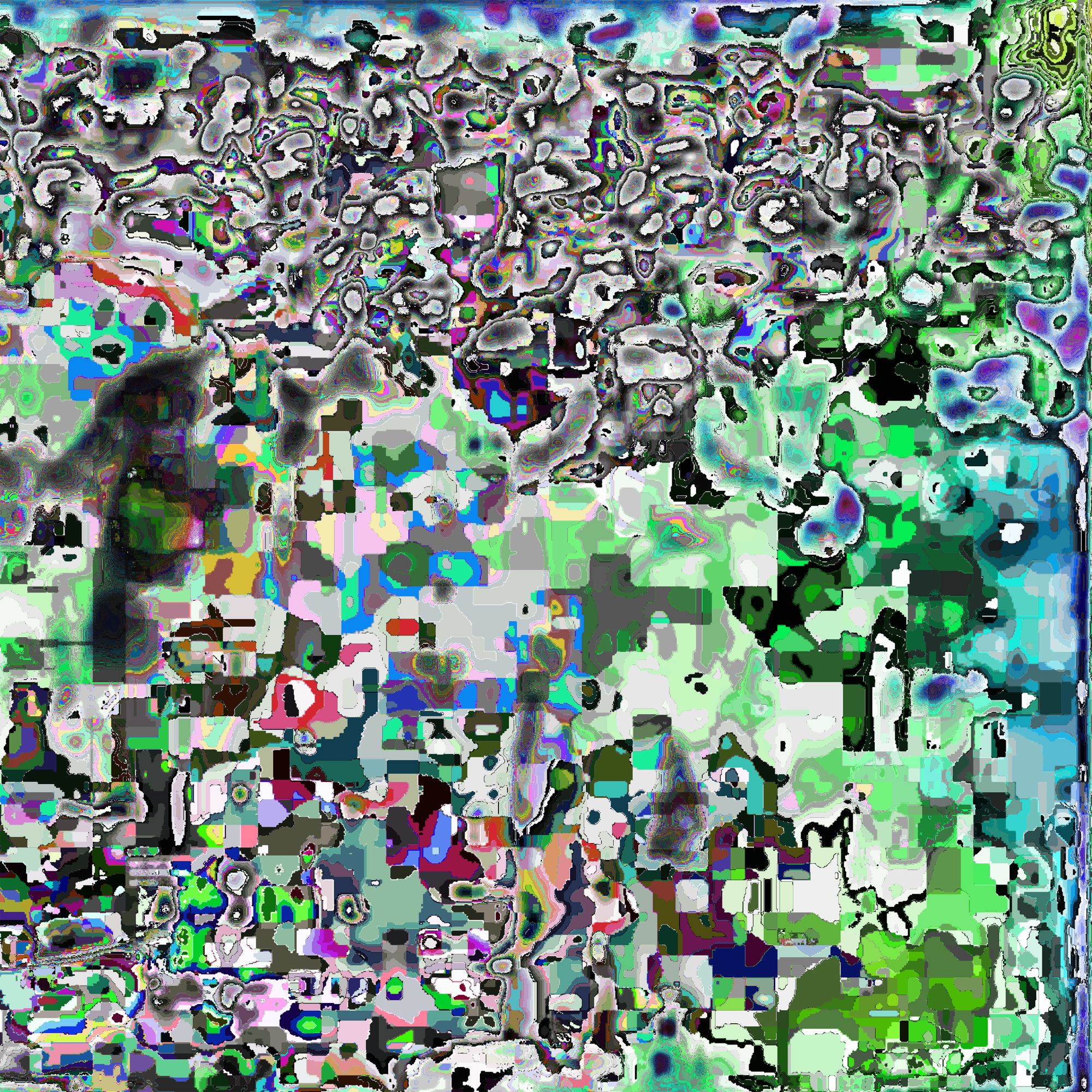
Two more outputs of the tool are on harm.work as works of their own, not in any series or collection, both described "8192×8192px, 8 bit PNG" and both entered on 13 February 2024, eight days after the final files of the series. Crowd (III) is a third version of the concert crowd: the same dark figure at the left, the field broken into grey, green, violet and white blotches, greener towards the right, with more of its blocks divided than in Crowd II. Transpiration shows the same image as the token Transpire, so the token entered in 2026 was made by February 2024; its picture is in the gallery above.
Exhibitions
- Struggle for Pleasure, Verse SOLOS, London, 2024, curated by Leyla Fakhr: the four wall works, with the collections Struggle for Pleasure and Swallow, only Shallow (→ Struggle for Pleasure).
- Judgment and Calculation, frontviews at HAUNT, Berlin, 11 July – 22 August 2026, with Elisabeth Sonneck and Carsten Becker: Vortex, Person in a Field and A Vale of Tears (→ Judgment and Calculation).
See also
- Swallow, Only Shallow — the tool and the working files — the pixelator, the found images, the saved states
- Struggle for Pleasure — the exhibition and the 128 quadtree tokens the series grew from
- Franke × van den Dorpel — the photograph as data; Blow Out and A Man beside Franke's Bruckner
- Algorithmic Archaeology — the wrap, found after the work
- Randomness and Pattern — pixels and varying resolution
- Afterimage — Loveless and shoegaze in the practice