
Interpolations — after Hanne Darboven (2024–25)
Interpolations is a series of nine plotter drawings on millimetre paper. The first four were shown in Angles Morts, his two-person show with Vera Molnár in Munich in 2024; the other five were made in 2025 and shown in Cloud Writings in Tokyo in 2026. The series text on harm.work gives the whole procedure:
"Series of plotter drawings that extend Hanne Darboven's Konstruktionen (1966) through interpolation. For each work, the lines of an existing Darboven construction are traced, and software then computes the lines that would lie between them — drawing out a continuum the original only implied. The results are plotted onto millimeter paper."
The series is one stop on the timeline of Algorithmic Archaeology, his name for rebuilding the rules of artists who worked by hand before the computer. Several of those reconstructions recover a rule and run it anew. This one keeps the drawing and adds what lies between its lines.
Darboven's construction
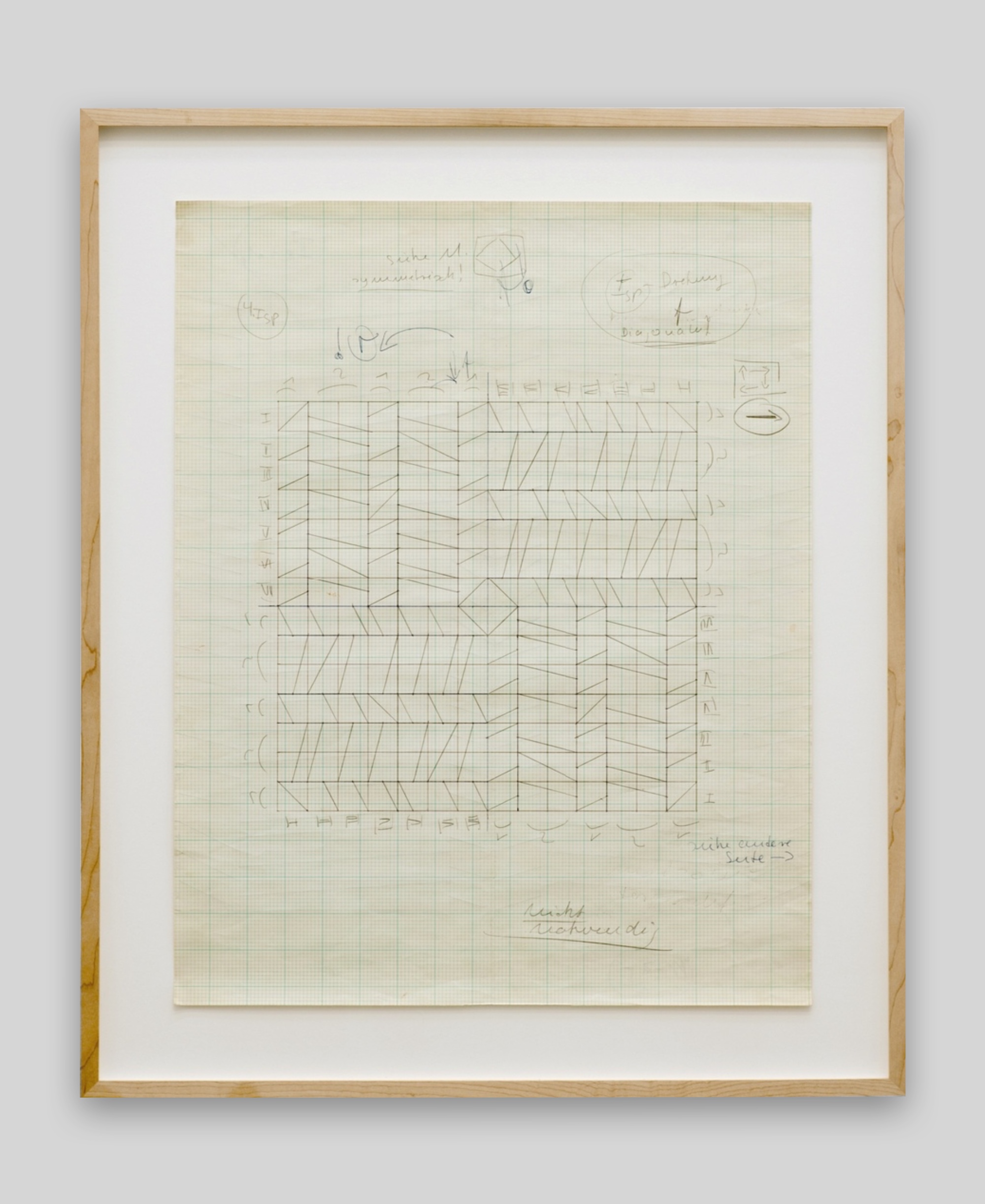
Hanne Darboven (1941–2009) made her Konstruktionen in New York in 1966–67, systematic drawings on graph paper. harm.work shows one of them on the page of Interpolation I, captioned "Original work Perforation, Konstruktion by Hanne Darboven, from 1966/67". It is a different sheet from the one he filed in his are.na channel on grids on 11 April 2024, Konstruktion / Perforation New York, "Pencil and ballpoint pen on paper, perforated" (block; → Modular Aesthetic Systems), in which the strokes zigzag down vertical columns.
On a sheet of ruled graph paper she drew a square grid and put one straight stroke in each cell. A cross divides the grid into four quarters, and the slope of the strokes changes from quarter to quarter; where the quarters meet, a small square stands on its corner. Roman numerals number the rows down the left margin. Among the notes above the grid are the words Drehung (rotation) and Diagonale. The construction is a rule written out by hand, cell by cell, and the strokes are all it shows.
Drawing what lies between
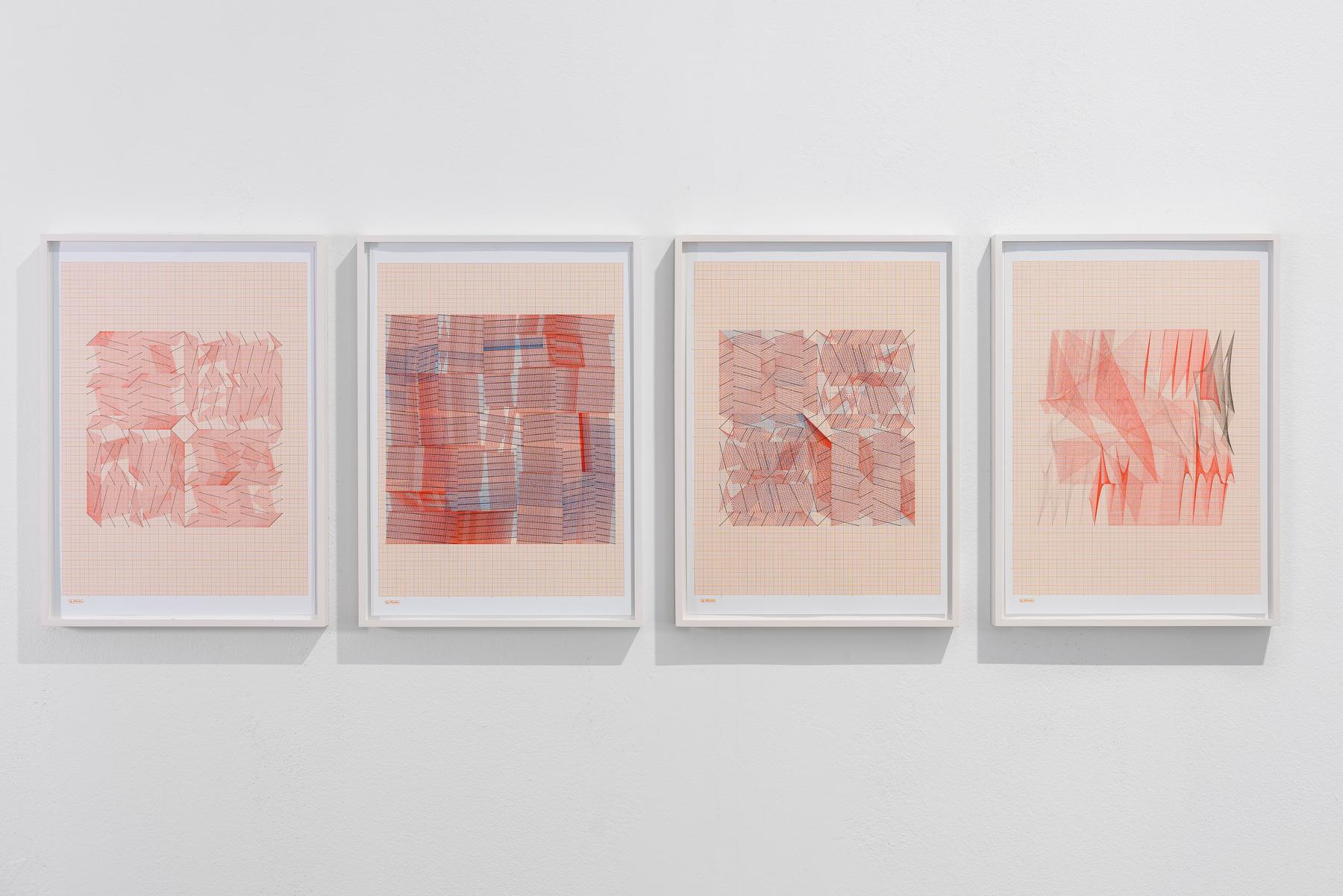
Interpolation I shows the procedure most plainly. Darboven's strokes are plotted in black, one per cell, in the same quarters and with the same diamond at the centre. Between each stroke and its neighbour the program draws a family of red lines, each a step from one stroke towards the next, so densely that they read as a tinted surface. Where two neighbouring strokes are nearly parallel the family is a band; where their slopes differ it fans out; where they cross, the in-between lines turn, and their outline becomes a curve, as in string art. The traced strokes stay visible as a skeleton over what was computed from them.
The paper repeats the source. Darboven drew on graph paper; the Interpolations are plotted on millimetre paper, so the printed grid and the construction share the sheet in both.
His are.na channel Interpolations, opened on 25 January 2025 and described "Interpolations of works by Hanne Darboven", has nine blocks: scans of the first four drawings, the installation view above from Angles Morts (September 2024), and four phone photographs taken on 22 January 2025 of the drawings later numbered V to VIII.
The nine drawings
The four drawings of 2024 are 44.5 × 32 cm, plotted mainly in red with grey or black, the construction a square field in the middle of the sheet. In the five of 2025 the constructions are arranged in vertical columns, like the strokes of the are.na sheet, and more than one family of lines is laid over another; which Darboven sheets they trace is not recorded. V to VIII keep the format of 44.5 × 32 cm; IX is larger.
Interpolation I
Interpolation I (2024) follows Perforation, Konstruktion and is described above; its image is on Angles Morts.
Interpolation II
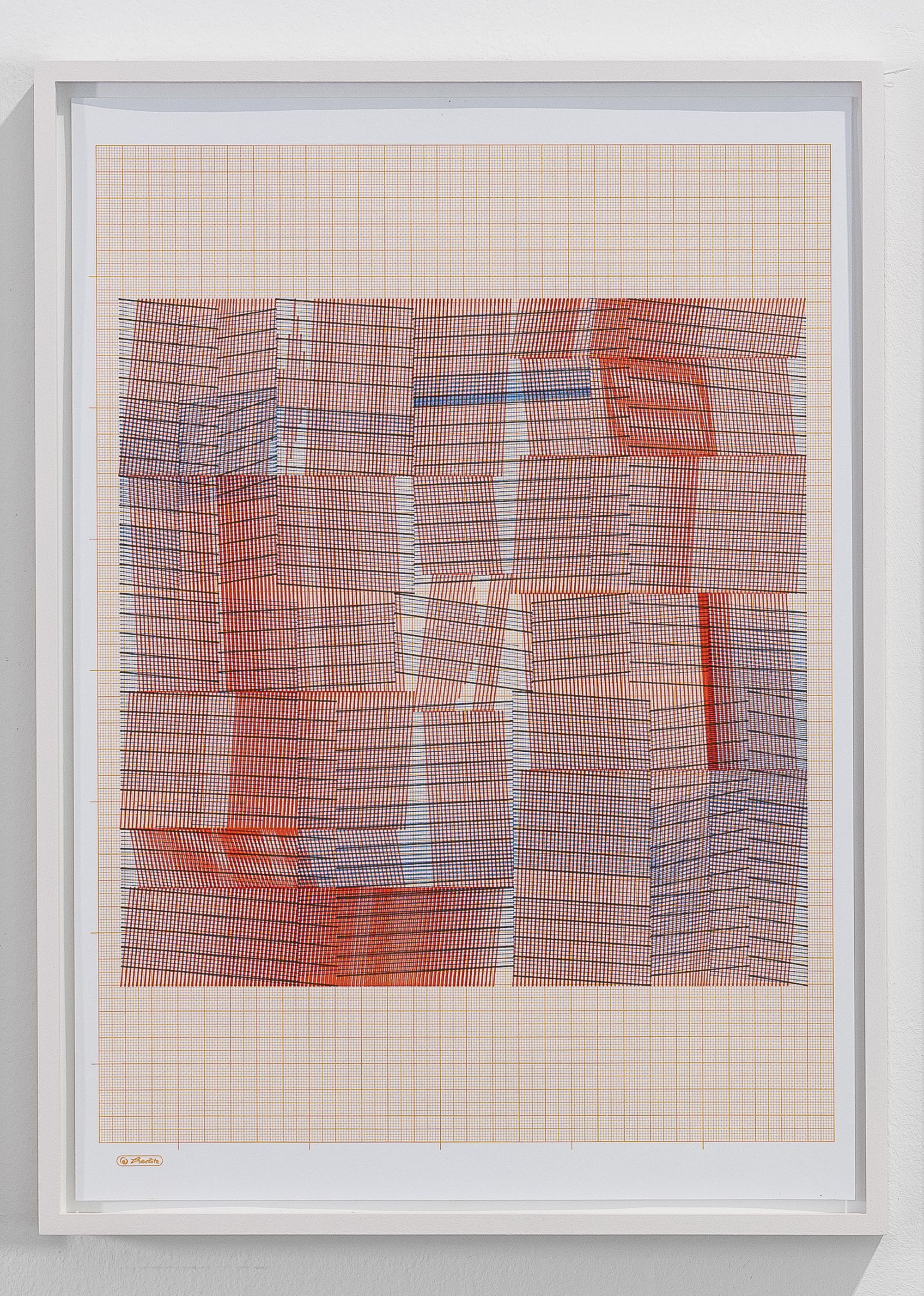
Interpolation II (2024) is built from a grid of tilted rectangles, each ruled across with short horizontal lines; the in-between lines, in red, dark red and a little blue, stack the rectangles into a block that looks woven.
Interpolation III
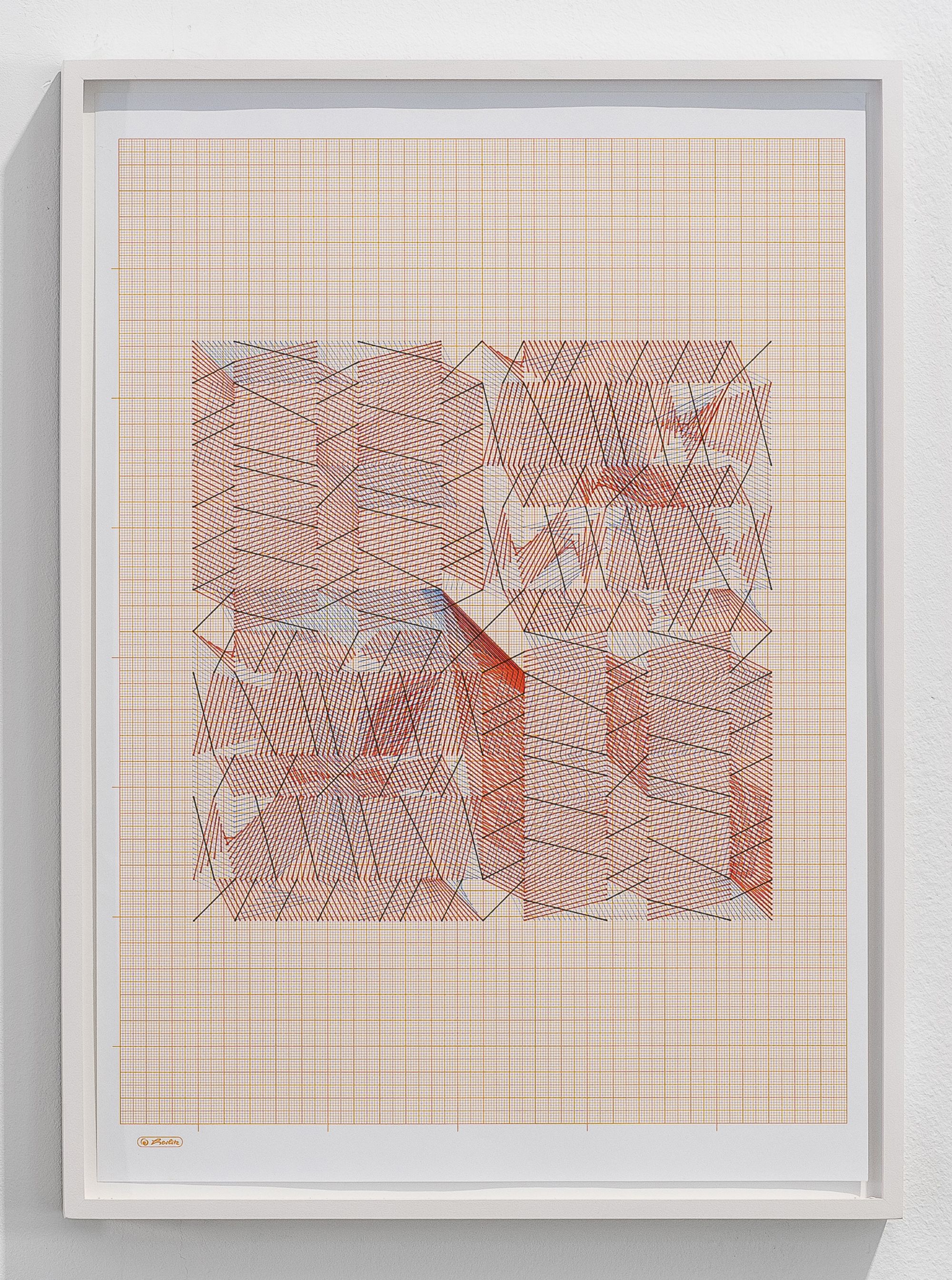
Interpolation III (2024) returns to four quarters meeting at a point, with zigzag black strokes laid over dense red hatching.
Interpolation IV
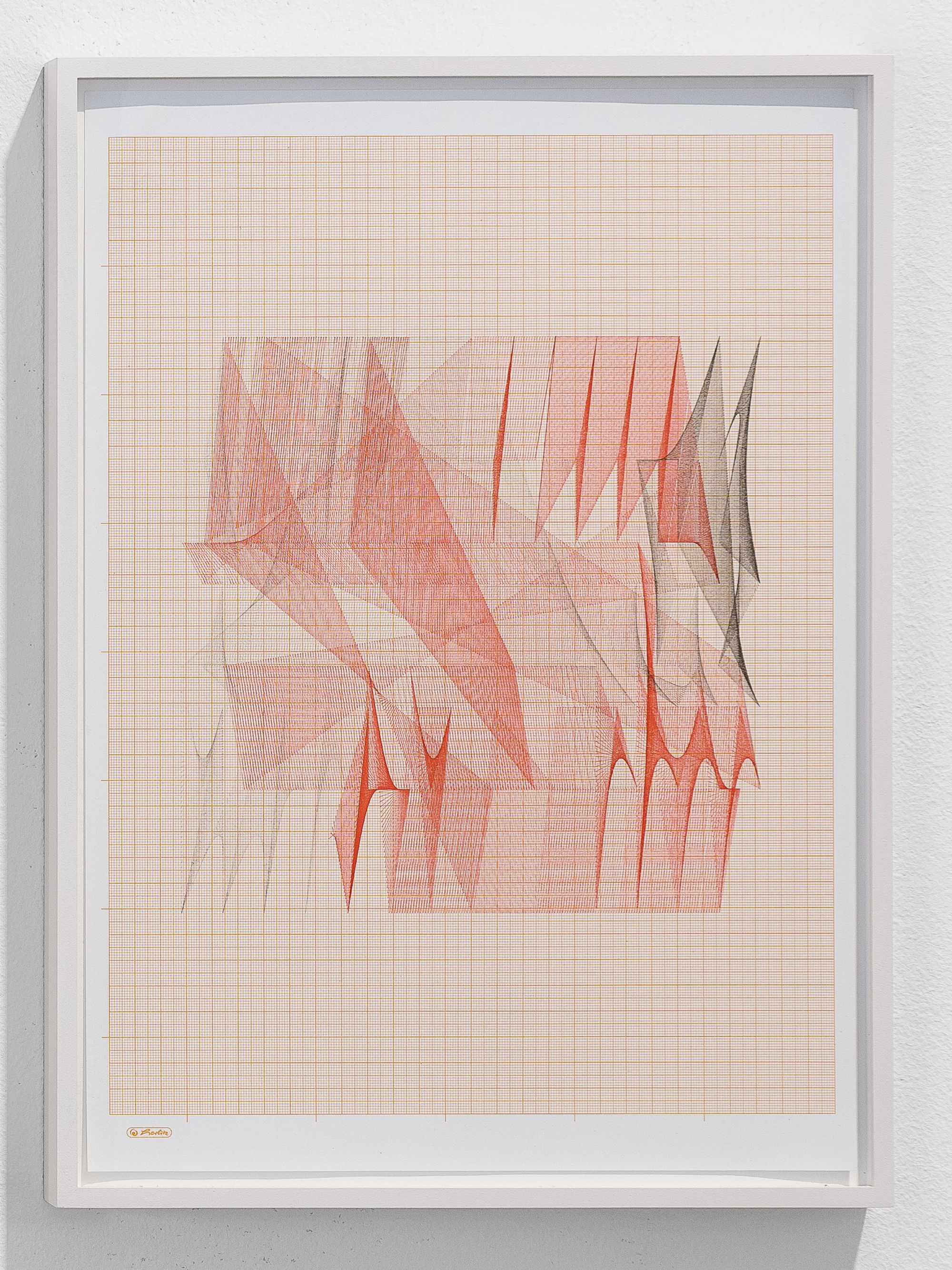
Interpolation IV (2024) is the loosest: few strokes, far apart and steeply angled, so the computed lines spread into large red and grey fans, and from the lower edge of the field rise rows of sharp cusps where neighbouring lines cross.
Interpolation V
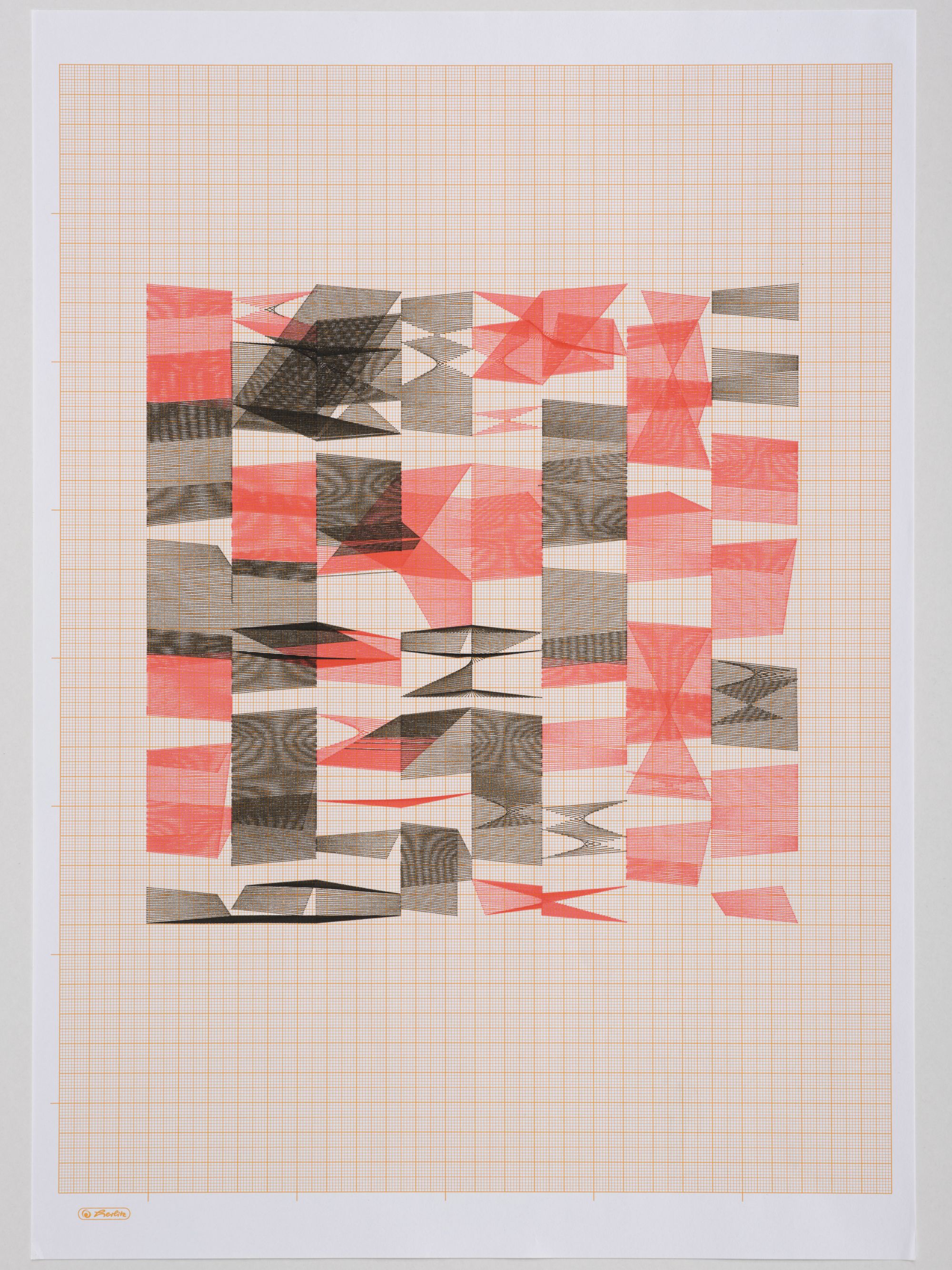
Interpolation V (2025) alternates red and black in seven columns of short bands. Where two lines of a pair cross, the band pinches into a bow-tie or an hourglass; where black is plotted over black, the dense lines leave moiré.
Interpolation VI
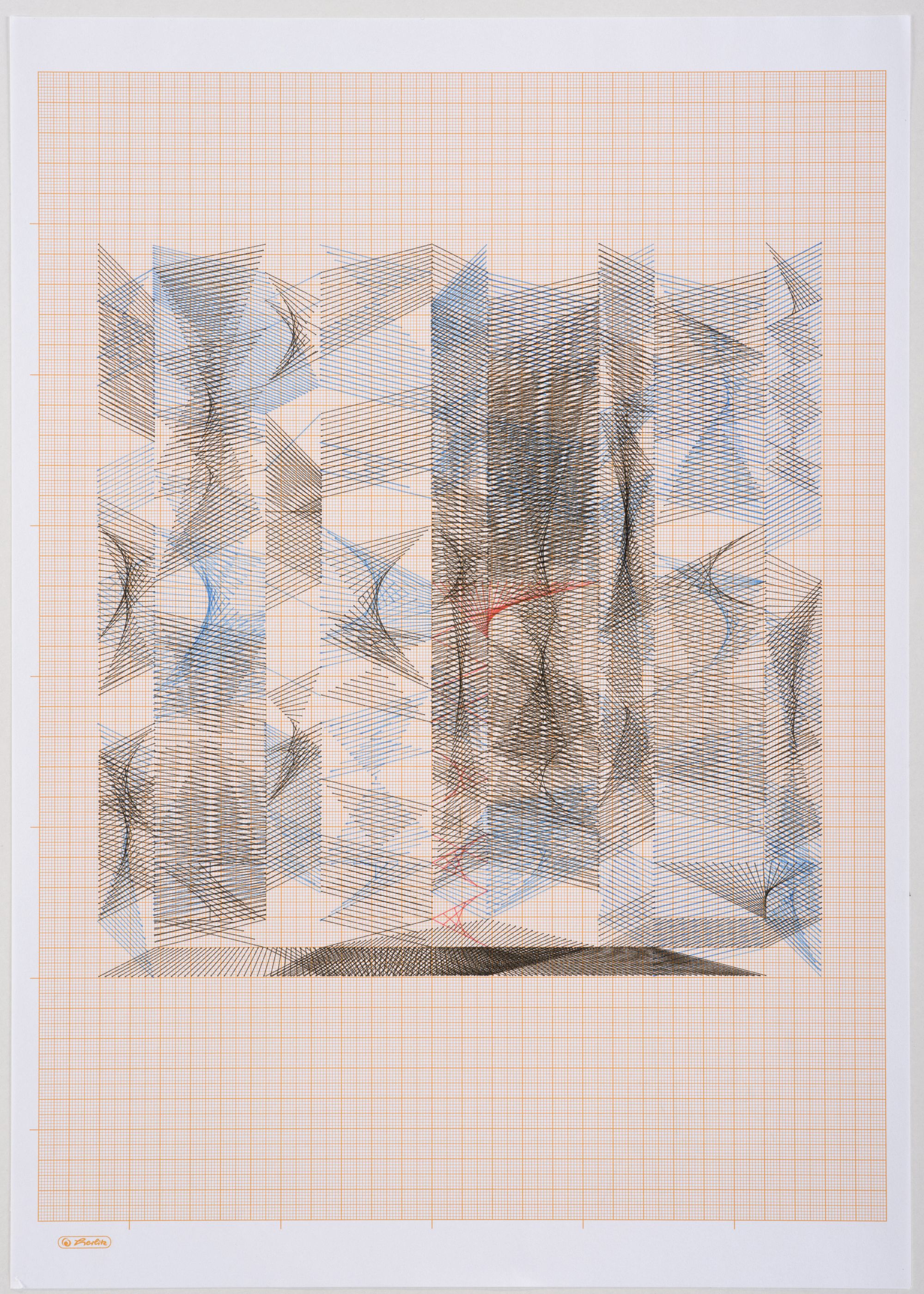
Interpolation VI (2025) is in black and blue: tall columns of slanted hatching whose crossings make pairs of curved envelopes facing each other, a thin thread of red near the middle, and a dark wedge along the foot of the field.
Interpolation VII
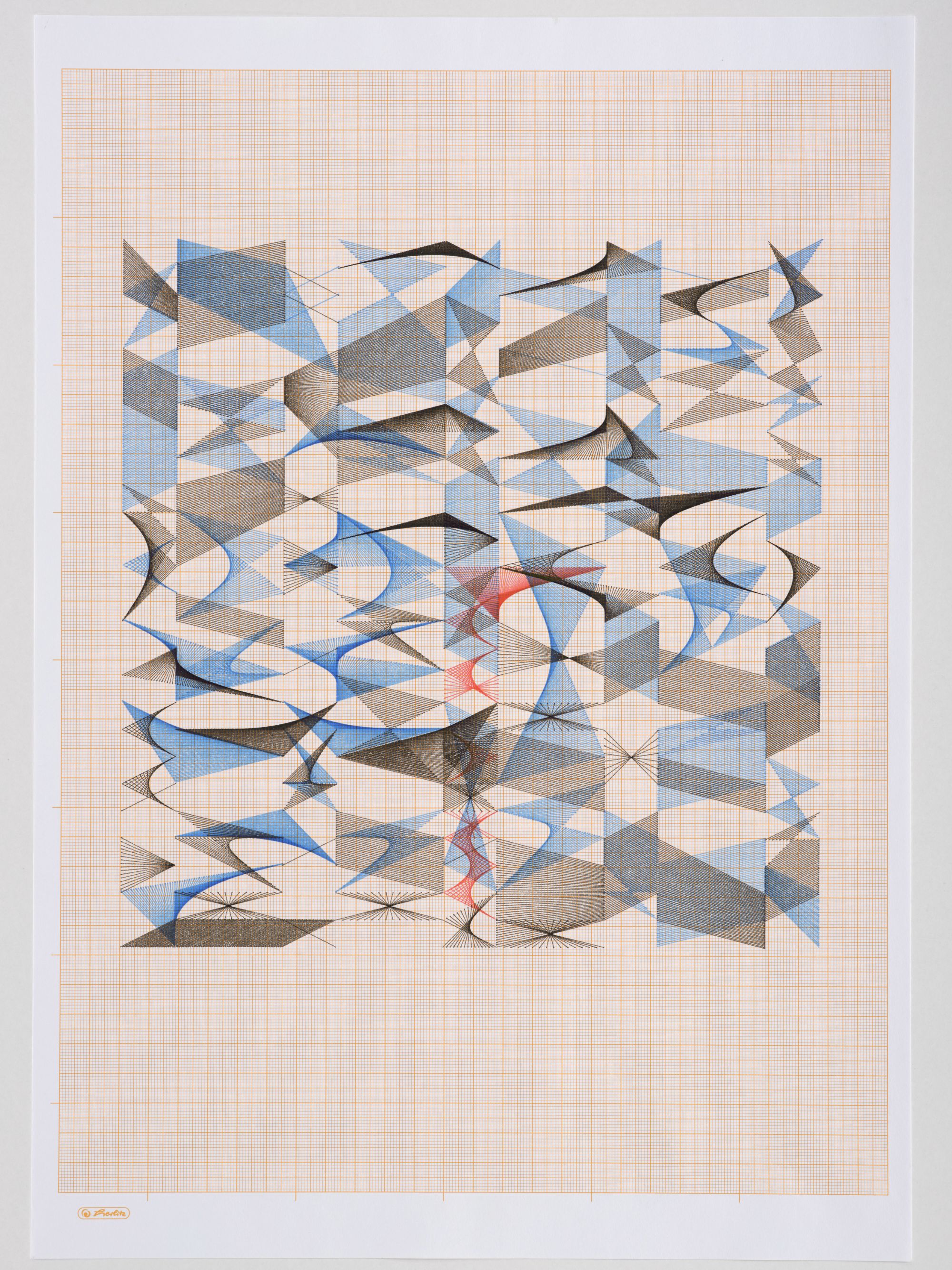
Interpolation VII (2025) is also blue and black, with red down one column. Its families of lines turn more sharply than in VI, so most of the field is made of hooked curves and fans, and the columns are hard to see.
Interpolation VIII
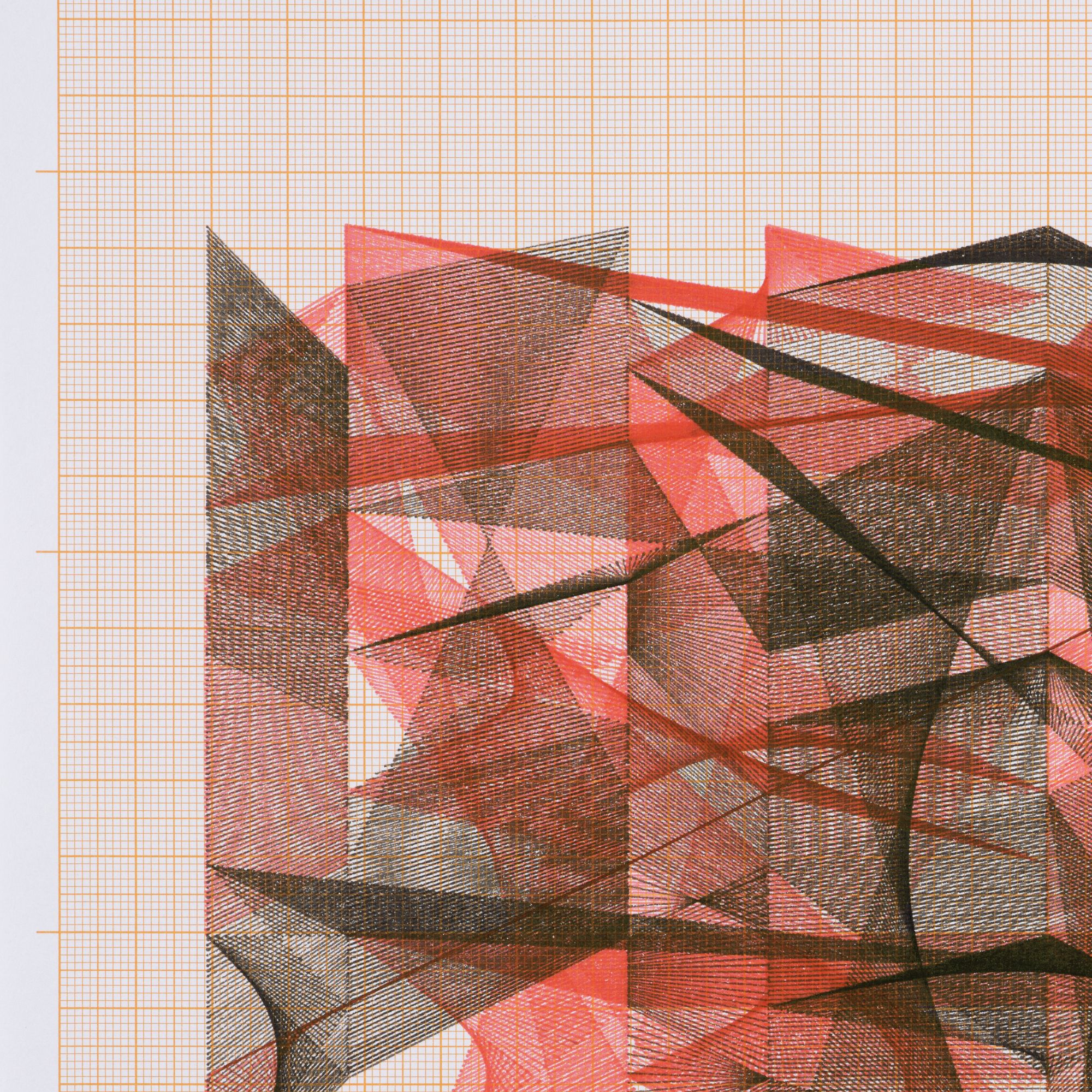
Interpolation VIII (2025) is the densest of the five: red and black families overlap across the whole field, and long dark spikes, the envelopes of lines that cross at a shallow angle, run through it in several directions.
Interpolation IX
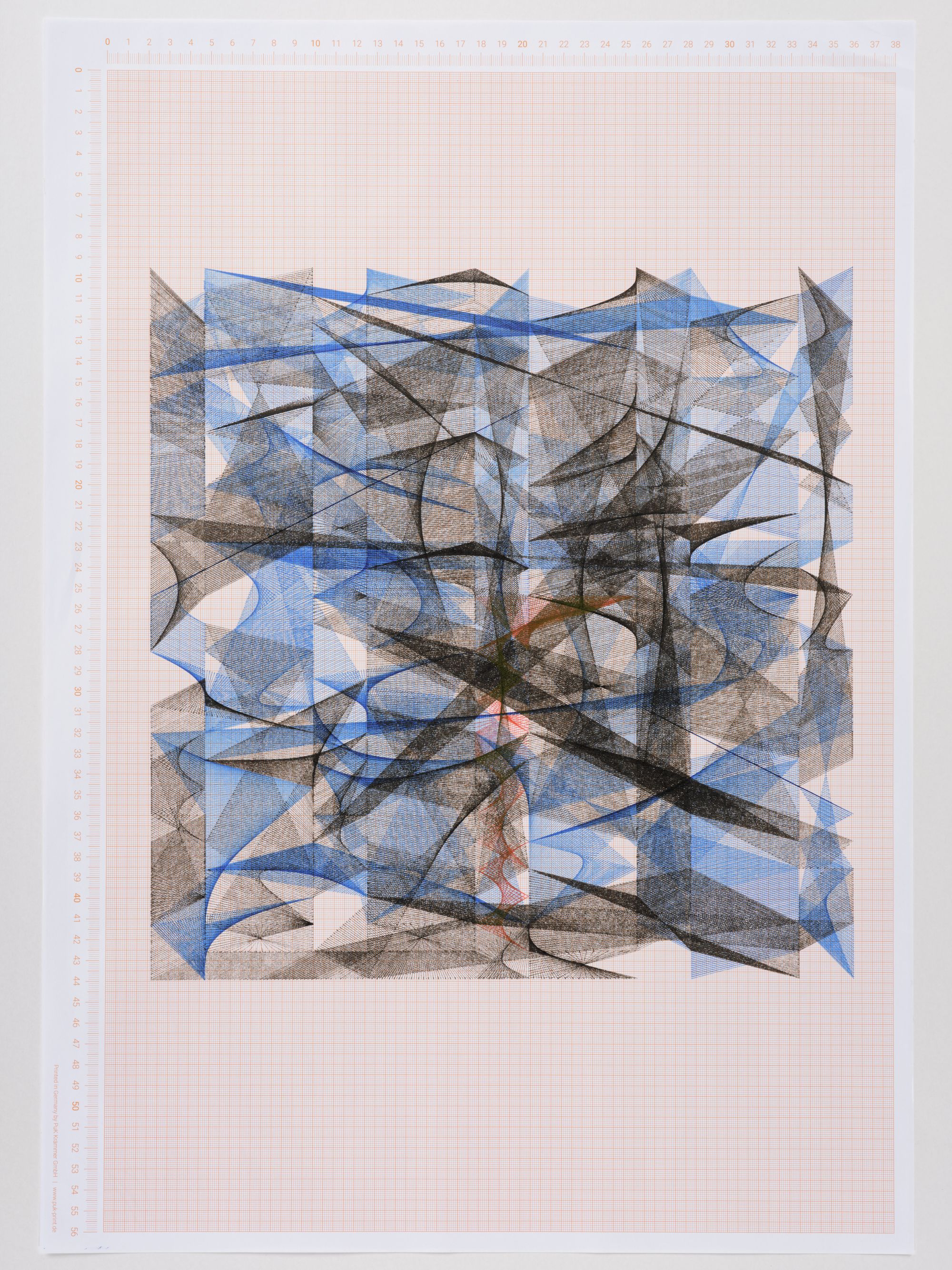
Interpolation IX (2025) is the largest, 42 × 60 cm, on a sheet with printed scales along its top and left edges. Its blue and black families are as dense as VIII's, with a trace of red down the middle.
Exhibitions
- Angles Morts, LOHAUS SOMINSKY, Munich, 6 September – 2 November 2024, with works by Vera Molnár: Interpolation I to IV in white frames. The gallery's text names four women whose grid work he had researched since 2019; Darboven makes a fifth (→ Angles Morts).
- Cloud Writings, Takuro Someya Contemporary Art, Tokyo, opened 14 February 2026: Interpolation V to IX. The gallery announced "algorithmic drawings shaped by his generative practice and the ideas of female artists active in minimalism and conceptual art in the late 20th century" (→ Cloud Writings; the installation view is on Algorithmic Archaeology).
The word
He used interpolate for the eye before he used it for a series. In the Verse conversation of January 2024, on the pixel works: "our mind tries to interpolate the space between those pixels and construct more complicated entities behind those pixels" (→ Verse Twitter Spaces (2024); Randomness and Pattern). There the viewer fills in what lies between given points; in the Interpolations the software does it, and plots the result. The connection between the two uses of the word is the wiki's.
See also
- Algorithmic Archaeology — Darboven among the precedents rebuilt in code
- Angles Morts — the four women and the first four drawings
- Cloud Writings — the 2025 drawings in Tokyo
- The Grid — graph paper, Krauss and the grid works
- Early Plotter Drawings — the plotter in the practice