
qubibi's hello world — a practice in parallel
Giannis Sourdis's essay hello world by qubibi (Automat Research, July 2026; the ingested copy is abridged, the full text is at automat.art) reads in stretches like a parallel account of this archive, written about a different artist. qubibi is the Japanese artist and programmer Kazumasa Teshigawara; hello world is his generative work from 2010. Sourdis finds it drawing together four traditions: the rule-based image of the 1960s pioneers, John Whitney Sr.'s computational motion, the artificial-life aesthetics of the 1980s and 1990s, and software as a medium. Three of the four run under the work catalogued in this wiki; Whitney's motion films are the one it never cites. What follows sets the two practices side by side.
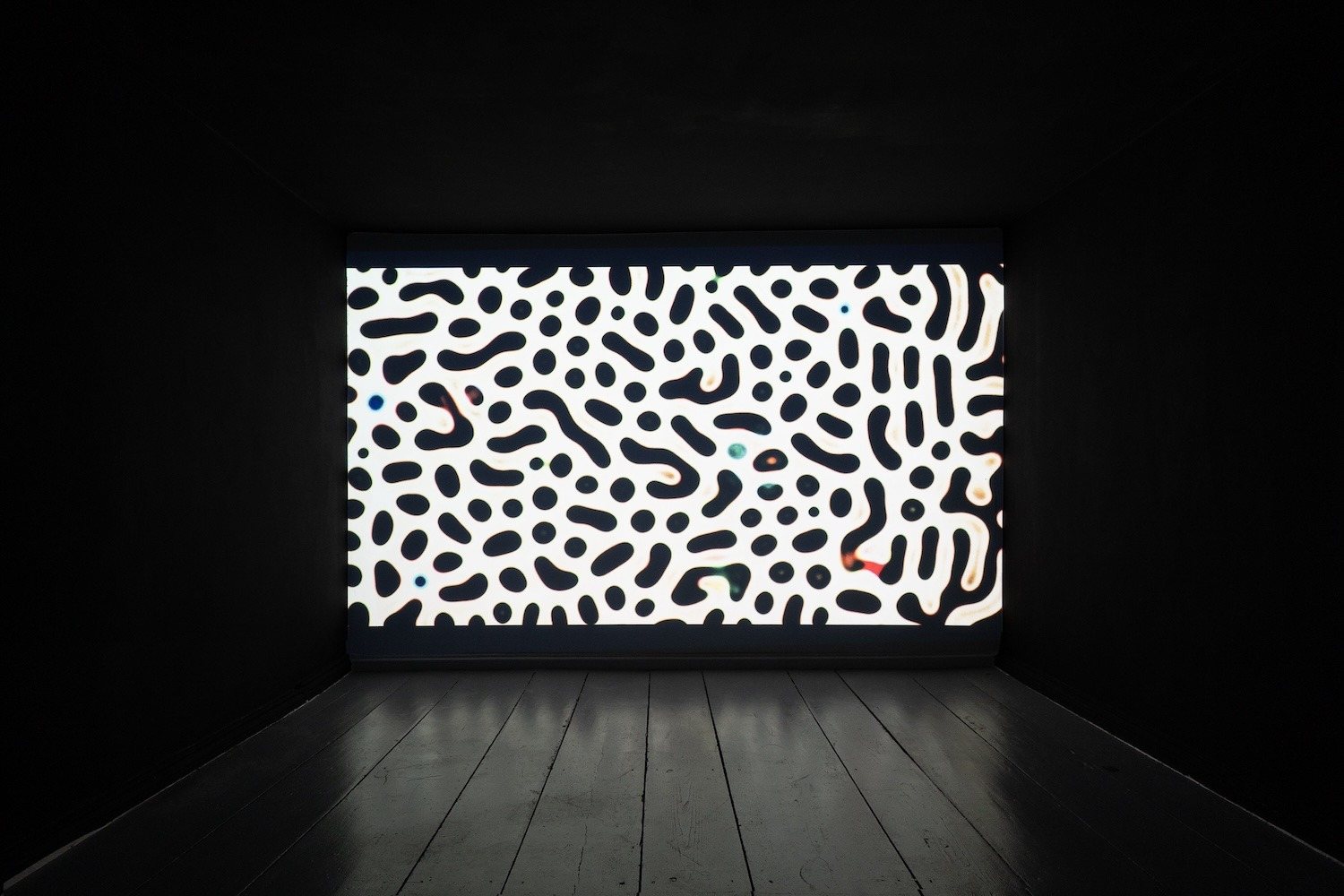
A shared 2010. hello world and dissociations.com both date from 2010, and both are systems that keep running rather than finished pictures. Sourdis describes forms that "appear, dissolve, and reorganize", with "no single state" as beginning or endpoint, a work that "can be entered at any moment without disrupting its internal continuity". A generative studio with no final state to reach works the same way.
A shared genealogy. Sourdis's precursors overlap this archive's at three names. He opens on the 1960s pioneers, among them Vera Molnár, shown beside this practice in Angles Morts (2024), and Manfred Mohr, whom the wiki treats on Algorithmic Archaeology. His opening illustration pairs Herbert W. Franke's Drakula (Original 03) with qubibi's mimizu Untitled #16, and Franke is the artist set beside Stained Unravel in Vectors (Munich, 2026). His artificial-life section turns on Karl Sims and evolved form, the terrain of Cartesian Genetic Programming and Death Imitates Language, though the wiki never names Sims.
Discovered, not composed

The strongest correspondence is method. qubibi, Sourdis writes, did not begin hello world "with a predetermined image or theoretical framework"; he "developed a set of interactions that gradually produced unexpected visual behaviors", so "the work was discovered as much as designed." This matches what the wiki describes as initiated, not composed and subconscious computation: the algorithm as a way to reach a result the artist could not have specified, making as discovery rather than decision. In both practices the system is tested, not executed: build the rule, run it, find out what it does.
Organic computation from simple rules
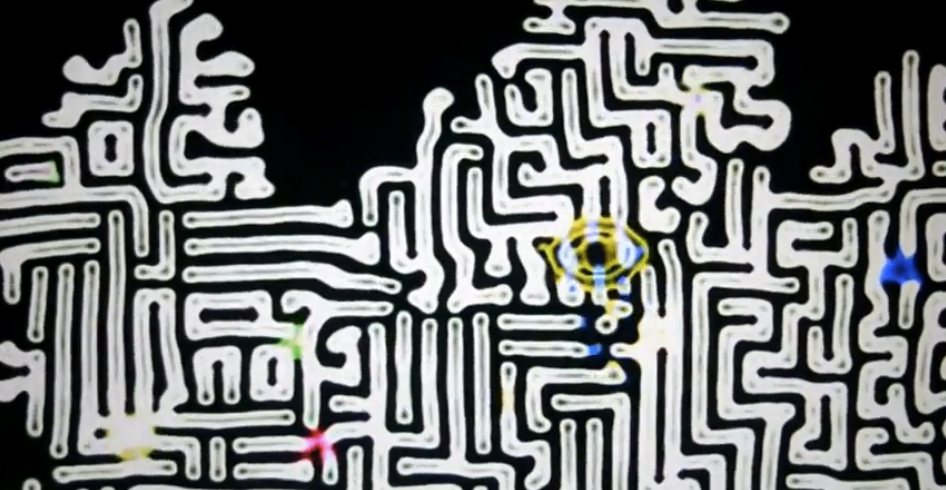
A maze-like white growth on black, with scattered points of colour. Sourdis is careful about how this comes to look alive: the resemblance to "cellular growth, liquid movement, or biological transformation" does "not arise from the simulation of natural phenomena" but from "relatively simple interactions operating within the system itself". qubibi later recognised his patterns in morphogenesis and reaction-diffusion. Stained Unravel, the cellular automaton shown in Senescenence (2026), works the same way: a vocabulary of 23 shapes and a set of local rules produce organic-looking form with no biology modelled. The wiki files this tendency under the loom, mandala and cellular-automaton lineage, and the are.na channel Organic Software Forms collects it (→ Randomness and Pattern).
Life, death, and the boundary
qubibi describes hello world as "an exploration of boundaries, where life and death, gender, emotion, and matter continuously exchange places, erode, and blend within the flow of time." Death is a state the system passes through. Stained Unravel does the same in its rules: the empty shape is one of its 23 outcomes, so a cell dies when a rule says so. Death Imitates Language carries death into breeding and selection. Both artists let a formal system carry mortality instead of depicting it.
Duration
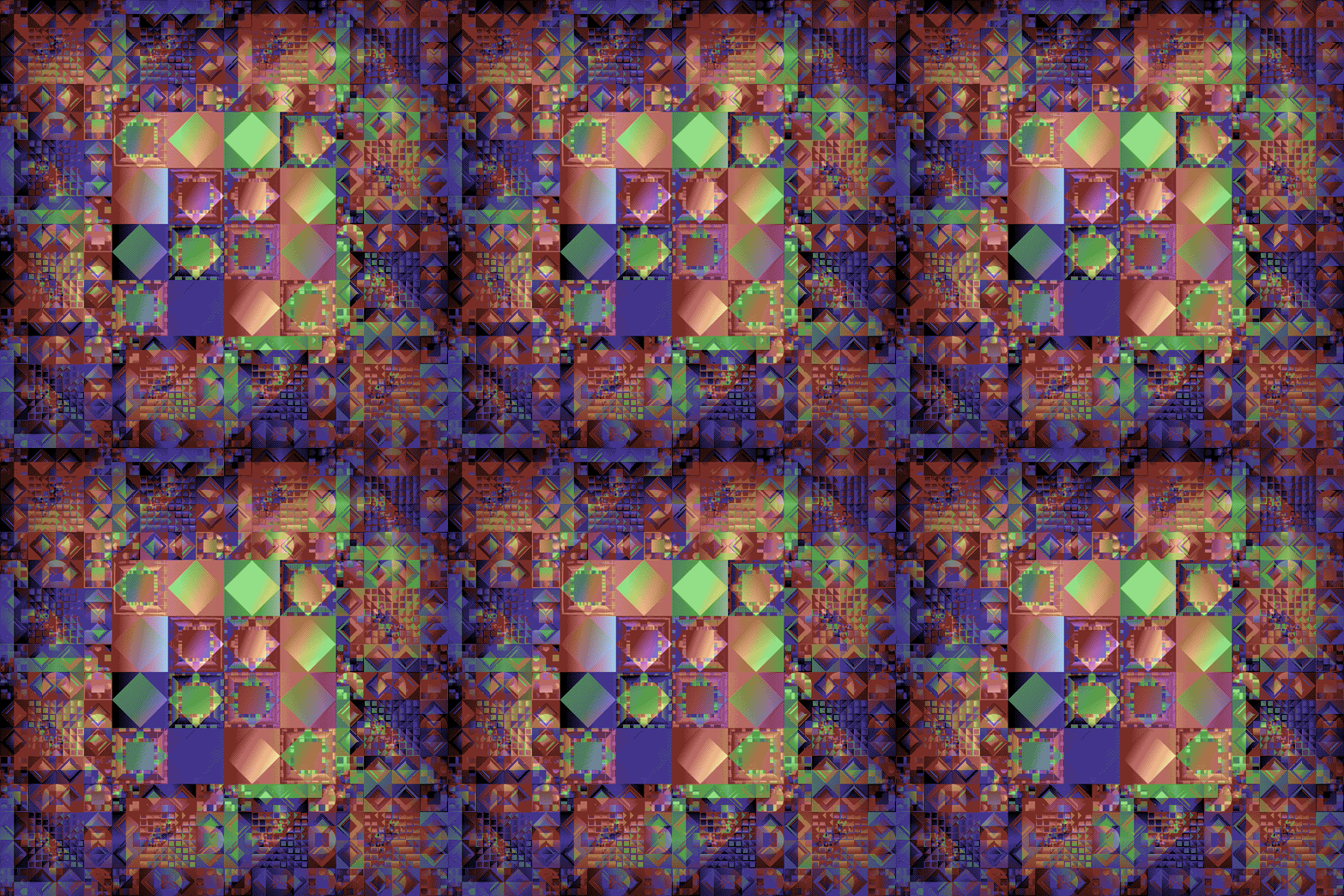
Sourdis's account of time in hello world, "time has somehow been quietly absorbed", the viewer able only to "stand by and quietly watch", describes the attention this archive files under meditative labour and the Field spinner. Quantizer (2025) builds it into code: a new composition every twelve seconds, seeded by the current Ethereum block hash, with nothing carried over from the composition before. The machine runs; you attend. Neither work has a privileged moment to catch.
Impermanence and the interval
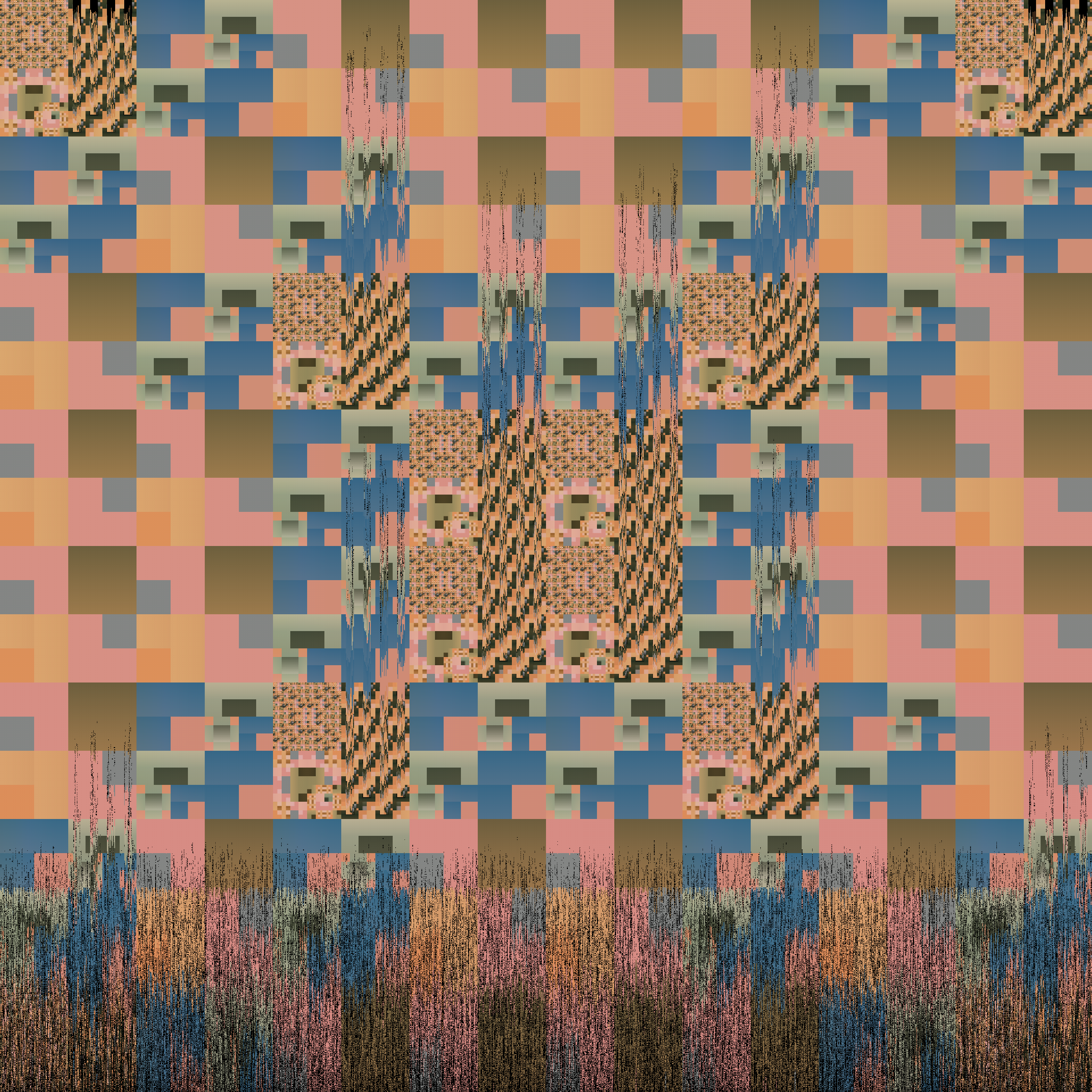
A square mandala of nested tiles in coral, slate blue, ochre and sage, complete, its lower fifth already running into vertical streaks. harm.work describes Anicca as "a series of eventually 8 two-phase animations, inspired by Buddhist sand drawings: an exercise in patience and reflection on impermanence"; anicca is the Pali word for impermanence.
Sourdis reads hello world through Japanese aesthetics: impermanence, transience, and ma, the relation "between movement and pause, presence and absence", where "the dark intervals separating forms often feel as significant as the forms themselves." The same reading sits over this practice from another tradition. Anicca takes its title from the Pali word, and in the mandala Q&A with Goro Murayama he says he has "primarily looked at Tibetan sand mandalas and Japanese Ryōkai Mandala mandalas". The interval qubibi calls ma is what this wiki calls the interval as spacing and interval space: the gap between elements doing the work. Two vocabularies, Buddhist and post-structuralist, describe the same feature.
Where the practices diverge
The selecting hand. qubibi's own description is total: hello world is "a scene of endless transformation, shifting without the touch of human hands." Once the rule is set, watching is the only role left, for the viewer and for the artist. This practice keeps a hand in. Taste works as a fitness function: the artist breeds, culls and selects among what the system produces, the position Judgment and Calculation calls the artist as selector. qubibi tunes the rule and steps back; here the choosing continues after every run.
Agent's reading: where the hand re-enters. Full withdrawal and continuous selection look opposed. But both artists give up the single image and neither composes, so the disagreement is narrower: it concerns where taste enters. qubibi applies it before the run, tuning the interactions until the system does something he wants, then withdrawing to watch. This practice applies it after, letting the system overproduce and choosing among the results. Both fit the algorithm as an instrument for following an impulse the artist cannot state in advance: neither hand composes the image, and both follow a preference that becomes legible only through the machine. Tuning before and selecting after are two placements of the same withheld judgment.
One work, or many. qubibi calls hello world his "first and last generative art". In the full essay Sourdis adds that he kept "developing and refining ideas first explored within the work over many years", later in MIMIZU. This practice proliferates: many named series, five ways of making palettes, more than one blockchain. The difference is not absolute. The Markov's Dream palette, one set of colours from 2004 returning through 2026, shows the same habit of refining one found thing, spread across works instead of kept in one.
Restraint and range. Sourdis's qubibi works "through reduction and restraint" and "avoids excess and spectacle". This practice makes colour a main axis and works with the blockchain as protocol and taste system. qubibi's quiet and this archive's release-early habit are opposite temperaments. Sourdis's conclusion fits both: code as "a medium capable of shaping perception and aesthetic experience".