
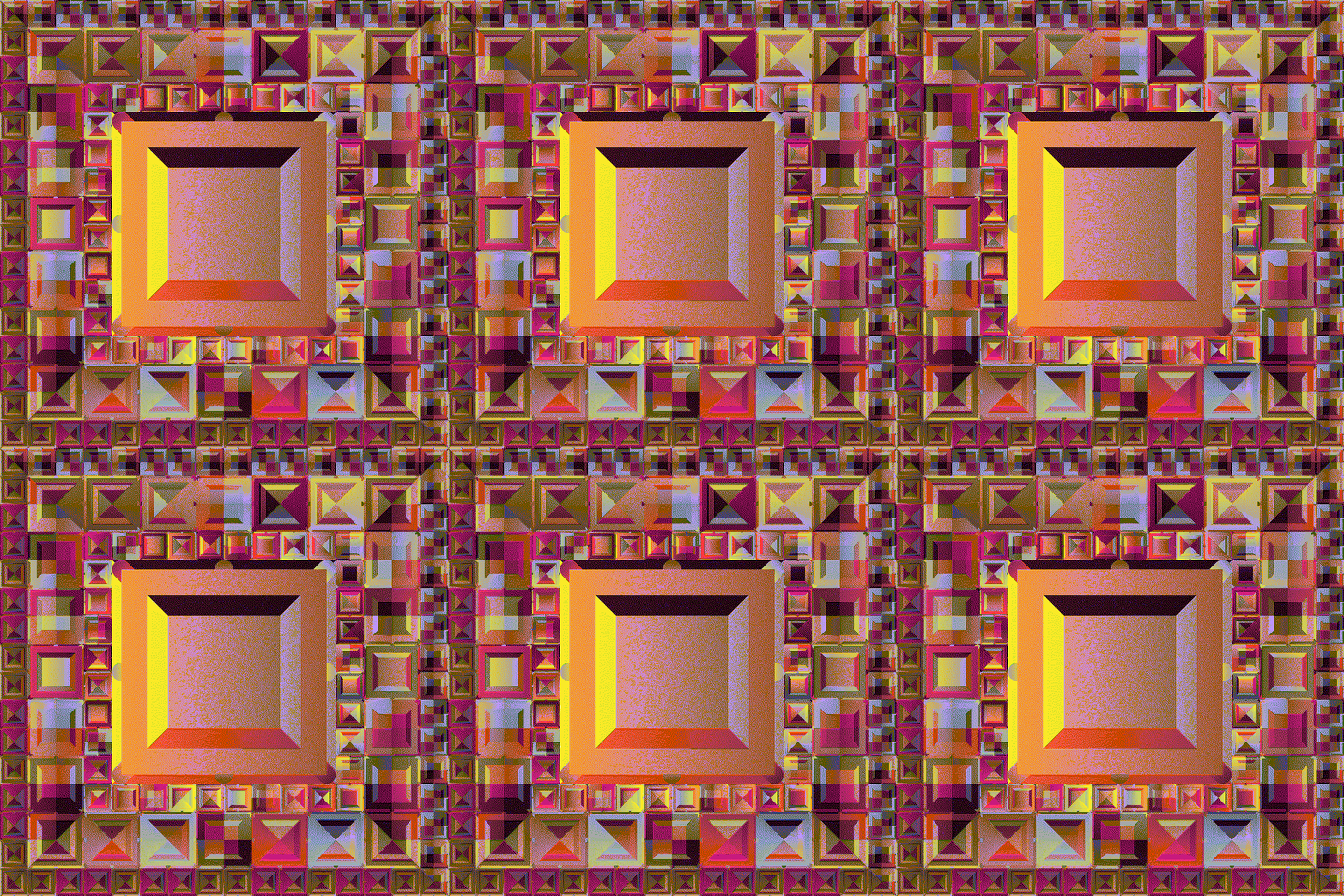
Quantizer
Collection: harm.work/nft/quantizer · Verse SOLOS exhibition: verse.works/exhibitions/quantizer · See ingested source: sources/ingested/verse-quantizer-exhibition.md
Every twelve seconds, a new composition is seeded directly from Ethereum block hashes, synchronising viewers worldwide in a shared visual experience. The work's deliberate instability and absence of memory reflect Harm's broader artistic philosophy, highlighting the inherent impermanence and poetic potential of generative digital art.
This page is the canonical home for Quantizer as a work. For the broader theme of quantization and dithering as an artistic operation, see Quantization and Dithering.
Collection
- Title: Quantizer
- Year: 2025
- Edition: 256 tokens
- Blockchain: Ethereum Mainnet
- Programme: Verse SOLOS (second exhibition with the programme, following Struggle for Pleasure in early 2024)
- License: CC-BY-NC-ND-4.0
- Site: harm.work/nft/quantizer
The mechanism
Each token receives a fixed grammar of shapes and rules at mint — a parameter set the token will carry for the lifetime of the work. From there, the live image is generated continuously: every Ethereum block (~12 seconds) the latest block hash is read as a seed, and a new composition is rendered from the grammar against that seed.
The system has no memory. Each composition is fully determined by the current block hash and the token's grammar; no prior state is carried forward. This is structurally a Markov process — see Randomness and Pattern for the parent-conditional Markov-chain mechanism shared with Anicca and the plotter drawings.
Because the block hash is the same for every viewer of every token at any given moment, all collectors see the same composition simultaneously, anywhere in the world. The blockchain functions as a global synchronisation clock; the twelve-second block interval is the temporal grain of the work.
Gaussian noise and dithering smooth the transitions between compositions so the eye perceives fluid continuity despite the underlying memorylessness.
Quantizer #066. One live frame of a token: the grammar fixed at mint, the seed supplied by the current block, the memorylessness of the system made visible in a composition that will not return.
Compositional vocabulary
The grammar of shapes draws on a vocabulary of twenty-four root trait values: Array, Block 9, Bricks, Checks, Circle, Circle 8, Double, Edge, Flower, Japan, Lozenge (see The Lozenge), Mandala (see Sacred Geometry), Margin, Pointing Inwards, Portal, Quad, Raster, Ring, Rotate, Split, Split Rotate, Star, Thangka, and Tibetan.
Generative parameters operating across this vocabulary include maxDepth (1–8) for recursion limit, colour seeds, noise values (1–20), overlay frequencies, and gradient intensities.
Dithering algorithms
Colour quantization in Quantizer is paired with classical error-diffusion dithering. Each algorithm distributes the quantization error into neighbouring pixels by a different rule, and at the twelve-second block cadence each produces a different temporal signature in the field. Algorithms used in the work:
- Floyd-Steinberg (1975) — the founding error-diffusion algorithm
- Atkinson — distributes only 6/8 of the error; characteristic high-contrast look (developed at Apple)
- Sierra3 — three-row error diffusion (Frankie Sierra)
- Jarvis-Judice-Ninke — wider distribution kernel; smoother gradients
- Stucki — Stucki kernel; slightly faster than JJN with similar smoothness
- Fan variants — both euclidean and manhattan distance measures for the palette lookup
Euclidean vs. Manhattan
Before the kernel distributes any error, the algorithm has to decide which palette entry is closest to the current source pixel. The two variants disagree about what "closest" means when colours are treated as positions in space.
Think of every colour as a point in an imaginary cube with three axes: red, green, blue. The current pixel is one point in that cube, and each palette colour is another. The algorithm picks the palette point closest to the pixel — but there are two ways to measure that distance.
- Euclidean is the as-the-crow-flies distance — the straight line between two points, the same kind of distance you'd measure with a ruler.
- Manhattan is the taxi-driver distance — you can only move along the streets of the grid (the red axis, then the green axis, then the blue axis), and the distance is how far you walk in total. The name comes from the gridded street plan of Manhattan, where you can't cut diagonally between two avenues.
The two metrics agree when one colour differs from another along a single axis only. They disagree when the difference is spread across two or three axes. A small step in red, a small step in green, and a small step in blue add up to a longer Manhattan walk than the straight-line Euclidean cut — even though both arrive at the same point.
The practical consequence: Euclidean tends to pick palette colours whose error is spread evenly across the three channels; Manhattan tends to pick palette colours whose error concentrates in one channel. With the same palette and the same Fan kernel, the two variants therefore map source pixels to different palette entries, and the error each is asked to propagate is different from the first pixel onward. The surfaces they produce are visibly distinct. They are not a speed/quality tradeoff — both are valid quantizations that read as different textures.
Holding multiple algorithms inside one work is the same gesture as holding multiple palettes — different ways of producing combinations in time. The palette and the dithering algorithm together constitute the unit of meaning (→ Colour).
Palettes
The palettes in Quantizer fall into two registers held simultaneously: historical hardware palettes — the chromatic signatures of specific 1980s–90s personal computers — and named emotional palettes that propose a feeling through a chord of values. The hardware palettes are not nostalgic quotation but strata of computational history (see Quantization for the strata argument).
Each palette name below links to its trait page on harm.work, where every token using that palette can be browsed.
Custom 1 — 10 colours
CGA — 16 colours
The original IBM CGA 16-colour palette (1981).
CGA (high) — 4 colours
The CGA high-intensity 4-colour mode.
EGA (high) — 4 colours
Cyan / magenta / black / white from the Enhanced Graphics Adapter.
EGA (low) — 4 colours
The darker EGA quartet.
Apple II — 15 colours
The Apple II lores palette (1977).
Mac Default 16 — 16 colours
The default 16-colour Macintosh palette.
Microsoft Windows — 17 colours
The Windows default 17-colour palette.
Commodore 64 — 16 colours
The Commodore 64 palette (1982).
Commodore 64 (no black) — 15 colours
The C64 palette with pure black removed.
Commodore VIC-20 — 16 colours
The earlier VIC-20 palette (1980).
ZX Spectrum — 15 colours
The Sinclair ZX Spectrum palette (1982).
The palette in the wild. A period Explorer screenshot shows the ZX Spectrum's fifteen colours in native use — the high-contrast primaries and attribute-clash that the Quantizer ZX palette abstracts into a chord.
The MSX chord. The Screen 2 parrot-test image carries in native use the same three-greens-plus-warm-coral register the Quantizer MSX palette distils — salmon reds, mustard tan and the characteristic muted violet.
Thomson M05 — 16 colours
The French Thomson MO5 palette (1984).
RISC OS — 16 colours
The RISC OS default desktop palette (Acorn, 1987).
Gameboy (simulated) — 4 colours
The four green tones of the original Game Boy DMG screen (1989).
IntelliVision — 16 colours
The Mattel IntelliVision palette (1979).
Magnavox Odessy 2 — 16 colours
The Magnavox Odyssey² / Philips Videopac palette (1978). Note: the trait URL preserves the source spelling Odessy.
Fairchild Channel F — 8 colours
The first cartridge-based home console — Fairchild Channel F (1976).
RGB — 5 colours
The three pure additive primaries plus black and white — the irreducible RGB chord.
RGB (no black) — 4 colours
Monochrome — 6 colours
Near-grey scale with a slight warm tint at the high end.
Named emotional palettes
Alongside the hardware register, Quantizer carries a second vocabulary in which the palette name proposes a feeling rather than identifying a device. See Colour (palette as proposition) for the structural argument.
Loveless — 9 colours
After My Bloody Valentine's Loveless (1991) — bruised pinks and reds, pulled directly from the saturated magenta-and-orange wash of the album cover (a motion-blurred Jazzmaster guitar in feedback colour).
Loveless. The album sleeve — a motion-blurred Jazzmaster caught in feedback colour — is the exact source of the Loveless palette's nine bruised pinks and reds.
Melancholic — 7 colours
Tibetan — 8 colours
Saturated reds, yellows, ultramarines — the chromatic register of Tibetan thangka.
Ocean — 6 colours
Ostinato — 5 colours
After the musical ostinato — the repeating motif.
Overflow — 8 colours
Stochastic Drift — 11 colours
After Sam Barker's Stochastic Drift — the palette as a name for a process: a wandering through saturated relations. The chord is pulled directly from the album cover (a faceted polyhedron sliced into coloured triangular faces against black), and the palette name preserves the album title.
Milieu — 8 colours
Named after the ambient musician Milieu (Brian Grainger), whose long-running Vibratelepathic Antiviral Broadcast series on the Vibra Telepathos label uses a consistent visual register that this palette distils. (Source data carries one out-of-range channel value at index 2; rendered here clamped to the standard 0–255 range.)
Milieu 2 — 7 colours
Distilled from a single specific Milieu release: Vibratelepathic Antiviral Broadcast 47 — pale yellow ground, mustard, three blues, a grey disc. Where the Milieu palette above is pulled from the visual register of the series as a whole, Milieu 2 is pulled from one cover.
Custom 2 — 5 colours
Sand mandalas and "the permanence of change"
The Verse exhibition text frames Quantizer's temporal logic against the Tibetan sand mandala — an elaborate composition built over days or weeks, then ritually destroyed. The destruction is not loss but the acknowledgement of impermanence. Quantizer performs this continuously, every twelve seconds:
The most interesting aspect of generative digital art is that it is inherently unstable and ever changing. This is a quality I want to retain, so I resist arriving at immutable outputs.
To collect Quantizer is to hold a position in perpetual transformation. The work lives as a single web page that can be acquired but not fixed. Each block hash produces a composition that will never recur. See Protocol, Taste, and Systems (permanence of change) and Senescenence (temporary negotiations with impermanence).
Quantizer #208. No two block hashes coincide, so this frame will never recur — to collect the work is to hold a position in perpetual transformation rather than a fixed image.
Predecessor: Anicca
Anicca (2025) is named the first algorithmic mandala in the practice by the Murayama Q&A — predating Quantizer and using the same parent-conditional Markov-chain construction (symmetrical subdivision driven by stochastic descent through an inheritance graph). The Pali term anicca names "the absence of permanence and continuity," making it the direct semantic complement to Quantizer's permanence-of-change. Both works are about the impermanence of the composition: Anicca states it in Buddhist vocabulary, Quantizer enacts it through blockchain time.
The trait taxonomy of Quantizer — explicitly naming tibetan, thangka, mandala — confirms that the mandala vocabulary is structural, not interpretive overlay. See Mandala Q&A — Goro Murayama for the full mechanism.
Plotter outputs
Three works in the Cloud Writings (2026) exhibition are plotter drawings produced directly from Quantizer outputs — the relay digital protocol → software output → mechanical drawing → physical object:
- Nethermind (2025) — ink on watercolour paper, 98×118cm
- Nethermind Quilt (2025) — ink on watercolour paper, 97×97cm
- Anobium (2025) — Sakura fineliner on Hahnemühle paper, 70×90cm
The quantized, dithered digital image becomes ink on paper. The constraint of the historical palette becomes a plotter line.
Exhibition
Verse SOLOS, August 2025 — Harm van den Dorpel's second exhibition with the programme, following Struggle for Pleasure (2024).
From the journal
- Harm van den Dorpel: Quantizer, algorithmic archeology, and digital preservation (2025-08-21)
- Harm van den Dorpel and Regina Harsanyi: the early days of Club Internet, the ephemerality of time based media and the birth of Quantizer (2025-08-18)
See also
- Quantization and Dithering — the theme page; quantization as colour-and-time operation; dithering as both aesthetic device and conceptual anchor
- Colour — five operating modes of colour in the practice; Quantizer as the canonical case of hardware-strata + named-emotional palettes
- Protocol, Taste, and Systems — Quantizer as destination of the taste-externalisation trajectory; "permanence of change"
- Randomness and Pattern — parent-conditional Markov-chain mechanism behind Quantizer, Anicca, and the plotter drawings
- Sacred Geometry — loom / mandala / stained glass / heraldry as Quantizer's structural references
- Markov's Dream Palette — the screen / print diagnostic and the palette-as-memory thesis
- Cloud Writings (2026) — Nethermind, Nethermind Quilt, and Anobium as Quantizer outputs made into ink
- Mandala Q&A — Goro Murayama (2026) — Tibetan sand mandala and Ryōkai Mandala as named references; Anicca as first algorithmic mandala
- Senescenence — "temporary negotiations with impermanence" as parallel to Quantizer's "permanence of change"
- Works Overview — chronological catalogue