
Stedelijk Base — Markov's Window at the Stedelijk Museum Amsterdam, 2020
Collection display, Stedelijk Museum Amsterdam, from 22 September 2020. Exhibition page: harm.work/exhibition/stedelijk-base, which credits Beatrix Ruf and Karen Archey. Announcement: Upstream Gallery, 18 September 2020.
The work and the announcement
Markov's Window is a Macromedia Flash animation of 2004. "The composition starts off as a single square, filling the whole screen. This square can split into multiple segments, it might change its colour, or it might rotate 45°. Each of these changes in appearance have a particular chance of happening, purely based on their current state" (harm.work). The title is Andrey Markov's, for whom the next state of a system depends only on the present one, a property the text calls "memorylessness". The colours are four picked in 2004 from the corners of the RGB cube: blue, green, magenta and a black-to-white gradient (→ The Markov's Dream Palette, 3002).
On 18 September 2020 Upstream Gallery announced that the work "will be part of the permanent collection display of the Stedelijk Museum Amsterdam":
"The work will be installed as a transhistorical intervention into BASE, the modern section of the display, where it will be in close proximity to sections on Bauhaus, Mondriaan, and the Russian Avant-garde. Harm's work will thus be the only contemporary work in this section of BASE, which will give it a unique emphasis. This positioning will be a strong statement, intertwining such a forward-thinking digital work within the canon of abstraction."
harm.work's text for Stedelijk Base gives the same words, attributing the last two sentences to the museum: "According to the museum: 'It will thus be the only contemporary work…'". The work went on view on 22 September 2020.
Stedelijk Base is the museum's display of its own collection. It opened on 16 December 2017 (museum announcement) in the lower-level gallery, a layout by AMO, the research studio of Rem Koolhaas's OMA, led by Koolhaas and Federico Martelli: art and design from 1880 to 1980 on freestanding walls of 15-millimetre steel plate (Dezeen, 22 December 2017). harm.work credits two curators. Beatrix Ruf directed the Stedelijk from 2014 to October 2017, while Base was prepared. Karen Archey has been the museum's curator of contemporary art for time-based media since 2017. Archey had curated his first solo exhibition in the United States, at Abrons Arts Center, New York, in 2013 (→ Release Early, Release Often). Both were involved in the acquisition, which dates from 2020, the year the work went on view (the artist, November 2026).
From Upstream, 2018
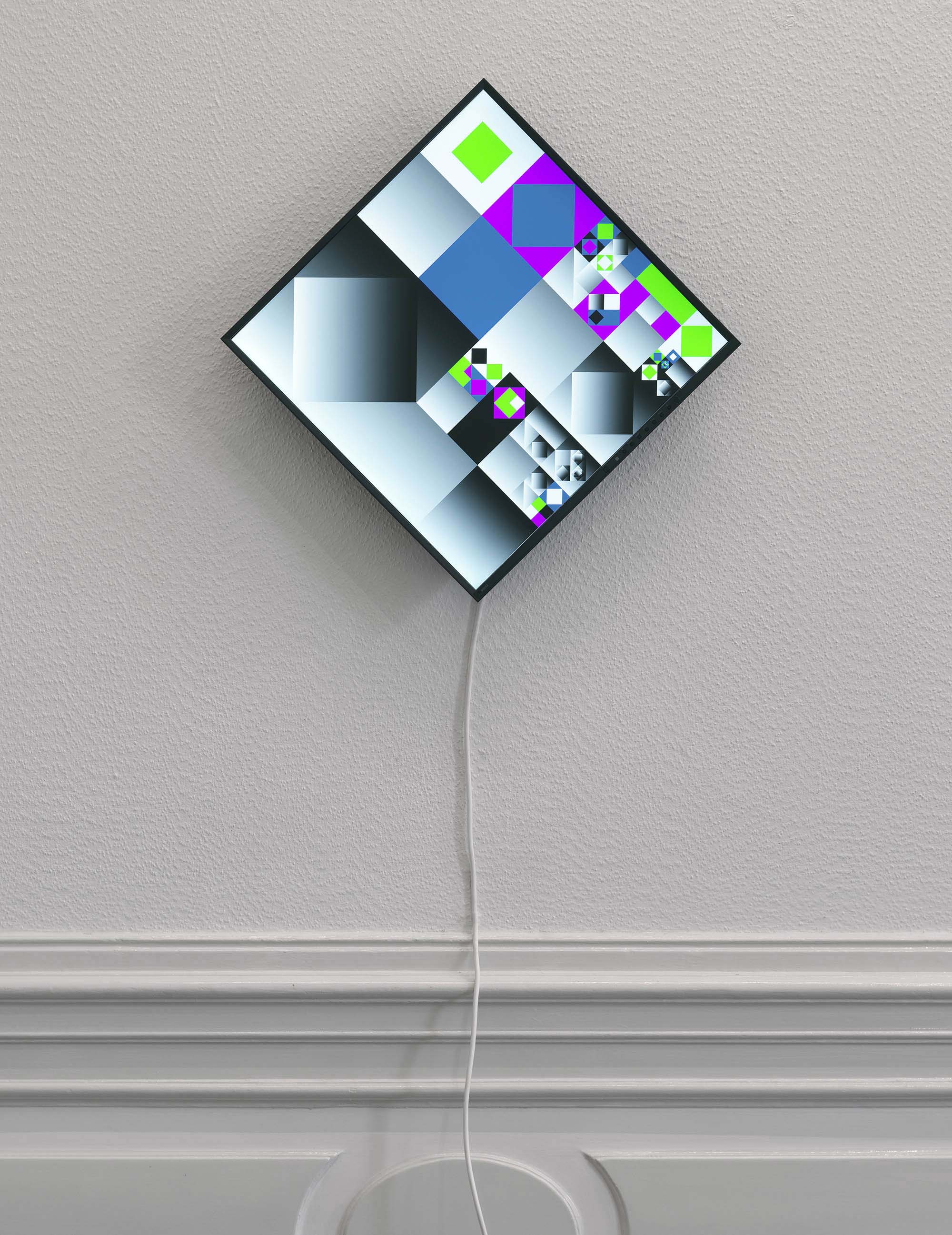
He had forgotten the work for fourteen years. In his text for Markov's Dream the artist writes that it was dismissed "at both uni and art school", that "I forgot about the artwork", and that "it found a place in a group exhibition at Upstream Gallery in 2018. A curator from De Stedelijk Museum Amsterdam visited this exhibition and decided to purchase and permanently install it alongside original work by Piet Mondriaan and Kazimir Malevich" (Memories and Memorylessness).
The group exhibition was Live and Let Live (Upstream Gallery, 2 June – 14 July 2018), with Manfred Mohr, Vera Molnár, Tabor Robak and Miao Ying. The gallery's text: "Generative art is perceived here as art that derives from systems with some level of autonomy. The artist often assumes the role of director, whose script or rules function as his/her stand-in, or proxy" (Gallery Viewer). His Instagram post the day before the opening, filed on are.na, reads "Markov's Window, 2004 - 2018. Part of group show opening tomorrow at @upstreamgallery" (block), and his caption for the photograph above gives the work as "2004 - 2018 / generative software / loop, not interactive, silent" (block). The screen already hangs on its point, as it would at the Stedelijk. Mohr and Molnár, the two pioneers beside him at Upstream, later became figures of his own research: Molnár shared Angles Morts with him in 2024, and Mohr's hypercubes are among the predecessors of Entfaltung (→ Angles Morts, Predecessors of Entfaltung).
The hang
The four photographs harm.work files with Stedelijk Base show the monitor hung on its point on a grey wall in more than one arrangement. The wiki's pages each take one:
- beside a Mondrian lozenge with two black lines and a square canvas whose red square is turned 45°, so that the installed work makes both moves at once, the frame turned as in Mondrian and the squares inside turned as in van Doesburg (→ The Lozenge);
- with Suprematist paintings by Kazimir Malevich around the corner, a red cross on white and a black bar across a red one, under a hanging string construction (→ The Markov's Dream Palette);
- between a red woven textile from the Bauhaus section and a white canvas with a thin red and black cross (→ Colour);
- with Suprematist paintings of black and red squares behind it (→ Protocol, Taste, and Systems).
In every arrangement the colours of 2004, chosen on and for a monitor, hang among the painted primaries of the 1910s and 1920s. The artist reads the green as "very much 'not printed matter'", since a screen green cannot be mixed in print (3002).
Against the single best composition
The work's text on harm.work names the difference the hang makes visible: "By defining only a few simple probabilistic rules the artist created a system that can achieve a very complex composition. Whereas Mondriaan might have made many studies and versions to reach one single best possible composition, this work instead embraces perpetual change." The 2022 text for Markov's Dream repeats the sentence with "Constructivists and Suprematists" in place of Mondrian. The museum hung it with both.
In 2024 he put the same contrast in his own words. "Mondriaan would obsess for a long time, I think, about how a particular composition would have to be, but for me it's actually the opposite. I generate things at random, or I breed generations, and then I curate and manipulate." Earlier in the same conversation, speaking of his metallic exposures: "what is also important to me is that they can be hung next to an oil painting. ... It is kind of taking a step towards other eras and almost like an anachronism that I make these things to see if they hold up next to an oil painting. Maybe I just always wanted to be a painter." Leyla Fakhr answered: "I really loved seeing your work in the Stedelijk Museum next to Mondriaan, I thought that was such a powerful display. As you were saying just earlier, you'd hoped to see your work sitting next to an oil painting and that's exactly what happened" (Verse interview, 2024; → Verse Twitter Spaces).
Afterwards
The acquisition changed the artist's own account of his career. His text for Our Inner Child (Upstream Gallery, 2023) opens on it: "After a run of successful exhibitions, the hysterical rise (and fall) of NFTs, and the acquisition by the Stedelijk Museum of Markov's Window for their collection. These felt like a kind of vindication of the work I had been doing, the culmination of decades of work, and a sense of arrival at an institutional level for generative art." Then: "While I was delighted by the recognition, I was also overwhelmed. ... Recognition made me want to become a hermit" (text; → Our Inner Child). The paintings in that show, the Resolution Paintings, were made, the exhibition text says, with "the same algorithm that was involved in producing Markov's Window in 2004", and they hang on their points (→ Resolution Paintings, The Lozenge).
The work also came back as tokens: the rounded remakes of Markov's Dream (2022), the "enhanced 2023 remake" Markov's Window 2023, and the on-chain Venster (2024), Dutch for window (→ Venster — the writing). The artist biography published with the Verse interview (2024) names the Stedelijk first among the collections that hold his work.
See also
- The Lozenge — the turned square from Mondrian to Markov's Window and Venster
- The Markov's Dream Palette — the four colours of 2004 and their returns
- Our Inner Child (2023) — the artist's account of the acquisition and what followed
- Screens and Skin (2022) — the first exhibition of Markov's Dream, the remake
- Memories and Memorylessness — the artist's text on the work and its acquisition