
Resolution Paintings (2023)
The Resolution Paintings are, in harm.work's words, a "Series of pixel 'paintings' constructed by recursively subdividing squares." harm.work lists twelve, all of 2023: eleven from the start and Candyflip (below), a twelfth lozenge, added to the series in November 2026 (the artist). Nine were the core of Our Inner Child, his solo show at Upstream Gallery Amsterdam that opened on 11 November 2023, whose text he wrote himself; that text, its account of therapy, recognition and the "rules of being good", and the show itself are on Our Inner Child. This page is about the works.
The series page quotes one passage of that text:
"I thought about what could happen if you moved in the opposite direction, taking something very basic, and applying the capacities of generative art to that form. In that way it becomes a process of decompression, you can move from very simple geometrical shapes to extreme complexities, moving from shapes to the level of pixels."
The opposite direction is Mondrian's: in the same text, Mondriaan and Theo van Doesburg reduce a tree "to a few shapes or lines to convey its essence", a compression (→ Randomness and Pattern).
The algorithm of 2004
"To create the images for this show, I used the same algorithm that was involved in producing Markov's Window in 2004" (Our Inner Child). Markov's Window divides a square into smaller squares, again and again, and fills some cells with flat colour and others with gradients (→ Markov's Dream Palette). In 2004 it ran as a Flash animation on the screens of the time. In 2023 it runs until the smallest cells are a few pixels wide; his are.na channel for the show records the descent, from a lozenge divided a few times on 22 July 2023 to one divided many levels down by late September (→ Our Inner Child, under Compression and decompression).
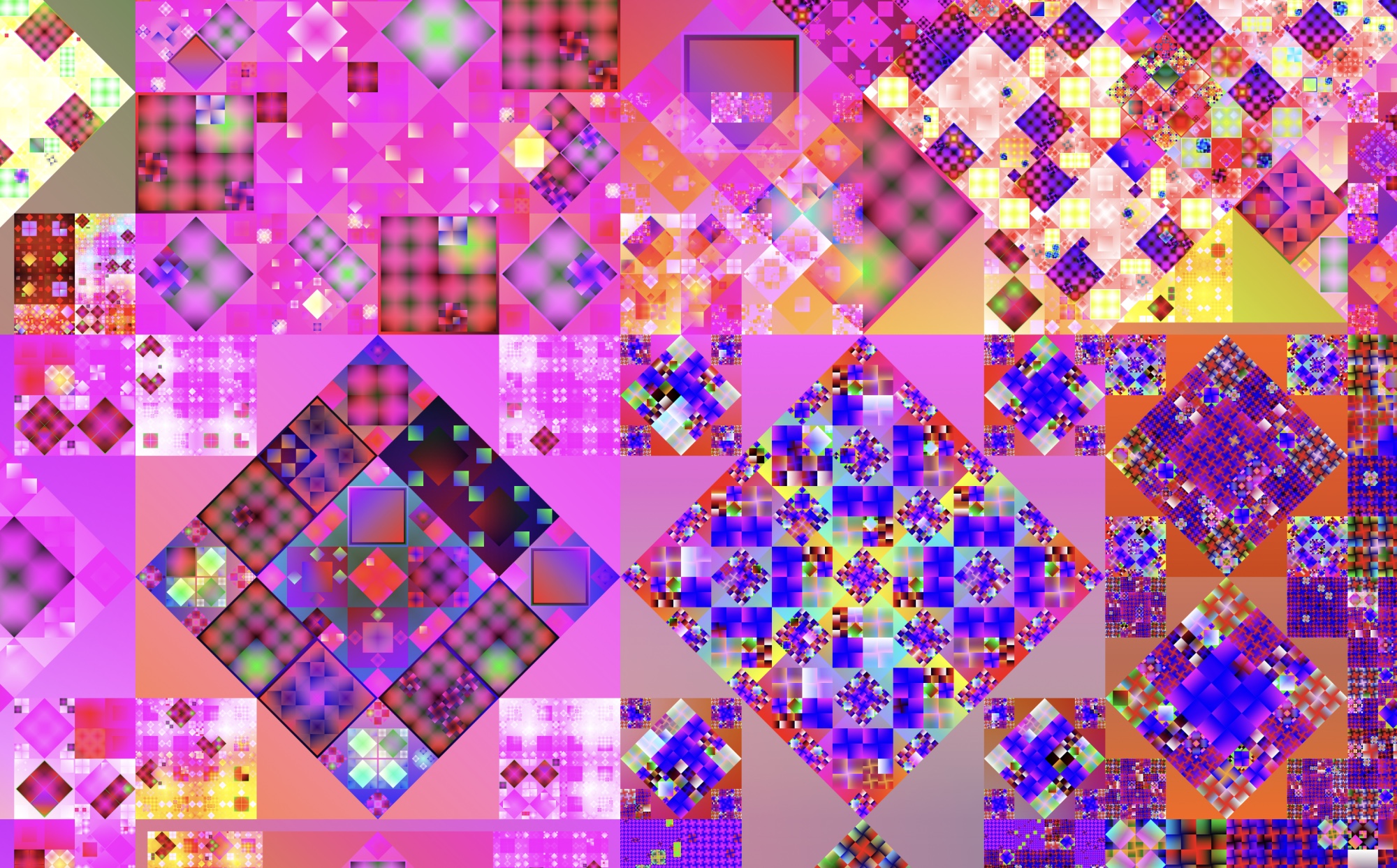
The details show the rule at work. In Synthesis Euphoria a square is filled, or cut along a diagonal into two triangles, or divided into four, and a divided square can contain a smaller square turned 45° whose cells are divided again. Gradients run across single cells. Near the corners of the detail the cells reach a few pixels, and the picture becomes texture.
The word in the series title comes up in two ways in the sources. The division is carried down to the resolution of the image itself, "to the level of pixels". And resolution is the reason for printing: "any kind of screen display reduces visual complexity, therefore the only way these works could truly convey their full complexity was to produce them as material objects" (Our Inner Child). That text ends on the same word: "embracing the complexities around us, in their full resolution."
The lozenges
Six of the eleven are lozenges: square, but hung on a corner; Candyflip is a seventh. For the four framed exposures harm.work notes "Dimensions are measured diagonally". The turn follows Mondrian's lozenge canvases, with one difference: in his lozenges of 1924–26 the lines inside stay horizontal and vertical, while here the subdivision turns with the frame and runs diagonal to the wall (→ The Lozenge, under The Resolution Paintings (2023), with the installation view at Upstream).
- Synthesis Euphoria, 150 × 150 cm, photographic exposure on metallic paper behind acrylic glass, black aluminium frame. Nested squares and triangles in magenta, pink, violet and yellow. harm.work: "Somewhat inspired by my encounter with cherry blossom in Japan"; a working render of 1 October 2023 was saved as cherry-blossom (→ The Lozenge).
- Hell, 150 × 150 cm, the same medium. Small triangles and squares in red, orange, black and white, darker towards the lower right (→ Our Inner Child, under The rules of being good).
- Nacre, 150 × 150 cm, in an aluminium frame. Large triangles of red, magenta, dark green and yellow, among which smaller squares are divided down to dense, many-coloured texture (→ Subconscious Computation for an image).
- Rite, 120 × 120 cm, edition of 2 + 1 AP. Orange, violet, grey and black triangles, with a dark round medallion near the top.
- Pivot, 85 × 85 cm, UltraChrome HD print on Canson paper. Of all the lozenges it has the most colours and the most kinds of cell: graded squares, circles drawn as shaded spheres, and fields of grey cells divided almost to the pixel (→ Judgment and Calculation).
- Markov's Window (exposure), 106 × 106 cm, not published on harm.work's lists.
- Candyflip, 150 × 150 cm, described on harm.work in the same words as Rite, "Photographic exposure on metallic paper, mounted behind acrylic glass, with black aluminium frame. Dimensions are measured diagonally. Edition of 2 + 1 AP", and entered on 23 November 2023, while Our Inner Child was open. It is not in the series list and was not in the show; harm.work marks its picture "(mockup)".
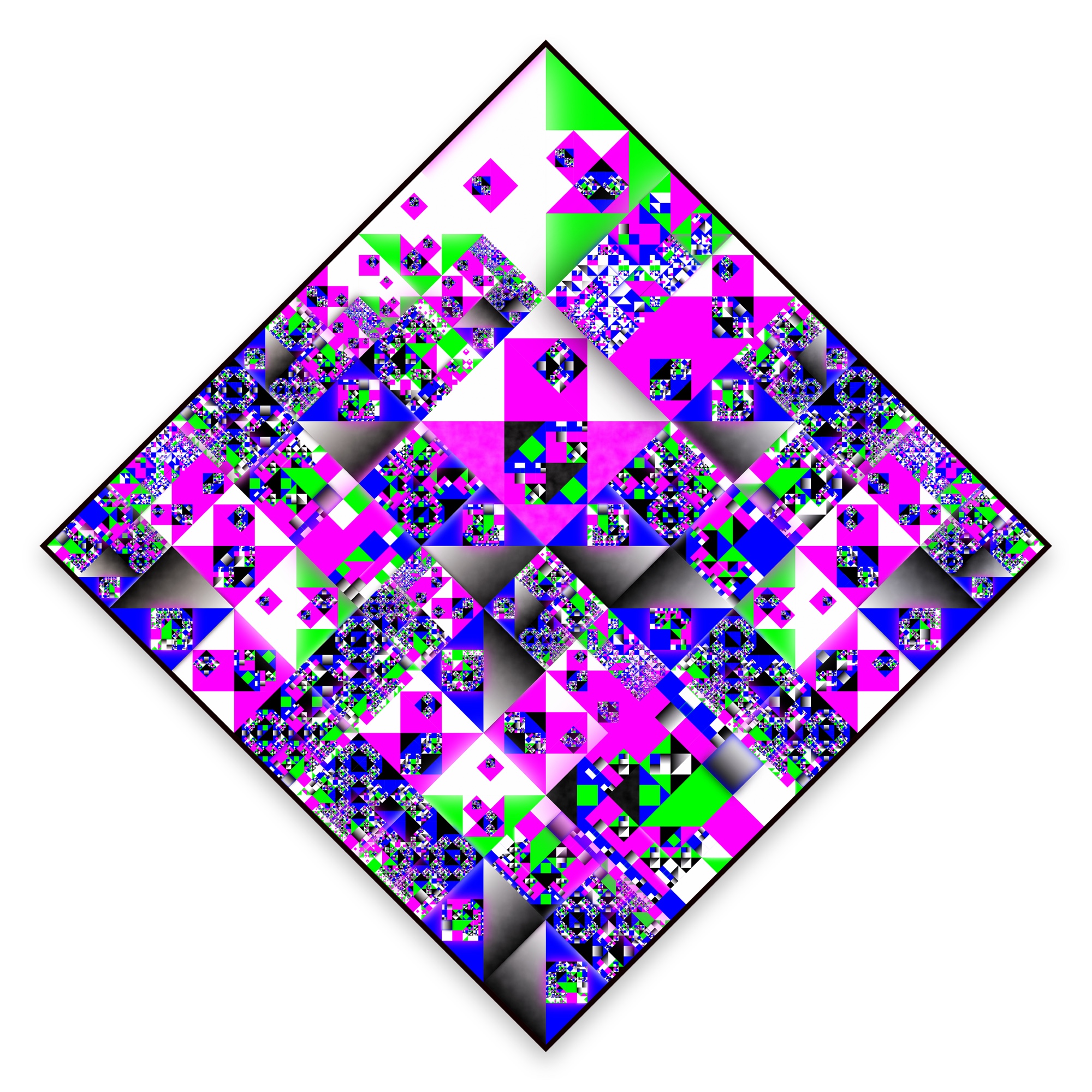
Markov's Window (exposure) is the one in the palette of 2004: magenta, green, blue, and black and white run as gradients, the four colours the artist "hand picked" for Markov's Window (→ Markov's Dream Palette). Large white and magenta triangles at the top give way to cells divided many times over in the lower half. It sets the old work's colours to the new depth.
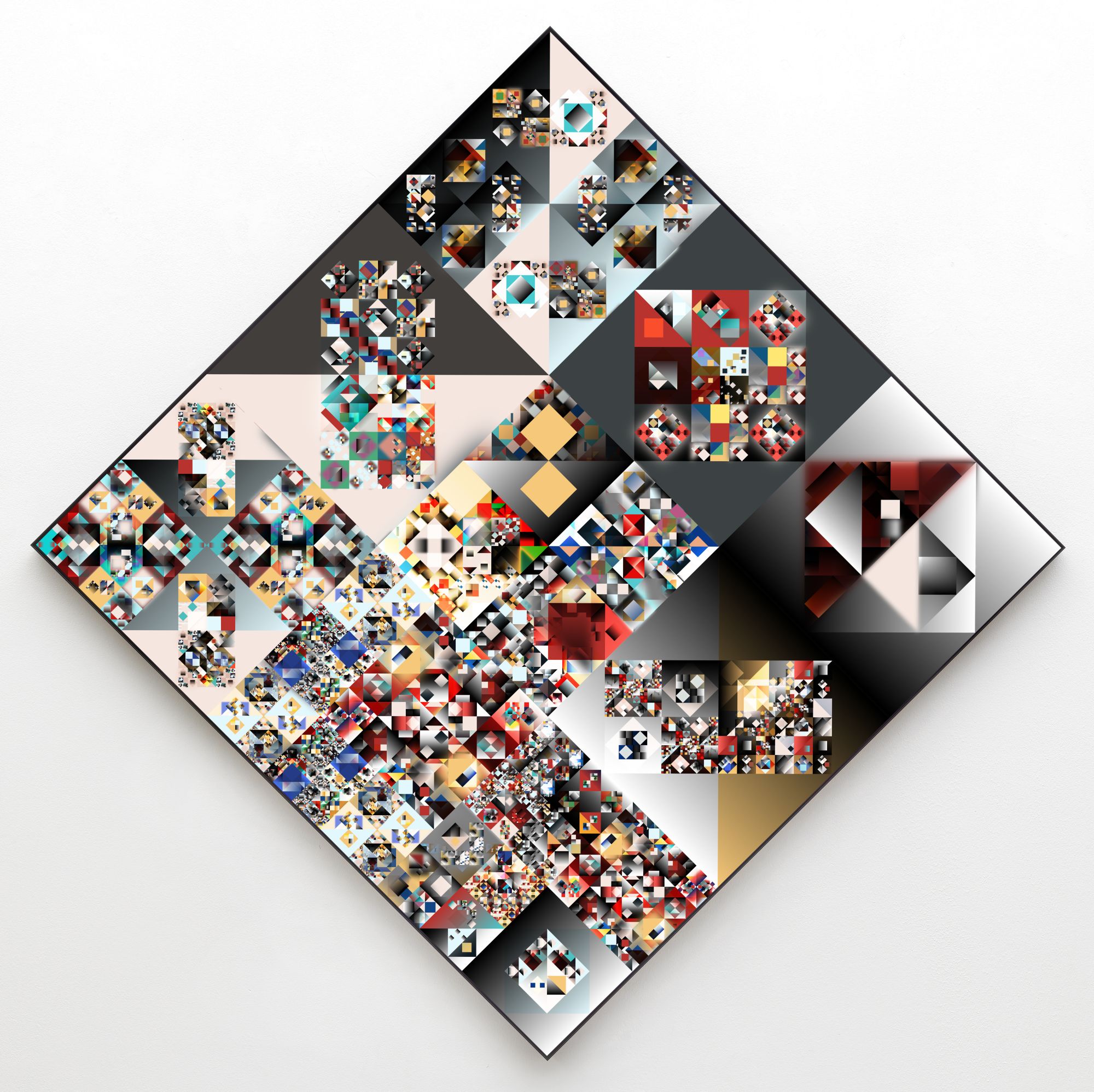
Candyflip has the construction of the series: large triangles and squares in graded black, grey, cream and gold, some of them divided over and over into small cells of red, cyan, blue and black, most densely in the lower half.
The square works
Five works hang square, at 103 × 103 cm or, for the prints, 85 × 85 cm. In them the division starts from an even grid of blocks across the whole square, and the blocks are subdivided to different depths, so some stay as single flat squares and others become patterns.
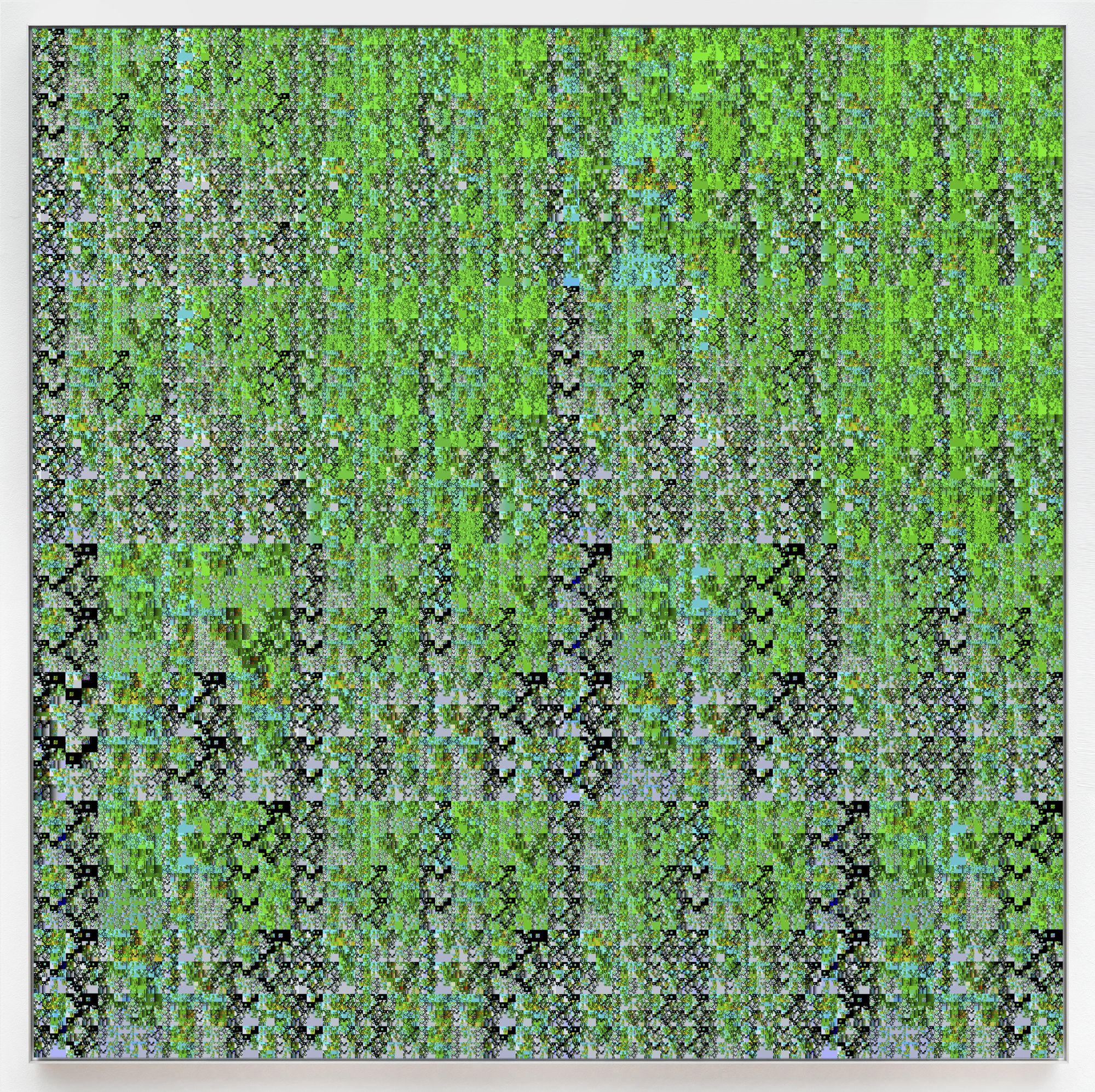
A Forest (edition of 2 + 1 AP) is, with Markov's Window (exposure), one of the two not shown in Our Inner Child. Its field of green, black, cyan and grey cells repeats a small pointed motif that reads as leaves, in rows; the repetition is regular enough that blocks of the pattern can be seen recurring across the square. The title answers the exhibition text's tree, which Mondrian reduced to lines: here a forest is built up from cells. harm.work gives no comment, so the connection is the wiki's.
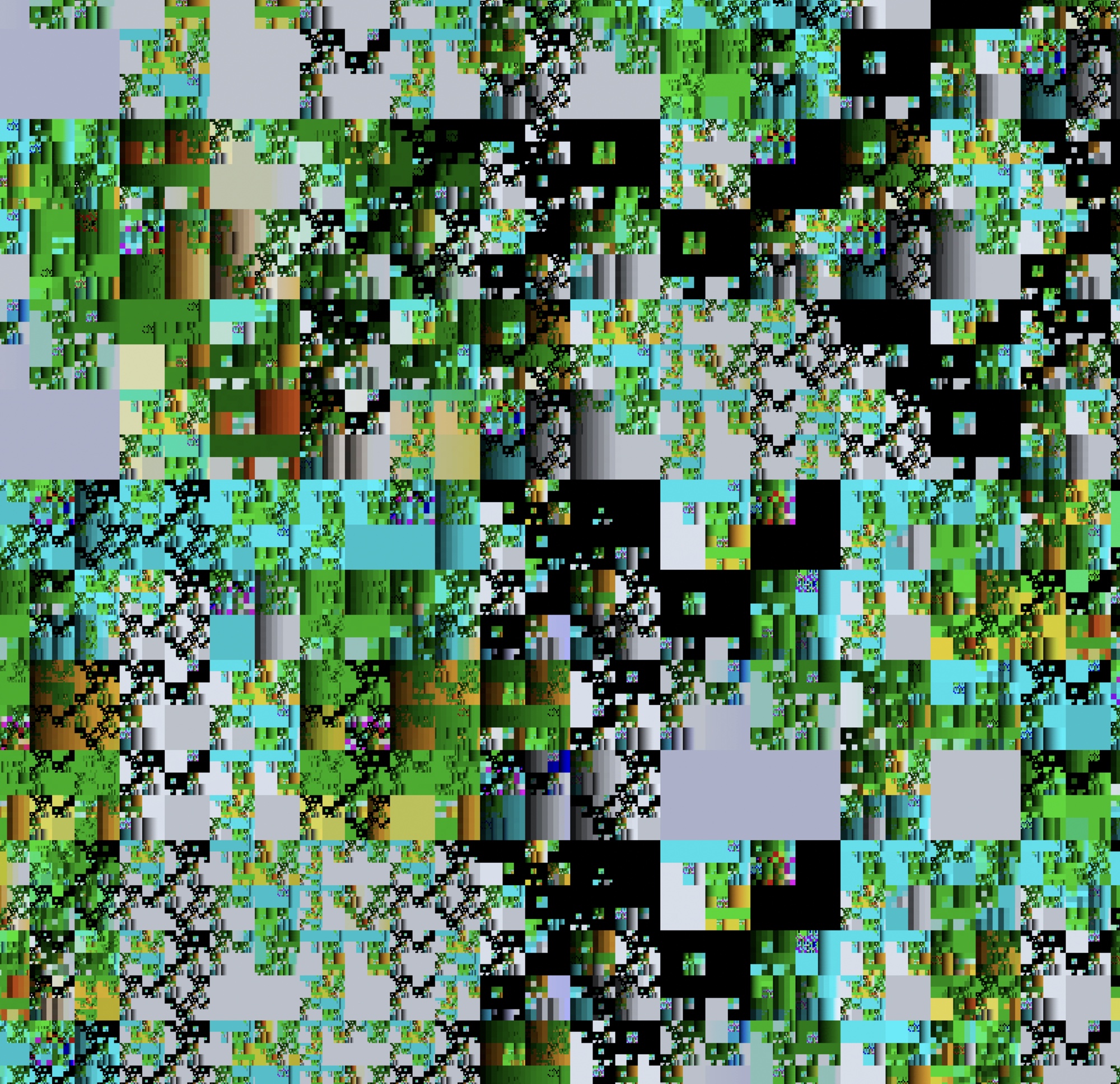
At close range the field breaks into blocks of different depth: flat grey or black squares, blocks of striped gradient, and blocks divided into the small pointed motif, green on black or black on green.
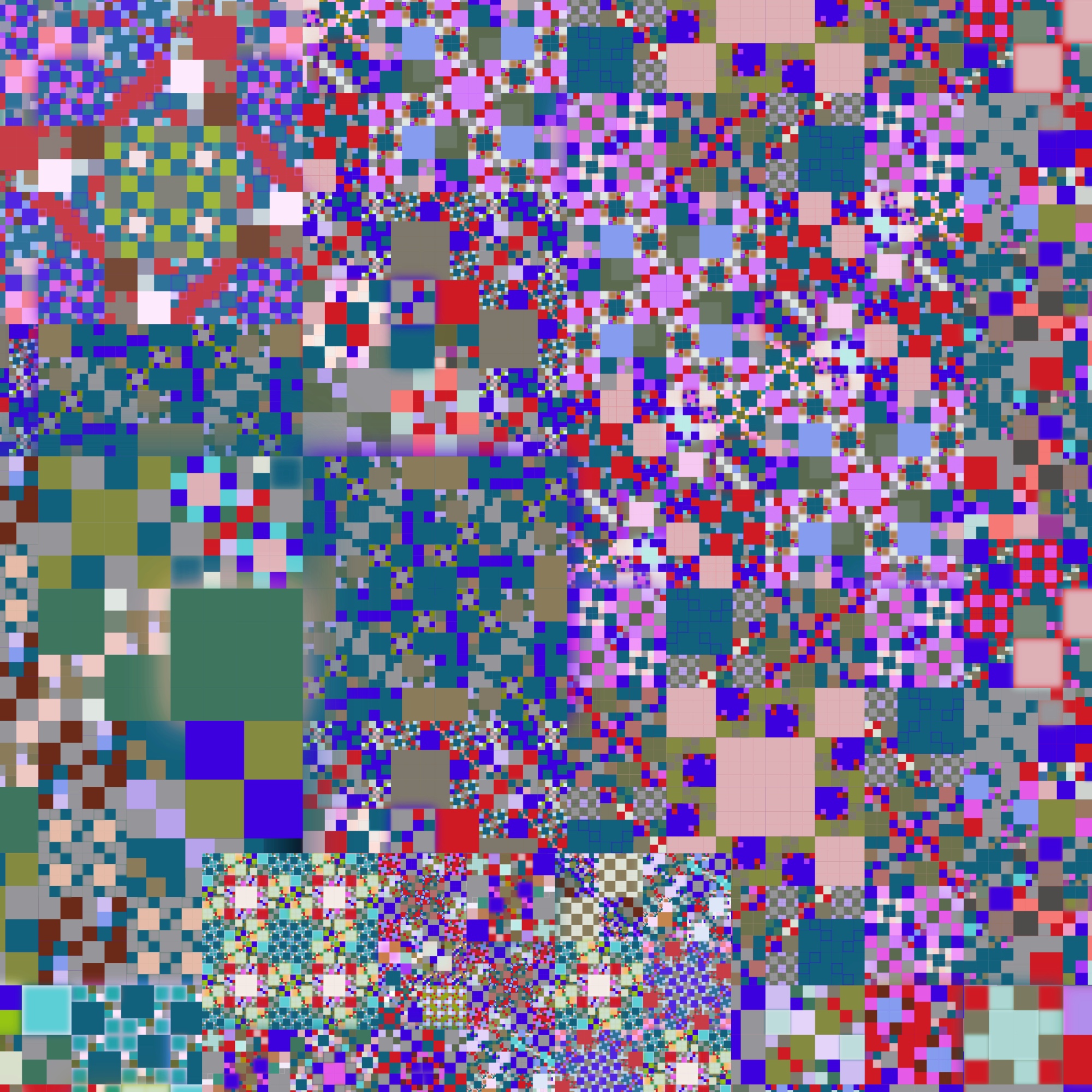
Klimt is an all-over mosaic in blue, red, white and green. The detail shows how it is made: squares of teal, olive, pink and violet, each quartered and quartered again into checkerboards, the quartering stopping at different depths in neighbouring squares; at the upper left a ring of red cells encloses a smaller checkered square. The title names Gustav Klimt; harm.work does not explain it.
Sprite is pale violet, white and navy with pink and yellow, and a few round, flower-like clusters of cells. Field (double exposure) divides a sky-blue square into blocks of pixel patterns, many of them symmetrical like quilt blocks, with red, orange and lilac cells scattered through (→ Randomness and Pattern for its image). Altibzz, named after a track by Autechre, is red, blue, white and yellow, larger blocks breaking into finer checkered patterns; with Pivot it is one of the two UltraChrome HD prints on Canson paper. Sprite, Klimt and Altibzz are illustrated on Our Inner Child.
Exhibitions
- Our Inner Child, Upstream Gallery Amsterdam, opened 11 November 2023: Klimt, Sprite, Field (double exposure), Synthesis Euphoria, Hell, Pivot, Nacre, Rite and Altibzz, with three tokens of Markov's Dream and the inflatable Recursive Intervention (→ Our Inner Child).
- Judgment and Calculation, frontviews at HAUNT, Berlin, 11 July – 22 August 2026, with Elisabeth Sonneck and Carsten Becker: Rite, Nacre, Pivot and Altibzz (→ Judgment and Calculation).
Around the series
The same algorithm went on-chain the next year. Venster (2024) is "A new version of Markov's Window from 2004, but now fully on-chain", a hundred recursive SVG animations (→ The Lozenge). And from December 2023, while the show was still open, he subdivided squares again in Struggle for Pleasure and Swallow, Only Shallow, this time letting the resolution vary inside one picture: "By varying the resolution of the pixels within one work, my eyes and my mind was jumping back and forth between feeling that I understood what I saw and constructing what I thought it would be" (Verse, January 2024; → Swallow, Only Shallow).
See also
- Our Inner Child — the exhibition and the artist's text
- The Lozenge — Mondrian's turned canvas and the hang at Upstream
- Markov's Dream Palette — the four colours of 2004 and their returns
- Randomness and Pattern — compression and decompression; Mondrian
- Recursion and Self-Reference — subdivision as recursion