
Predecessors of Entfaltung
Entfaltung takes its machinery from earlier works in Harm van den Dorpel's practice, and its closest precedent outside the practice is Manfred Mohr. The most direct predecessor is Quantizer.
Quantizer (2025)
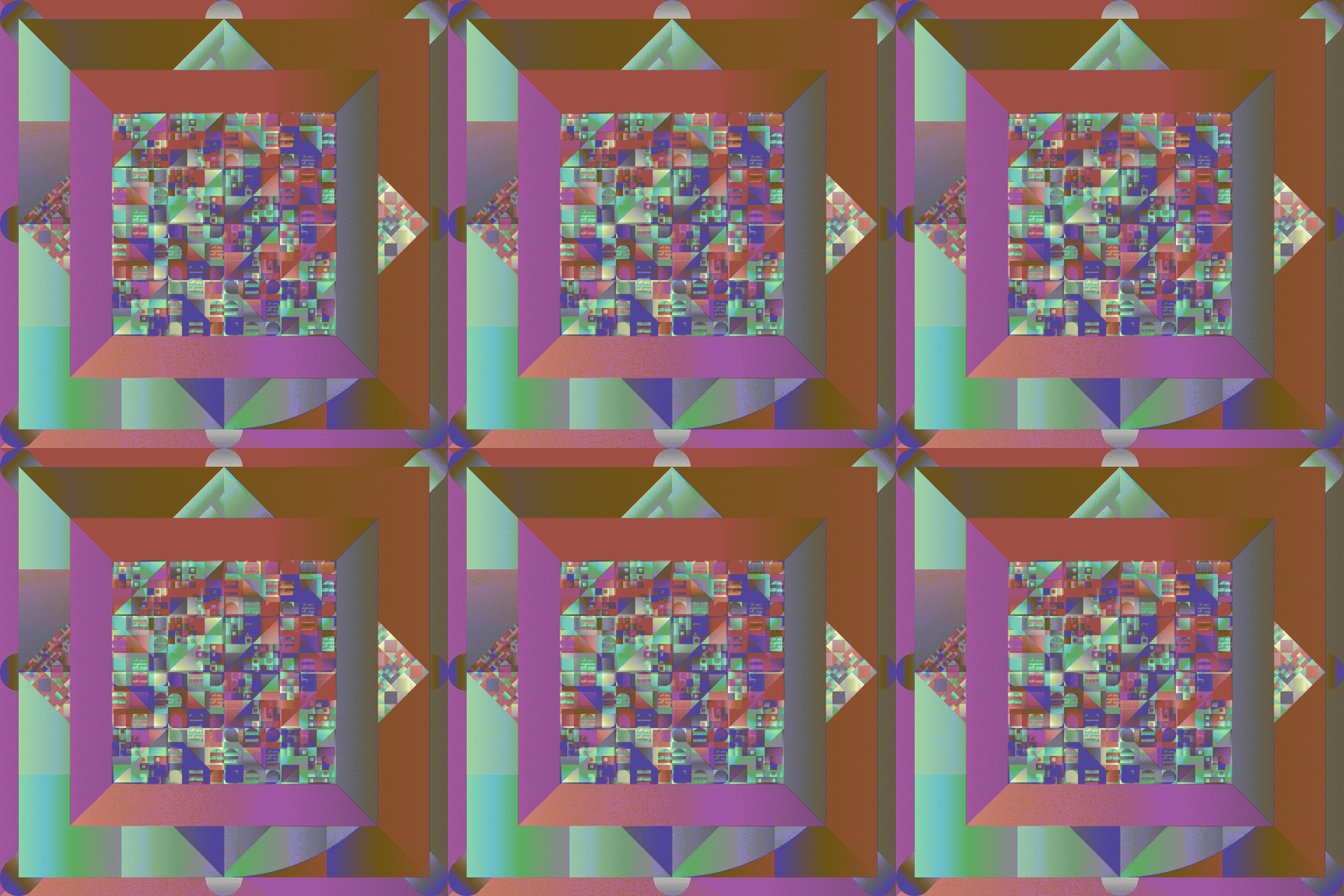
Concentric square frames in gradients of rust, violet and pale green close in on a dense central field of small tiles; diamond-shaped panels sit on the left and right edges.
Quantizer is a collection of 256 tokens on Ethereum, shown with Verse SOLOS in August 2025 (sources/ingested/verse-quantizer-exhibition.md). Each token "begins with a set of parameters determined at mint, forming a 'grammar' of shapes and rules. From there, Ethereum block hashes act as seeds, triggering new compositions every twelve seconds. The system has no memory: each image is independent." Because the block hash is the same for everyone, all collectors see the same composition at the same moment. The artist, in the Verse text: "I resist arriving at immutable outputs."
Entfaltung inherits the block hash as the recurring seed, the determinism, the same picture for every viewer and the refusal of a final image. Two things differ in how the work is stored. Quantizer is not on-chain: its page fetches each block hash from an online API, a work that depends on the chain without living in it, "crypto-dependent" in the artist's word (November 2026). The Entfaltung renderer and each token's configuration are stored on-chain, and the configurations stay editable after mint: nothing in its contracts can be locked (→ Entfaltung on Chain).
The main change is the transition. Like a Quantizer composition, each Entfaltung shape is drawn from one block hash, with no memory of the shape before. Quantizer replaces one picture with the next at every block. Entfaltung turns the figure for three blocks, from one symmetric view to the next, and on the fourth seeds new positions for its points. It keeps the number of points and the symmetry group, gives each new point the identity of an old one, and moves every point in a straight line over ten seconds. Every point is joined to every other, so no move breaks a connection. The synchronisation widens too: Quantizer shows every collector the same composition, and two Entfaltung tokens with the same symmetry, point count and bounding show the same structure at the same moment.
Anicca (2025)
Anicca (2025) is, on harm.work, "a series of eventually 8 two-phase animations, inspired by Buddhist sand drawings: an exercise in patience and reflection on impermanence"; two tokens exist, on Ethereum. Its Pali title names the absence of permanence. In the Murayama Q&A the artist calls it his "first attempt to construct [mandalas] algorithmically" and says he "went deeper into their construction later" in Quantizer (→ Mandala Q&A). The Verse text ties Quantizer to the same source: his interest in impermanence was "shaped in part by the Tibetan Buddhist practice of sand mandalas", which he reinterpreted "by favouring flux over fixity". Entfaltung is collectible and never fixed in the same way. Anabel Zenith's essay on the series describes that impermanence from the viewer's side without naming the mandala. She wants to "freeze these moments in the work and keep them forever", finds the work will not allow it, and ends on "the freedom to just watch something beautiful change, without holding on" (sources/ingested/zenith-terrifying-and-glorious-2026.md). The work itself is described on Anicca (2025).
Manfred Mohr, an external precedent
Manfred Mohr (b. 1938) has worked with the cube since 1972, with the four-dimensional hypercube since 1977 and with five- and six-dimensional hypercubes since 1989. He takes one rigid object with a fixed set of vertices and edges, rotates it in four, five or six dimensions, and projects the result to the plane, so the variety in the image comes from rotation and projection while the object never changes. He drew in black and white from the 1960s and took up colour in 1998.
Entfaltung shares the invariant: a fixed set of points and connections producing an endless run of different figures. It parts from Mohr on where the change happens. Mohr's object is rigid and only its orientation moves. In Entfaltung the points move and the object deforms. Its colour comes from Kunz: the fill of the slivers between crossing lines, carried onto the moving faces.
What Entfaltung takes and changes
From Quantizer it takes the engine that re-seeds a picture from the block hash; from Anicca the mandala and its impermanence; from Mohr the single structure that yields endless figures. What it changes: the drawing has three dimensions, its points move while every point stays joined to every other, and its colour follows Kunz's sliver-fill.
See also
- Entfaltung — the series and Kunz's method
- Entfaltung on Chain — the 36 tokens, the cycle and the twins
- Quantizer — the 256 tokens and their traits
- Mandala Q&A — Anicca and Quantizer in the artist's account of his mandala works
- Algorithmic Archaeology — Mohr in the timeline