
Bags — Cut Paper Bags after Hans Arp (2019–2026)
Bags is a series of "Hand- and CNC-cut brown paper bags; interpretations of lithographies by Hans Arp" (harm.work). The bags are ordinary brown paper shopping bags, nested two or more deep. The outer bag is cut through with rounded, organic shapes, and each opening shows the bag inside it, which has been cut with smaller shapes of its own; through those the dark interior shows. A flat object of plain brown paper becomes a relief with three depths.
harm.work lists five bags. The three of 2019, Bag, Another Bag and Spectre, are "Hand cut brown paper bags", flat-bottomed bags without handles. The two of 2026, Bag (Skeleton and its entourage) and Bag (Pflanzenbild), are "CNC-cut nested brown paper shopping bags", 45 × 30 × 10 cm, with paper handles. The harm.work page on his sculpture sums up the change: "Later work turns to brown paper shopping bags, first hand-cut, then CNC-cut, and nested inside one another."
The source: Arp
harm.work names Jean (Hans) Arp as the source of three of the five bags. Another Bag is "Based on the work 'Constellations' by Jean Arp from 1938"; for both bags of 2026, "The cutout design refers to a lithography by Hans Arp from 1962." The 1962 print Pflanzenbild ("plant picture") is an offset colour lithograph, 40.7 × 40.7 cm, in an edition of 160 (Ludorff). For Bag (Skeleton and its entourage) the closest title the wiki found is an Arp serigraph of 1959, Lunettes et lorgnon – le squelette et son entourage, from the album Jean Arp (Buffalo AKG); harm.work's date of 1962 and this record do not match, and which print the bag follows is not stated.
Arp has come up in the practice before. Of the seaweed curves of Algues Artificielles (2016–) the artist wrote, "Somehow, my shapes reminded me of the sculptural works of Hans Arp", and Randomness and Pattern traces the mise en abyme prints of about 2012, "arranged according to the Laws of Chance", to the title of Arp's collage of 1916–17. When the Rotterdam space Shimmer showed the bags in 2021, its exhibition text put them in the same frame: "a series of nested brown paper bags from which the artist hand-cuts organic shapes. Referencing the chance-based practice of late dadaist artist Hans Arp, van den Dorpel creates logics within logics, and layerings of intentional serendipity" (handout). Upstream Gallery's announcement of the show ends the same sentence with "layerings of chance" (Upstream Gallery).
The bags
Bag (2019)
Bag stands upright on a white plinth in the photograph on harm.work. The front of the outer bag is cut with an oval holding a smaller ring, a large shape like a kidney or a cushion, a band below it and a small round hole near the top edge. In each opening the inner bag shows, a shade darker, with its own smaller oval cut, and in the ring at the top the cut goes through to the dark inside. A notch has been cut into the left edge of the bag.
Another Bag (2019)
Another Bag, after Arp's Constellations of 1938, is the same kind of flat-bottomed bag. Its front is cut with a figure with spreading limbs, a long curved blade at the right and small shapes at the corners, and the inner bag shows through each in a darker brown. It is reproduced on Works Overview.
Spectre (2019)
Spectre is the simplest. The outer bag, standing on a grey cabinet, is cut with one shape, a ghost with raised arms; through it the inner bag shows two dark eye holes and a narrow stem below them. harm.work notes "Photo taken at Shimmer Rotterdam". It is reproduced on Sculpture and the Object.
Bag (Skeleton and its entourage) (2026)
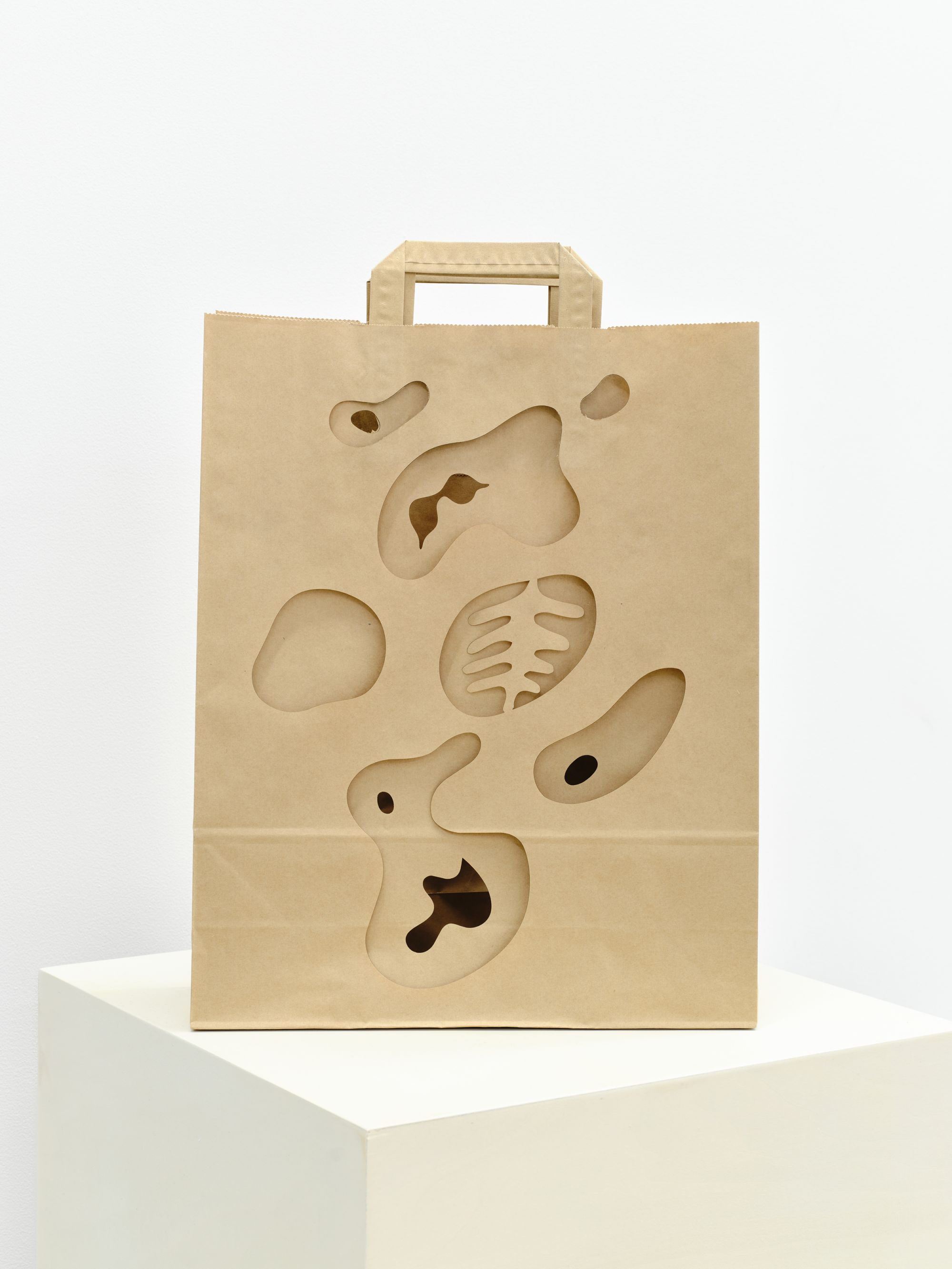
A shopping bag with folded paper handles. Seven rounded shapes are cut into its front and spread over the panel. The one in the middle is an oval crossed by curved ribs, a small ribcage, the skeleton of the title; the others, the entourage, are blobs and drops, and three of them contain a smaller dark cut where the inner bag is opened in turn. The edges are clean and the curves even, the marks of the router.
Bag (Pflanzenbild) (2026)
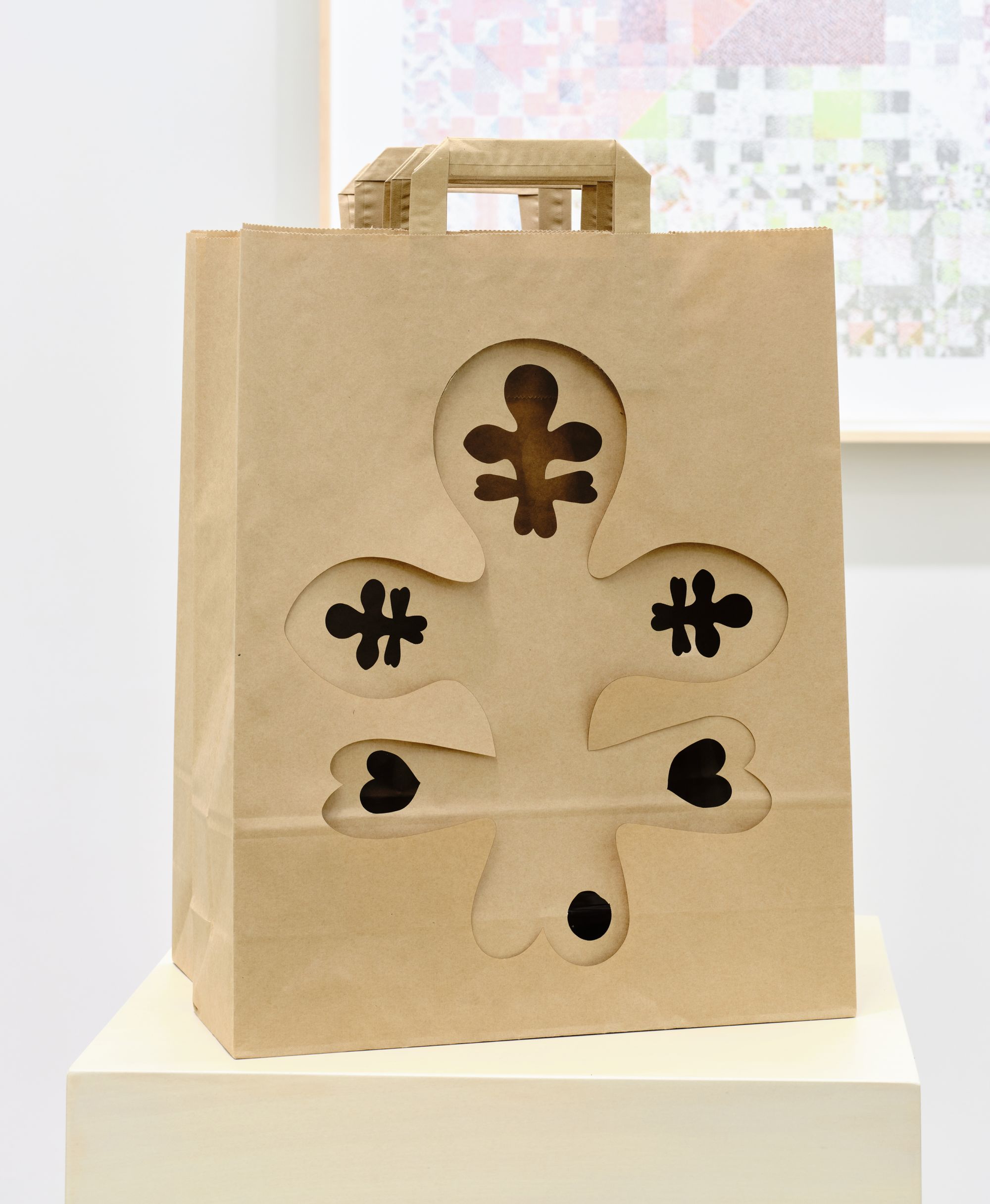
Here a single figure is cut out of the outer bag: a cross of four round lobes on a stem, like a stylised plant. In each lobe the inner bag is cut again with a smaller sign, two leaf-like stars at the sides, a flower at the top, hearts in the lower lobes, so that the small shapes are dark holes framed by a lighter field. It is the most nested of the bags: figure inside figure inside the bag.
Where they were shown
- Notes on Objects, narrative projects, London, 27 February – 13 April 2019, curated by Daria Kirsanova (harm.work): Bag and Another Bag, each on a plinth. The other artists were Teresa Braula Reis, Braco Dimitrijević, Marte Eknæs, Carlos Noronha Feio and Anton Ginzburg. The gallery's walking list titles the two bags Invariable Depth Constellation and Pseudocount Arp Bootleg, "Hand cut brown paper bags"; it does not say which is which, though the first shares a word with the Arp Constellations that harm.work names for Another Bag. The press image is captioned "Bag of Words, 2015-2019", a title that is also the name of the bag-of-words model of text, which counts words and ignores their order. The press text answers Robert Morris's "Notes on Sculpture" (1966). Its essay says the artist "presents a humble, simplistically recognisable readymade—a paper bag—but intercepts its presence with contemporary technology", and that he "moves us away from a focus on surface, and pulls from Morris' traditional value of negative space" (press release). In the bags the negative space is literal: each shape is made by cutting paper away. The gallery's checklist titles the two bags Invariable Depth Constellation and Pseudocount Arp Bootleg (→ Notes on Objects).
- World as Lover, World as Self, Chapter 2: A Field Without Boundaries, Shimmer, Rotterdam, 5 February – 12 June 2021, "a back-catalogue of works" shown in phases, the first combining Death Imitates Language with the bags. Spectre was photographed there. Shimmer's first exhibition report, written as a list of observations on 6 February 2021, records "Two works made of brown paper, bags within bags within a bag", "each piece is hand-cut, taken away but adds something", and "Two eyes light up" (handout).
- Cloud Writings, Takuro Someya Contemporary Art, Tokyo, 2026: the two CNC-cut bags of 2026 among plotter drawings (→ Cloud Writings).
Cut flat, then opened
The bags take the method of the Assemblage spheres into another material. The spheres were cut from flat printed sheets of synthetic glass and joined into a volume; the image existed before the form (→ Sculpture and the Object). A paper bag is a flat sheet already folded into a volume, and the cut opens the volume back up. The bags are also the paper form of nesting, the structure of his generative work of 2017–2019 and of the nested plotter drawings of the same years: a composition made of containers inside containers (→ The Grid, From nesting to the grid). In a bag the nesting is literal, one bag inside the other, and each level is reached by cutting through the one in front.
See also
- Sculpture and the Object — the Assemblages, the Chrysalis sculptures and Spectre
- Algues Artificielles — bred seaweed curves after Arp
- Randomness and Pattern — Arp's collages and chance
- Cloud Writings (2026) — the two bags of 2026 in Tokyo
- Automated Drawings — the nested drawings of 2017–2018