
Notes on Objects (Narrative Projects, London, 2019)
Notes on Objects was a group exhibition of sculpture at narrative projects in London, from 27 February to 13 April 2019. It showed work by Teresa Braula Reis, Braco Dimitrijević, Harm van den Dorpel, Marte Eknæs and Carlos Noronha Feio, "as well as a new site-specific work by Anton Ginzburg" (press release and checklist). harm.work credits the show to Daria Kirsanova, who founded narrative projects in 2013; the gallery's text names no curator. Van den Dorpel had had his solo show IOU there in 2015 (→ IOU). For Notes on Objects he showed two brown paper bags, cut with shapes after Hans Arp, from the series Bags (→ Bags).
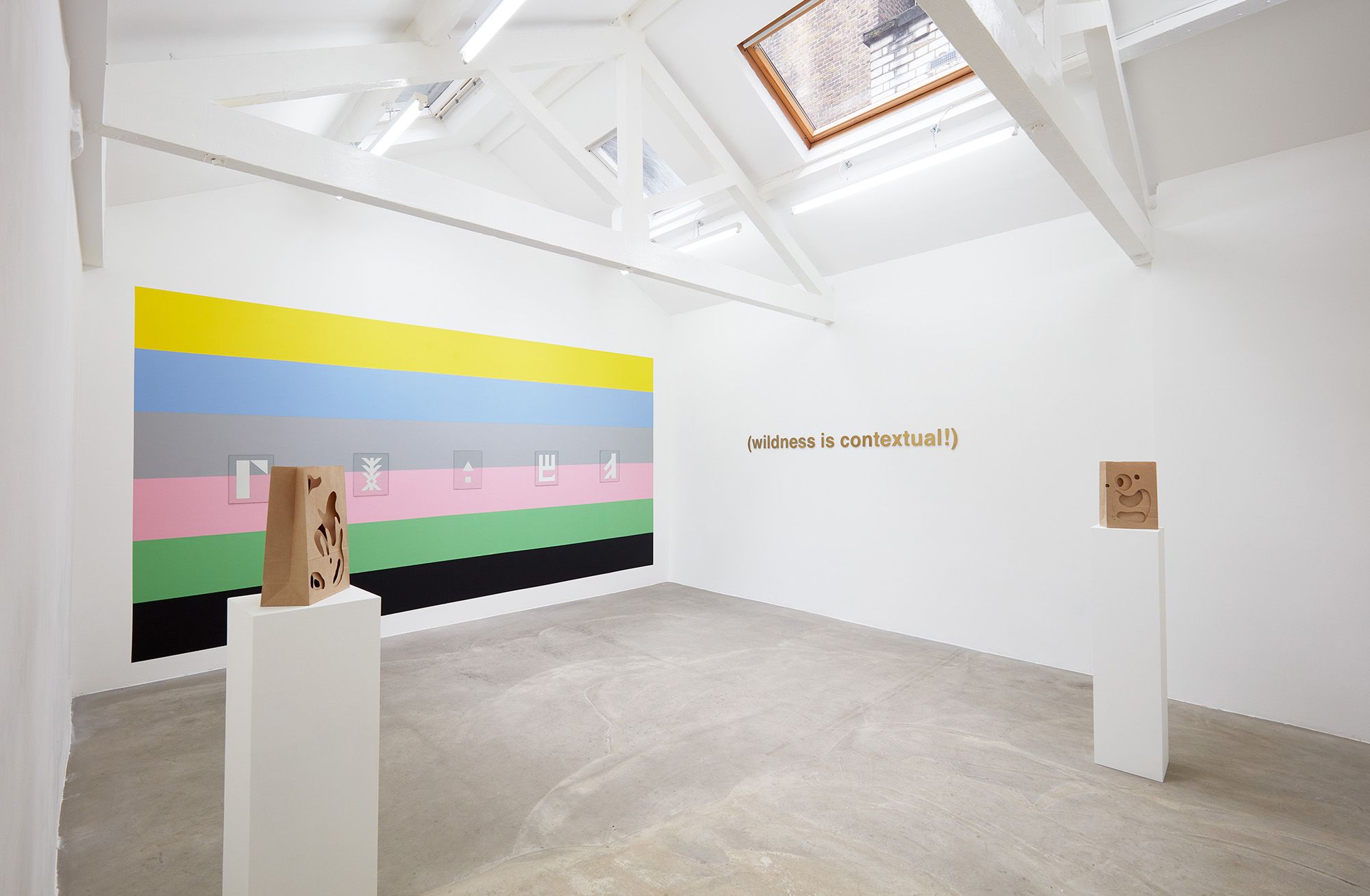
The second room. Ginzburg's mural, Glyph Color-Space Initiative 1 (London), covers the back wall in six horizontal stripes, with five mirrored glass panels carrying white glyphs across the grey and pink bands. Noronha Feio's (wildness is contextual!), gold stainless-steel letters, runs along the right wall. The two bags stand on white plinths, one in front of the mural and one at the far right.
Morris
The title echoes Robert Morris's "Notes on Sculpture", published in Artforum in 1966 and 1967, and the gallery's text says the show "responds to this essay". It gathers artists who share a "dedication to the expansion of the definitions of sculpture, and an embrace of text, painting, data, found objects, and materials both organic and inorganic, in a questioning of sculpture's physical and structural limitations, toward an exploration of its experiential possibilities." It ends on Morris's phrase: the artists "create a Morris-esque 'experienced variable.'"
A longer essay on the second page of the press release walks through the rooms. It sets the works around Dimitrijević's marble plaque, I'm Not Maker of Objects But Creator of Vision (1969–2017), whose gold-leaf words "set the tone for the exhibition": the artist "not as a producer, but as an orchestrator". It then reads each work against a phrase of Morris's, Ginzburg's mural for its "quasi-architectural focus", Eknæs's inflated boat fenders, I'm in the wrong place (2017), for their reference to manufactured objects, and arrives at van den Dorpel by way of Noronha Feio's text sculpture, which "both contrasts and corresponds with Harm van den Dorpel's piece".
The two bags
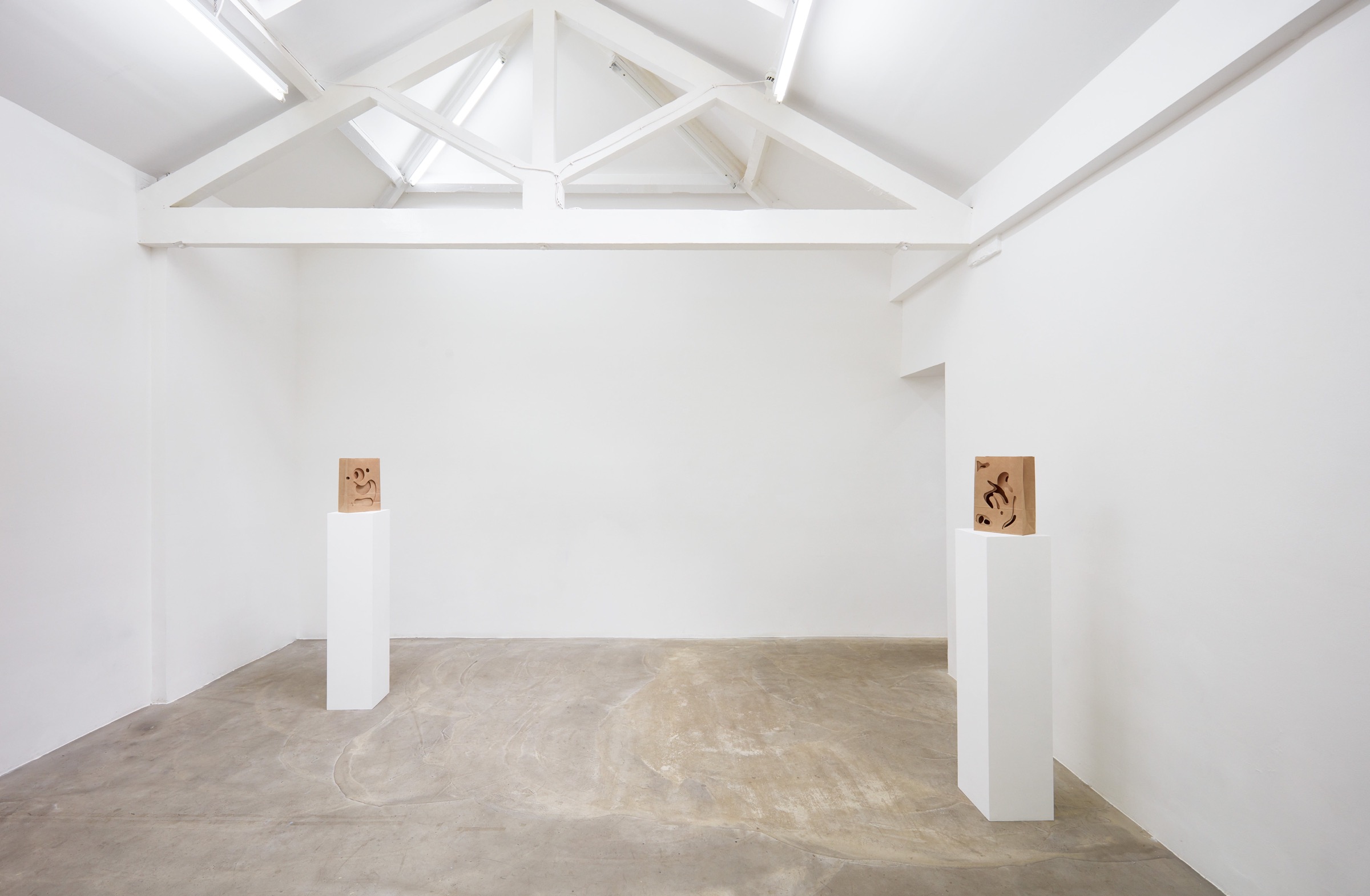
Seen from the other end of the room, the two bags stand on white plinths with nothing else in view. On the left is Bag, its front cut with an oval inside a ring and a large rounded opening; on the right Another Bag, cut with a spreading figure and smaller shapes, "Based on the work 'Constellations' by Jean Arp from 1938" (harm.work). In both, two bags are nested and the outer one is cut, so each opening shows the inner bag and its own smaller cuts.
The gallery's walking list gives the two works other titles: Invariable Depth Constellation (2019, "Hand cut brown paper bags") and Pseudocount Arp Bootleg (2019, "Hand cut paper bags"). It does not say which bag is which, and both titles point at Arp, one through the constellation of his 1938 print and one by name, so the two lists cannot be matched from the titles. The press release illustrates the show with an image captioned "Harm van den Dorpel, Bag of Words, 2015-2019".
Two of the three titles are terms from statistical language processing. A bag-of-words model treats a text as an unordered collection of its words, counting them and discarding their order; a pseudocount is a small number added to every count so that a word never seen still gets a probability above zero. The title Bag of Words takes a model of language named after a bag and gives the name back to a bag. The word Bootleg names the bag an unauthorised copy of Arp. The dates "2015-2019" given for Bag of Words reach further back than the harm.work entries, which date both bags 2019. The gallery's texts explain none of this.
The gallery's reading
The essay's paragraph on van den Dorpel:
Van den Dorpel, whose work interprets visual inputs and lived experiences through computer programming, code, and logged information, transforming them into tangible entities, here presents a humble, simplistically recognisable readymade—a paper bag—but intercepts its presence with contemporary technology. Incorporating part of the surroundings in a distinctly post-historical, or post-conceptual way that Morris might not have yet imagined, van den Dorpel moves us away from a focus on surface, and pulls from Morris' traditional value of negative space, in a less structured, modular way, and a new kind of 'industrial sensuality.'
The "contemporary technology" is hard to find in the objects. The checklist gives both bags as cut by hand, and the release does not say what technology it means; the CNC router appears only in the bags of 2026 (→ Bags). The titles' borrowing from language modelling is the clearest sign of computation in the work, and the release does not mention it.
The negative space Morris valued is in the bags literally: their forms are made by removing paper. The year before, at the MCA in Chicago, an Assemblage sphere had hung in a show on translating digital images into real space (→ I Was Raised on the Internet). Both are built from flat sheets: the spheres from printed plastic cut and joined into a volume, the bags from a volume that the cut opens up again (→ Sculpture and the Object).
See also
- Notes on Objects — press release and checklist — the gallery's texts and walking list
- Bags — the cut paper bags after Arp, 2019–2026
- Sculpture and the Object — the Assemblages and the later sculpture
- IOU (Narrative Projects, 2015) — his solo show at the same gallery
- Algues Artificielles — earlier work after Arp