
Wer nicht denken will, fliegt raus — Museum Kurhaus Kleve, 2016
Group exhibition "Wer nicht denken will, fliegt raus – Handlungsanweisungen nach Beuys", Museum Kurhaus Kleve, Germany, 1 July – 18 September 2016. Curated by Heinrich Dietz and Harald Kunde. Exhibition text in German and English: sources/ingested/wer-nicht-denken-will-fliegt-raus-exhibition-text.md. harm.work: Wer nicht denken will, fliegt raus.
The Museum Kurhaus Kleve stands in the former spa building where Joseph Beuys kept a studio for years. In the summer of 2016 it showed his work in Joseph Beuys – Werklinien and, beside it, Wer nicht denken will, fliegt raus, nine contemporary artists' rooms spread over three floors. Van den Dorpel's room held work from Death Imitates Language, the series he had begun that March: six square wall objects and the screen work Autobreeder. The museum's page credits his image "Courtesy Neumeister Bar-Am", the Berlin gallery that worked with him then.
The exhibition
The title is a saying of Beuys's, printed on a postcard edition: Wer nicht denken will, fliegt raus, "Whoever does not want to think gets thrown out." The subtitle, Handlungsanweisungen nach Beuys, means "instructions for action after Beuys". The museum called the show "a reflexive commentary" on Werklinien and said each room related "in its own way to aspects of the Expanded Concept of Art", Beuys's idea of art extended to all human activity (→ social sculpture). It expected the instructions to fail as instructions: "the strictness of a concrete objective, as implied by the word 'instruction for action', will in most cases appear as a reflection on certainties believed to be secure." (The museum's text is in German; translations here are the wiki's.)
The text places the artists after Beuys rather than with him. Their background "is no longer fed by utopias and missions of redemption but is shaped fundamentally by reflexive irony, pragmatic disillusionment or unbiased speculation", and the show "offers no solutions, but makes displacements of reality tangible".
The other eight were Olga Balema, Alice Channer, Thea Djordjadze, Krištof Kintera, Martin Kippenberger, Hito Steyerl, Barthélémy Toguo and Erwin Wurm. Van den Dorpel, born 1981, was among the youngest. A catalogue in German and English documented every room.
His London gallery, Narrative Projects, announced the show with a line from an interview with Dietz, who "wanted to further explore Beuys's suggestion that the engagement and interpretation of art is entirely contingent on the ability to think". The gallery added its own reading of the room: "The works by van den Dorpel challenge the notion that thinking and the capacity for making and appreciating art are exclusive to human beings."
Van den Dorpel's room
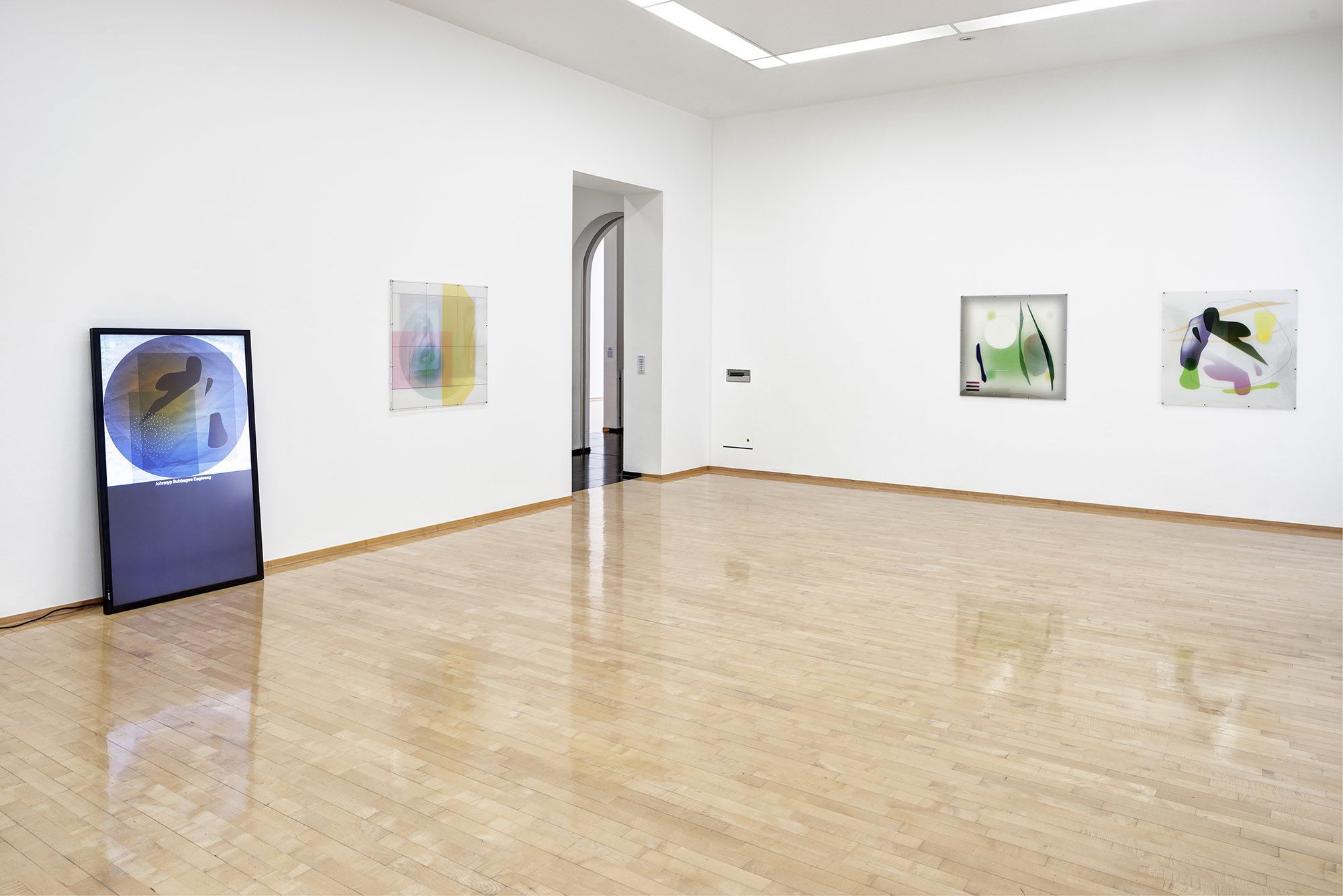
harm.work describes the room: "6 wall pieces, multi layered UV prints with white channel between CNC-cut plexiglass, packing material, screw system, unique editions, each 100×100×4cm, and an animated software work, showing the entire genealogy." The installation views show a white room with a pale wooden floor and tall windows behind white blinds, the six objects hung singly, with wide gaps, on three of its walls.
Each wall object is a frozen specimen of the series: a square of clear acrylic sheets, CNC-cut and UV-printed, screwed together at the edges with packing foil between them, so the image sits in depth and the foil's fine texture shows through. The series text says such objects "can be hung and watched from all sides" (→ Death Imitates Language).
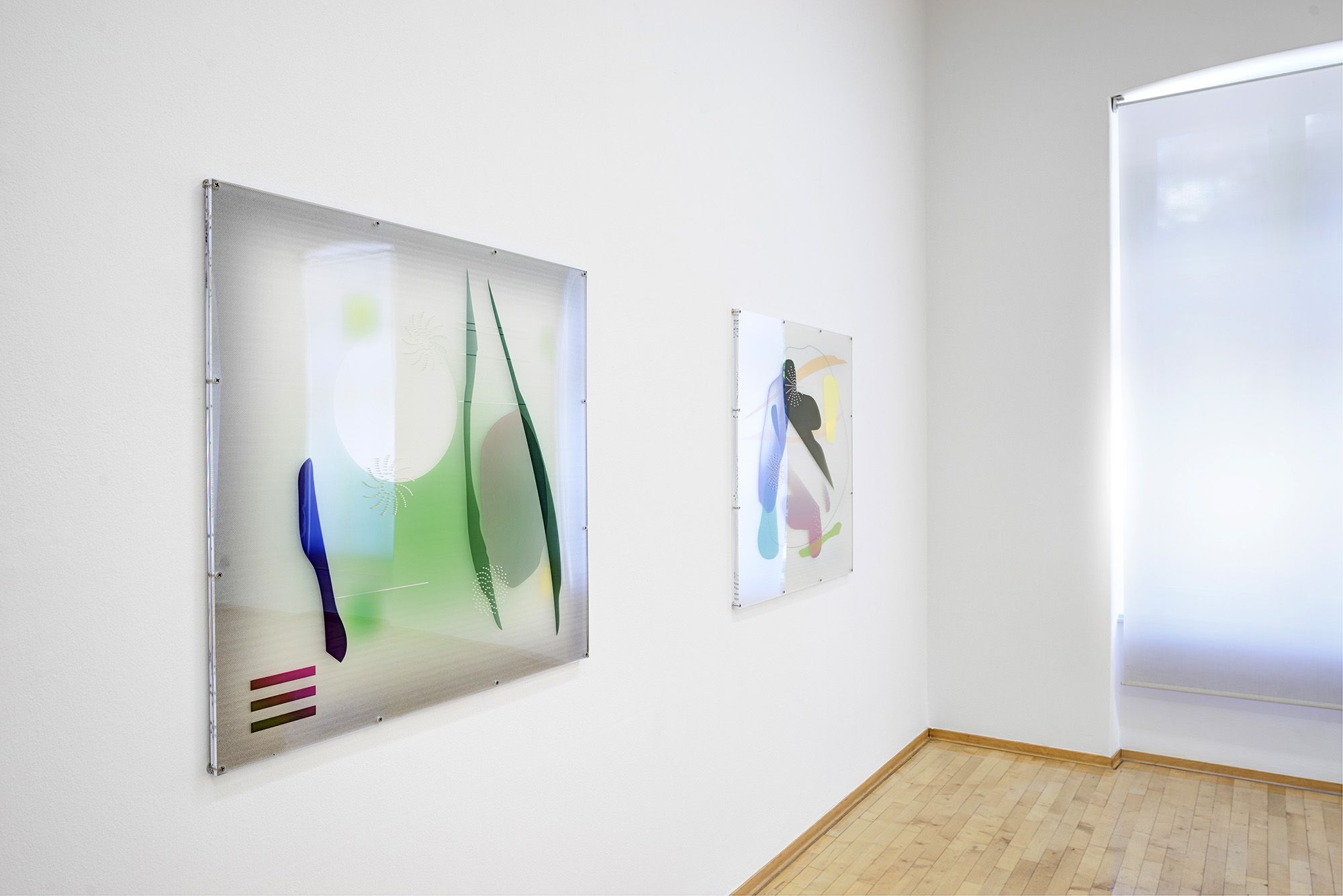
Shtonk Vtejuwoh Bonifac
Shtonk Vtejuwoh Bonifac is the specimen the museum used to announce the show. Seen at an angle, two long dark-green leaf shapes rise through a soft green field, with a white disc behind them, a violet-blue blade at the left, small rosettes of perforated dots, and three short bars of pink and green in the lower left corner. The layers separate as the viewer moves: the leaves sit on the front sheet and the colour field further back. Further along the same wall hangs a second specimen, overlapping violet, black, yellow and pink shapes crossed by a thin outline.
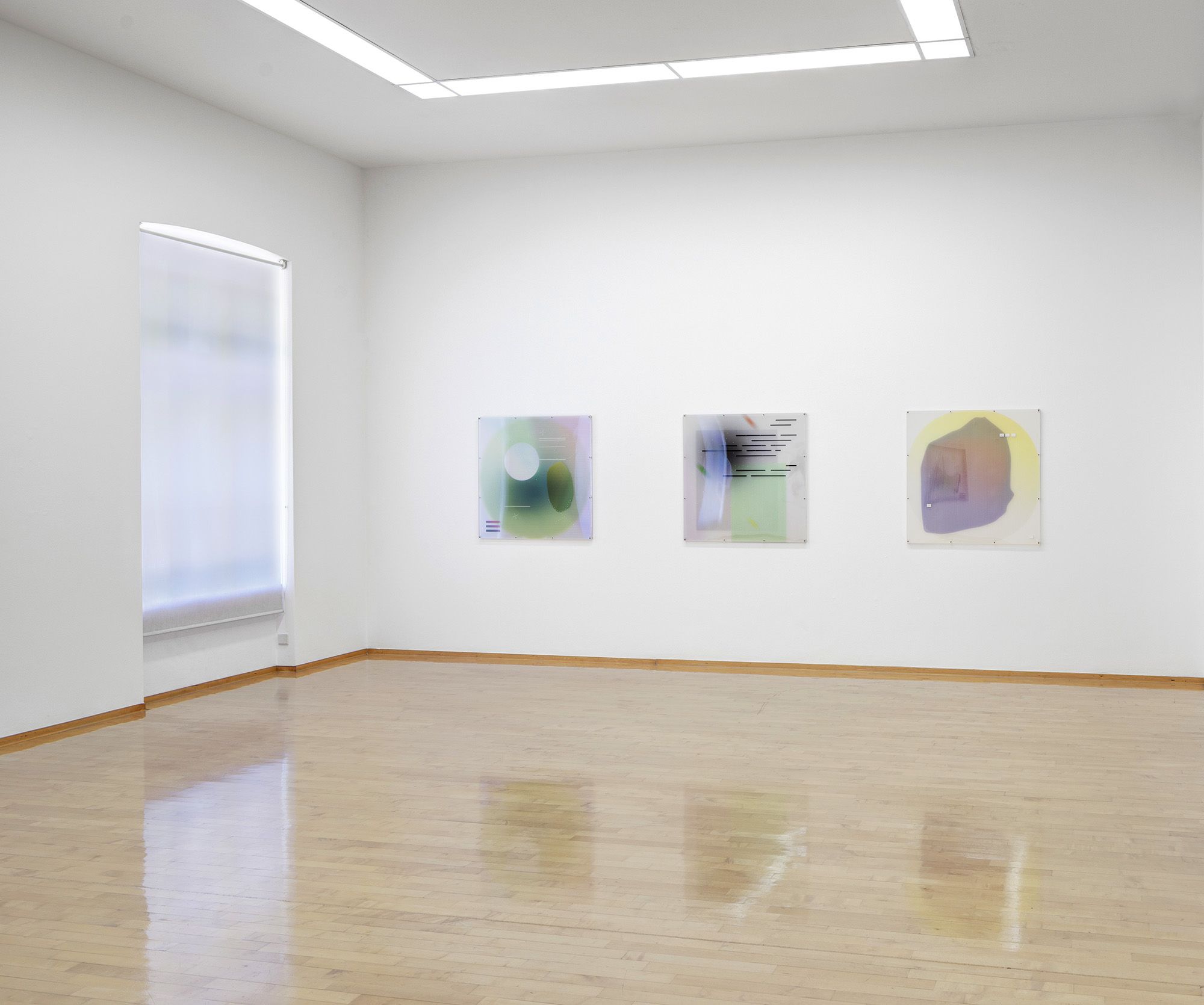
Vuwtvvyft Zcuviey Dayssuck
Another wall holds three more. In the middle hangs Vuwtvvyft Zcuviey Dayssuck: rows of short black bars over a dark smudge and a pale green rectangle, like lines of redacted text. To its left a specimen built around a white disc and green ellipses, with the same three short bars in a corner; to its right a violet-grey stone shape in a yellow halo. The three-bar mark recurs on several specimens; in the series' terms, shared elements like it come from the "sequences of information, a sort of DNA" that each work inherits from its ancestors.
harm.work also links Vvgdamn Pipikaka Yozdczmi, a pink and crimson specimen dated 2017, to the exhibition. It was in the show (the artist, November 2026), though it does not appear in the installation views; harm.work, which used to date it 2017, now gives 2016. The names of the other specimens in the room are not recorded.
Autobreeder
Autobreeder (2016) stands on the floor: a large screen in portrait format, leaning against the wall in a black frame. In the view it shows one specimen in a circle, violet and blue with a black blot, and under it the specimen's name, Johnnyp Bubbagee Eagleeag. harm.work describes the program: "This fullscreen software autosurfs the massive genealogy of the 'death imitates language' project, containing the entire population, bred by a genetic algorithm, and selected by micro-feedback of the artist", "offline, duration infinite, not interactive, silent, macOS". The walls showed six survivors; the screen ran through the whole genealogy.
The saying and the series
The wiki reads the title against the work. In Death Imitates Language the population changes by "subjective ('natural') selection by the artist: micro feedback or 'likes' about which of the works can live on, which ones should die, and who can procreate" (series text). A specimen that fails the selection is thrown out of the population. The wall objects in Kleve were the ones that stayed in, "frozen" when they reached what the series calls their optimal state. Narrative Projects took the opposite side of the saying, the question of who or what does the thinking. In the series the software makes the images and the artist only judges them, which is the division the gallery meant by thinking that is not "exclusive to human beings". The museum's text does not discuss the individual rooms and no statement by the artist on the show is recorded, so this reading is the wiki's (→ Evolutionary Logic).
See also
- Death Imitates Language — the series: origin, mechanism, names, physical works
- Evolutionary Logic — selection by likes beside the later fitness functions
- Algues Artificielles — the second breeding series, begun the same summer
- Limit Experience — selection read through Bataille