
Zeuchnungen
A series from around 2012, made as posts for dissociations.com — the online studio that is also the source archive for this wiki. Each work is a physical drawing or painting that was scanned and reworked by hand in Photoshop. The series page on harm.work is Zeuchnungen.
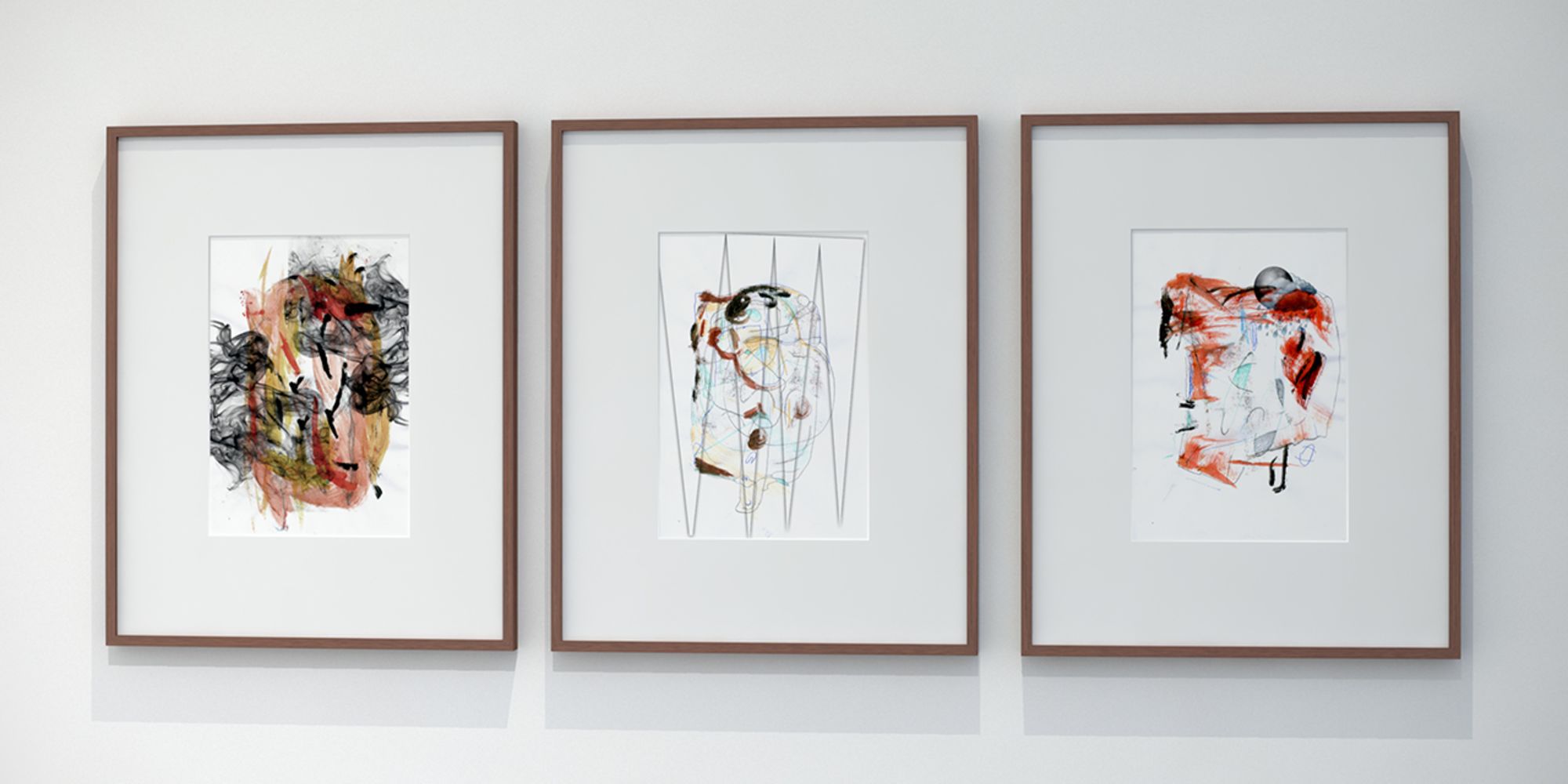
These were made for the screen. dissociations.com is Harm van den Dorpel's generative online studio, running since 2010 (see the about page), and the Zeuchnungen were built specifically as entries in it — images meant to be seen as web pages, not as objects on a wall. The installation view above makes the point by contradiction: it is not a photograph of a show but a 3D render built in Cinema 4D, a simulated wall hang for works that were never primarily objects. That origin explains everything about how they are made. Each begins as something physical and hand-made — an acrylic painting, a pencil or crayon drawing, in one case a photograph rendered in graphite — which is then scanned and reworked in Photoshop by hand, one decision at a time.
What keeps a Zeuchnung from being straight documentation of a drawing is that the digital layer never hides. The rendered elements read plainly as digital and the hand marks read plainly as physical, and the two are held apart on one surface rather than blended into a single look. Across the series the digital move takes three forms: overlay (dropping a rendered substance onto the scan), subtraction (cutting the image away to blank voids), and composite (splicing the scan into displaced blocks or generative line fields).
The series also runs darker than much of the practice around it. The palette stays muted and often monochrome: grey smoke, black ink, ochre, bruised red. The subjects are melancholic — an embrace with the faces rubbed out, half-animal shapes surfacing from the hatching, dark thresholded fur and bone. Van den Dorpel notes this tone is something his generative work on Ethereum, with its brighter systematic colour and clean rule-based forms, does not always carry. The mood arrives with the hand: these start as physical drawings and paintings, and they keep it.
The title
Zeuchnungen is a made-up word that folds two German ones together: Zeichnung, "drawing," and Zeugnis. A Zeugnis is a formal document that attests to something — a school report card, a work reference, a health certificate — or, in a courtroom, spoken evidence; the root zeugen means to bear witness. Zeich- is pulled toward Zeug-, so the coinage reads as something like drawing-as-testimony. Van den Dorpel coined it shortly after moving from Amsterdam to Berlin, taken with the flexibility of German — the way the language lets you fuse and bend words into new compounds to fit your needs. These are drawings and paintings passed through software until they are no longer quite either, minted as NFTs.
Overlay
Zeuchnung #4. Token 2 of the 2024 collection, and a clear case of overlay. A vertical band of salmon, ochre and red acrylic runs up the sheet, cut across by short black brushstrokes. Over it drifts a rendered plume of grey smoke, thick at the left and right edges and thinning to nothing across the middle. The smoke is the software artefact: soft, volumetric, evenly lit, obviously computed, laid over the hard physical drag of the brush. Where the paint records a fixed gesture, the smoke stays weightless, and the contrast between the two is the image.
A sheet with clip-art. Orange and vermilion acrylic strokes cover most of the page, with blue-pencil scribbles underneath. Into the top-right corner the artist drops a piece of ready-made 3D imagery: a glossy chrome sphere against a cartoon rain cloud shedding a neat row of droplets. The stock object is deliberately banal, and its slick catalogue-render finish is completely at odds with the smeared paint around it. The clash is not softened.
Subtraction
Thread. Token 0 of the collection, and the subtractive method at its most controlled — though it was made by a longer loop between hand and machine than the others. It starts from a graphite drawing of a family portrait: figures in a tangled embrace, clasped hands stacked at the centre. That drawing was edited so that large parts of the bodies and faces drop to flat white, leaving only thin outline contours where volume used to be; the edited image was printed on a laser printer, worked back over by hand in pencil, and scanned again. What remains reads as a photograph with its subjects half-deleted, the blank shapes carrying as much weight as the drawn ones, and the title names the few loose lines still threading the voids together. Unlike most of the series, Thread's physical version was not lost — the laser print reworked in pencil is in a private collection.
A crayon sheet, sliced. Here the ground is a loose pencil-and-crayon figure in brown, blue, teal and yellow. Five tall white triangles are dropped over it, tapering to points at top and bottom, as if wedges of the sheet had been lifted out and left blank. Same operation as Thread, blunter instrument: instead of following the drawn form, the voids are hard geometric wedges punched straight through a soft hand-drawn surface.
Composite
Untitled (beast swirl). A dense grey composite. Hand-drawn ink hatching and a half-animal, half-figure form are folded into a generative field of fine swirling lines — the kind of smooth, layered curve a plotter or particle routine produces, not a hand. The two line systems interleave until it is hard to say where the drawn marks stop and the computed ones begin, which is the opposite strategy to Zeuchnung #4: instead of a clean contrast between physical and digital, here they are dissolved into each other.
Boarish. A square, high-contrast black-and-white piece. A thresholded photographic texture — matted fur, an animal snout at the edges — is crossed with engraving-style hatching and then broken by hard rectangular blocks that sit slightly out of register, like a displaced image tile or a compression glitch. The photographic, the drawn and the software-error registers are stacked on the same square, none given priority. The title bends the market-sentiment words of trading — bullish, bearish — into Boarish, matching the boar in the image and, van den Dorpel suggests, taking a jab at the hype-driven uncriticality of the NFT space the work was minted into.
The figure
Zeuchnung #19. Token 1 of the 2024 collection, and the most nearly straight drawing of the group: a seated figure built from black ink masses, an ochre wash and grey pencil hatching, ringed by blue-pen scribbles, with only light digital handling. Note that the token numbers do not track the # in the titles — token 1 is Zeuchnung #19, token 2 is Zeuchnung #4, token 0 is Thread — because only a selection of the series was minted, not the whole run in order.
From web posts to NFTs — and the lost originals
The series lived first as pages on dissociations.com. Only later did the files become blockchain editions, in two waves, both on Tezos. The chain was chosen for a specific reason: van den Dorpel wanted these to exist as editions, and editioned art was not really the convention on Ethereum, where the norm for an artwork was the unique 1/1 token. Tezos platforms treated multiple editions as the default, which suited a series that had always been screen images rather than singular objects. In August 2022 two works were minted on Versum, the artist-run Tezos platform: Untitled (beast swirl) and Boarish (editions of twelve and sixteen). In March 2024 three more were minted on the artist's own Tezos contract (KT1CxGvrqM9Yja9U9E2kXFuRKHvAHpXhibiH) — Thread, Zeuchnung #19 and Zeuchnung #4 — each in an edition of twelve. The 2024 mint captions carry a plain statement of loss: "Digital collage with pencil drawing. Originals lost."
The five minted editions:
| Work | Platform | Minted | Edition |
|---|---|---|---|
| Untitled (beast swirl) | Versum (Tezos) | Aug 2022 | 12 |
| Boarish | Versum (Tezos) | Aug 2022 | 16 |
| Thread | Own Tezos contract | Mar 2024 | 12 |
| Zeuchnung #19 | Own Tezos contract | Mar 2024 | 12 |
| Zeuchnung #4 | Own Tezos contract | Mar 2024 | 12 |
The two other sheets shown above — the sliced crayon drawing and the clip-art sheet — appear on harm.work but were never minted, so they carry no edition.
That closing phrase — Originals lost — is what makes the re-mint more than housekeeping. Because the works were made for the screen, the physical sheets were only ever the starting material, and for most of the series they are now gone. Thread is the exception — its laser-printed, hand-worked sheet survives in a private collection — but for the rest the scanned, edited file is the only version that still exists. There the scan began as a stage in making a web image and is now the work itself, since the drawing it once recorded no longer exists to outrank it. This is note 992's formula — The Work = The Work + Its Documentation — pushed to the case where the second term is all that survives, and it lands the series in the territory of the mediation and archive page: the record outliving and then replacing its referent.
The hand-plus-machine structure also connects across the practice. The early plotter drawings run the same negotiation the other way round — a machine drawing interrupted by hand — where a Zeuchnung is a hand drawing interrupted by the machine. In both, the finished image is a record of decisions made while the two were working against each other.