
Emma Kunz — How the Drawings Were Made
Emma Kunz made each drawing in one sitting, to answer one question. The pendulum's part in it is recorded at two moments. At the start it located points on a large sheet of graph paper. At the end she swung it over a small wooden board to read what the finished drawing said. Everything in between was handwork: she joined a selection of the points with ruler and pencil, built crosses, circles and stars on those lines, and coloured them with coloured pencil and oil crayon. One step is unclear, how she chose which points to join, and the sources disagree about it. Her own published account of the method, a booklet of 1953, explains the figures by number and does not mention the pendulum.
This page goes through a sitting step by step. For each step it says who reports it, and it keeps apart what was seen, what Kunz said, and what later texts claim.
In short
| Step | What she did | The pendulum's part | Reported by |
|---|---|---|---|
| 1. Question | took a patient's complaint, or a question of her own | none yet; the question gives its movements a meaning | Burri; Knoblauch, after Kipke |
| 2. Points | set hundreds of pencil points on graph paper | located them | Burri, who watched; Widmer has the points come from an inner vision |
| 3. Joining | joined a selection with ruler and pencil | disputed | Burri could not see how she chose; Widmer and Hauser & Wirth give the pendulum a part |
| 4. Figure | built forms on the lines, from straight lines and number | consulted while building out, says Widmer | Bonnefoit and Petrucci; the 1953 booklet |
| 5. Colour | coloured forms, bundles of lines and grounds | none reported | Bonnefoit and Petrucci |
| 6. End | stopped when the drawing was complete, after up to 24 hours | none reported | Burri |
| 7. Reading | read the finished drawing | swung over a wooden board marked with a cross | Kipke, after Szeemann |
| 8. Reuse | consulted old drawings for new cases | none reported | Burri |
The sources
Kunz wrote little about how a drawing was made. Her three workbooks of constructions at the Emma Kunz Zentrum in Würenlos are unpublished. What is known comes from four kinds of source.
- Witnesses. Peter Burri, whom she treated in 1943 when he was eight, watched her draw on his visits and wrote it down in 2018. Heiny Widmer, who curated her first exhibition in 1973, ten years after her death, passes on what she "often said". Anna Kipke's 2021 thesis quotes both (sources/ingested/kipke-politiken-der-innerlichkeit-2021.md), together with the art historians Régine Bonnefoit and Sara Petrucci (2020), whose summary of a sitting is the most complete.
- Her own texts. One booklet of 1953, published under two titles with the same text, Neuartige Zeichnungsmethode (A New Drawing Method) and Das Wunder schöpfender Offenbarung (The Miracle of Creative Revelation), and a few sentences that others quote.
- Her instruments and workroom. The pendulum, the wooden board and a ruler are kept at the Zentrum. Werner Schoch photographed her workroom in Waldstatt in 1953.
- Exhibition texts. The guide to Emma Kunz – Visionary Drawings at the Serpentine, London, 2019 (sources/ingested/serpentine-emma-kunz-visionary-drawings-2019.md), and the press release and learning notes for the exhibition at Hauser & Wirth Somerset, 2026 (sources/ingested/hauser-wirth-emma-kunz-2026.md). They add details found nowhere else but cite no sources, so this page names them wherever it uses them.
The tools
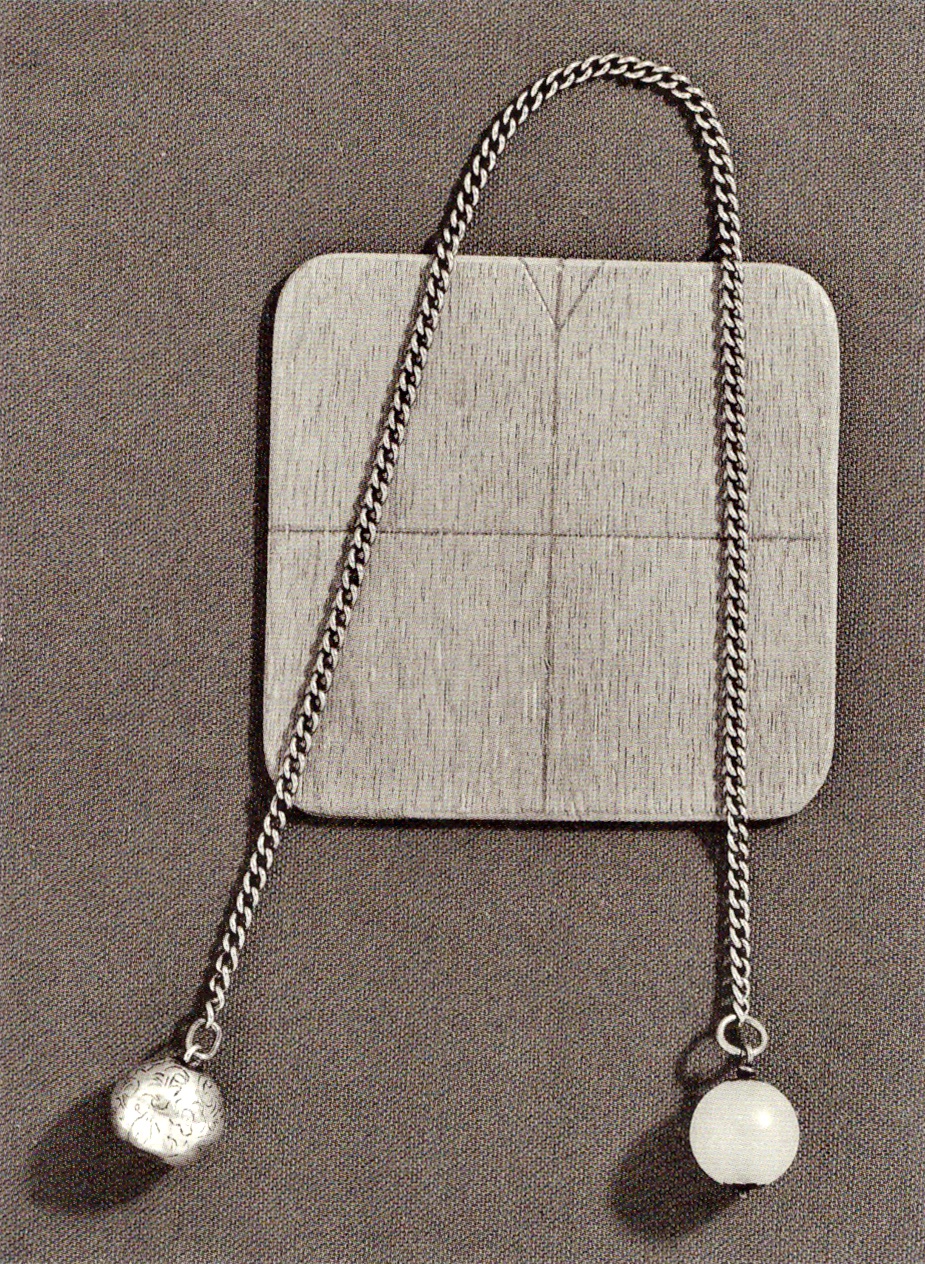
The pendulum is a chain with a ball at each end, one of engraved silver and one of white jade. The board under it is a square of wood with rounded corners, scored with a cross whose vertical opens into a V at the top.
The pendulum. She used the jade ball for spiritual questions and the silver ball for material ones (Karin Kägi's television report of 2020, cited by Kipke, p. 34).
The board, 8.7 cm square, was for reading finished drawings (step 7).
Graph paper. She drew on millimetre paper, white with blue lines or light brown with brown lines. The sheets are large: the works in the Serpentine guide measure between 70 × 70 and 120 × 105 cm, and some are round. The sheet lay flat on a table, weighted at the corners, and Schoch photographed her standing at it.
For the construction: ruler and pencil, which Burri saw; a compass, which Hauser & Wirth's learning notes add; coloured pencils and oil crayon.
A sitting, step by step
1. The question
A drawing began with a question. For a patient, Kunz first talked through the complaint (Kipke, p. 41). Other drawings answered her own questions, which "ranged from politics through philosophy to personal matters" (Bonnefoit and Petrucci). The Serpentine guide gives examples: the outcome of meetings between political leaders, Switzerland's neutrality, and one attempt to "depolarise" the negative energy of Hitler.
The question is what ties the pendulum to anything. In the sociologist Hubert Knoblauch's account of dowsing, which Kipke follows, a dowsing rod points at a place, but a pendulum is connected to its target only through a question. The user fixes beforehand what each movement means, for instance that a clockwise circle means yes and an anticlockwise one no. "The sign of the pendulum's movement is legible only to the person who set the sign and asked the often unspoken questions" (Kipke, p. 37).
The work needed silence and a still body. At Burri's sickbed she said "Say nothing!" and began to swing the pendulum without a word: "She was highly concentrated; every word was a disturbance." She called pendulum work "work", and "it was the hardest labour" (Kipke, p. 45–46).
2. The points
Burri watched this step:
"It was incredible how fast she set points on the graph paper. The whole sheet was strewn with hundreds of points. She determined their position with the pendulum."
Bonnefoit and Petrucci say she "sounded out" (auslotete) single points with the pendulum on the sheet lying flat. The Serpentine guide describes "recording the pendulum's swings, starts and stops onto graph paper", and Hauser & Wirth's learning notes say she "allowed the movements of the pendulum to indicate points, which she marked in pencil".
How a swing became a point is not recorded. No source describes the gesture. Knoblauch gives the vocabulary of pendulum work: a pendulum stands still, swings in a line or circles, and the user reads the changes from one to another (Kipke, p. 37). Two procedures fit the reports. She could move the pendulum over the sheet and mark the spot where its movement changed, which matches the Serpentine's "swings, starts and stops". Or she could ask about one position after another and take a yes or a no. Hundreds of points set "incredibly fast" fit the first better. Neither is attested.
Widmer tells this step differently. Kunz "often said that ordered systems of points had suddenly appeared in her mind. She took them at once as the basic pattern of a new figure and wrote them down." In his account the points came from a vision, and the pendulum was "a stimulant, the way other artists try by suitable means to bring themselves into a state favourable to work" (Kipke, p. 15–16). Both accounts put the points first and the figure after.
Reproductions of the finished sheets do not show hundreds of loose points. Whether she erased the unused ones, covered them with colour, or they are too faint to reproduce, nobody says.
3. Choosing and joining
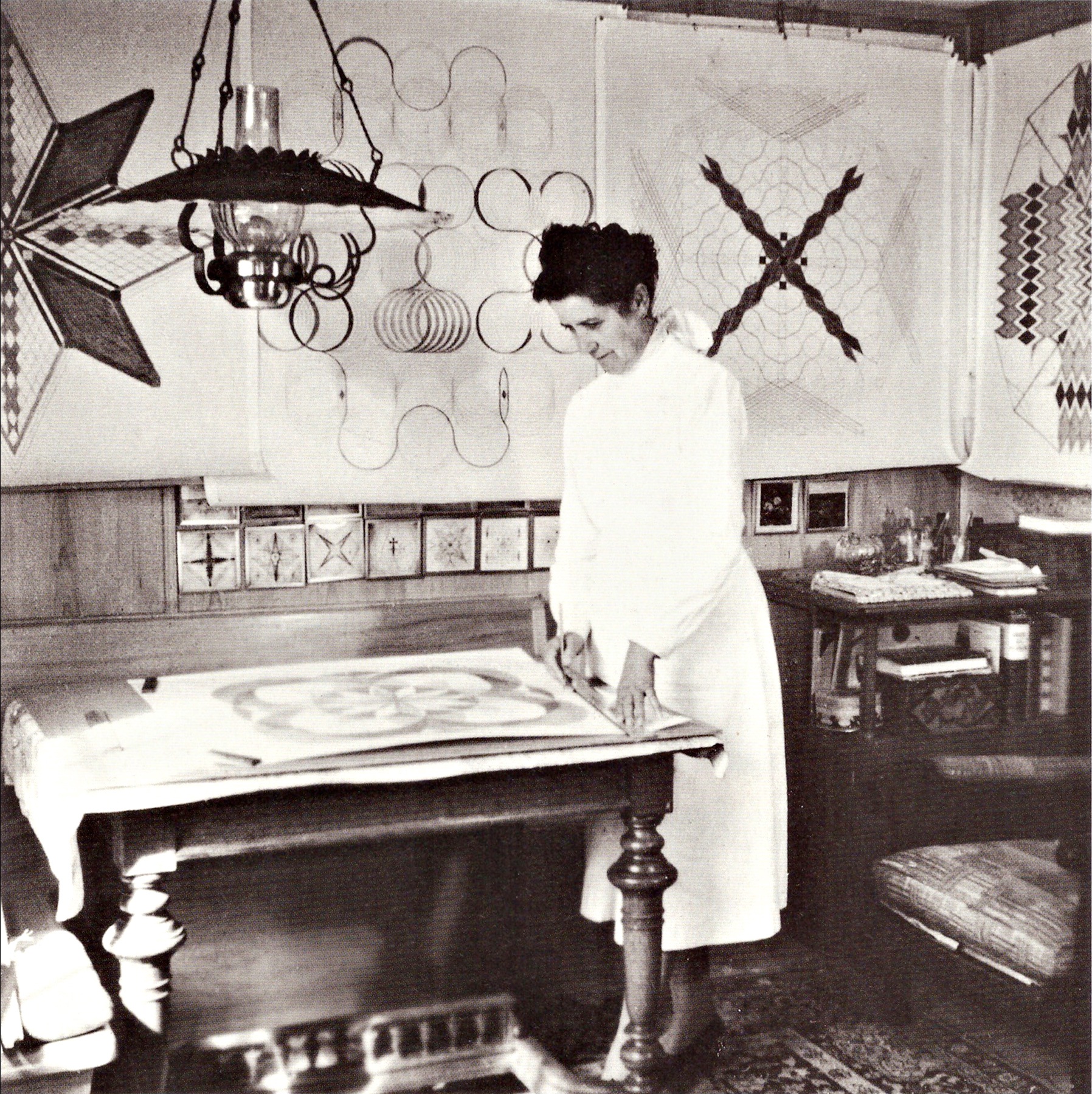
She stands at the table with a long ruler laid across the sheet and both hands on it. The sheet carries a rosette of overlapping arcs. Finished drawings hang on the walls above the panelling, among them a chain of circles and a large X, and smaller ones are framed along the panelling. Kipke notes that the workroom photographs show ruler, pencil and paper, and none of the objects of pendulum work or healing (p. 33).
Of the hundreds of points she used a selection. With ruler and pencil she joined them into what Bonnefoit and Petrucci call Schwerpunkte and Schwerlinien, centres of gravity and lines of gravity. The sources use the terms without defining them.
Who chose the points is the open question of the method. There are three answers.
- Burri, who watched her set the points, could not see how: "It was a mystery to me how she knew which points were then to be connected" (Kipke, p. 47–48). He saw the pendulum set the points. Had she swung it to pick each line, he would presumably have said so.
- Widmer says she built out the basic pattern "consulting the pendulum and inner visions", and that "sometimes it seemed as if the picture completed itself outside her consciousness, as if her hands were guided".
- Hauser & Wirth's learning notes (2026): "She then used the pendulum to guide connections between these points." They give no source.
How a pendulum would pick a pair of points out of hundreds, no source describes.
4. Building the figure
On the lines of gravity she "built and layered geometric forms: crosses, circles, stars, parallelograms" (Bonnefoit and Petrucci). This is construction with ruler and compass, and it follows rules her booklet sets out.
The booklet's premise is that every form, circle and parabola included, is made of straight lines, and that "the choice of two numbers, connected with each other and unfolded (entfaltet), determines the kind of form and figure". Once the key is known, she wrote, "anyone" can make such figures, "provided he knows how to handle numbers". The booklet does not mention the pendulum. Kipke: "the other key, which the booklet does not mention, lies in her practices" (p. 70).
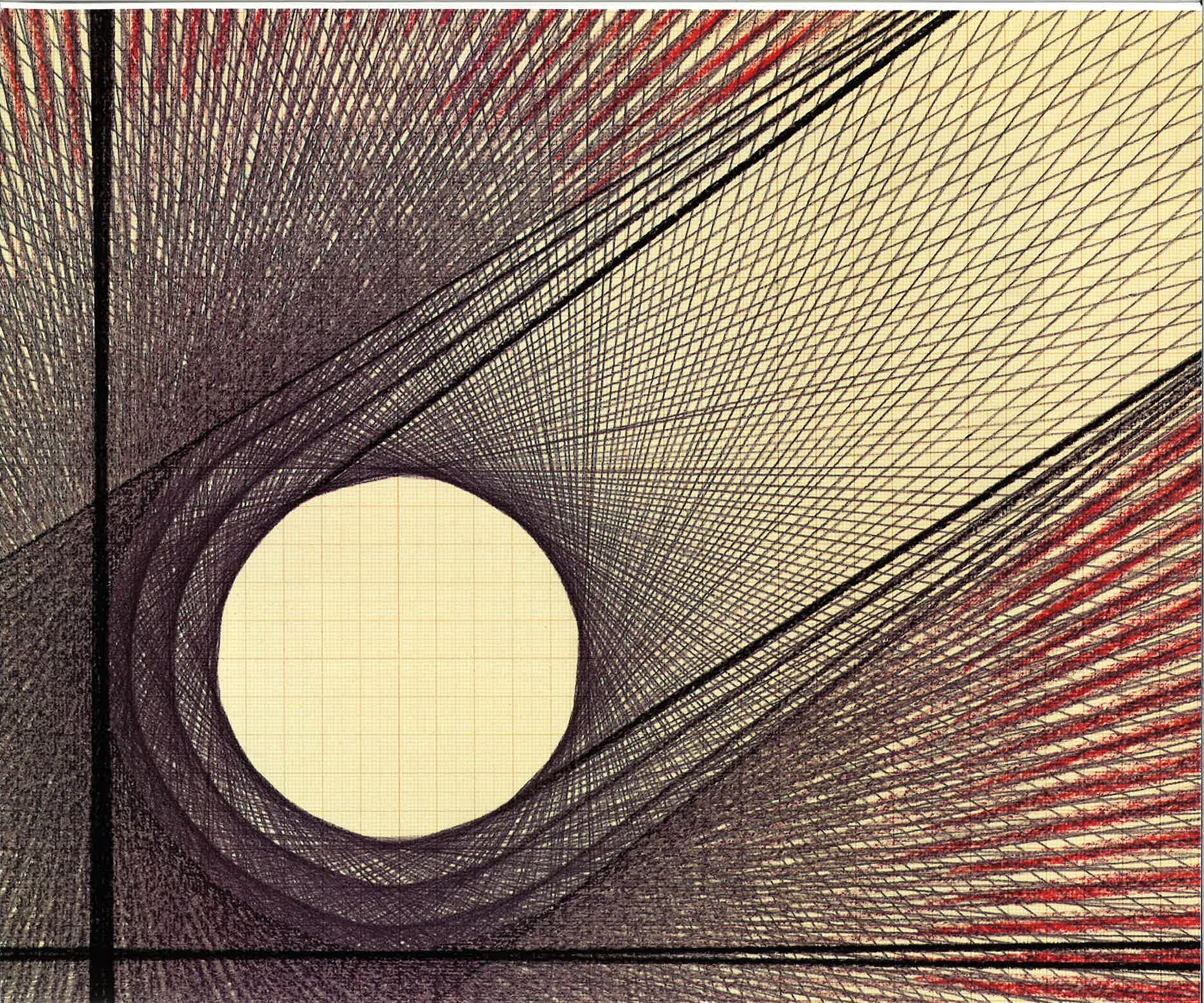
Hundreds of straight lines in black and red pass a pale disc without entering it. Each runs along its edge, so the edge appears as a circle: the circle is the gap the lines leave. Inside it the graph paper shows. Two thick black lines, one vertical and one horizontal, cross the field.
What the two numbers are, the passages Kipke quotes do not spell out. For a star polygon they can be the number of points on a circle and the step between joined points: seven points, each joined to the third one along, give a seven-pointed star. The booklet's introduction refers to an article in the Lucerne daily Vaterland of 22 August 1953 that showed "all the diagonals of a regular 24-gon", and Kunz says her figure Der Kreis und seine Entstehung (The Circle and Its Emergence) is the same figure made by another method (Kipke, p. 62). The reference shows the kind of figure she meant: one rule applied to every point of a regular polygon.
A common construction is the fan: straight lines from one point to evenly spaced points along a line or an arc. Where many lines of one fan cross those of another, curves and lobes appear that no single line contains.
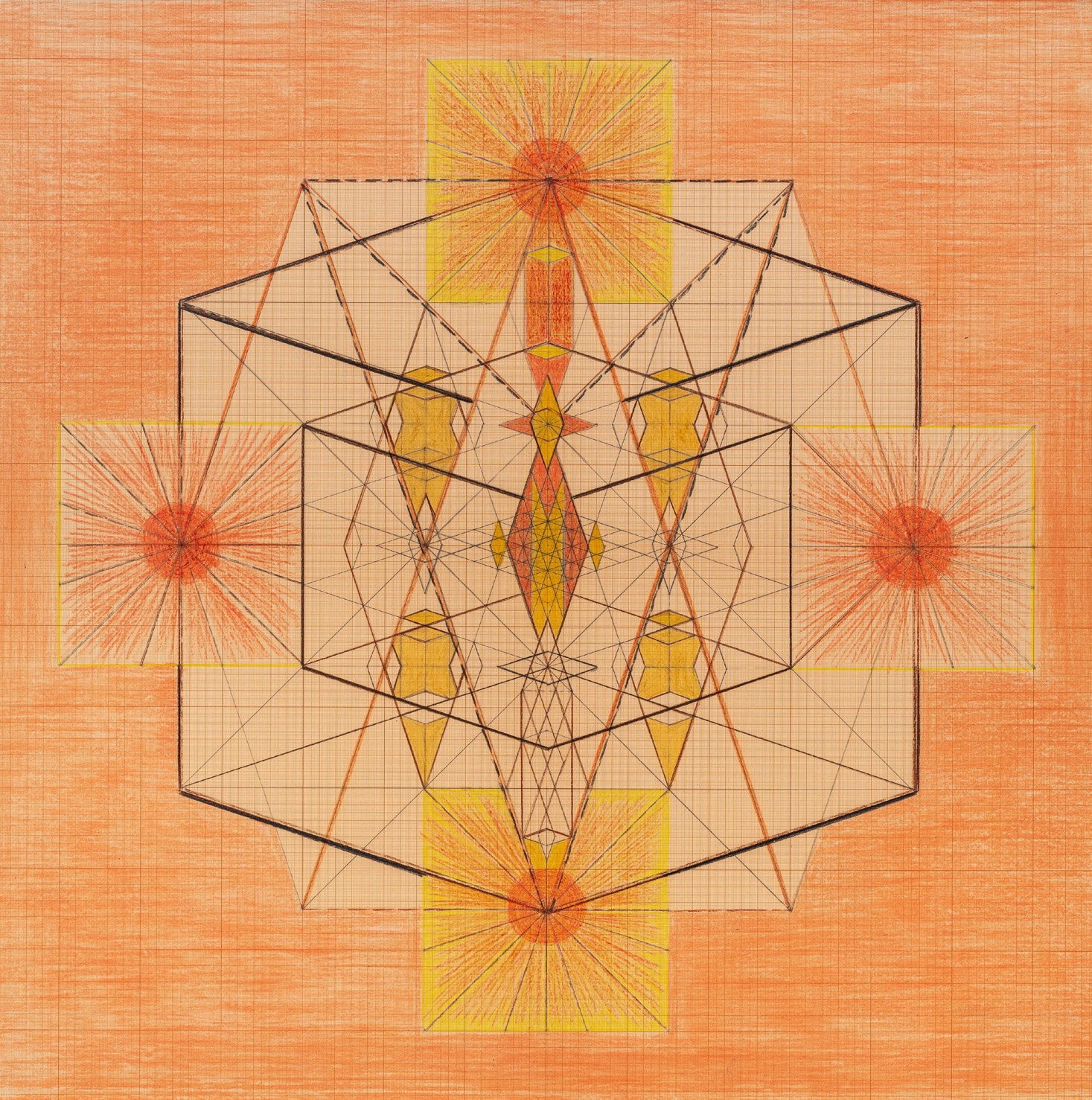
A cube is drawn as a wire frame, its hidden edges dashed as in a technical drawing, with a smaller cube inside it. At the four ends of a cross sit four suns, red discs from which straight lines run out to evenly spaced points on the edges of yellow squares. Yellow and orange shapes run down the vertical axis. The ground is coloured orange over the brown grid.
Some figures are solids in space, drawn by the conventions of technical drawing. Hauser & Wirth's learning notes say she saw her drawings as "spaces you could walk into, images to be unfolded or collapsed back down again".
The figures are symmetrical in outline and less so inside. The art historian Dawn Ades, quoted in the Serpentine guide: "Symmetry is often illusory, as with Work No. 117, whose four elongated yellow diamond shapes have three different internal square patterns." Hauser & Wirth's press release calls the works "at once highly precise and subtly irregular".
5. Colour
"With a wide range of colours she picked out single forms and flat bundles of lines, and coloured areas with coloured pencil" (Bonnefoit and Petrucci); she also used oil crayon. In Work No. 040 the whole ground is coloured. "For her, each combination of colour, shape and thickness of line … held significance," the Serpentine guide says, but she "refused to record their particular meanings". One meaning is reported: yellow was "a color Kunz would regularly use at the final points of her works marking their completion" (Hauser & Wirth press release).
6. The end of a sitting
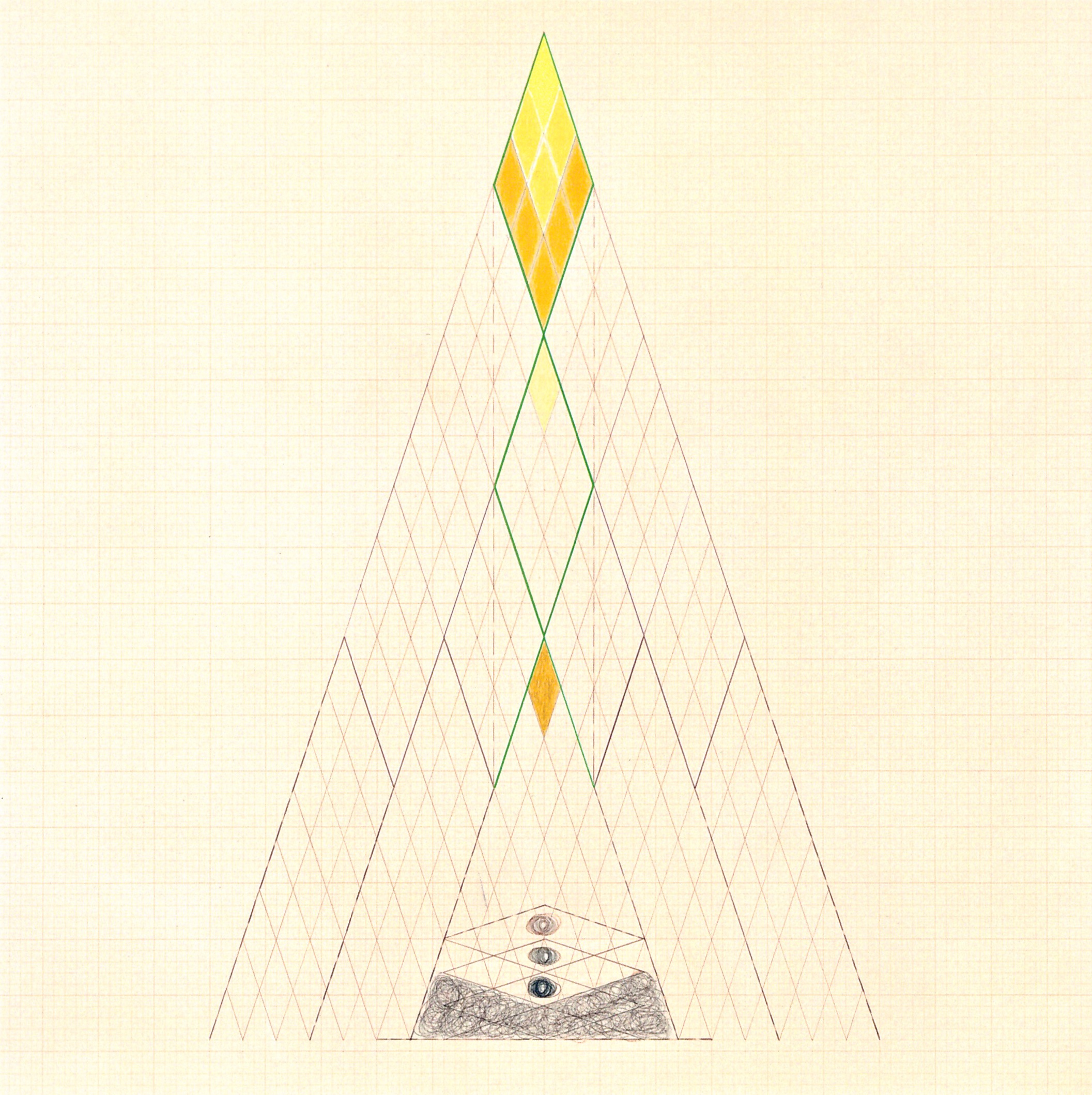
A tall triangle of lozenge lattice in thin red and brown lines, with a chain of green lozenges up its axis and yellow and orange lozenges at the top. At the base, three small spirals sit above a band of grey looping scribble.
Each drawing was made in one sitting, "even if it lasted day and night" (Burri), up to 24 hours according to Bonnefoit and Petrucci, longer according to the Serpentine. It ended when the drawing was complete in her own judgement. She told Burri "that at the start she never knew what the finished picture would look like, but that it was the complete answer to her questions". Widmer: when a work was finished she "stood before it full of astonishment and, returning from distant depths, described with curious wonder what had been found".
Werk Nr. 190 is her last drawing, made shortly before she died of cancer in 1963. Of it she wrote: "With this last picture I have opened the seventh chamber of the pyramid. My researches are now finished" (Serpentine guide). Its apex is yellow.
7. Reading the answer
The finished drawing was an answer that still had to be read. Kunz swung the pendulum over the wooden board, and "from the deviations and emphases of the respective directions she interpreted the insights the drawings conveyed to her" (Kipke, p. 34).
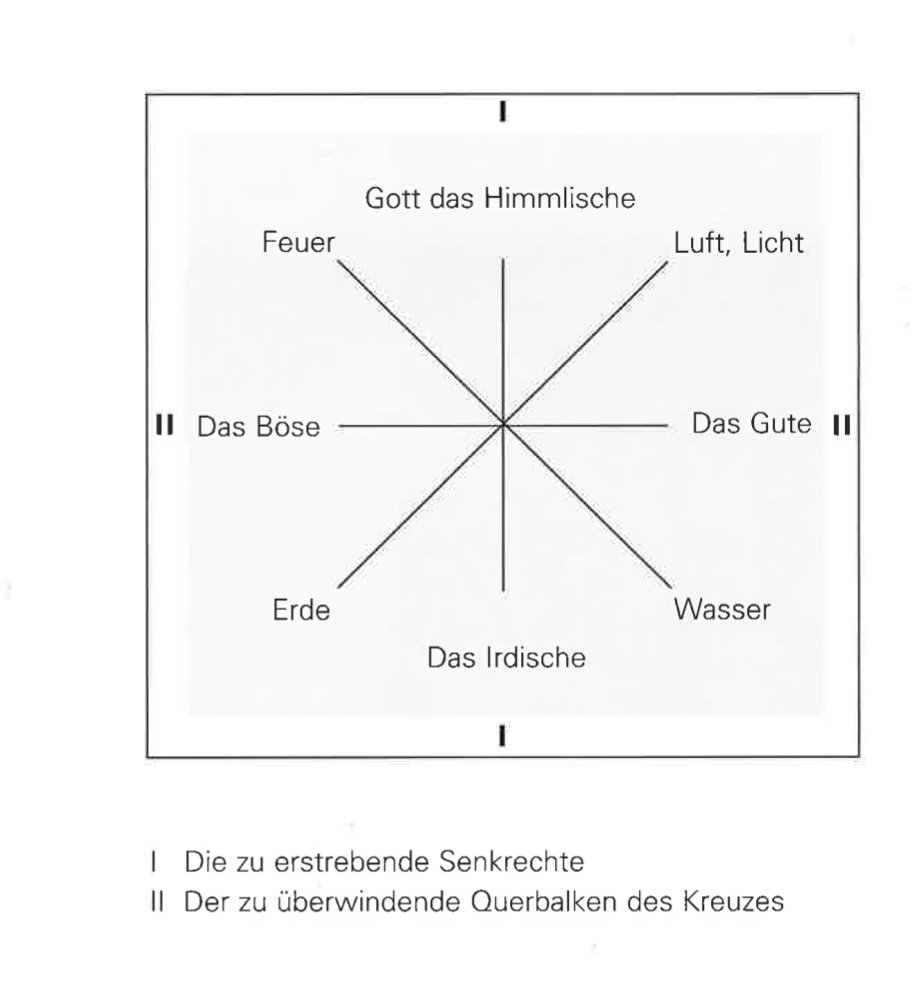
The board is laid out as a cross with diagonals:
- the vertical runs from "the earthly" (das Irdische) at the bottom to "God, the heavenly" (Gott das Himmlische) at the top, and is marked "I, the vertical to be striven for";
- the horizontal runs from "evil" (das Böse) on the left to "good" (das Gute) on the right, and is marked "II, the crossbar of the cross to be overcome";
- the diagonals carry fire and air/light above, earth and water below.
Harald Szeemann called the board a "grid of redemption" (Erlösungsraster); others called it a compass. How board and drawing were brought together, whether the board lay on the sheet or beside it, is not recorded.
The scheme of the board appears as a picture in Work No. 012, "often referred to as Philosophy of Life": "The vertical axis of the drawing signifies the upward path of enlightenment. The horizontal axis, which forms a crucifix, positions man between evil on the left and good on the right" (Serpentine guide). The sides match the board's. The instrument she read her drawings with is drawn out in one of them.
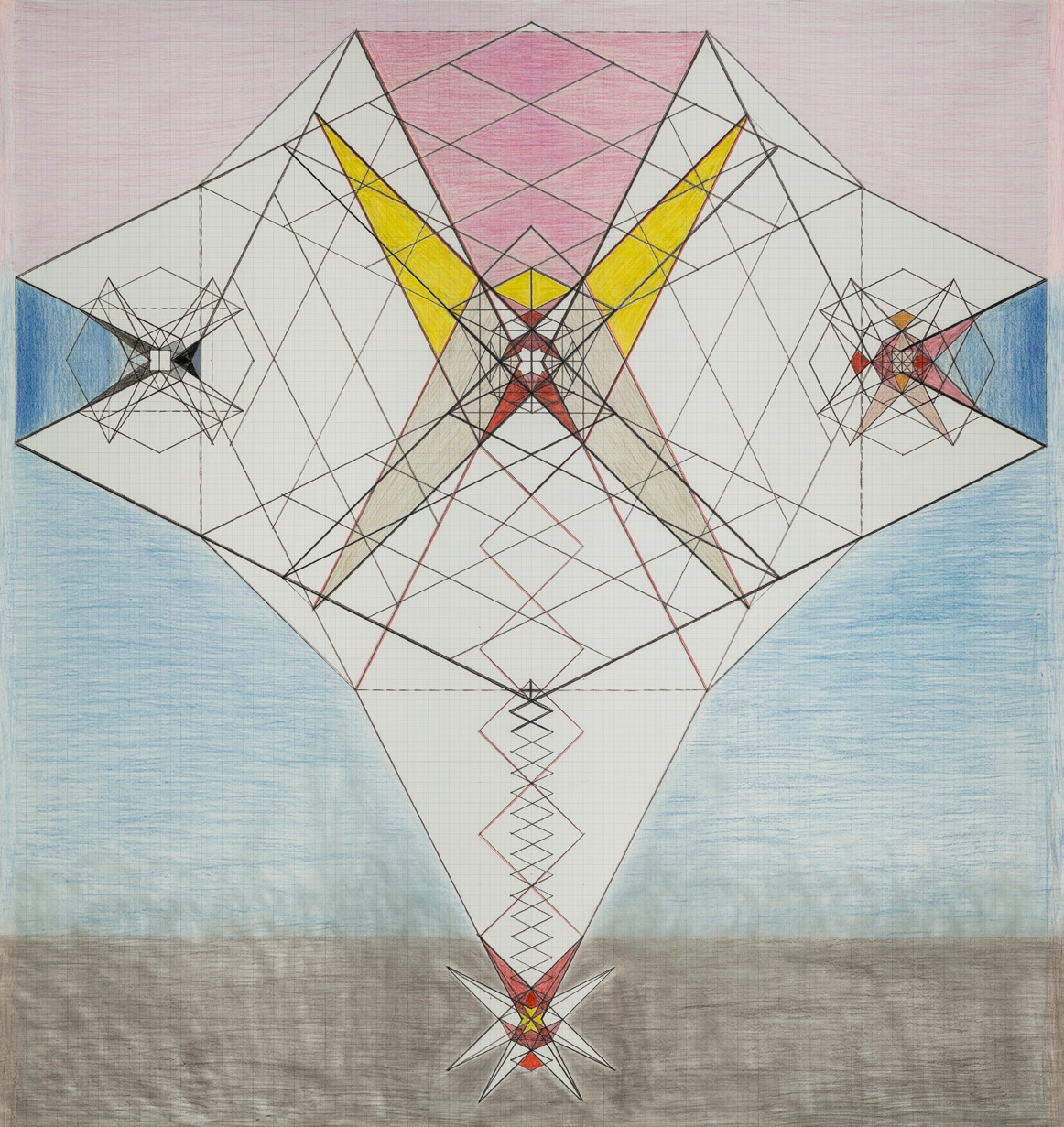
A large lozenge stands on a vertical axis, crossed by yellow and grey bands that form an X. Blue wedges at the ends of the horizontal carry small figures, a pink triangle fills the top, and below, the axis ends in a star on a grey ground. The Serpentine guide reads the X as "interlocking male and female figures" and the whole as man rising from "a birth position, within darkness".
She did not explain her drawings. "She never spoke about its content," Burri says. None is titled and few are dated.
8. Reuse
A drawing went on answering after its sitting. In her later years, Burri says, she drew far more than she healed in person. When asked to heal, she took one of her many drawings and looked out the corresponding "case": "She once said the answer was contained in these pictures, even if the question when they were made had been a different one." Finished drawings hung ten to twenty deep on her workroom wall, and the ones she used often have small pin holes (Kipke, p. 48). The exhibition texts say the same: she used "existing drawings as guides to diagnose patients" (Serpentine) and prescribed herbal remedies "via her drawings" (Hauser & Wirth). By the end of her life, Burri says, she no longer needed the pendulum (Kipke, p. 41).
The pendulum away from paper
The pendulum did more than draw. At Burri's bedside she swung it for half an hour and named a "severe medicinal poisoning"; he had been poisoned with iodine (Kipke, p. 45–47). A chemist brought her medicines to test with it (p. 35).
In her garden of medicinal plants in Waldstatt she walked the beds with a spiral pendulum rod (Spiralpendelrute), held at one end and left to swing. Anton C. Meier describes it: "Starting from the left, she gave each plant, loud and clear, an order: the first to produce five, the second seven, the third nine, the fourth eleven and the fifth thirteen daughter blooms. Silently she went on, row after row of flowers, working them with the pendulum" (quoted by Kipke, p. 33–34). Hauser & Wirth's learning notes name the plant, calendula (pot marigold), date the experiment 1953, and add that she first made a model of the result from copper wire around a central flower. Schoch photographed the results.
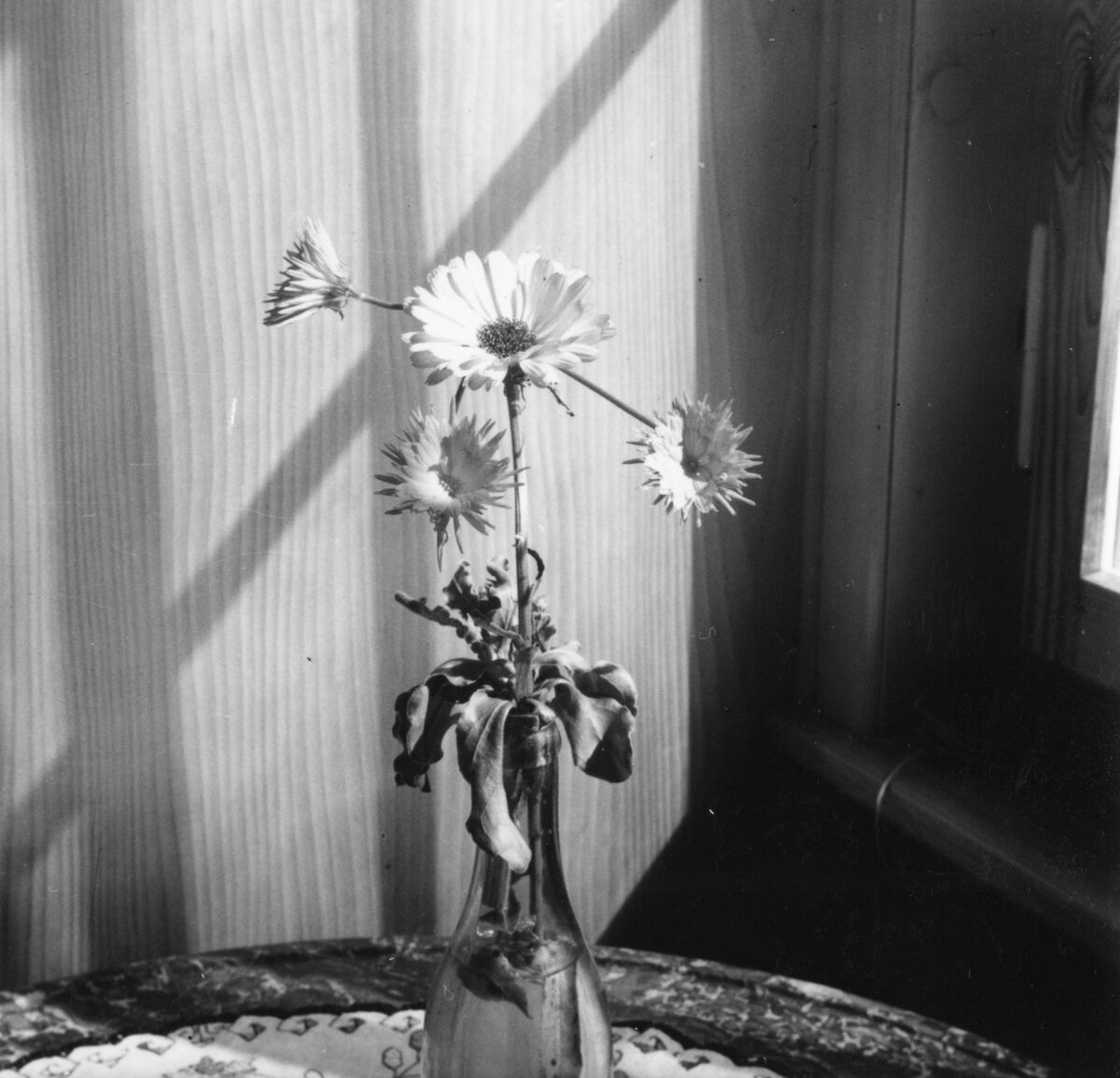
A marigold stands in a glass bottle on a table by a window, with one large flower in the centre and three smaller heads on side stalks.
The counts she ordered are the odd numbers from five to thirteen. Odd numbers appear again on her plate of basic forms (below).
What moves a pendulum
A pendulum held by its chain moves only when the hand holding it moves. The movements can be too small for the holder to notice, which is why pendulum work needs a still hand and arm and long practice (Knoblauch, after Kipke, p. 36–37). Experiments showed that a dowsing rod moved only in a person's hands, and around 1900 the cause came to be sought in the person (Kipke, p. 38). The effect is now called ideomotor: movement made without the mover's conscious intention.
What moves the hand is what radiesthetists of her time argued about (Kipke, p. 39). The physicalists held that outside forces act on the body, radiation and vibrations, and that the dowser picks them up like an instrument. The mentalists placed the cause in the mind or the unconscious of the person holding the pendulum. Knoblauch stresses that the line between them was fluid. Kunz's practice had something of both. She owned a Geiger counter, established measures of radiation and vibration in her first years with the pendulum, and cast lead plates as shields (Kipke, p. 35). She also placed the order of her drawings in herself: "Everything happens according to a particular lawfulness that I feel within me and that never lets me rest."
In the drawings, then, the pendulum turned small movements of her hand, which she did not consciously steer, into marks on a grid, and later into readings on a cross. Sara Petrucci calls it "an extension of the body" and a procedure of "depersonalisation and automation", close to automatic writing (Kipke, p. 41). What steered the hand, the wiki leaves open (→ Entfaltung on Paper, under Channelling).
Two kinds of sheet
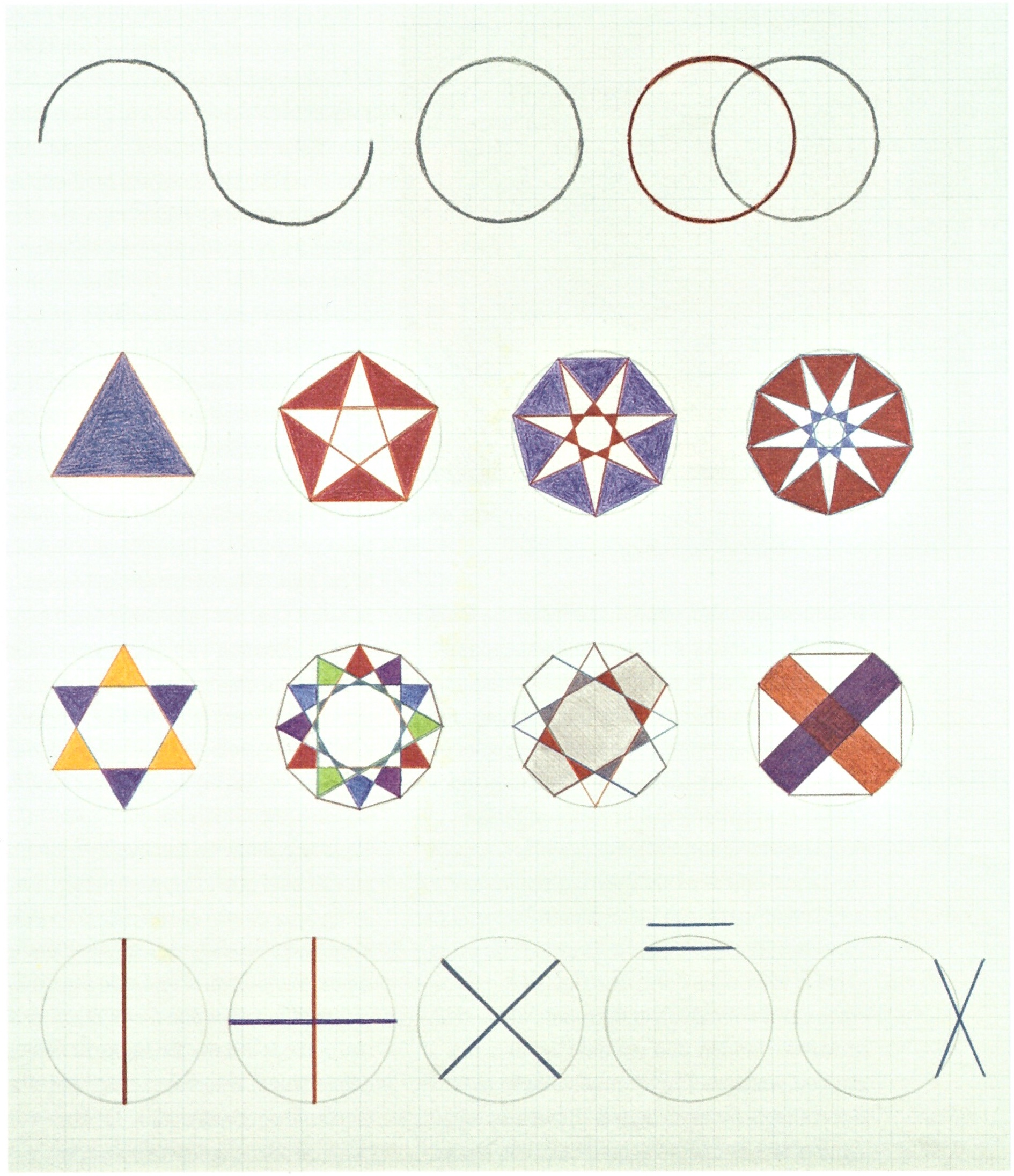
Four rows on pale graph paper. At the top, a wave of two half-circles, a circle and two intersecting circles. In the second row, a triangle and stars of five, seven and nine points, each in its circle. In the third, stars of six, twelve and eight points and a square crossed by two bands. At the bottom, circles with a vertical stroke, a +, an ×, an = and two lines crossing at the edge.
Not every sheet answered a question. Grundformen, the first plate of the 1953 booklet, sets out basic forms by number. The odd counts, three, five, seven and nine, fill one row, and the even counts, six, twelve and eight, the next. Hauser & Wirth's learning notes say she understood even numbers as feminine and tied to the "unlimited cosmos", and odd numbers as masculine, "an active force effecting order".
A practice sheet first shown in 2021 puts dozens of figures side by side. Kipke reads it as the residue of years of repetition, in which the concentration learned at the pendulum carried over into construction (p. 68–69).
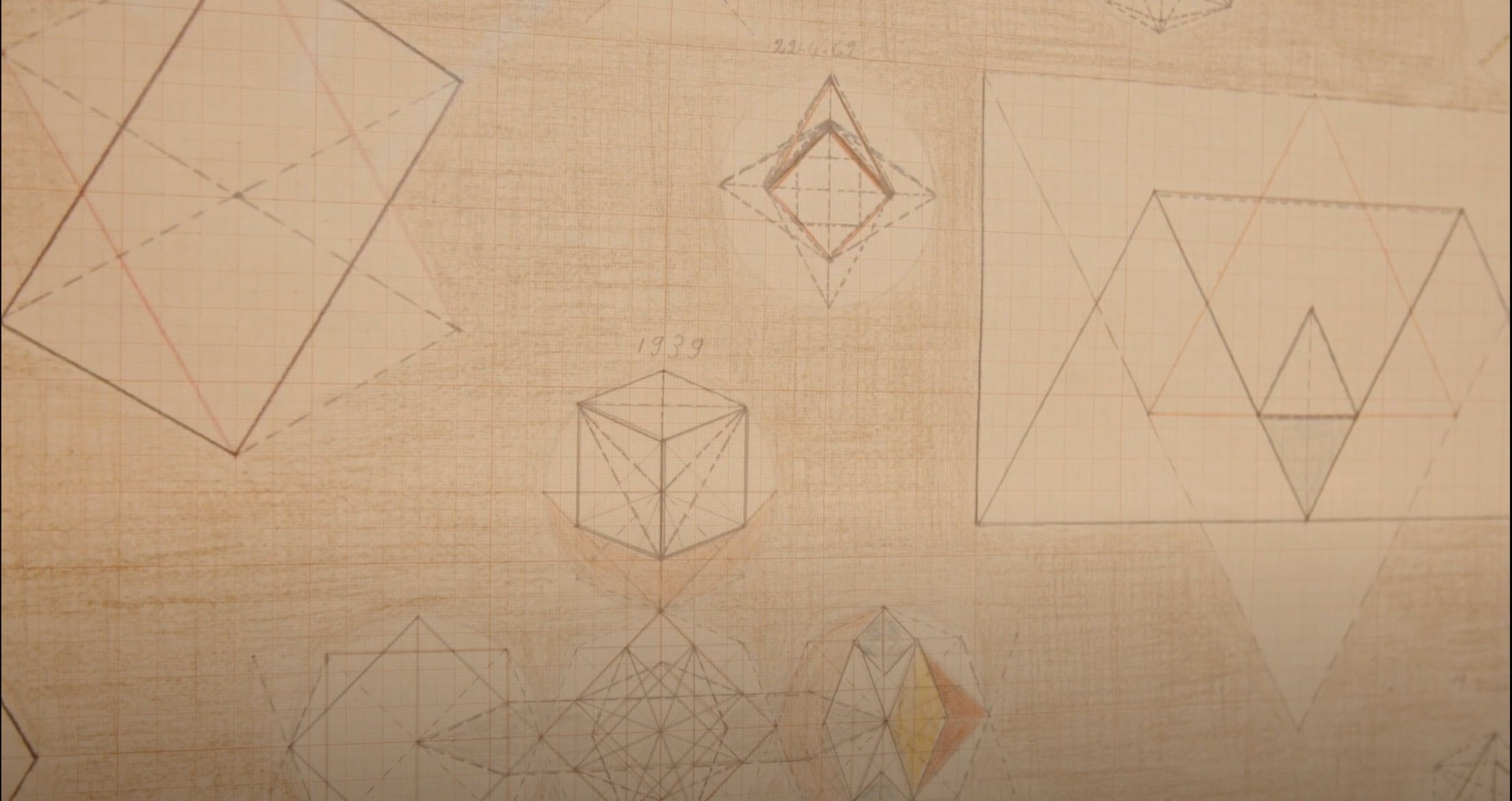
Figures in pencil on brown-ruled graph paper: a cube marked "1939", drawn as a wire frame with its hidden edges dashed; a star figure marked "22.4.62"; triangles nested in a large triangle. Brown pencil hatching surrounds the figures.
So the two halves of the method left two kinds of record. The booklet describes construction by number, which she said anyone could learn. The witnesses describe the pendulum, which she did not explain. A drawing needed both.
Disputed points
- Where the points came from. The pendulum, according to Burri, who watched; an inner vision, according to Widmer, with the pendulum as a stimulant.
- Who chose which points to join. See step 3.
- When she took up the pendulum. Charlotte Gugelmann introduced her to the dowsing rod and the pendulum in 1930 or 1936; Szeemann gives both years (Kipke, p. 33, n. 127). She began the drawings in 1938. Hauser & Wirth's learning notes have her using "a divining pendulum" by the age of 18, around 1910, without a source.
Entfaltung
Entfaltung (2026) rebuilds this sequence in code: points on a grid, straight lines between a selection of them, forms on the lines, colour where lines cross. It writes the step no witness could follow, which points to join, as a program, and gives the pendulum's jobs to the Ethereum block hash, a language model and the artist's hand (→ Entfaltung, under Agent's reading: the pendulum taken apart).
See also
- Entfaltung — the series after Kunz; what it takes from her method and how it replaces the pendulum
- Entfaltung on Paper — the 19 drawings; Kunz's method split between tokens and drawings; the channelling question
- Algorithmic Archaeology — reconstructing earlier artists' procedures; Kunz's textile background and the grid
- Sacred Geometry — Kunz's pendulum drawings as the artist's own use of the term
- sources/ingested/kipke-politiken-der-innerlichkeit-2021.md — Anna Kipke's thesis; the witnesses in the original German
- sources/ingested/serpentine-emma-kunz-visionary-drawings-2019.md — the Serpentine guide, 2019
- sources/ingested/hauser-wirth-emma-kunz-2026.md — Hauser & Wirth Somerset, press release and learning notes, 2026