
Computer Graphics and Art — Yearbook 1980–1981, Vol. 5
Grace C. Hertlein (ed.), Computer Graphics and Art, 1980–1981 Yearbook, Volume 5. Hertlein Associates, Chico, California, © 1981. Published as a yearbook, one issue per year. Theme of the issue: "Mathematics and Computer Art". Contributing editors include Charles Csuri, Herbert Franke and Nicholas Negroponte; the advisory board includes Edmund C. Berkeley, Kenneth Knowlton and Frank Malina, editor of Leonardo.
About this file. The yearbook is under copyright. A 600 dpi scan is kept in the vault as sources/COMPUTER_GRAPHICS_AND_ART_Yearbook_1980_1981_Volume5.pdf for personal study. The scan has no text layer; this digest was made from an OCR pass, and every quotation below was checked against the page images. The scan has 67 images: pages 1–66 and the back cover, which the contents count as page 68. Page numbers are those printed in the yearbook. Names are spelled as the yearbook spells them (Vera Molnar, without the accent).
The wiki compares the cover with van den Dorpel's Swallow, Only Shallow (2024) on Franke × van den Dorpel, under The photograph as data.
Contents
| Page | Item | By |
|---|---|---|
| 1 | Front cover, Transformation, Anton Bruckner | Herbert W. Franke |
| 3 | Announcement of the touring exhibition Art by Computer | Association of Science-Technology Centers, Washington, D.C. |
| 4–13 | "PIX-ART" | Frank Dietrich and Zsuzsanna Molnar |
| 14–18 | "Microcomputer Graphics" | David Dameron |
| 20–26 | "Mathematics, Microcomputers, and Art" | Kerry Jones |
| 28–29 | "The City as an Electronic Gameboard" | Thomas E. Linehan |
| 30–41 | "Mathematics and Computer Art" | Herbert W. Franke, translated by James Loren Brown |
| 42–50 | "Mathematics Plus Art" | Grace C. Hertlein |
| 51–56 | "German Computer Graphics & Computer Art Society" | the GCC, Munich |
| 56 | "Picture Transformation" (illustrations) | Chihaya Shimomura |
| 57–60 | "Grids and Computer Art" | Roger Coqart |
| 61–65 | "Composition and Transformation of Digital Pictures for Plastic Purposes" | Hervé Huitric and Monique Nahas |
| 66 | Review of Information Processing 80 (IFIP Congress proceedings) | Grace C. Hertlein |
| 68 | Back cover, Transformation, Anton Bruckner, illustration two | Herbert W. Franke |
The covers: Transformation, Anton Bruckner
The contents page describes the front cover: "'Transformation, Anton Bruckner' by Herbert W. Franke, Germany. A photograph of the composer is input as data for computer transformation in a series of very different generative works, resulting in Surrealistic compositions, front and back covers." Of the back cover: "Illustration two in the series, representing some of the finest, enduring computer art created in the world today. Provocative images of the 'continent of man'." The sitter is the Austrian composer Anton Bruckner (1824–1896). The yearbook gives no date for the series and does not say which operations made it.
Front cover. The portrait fills the frame in a few greys on a coarse square raster. Every boundary between two greys is a staircase of pixels. Around the eyes, nose and mouth the boundaries crowd into thin alternating light and dark stripes; across the cheeks and background they open into wide patches.
Back cover. The same portrait under other rules. Areas of face and ground are filled with checkerboards and dot grids of several sizes, outlined by thin contours. Concentric rings are laid over the picture, one beside the nose and one at the collar, with a third cut off at the right edge.
Page 46. Hertlein's essay reprints the back cover full page: "HERBERT FRANKE, GERMANY: 'Transformation, Anton Bruckner'. BELOW: A photographic reversal of the back cover, the 'continent of man'."
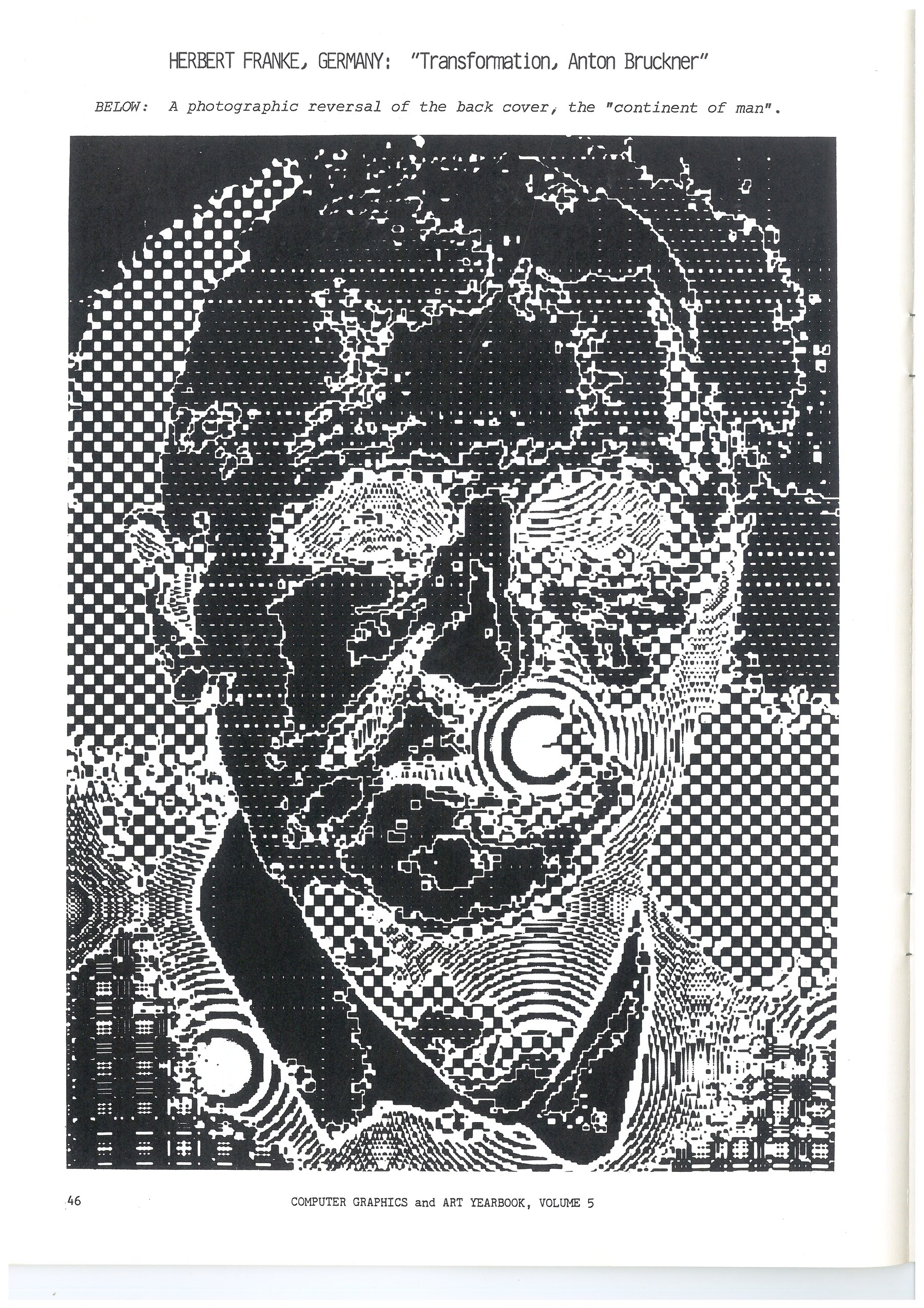
The reversal is a negative and a mirror image at once: set beside the back cover, its tones are inverted and its left and right are swapped, so the rings beside the nose and at the collar sit on the opposite sides.
Herbert W. Franke, "Mathematics and Computer Art" (pp. 30–41)
By Dr. Herbert W. Franke, Puppling, West Germany. Translated by Dr. James Loren Brown, California State University, Chico. Illustrated with works by Coqart, the Ars Intermedia group, Reiner H. Schneeberger, Jean Brette, Leslie Mezei, Christoph Poppe, Roger Pfund, Jean-François Colonna, Manuel Barbadillo, Vera Molnar, Ken Knowlton and Benoit B. Mandelbrot. The essay does not mention the cover.
Herbert W. Franke (1927–2022) opens on style. "Computer art is not bound to any one style." The critics who held "that computer graphic methods were confined to non-representational statements" are answered: "With the technic of 'picture processing', pictures may be estranged and quite new effects won for the abstraction" (p. 30). Picture synthesis also allows "the representation of real objects and scenery".
Constructivism. Computer graphics has "a close affinity" with constructivism, which works "with simple geometric elements and high precision -- foundations for which the computer is no less than predestined" (p. 30). The beginner's horizontal and vertical lines should not be laughed at, because the "horizontal-vertical principle" of Constructivism "must be completely exhausted" (p. 31). As the camera once brought a crisis to realistic representation, the computer now "renders illusory a further application of the horizontal-verticle principle": one program covers all the superimpositions of squares and rectangles that once had to be drawn one by one (p. 32). It extends Constructivism to curves of higher order and to moiré, where "even extremely small imprecisions stand out as distortions" (p. 32).
Series. "It is hardly sensible to involve the expense of programming if one wishes to prepare only a single picture." The single picture is no longer "the best solution to an esthetic problem, but rather an example of a multiplicity in which still other possible solutions may inhere". Variants arise when the parameters of the formula change, and the question becomes which characteristics stay fixed across the series: "The mentioned invariants, through which the higher order gets defined, prove to be the stylistic elements." The other parameters may change step by step "or else be determined through random generators" (p. 31).
Movement. Series lead to film. With a random generator choosing the open parameters, a film becomes "strolls through the field of possibilities marked out by the program". His example is the program "Mondrian", "which begets series of pictures in any desired length, whereby anterior elements are over-written by the new" (p. 32).
Visualising mathematics. Each use of computer graphics visualises a mathematical context, and each context can be visualised "in as many ways as one desires", which brings "a new library of forms" into art (p. 32). Franke lists the principles: symmetry and ornament, which the critics are wrong to dismiss; constancy of curvature; and fields of numbers over a surface, shown "with contour lines or else through lines of maximum slope, known from topological maps". Then the grey coding: "New kinds of patterns are approached through the gray-or color-coordination module-n, where n assigns the number of the value of gray or of the color. This means that the numbers coordinated with the field will be marked by the same grayness or color when they have the same positive difference in relation to a multiple of n" (p. 33). The grey is assigned by modular arithmetic, so the same grey returns every n values.
Moiré. "The already mentioned Moirés are a means of design of a special sort." Superimposed masses of curves interfere, as in optics, and the bright and dark spots form "a 'supersign'", a form built from the elementary signs. If the lines "crowd together so closely that they cannot by the naked eye be perceived as separate, the Moiré pattern can still be recognized" (p. 33).
Transformations. Geometric alterations "which extend to complete deformation and the construction of new forms": Leslie Mezei's Beavers, mirror images in circles, and Fourier transformations, which "to my knowledge … have not yet been evaluated esthetically for computer graphics" (p. 33).
Matrices. "By matrix of course is understood a digital numbers-field." Numbers coordinated "with the grays or the colors in a module-n representation" yield transpositions "some of which are scarcely forseeable". "If one uses matrices with a sufficient number of lines and columns, then with their help real objects too may be delineated in a corresponding degree of fineness. In this way one may mathematically transpose single pictures and may also merge several with each other (e.g. an apple with a fir tree)" (p. 38).
Chance. Probability can be used "as Vera Molnar did, successively to destroy transparent organizations". Statistical methods, unlike the others, lead "not to the heightening of the degree of organization but to its decrease, to the production of chaos. In this way one attains to genuine innovation". A computer "cannot generate any truly random number", but the pseudo-random suffices for human observation (p. 38).
Towards a rational aesthetics. Program code can serve as "a 'graphic notation'" for plastic art, and the computer calls forth "a sort of 'mathematical theater'" in which mathematics performs (p. 39). Critics reject the new forms because they measure "the new by the standards of the old" (p. 32); both sides "can learn from the other" (p. 39).
Grace C. Hertlein, "Mathematics Plus Art" (pp. 42–50)
Written as "a complement to the superior ideas expressed by Herbert Franke". Hertlein describes an early school that held mathematically dominant computer art to be "more 'pure'" and wanted the computer to be "the dominant partner". Against that she asks what makes computer art endure, from a class visit with thirty beginning computer artists to an exhibition of Auguste Rodin's sculptures. Among her points: "A work of art need not be beautiful"; "The originator of a work of art is too often not a good judge of the aesthetic content"; "meaningful computer art is not an 'instant art'". She proposes a taxonomy of eleven categories. Two describe the cover's kind of work: "Transformation, metamorphoses of patterns (1960 to present)" and "Art and nature — nature vs. abstraction (1970 to present)", in which "representational or lyrical motifs from nature are used as input source designs" (p. 50). Illustrations include Franke's Bruckner reversal (p. 46), M. C. Escher's Liberation (1955), Otto Beckmann's Imaginare Architektur (1977), and works by Chris French, Susan Casey and Aldo Giorgini.
The German Computer Graphics and Computer Art Society (pp. 51–56)
The Gesellschaft für Computergrafik und Computerkunst (GCC), Unterföhring near Munich, had about 300 members. The yearbook gives two founding dates: 30 November 1978, as an incorporated association, and 1977, "by computer graphic artists assisted by Dr. Herbert W. Franke and Reiner Schneeberger". Its first competition (1979, sponsored by NCR with about DM 20,000) had a jury "presided over by Dr. Herbert W. Franke"; first prize went to Hans Korneder's Six Centers, second to Vera Molnar's Letters, third to Axel Miessner's Man of Munich. In 1980 Franke sat on the jury again and Robert Stoiber won with Ebene im Umbruch. Franke and Hertlein are on the society's advisory board of art experts, with Gottfried Jäger, William Kolomyjec, François Molnar, Klaus Staudt, Dominic Boreham, Manuel Barbadillo and Roger Coqart.
Roger Coqart, "Grids and Computer Art" (pp. 57–60)
Coqart, photographer and computer artist at the Université Libre de Bruxelles, opens with the grid's history: the Egyptian canon of proportion, the medieval transfer grid, Islamic ornament, Op art, graph paper. He treats computer-generated grids as "autonome works of aesthetic nature" and uses them in murals, paintings and panels. One type is built from random arrangements of line elements in modules; another lays a grid of small squares, "windows", over a second grid behind. Random numbers set direction, start and order of the lines; "the use of statistical sampling excludes human intervention and insures the objectivity with which the picture is executed" (p. 58). His equipment is "an already old-fashioned WANG 600". The yearbook spells the name both Coqart and Cogart; the signature on the drawings reads COQART.
Hervé Huitric and Monique Nahas, "Composition and Transformation of Digital Pictures for Plastic Purposes" (pp. 61–65)
Two artists at the University of Paris 8 working on a colour television screen with 4,096 tints (16 levels each of red, green and blue). Each colour component follows a set of "level lines" over the screen, and "the coloured move of the picture results from the interference of the 3 sets of level lines" (p. 61). They then transform pictures by mixing, filtering, histogram equalisation, which brings out "outlines of level" (p. 62), and Fourier and Walsh filtering. One sequence builds a family tree of a picture's "light and dark antecedents" (p. 63). Frequency modulation of the colour functions follows John Chowning's work on audio synthesis.
Frank Dietrich and Zsuzsanna Molnar, "PIX-ART" (pp. 4–13)
Art on the Bally Arcade, a $400 home video-game computer with a 160 × 88 pixel screen, at the Electronic Visualization Laboratory of the University of Illinois at Chicago Circle. The user should not expect smooth shading: "the user has to accept -- or 'buy the pixels', those blocky constituents of every raster system, which most people try to hide" (p. 4). Programs by Dan Sandin (MOD, Near Neighbor), Julie Boren (Sun), Mark McKernin (Geo, after an Algerian carpet), Larry Cuba (Scroll) and others. On "controlled randomness": "The main problem when working with random numbers is to set up programs which balance between the pole of completely predictable pattern and the pole of chaos" (p. 9).
Other contents
- Art by Computer (p. 3): a touring exhibition of 45 works curated by Hertlein, with "a computer and graphics tablet on loan from Apple Computer, Inc." for visitors; openings from January 1982.
- David Dameron (pp. 14–18): a modified plotter; Head #6, from measurements of a clay sculpture of a face; variations after Manfred Mohr.
- Kerry Jones (pp. 20–26): the Scanline series after Victor Vasarely's black-and-white period; the computer as "a literal treasury of forms, as Herbert Franke advocates" (p. 21).
- Thomas E. Linehan (pp. 28–29): computer-animated learning games about the city for schoolchildren.
- Review of Information Processing 80 (p. 66): papers from the IFIP Congress in Tokyo and Melbourne, among them Alan Kay on the Smalltalk interface.