
Future Art Ecosystems R&D Fellowship
Art x Convergence - application by Harm van den Dorpel
This is a working document presenting the long-form, illustrated proposal. This page is not in the index and is not linked from any other page - it is for the FAE / Serpentine reading group only.
At a glance
- Applicant: Harm van den Dorpel - artist, Berlin / Amsterdam. Represented by Lohaus Gallery (Munich), Nguyen Wahed (New York), and Interface Gallery (Netherlands).
- Project: Dissociations → Tractatus - distilling a twenty-year LLM-maintained archive (dissociations.com) into an immutable printed monograph.
- Research question: When an artist delegates the structuring of a twenty-year archive to a large language model, what authority does the resulting knowledge have - and can it be fixed into an enduring, immutable medium?
- Prior relationship with FAE: contributor to Future Art Ecosystems Vol. 3; ongoing dialogue with Victoria Ivanova (poetic consultation on Chemsex Benelux).
- Collaborators: Enver Hadzijaj (graphic design / algorithmic typesetting); a small number of invited writers (essays in response); representing galleries Lohaus (Munich), Nguyen Wahed (New York), and Interface (Netherlands) for production and release.
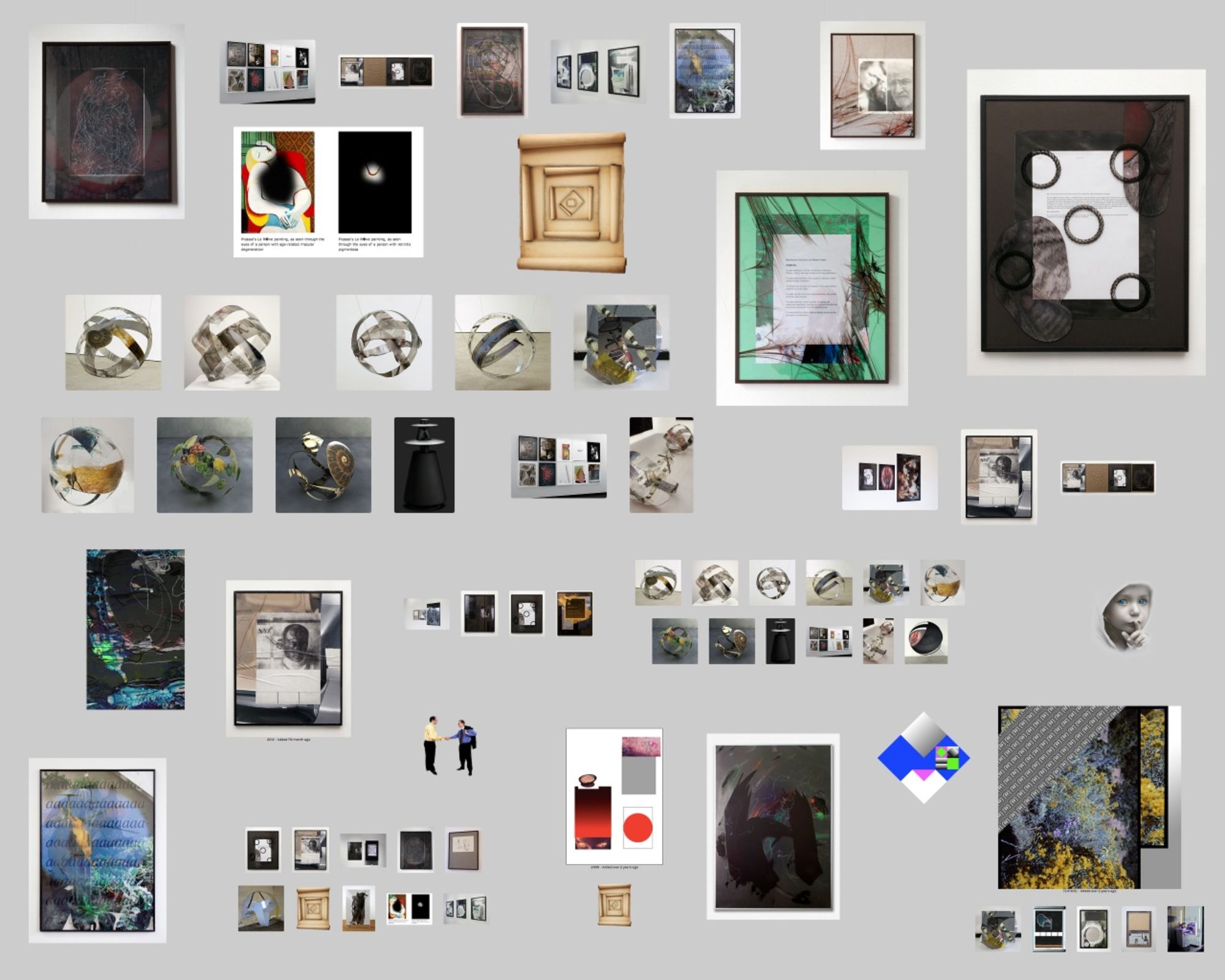
Dissociations .com. The online artist studio at the centre of the proposed R&D — in 2026 it became this LLM-maintained wiki layer over the vault.
1. The project and its history
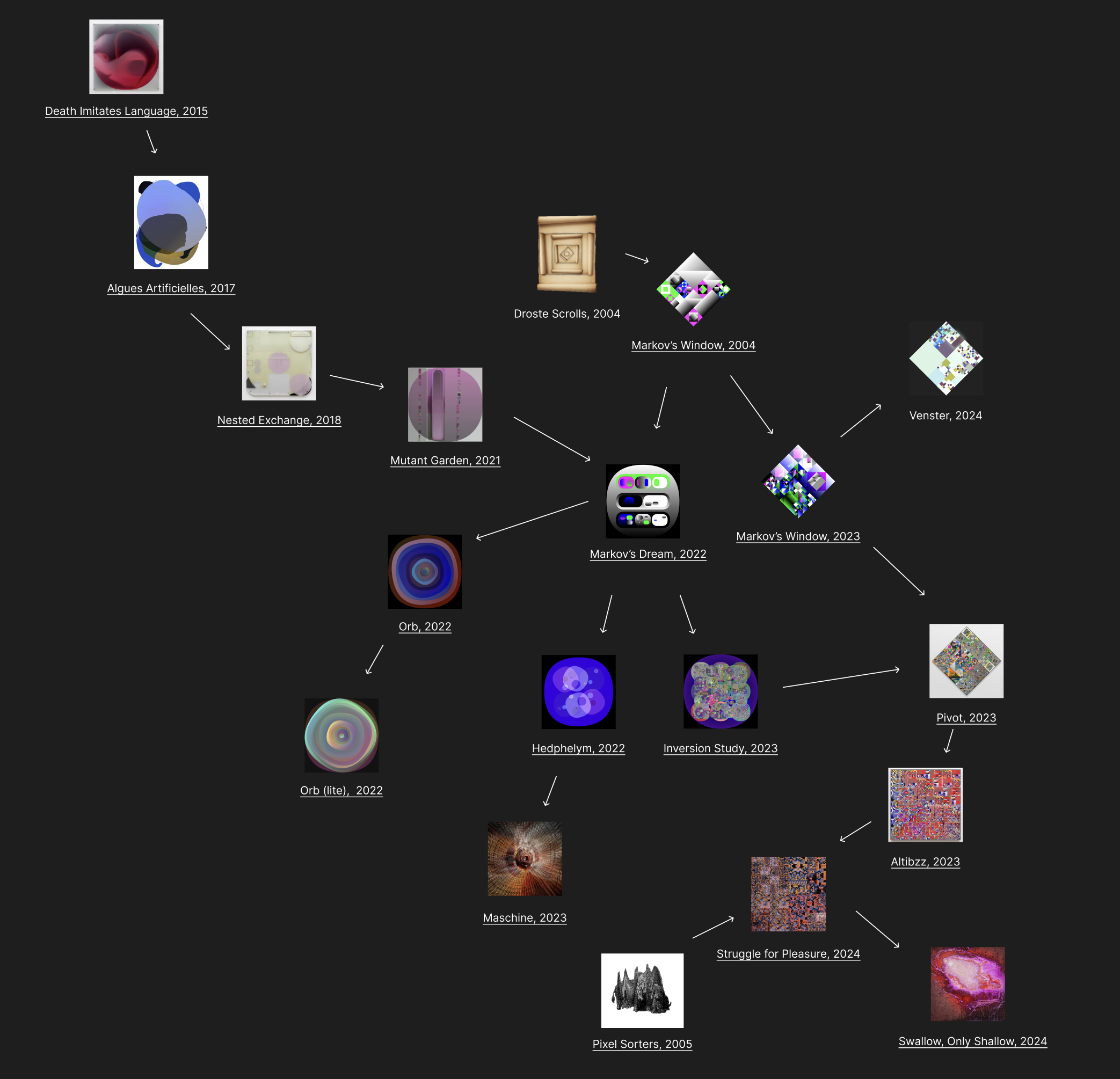
dissociations.com is an ongoing online artist studio I began in 2010. It started as a concatenation of references, influences, and works - made, unmade, or only imagined - arranged so that the relations between them, not the works, were the subject. Its first mechanism was negative selection: the site showed three nodes at random and I eliminated the one that belonged least. From the accumulation of these dissociations, the inverse was computed - what unconsciously cohered. It was an aesthetic immune system: a way of training an algorithm on my taste by naming only what I rejected.
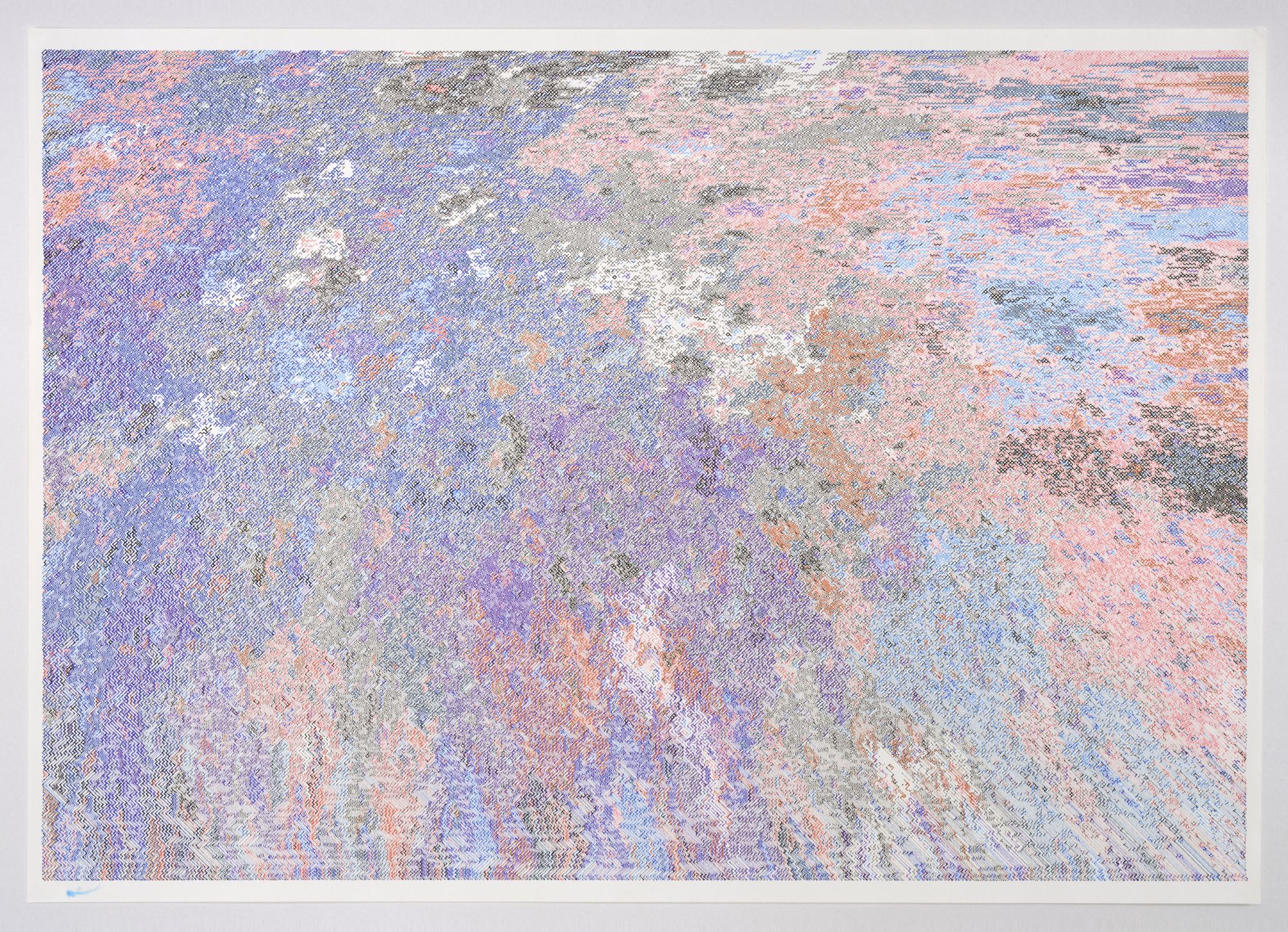
In 2013 the project was commissioned for the New Museum's First Look online series (with Rhizome), curated by Lauren Cornell. The Museum described it as tracking an "interval space, where the interrelationships between ideas and forms become the focus rather than the works themselves" - placing it in the lineage of Aby Warburg's Mnemosyne Atlas and its "iconology of intervals." For a decade the site held everything: my notes, my critical writing, the press releases I wrote, and the writing other artists made about my practice. It works in tandem with harm.work, the discrete portfolio of works, series, and exhibitions; dissociations is the associative reservoir beneath that catalogue.
The 2026 mutation. With the arrival of large language models, the original strategy of negative dissociation has been superseded. The numbered notes - always the raw stratum - now feed an LLM-maintained wiki: pages that read across the archive, surface what coheres, and make the latent conceptual terrain explicit. The logic is unchanged - relations between disparate nodes - but the register has shifted from visual elimination to textual synthesis, and the direction has reversed: where the 2010 system revealed unconscious taste by removing, the 2026 wiki makes the underlying structure speakable. The wiki now carries three formally distinct voices: the notes in their own grammars; the artist, situating and developing; and Agent, the AI interlocutor, who appears only in marked sections, reads contradictions across the material, and proposes the higher concept under which they dissolve.
The goal of this knowledge base has been constant for twenty years: to distil my unconscious assumptions, my established convictions, and every degree between - the layers that have guided a personal spiritual development rooted in a Christian theological upbringing, in the strategic wisdom of software architecture, and in the daily discipline of a yoga and studio practice held as meditation. I have always used art not to express but to find out - to reach the existential and epistemological questions I have carried since childhood. The final work = the work + its documentation. The wiki is, on the same flat ontology, an artwork.
2. The R&D: from a fluid wiki to an immutable book
The fellowship work is a single, focused act of compression: to contemplate the content of dissociations.com deeply and distil it into a book - a monograph whose primary purpose is not to show the art but to use the art practice as input material for arriving at metaphysical positions I can live with. The book is meant to be a magnum opus and a physical object that withstands time. This desire for permanence is the same desire that brought me to NFTs, which are immutable to a degree the web is not. If I am honest, the wish to solidify a practice into something durable might be a quiet response to the faintly apocalyptic mood of the moment - the sense that an immaterial body of work could vanish with the infrastructure it happens to live on.
The book's root structure already exists in draft: the Tractatus form of the propositions - the practice given the shape Wittgenstein gave the Tractatus Logico-Philosophicus, a hierarchy of numbered declarative propositions. It will contain:
- the Tractatus of Harm - the propositions as spine;
- a glossary - definitions of the load-bearing concepts of the practice;
- high-resolution images of work, including unreleased work, as illustration;
- inline marginalia - side notes against each text;
- QR codes on the work pages, linking to the actual animated artworks online.
Its argument is organised, preliminarily, into five chapters that move from lineage through method and metaphysics to the object and its preservation:
- Before the Algorithm - Roots and Archaeology. The pre-digital lineage of generative art (Vera Molnár, Anni Albers, Charlotte Posenenske) and the algorithmic archaeology of the practice's own past.
- Chance with a Direction - Stochastic and Recursive Form. Stochastic strategies given an evolutionary direction, and recursion and self-reference as the structural grammar.
- The Via Negativa - Taste, Negation, and the Theological Inheritance. Taste as the only material - negative selection - read together with sacred geometry and apophatic theology as one method: the Christian inheritance as a way of negation.
- The Object Withdraws - Flat Ontology and Impermanence. Digital and physical as equally completed works in a single flat ontology, and impermanence - the structural halt, anicca as state space - as the object's mode of being.
- Documentation and the Immutable - The Archive, the Machine, and the Book. The work = the work + its documentation: the archive as constitutive, the LLM/wiki turn, NFT-grade immutability, and the book itself as the enduring object. The reflexive, closing chapter.
Throughout, the book situates the practice against existing art criticism - engaging writings by critics and historians such as Tina Rivers Ryan and Margit Rosen - alongside the critical texts and press releases already gathered in the Dissociations archive.
It will be algorithmically generated and typeset into a printable object in collaboration with the graphic designer Enver Hadzijaj - who was responsible for the design of the most recent Berlin Biennale - and with whom I have already made work (the Phantom Crush portraits of Chemsex Benelux were programmed from his pastel drawings). Printing and release would be supported by my representing galleries in Munich, New York, and the Netherlands. When the book is finished, a dedicated website will sell it and link back to dissociations.com through a video work that could stand on its own and be exhibited independently. The book is not a portfolio. It is knowledge-finding: its creation produces the reasoning, and the reasoning produces its content. To be precise about what the fellowship funds: the book is the byproduct, not the object, of the research. What I am actually researching is the distillation method itself - how an LLM can read a practice into legible knowledge - and the question of authorship it forces. The printed object is what that inquiry leaves behind; the inquiry is the work.
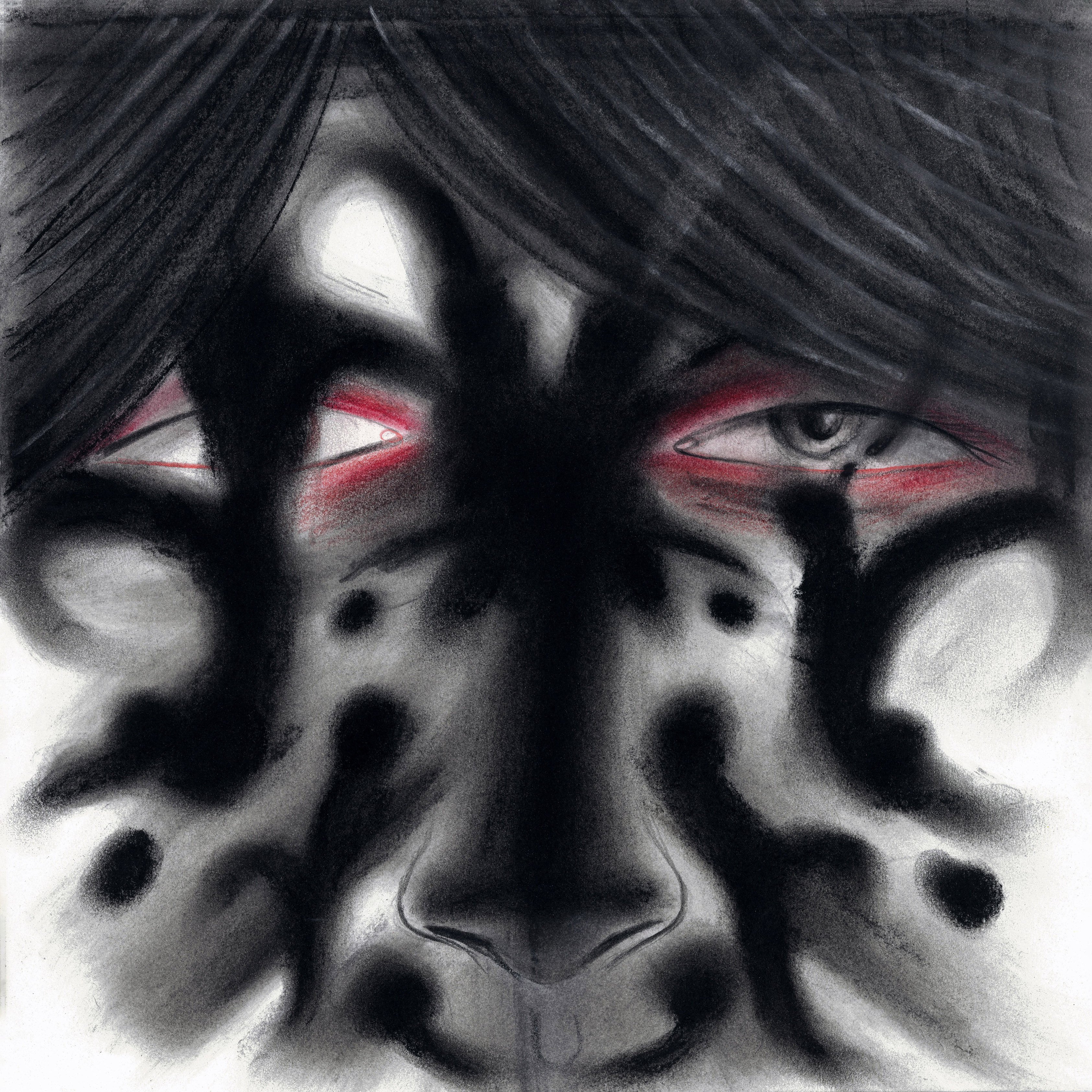
Phantom Crush. Generative portraits programmed from Enver Hadzijaj's pastel drawings — the artist's design collaborator on the proposed book.
3. Why this is Art x Convergence
The briefing defines convergence as the breakdown of the boundaries that keep technical, legal, cultural and material systems apart. This project stages that breakdown at the scale of a single practice - small enough to be examined, not only theorised - and it sits on all four boundaries at once.
- Technical / cultural. A statistical inference engine is admitted into the most cultural act there is: the authorship of meaning, canon, and self-understanding. The LLM models a twenty-year cultural and spiritual archive and pursues a goal - canonisation, the production of an enduring, authoritative text. The boundary that kept the technical (computation) apart from the cultural (criticism, scripture, taste) is exactly what dissolves here. I treat the model not as a tool of efficiency but as an oracle or channel for surfacing the unconscious at play in the work; the interest is not speed but what the algorithmic reading reveals that I could not reach by trying.
- Legal. Once an LLM structures the archive, authorship and ownership stop being settled. What takes primacy - does the knowledge emerge from the work, or does the knowledge inspire the work? is also a legal question: who owns a truth a machine inferred from a person's corpus; what is the rights status of a machine-shaped canon, of the commissioned written responses, of a book whose reasoning is co-produced. The work answers in the register I have used for a decade - NFT-grade immutability, where ownership and provenance are fixed at the protocol level - and asks the printed book to inherit that same logic of the fixed, owned, immutable artefact.
- Material. The practice is immaterial and infinitely revisable on the web; the book and the token are slow and immutable. The R&D is the friction between them: how ever-changing digital theory can be fixed into an enduring material object. The book answers a real risk - that a highly immaterial, ever-mutating practice could simply be lost - by leaving a legacy that survives the network.
- The old canon-systems converge on the new. The project reads the LLM through the frames that have always governed the production of authoritative text: scripture and dogma; software's cathedral vs. bazaar; Derrida's Of Grammatology and Archive Fever; Wittgenstein. Generating a book is structurally close to forming a canon - and these are the disciplines that already know what canon-formation costs.
The wider stakes, for FAE's network: this is a case study in how artists can metabolise LLMs - not as illustration engines but as instruments of self-knowledge and criticism - and a question about what art criticism becomes when the first critic of a practice is a model trained on its own archive.
Anicca 1. Anicca — impermanence — names the state space of the practice; the book is the attempt to fix an impermanent body of work into an enduring object.
4. Method and outputs
The method is a close, documented feedback loop between me and the LLM, already running live on dissociations.com. The fellowship would sharpen it in three moves:
- Distil. Compress the wiki from growth-in-size toward growth-in-substance - fewer, sharper, less speculative propositions, each tested against the archive.
- Contest. Invite a small number of writers to respond to the theses the wiki has discovered, contributing essays that confirm, complicate, or refuse them. Their friction is part of the truth-finding, not decoration around it.
- Fix. Typeset the result algorithmically with Enver Hadzijaj into a printed monograph, periodically revised in future editions - a slow counterpart to the fast site.
Documented outputs (process-led, as FAE asks):
- the distilled Tractatus and glossary, public on dissociations.com;
- a small set of commissioned essays in response to the theses;
- a printed monograph (galleries supporting production and release) and its dedicated site with an exhibitable video work;
- a publicly shared account of the method - how the wiki was built and how its content was transformed into a book - usable by other artists who want to do the same with their own practice. This is the part most directly addressed to FAE's network: a transferable production model, not a one-off artwork;
- the full source code of the project and its LLM-maintained wiki, released openly so other cultural producers can run the same method on their own archives - the method as infrastructure, not just as a finished result.
5. Why this fellowship, and what I need from it
I have a longstanding interest in publishing - arguably more than in exhibiting. I have worked with FAE before: I contributed monochrome rasterised images derived from Markov's Dream to Future Art Ecosystems Vol. 3, and Victoria Ivanova gave poetic consultation on Chemsex Benelux. The fellowship's frame - process-led R&D at the convergence of art and advanced technology, held inside a critical cohort - is the exact environment this work needs.
What I need is specific and human: critical partners. The content is esoteric by nature, and my goal for the book is the opposite - to be clear, communicative, and load-bearing. I need interlocutors to help me distil, curate, consolidate, and summarise: to pressure-test which propositions survive, to catch where the writing hides behind its own difficulty, and to keep the compression honest. The biweekly sessions, the three London intensives, the one-to-one mentorship, and the peer cohort map directly onto that need. I can commit to all three in-person intensives (September, November, March) and the weekly online time.
The £10,000 supports the distillation and curation phase and the commissioned written responses; printing and release are already underwritten by my galleries, so the fellowship funds the part that most needs critical company rather than capital - the thinking.